



Biomedical Refrigerators and Freezers Market Size, Key Companies, Company Product Portfolio, Hospital Procurement Trends, Manufacturing Capacity, Sales Performance, Regulatory Approvals, Company Market Share, and Forecast
Biomedical Refrigerators and Freezers Market (By Product: Blood Bank Refrigerators, Shock Freezers, Plasma Freezers, Ultra Low-Temperature Freezers, Laboratory /Pharmacy/Medical Refrigerators, Laboratory /Pharmacy/Medical Freezers; By End Use: Hospitals, Research Laboratories, Pharmacies, Diagnostic Centres, Blood Banks, Others) - Global Industry Analysis, Size, Trends, Leading Companies, Regional Outlook, and Forecast 2026 to 2035
Source: https://www.precedenceresearch.com/biomedical-refrigerators-and-freezers-market
 Get a Sample
 Table Of Content


What is the Biomedical Refrigerators and Freezers Market Size?
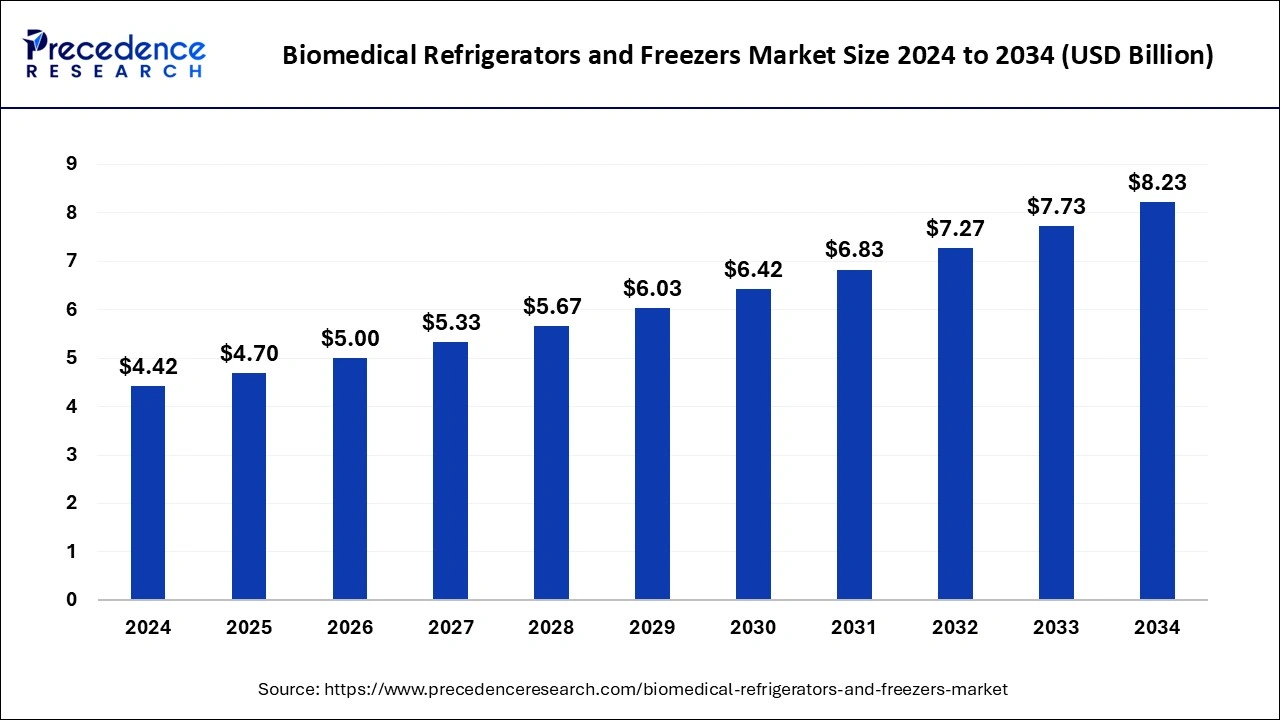
The global biomedical refrigerators and freezers market size is calculated at USD 4.70 billion in 2025 and is predicted to increase from USD 5.00 billion in 2026 to approximately USD 8.70 billion by 2035, expanding at a CAGR of 6.35% from 2026 to 2035.
Biomedical Refrigerators and Freezers Market Key Takeaways
- In terms of revenue, the market is valued at 4.70 billion in 2025.
- It is projected to reach 8.70 billion by 2035.
- The market is expected to grow at a CAGR of 6.35% from 2026 to 2035.
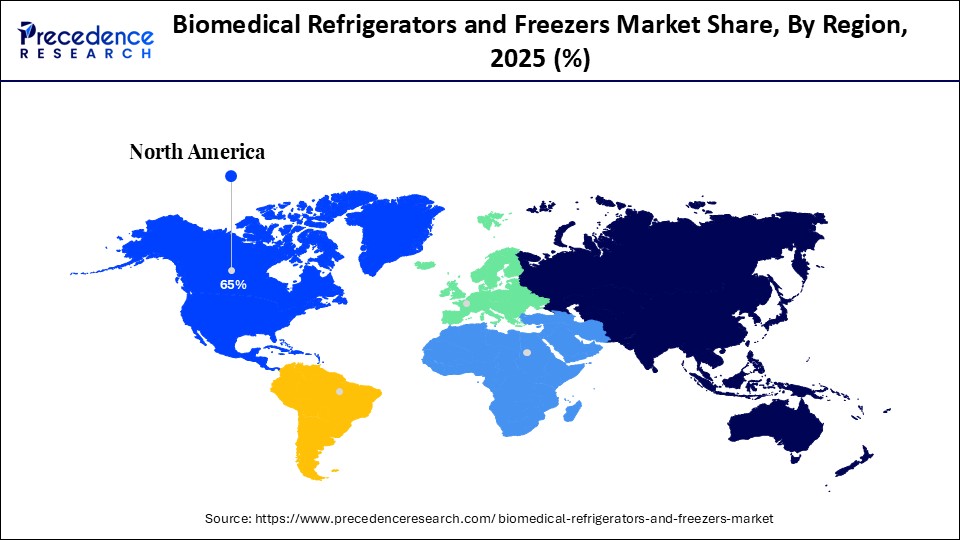
- North America led the biomedical refrigerators and freezers market share with the largest market share of 65% in 2025.
- The U.S. market has held a major market share of 40.8% in 2025.
- Asia Pacific is anticipated to witness the fastest growth during the forecasted years.
- By product, the plasma freezers segment contributed the biggest market share of 30% in 2025.
- By product, the laboratory/pharmacy/medical refrigerators segment is projected to grow at the fastest CAGR during the forecast period.
- By end user, the blood banks segment accounted for the largest market share of 40% in 2025.
- By end user, the pharmacies segment is projected to witness the fastest growth during the forecast period.
Market Overview
Biomedical refrigerators and freezers are medical equipment used in the storage of different biological samples including blood, medicines, blood derivatives, vaccines, biological reagents, RNA, and DNA. Biomedical freezers are primarily used to store fresh and frozen blood. These products provide optimum conditions and ensure the proficient storage required for biological samples. The biomedical refrigerators and freezers market is poised to experience exponential growth globally as researchers gradually focus on developing innovative technologies and products for treatment procedures.
The rising R&D activities in life sciences are the primary factor for the growth of the biomedical refrigerators and freezers market. The pharmaceutics and biotechnology business, scientific organizations, and research institutions are escalating their R and D activities in fields such as drug discovery and genetics/molecular biology. These activities encompass the handling of delicate biological samples, reagents, vaccines, and cell cultures, which are highly sensitive to temperature changes and stored at the correct temperatures for optimal functionality. In addition, the increase in biopharmaceuticals and clinical trials on new therapeutic agents, such as biologicals and individualized medicine, require complex cold chain infrastructure.
Artificial Intelligence (AI) Integration in the Biomedical Refrigerators and Freezers Market
The incorporation of the Internet of Things and AI-driven monitoring solutions potentially improves efficiency and device management, in addition to green technologies that improve the energy efficiency of cooling systems. The use of Artificial Intelligence and automation technology is transforming the biomedical refrigerators and freezers market by improving functionality and information tracking systems. With the use of AI in monitoring, laboratories will be able to track the status of the refrigeration units and perform predictive maintenance to ensure that the samples do not spoil. Automation tools increase workflow by allowing remote control and monitoring of refrigerators, ensuring consistent temperature maintenance and compliance with safety regulations.
Biomedical Refrigerators and Freezers Market Growth Factor
- Rising healthcare and research activities: During the growth of healthcare facilities and the advances in the life sciences, there is a need to store biological samples and other supplies requiring a low temperature for effectiveness, such as drugs and lab gear.
- Strict regulatory requirements: These policies concern the handling, packaging, transportation, and storage of drugs, blood, and vaccines that are driving the market for biomedical refrigerators and freezers.
- Technological advancements: Technological advancement in refrigeration equipment including energy efficiency and temperature control is a factor that is contributing to the growth of the biomedical refrigerators and freezers market.
- Aging population: This factor is driven by population aging that is closely associated with chronic diseases that necessitate a constant supply and storage of medicines and other healthcare products, hence the need for biomedical refrigerators and freezers.
Biomedical Refrigerators and Freezers Market Trends
- The increasing demand from various sectors such as medical, hospitals, blood banks, pharmaceutical companies, and research institutes drives the growth of the market.
- Advancement in technologies to increase efficiency and reduce frequent maintenance requirements, and also the equipment that provides remote monitoring, increases the adoption.
- The biomedical refrigerators and freezers have a large demand from the pharmaceutical companies to maintain potency and safety of the drugs and vaccines for during transportation and storage of the drugs.
Biomedical Refrigerators and Freezers Market Outlook
- Industry Growth Overview: The rising R&D activities in life sciences are the primary factor for the growth of the biomedical refrigerators and freezers market.
- Global Expansion: The global biomedical refrigerators and freezers market is expanding significantly, fuelled by increased demand for temperature-controlled storage in clinical trials, research, and healthcare settings.
- Major investors: Major investors and players in the market include large, diversified companies like Thermo Fisher Scientific and Haier Biomedical, as well as specialized manufacturers such as Eppendorf AG and Helmer Scientific.
- Startup Ecosystem: The biomedical refrigerators and freezers market is mature and largely dominated by established, global manufacturers. With an emphasis on energy efficiency and specialized storage for advanced therapies.
Market Scope
| Report Coverage | Details |
| Market Size by 2025 | USD 4.70 Billion |
| Market Size in 2026 | USD 5.00 Billion |
| Market Size in 2035 | USD 8.23 Billion |
| Market Growth Rate from 2026 to 2035 | CAGR of 6.35% |
| Dominating Region | North America |
| Fastest Growing Region | Asia Pacific |
| Base Year | 2025 |
| Forecast Period | 2026 to 2035 |
| Segments Covered | Product, End Use, and Regions. |
| Regions Covered | North America, Europe, Asia-Pacific, Latin America, and Middle East & Africa. |
Market Dynamics
Drivers
Growing Geriatric Population
Health-related problems are generalized in the elderly, and older people often take longer to recover from these conditions. The elderly population is prone to general diseases, including diabetic complications, cancer, cardiac ailments, neurological problems, and organ system dysfunction. The geriatric population needs many medical interventions, such as vaccines, drugs, and organ transplants, and most of them need biomedical fridges and freezers to store these commodities under the correct temperatures. Moreover, aging-related diseases and illnesses create a need for developing better and improved technologies for gerontology, increasing the demand for the biomedical refrigerators and freezers market.
- According to the World Health Organization (WHO), by 2030, one in six individuals worldwide will be aged 60 or older. The number of people in this age group is expected to increase from 1 billion in 2020 to 1.4 billion by 2030.
Restraint
High cost of biomedical refrigerators and freezers
The high initial expenses required for the purchase of biomedical refrigerators and freezers are considered a major factor constraining the global market. Because of the expense of refrigerators, people could feel reluctant to purchase refurbished equipment, which hamper the development of the biomedical refrigerators and freezers market. Advanced models armed with sophisticated features like temperature monitoring systems, remote diagnostics, and energy-efficient designs often come with higher price tags.
Opportunity
Rising demand for innovative techniques
Higher spending on R&D is expected to drive the need for biomedical refrigerators in the health sector. The market receives additional demand from educational and research sectors, utilizing medical refrigerators and freezers in their operations. In addition, government funding for research and clinical trials brings a considerable boost to the biomedical refrigerators and freezers market. Grants, subsidies, and tax credits make healthcare R&D investments that enhance patient benefits. Further growth in research and clinical trials around the world also drives the market forward as the need for biomedical refrigeration grows. Healthcare entities and manufacturers can leverage more opportunities in the demand for refrigeration services, propelling the overall market as well as the progress of biopharmaceutical innovation and advancements.
Biomedical Refrigerators and Freezers Market Segment Iinsights
Product Insights
The plasma freezers segment noted the largest share of the biomedical refrigerators and freezers market in 2025. Plasma freezers are used to store plasma, blood plasma, and other biological samples at low temperatures. They are used in hospitals, blood banks, laboratories, and universities to store a wide range of products. New features developed by major plasma freezer manufacturers cut energy use, prevent crystallization, and ensure a balanced temperature distribution, one of the major drivers of growth in this market. Pharmaceutical companies and research organizations are constantly laboring to create new drugs and remedies from plasma. This is due to the rise in the requirement for plasma freezers to maintain the viability and stability of plasma samples that are collected to assist in research and development work.
The laboratory/pharmacy/medical refrigerators segment is projected to witness the fastest growth in the biomedical refrigerators and freezers market during the forecast period. The increasing need for precise storage of biological samples, reagents, and other temperature-sensitive materials used in laboratories for research and diagnostics has led to the rise of lab refrigerators. With more research activities being done worldwide and laboratories enhancing their equipment, there is a greater need for efficient and sound refrigeration systems.
End User Insights
The blood banks segment accounted for the largest biomedical refrigerators and freezers market share in 2025. A blood bank refrigerator is basic equipment used in storing and preserving blood and other biomedical specimens in diagnostic centers and other health-related organizations. Stringent regulation for the storage of blood components in the blood banks is one of the key factors stimulating the growth of the market. The market is experiencing growth in the segment of biomedical refrigerators and freezers because of the high popularity of sophisticated equipment for biomedical product storage. Blood bank refrigerators are constructed with safety and performance in mind, featuring user-friendly interfaces and precise temperature control.
WHO estimated that approximately 118.54 million blood donations are collected globally, 40% of these are collected in high-income countries, home to 16 % of the world's population. Out of 169 countries and territories, 13,300 Blood centers claim to have collected a total of 106 million donations.
The pharmacies segment is projected to witness the fastest growth in the biomedical refrigerators and freezers market during the forecast period. Biomedical refrigeration technology has improved, making these units more appealing to pharmacies with characteristics such as energy efficiency, monitoring, and integration of smart features. This growth is due to factors such as increased vaccine wastage and, therefore, demand for storage equipment, increased cases of adverse effects, and the use demand for biomedical refrigerators and freezers in pharmacies in developed nations. The growing establishment of specialty pharmacies that focus on dispensing drugs for complicated and chronic diseases makes the need for biomedical preservation appliances such as biomedical refrigerators and freezers higher. These pharmacies handle costly specialty medicines, which, on the other hand, require specific temperature control to remain potent.
Biomedical Refrigerators and Freezers Market Regioal Insights
U.S. Biomedical Refrigerators and Freezers Market Size and Growth 2026 to 2035
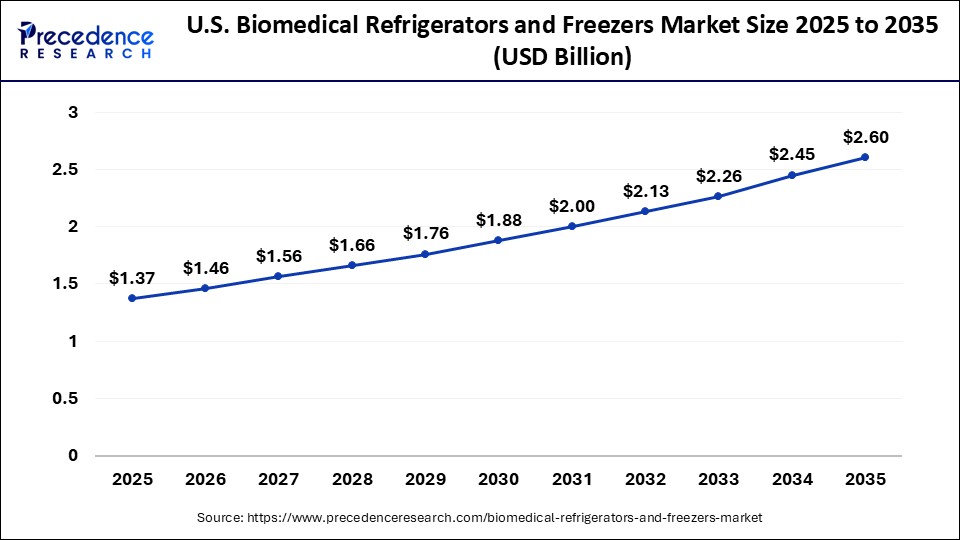
The U.S. biomedical refrigerators and freezers market size is exhibited at USD 1.46 billion in 2026 and is projected to be worth around USD 2.60 billion by 2035, growing at a CAGR of 6.62% from 2026 to 2035.
North America accounted for the largest biomedical refrigerators and freezers market share in 2025. North America, especially the U.S., has an established healthcare infrastructure consisting of improved healthcare facilities, research centers, and many related industries, mainly in the field of pharmaceuticals and biotechnology. This infrastructure creates the need for biomedical refrigerators to preserve biological products, vaccines, and drugs. An increased number of research and developments in the life sciences, pharmaceutical, and biotechnology industries contribute to the high usage of biomedical refrigerators and freezers. These facilities need to have dependable storage systems since samples can be contaminated during experimenting or testing procedures.
U.S. Biomedical Refrigerators and Freezers Market Trends
The U.S. has an established healthcare infrastructure consisting of improved healthcare facilities, research centers, and many related industries, mainly in the field of pharmaceuticals and biotechnology. Technological innovations and the growth of the pharmaceutical and biotechnology industries are also contributing to positive market growth in the country soon.
Why Is Asia Pacific Expected to Witness the Fastest Growth in the Biomedical Refrigerators and Freezers Market?
Asia Pacific is anticipated to witness the fastest growth in the biomedical refrigerators and freezers market during the forecasted years. The growing number of patients with chronic diseases and the growth in the need for various blood components and medicines. Growing healthcare structures such as hospitals and laboratories to enhance their storage systems requisites are the major contributing factors for the biomedical storage market. Currently, the Asia Pacific biopharmaceutical industry is evolving, with some companies being committed to developing biologics and biosimilars. This growth calls for proper storage that helps to ensure that the products requiring such conditions are well stored, thereby increasing the need for biomedical refrigerators and freezers.
China Biomedical Refrigerators and Freezers Market Trends
In the Asia Pacific, Chiana led the market due to growing demand for temperature-controlled storage for vaccines and biopharmaceuticals. Moreover, China's growing investment in advanced and modern healthcare facilities, such as hospitals, research centers, and diagnostic labs, creates a lucrative demand for biomedical equipment.
Europe is expected to grow at a notable CAGR over the forecast period. The growth of the region can be credited to the growing incidence of chronic diseases and a rise in organ transplants, all necessitating advanced cold storage solutions. In addition, the growth of biobanks for sample preservation also drives he demand for specialized refrigeration systems.
Germany Biomedical Refrigerators and Freezers Market Trends
The growth of the market in Germany can be driven by the growth of the pharmaceutical and healthcare sectors, which require reliable storage for biologics, vaccines, and clinical samples. The country's strong emphasis on biomedical research creates a huge demand for specialized refrigeration to store samples such as cells, tissues, and DNA.
Biomedical Refrigerators and Freezers Market Value Chain Analysis
- Raw material sourcing: This initial stage involves procuring the specialized materials required for manufacturing medical-grade refrigeration units.
- Manufacturing and assembly: This phase emphasizes the design, engineering, and assembly of the various types of biomedical refrigeration units.
- Distribution and sales: This stage involves marketing the finished products and distributing them to the end-users
- End-user deployment: The final stage includes the use of the equipment by various healthcare and research institutions.
Biomedical Refrigerators and Freezers Market Companies
- Thermo Fisher Scientific Inc: It offers a broad portfolio including TSV and TSX series lab refrigerators and freezers, ultra-low freezers, and vaccine storage units, with a focus on advanced temperature control and sustainability.
- Helmer Scientific: Specializes in blood bank and pharmacy refrigerators and freezers (GX Solutions), emphasizing thermal uniformity, energy efficiency, and environmental monitoring.
Other Major Key Players
- Panasonic Healthcare Corporation
- Haier Biomedical
- Eppendorf AG
- Power Scientific, Inc.
- Aegis Scientific, Inc.
- Follett LLC
- Azbil Corporation
Recent Developments
- In February 2024, PHC Corporation of North America, which supplies the PHCbi brand of cell preservation and growth products in the North America and Latin America markets, announces the launch of a new model in the PHCbi VIP ECO SMART ultra-low temperature (ULT) freezer series. This freezer is designed for facilities such as medical institutions, universities, and pharmaceutical companies. The MDF-DU703VHA-PA marks the first PHCbi ULT freezer equipped with dual voltage capability, allowing laboratories to switch between 115V and 220V power sources while enjoying the renowned energy-efficient performance and enhanced security features of the VIP ECO SMART series.
- In April 2024, Emerson, a US manufacturer, is set to launch and introduce a modular refrigeration unit with CO2 (R744) scroll compressors for small and medium retail stores in Europe. The small modular Copeland-branded units can be installed, packed ,or split, indoor or outdoor, according to Emerson; the gas cooler can be placed horizontally or vertically or be self-standing. The units are also Ecodesign compliant.
- In June 2024, ICECO asserts that its new APL35 is ready for summer as the most portable dual-zone chiller on Indiegogo right now. It is touted as being far lighter than rivals such as the EcoFlow Glacier while delivering a wider range of cooling for about the same amount of food, thanks to SECOP Nano compressor technology.
- In April 2024, Thermo Fisher Scientific, a contract development and manufacturing organization (CDMO), disclosed its latest ultra-low temperature (ULT) freezers. The TSX Universal Series ULT Freezers are reportedly capable of acclimating to scientists' workflows across multiple lab settings.
- In February 2024, Helmer Scientific GX Solutions ultra-low temperature freezers were ENERGY STAR certified by the U.S. Environmental Protection Agency (EPA) for the High-Performance Laboratory Grade Freezer.
- In February 2024, PHC Corporation released a new model of the PHCbi brand VIP ECO SMART ultra-low temperature (ULT) freezer series with the freezer for medical institutions, universities, and pharmaceutical companies.
Segments Covered in the Report
By Product
- Blood Bank Refrigerators
- Shock Freezers
- Plasma Freezers
- Ultra Low-Temperature Freezers
- Laboratory /Pharmacy/Medical Refrigerators
- Laboratory /Pharmacy/Medical Freezers
By End Use
- Hospitals
- Research Laboratories
- Pharmacies
- Diagnostic Centres
- Blood Banks
- Others
By Geography
- North America
- Europe
- Asia Pacific
- Latin America
- Middle East and Africa
For inquiries regarding discounts, bulk purchases, or customization requests, please contact us at sales@precedenceresearch.com
Frequently Asked Questions





Ask For Sample
No cookie-cutter, only authentic analysis – take the 1st step to become a Precedence Research client
 Get a Sample
.webp)



 sales@precedenceresearch.com
 Schedule a Meeting
