



Biphasic External Defibrillator Market Size, Companies, Share, Patient Volume, Treatment Adoption Rates, Pricing Analysis, Regulatory Landscape, Competitive Positioning, and Demand Forecast
Biphasic External Defibrillator Market (By Product Type: Automated External Defibrillators (AEDs), Manual External Defibrillators, Transcutaneous External Defibrillators, Wearable External Defibrillators; By End User: Hospitals & Clinics, Emergency Medical Services (EMS), Public Access Defibrillation (PAD) Programs, Home Care Settings) - Global Industry Analysis, Size, Trends, Leading Companies, Regional Outlook, and Forecast 2026 to 2035
Source: https://www.precedenceresearch.com/biphasic-external-defibrillator-market
 Get a Sample
 Table Of Content


What is the Biphasic External Defibrillator Market Size in 2026?
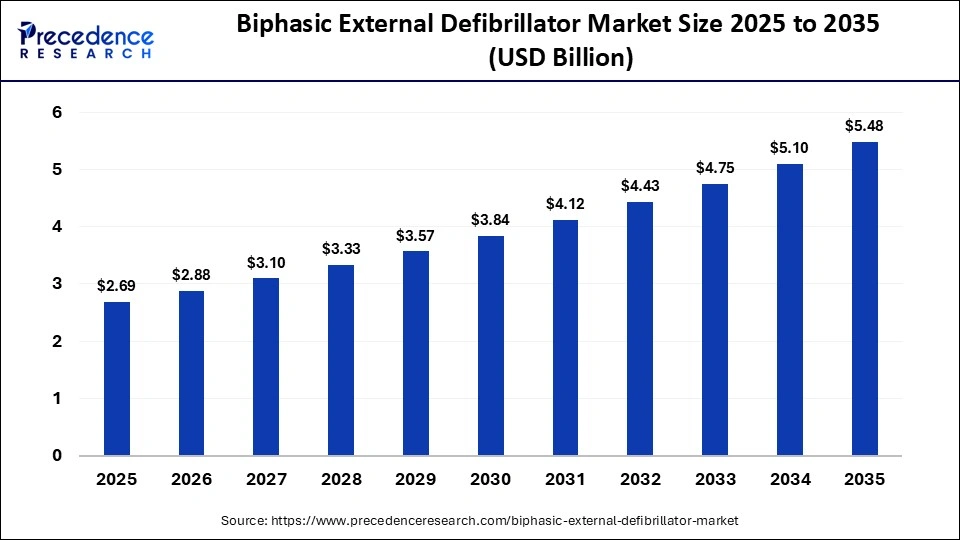
The global biphasic external defibrillator market size accounted for USD 2.69 billion in 2025 and is predicted to increase from USD 2.88 billion in 2026 to approximately USD 5.48 billion by 2035, expanding at a CAGR of 7.40% from 2026 to 2035. This market is growing due to rising incidences of sudden cardiac arrest and increasing adoption of advanced, energy-efficient defibrillation technology in hospitals and emergency care settings.
Key Takeaways
- North America dominated the biphasic external defibrillator market in 2025.
- Asia Pacific is expected to grow at the fastest CAGR between 2026 and 2035.
- By product type, the automated external defibrillators (AEDs) segment held the biggest market share in 2025.
- By product type, the wearables external defibrillators segment is expected to expand at the fastest CAGR between 2026 and 2035.
- By end user, the hospitals and clinics segment contributed the highest market share in 2025.
- By end user, the public access defibrillation (PAD) programs segment is expected to grow at a strong CAGR between 2026 and 2035.
What Drives the Growth of the Biphasic External Defibrillator Market?
The biphasic external defibrillator market is witnessing rapid growth, driven by the growing prevalence of cardiovascular diseases and sudden cardiac arrest across the world. Biphasic external defibrillators are preferred over conventional monophasic defibrillators since they reduce heart tissue damage, increase patient survival rates, and deliver energy more effectively. They are being increasingly used by hospitals, emergency healthcare facilities, and ambulatory care centers to improve prompt and efficient resuscitation. Furthermore, technological developments like portable designs, real-time monitoring, and user-friendly automated external defibrillators are contributing to market growth.
How is AI Transforming the Biphasic External Defibrillator Market?
Artificial intelligence is increasingly being integrated into biphasic external defibrillators to improve real-time decision-making and patient outcomes. AI-powered gadgets are able to instantly assess cardiac rhythms, suggest ideal energy levels, and assist users with defibrillation techniques, even in life-threatening circumstances. Additionally, hospitals are using machine learning algorithms and predictive analytics to monitor patients who are at risk, place devices optimally, and speed up response times in the event of a sudden cardiac arrest. These advancements are improving device accuracy, usability, and overall clinical effectiveness, thereby driving greater adoption across healthcare facilities worldwide.
What are the Major Trends Influencing the Market?
- Sedentary lifestyles, aging populations, and rising obesity rates are contributing to higher cardiac risk.
- Growing adoption of automated external defibrillators (AEDs) in hospitals and public spaces.
- Mandatory placement regulations in airports, schools, and workplaces are accelerating installations.
- Shift from monophasic to biphasic defibrillators due to higher efficiency and lower energy requirements. Biphasic technology improves first stock success rates and minimizes myocardial damage.
- Integration of AI & machine learning for real-time heart rhythm analysis and decision support. Smart algorithms enable accurate detection of shockable rhythms within seconds.
- Rising awareness and training programs on emergency cardiac care among healthcare professionals and the public.
- Technological advancements in portable and compact defibrillators are driving their adoption in ambulatory and home care use. Lightweight designs improve mobility for emergency responders and caregivers.
- Enhanced device connectivity enables remote monitoring and data analytics. Cloud integration allows real-time performance tracking and maintenance alerts.
- Increasing emphasis on regulatory compliance and safety standards in medical devices is driving the market. Manufacturers are focusing on strict quality assurance and certification processes.
Future Growth Outlook
- The expansion of emergency cardiac care infrastructure in developing countries is boosting device demand, as the increasing establishment of cardiac centers, ambulance networks, and trauma care units strengthens emergency response systems.
- The growing demand for AI-enabled and smart defibrillators is driving market growth, as advanced algorithms enable accurate rhythm detection and improve first-shock success rates.
- The rise of e-commerce and online sales channels is making AED procurement easier and more accessible for corporate offices, schools, and residential users.
- The development of cost-effective, compact, and user-friendly defibrillators is improving accessibility, particularly in homes and small clinics outside traditional hospital environments.
- Partnerships with governments and NGOs are expanding public access defibrillation programs, increasing installations in high-traffic locations such as airports, malls, and schools.
- Integration with telemedicine platforms is enhancing remote monitoring and emergency response, with cloud-based connectivity enabling real-time device tracking and maintenance alerts.
- Increasing investments in research and development are advancing biphasic waveform technologies, focusing on improving energy efficiency and reducing cardiac tissue damage.
- Growing awareness campaigns and CPR/AED training programs are supporting broader adoption across public and private sectors by improving emergency preparedness and response readiness.
How are Government Initiatives Supporting the Biphasic External Defibrillator Market?
Through public access defibrillation programs & required AED installations in public areas like offices, airports, and schools, government initiatives are stimulating the biphasic external defibrillator market. The goal of such initiatives is to improve survival rates from sudden cardiac arrest by ensuring timely access to life-saving devices. Increased healthcare funding, strengthened emergency response infrastructure, and nationwide CPR/AED awareness and training programs are further accelerating adoption. Additionally, investments in healthcare infrastructure and national heart health initiatives are promoting the deployment of advanced defibrillation technologies across both urban and rural settings.
Strategic Sustainability and Continuity Practices in the Defibrillator Industry
| Category | Sustainability Initiatives | Resilience Strategies | Industry Impact |
| Product Design | Use of recyclable plastics, reduced hazardous materials, and eco-friendly packaging | Shock-resistant casing, extended battery life, and durability in extreme temperatures | Lower environmental footprint while ensuring long-term reliability in emergencies |
| Energy Efficiency | Low-energy biphasic waveform reduces overall power usage | High-efficiency lithium batteries with long standby life (4–5 years typical) | Reduces operational cost and ensures readiness during prolonged outages |
| Battery & Pad Disposal | Battery recycling programs and eco-compliant disposal guidelines | Multi-year battery lifespan and smart alerts to prevent sudden failures | Minimizes medical e-waste and improves device reliability |
| Manufacturing Practices | Carbon footprint reduction, energy-efficient production plants | Diversified manufacturing locations to avoid supply disruption | Stable production even during geopolitical or pandemic disruptions |
| Digital Connectivity | Cloud-based monitoring reduces unnecessary maintenance visits | Remote diagnostics and automated self-testing features | Enhances uptime and reduces carbon emissions from service logistics |
| Disaster Preparedness | Portable, lightweight AED models for emergency response kits | Integration into national emergency response frameworks | Strengthens healthcare system resilience during natural disasters |
| Lifecycle Management | Modular component replacement instead of full device disposal | Firmware updates extending product lifespan | Supports circular economy and cost efficiency |
Market Scope
| Report Coverage | Details |
| Market Size in 2025 | USD 2.69 Billion |
| Market Size in 2026 | USD 2.88 Billion |
| Market Size by 2035 | USD 5.48 Billion |
| Market Growth Rate from 2026 to 2035 | CAGR of 7.40% |
| Dominating Region | North America |
| Fastest Growing Region | Asia Pacific |
| Base Year | 2025 |
| Forecast Period | 2026 to 2035 |
| Segments Covered | Product Type, End User, and Region |
| Regions Covered | North America, Europe, Asia-Pacific, Latin America, and Middle East & Africa |
Segment Insights
Product Type Insights
What Made Automated External Defibrillators (AEDs) the Dominant Segment in the Market?
The automated external defibrillators (AEDs) segment dominated the biphasic external defibrillator market in 2025 because of their portability, simplicity of use, and extensive use in public places like schools, hospitals, ambulances, & airports. They are very effective for quick response during sudden cardiac arrest due to their capacity to deliver controlled biphasic shocks with voice-guided instruction, which raises survival rates and creates strong demand worldwide. Additionally, government mandates, public access programs, and rising awareness of cardiac emergencies have accelerated AED deployment, solidifying their leadership in the market.
The wearable external defibrillators segment is expected to grow at the fastest CAGR in the coming years because high-risk patients who are not in hospitals are increasingly requiring continuous cardiac monitoring. These gadgets guarantee prompt intervention during potentially fatal arrhythmias by offering remote monitoring and automatic shock delivery. Demand is being accelerated by rising awareness of preventive cardiac care and growing preference for home healthcare solutions.
End User Insights
Why Did the Hospitals and Clinics Segment Dominate the Biphasic External Defibrillator Market?
The hospitals and clinics segment dominated the market while holding the largest share in 2025 since they oversee a significant number of critical care and emergency cases that need prompt defibrillation assistance. Biphasic defibrillator use is guaranteed by the availability of trained medical personnel and state-of-the-art facilities. Strong procurement budgets and an increase in patient admissions for cardiovascular conditions in these facilities reinforced their dominant position in the market.
The public access defibrillation (PAD) programs segment is expected to grow at the fastest CAGR in the coming years because of growing government regulations promoting the installation of AEDs in public spaces like shopping centers, transportation hubs, educational hubs, and educational institutions. Campaigns to raise awareness of sudden cardiac arrest responses are increasing in installation all over the world. The implementation of corporate workplace safety policies and community emergency preparedness initiatives is also driving the segment's growth.
Regional Insights
Why Did North America Dominate the Biphasic External Defibrillator Market?
North America dominated the market with a major revenue share in 2025 because of the strong presence of leading medical device manufacturers like ZOLL Medical Corporation and Stryker Corporation, the sophisticated healthcare infrastructure, and the high level of awareness regarding cardiac emergencies. Adoption of the product is further supported by established emergency medical services and favorable reimbursement structures. Furthermore, strong government support through public access defibrillation programs, regulations mandating AED installations in schools, airports, and workplaces, and national CPR/AED awareness campaigns have further accelerated market growth.
U.S. Biphasic External Defibrillator Market Trends
The U.S. leads the North American biphasic external defibrillator market due to extensive public access AED deployment programs, a robust emergency medical services network, and a well-established healthcare infrastructure. Key manufacturers, such as ZOLL Medical Corporation, support ongoing product availability and drive technological innovation. The country's market dominance is further reinforced by favorable reimbursement policies, regulations mandating AED installations in public spaces, and widespread awareness of sudden cardiac arrest, ensuring broad adoption across both public and private sectors.
What Drives the Market in Asia Pacific?
Asia Pacific is expected to grow at the fastest CAGR in the coming years due to the increasing incidence of cardiovascular diseases in emerging economies and the development of advanced healthcare infrastructure. Improved cardiac care services are being provided by governments through hospital network expansion and emergency response system investments. Demand is being increased by growing urbanization, rising healthcare costs, & increased knowledge of early defibrillation.
India's Biphasic External Defibrillator Market Trends
India is emerging as a high-growth market for biphasic external defibrillators due to the rapid expansion of hospital and emergency room infrastructure and the rising prevalence of cardiovascular diseases. Adoption in urban and semi-urban areas is being accelerated by the government's focus on strengthening emergency response systems and ambulance networks. The market is further fueled by increasing awareness of early defibrillation, the growth of private hospital chains, and rising healthcare investments, driving broader accessibility and adoption across the country.
How is the Opportunistic Rise of the Middle East & Africa in the Market?
The Middle East & Africa (MEA) is expected to experience an opportunistic growth in the biphasic external defibrillator market due to rising awareness of sudden cardiac arrest and improvements in healthcare infrastructure. Expansion of emergency medical services, increased investments in hospital facilities, and government initiatives to enhance cardiac care in countries like South Africa, the UAE, and Saudi Arabia are driving market growth. Additionally, the growing prevalence of cardiovascular diseases and the expansion of training programs for emergency responders are further supporting the uptake of automated external defibrillators across the region.
Biphasic External Defibrillator Market Value Chain Analysis
- R&D
This stage focuses on improving waveform accuracy, energy efficiency, and real-time CPR feedback features. Companies also work on compact designs and smart connectivity for faster emergency responses.
Key Players: ZOLL Medical Corporation, Stryker Corporation, Koninklijke Philips N.V.
- Raw Material & Component Sourcing
This stage involves the supply of essential components such as batteries, capacitors, printed circuit boards (PCBs), electrodes, sensors, and semiconductor chips.
Key Players: Texas Instruments, STMicroelectronics, and TE Connectivity.
- Device Manufacturers & Assemblers
Manufacturers design, engineer, and assemble biphasic external defibrillators while integrating waveform technologies, AI algorithms, and safety features.
Key Players: Stryker Corporation, Koninklijke Philips N.V., ZOLL Medical Corporation, Medtronic, and Nihon Kohden Corporation.
- Distribution & Logistics
This stage includes partnerships with medical device distributors, hospital procurement networks, and e-commerce platforms to ensure timely product availability across hospitals, ambulatory centers, public access locations, and home care settings.
Biphasic External Defibrillator Market Companies
- ZOLL Medical Corporation (Asahi Kasei)
- Stryker (Physio-Control)
- Koninklijke Philips N.V.
- Medtronic
- Defibtech (Nihon Kohden)
- Nihon Kohden Corporation
- Mindray Medical
- Schiller AG
- BPL Medical Technologies
- CU Medical Systems
- Mediana Co., Ltd.
- Progetti S.r.l.
- HeartSine Technologies
- Bexen Cardio
- A.M.I. Italia
- Abbott Laboratorie
- Boston Scientific Corporation
Recent Developments
- In February 2026, ZOLL Medical Corporation announced the launch of the Zenix monitor/defibrillator. The device received EU MDR approval and features the new Real BVM Help technology. This solution provides real-time feedback on ventilation quality to assist rescuers during cardiac arrest.(Source: https://sg.finance.yahoo.com)
- In November 2024, BPL Medical Technologies announced the launch of the Relife 1000 biphasic defibrillator. This device was part of a new critical care portfolio, including Orion & Magna modular patient monitors, unveiled at ISACON 2024 in Bengaluru. The launch aims to enhance hospital emergency care with advanced resuscitation technology and monitoring solutions.(Source: https://www.expresshealthcare.in)
Segments Covered in the Report
By Product Type
- Automated External Defibrillators (AEDs)
- Manual External Defibrillators
- Transcutaneous External Defibrillators
- Wearable External Defibrillators
By End User
- Hospitals & Clinics
- Emergency Medical Services (EMS)
- Public Access Defibrillation (PAD) Programs
- Home Care Settings
By Region
- North America
- Europe
- Asia-Pacific
- Latin America
- Middle East & Africa
For inquiries regarding discounts, bulk purchases, or customization requests, please contact us at sales@precedenceresearch.com
Frequently Asked Questions





Ask For Sample
No cookie-cutter, only authentic analysis – take the 1st step to become a Precedence Research client
 Get a Sample




 sales@precedenceresearch.com
 Schedule a Meeting
