



Building Information Modeling Market Size, Key Companies, Company Product Portfolio, Digital Transformation, Technology Investment, Adoption Rates, Customer Acquisition, Company Market Share, and Market Outlook
Building Information Modeling Market (By Deployment Mode: On-premises, Cloud, By Building Type: Commercial, Residential; By Component: Solution, Service; By Application: Planning and Modelling, Construction and Design, Asset Management, Building System Analysis and Maintenance Scheduling; By End-user: Architects/Engineers, Contractors, Others; By Geography: North America, Asia Pacific, Europe, Latin America, Middle East & Africa) - Global Industry Analysis, Size, Trends, Leading Companies, Regional Outlook, and Forecast 2026 to 2035
Source: https://www.precedenceresearch.com/building-information-modeling-market
 Get a Sample
 Table Of Content


What is the Building Information Modeling Market Size?
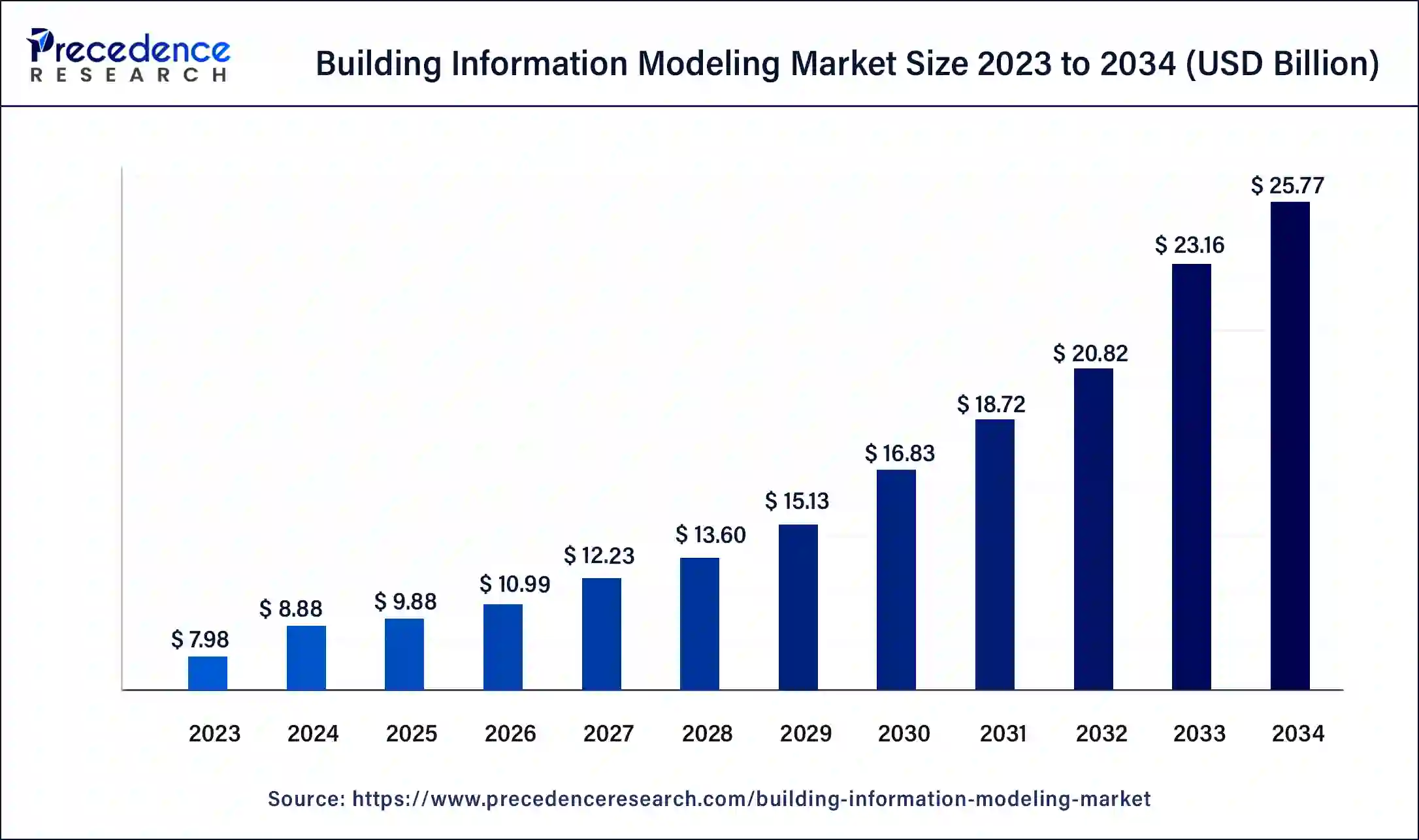
The global building information modeling market size is calculated at USD 9.88 billion in 2025 and is predicted to increase from USD 10.99 billion in 2026 to approximately USD 28.2 billion by 2035, expanding at a CAGR of 11.06% from 2026 to 2035. The North America building information modeling market size reached USD 3.46 billion in 2024. The building information modeling market is driven by a greater focus on energy efficiency and sustainability.
Building Information Modeling Market Key Takeaways
- The global building information modeling market was valued at USD 8.88 billion in 2025.
- It is projected to reach USD 28.2 billion by 2035.
- The building information modeling market is expected to grow at a CAGR of 11.06% from 2026 to 2035.
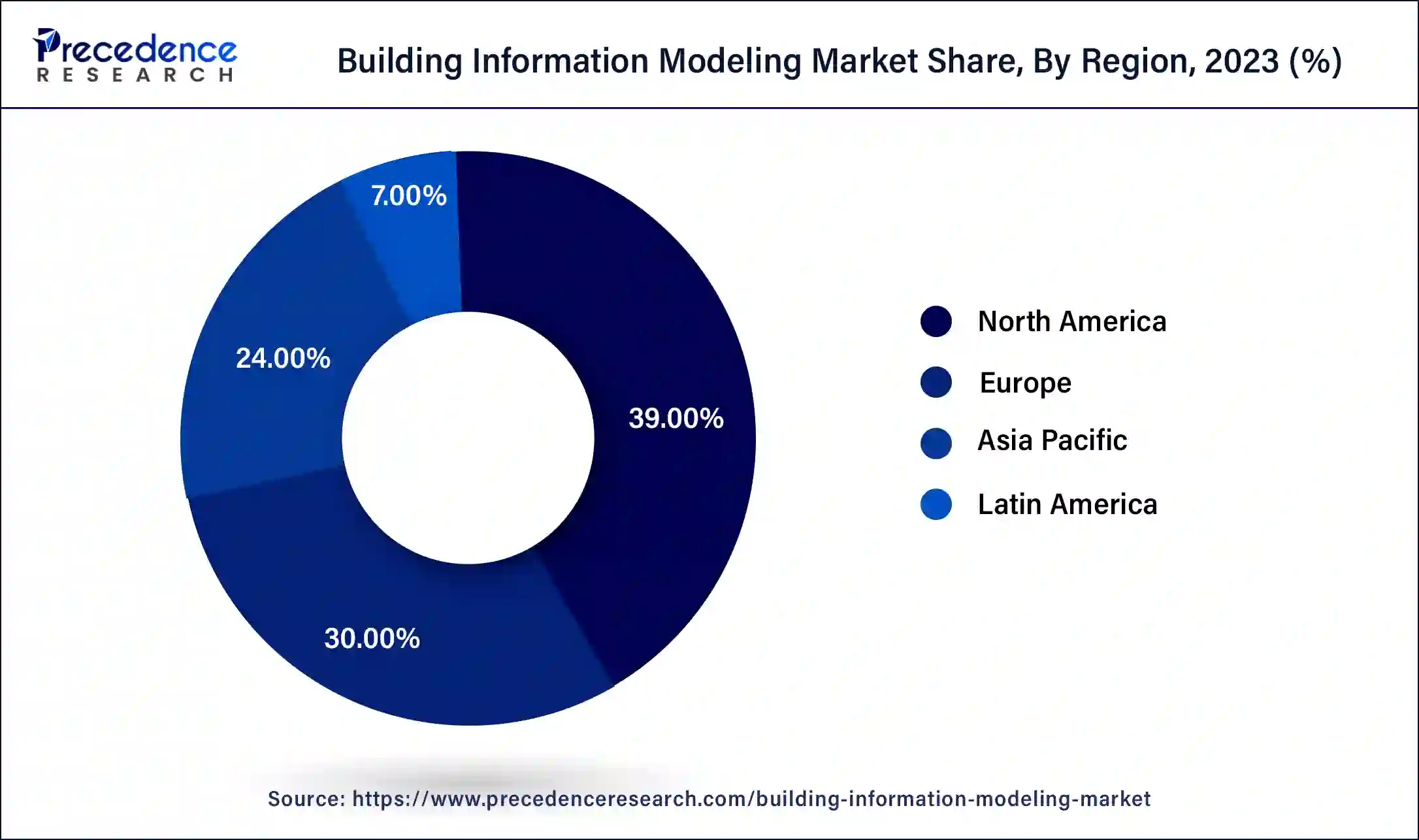
- North America dominated in the building information modeling market with the largest market share of 39% in 2025.
- Asia-Pacific is observed to be the fastest growing in the building information modeling market during the forecast period.
- By deployment mode, the on-premises segment is observed to be the fastest growing in the market.
- By deployment mode, the cloud segment shows a notable share in the building information modeling market during the forecast period.
- By building type, the residential segment dominated the market in 2025.
- By building type, the commercial segment is observed to grow at a notable rate during the forecast period.
- By component, the solution segment dominated in the market in 2025.
- By component, the service segment is observed to show a significant growth in the building information modeling market during the forecast period.
- By application, the planning and modeling segment held a significant share in the market in 2025.
- By application, the construction and design segment is observed to grow at a notable rate during the forecast period.
- By end-user, the architects /engineers segment led the market in 2025.
- By end-user, the contractors segment shows a significant growth in the building information modeling market during the forecast period.
Market Overview
The building information modeling market includes the products, services, and technology used to design, administer, and distribute digital representations of the functional and physical aspects of locations. Stakeholders may work together and cooperate throughout the lifecycle of a building or infrastructure project, from planning and design to construction, operation, and maintenance, due to these representations or models, which comprise intricate 3D models and related metadata.
Stakeholders may see the project in depth with 3D models before construction starts. This aids in early project lifecycle decision-making, design optimization, and identifying possible problems. By enabling the examination of energy performance, material usage, and environmental impact, BIM promotes sustainable construction practices. This aids in the design of more ecologically and energy-conscious buildings. IM assists in ensuring that designs adhere to building codes and regulatory norms. It also helps with risk management by tracking modifications during the project and offering thorough documentation.
Building Information Modeling Market Trends
- In April 2024, there were 461 industrial projects included, totaling 63.99 million square meters and INR 46,991 crore in building costs.
- It is projected that over 40% of India's population, currently 35%, will reside in urban areas by 2030, creating a need for an additional 25 million reasonably priced housing units.
- In March 2025, an additional $10 million USD was secured in the seed funding round by Augmenta, which is the leading autonomous design platform for the built environment, where the round was led by Prelude Ventures, along with the participation of Montage Ventures. This, in turn, makes the total funding of Augmenta $25.6 million USD. The strategic collaboration with ENG, which is a global leader in Building Information Modeling (BIM), supports the investments of Augmenta. To automate electrical design modeling for subcontractors, this collaboration will combine the innovative AI technology of Augmenta with the BIM expertise of ENG.
- In January 2025, CION Grosvenor Infrastructure Fund was launched by the collaboration between GCM Grosvenor, which is a global alternative asset management solutions provider, and CION Investments, which is a leading alternative investment solutions platform. A total of $240 million portfolio invested in 43 infrastructure assets, along with $82 million for additional committed capital, will be included in this fund during its launch. Moreover, major institutional investor also provided their support for the launch of this fund.
Building Information Modeling Market Growth Factors
- BIM solutions are necessary for effective project management in global urbanization and infrastructure development.
- BIM tools support sustainability objectives by minimizing environmental effects and maximizing resource utilization.
- BIM improves project coordination by making it easier for contractors, engineers, and architects to collaborate in real-time.
- Governments across different areas are requiring the use of BIM for public projects, which is driving the market's expansion.
- When AI, VR, AR, and IoT are integrated with BIM, project visualization, collaboration, and decision-making improve.
- BIM makes it possible to identify any project hazards early on and mitigate them with thorough modeling and analysis.
- Processes are streamlined, errors are decreased, and resource allocation is optimized with BIM, which lowers costs.
- Beyond construction, facilities management, operations, and maintenance are now included in BIM.
Best 3D Construction Software
| Sr.No. | Software | Applications |
| 1. | Revit | By producing a digital three-dimensional model of a building, it thoroughly depicts all of its constituent parts and physical structure. |
| 2. | Rhino7 | It applies to many design disciplines, such as architecture, automobile design, and industrial design. |
| 3. | Maya | It has a strong rendering engine for realistic settings and excellent graphics. |
| 4. | Blender | Its toolkit is extensive and includes tools for 3D modeling, animation, rendering, simulation, compositing, and video editing. |
| 5. | Cinema 3D | Its smooth integration allows for effective data sharing and collaboration with other widely used programs and file types. |
Building Information Modeling Market Outlook
- Industry Growth Overview: The building information modeling market is growing rapidly due to increasing demand for digital solutions in the construction and infrastructure sectors, as well as the rising adoption of smart city and sustainable urban development initiatives. Government mandates for BIM in large-scale infrastructure projects, advancements in 3D modeling to multi-dimensional digital management systems, and the need for improved project efficiency, cost control, and collaboration across architecture-engineering-consulting (AEC) firms also drive market growth.
- Technology & Innovation Trends: BIM technology is advancing beyond traditional design modeling into sophisticated digital twin and AI-driven simulation systems. Vendors now offer 4D, 5D, and 6D BIM solutions that integrate scheduling, cost estimation, sustainability analysis, and facility management into a single workflow. Companies like Autodesk, Bentley Systems, and Hexagon are leading innovation in cloud-based collaboration and visualization tools, allowing global teams to work together in a unified project environment.
- Global Expansion: There is a strong potential for market expansion worldwide. Major BIM providers are increasingly targeting emerging markets in regions like Asia-Pacific, the Middle East, and Central/Eastern Europe, driven by rapid construction growth, infrastructure investment, and the rise of smart cities and commercial real estate. The market's expansion is further supported by regional government incentives that promote sustainable and efficient construction practices, driving demand for advanced digital construction tools and technologies.
- Major Investors: Major investors in the market include software giants like Autodesk, Trimble, and Bentley Systems, as well as construction firms and government organizations. These investors contribute by driving technological advancements, investing in R&D to develop more integrated BIM solutions, and funding initiatives that promote sustainable construction practices and smart city development, ultimately accelerating the adoption of BIM technologies across industries.
- Startup Ecosystem: The BIM startup ecosystem is rapidly maturing. Companies like OpenSpace (U.S.), nPlan (UK), and Cupix (South Korea) are leading the way with solutions for predictive scheduling, 3D reality capture, and real-time site monitoring. AR/VR technologies are becoming increasingly popular among startups for delivering immersive visualization and training, improving communication, and supporting decision-making among stakeholders.
Building Information Modeling Market Scope
| Report Coverage | Details |
| Market Size by 2035 | USD 28.2 Billion |
| Market Size in 2025 | USD 9.88 Billion |
| Market Size in 2026 | USD 10.99 Billion |
| Market Growth Rate from 2026 to 2035 | CAGR of 11.06% |
| Largest Market | North America |
| Base Year | 2025 |
| Forecast Period | 2026 to 2035 |
| Segments Covered | Deployment Mode, Building Type, Component, Application, End-user, and Regions |
| Regions Covered | North America, Europe, Asia-Pacific, Latin America, and Middle East & Africa |
Market Dynamics
Driver
Expanding construction activities
BIM helps contractors, architects, engineers, and stakeholders collaborate more effectively by offering a shared digital picture of the project. This lowers errors and miscommunication. BIM's usefulness in construction activities is increased by its smooth integration with other cutting-edge technologies, including artificial intelligence (AI), virtual reality (VR), and the Internet of Things (IoT). The industry's adoption of BIM has been fueled by many government mandates requiring the use of BIM for public construction projects to guarantee efficiency and transparency. This drives the growth of the building information modeling market.
Restraint
High implementation cost
The cost of BIM software licensing is high. Prominent BIM programs such as Bentley Systems, Autodesk Revit, and ArchiCAD have significant upfront expenditures that may be unaffordable for small and medium-sized businesses. Sturdy hardware is needed for BIM to function well. This frequently entails making higher-end server and computer purchases, which raises the initial cost. Upgrading IT infrastructure, such as network systems and storage solutions, may be necessary for businesses to manage the massive data volumes produced by BIM procedures. This limits the growth of the building information modeling market.
Opportunity
Advancements in design and modeling technologies
Improvements in simulation and analytic technologies enable more precise modeling of building performance, including thermal comfort, structural integrity, and energy efficiency. These tools can save money and time by spotting problems before the building starts. Example: Comprehensive analytical capabilities are provided by tools such as IES VE and Green Building Studio, which can simulate different environmental conditions and their effects on building performance.
Cloud-based BIM solutions make remote collaboration more accessible, which is especially helpful in today's workplace. These technologies improve Project coordination, which facilitates real-time data sharing and communication. This opens an opportunity for the growth of the building information modeling market.
Segment Insights
Deployment Mode Insights
The on-premises segment is observed to be the fastest growing in the building information modeling market. On-premises BIM systems provide more data control, which is essential for sectors like government projects and critical infrastructure that have strict regulations regarding data security and privacy. Many businesses must abide by national and international data protection laws, which are simpler to administer when using on-premises software. These solutions can be changed to satisfy legal obligations.
The cloud segment shows a notable share in the building information modeling market during the forecast period. Real-time collaboration between project stakeholders, such as architects, engineers, contractors, and owners, is made more accessible by cloud-based BIM tools. Team members can concurrently view, edit, and share information from any place by centralizing the BIM data on the cloud. Decision-making processes are accelerated, errors are decreased, and communication is improved. Cloud-based BIM platforms offer the means to meet the growing digital standards and regulations the construction sector must adhere to. Numerous cloud BIM solutions are made by industry standards, guaranteeing that projects fulfill legal requirements and quality standards.
Building Type Insights
The residential segment dominated the building information modeling market in 2025. Using BIM, designers and architects can produce incredibly accurate 3D models of residential structures. This lowers uncertainty and improves decision-making by enabling homeowners and other stakeholders to see the finished project before construction starts. Residential projects frequently call for a high level of customization to satisfy the homeowners' unique requirements and tastes. BIM makes it simple to adjust and customize designs during the design process, ensuring that the finished product meets client expectations.
The commercial segment is expected to grow at a notable rate in the building information modeling market during the forecast period. Commercial construction firms have adopted and integrated BIM workflows, facilitated by BIM software and tools advancements. For commercial projects particularly, these tools' features, such as clash detection, 4D scheduling, and 5D cost estimation, are quite helpful. Other cutting-edge technologies, such as augmented reality (AR), artificial intelligence (AI), and the Internet of Things (IoT), are being combined with BIM. The possibilities of BIM are improved by these interfaces, increasing its value for commercial development.
Component Insights
The solution segment dominated in the building information modeling market in 2025. BIM solutions provide accurate modeling and analysis, which increases project efficiency and accuracy. They make it possible to combine different kinds of data into a single model, which aids in the early detection of possible problems during the design stage. This lessens the possibility of expensive mistakes and rework while building. Project planning and management are further improved by the capacity to visualize projects in 3D, 4D (time), and even 5D (cost). This improves resource allocation and time management.
The service segment shows significant growth in the building information modeling market during the forecast period. Services like consultancy, training, and support are in greater demand as BIM becomes increasingly integrated into architectural and construction. These services are necessary for businesses to successfully incorporate BIM into their operations. The development of BIM is being driven, in part, by government mandates and large-scale infrastructure projects, especially in industrialized and developing nations. As a result, more specialist services are required to guarantee efficiency and compliance.
Application Insights
The planning and modeling segment held a significant share in the building information modeling market in 2024. Planning and modeling are essential to the construction project lifecycle from the beginning to the end. This section's task is to make intricate 3D models that incorporate structural, architectural, and MEP (mechanical, electrical, and plumbing) components. By acting as a single source of truth, these models ensure that everyone involved in the project knows its specifics.
The construction and design segment are expected to grow at a notable rate in the building information modeling market during the forecast period. The use of BIM is expanding across a range of construction projects, such as infrastructural, commercial, and residential complexes. This is motivated by the need for improved stakeholder participation, more effective project management, and the capacity to model and simulate building designs before construction. BIM encourages better cooperation and communication between architects, engineers, contractors, and owners in construction projects. BIM creates a common platform for project information access, which minimizes misconceptions and improves decision-making. The management of intricate construction projects is becoming increasingly dependent on this collaborative approach, which is helping to expand BIM use.
End-user Insights
The architects /engineers segment led the building information modeling market in 2025. Engineers and architects were some of the first professionals to use BIM software. Their early acceptance made it easier to switch from more sophisticated BIM platforms to more conventional CAD (Computer-Aided Design) systems. Engineers and architects may find and fix problems early in the design process using the sophisticated clash detection technologies that BIM offers. This lessens the possibility of expensive adjustments and building delays. Early in the design process, BIM assists engineers and architects in identifying possible risks by providing a thorough project view. Unexpected problems during construction are less likely to occur when risk management is done proactively.
The contractors segment shows a significant growth in the building information modeling market during the forecast period. Due to its ability to streamline the project planning, design, construction, and maintenance stages, BIM is being adopted by contractors more and more. Using BIM, contractors may digitally depict the building process, improving stakeholder coordination and communication. Other cutting-edge technologies like augmented reality (AR), virtual reality (VR), and the Internet of Things (IoT) all work nicely with BIM. The augmentation of project visualization, communication, and management capabilities through this integration is appealing to contractors who want to use cutting-edge solutions to complete projects.
Regional Insights
What is the U.S. Building Information Modeling Market Size?
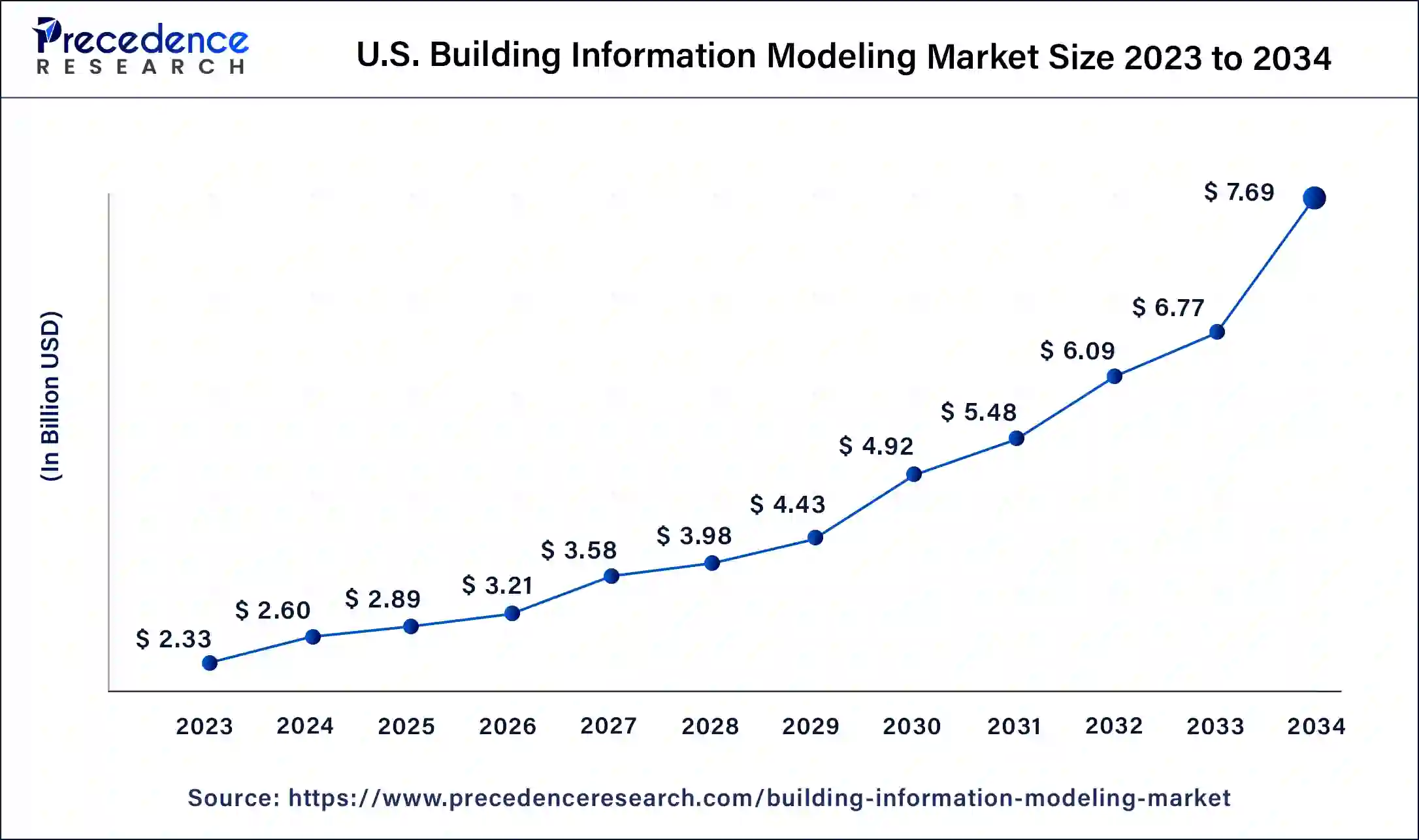
The U.S. building information modeling market size is exhibited at USD 2.89 billion in 2025 and is projected to be worth around USD 8.45 billion by 2035, growing at a CAGR of 11.33% from 2026 to 2035.
North America dominated the building information modeling market in 2024. The United States adopted BIM technology early in North America. Major North American countries have witnessed a surge in the development of BIM software and methodology, leading to significant investments in research and development. North America's top research and academic universities concentration has produced a workforce with advanced BIM skills. This architecture of education fosters ongoing innovation and the creation of fresh BIM methods and applications.
U.S. Building Information Modeling Market Trends
The U.S. leads the market in North America due to a strong push for digital transformation in the construction and infrastructure sectors, driven by the need for more efficient and accurate project management. Government mandates, such as those requiring BIM for federal projects and public infrastructure, have accelerated adoption across public and private sectors. Additionally, increasing investments in smart cities, sustainable urban development, and the real estate sector are fueling demand for advanced BIM tools to improve collaboration, cost management, and project outcomes.
What Makes Asia Pacific the Fastest-Growing Region in the Market?
Asia-Pacific is observed to be the fastest growing in the building information modeling market during the forecast period. Asia-Pacific is home to several nations making significant investments in infrastructure initiatives like smart cities, transit networks, and commercial expansions. The use of BIM is growing to simplify the design, construction, and management of these intricate projects. Through the reduction of rework, optimization of resource usage, and improvement of project timeliness, BIM provides significant cost efficiencies. Furthermore, the region is increasingly emphasizing sustainable construction methods, and BIM makes it easier to design and build ecologically friendly structures by providing improved simulation and visualization capabilities.
China Building Information Modeling Market Trends
China is a major contributor to the market in Asia Pacific, thanks to its rapid urbanization, massive infrastructure expansion, and large-scale smart city initiatives. Major construction projects, such as metro systems, high-speed rail, and commercial developments, are increasingly adopting BIM for cost optimization, planning, and lifecycle management. Government-backed programs promoting digital building regulations and intelligent city technologies are further accelerating the adoption and demand for BIM solutions in the country.
What Makes Europe a Significantly Growing Area in the Market?
Europe is expected to grow significantly in the building information modeling market during the forecast period. The growing digitalization in Europe is increasing the use of building information modelling. At the same time, new platforms powered by AI or cloud are also being developed, which are improving real-time collaborations, scalability, predictive analytics, etc. Moreover, their adoption is increasing in the UK and Germany, where the growing initiative and investments are encouraging their use, as well as developments. Additionally, the presence of sustainability certification is also driving their demand. Hence, these developments are supported by the government as well. Thus, this promotes the market growth.
UK Building Information Modeling Market Trends
In the UK, the market is propelled by government mandates requiring BIM for public sector projects. High-end BIM software is used in large-scale infrastructure projects, such as transportation networks, hospitals, and urban redevelopment initiatives. Ongoing investment in digital building skills is expected to drive market growth in this country.
What Potentiates the Building Information Modeling Market in Latin America?
The market in Latin America is driven by ongoing infrastructure modernization programs, housing demand, and public-sector investments. BIM is becoming more popular for planning, scheduling, and cost estimation in commercial and residential projects. Brazil is leading the market due to the rising demand for efficient project management solutions. The rising use of BIM in the management of complex commercial and residential constructions is further boosting the market in the coming years.
Brazil Market Trends
The Brazilian market is driven by the proliferation of government initiatives and a growing portfolio of infrastructure investments and modernization. BIM is gaining traction across the transportation, commercial, residential, and public infrastructure sectors, as teams are trying to better plan for projects in an efficient way to save money and improve collaboration between stakeholders. Furthermore, due to the rising demand for sustainable construction and resource utilization, the use of BIM solutions is becoming popular.
What Opportunities Exist in the Middle East & Africa (MEA)?
The Middle East & Africa (MEA) presents significant opportunities for the building information modeling market as governments are incorporating BIM into planning and approval processes. Growth in urbanization and infrastructure development also drives market growth. The UAE is a significant player in the BIM market, fueled by high-value infrastructure projects, urban development, and smart city initiatives. The country's emphasis on innovation, digital infrastructure, and workforce development is expected to accelerate the adoption of BIM technologies, driving strong growth in the region.
Saudi Arabia Market Trends
The Saudi Arabian market is expanding significantly, supported by ambitious plans of infrastructure developments alongside long-term economic diversification measures outlined by the Saudi Arabia 2030 vision. The use of BIM technologies in major construction projects for smart cities, transportation, tours, and commercial buildings. The government and private sector are pushing for greater use of digital methods of building to improve productivity and to cut down on project delays.
Competitive Landscape
The building information modelling market is highly competitive, driven by marketing of technologies for digital construction, project collaboration, and lifecycle asset management solutions. In April 2025, Nemetschek Group entered into a strategic partnership with Google Cloud to enhance its BIM on the cloud platform, expand product innovation through AI, and solidify its positioning as a global leader.
Emerging challengers are launching to compete on a browser-native platform with a range of modeling platforms, AI-driven code compliance tools, and regional-specific and niche construction system-enabling SaaS. Automation, generative design, real-time collaboration, and integrated project delivery are being targeted as investments and transforming the competitive landscape.
Building Information Modeling Market - Value Chain Analysis
- Software Development
This stage involves designing, coding, and enhancing BIM platforms, 3D modeling engines, cloud collaboration systems, simulation modules, and interoperability frameworks. Technology providers develop the core software architecture that enables digital design, visualization, and data integration across the construction lifecycle.
Key Players: Autodesk, Bentley Systems, Nemetschek Group, Dassault Systemes, Trimble. - BIM Implementation, Consulting & System Integration
At this stage, consulting firms, engineering specialists, and digital construction experts help organizations deploy BIM systems. This includes workflow re-engineering, training, CDE (Common Data Environment) setup, and integration with ERP, GIS, project management, and digital twin platforms.
Key Players: Pentagon Solutions, Beck Technology, AEC consultancies, Asite Solutions. - Model Creation, Design & Engineering Services
Architects, engineers, surveyors, and construction planners use BIM tools to create 3D models, perform simulations, run clash detection, and generate construction-ready documentation. This stage is when the BIM model serves as the foundation for coordination, cost estimation, energy modeling, and structural analysis.
Key Participants: Architectural firms, engineering firms, construction design consultancies, BIM service providers. - Facility Management, Digital Twins & Asset Lifecycle Operations
Once construction is complete, BIM models become operational digital twins used for building maintenance, energy optimization, asset tracking, space management, and renovation planning. This is where BIM delivers long-term value through lifecycle intelligence.
Key Players: Autodesk (BIM 360 Ops), Bentley Systems (iTwin), IBM Maximo integrations, and facility management software providers.
Building Information Modeling Market Companies
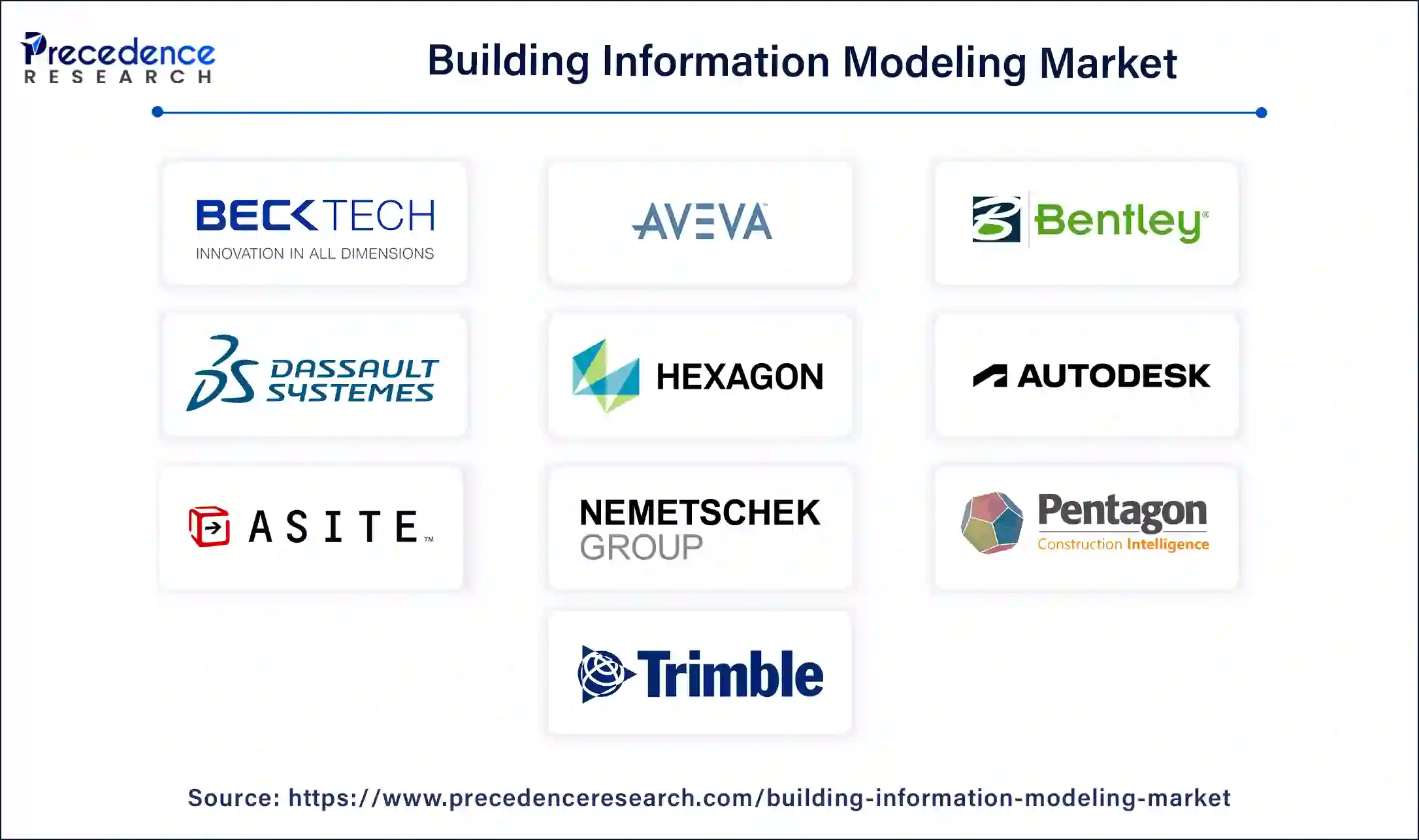
- Autodesk, Inc. – Provides industry leading BIM software like Revit and BIM 360 for integrated 3D design, collaboration, and project management across architecture, engineering, and construction.
- Nemetschek Group – Offers a suite of BIM tools, including Allplan, ArchiCAD, and Vectorworks, that emphasize interoperability and lifecycle project management.
- Bentley Systems, Incorporated – Delivers enterprise scale BIM solutions such as OpenBuildings Designer and ProjectWise for infrastructure and industrial project design and operations.
- Trimble Inc. – Combines hardware and software like Tekla Structures and Trimble Connect to bridge field data capture with BIM workflows for precision construction and coordination.
- Dassault Systèmes – Provides BIM and digital twin capabilities via its 3DEXPERIENCE platform that supports design simulation and lifecycle management.
- Hexagon AB – Offers BIM integrated geospatial, design, and construction solutions that improve project accuracy and data interoperability throughout building lifecycles.
- Procore Technologies, Inc. – Delivers cloud based construction management and BIM integration tools that enhance real time collaboration and project execution on job sites.
- AVEVA Group plc – Provides BIM and asset performance software for complex industrial and infrastructure projects, focusing on digital integration and operational insights.
- Asite Solutions Ltd. – Offers a scalable cloud BIM platform that supports common data environments and collaborative project delivery across stakeholders.
- Archidata Inc. – Develops BIM solutions tailored to data management and project coordination, helping AEC teams maintain organized digital models throughout the project lifecycle.
Recent Developments
- In November 2025, Autodesk announced the launch of a new cloud-based platform aimed at streamlining project collaboration and enhancing real-time data sharing among stakeholders. This strategic move is likely to position Autodesk as a leader in digital transformation within the BIM Services Market, as it addresses the growing need for integrated solutions that facilitate remote collaboration and improve project outcomes. (Source: https://techobserver.in)
- In October 2025, Bentley Systems expanded its partnership with a leading construction firm to integrate advanced analytics into its BIM solutions. This collaboration is significant as it not only enhances Bentley's service offerings but also aligns with the industry's shift towards data-driven decision-making, potentially increasing efficiency and reducing project costs. (Source: https://www.bentley.com)
- In June 2024, Construct Monitor, a SaaS solution from Neilsoft for monitoring construction quality and progress, was just released. The solution addresses construction project quality issues in larger projects like commercial offices, data centers, hospitals, high-rise buildings, industrial plants, factories, IT parks, malls, and other infrastructure projects. It was developed in cooperation between Neilsoft and Tokyo-based Fujita Corporation.
- In April 2024, Graphisoft declared that perpetual licenses will be phased out gradually by the end of 2025 as part of their strategy change to a sustainable subscription software delivery model. The provision of Software Service Agreement (SSA)/Forward subscription services to current clients is unaffected by this modification.
- In June 2023, Following the introduction of its most recent collaboration with Revizto, OpenSpace announced the launch of OpenSpace BIM+. By enabling BIM coordination on-site, OpenSpace BIM+ is a set of user-friendly 3D tools that assist field and virtual design and construction (VDC) teams in doing their work more quickly.
Segments Covered in the Report
By Deployment Mode
- On-premises
- Cloud
By Building Type
- Commercial
- Residential
By Component
- Solution
- Service
By Application
- Planning and Modelling
- Construction and Design
- Asset Management
- Building System Analysis and Maintenance Scheduling
By End-user
- Architects/Engineers
- Contractors
- Others
By Geography
- North America
- Asia Pacific
- Europe
- Latin America
- Middle East & Africa
For inquiries regarding discounts, bulk purchases, or customization requests, please contact us at sales@precedenceresearch.com
Frequently Asked Questions





Ask For Sample
No cookie-cutter, only authentic analysis – take the 1st step to become a Precedence Research client
 Get a Sample




 sales@precedenceresearch.com
 Schedule a Meeting
