



Cell to Body Market Trends, Companies, Contract Wins / Project Pipeline, Installed Capacity, Power Generation, Government Investment, Technology Adoption, Competitive Positioning, and Growth Forecast
Cell to Body Market (By Propulsion Type: BEV, HEV; By Battery Type: Lithium Ion Battery, NI-MH Battery) - Global Industry Analysis, Size, Trends, Leading Companies, Regional Outlook, and Forecast 2026 to 2035
Source: https://www.precedenceresearch.com/cell-to-body-market
 Get a Sample
 Table Of Content


What is the Cell to Body Market Size?
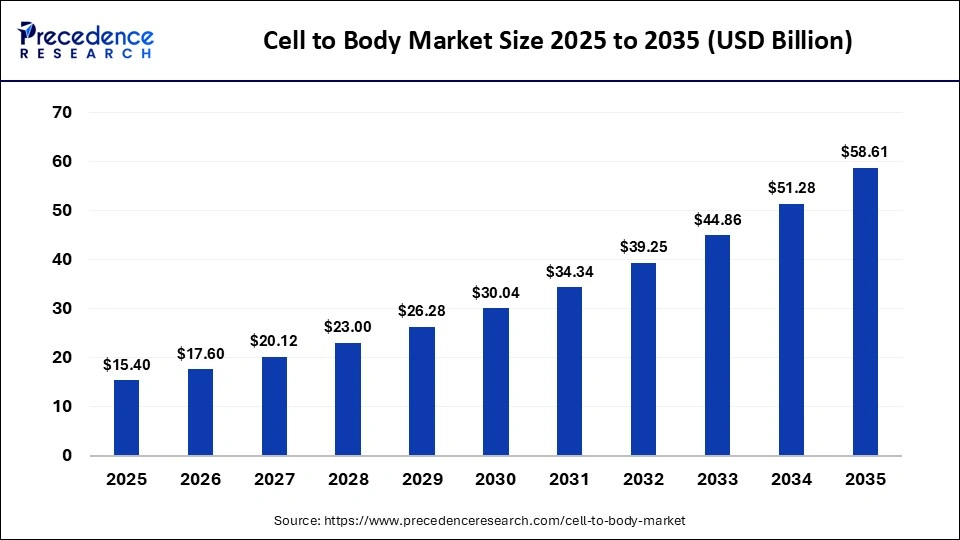
The global cell to body market size was calculated at USD 15.4 billion in 2025 and is predicted to increase from USD 17.60 billion in 2026 to approximately USD 58.61 billion by 2035, expanding at a CAGR of 14.30% from 2026 to 2035.The market in the automotive manufacturing industry is motivated by the need to transition to electric cars and the necessity to have affordable and scalable battery integration packages. The adoption is accelerating with the growing attention to vehicle lightweighting, structural efficiency, and simplification of manufacturing.
Market Highlights
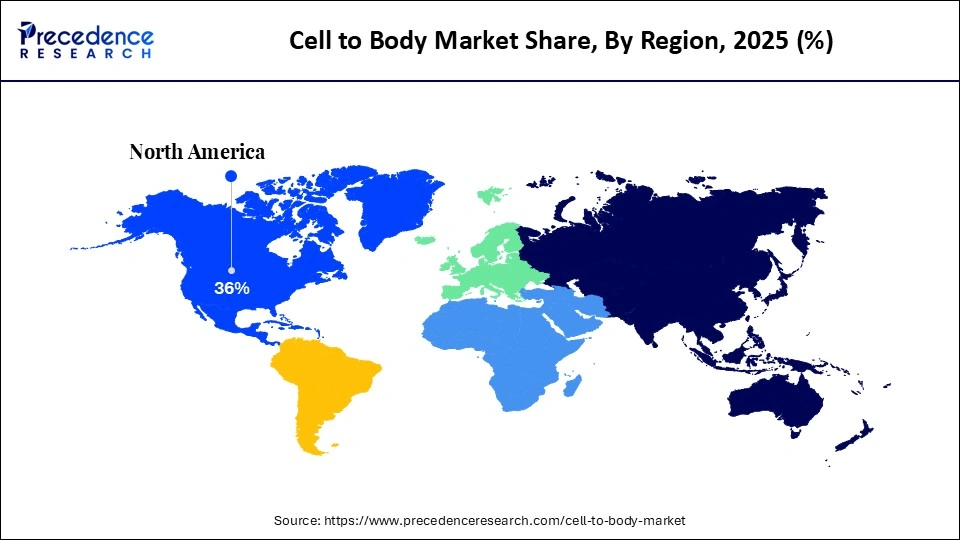
- North America contributed the biggest market share of 36% in 2025.
- Asia-Pacific is expected to host the fastest-growing market in the coming years.
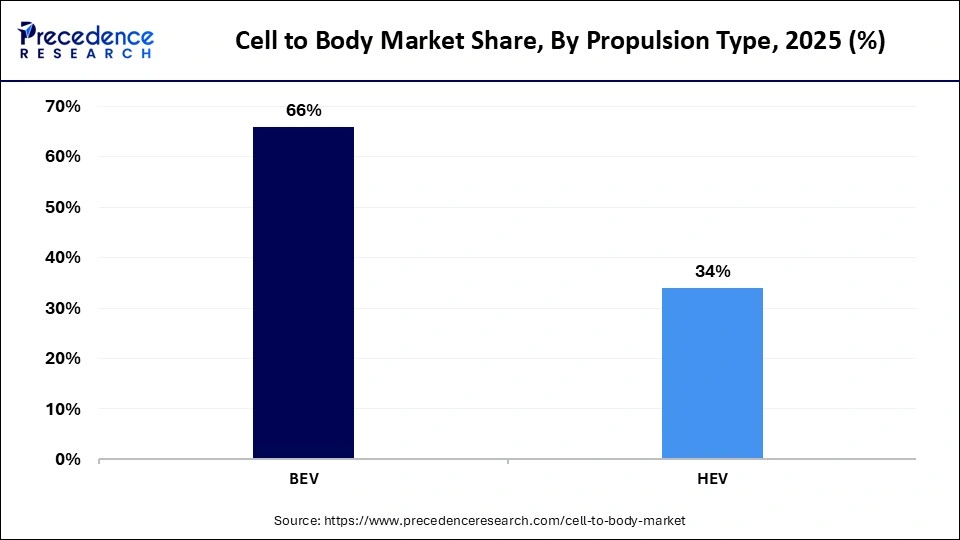
- By propulsion type, the BEV segment held the major market share of 66% in 2025.
- By propulsion type, the HEV segment is expected to gain the highest share of the market between 2026 and 2035.
- By battery type, the lithium-ion battery segment contributed the biggest revenue share in the market in 2025.
- By battery type, the NI-MH battery segment is expected to grow with the highest CAGR in the market during the studied years.
Redefining the Vehicle Architecture with Integrated Energy Design
The cell to body market refers to changing the design of electric cars, whereby the battery cells can be incorporated into the body structure of the car. The strategy helps to minimize unnecessary elements, decrease the weight of the vehicle, and enhance energy efficiency. Car manufacturers are shifting towards cell-to-body designs, as it allows them to increase their range and maximize interior space. These cells are cheaper to manufacture than the alternative design of cell modules that are connected into packs. The increased competition between EV manufacturers is boosting the pace of investments in advanced structural designs of batteries.
AI Integration: Structural Battery Innovation Intelligent Driving
Artificial intelligence (AI) is revolutionizing the cell to body market by introducing automation in manufacturing and assembly. It is vital to the perspicacity of cell-body architectures in which the structural integrity and battery behaviour are replicated. AI-based design tools allow for optimizing crash safety, thermal, and energy density quickly. AI is used to predict quality in manufacturing processes. AI-based predictive analytics enables manufacturers to detect potential manufacturing defects and make proactive decisions. With the increasing softening of the vehicle platforms, AI is becoming critical in handling the complexity of battery-body systems, providing future opportunities for market players.
Cell to Body Market Trends
- Increasing the use of a structural battery pack to enhance the range and efficiency of vehicles.
- Enhancing the partnering of car manufacturers and battery producers.
- Increased interest in lightweight materials and new chassis integration.
- Diversification of cell-to-body designs in mass-market and high-end EVs.
- Combined thermal control and safety.
- Develop great R&D in EV next-generation platform architectures.
Market Scope
| Report Coverage | Details |
| Market Size in 2025 | USD 15.4 Billion |
| Market Size in 2026 | USD 17.60 Billion |
| Market Size by 2035 | USD 58.61 Billion |
| Market Growth Rate from 2026 to 2035 | CAGR of 14.30% |
| Dominating Region | North America |
| Fastest Growing Region | Asia Pacific |
| Base Year | 2025 |
| Forecast Period | 2026 to 2035 |
| Segments Covered | Propulsion Type, Battery Type, and Region |
| Regions Covered | North America, Europe, Asia-Pacific, Latin America, and Middle East & Africa |
Segmental Insights
Propulsion Type Insights
Why the BEV Segment Dominated the Cell to Body Market?
The BEV segment held a dominant position in the market in 2025 because of zero-emission requirements and an increase in consumer demand towards all-electric mobility. The fast growth of charging networks and the reduction in battery prices are making battery electric vehicles (BEVs) available in the mass and high-end markets.
Government policies on BEV adoption in the global arena are providing subsidies, tax breaks, and conducive policies to boost BEV uptake. To achieve long-term sustainability, automakers are giving more consideration to BEVs in their product portfolio. Vehicle range and performance are improving owing to improvements in battery energy density. The penetration of BEVs is further enhanced by urbanization and tougher rules on emissions.
The HEV segment is expected to grow at the fastest CAGR in the market between 2026 and 2035 because they present a transitional step between internal combustion and complete electrification. Consumers are choosing hybrid electric vehicles (HEVs) because of their efficiency in fuel consumption and less range anxiety than BEVs.
HEVs do not need such an extensive amount of charging infrastructure, which is appealing in areas with low EV preparedness. The increase in HEVs by automakers is to meet the norms of emissions without being too costly. The performance of HEVs is being improved by technological advances in the power management systems. Increasing uptake in developing economies is increasing segment growth.
Battery Type Insights
How the Lithium-Ion Battery Segment Dominated the Cell to Body Market?
The lithium-ion battery segment held a major revenue share of the market in 2025 because of the high energy density, lightweight design, and high cycle life. Lithium-ion battery enables travellers to travel long distances and provides rapid charging, thus suitable for the latest electric cars. Constant improvement of lithium-ion chemistry leads to enhanced safety and thermal stability. Mass production and economies of scale are lowering the prices of batteries. Automakers are keen on using lithium-ion batteries due to their compatibility with the battery management system. Segment dominance is strong because of intense investment in gigafactories.
The NI-MH battery segment is expected to grow with the highest CAGR in the market during the studied years, because it is reliable and has demonstrated its performance in hybrid cars. These batteries are very durable and tolerant to changes in temperature. NI-MH batteries are popular with HEVs due to their low cost and safety profile. Recycling of the NI-MH battery infrastructure is more developed and helps in the sustainability agenda. Automakers are still working on the Ni-MH technology to enhance energy efficiency. The demand for hybrid vehicles is increasing, thereby potentiating the use of the NI-MH battery.
Regional Insights
How Big is the North America Cell to Body Market Size?
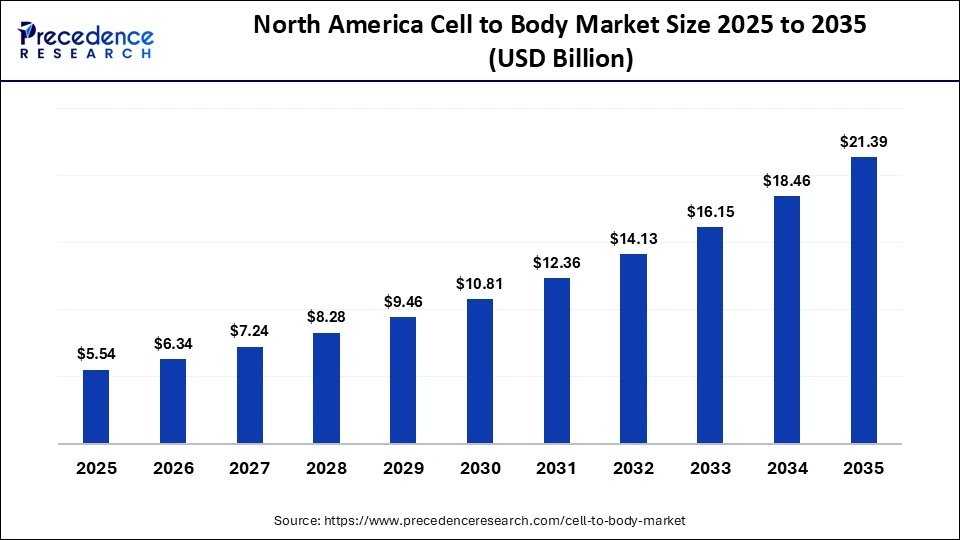
The North America cell to body market size is estimated at USD 5.54 billion in 2025 and is projected to reach approximately USD 21.39 billion by 2035, with a 14.46% CAGR from 2026 to 2035.
Why North America Dominated the Cell to Body Market?
North America dominated the market in 2025 because of the early adoption of sophisticated EV architecture. In the region, there are high R&D, structural battery technologies, and fast commercialization. The adoption of integrated battery-body designs is increasing at a pace, with high investments in EV platform innovation. The optimization of range and lightweighting are the priorities for automakers in the region to make cars competitive. Market penetration is being enhanced by favorable government subsidies and clean mobility. The existence of leading EV manufacturers strengthens the leadership in the region.
What is the Size of the U.S. Cell to Body Market?
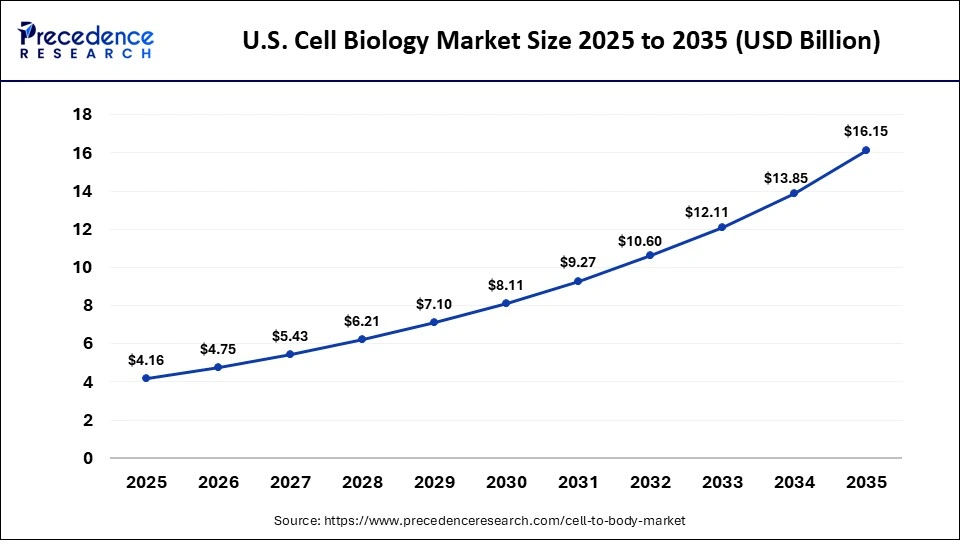
The U.S. cell to body market size is calculated at USD 4.16 billion in 2025 and is expected to reach nearly USD 16.15 billion in 2035, accelerating at a strong CAGR of 14.53% between 2026 and 2035.
Country Level Analysis
The U.S. is the country with the biggest percentage due to active EV adoption and manufacturing innovations. Cell-to-body designs are investments that major OEMs are setting up to enhance the efficiency of production and lower expenses. The growth of production of domestic batteries is facilitating local supply chains. Canada's steady growth is driven by clean energy and investments in EVs. There is rising cooperation between car manufacturers and battery technology companies. High-tech manufacturing systems are increasing in commercial-scale implementation.
How is Asia-Pacific Growing in the Cell To Body Market?
Asia-Pacific is expected to grow at the fastest CAGR in the market during the forecast period, driven by the development of electric cars at a rapid rate. High government requirements and subsidies are favoring the use of advanced battery integration technologies. The area enjoys hegemony in battery production and the supply of materials. Companies in the automobile industry are swiftly moving to next-generation EV platforms to stay affordable. Cell-to-body architectures can be scaled faster using high-volume manufacturing capabilities. The increase in domestic EV demand is enhancing the growth in the region.
Country Level Analysis
China holds a major regional share of the market due to the mass production of EVs and vertically integrated battery supply chains. There is a strong move towards cell-to-body designs by local OEMs to make vehicles efficient. Japan emphasizes both accuracy in the engineering of structural batteries and safety maximization. South Korea is using the advantage of its battery technology to facilitate the high-tech EV architecture. India is becoming a growth market through the support of policies and localisation. Innovation and supply resilience are being enhanced through regional cooperation.
Will Europe Grow in the Cell to Body Market?
Europe is expected to grow at a notable CAGR in the foreseeable future due to strict emission standards and sustainability goals. Vehicle designers in the region are putting emphasis on futuristic vehicle designs to achieve carbon reduction targets. Cell-to-body adoption is being fuelled by a great focus on lightweight materials and energy efficiency. The growth of investments in production facilities of EVs is enhancing the development of markets. New technologies are being promoted with the help of regulatory support for battery innovation. Adoption is also enhanced by the fact that the region is centred on principles of the circular economy.
Country Level Analysis
Germany is in the lead of the region due to its great automotive engineering capacity and EV platform development. To enhance performance and efficiency in its structure, OEMs are incorporating cell-to-body designs. France is spending on batteries and EV second-generation. The UK is also investing in innovation with EV-related R&D. Nordic nations are pioneers in the use of advanced EV technologies. Standardization and commercialization are being fastened by regional cooperation.
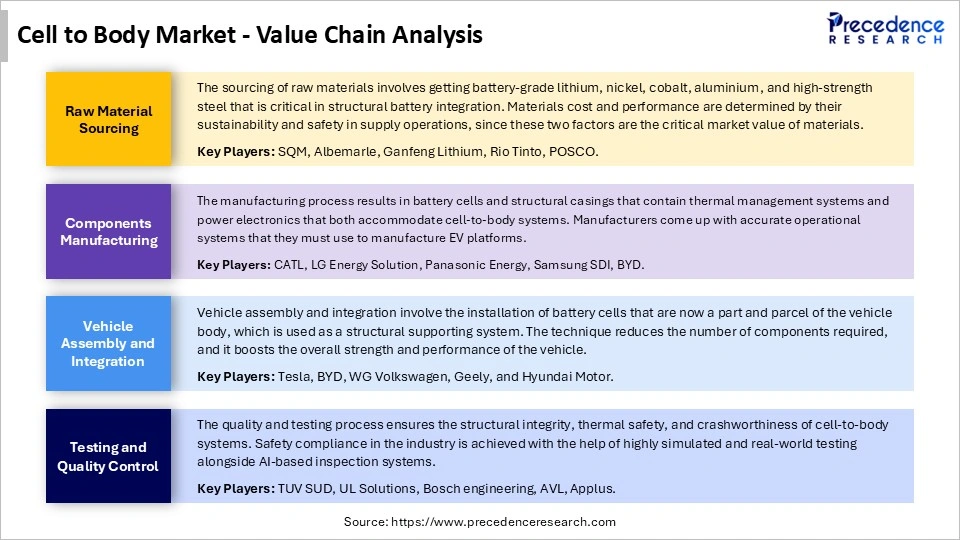
Cell to Body Market Market Value Chain Analysis
Who are the Major Players in the Global Cell to Body Market?
The major players in the cell to body market include Siemens India Limited, ABB India Limited, Rockwell Automation India Private Limited, Schneider Electric India, Honeywell Automation India Private Limited, Larsen & Toubro Limited, Voltas Limited, Titan Engineering and Automation Limited, Fanuc India Private Limited, Emerson Automation Solutions Intelligent Platforms Private Limited
Recent Developments
- In February 2026, Porsche's Cayenne Electric announced the automation for about 95% of its production process to make the build process more accurate and efficient. This new way of doing things shows how much Porsche cares about new technologies and being good to the environment while also making cars faster and better.
- In January 2026, Hero and TVS announced the launch of new electric bikes, with patents filed outlining innovative designs and technologies. These developments reflect the growing push for sustainable transportation options as both companies aim to strengthen their positions in the competitive electric vehicle industry.In January 2026, Audi announced plans to scale AI deployment across its global manufacturing operations by using cloud-driven systems to enhance quality monitoring, minimize rework, and improve energy efficiency. Its Edge Cloud 4 Production platform unifies factory automation, strengthens operational coordination, and enables intelligent inspection tools such as weld-splatter detection and real-time process anomaly identification.
- In January 2026, Luminous Power Technologies introduced its first lithium-ion battery assembly line at Baddi in Himachal Pradesh. The assembly line has been set up with robotic automation and digital tracking systems to enhance product quality and operational efficiency. The factory will produce battery packs for energy storage and electric mobility, thereby supporting the expansion of Indian energy manufacturing ecosystem.
Segments Covered in the Report
By Propulsion Type
- BEV
- HEV
By Battery Type
- Lithium Ion Battery
- NI-MH Battery
By Region
- North America
- Europe
- Asia-Pacific
- Latin America
- Middle East & Africa
For inquiries regarding discounts, bulk purchases, or customization requests, please contact us at sales@precedenceresearch.com
Frequently Asked Questions
Tags





Ask For Sample
No cookie-cutter, only authentic analysis – take the 1st step to become a Precedence Research client
 Get a Sample




 sales@precedenceresearch.com
 Schedule a Meeting
