



Cross Laminated Timber (CLT) Market Size, Share and Trends 2026 to 2035
Cross Laminated Timber (CLT) Market (By Product: Adhesive Bonded Cross Laminated Timber, Mechanically Fastened Cross Laminated Timber; By Application: Residential, Institutional, Commercial, Others) - Global Industry Analysis, Size, Trends, Leading Companies, Regional Outlook, and Forecast 2026 to 2035
Source: https://www.precedenceresearch.com/cross-laminated-timber-market
 Get a Sample
 Table Of Content


What is the Cross Laminated Timber (CLT) Market Size?
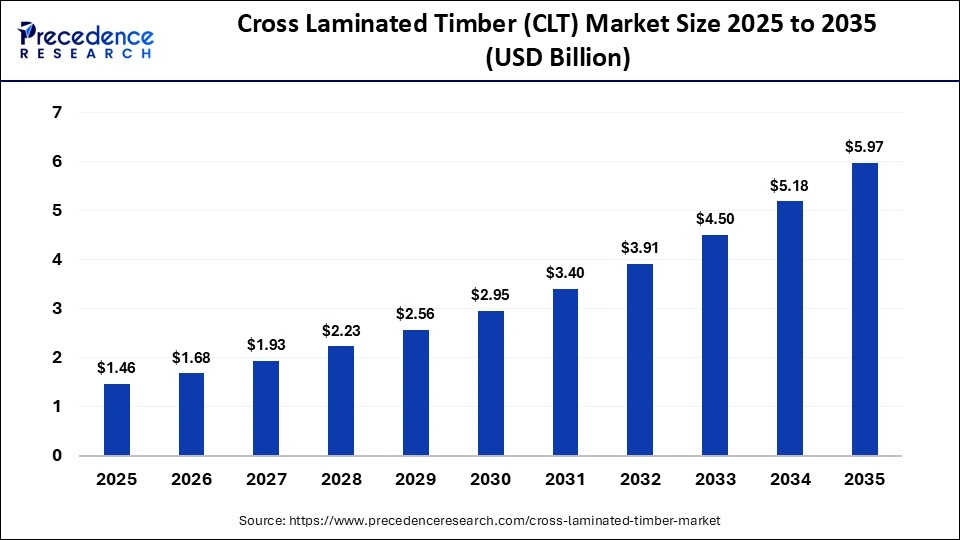
The global cross laminated timber market size was estimated at USD 1.46 billion in 2025 and is predicted to increase from USD 1.68 billion in 2026 to approximately USD 5.97 billion by 2035, expanding at a CAGR of 15.12% from 2026 to 2035. This market is growing due to increasing demand for sustainable, lightweight, and low-carbon construction materials in residential and commercial buildings.
Market Highlights
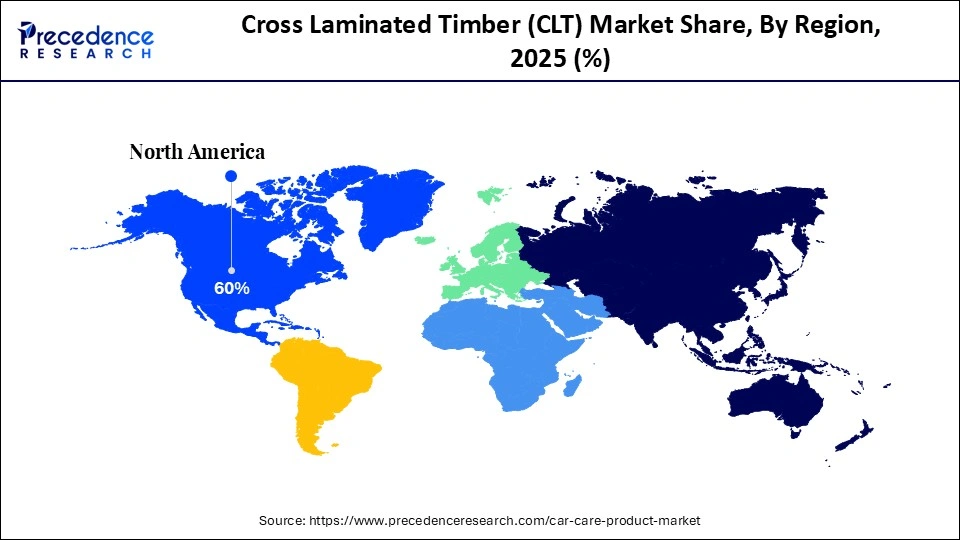
- Europe dominated the global cross laminated timber (CLT) market with a major market share of 60% in 2025.
- Asia Pacific is expected to grow at the fastest CAGR between 2026 and 2035.
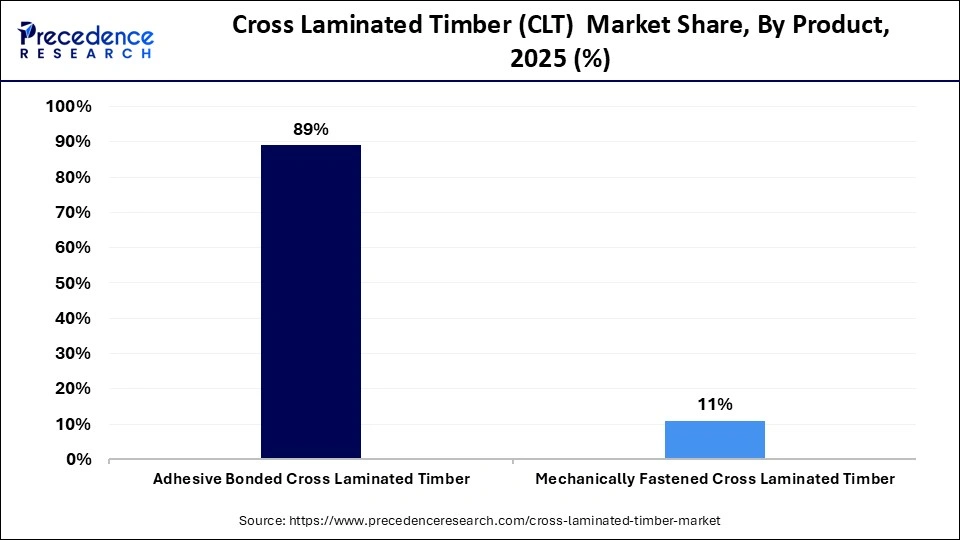
- By product, the adhesive bonded cross laminated timber segment held the biggest market share of 89% in 2025.
- By products, the mechanically fastened cross laminated timber segment is expected to expand at the fastest CAGR between 2026 and 2035.
- By application, the residential segment contributed the highest market share in 2025.
- By application, the institutional segment is expected to grow at a strong CAGR between 2026 and 2035.
Why is the Cross Laminated Timber (CLT) Market Gaining Strong Momentum?
The cross laminated timber (CLT) market is experiencing robust growth, as the building & construction sector moves rapidly toward environmentally friendly and sustainable building materials. Compared to conventional materials like concrete and steel, CLT offers superior structural strength, design flexibility, and quicker construction schedules. There is a rising demand for CLT in the residential, commercial, and institutional construction sectors, driven by favorable green building regulations. The increasing use of mass timber in mid-rise and high-rise buildings and a growing emphasis on reducing carbon footprints are positively contributing to market growth.
How is Artificial Intelligence Influencing the Cross Laminated Timber (CLT) Market?
Artificial Intelligence is positively impacting the market by streamlining the construction, manufacturing, and design processes. Architects and engineers are able to enhance fire and load-bearing analysis for CLT buildings, decrease material waste, and improve structural performance with the help of AI-based modeling and simulation tools. While predictive analytics enhance supply chain planning and production efficiency, AI-driven quality control systems in manufacturing guarantee accurate layering and bonding of timber panels, hastening the adoption of CLT in contemporary construction projects.
Market Trends
- Increasing adoption of mass timber construction in mid-rise and high-rise buildings.
- Rising demand for sustainable and low-carbon building materials across residential and commercial sectors.
- Growing use of digital design tools, BIM, and AI for optimized CLT structural planning.
- Expansion of prefabrication and modular construction using CLT panels to reduce project timelines.
- Strong focus on fire-resistant and high-strength CLT product innovations.
- Supportive green building certifications and government policies promoting timber-based construction.
- Increasing investments in local CLT manufacturing facilities to reduce supply chain dependence.
How are Government Initiatives Supporting the Cross Laminated Timber (CLT) Market?
Government initiatives are playing a crucial role in accelerating the growth of the market by encouraging low-carbon and sustainable building techniques. Regulations about green building carbon reduction goals and government incentives are promoting the use of renewable resources like mass timber. Such regulations also encourage the adoption of CLT and promote wood-based construction in public infrastructure, including government buildings, housing, and schools. Furthermore, financing for studies, pilot programs, and revisions of building codes to permit taller timber structures is fostering a supportive regulatory environment for the market's sustained expansion.
How is Cross-Laminated Timber (CLT) Reshaping Modern Construction Practices?
Cross-laminated timber (CLT) is gaining popularity as a high-performance, low-carbon alternative to steel and concrete in modern construction. It reduces labor and material waste, supports prefabrication, and enables faster project delivery. With strong structural performance, enhanced fire and seismic compliance, and alignment with green building standards, CLT is increasingly adopted in residential, commercial, and institutional projects, making it a scalable solution for sustainable construction.
Market Scope
| Report Coverage | Details |
| Market Size in 2025 | USD 1.46 Billion |
| Market Size in 2026 | USD 1.68 Billion |
| Market Size by 2035 | USD 5.97 Billion |
| Market Growth Rate from 2026 to 2035 | CAGR of 15.12% |
| Dominating Region | Europe |
| Fastest Growing Region | Asia Pacific |
| Base Year | 2025 |
| Forecast Period | 2026 to 2035 |
| Segments Covered | Product, Aplication, and Region |
| Regions Covered | North America, Europe, Asia-Pacific, Latin America, and Middle East & Africa |
Segmental Insights
Product Insights
What made adhesive bonded cross laminated timber segment the dominant segment in the market?
The adhesive bonded cross laminated timber segment dominated the cross laminated timber (CLT) market with the largest share in 2025. This is because of its superior durability, higher load-bearing capacity, and structural reliability compared to mechanically fastened alternatives. Adhesive bonding improves dimensional stability and resistance to deformation under high loads by facilitating uniform stress distribution across layers. For mid-rise and high-rise construction projects, adhesive-bonded CLT is therefore ideal, especially for residential and commercial structures.
The mechanically fastened cross laminated timber segment is expected to grow at the fastest CAGR in the coming years, driven by the growing need for easily demonstrated modular and affordable building solutions. For temporary structures, prefabricated housing, and small-scale projects, mechanical fastening is appealing because it enables quicker on-site assembly and makes repairs or modifications easier. Growth is also being accelerated by growing adoption in emerging economies, where flexible construction techniques and cost sensitivity are valued highly. Furthermore, the development of mechanically fastened CLT systems is driven by rising interest in circular building techniques and reversible construction.
Application Insights
Why did the residential segment lead the cross laminated timber (CLT) market?
The residential segment led the market while holding a major revenue share in 2025 because of the rapid shift of consumers toward environmentally friendly, energy-efficient, and aesthetically pleasing housing options. CLT is perfect for single-family homes and multi-story residential buildings due to its high thermal performance, lightweight nature, and design flexibility. Residential CLT adoption has been greatly increasing due to growing urbanization and government incentives for low carbon building and green housing. Additionally, residential developers favored CLT over traditional materials due to its shorter construction timelines and lower labor requirements.
The institutional segment is expected to grow at the fastest CAGR in the coming years, driven by increasing investment in public infrastructure such as government buildings, schools, colleges, and healthcare facilities. CLT's seismic strength, acoustic performance, and fire resistance make it ideal for reducing the carbon footprint of large public projects. Growing policy support for mass timber construction in institutional buildings is further accelerating CLT adoption in this segment.
Regional Insights
What is the Europe Cross Laminated Timber (CLT) Market Size and Growth Rate?
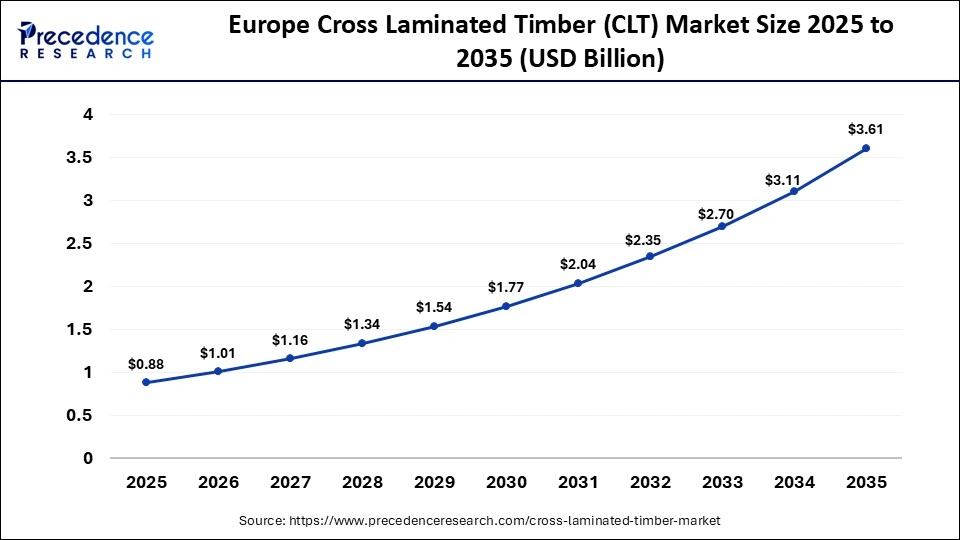
The Europe cross laminated timber (CLT) market size has grown strongly in recent years. It will grow from USD 0.88 billion in 2025 to USD 3.61 billion in 2035, expanding at a compound annual growth rate (CAGR) of 15.16% between 2026 and 2035.
What made Europe the dominant region in the cross laminated timber (CLT) market?
Europe dominated the cross laminated timber (CLT) market by capturing the highest share in 2025. The region's dominance in the market is attributed to early adoption of mass timber technologies and robust regulatory support for environmentally friendly building practices. Several areas in the region have established strong supply chains and a long history of producing CLT. Regional demand was further bolstered by strict carbon reduction and the general acceptance of wood in multi-story structures. Additionally, Europe maintained its position as a global leader in CLT innovation and deployment due to ongoing R&D investments and advantageous building codes.
Germany Cross Laminated Timber Market Trends
Germany is leading the market in Europe, propelled by robust government backing for environmentally friendly building practices and cutting-edge timber engineering skills. The country benefits from a robust forestry supply chain, established CLT manufacturers, and strict carbon-reduction building codes, making wood-based construction structurally reliable, fire-compliant, and aligned with national climate-neutral goals. Extensive use of CLT in residential, commercial, and institutional buildings, along with early adoption of multi-story timber construction and ongoing R&D investments, has positioned Germany as a technological and regulatory leader in the European market.
What makes Asia Pacific the fastest-growing region in the market?
Asia Pacific is expected to grow at the fastest CAGR in the coming years because of the growing awareness of the benefits of sustainable building materials, rising construction activity, and rapid urbanization. To solve environmental issues related to traditional materials, governments throughout the region are encouraging green building techniques. Demand for CLT solutions is being driven by the expansion of residential and institutional infrastructures in nations like Australia, Japan, and China. Regional market growth is also accelerated by rising investments in domestic CLT manufacturing and prefabrication facilities.
India Cross Laminated Timber (CLT) Market Trends
The market in India is growing rapidly, driven by increasing demand for sustainable and low-carbon construction materials in residential, commercial, and institutional projects. Rapid urbanization and the need for faster, cost-effective building solutions are driving adoption of prefabricated and modular timber construction. Additionally, supportive government policies, green building certifications, and rising awareness of eco-friendly building practices are encouraging developers to use CLT in mid-rise and high-rise structures.
Why is North America considered a significant region in the market?
North America is considered a significant region in the market, driven by a growing emphasis on modern wood-based building technologies, carbon footprint reduction, and sustainable construction. There is a high adoption of mass timber solutions into urban infrastructure to meet climate targets and increase construction efficiency. The demand for CLT has been further bolstered by the growing use of prefabricated and modular building techniques, which provide quicker installation, structural stability, and design flexibility
U.S. Cross Laminated Timber (CLT) Market Trends
The U.S. is the major contributor to the North American market, supported by favorable changes to building codes, robust domestic production capabilities, and growing acceptance of mass timber in the construction of high-rise buildings. The use of CLT in residential and institutional buildings has grown dramatically since the International Building Code was amended to allow for taller mass timber buildings. The country also benefits from a wealth of forest resources, cutting-edge research on engineered wood, and government-supported programs that support low-carbon building materials.
How is the opportunistic rise of Latin America in the market?
Latin America is expected to experience an opportunistic growth in the cross laminated timber (CLT) market, driven by the need for quicker, less impactful building solutions and growing awareness of sustainable construction. The use of engineered wood materials is encouraged by urbanization, housing demand, and an abundance of forestry resources, especially in residential and institutional projects. It is anticipated that growing interest from private developers will sustain consistent market expansion throughout the region.
Brazil Cross Laminated Timber (CLT) Market Trends
Brazil leads the Latin American market, supported by abundant forest resources and increasing use of sustainable building materials. Rising demand in residential and mid-rise commercial projects, driven by faster construction timelines and environmental benefits, is fueling adoption. The market is further strengthened by expanding domestic CLT production and evolving building standards.
What drives the cross laminated timber (CLT) market in the Middle East & Africa?
The market in the Middle East & Africa (MEA) is driven by the growing focus on sustainable and low-carbon construction to meet environmental and green building goals. Rapid urbanization and infrastructure development are creating demand for prefabricated and modular building solutions that reduce construction time and costs. Additionally, government initiatives, rising awareness of eco-friendly materials, and the adoption of international building standards are encouraging the use of CLT in residential, commercial, and institutional projects.
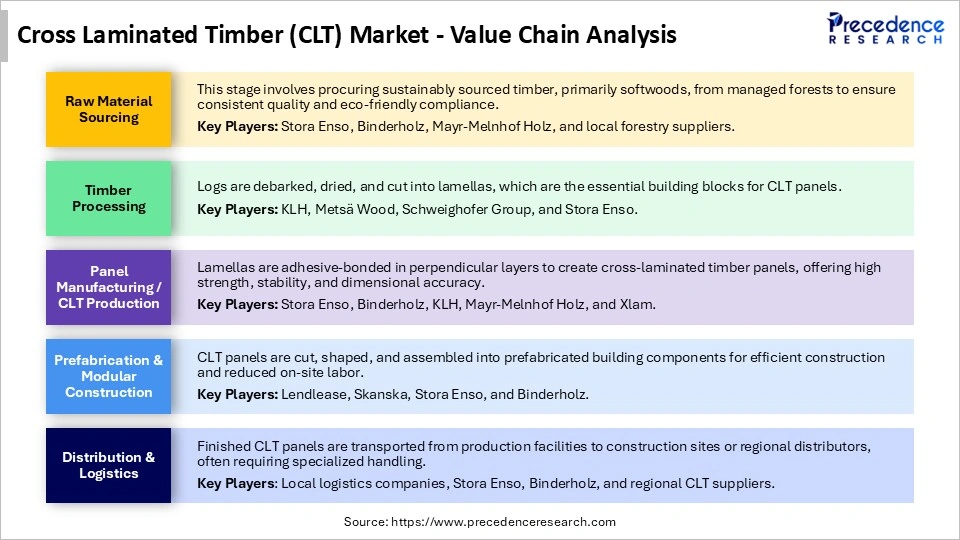
Cross Laminated Timber (CLT) Market Value Chain Analysis
Who are the Major Players in the Global Cross Laminated Timber (CLT) Market?
The major players in the cross laminated timber (CLT) market include Stora Enso Oyj, Mayr-Melnhof Holz Holding AG, Binderholz GmbH, XLam, Sterling Company, Schilliger Holz AG, KLH Massivholz GmbH, B&K Structures, Eugen Decker & WebMan, Structurlam Mass Timber Corporation, SmartLam NA, and MEIKEN LAMWOOD Corp.
Recent Developments
- In May 2025, Sterling Structural announced its integration into the CLT Toolbox platform, becoming the first U.S. cross-laminated timber manufacturer listed on the software. This partnership aims to provide structural engineers with real-time supplier data and automated design tools to make mass timber design more accessible and accurate for developers seeking lower-carbon construction solutions(Source: https://www.globenewswire.com)
- In September 2025, Cambium Carbon announced its Carbon Smart Wood won Fast Company's 2025 Innovation by Design Award in the Materials and Biodesign category. The company has scaled production of structural cross-laminated timber panels from salvaged urban trees, creating a sustainable alternative to traditional lumber that tests indicate is often stronger and denser than standard softwoods.(Source: https://www.fastcompany.com)
- In April 2025, Stora Enso announced a partnership with the Czech National Pavilion for the World Expo 2025 in Osaka, Japan, to showcase sustainable mass timber construction using Sylva CLT. The collaboration involved supplying over 800 m³ of Sylva CLT for one of Japan's tallest wooden structures and highlights innovative, carbon-storing building solutions.(Source: https://www.storaenso.com)
- In September 2024, Cambium Carbon was announced as a winner of Fast Company's 2024 Innovation by Design Awards. The company launched a circular supply chain that salvages fallen urban trees for materials in the construction and furniture industries. This initiative was recognized for its ability to reduce landfill waste and lower the carbon footprint of building projects.(Source: https://www.fastcompany.com)
Segments Covered in the Report
By Product
- Adhesive Bonded Cross Laminated Timber
- Mechanically Fastened Cross Laminated Timber
By Application
- Residential
- Institutional
- Commercial
- Others
By Region
- North America
- Europe
- Asia-Pacific
- Latin America
- Middle East & Africa
For inquiries regarding discounts, bulk purchases, or customization requests, please contact us at sales@precedenceresearch.com
Frequently Asked Questions





Ask For Sample
No cookie-cutter, only authentic analysis – take the 1st step to become a Precedence Research client
 Get a Sample




 sales@precedenceresearch.com
 Schedule a Meeting
