



Cyber Insurance Market Trends, Companies, Revenue / Sales Performance, Subscriber Growth, Pricing Strategies, Cloud Adoption, Infrastructure Expansion, Competitive Landscape, and Industry Outlook
Cyber Insurance Market (By Insurance Type: Standalone Cyber Insurance, Packaged/Endorsed (Add-on to General Liability); By Coverage Type: First-party Coverage (Breach Response, Ransom), Liability / Third-party Coverage; By Organization Size: Large Enterprises, Small & Medium Enterprises (SMEs); By End-User Industry: BFSI (Banking & Finance), Retail & E-commerce, IT & Telecom, Healthcare) - Global Industry Analysis, Size, Trends, Leading Companies, Regional Outlook, and Forecast 2026 to 2035
Source: https://www.precedenceresearch.com/cyber-insurance-market
 Get a Sample
 Table Of Content


What is the Cyber Insurance Market Size in 2026?
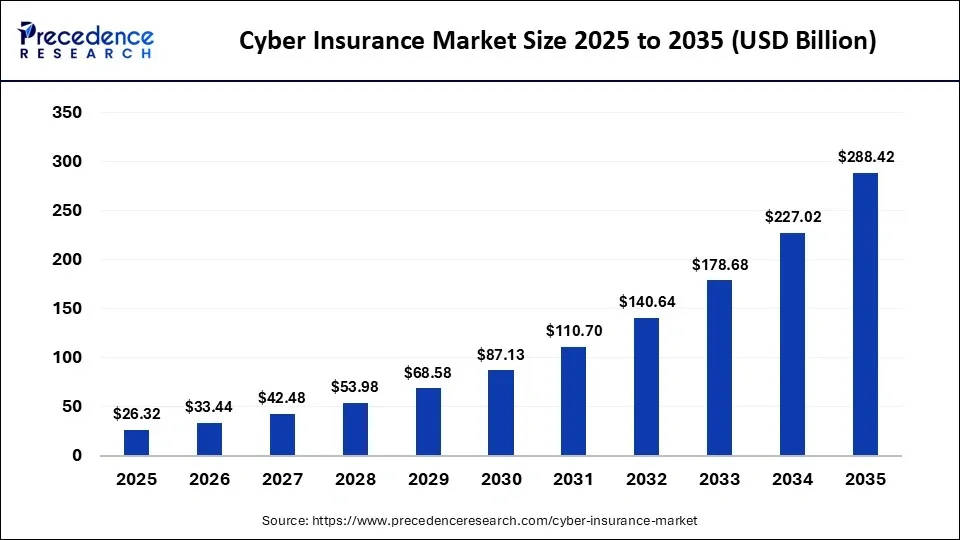
The global cyber insurance market size was calculated at USD 26.32 billion in 2025 and is predicted to increase from USD 33.44 billion in 2026 to approximately USD 288.42 billion by 2035, expanding at a CAGR of 27.05% from 2026 to 2035.These factors lead to the development of a growing cyber insurance sector driven by an increase in cyber threats, a need to be compliant with regulations, the ongoing projects of digital transformation, and an increased understanding of vulnerability/risk. Organizations are increasingly looking for comprehensive insurance solutions with the advent of more cyber incident cases, ensuring the mitigation of financial impacts and managing risks associated with cyberattacks like data breaches or ransomware attacks.
Key Takeaways
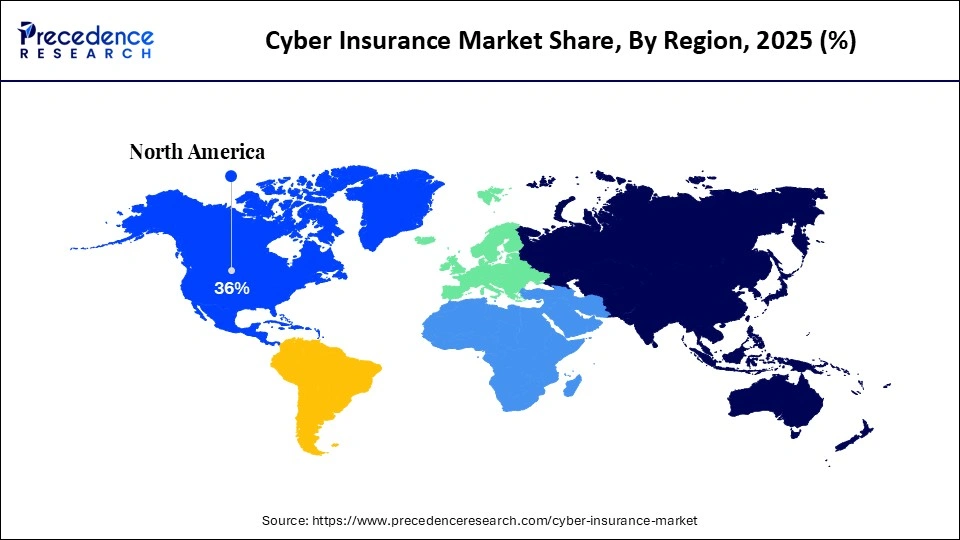
- By region, North America dominated the cyber insurance market with a market share of 36.4% in 2025.
- By region, Asia-Pacific is fastest growing region in the cyber insurance market in the forecast period.
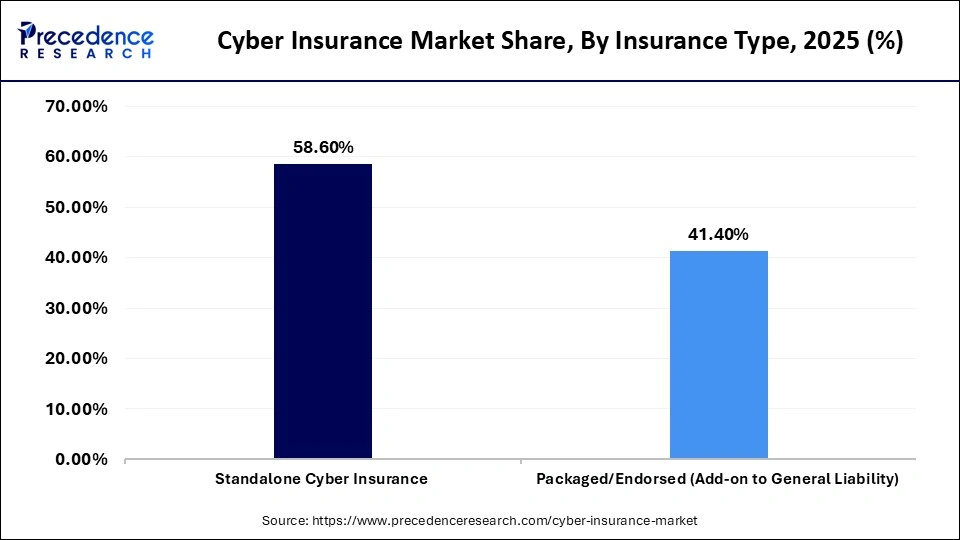
- By insurance type, the standalone cyber insurance segment dominated in the cyber insurance market with 58.6% market share in 2025.
- By insurance type, the packaged or endorsed segment is growing at a rapid pace during the forecast period.
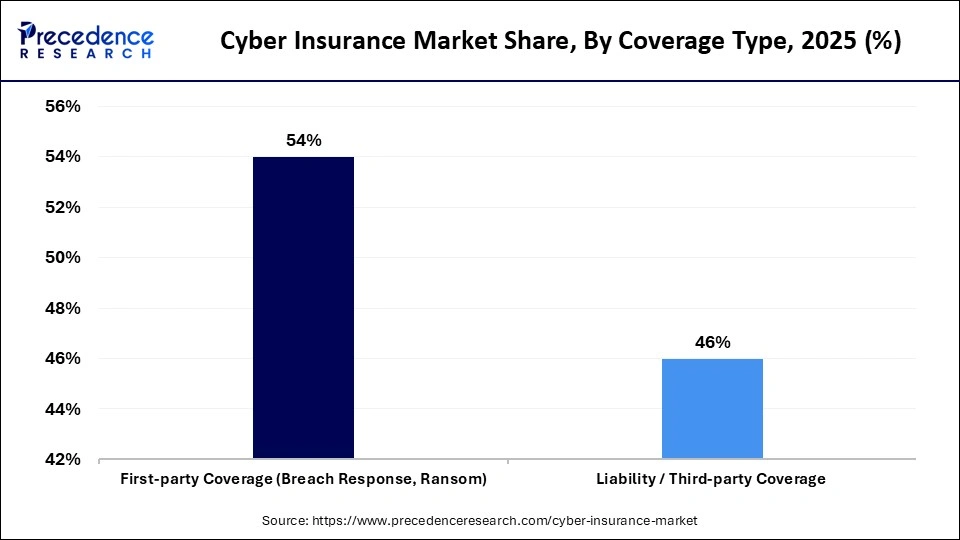
- By coverage type, the first-party coverage segment is dominant with a market share of 54.0% in 2026.
- By coverage type, the liability/third-party coverage segment is expected to record the highest CAGR during the forecast period
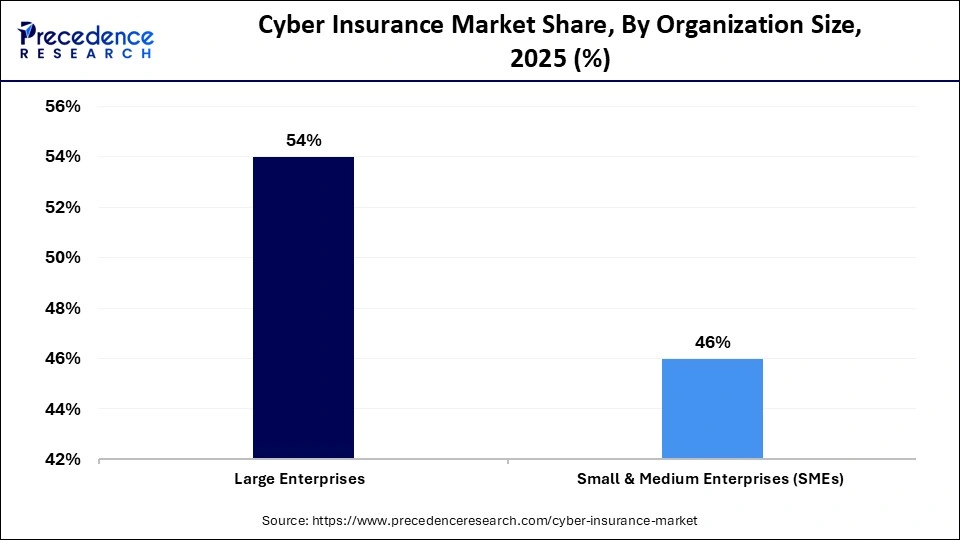
- By organization size, large enterprises held dominance over policyholders with 54.0% of the market share in 2025.
- By organization size, the SMEs segment is growing rapidly with a CAGR of 29% or more in the forecast period of 2026 to 2035.
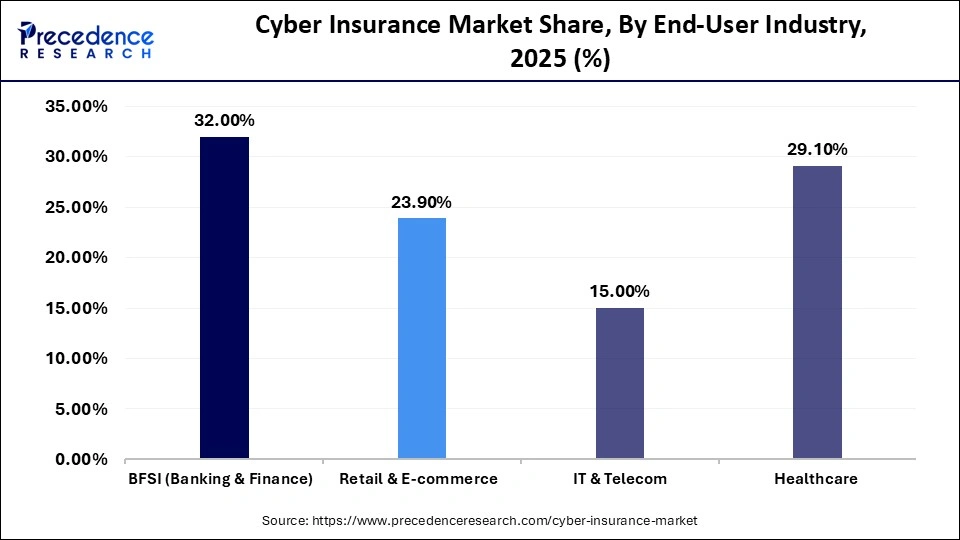
- By end-user, the BFSI segment dominated the market with the largest market share, approximately 32.0% in 2025.
- By end-user, the healthcare segment is growing rapidly with a CAGR of approximately 30% or more in the forecast period.
What is the Cyber Insurance Market?
An insurance policy that covers the insurance of businesses as well as individuals to protect them against possible breaches that may happen due to the security threats that could occur when there is an internet attack. The increasing number of companies understood that these threats need to be protected against. This insurance insulates the company from the costs associated with data breaches, cyber-attacks, ransomware incidents, and all types of cybercrime by protecting them against the cost of expenses. The cyber insurance policy protects against different risks like loss of data, legal fees, and interruption of business, thus cyber insurance acts as a cyber disaster recovery of company for the interruption of business and also any legal fees and all other things you may need at law.
They continue to be a cornerstone of contemporary risk management. The development of a more flexible regulatory environment that focuses on data protection and privacy, among other things, would impact the cyber insurance sector as well. Regulators would increasingly regulate the kinds of data management enterprises engage in. And when they break that rule, they'll face hefty fines and reputational damage. Cyber insurance allows organizations to address these barriers by offering insurance covering penalties and legal obligations, which may have been imposed under applicable regulations. Since the regulatory era brought in new methods of compliance under new laws and regulations, cyber insurance has become an integral part of a company's risk management strategy.
Impact of AI in the Cyber Insurance Market
Artificial Intelligence (AI) technologies have evolved rapidly and pose a novel set of cyber threats that can affect the existing cyber insurance policies. Due to the increasing complexity and variability of these technologies, the insurance community is increasingly faced with complex and unpredictable liabilities. Cyber insurance products of some of the largest insurers have started to put limitations on the AI risks. This shift highlights a growing concern over new risks, including AI hallucinations, algorithmic bias, failures in data integrity, and the erratic behavior of autonomous or agentic AI systems.
Current cyber coverage was not designed to address these issues, and it often fails to distinguish between operational troubles, professional negligence, and technological failures. As a result, a growing number of insurers are blaming such losses on the shoulders of errors and omissions (E&O) policies, considering that claims in the future could balloon into billions should AI accidents cause enormous market or reputational damage.
Key Regulations for the Cyber Insurance Market
|
Regulations |
Focus Areas |
Key Impacts on Market |
|
CIRCIA Implementation |
Critical Infrastructure Reporting |
Requires 72-hour incident reporting and 24-hour ransom payment reporting. Underwriters demand strict compliance to ensure critical sectors. |
|
DIFC/AI Governance |
AI and Automated Systems |
Mandates Autonomous Systems Officers for high-risk AI, forcing insurers to exclude or specially underwrite AI-driven liability. |
|
Mandatory Security Controls |
Underwriting Standards |
Insurers now refuse coverage without phishing-resistant MFA, immutable backups, and validated endpoint detection. |
Market Trends of the Cyber Insurance Market
- Rising Adoption of Crypto Insurance Service: Every day, cryptocurrencies are owned globally. With the rising ownership of crypto comes its related concerns. Facing such rising attacks as a consequence of these emerging risks, companies are investing in insurance policies to protect themselves against the same. Cybersecurity insurance now also incorporates coverage that comprises custodial theft, vulnerabilities in smart contracts, and downtimes of exchanges as evidence of blockchain in its security risk management.
- Cybersecurity Services Integrated with Insurance Policies: The intersection of cyber protection services with insurance companies creates a closed loop wherein security telemetry data with real-time security parameters is used to dynamically adjust the premium structure based on security risks posed by policy recipients in terms of real-world risk. Insurers provide insurance coverage packages with different services, including vulnerability assessments, threat intelligence feeds, alert security teams, and incident response retainers (IRTRs), included directly into their policies.
- Custom Policies to Meet the Needs and Regulations of Different Sectors: There are specific challenges and consequences of breaches faced by operators operating across all areas of value, including healthcare, fintech, and critical infrastructure. Insurers are crafting customized cyber liability regimes that respond specifically to these sector-specific requirements, incorporating regulatory fines, forensic fees, and costs of reputational rehabilitation. This development is a step toward a specific underwriting strategy rather than blanket cyber protections.
- Intelligent Solutions for SMEs: Small and medium-sized businesses have quickly developed into the largest market segment of the cyber protection sector. In light of this increase, insurers are redesigning their policy with simplified underwriting processes, accelerated digital onboarding processes, and modular coverage plans with adjustments based on revenue size and the maturity of the cyber domain. This development is an indication that SMEs often do not have strong in-house cyber capabilities and consequently require actionable risk transfer solutions (instead of complex enterprise-level contracts).
Market Scope
| Report Coverage | Details |
| Market Size in 2025 | USD 26.32 Billion |
| Market Size in 2026 | USD 33.44 Billion |
| Market Size by 2035 | USD 288.42 Billion |
| Market Growth Rate from 2026 to 2035 | CAGR of 27.05% |
| Dominating Region | North America |
| Fastest Growing Region | Asia Pacific |
| Base Year | 2025 |
| Forecast Period | 2026 to 2035 |
| Segments Covered | Insurance Type, Coverage Type, Organization Size, End-User Industry, and Region |
| Regions Covered | North America, Europe, Asia-Pacific, Latin America, and Middle East & Africa |
Market Dynamics
Driver
Rising Cyberattacks
Increasing ransomware attacks, phishing campaigns, and major data breaches globally are underscore as a driving force for cyber insurance solutions. Companies are taking such insurance to mitigate financial losses regarding data recovery, legal claims, regulation fines, and business interruptions. The growing digital transformation and expansion of cloud adoption have further strengthened the demand for comprehensive cyber risk protection across industries.
Retraint
Complex Claims Process
Cyberinsurance claims usually involve complex investigations, maturing cyber threats, and uncertain damage estimate assessments. This causes considerable problems for both the insurers and the policyholders. In many businesses, there is confusion over the limitations of the coverage in the policy, exclusions, and how the claims are settled. In addition, rising premiums and a lengthy period for settlement of claims discourage SMEs from taking out comprehensive cyber insurance.
Opportunity
Growing SME Adoption
Small and medium enterprises are on the radar of attackers, mainly due to limited cybersecurity resources and weaker digital protection systems. This represents an attractive growth opportunity for insurers to create affordable, flexible, and industry-specific cyber insurance schemes. Increased awareness of financial risks, data protection regulations, and operational disruptions is expected to bolster global cyber insurance adoption among SMEs.
Segment Insights
Insurance Type Insights
Standalone Cyber Insurance
The standalone cyber insurance segment dominated the cyber insurance market with 58.6% market share in 2025, as it is preferred for its comprehensive, dedicated limits specifically for cyber risk. Meanwhile, property-and-casualty riders fail to provide adequate coverage for ransomware attacks, cloud outages, or social engineering scenarios. Standalone policies allow insurers to employ fine-grained scanning data and flexible endorsements, yielding very fast rates of several hours per claim by means of algorithmic underwriting technology.
Packaged/Endorsed (Add-on to General Liability)
The packaged or endorsed segment is growing at the fastest rate during the forecast period. This makes this strategy most appropriate for organizations experiencing a variety of risks, and it adds multiple tiers of protection to businesses. Standalone wording's inherent flexibility, though, also allows coverage to incorporate newly created add-ons to general liability, such as cryptojacking protection and reimbursement for voluntary shutdowns.
Coverage Type Insights
First-party Coverage (Breach Response, Ransom)
The first-party coverage segment dominated with a market share of 54.0% in 2025. This type of insurance deals with scenarios in which the impacted parties are directly linked to the incident. It also helps companies in combating data breaches and cyberattacks. This segment is expected to grow as online theft, hacks, extortion activity, and data destruction continue to rise.
Liability / Third-party Coverage
The liability/third-party coverage segment is expected to record the highest CAGR during the forecast period due to increased litigation and regulatory fines following mass data breaches. As a function of risk management, such liability insurance is in high demand. This type of coverage is tailored to the exact nature of a kind for which businesses have their own requirements, offering benefits ranging from payment to offset losses arising from business interruptions, protection against data breaches, forensic assistance at defending against cyber extortion, and additional coverage above the typical liability policy. Consequently, the businesses handling sensitive client data are increasingly getting third-party coverage.
Organization Size Insights
Large Enterprises
Large enterprises hold dominance over policyholders with 54.0% of the market share in 2025. Their extensive digital infrastructure, use of multi-cloud systems, and worldwide data operations have made them highly susceptible to intricate cyber threats. Such companies generally acquire tailored policies with substantial limits that include provisions for incident response retainers and clauses addressing systemic risks. Moreover, the governance of the board and the demands from shareholders drive sustained investment in strong cyber liability frameworks.
Small & Medium Enterprises (SMEs)
The SMEs segment is growing rapidly in the cyber insurance market in the forecast period of 2026 to 2035. SMEs experience massive growth as insurers pivot to offer SME-friendly automated underwriting.
End-User Industry Insights
BFSI (Banking & Finance)
The BFSI segment dominated the market with the largest market share, approximately 32.0% in 2025. This dominance is driven by the significant value of financial data, the development of digital banking, and fraud and phishing attacks that are still ongoing threats. In this new landscape, financial institutions have a high demand for compliance with strict compliance regulations and risk to reputations, which has led to a surge in the number of acquisitions of cyber insurance products. As a result of the huge economic ramifications of security violations, the banks and fintech firms are concentrating on establishing full first- and third-party coverage to ensure operational resilience.
Healthcare
The healthcare segment is growing rapidly in the cyber insurance market with a CAGR of approximately 30% or more in the forecast period, driven by the high “black market” value of medical records and rising ransomware targeting hospitals. Ransomware incidents targeting clinical systems have risen in number, increasing operational risks. With the rising prevalence of electronic health records and interconnected medical devices at the same time, insurers are drafting bespoke policies to protect against data breaches, extortion cases, and fines from regulators for ransomware attacks.
Regional Insights
North America Cyber Insurance Market Size and Growth 2026 to 2035
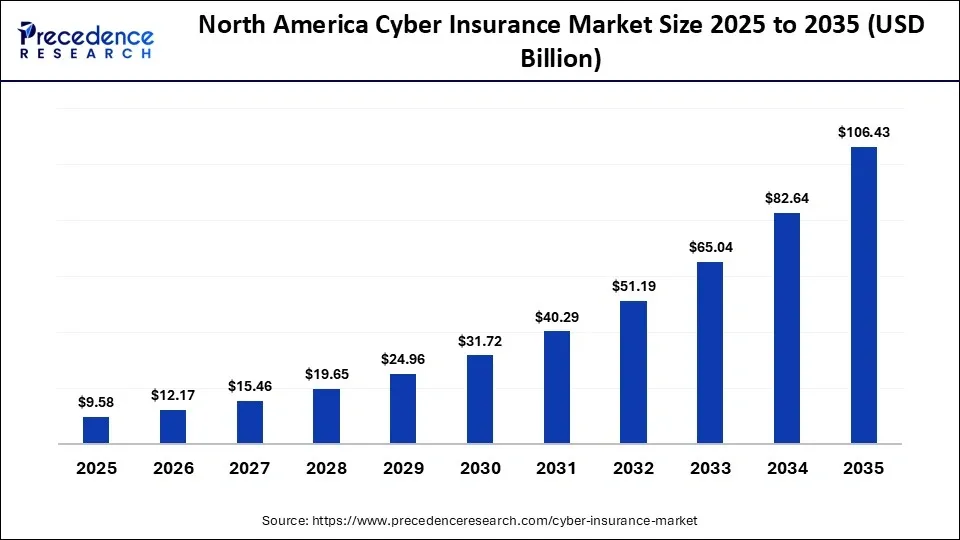
The North America cyber insurance market size is estimated at USD 9.58 billion in 2025 and is projected to reach approximately USD 106.53 billion by 2035, with a cyber insurance 27.22% CAGR from 2026 to 2035.
North America Cyber Insurance Market Trends
North America dominated the cyber insurance market with a market share of 36.4% in 2025. The U.S. remains the world's most mature market due to strict breach-notification laws and the highest volume of high-value cyber litigation. The booming presence of cyber insurance in industries such as banking, healthcare, and technology sectors with substantial digital infrastructure is playing a big role. A growing volume of ransomware incidents and stronger reporting requirements, as well as the prevalence of strong reporting requirements and strong influence from the industry's best vendors, are adding to the demand for coverage.
U.S. Cyber Insurance Market Size and Growth 2026 to 2035
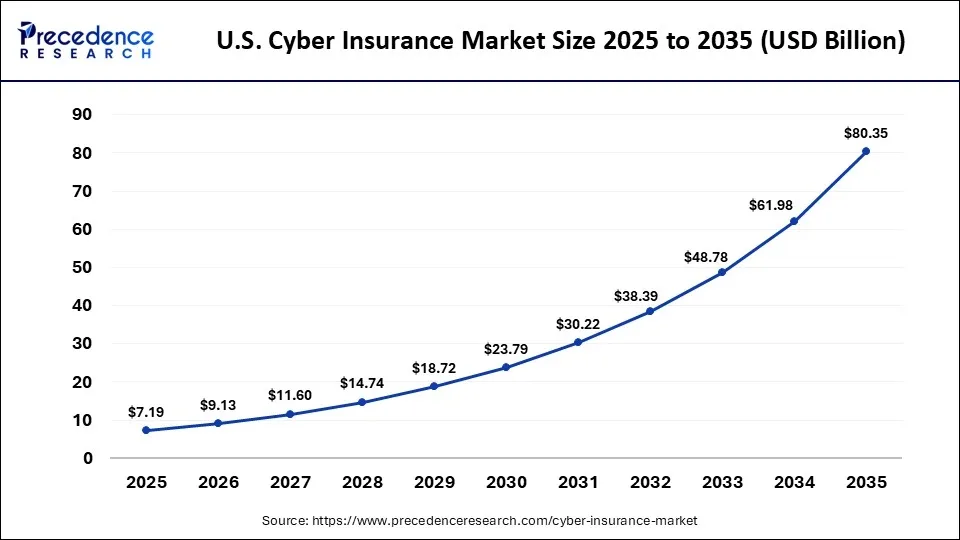
The U.S. cyber insurance market size is calculated at USD 7.19 billion in 2025 and is expected to reach nearly USD 80.35 billion in 2035, accelerating at a strong CAGR of 27.30% between 2026 and 2035.
U.S. Cyber Insurance Market Trends:
American companies now account for a major share of the U.S. cyber insurance market, and businesses play a key role in its trajectory as this sector expands rapidly. Different types or sizes of business entities are forming market segments in applications, including insurance companies, banks, and health care providers. Although the overall market may be soft, rising ransomware threats make it necessary for companies to adopt comprehensive practices in their cybersecurity program. Increased risks and legal mandates are powering the development of the U.S. cyber insurance market.
Asia Pacific Cyber Insurance Market Trends:
Asia Pacific is fastest growing region in the cyber insurance market in the forecast period. The increase in premium growth is on an upward trend, spurred by higher literacy in society and the introduction of new regulations. In particular, demand for cyber insurance is growing in the space of digital transformation, and this happens especially for SMEs and critical infrastructure players. Insurance products and services to limit the negative impact of cybercrime are emerging as investments developed by Japan, India, South Korea, and China.
India Cyber Insurance Market Trends:
India is expected to be the fastest-growing cyber insurance market in the Asia Pacific. High online penetration among SMEs, growth in fintech services, and the increase in ransomware cases are fueling demand for cover. What is more, the implementation of the Digital Personal Data Protection Act has promoted the compliance-based implementation of cyber insurance products. Insurers such as Tata AIG General Insurance Company Limited are diversifying their portfolio of solutions, addressing demand for cybersecurity specifically to satisfy this accelerating business.
How is Europe Growing in the Cyber Insurance Market?
Europe is a notably growing region in the global market, with stringent regulatory frameworks, a high frequency of ransomware attacks, and rapid digitalization. Strict data protection laws, breach reporting, and potential fines are prompting companies to adopt insurance to mitigate liability. The prevalence of cyberattacks across various European industries necessitates financial protection against extortion, business interruption, and data restoration costs, with countries like Germany, France, and the Netherlands seeing significant adoption of these measures.
Germany Market Trends
Germany continues to solidify its status as a global innovation powerhouse by revolutionizing precision engineering with Industry 4.0, where high-end automatic wax injectors from leaders like Lexalh Dynamics are transforming investment casting. Driven by eco-friendly hybrid technologies, merging IoT-driven automation with sustainability to ensure superior quality and cutting-edge research and development collaboration.
How will Latin America Emerge in the Cyber Insurance Market?
Latin America is emerging as a significantly growing region in the global market. This is due to a rise in sophisticated ransomware attacks, rapid digital transformation in sectors like banking, and the adoption of stricter data protection regulations. The region has seen a massive increase in ransomware attacks targeting both public and private entities, making risk transfer essential. The accelerated shift to digital has significantly widened the attack surface, presenting substantial potential as awareness increases.
Brazil Market Trends
Brazil is establishing itself as a regional manufacturing hub, responding to explosive demand for reliable, cost-effective semi-automatic wax injectors as the market aims for high revenue growth. The sector is increasingly adopting digital tools, sustainability initiatives, and advanced industrial casting automation to navigate raw material volatility and meet the rising demand for high-quality jewelry.
How will the Middle East and Africa be growing in the Cyber Insurance Market?
The Middle East and Africa are significantly growing regions in the global market. This is due to rapid digitalization, increasing ransomware attacks, and new, stricter regulatory frameworks. The swift adoption of cloud computing, smart city projects, and financial modernization has broadened the attack surface. In response, governments are enforcing mandatory data protection laws and higher cybersecurity compliance, prompting companies to secure insurance to manage risks beyond simple data breaches.
UAE Market Trends
The UAE is establishing itself as a premier industrial powerhouse in the region, leveraging strategic investments to become a high-tech hub for AI-driven manufacturing, advanced medical technology, and precision-focused automation. By prioritizing localized production in medical devices, integrating cutting-edge AI, and adopting sealed wax packaging for future-ready and sustainable manufacturing, leaders.
Cyber Insurance Market Companies
- Chubb (Switzerland/USA)
- Travelers Companies, Inc. (USA)
- Zurich Insurance Group (Switzerland)
- AIG (American International Group) (USA)
- Beazley Group (UK)
- Munich Re (Germany)
- AXA XL (France)
- Allianz SE (Germany)
- Berkshire Hathaway Inc. (USA)
- Tokio Marine Holdings (Japan)
- CNA Financial Corporation (USA)
- Hiscox Ltd. (Bermuda/UK)
- Lloyd's of London (UK)
- Liberty Mutual Insurance (USA)
- Arch Capital Group (Bermuda)
Recent Developments
- In February 2026, Lockton insurance broker market data saw an average drop in cyber insurance premiums by around 11 % in 2025, even though the frequency and severity of incidents had sharply increased. This rare discrepancy between price and loss trends is the result of intense competition, expanded provision, and rapid capacity expansion by underwriting groups, creating an environment favorable to buyers through the first half of 2026.
- In February 2026, industry commentary in Forbes noted that cyber risk has moved beyond IT-focused considerations and is therefore emerging as a board-level financial strategy question for middle-market corporations. Executives realize, more and more, and understand that cyber insurance and security investments are no longer siloed; robust cyber governance and insurance congruence are becoming critical in maintaining balance sheet stability and the growth potential.
- In January 2026, Dark Reading reported that 'The soft cyber insurance market is getting tighter.' Insurers have begun to look for more evidence of strong security practices instead of responses to questionnaires only, and underwriters are also beginning to question telemetry and real operating controls. Those shifts represent a maturing risk marketplace in which better cybersecurity requirements are necessary for coverage and more favorable terms.
Segments Covered in the Report
By Insurance Type
- Standalone Cyber Insurance
- Packaged/Endorsed (Add-on to General Liability)
By Coverage Type
- First-party Coverage (Breach Response, Ransom)
- Liability / Third-party Coverage
By Organization Size
- Large Enterprises
- Small & Medium Enterprises (SMEs)
By End-User Industry
- BFSI (Banking & Finance)
- Retail & E-commerce
- IT & Telecom
- Healthcare
By Region
- North America
- Europe
- Asia-Pacific
- Latin America
- Middle East & Africa
For inquiries regarding discounts, bulk purchases, or customization requests, please contact us at sales@precedenceresearch.com
Frequently Asked Questions
Tags





Ask For Sample
No cookie-cutter, only authentic analysis – take the 1st step to become a Precedence Research client
 Get a Sample




 sales@precedenceresearch.com
 Schedule a Meeting
