



Data Center Busways Market Trends, Companies, Revenue / Sales Performance, Subscriber Growth, Pricing Strategies, Cloud Adoption, Infrastructure Expansion, Competitive Landscape, and Industry Outlook
Gautam Mahajan is the electrical infrastructure market research analyst for hyperscale and AI data centers, looking at capacity growth, voltage trends, ratings, bus types, and busways. He provides analysis of Schneider Electric, Legrand, Eaton, ABB, and Siemens, using client data along with facts and public records. His research is valuable to data center operators, manufacturers, and investors. The global market value was USD 3.15 billion in 2025.
Source: https://www.precedenceresearch.com/data-center-busways-market
 Get a Sample
 Table Of Content


Data Center Busways Market Size and Forecast 2026 to 2035
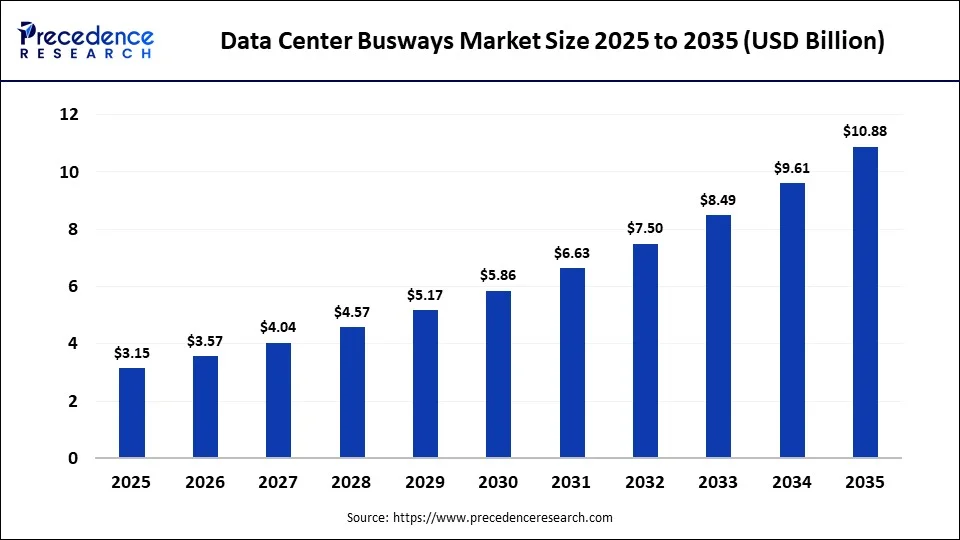
Gautam Mahajan has over five years of experience in the market for electrical infrastructure in data centers, where he is focused on the changing power distribution demands of data centers. His analysis includes insights on busway technologies, voltage transitions, rack power growth, hyperscale expansion, and AI-fueled infrastructure, offering a clear understanding of how the industry's key suppliers are paving the way for the future of data center power delivery. The global data center busways market is estimated to grow at 13.2% CAGR during the forecast period. Reaching nearly USD 10.88 billion by 2035 from its value of USD 3.57 billion in 2026. He also identifies the explosive growth of the per-rack power density as the biggest driver here, as well as renewables and a surge in busway named-manufacturer acquisition velocity like Legrand and Schneider Electric.
Key Takeaways
- By busway type, the sandwich busway segment led the market with a 41% share in 2025 and is expected to grow at a rapid pace with a CAGR of 14.6 through 2035.
- By conductor material, the copper segment captured the largest commercial vehicle braking system market share of 72% in 2025.
- By power rating, the 801-1,250 A segment captured the largest market share of 18% in 2025.
- By voltage, the low voltage segment captured the largest market share of 81% in 2025.
Market Overview
Market Value Projected to Reach USD 10.88 Billion by 2035
In 2025, the global data center busways market is valued at USD 3.15 billion. By 2035, driven by AI-powered rack power density that is transforming electrical distribution architecture, the market will grow to about USD 10.88 billion. The compound growth rate will be nearly 3.5 times in the coming decade. That trajectory tracks closely with what is happening one level up in the value chain. As described in more detail shortly, combined capital spending of hyperscalers has spiked significantly in a single year from 2025 to 2026, and the demand for busways is a downstream component of capital spending.
Key Insight: Dollars spent on busways in projects like these used USD 3.15 billion and account for a small portion of the much larger capital expenditures. A projected 3.5 times expansion over ten years lines up directionally with the even sharper single-year jump already visible in hyperscaler capital spending, since busway demand really is downstream of that bigger spending cycle.
Source: Precedence Research Database
Recent Developments in Data Center Busways Market
| Date | Development | Source |
| Apr 2024 | In April 2024, Schneider Electric successfully launched the I-Line Track Medium Power Distribution Busway. This design of open track was created for data centers to provide flexibility for data center personnel to install and move around the tap-off units. | MarketsandMarkets, "Data Center Busway Market Report 2026-2032." |
| Dec 2024 | The firm then broadened its footprint overseas in North America by acquiring the Canadian-based Power Bus Way, a cable bus systems and high current power distribution developer. The purchase enhanced Legrand's power infrastructure manufacturing capabilities for data centers. | MarketsandMarkets. |
| 2025 | NVIDIA's GB200 NVL72 platform highlighted more rack-level power consumption parameters into the spotlight: 72 GPUs, about 120 kW of nominal rack power. The extension of large-scale deployments by hyperscalers like Azure and AWS further accentuated the importance of the advanced busway and busbar architecture. | SemiAnalysis (Oct 2025); Spheron Blog (Mar 2026). |
| 2025 (full year) | Legrand Group grew by 13% driven in part by data center demand and acquisitions. It further reported its operating margin (excluding adjustments) was 20.7% with strong demand in electrical and digital infrastructure lines. | Legrand Group investor disclosures. |
| Sept 2025 | High voltage power infrastructure will also play an important role in AI data centers with NVIDIA's SuperX GB300 NVL72 platform. The 800VDC architecture highlighted its focus on increasing power efficiency naturally because, as the AI racks become more power hungry they need more efficient power transmission. | PRNewswire/Barchart (Oct 2025). |
| Feb 2026 | Major U.S. hyperscalers greatly ramped up their forecasts for infrastructure expenditure in 2026. As the companies indicate, the trajectory of investment inflows to AI computing and data centre infrastructure continues to ramp up, with Amazon, Alphabet, Meta and Microsoft spending around USD 725 billion together. |
Futurum Group (Feb 2026); Introl (Jan 2026). |
Top Data Center Busways Market Companies 2025-2026
| Company | Headquarters | Core Business | Relevant Public Information | Source |
| Schneider Electric SE | Rueil-Malmaison, France | Electrical equipment manufacturing, including data center busway systems | Schneider Electric's I-Line Track Medium Power Distribution Busway added to its data center busways portfolio. It features an open-track design and tap-off flexibility that meets the evolving demand for power distribution from today's data centers. | "Data Center Busway Market Report 2026-2032." |
| Legrand SA (Starline brand) | Limoges, France (Starline: West Chester, Ohio, U.S.) | Electrical and digital building infrastructure; Starline is Legrand's dedicated data center overhead track busway brand | Schneider Electric's I-Line Track Medium Power Distribution Busway added to its data center busways portfolio. It features an open-track design and tap-off flexibility that meets the evolving demand for power distribution from today's data centers. | Legrand Group investor disclosures; Legrand.us product pages; |
| Eaton Corporation plc | Dublin, Ireland | Power management, including data center busway and power distribution systems (PowerWave) | Vertiv has been a top player in power distribution for data centers for years, and it continues to supply power distribution based on busways as part of its extensive offering of critical digital infrastructure solutions. It utilizes its CouplerTek technology, which is integral to the guiding that simplifies the field jointing and installation of busway systems. | datacenterss.com busduct/busway vendor guide (Mar 2026); ReportPrime. |
| ABB Ltd. | Zurich, Switzerland | Electrification and automation technology, including busbar trunking systems | With a rich history of electrical infrastructure solutions and a strong worldwide manufacturing footprint, Eaton has emerged as a significant global player. Its data center power solutions give it an edge as operators upgrade their data center facilities for increased density. | - |
| Siemens AG | Munich, Germany | Electrical infrastructure and automation, including busbar power distribution | With its long-standing portfolio of electrical infrastructure products and the strength of its global presence, Siemens will continue to be an important player in the global data center busways market. The business has been strong in its presence in European data centre projects, where stable and scalable electricity distribution is ongoing. | ReportPrime; |
Regional Analysis
Asia-Pacific Set to Overtake Europe as the Second-Largest Regional Market
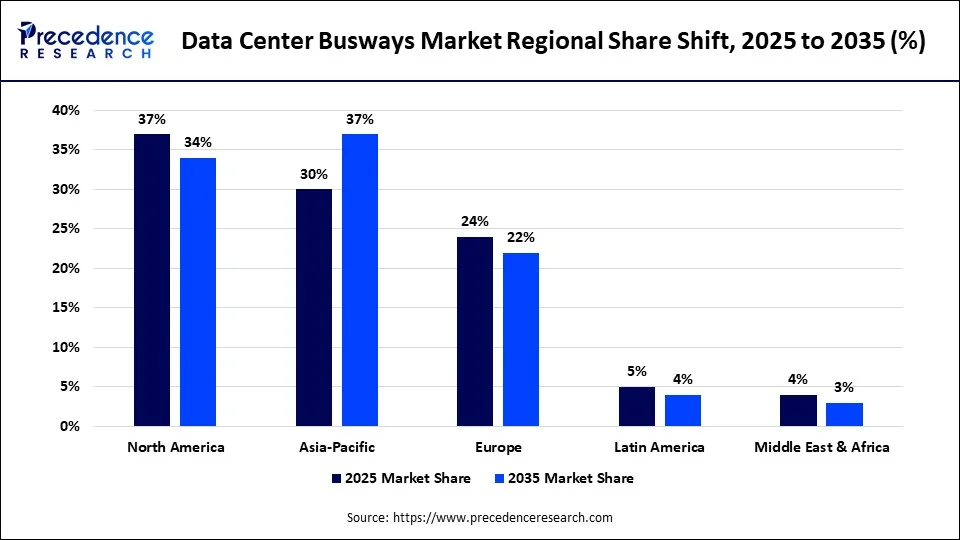
The region's market shares suggest a significant change in the global data center busways market by 2035. North America is expected to dominate the market in 2025 with 37% of the market, followed by APAC with 30% and Europe with 24%. Asia Pacific is expected to account for 37% of the market share by 2035, with North America following with a share of 34% and Europe with 22%. The change highlights the growing hyperscale and AI data center pipeline in the Asia-Pacific region, including China, India, Japan and Southeast Asia. On the other hand, North America's installed base is sizeable, and the overall market share in the region is comparatively sluggish, with other regions increasing infrastructure rollout.
Key Insight: Asia-Pacific is forecast to overtake North America as the largest single region by 2035, on the strength of a regional growth rate running at more than one and a half times North America's own pace.
Source: Precedence Research Database
North America: 37% Share in 2025, Declining to 34% by 2035
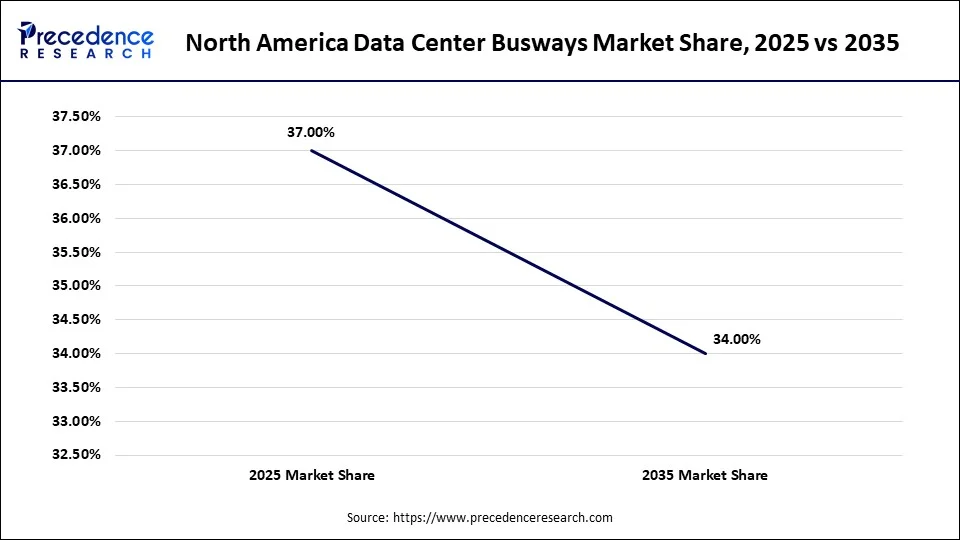
North America continued to lead the region with 37% in 2025, due to its proven hyperscale data center footprint and ongoing investments made by hyperscale cloud providers. It is estimated that the market will grow at 11.8% CAGR globally, while the region will see a decline to 34% by 2035. The lower share growth is due to the relatively mature data center infrastructure in North America, seeing more busway demand from upgrades and capacity expansions as well as from AI retrofits. Meanwhile, AI workloads are growing at the same time, yet there continues to be a need for higher current busways and power distribution upgrades throughout the facility.
Key Insights: North America is the largest established market, but the regions having the fastest growth in infrastructure expansion slowly diminish the regional share of North America.
Source: Precedence Research Database
Europe: 24% Share in 2025, Declining to 22% by 2035
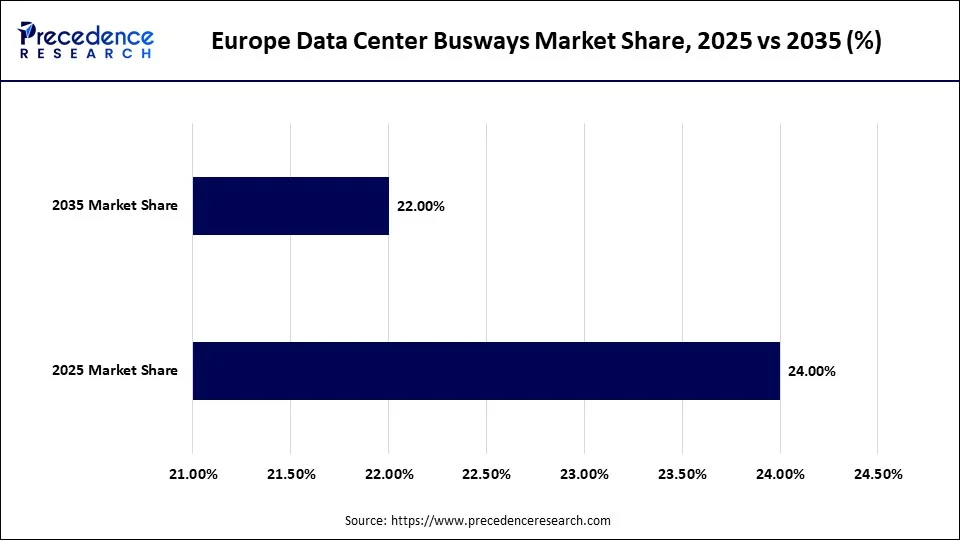
Europe's policies and plans for green data centers continue to accelerate infrastructure modernization in the region, resulting in the second-largest regional share in 2025 of 24%. The percentage decreases to 22% by 2035 when taking into account the region's population growth rate of 11.2% per year, which is the slowest of the three major regions, such as North America and Asia Pacific.
Key Insight: Europe's 11.2% share growth rate is lower than the market's 13.2% market average, so the region will lose its share of the market by 2035.
Source: Precedence Research Database
Asia-Pacific: 30% Share in 2025, Growing to 37% by 2035
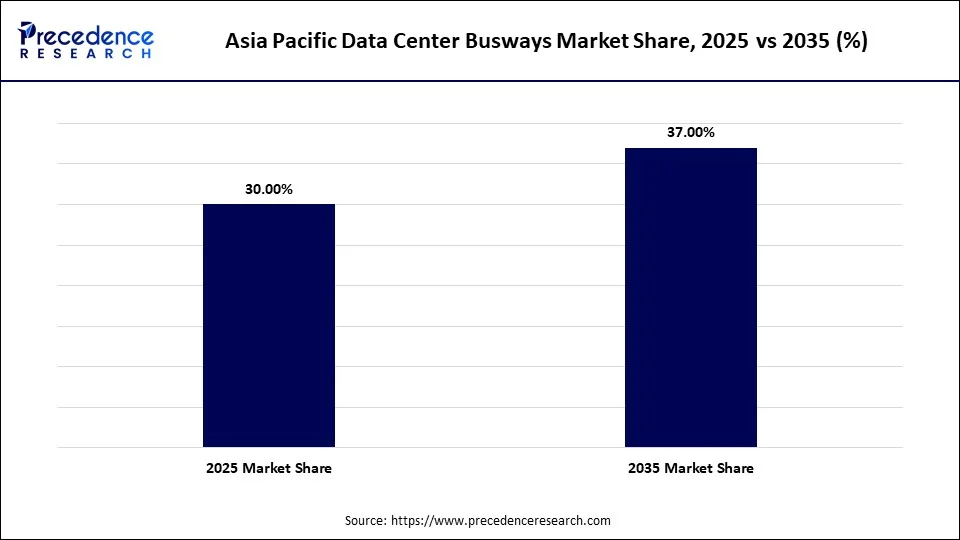
AI adoption, cloud expansion, and hyperscale construction for services in Asia-Pacific are boosting it to be the fastest-growing region in this market in 2025, with a 30% market share already acquired. By 2035, its share rises to 37% on a 16.4% CAGR, which is higher than the world average.
Key Insight: Asia-Pacific, with 16.4% growth over the course of the market, is expected to increase its share in the global domain over time till 2035.
Source: Precedence Research Database
Latin America: 5.0% Share in 2025, Declining to 4.0% by 2035
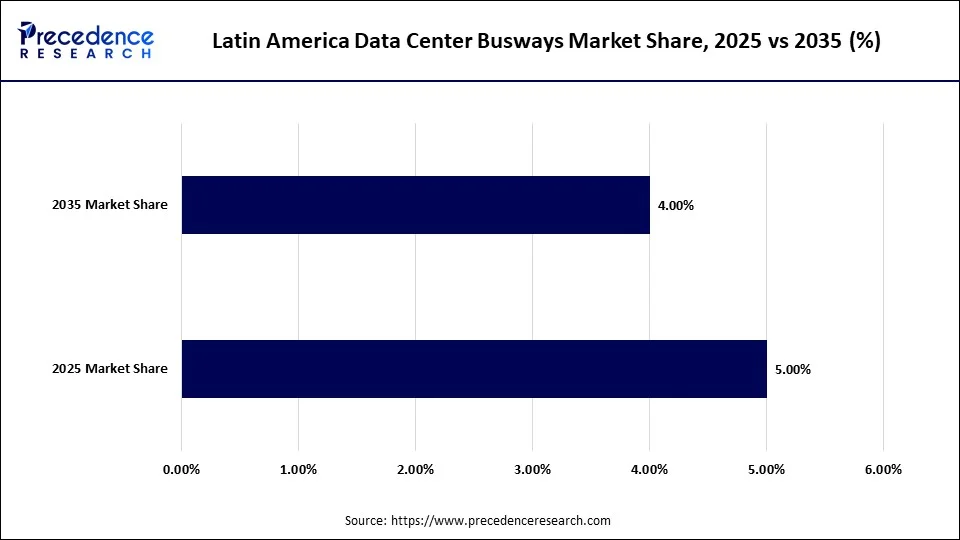
Latin America's share of global had modestly grow to 5% in 2025, and with continued investments in colocation facilities, the market is witnessing expansion contributed by various countries in the region. The share declines to 4% by 2035 as the region expands at 12.6% annually.
Key Insight: Latin America loses its share in the globe through 2035, which is comparable to the region's growth of 12.6%, compared with the market's 13.2% global growth.
Source: Precedence Research Database
Middle East & Africa: 4% Share in 2025, Declining to 3% by 2035
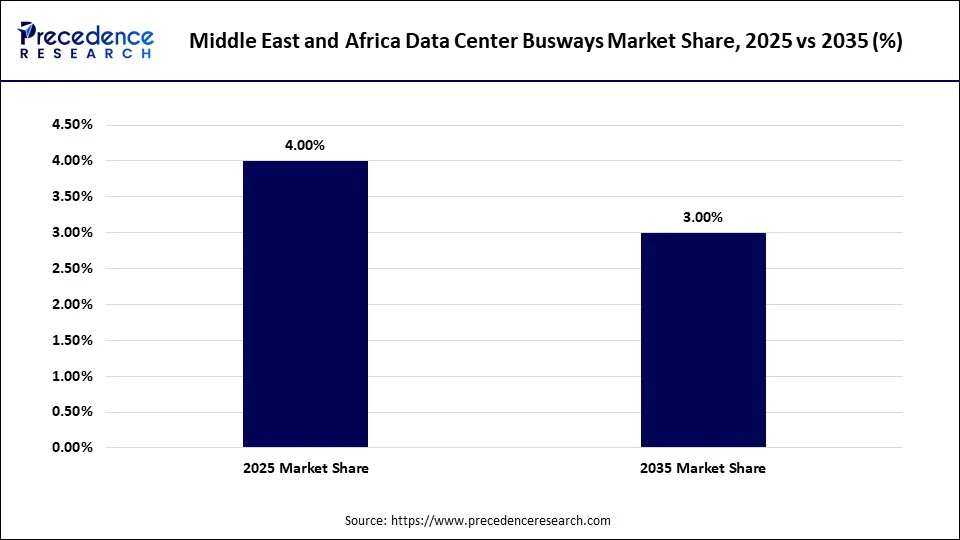
I interpret that, by 2025, the Middle East and Africa region had the smallest representation at 4%, although smart city projects and overall IT transformation provided some growth in the region. The data centers deployed across the region's smart cities are still a gradual part. The market share is expected to reduce to 3% by 2035, with 12.9% CAGR during the projected period.
Key Insight: The Middle East and Africa region forgoes global share through 2035 with 12.9% CAGR growth compared with the market's global average of 13.2%.
Source: Precedence Research Database
Hyperscaler Capital Expenditure Is Set to Grow 77% in a Single Year
| Year | Hyperscaler Capex (USD Billion) |
| 2025 | $410B |
| 2026 (Guidance) | $725B |
I found that the primary demand driver behind this entire market, hyperscale and AI infrastructure investment, is not just a narrative but a genuinely quantifiable and fast-accelerating trend. The four biggest U.S. hyperscalers, including Amazon, Alphabet (owner of Google), Meta, and Microsoft, collectively announced that they expect to spend USD 725 billion on capital expenses in 2026, which's 77% higher than the capital expenditures estimated at around USD 410 billion for 2025. Among all of these, Amazon accounts for USD 200 billion, Alphabet for USD 175 to 185 billion, Meta for USD 115 to 135 billion, and Microsoft for USD 110 to 120 billion, and Goldman Sachs estimated that the capital expenditure for all the hyperscalers equals USD 5.3 trillion between FY 2025 and FY 2030.
Key Insight: The capital spending increase will eventually enable new data center builds and therefore the installation of new busways. This is in excess of this market's forecast capital expenditure growth of 13.2%, suggesting that the forecast may be conservative if hyperscaler capital expenditure guidance actually comes through.
Source: Futurum Group, "AI Capex 2026: The $690B Infrastructure Sprint" (Feb 2026); Introl, "Hyperscaler CapEx Hits $600B in 2026" (Jan 2026); Yahoo Finance/Goldman Sachs capex projection (Jun 2026).
AI Racks Now Draw Up to 79x the Industry-Average Rack
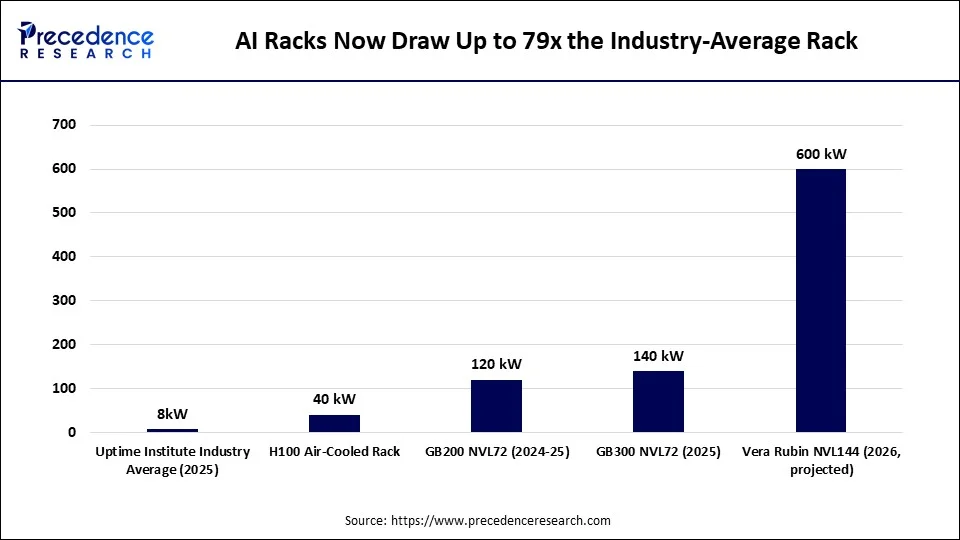
The most notable technical explanation behind the fastest-growing power rating tier, as part of modern AI accelerator racks, is now being scaled in massive quantities. According to the Uptime Institute's 2025 data for the industry average data center rack, it consumes only 7.6 kilowatts. The H100 air-cooled AI rack consumes about 40 kilowatts of power, while the NVIDIA GB200 NVL72 rack, which will be deployed in 2024 and 2025.
Consumes about 120 kilowatts nominal, with measured values of 130 to 132 kilowatts being applied through an integrated server DC power supply. Subsequently called a common DC power supply rather than through individual power supplies. A new line of NVIDIA GPUs, known as the Blackwell Ultra (GB300) series, is scheduled for release in 2025, consuming 135 to 142 kilowatts, while another generation from NVIDIA would be a platform. They will be called Vera Rubin NVL144, expected to be available at large volume in 2026, and would require closer to 600 kilowatts per rack.
Key Insight: With NVIDIA's very own new rack platforms, the company has actively made use of a common busbar instead of a single server power supply. Showing, meaning busway architecture is not merely accommodating rising AI power density. It has become structurally required by the chip platforms themselves.
Source: SemiAnalysis, "GB200 Hardware Architecture" (Oct 2025); ModulEdge, "Nvidia Blackwell Explained" (Jun 2026); Introl, "GB200 NVL72 Deployment" (Apr 2026); Pantheon GB200 NVL72 datasheet.
Legrand's Record 2025 Results Are Explicitly Attributed to Data Centers
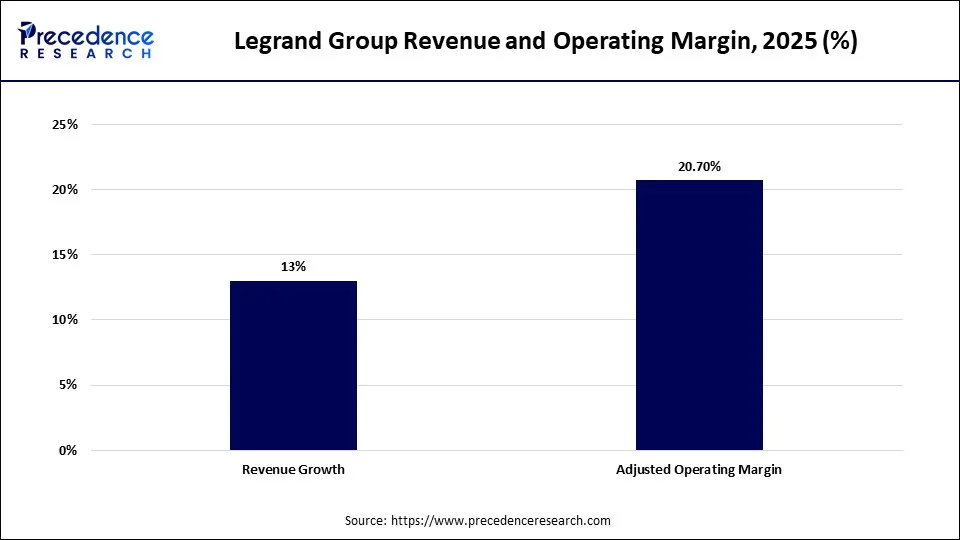
| Metric | 2025 Value | Description |
| Revenue Growth | 13% | Record revenue growth, driven by data centers and acquisitions |
| Adjusted Operating Margin | 20.70% | Adjusted operating margin after acquisitions |
Aman interpreted by looking at named manufacturer financial results to see whether this market's growth story shows up in actual audited numbers, not just analyst projections. Legrand's 2025 financials don't disappoint. For the year, the company reported record revenue growth of 13%, of which the growth was directly attributed to data centers and acquisitions at 7.7% and 5.1%, respectively. Adjusted operating margin was achieved at 20.7% on the back of acquisitions. Starline, the dedicated data center busway brand, posted a standalone brand revenue of around USD 19.4 million for the year.
Key Insight: That a top-tier global busway maker made a specific 13% record revenue year, brazenly reported to explicitly credit data centers, is audited revenue, rather than analyst-driven, and represents direct company-level support for this market's double-digit growth rate.
Source: Legrand Group, "Acquisitions" investor page (legrand.com, 2025 results).
Leading Manufacturers Are Actively Acquiring to Expand Busway Capabilities
| Date | Company | Development | Details |
| Dec-24 | Legrand | Acquired Power Bus Way (Canada) | Cable bus systems and high-current power distribution |
| Apr-24 | Schneider Electric | Launched I-Line Track Medium Power Distribution Busway | Designed for data centers |
| Jun-25 | Legrand | Acquired Linkk Busway Systems (Malaysia) | Power busbars for data center grey-space |
Busway manufacturers such as named brands are actively marketing to centralize and streamline the portfolio of products. These are best suited for data center power distribution over 2024 and 2025. Schneider Electric released its I-Line Track Medium Power Distribution Busway in April 2024, an unconfined-track range of power distribution products specifically designed for the data center industry, and optimised for flexible tap-off configurations. Legrand also grew its North American manufacturing base through the acquisition of Power Bus Way. This is a Canadian company producing power bus systems and high-current power distribution in December 2024. Before Legrand made its latest acquisition, Linkk Busway Systems in Malaysia, which specializes in cable bus systems for data center grey space applications, in June 2025.
Key Insight: All three of these acquisitions center on data center applications instead of the manufacturer's wider industrial electrical business and comprise two acquisitions where the geographical component and the manufacturing of data center-specific equipment appear to be well in advance of any need.
Source: Precedence Research Database
Important Segment Categories
Sandwich Busway Leads and Extends Its Share as the Compact-Design Favorite
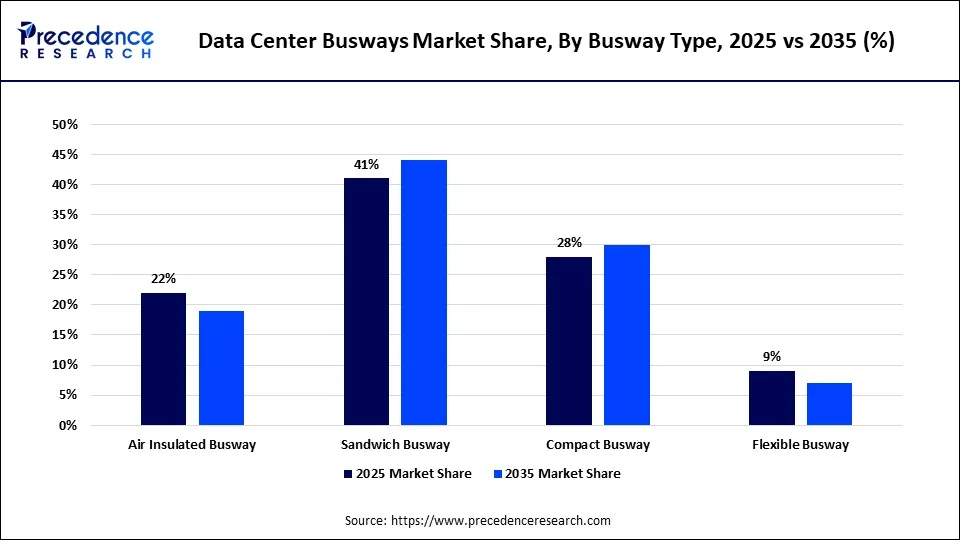
The busway type category was dominated by sandwich busway, which accounted for 41% of the market in 2025. They are gaining popularity due to their space-saving advantages in the ever-crowded data center environment and high power density. The share of this segment is expected to grow to 44% by 2035, and the segment is the highest-growth segment with a 14.6% CAGR. This trend is driven by the increasing demand for scalable power distribution, which requires more power without taking up too much space. To be added.
Key Insight: Sandwich busway leads with a 41% share in 2025 and expands to 44% by 2035 at a 14.6% CAGR. It's smaller and more powerful, making it more and more ideal for a high-load, space-critical data center environment.
Source: Precedence Research Database
Conductor Material: Copper Retains Its Lead as Aluminum Grows Faster on Cost Efficiency
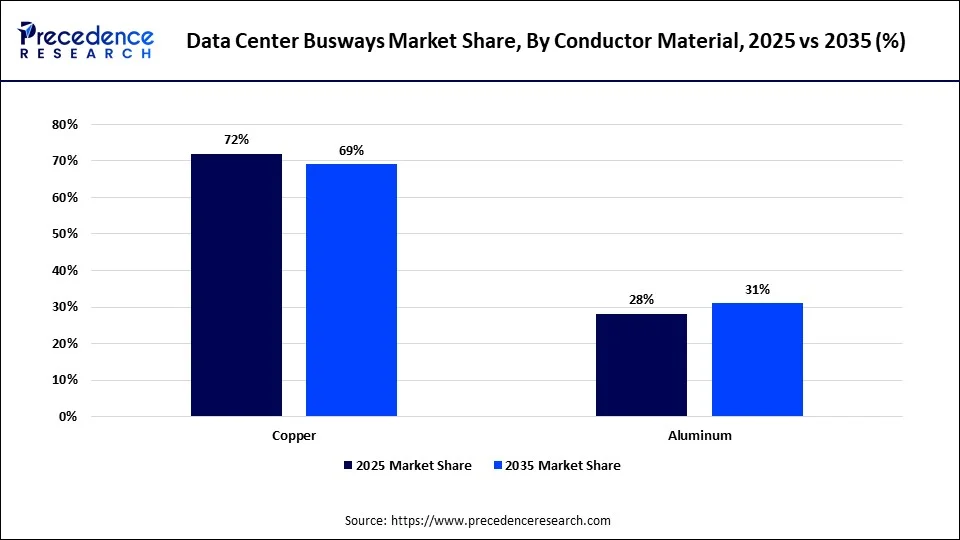
Copper led the conductor material category with a 72% market share, owing to its outstanding electrical conductivity, durability, and proven reliability in heavy-load power distribution systems. The share is expected to grow in a moderate manner to 69% by 2035, and the segment is also registering a CAGR of 12.4%. Aluminium, on the other hand, has risen from 28% to 31% in the same time period and has a higher CAGR of 15%. The data center operators are being encouraged to consider aluminium busways, where the economics of installation, the structural weight, and long-distance power distribution are still meaningful.
Key Insight: Copper holds the number one position with a share of 72% in 2025 and continues to grow at 15% CAGR till 2035, as compared to aluminium, which is growing faster.
Source: Precedence Research Database
801-1,250A Leads Power Rating Share as Above-1,250A Grows Fastest
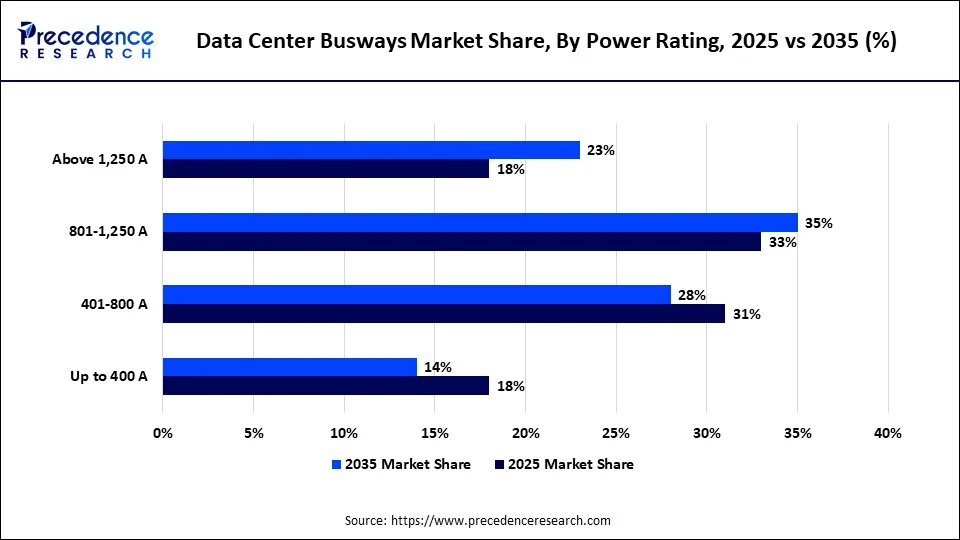
The 801-to-1,250 A band held the largest share of the power rating category in 2025 at 33%, fueled by increasing power density in racks, which has boosted the growth of power ratings at this level. By 2035, the share of the power rating category in 2025 will reach 35% at a 13.9% CAGR.
The tier that will pass the top spot in the second tier is above 1,250 amps, which will start in 2025 still tied for the smallest tier at 18% share. This shows the fastest growth of all the four tiers, at 17.6% CAGR, arriving at a 23% share in 2035 as AI and hyperscale workloads demand higher-capacity power distribution ever.
Key Insight: The top millimeter (2025+ amp) segment will accelerate at 17.6% CAGR through 2035, albeit not as rapidly as the 801-1,250 amp segment, which will take a bigger share of the market at 33% until 2035.
Source: Precedence Research Database
Low Voltage Dominates as Medium Voltage Grows Fastest
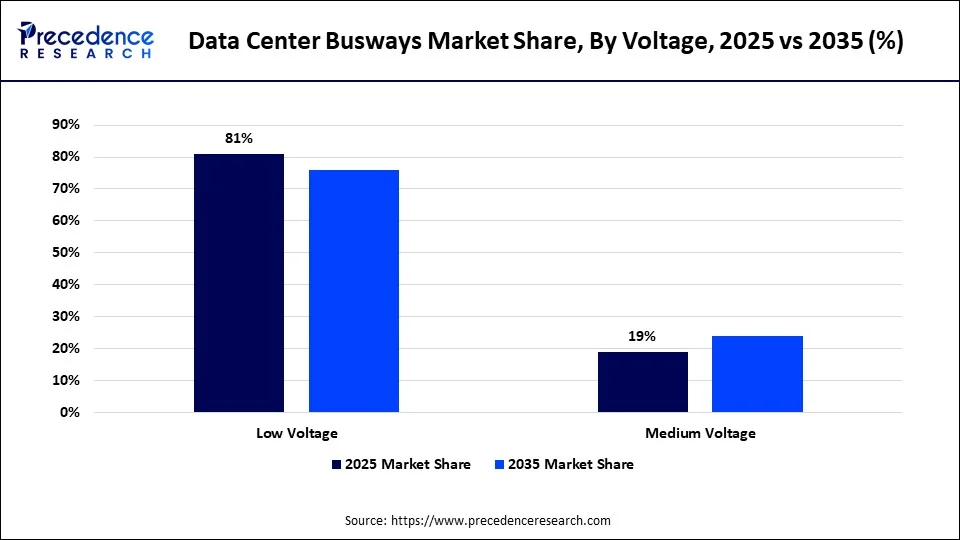
Low voltage was the largest voltage segment in 2025 at 81% of the market, bolstered by having a broad presence in traditional data center power distribution systems. The segment will see its share drop to 76% by 2035, even as operators are investing in new facilities and upgrades of existing ones and continuing to expand, with a 12.3% CAGR. Medium voltage, on the other hand, has a much higher CAGR of 16.2% and will account for 24% of the market by 2035. This is because it is growing faster than its medium-voltage counterpart due to higher power demands and longer distribution distances. They are further driving increased interest and adoption of medium-voltage architectures in hyperscale and high-capacity campus environments.
Key Insight: Low voltage is the largest market with 81% of sales in 2025, and medium voltage is emerging fastest with a CAGR of 16.2% through 2035, which is especially strong in hyperscale and high-capacity campus deployments.
Source: Precedence Research database
Overhead Busway Extends its Lead as the Preferred Installation Method
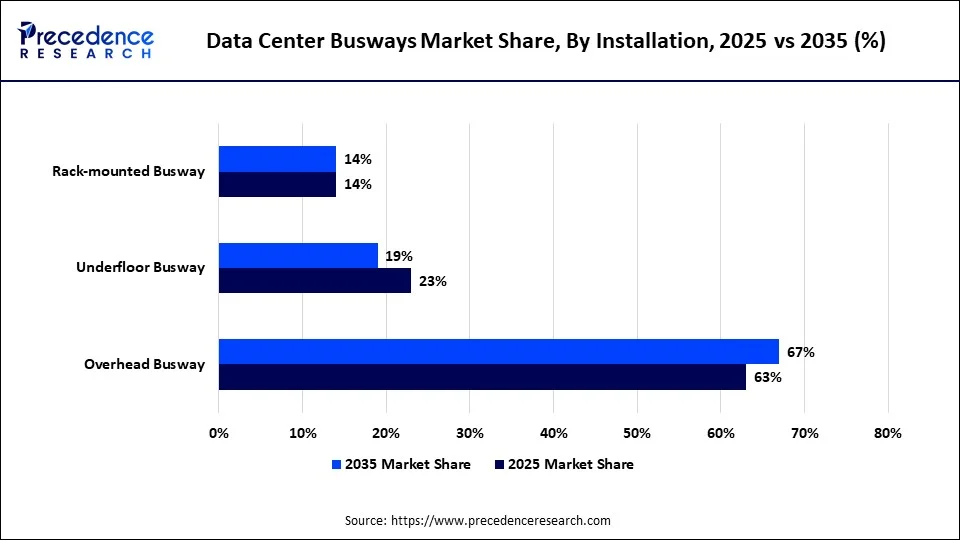
The overhead busway accounted for the largest percentage of installations in 2025 (63%), due to the ease of access to maintain. From the segment, its share is expected to grow to 67% by 2035, with the segment clocking a respectable 14.3% CAGR. As operators increasingly require flexibility in electrical designs to support evolving rack configurations and future growth, growing adoption is an indicator of their needs. Another advantage of overhead systems is that they can be scaled up easily without disrupting floor plans. This makes them ideal for hyperscale and AI data centers.
Key Insight: Overhead busway leads with a 63% share in 2025 and is projected to reach 67% by 2035 at a 14.3% CAGR. It's so scalable, easy to maintain, and flexible to install that it is becoming a more viable option for growing high-density data centers.
Source: Precedence Research Database
Busway Trunking Leads Component Share as Monitoring Modules Grow Fastest
Data Center Busways Market Share, By Component, 2025 vs 2035 (%)
| Component | 2025 Share (%) | 2035 Share (%) |
| Busway Trunking | 46% | 44% |
| Tap-off Units | 21% | 23% |
| End Feed Units | 10% | 9% |
| Joint Packs | 8% | 7% |
| Monitoring & Comms Modules | 10% | 14% |
| Accessories | 5% | 3% |
In 2025, busway trunking with 46% of market share had the largest proportion of the component category, although the rate of increase slowed to 12.7% CAGR in 2035. The other significant growth is in monitoring and communication modules, which grew by 18.6% CAGR, by far the fastest, as smart power monitoring becomes essential in all AI data centers. The growing importance of AI data centers in reducing power consumption will drive demand for smart power monitoring, which monitors and controls energy usage to ensure efficient operations.
Key Insight: Busway trunking is the largest contributor at 46.0% in 2025, with monitoring and communication modules showing the fastest growth rate among all components at 18.6 % CAGR.
Source: Precedence Research Database
Hyperscale Data Centers Dominate and Extend Their Lead Through 2035
Data Center Busways Market Share, By Hyperscale data centers, 2025 vs 2035 (%)
| Data Center Type | 2025 Share (%) | 2035 Share (%) |
| Enterprise Data Centers | 24% | 18% |
| Colocation Data Centers | 28% | 27% |
| Hyperscale Data Centers | 36% | 46% |
| Edge Data Centers | 12% | 9% |
The data center type category was dominated by hyperscale data centers in 2025, accounting for 36.0% of the market, as major cloud providers continue to expand and AI computing infrastructure is rapidly developed. The share of these is expected to increase to 46.0% by 2035, with the fastest growth rate at 17.5% CAGR in the segment. This speed-up is driven by the demand for larger campuses with high-density GPU clusters, higher power usage, and scalable computing power.
Key Insight: Hyperscale data centers lead with a 36.0% share in 2025 and expand to 46.0% by 2035 at a 17.5% CAGR. The need for scalable, high-capacity power distribution infrastructure is growing with the increased demand for AI computing and the hyperscale expansion of campuses.
Source: Precedence Research Database
Tier III Leads Tier Standard Share as Tier IV Grows Fastest
Data Center Busways Market Share, By Tier Standard, 2025 vs 2035 (%)
| Tier Standard | 2025 Share (%) | 2035 Share (%) |
| Tier I & II | 17% | 13% |
| Tier III | 52% | 49% |
| Tier IV | 31% | 38% |
The Tier III standard continues to be the popular commercial tier, with 52% of the tier standard of the category in 2025, but that drops to 49% by 2035, as the category expands at 12.6% of CAGR. Mission-critical and AI workloads are driving growth in share of business in Tier IV facilities, up from 31% to 38% with 15.8% CAGR, the fastest of the three tiers.
Key Insight: AI workloads and mission-critical applications are driving up demand for higher-redundancy facility designs. Tier III has the largest share in 2025 with 52%, and Tier IV has the fastest CAGR in the forecast of 15.8% through 2035.
Source: Precedence Research Database
Power Distribution Leads Application Share as IT & Server Racks Grow Fastest
Data Center Busways Market Share, By Application, 2025 vs 2035 (%)
| Application | 2025 Share (%) | 2035 Share (%) |
| Power Distribution | 39% | 37% |
| IT & Server Racks | 24% | 27% |
| UPS Integration | 13% | 12% |
| Cooling Infrastructure | 10% | 12% |
| Backup Power Distribution | 8% | 7% |
| Network Equipment | 6% | 5% |
The major application in this segment is power distribution with a 39% share in 2025, where it continues to be the most important use case for reliable electric power distribution, with the slowest growth to 12.1% at 37% share in 2035. According to my research, the underlying data shows that the fastest growth in this category is in cooling infrastructure, which will change from 10% to 12% of the market share, with liquid cooling infrastructure driving electrification needs in IT and server racks as its competitor.
Key insight: The power distribution segment holds the largest portion with 39% of market share in 2025, followed by the cooling infrastructure segment, in the category with the highest growth profile, at 15.4% of CAGR, narrowly outpaced by IT and Server racks.
Source: Precedence Research Database
Cloud Service Providers Lead End-User Share and Post the Fastest Growth
Data Center Busways Market Share, By End User, 2025 vs 2035 (%)
| End User | 2025 Share (%) | 2035 Share (%) |
| Cloud Service Providers | 34% | 39% |
| Telecom Operators | 17% | 15% |
| BFSI | 13% | 11% |
| Government & Defense | 9% | 8% |
| Healthcare | 7% | 7% |
| Manufacturing | 7% | 7% |
| Retail & E-commerce | 6% | 7% |
| Energy & Utilities | 4% | 4% |
| Others | 3% | 2% |
In the end-user segment, I believe cloud service providers led the pack in share in 2025, with investments in cloud infrastructure, AI computing power, and large-scale data center construction continuing. The segment is expected to have a share of 39% in 2035, and the segment has a healthy CAGR of 16.5%. This increased growth is driven by the growing need for more cloud-based AI services, digital workloads, and high-density computing power. The demand for scalable busway systems that can support up to 200 racks and provide flexible power distribution, plus future-proofing for more capacity. This is becoming a growing need for cloud operators as they are constructing larger facilities and upgrading their campuses.
Key Insight: Cloud service providers lead with a 34% share in 2025 and expand to 39% by 2035 at a 16.5% CAGR. With the growth of cloud and AI infrastructure, there is an increasing demand for a scalable data center busway solution with higher power needs.
Source: Precedence Research Database
Expert Insights
The data center busways market isn't solely an old power delivery model anymore. But is evolving into a complex, flexible, and increasingly intelligent electrical backbone for the data center. I think there is plenty of room for manufacturers who can incorporate with them the higher current busways, medium-voltage distribution, modular design, intelligent monitoring, and efficient power management. I believe the following factors will determine who will be more competitive in the next ten years. The rapid growth of AI workloads, increasing rack power densities, hyperscale construction, and increased investments in cloud infrastructure. In addition, I'm sure that the demand for overhead busways, sandwich busways, and sophisticated monitoring systems will grow along with a focus on scalability, space efficiency, and ease of maintenance. AI-driven and hyperscale data centers are likely to have different power demands. Companies that can deliver scalable solutions, reliable installation support, and robust manufacturing capacity are likely to be best positioned to handle the changing power needs.
Our Experts
Gautam Mahajan led the primary market research, developed the methodology, and analyzed segmentation, regional trends, competition, and forecasts, forming the report's analytical foundation.
Aman was responsible for collecting and validating regulatory filings, company financial data, commodity pricing, and other independently sourced quantitative datasets, strengthening the evidence base behind the market estimations.
Aditi reviewed the complete research document, performed quality checks, validated findings, refined content, corrected inconsistencies, and finalized the report, ensuring accuracy and clarity.
Data Center Busways Market Segmentation
By Busway Type
- Air Insulated Busway
- Sandwich Busway
- Compact Busway
- Flexible Busway
By Conductor Material
- Copper
- Aluminum
By Power Rating
- Up to 400 A
- 401-800 A
- 801-1,250 A
- Above 1,250 A
By Voltage
- Low Voltage
- Medium Voltage
By Installation
- Overhead Busway
- Underfloor Busway
- Rack-mounted Busway
By Component
- Busway Trunking
- Tap-off Units
- End Feed Units
- Joint Packs
- Monitoring & Communication Modules
- Accessories
By Data Center Type
- Enterprise Data Centers
- Colocation Data Centers
- Hyperscale Data Centers
- Edge Data Centers
By Tier Standard
- Tier I & II
- Tier III
- Tier IV
By Application
- Power Distribution
- IT & Server Racks
- UPS Integration
- Cooling Infrastructure
- Backup Power Distribution
- Network Equipment
By End User
- Cloud Service Providers
- Telecom Operators
- BFSI
- Government & Defense
- Healthcare
- Manufacturing
- Retail & E-commerce
- Energy & Utilities
- Others
By Region
- North America - U.S., Canada, Mexico
- Europe - Germany, U.K., France, Italy, Netherlands, Spain, Rest of Europe
- Asia-Pacific - China, Japan, India, South Korea, Singapore, Australia, Rest of Asia-Pacific
- Latin America - Brazil, Mexico, Rest of Latin America
- Middle East & Africa - GCC, South Africa, Rest of Middle East & Africa
References
- Precedence Research Database market model - Data Center Busways Market: market value, forecast CAGR, and ten segmentation tables (Busway Type, Conductor Material, Power Rating, Voltage, Installation, Component, Data Center Type, Tier Standard, Application, End User) plus regional segmentation, 2025–2035.
- Futurum Group - "AI Capex 2026: The $690B Infrastructure Sprint" (Feb 2026), futurumgroup.com.
- Introl - "Hyperscaler CapEx Hits $600B in 2026" (Jan 2026); "GB200 NVL72 Deployment" (Apr 2026), introl.com.
- Yahoo Finance - Goldman Sachs hyperscaler capex projection coverage (Jun 2026).
- SemiAnalysis - "GB200 Hardware Architecture and Component Supply Chain & BOM" (Oct 2025).
- ModulEdge - "Nvidia Blackwell Explained: Data Center Impact" (Jun 2026).
- Pantheon - "NVIDIA GB200 NVL72 Specs & Datasheet."
- Barchart/PRNewswire - SuperX GB300 NVL72 rack-scale AI platform launch (Oct 2025).
- Legrand Group - Investor "Acquisitions" disclosures (legrand.com, 2025 results); Legrand.us Starline product pages.
- datacenterss.com - "Busduct & Busway Systems for Data Centers: Vendors, Tech & AI-Ready Guide" (Mar 2026).
For inquiries regarding discounts, bulk purchases, or customization requests, please contact us at sales@precedenceresearch.com
Frequently Asked Questions





Ask For Sample
No cookie-cutter, only authentic analysis – take the 1st step to become a Precedence Research client
 Get a Sample




 sales@precedenceresearch.com
 Schedule a Meeting
