



Diesel Fuel Market Size, Key Companies, Company Production Capacity, Electricity Generation, Capacity Utilization, Export & Import Analysis, Cost Structure, Competitive Landscape, and Market Outlook
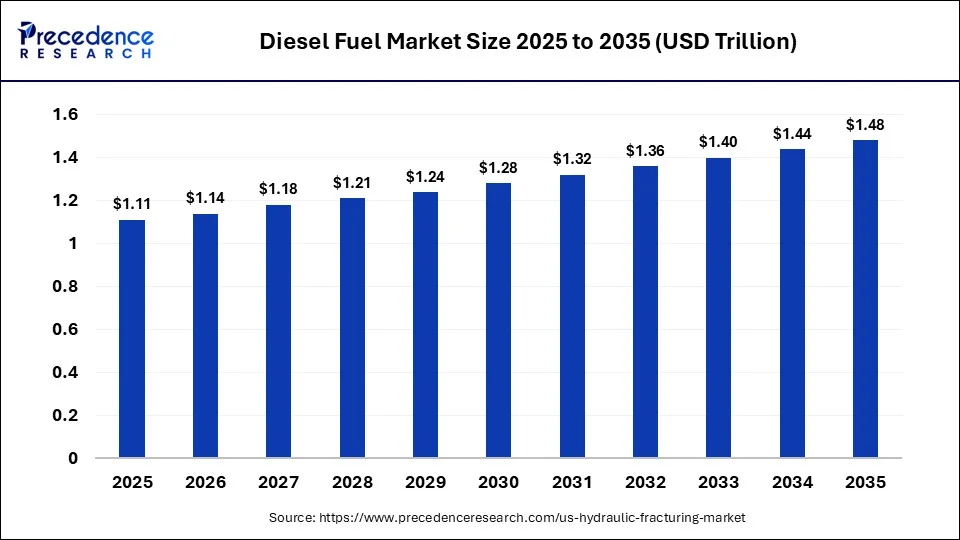
The global diesel fuel market is estimated at approximately USD 1.14 trillion in 2026. The driving factor for this market is rising demand from transportation, logistics, construction, agriculture, industrial operations, and expanding commercial vehicle fleets. These trends were evaluated by our Senior Research Analyst, Laxmi Narayan to curate this well-researched report. His analysis benefits diesel fuel manufacturers, distributors, and stakeholders and consumers in conducting competitive analysis and making well-informed decisions.
Source: https://www.precedenceresearch.com/diesel-fuel-market
 Get a Sample
 Table Of Content


Diesel Fuel Market Demand, Size, and Growth Rate Forecast 2035
The diesel fuel market is forecasted to expand from USD 1.14 trillion in 2026 to USD 1.48 trillion by 2035, growing at a CAGR of 2.9% from 2026 to 2035. The market is mainly driven by increasing freight transportation, infrastructure development, industrial activity, agricultural mechanization, and demand for reliable heavy-duty power generation. Laxmi Narayan has over 5 years of experience in Energy and Power sector. He identified that diesel is transitioning from a general-purpose transportation fuel into a more freight- and industrial-themed market. Volume growth is being driven more and more by emerging markets and heavy-duty use while passenger vehicle demand is under pressures in developed markets due to the rise of electric cars and improved efficiency.
Key Takeaways
- By diesel fuel types, the petroleum diesel segment dominated the market with a share of 82.40% in 2025.
- By end-use, the road transportation segment held the largest market share of 55.85% in 2025.
- By transportation application, the heavy-duty trucks segment accounted for the highest market share of 35.65% in 2025.
- By fuel specification / formulation, the ultra-low-sulfur diesel segment contributed the biggest market share of 58.40% in 2025.
- By distribution channels, the retail fuel stations segment contributed the biggest market share of 47.85% in 2025.
- By region, Asia Pacific held a major market share of 45.40% in 2025.
- Asia Pacific contributed around 360 kb/d of incremental oil demand in 2025, with China and Southeast Asia providing substantial growth.
- In the United States alone, transportation-sector consumption of conventional distillate/diesel was approximately 2.94 million barrels per day in 2025, accounting for about 75% of total U.S. distillate consumption.
How is the Diesel Fuel Market Growing Through 2035?
Diesel fuel market is expected to grow at CAGR of approximately 2.9% period driven by many factors such as industrial production, agricultural mechanization, petroleum refining capacities, fuel quality standards, electrification, renewable fuel requirements, etc. As stated in the report by IEA, diesel and gasoline fuel demand in 2025 will not grow compared to 2025 values, which means that the market is changing from volume-driven growth to an industry-specific type of demand. However, emerging markets are still expected to be the main contributors to oil demand, due to industrial development, infrastructure investments, and increase in mobility needs. For example, in 2025 oil consumption in Asia Pacific will come around 360 kb/d, with China and Southeast Asia contributing the most.
Expert Analyst View - Market Size
The market for diesel fuel is changing from transportation-based demand towards greater utilization of freight, industrial activities, construction, mining, agriculture, and infrastructure growth. Future market development would mostly be concentrated in heavy-duty applications as well as emerging markets, while the demand for passenger vehicles is declining in advanced economies due to the growth of EVs and more strict rules regarding fuel consumption. As a result, biodiesel and renewable diesel are most likely to be increasingly incorporated into the diesel fuel supply structure contributing to the gradual transition to more diversified and less carbon-intensive fuel types overall.
Segmentation Analysis
Which Diesel Fuel Types Segment Dominated the Space Materials Market?
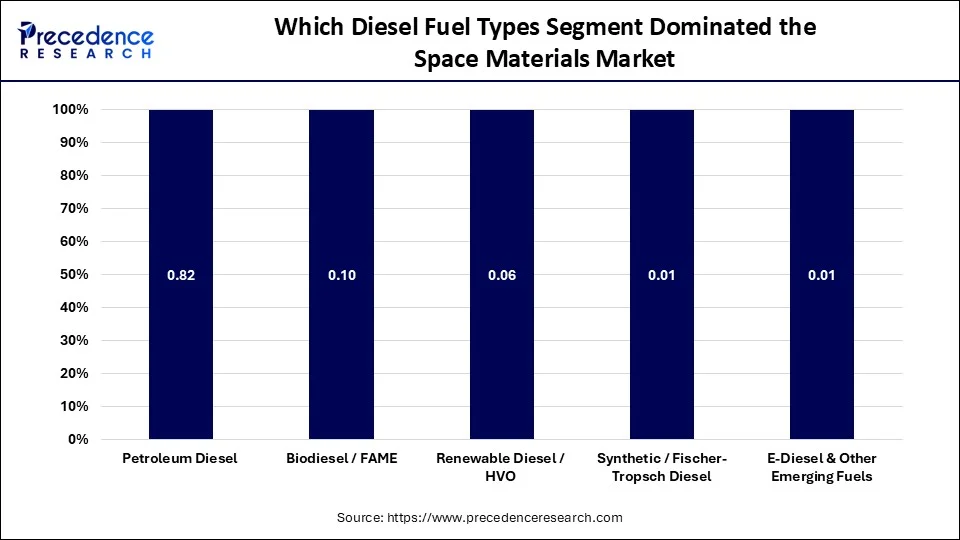
The petroleum diesel is the leading show in this segment, due to the large fleet of diesel-powered vehicles across the world and the capabilities of established oil refineries, pipelines, storage terminals and distribution networks used in traditional diesel production. On the other hand, renewable diesel/HVO is the fastest growing segment, since it can use existing diesel engines and infrastructure, thus saving consumers from the need to invest in new infrastructure.
Expert Analyst View - Material Type
Renewable diesel is moving from being a niche alternative fuel to a more established part of global fuel portfolios due to the increasing production capacity and commercial usage. Neste's 4.1 million tonnes in 2025 reflects the increasing scale of the field, while Imperial Oil's launching of the Strathcona renewable diesel facility with capacity of up to 20,000 barrels per day proves the ongoing investment in large-scale production capacities. All this helps to suggest that refiners and fuel producers begin to integrate renewable diesel into conventional fuel supply routes even more actively, particularly because there are already existing diesel facilities available for usage.
Which End User Sector Account for the Largest Share?
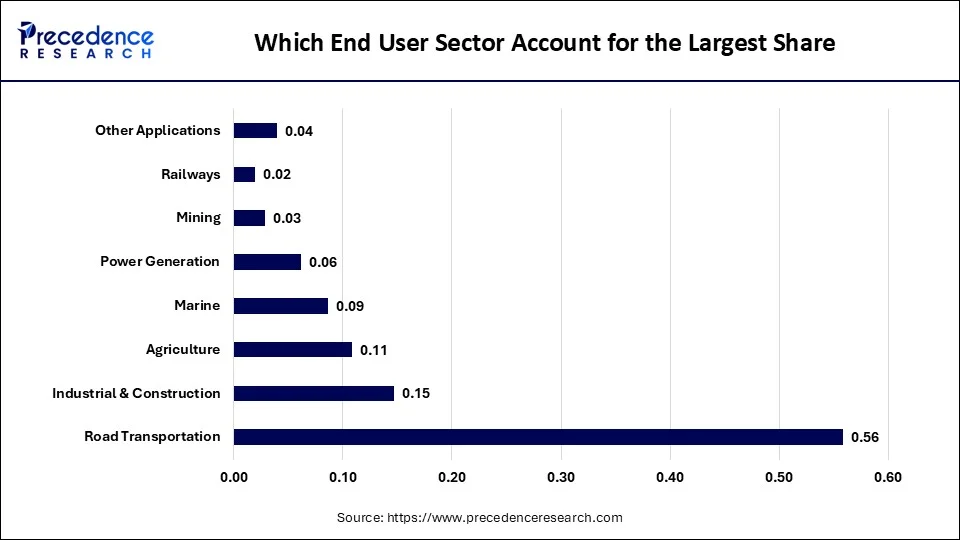
Road transportation remains the dominant demand segment, supported by the extensive use of diesel-powered vehicles, in particular heavy trucks that have a great need in energy density, long range and required facilities for filling fuel. At the same time, the sphere of mining shows the highest growth rates, since diesel use continues to play a vital role in the functioning of powerful mobile devices and machinery in locations where electric power cannot be applied.
Expert Analysis
This category of diesel consumption is becoming more differentiated across applications as progress in electrification is not occurring uniformly across the market. The passenger car sector is receiving a stronger structural push from electric vehicle (EV) uptake, while heavy duty trucks, construction machinery, farming machinery and mining fleets remain heavy users of diesel because of the long lifespan of the machinery, severe working conditions and lack of viable electrification options. According to the IEA, more extensive fame of EVs is expected to progressively bring about oil displacement from consumption of gasoline and diesel in the near future, especially the usage of electric trucks and buses in the second half of this decade.
How is Diesel Demand Divided Between Transportation Applications?
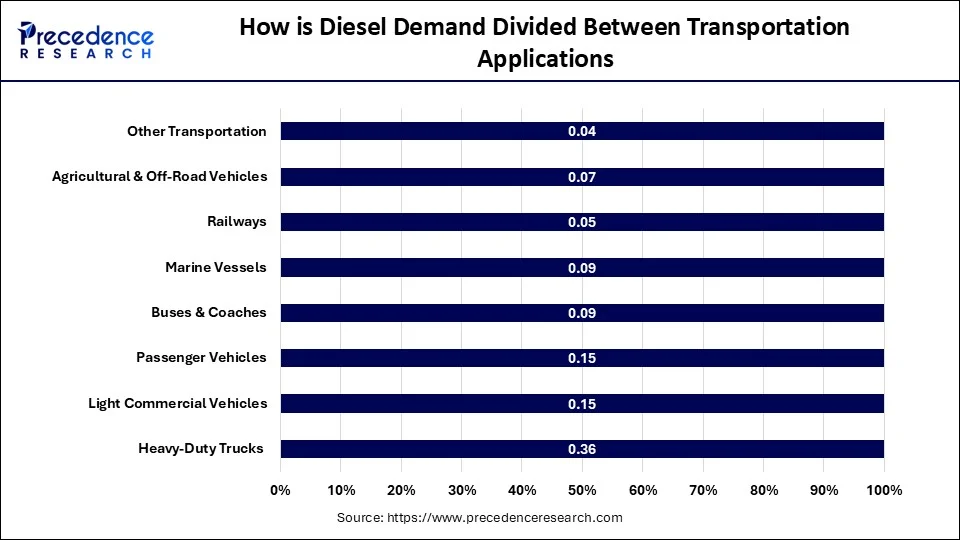
Heavy-duty trucks continue to be the leading use of transportation methods as diesel remains prevalent in long-haul transport activities, owing to its energy density, distance it can cover, and capacity for carrying heavy loads. At the same time, agricultural and off-road vehicles are the fastest-growing transportation application due to growing mechanization, growing agricultural production, and high demand for modern equipment in developing economies.
Expert Analysis
The competitive dynamics between diesel fuel and electrification differ greatly from one type of vehicle to the other. As per estimates from the International Energy Agency, sales of electric trucks worldwide doubled by 2025 to account for a share of around 9% in total truck sales, driven hugely by China. However, electric trucks are still more expensive than conventional counterparts, and the replacement and operational needs of fleets are still largely driving diesel demand in the short-term.
Which Diesel Quality and Formulation Accounts the largest Market Share?
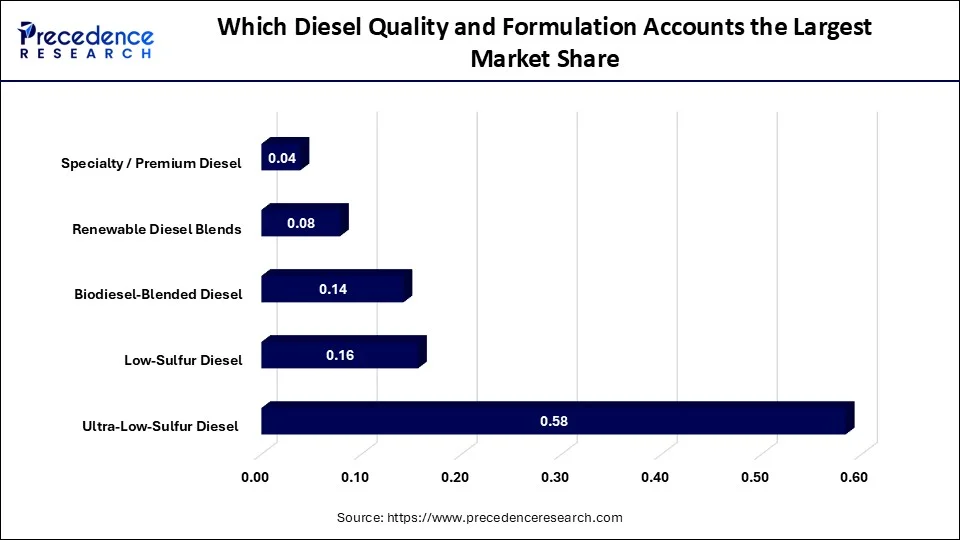
ULSD is the most widely used diesel type, which is due to its extensive use in road transport fleets and strict fuel quality regulations in important developed markets. At the same time, renewable diesel blends are the fastest-growing sector, encouraged by government regulations for decarbonization and fleets that seek to use lower carbon fuels that can be used in diesel engines without replacing vehicles.
Expert Analysis
Stricter fuel regulations constrain diesel parameters, which makes production of ultra-low-sulfur a must. The US makes use of ULSD diesel with sulfur content of 15 ppm whereas EU regulations maintain diesel content of sulfur equal to 10 mg/kg. Stricter parameters imply higher operational and investment costs throughout the supply chain of refining, particularly hydrotreating and desulfurization processes.
Which Distribution Channels Control Diesel Fuel Sales?
Retail stations are predominant due to their extensive network of refueling stations that offer convenient and accessible diesel supply for the extensive inventory of vehicles across the world. Notably, their widespread geographical coverage, established supply chains, and familiar payment methods allow frequent refueling for both commercial and individual consumers on regular basis. Meanwhile, digital B2B procurement channel is picking up momentum for adoption across the logistics space due to the increasing adoption of automated purchasing applications by the commercial fleets which include fuel cards, central fleet management systems, and data-driven procurement solutions.
Expert Analysis
Diesel purchases by large companies have become more complex than before, starting from diesel price and going all the way to supply reliability, geographical coverage of stations, payment conditions, presence of taxes, quality of fuels, and use of cards.
Regional Analysis
Which Regions are at the Forefront of Driving the Demand for Diesel Fuel?
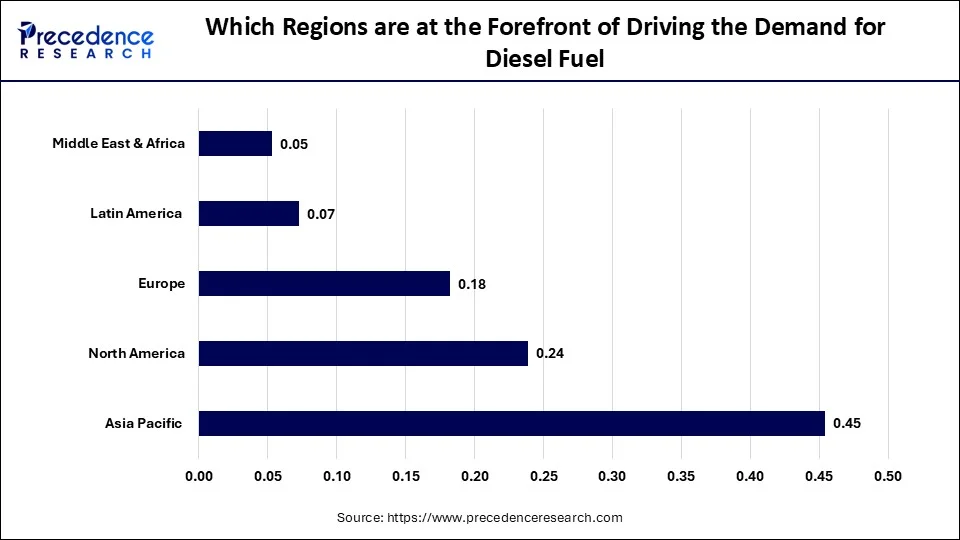
The Asia Pacific region was a winner in the diesel fuel market in 2025 as the region accounted for 45.40% of the market due to industrialization, road transport, construction, agriculture, and essential refining capacity. The North America region, on the other hand, claimed 23.85% of 2025's market share primarily due to the success of trucks, machinery, and established diesel infrastructure. While the Europe region accounted for 18.20% of the market share owing to the regional transport and industry, advancements in electrification and fuel efficiency are driving the market forward. The Latin Americanregion accounted for only 7.25% but it is expected to experience the fastest growth in the future with a CAGR of 4.10% as it will be aided by mining, agriculture, freight, and infrastructure activities. Meanwhile, the Middle East and Africa region accounted for just 5.30% of the total share due to its infrastructure, mining, electricity production, and industrial development potentials.
Expert Analyst View - Regional Analysis
Asia-Pacific is the dominant region in diesel consumption, with China and India being the principal counters of consumption. The demand in this region is mainly driven by the growth of industries, cargo transportation, construction, agricultural machinery usage, and operation of large vehicles. Japan and South Korea also help meet the demand due to their well-established automotive and industrial sectors.
The second largest market for diesel fuel is North America, namely the United States and Canada. In this case, the United States again proves to be a key player, mainly due to its large freight, construction, agriculture, and heavy machinery industries. Fuel infrastructure plays a great role in promoting fuel consumption in the region.
Europe has proved to be a traditional diesel market with Germany, France, the UK, Italy, and Spain being the main players. Germany and France are known for their achievements in cargos and industries, whereas Italy and UK yield high diesel consumption in logistics and agriculture. However, the rise of electrification, fuel efficiency, and regulations has led to the decrease in diesel consumption over the past years.
What are Buyers Prioritizing When Selecting Diesel Suppliers?
Commercial Fleet Buyers
- Delivered Price and Costs: Competitive delivered fuel costs, transparent pricing, discounts, and contract clarity are given importance by buyers.
- Fuel Quality and Availability: Fuel performance continues as a priority area in fuel supply with respect to fuel quality, availability of emergency supply, and product specifications.
- Payment and Sustainability: Fleet card integration into systems, flexible credit terms, compliance to regulations, and access to low-carbon are all influencing how buyers select fuel suppliers.
Industrial and mining buyers
- Reliability of Bulk Supply: Reliable deliveries of bulk fuel continue as an important area for buyers regarding operations particularly at remote and difficult mining and manufacturing sites.
- Fuel Performance: Cold flow characteristics, fuel stability, contamination control, and storage compatibility are also some of the areas of importance for heavy machinery and harsh operating conditions.
- Flexibility in Contracts: Buyers take into account aspects like contract price, minimum volume requirement, payment conditions, and agreements for fuel supply regarding operational requirements.
Marine buyers
- Sulfur Compliance: Marine customers are concerned about the fuels used that meet sulfur regulations and environmental requirements.
- Fuel quality: The standard specifications of fuels, prevention of contamination and performance of fuel are essential for marine engines and equipment on board.
- Documentation & Traceability: Quality certificates and delivery documents and data that makes tracking possible are required in order to be compliant and accountable.
What Factors are Restraining the Growth of Diesel Demand?
Electrification
The rising use of electric cars is making people less dependent on conventional fuels. The IEA predicts that EV usage will cut the demand for diesel and gasoline by more than 5 million barrels per day by 2030 because of the usage of electric buses and trucks.
mprovements in fuel efficiency
The higher the engine efficiency, vehicle aerodynamics and routing improvements, combined with fleet telematics, means that more goods are being carried with less diesel per tonne-kilometer.
Emission standards
Higher standards have necessitated more costly exhaust handling technologies leading to more expensive diesel vehicles.
Economics of refiners
The refining process influences supply as well as crude oil type, maintenance operations, middle-distillate yield and outside market conditions.
Price volatility
Prices are influenced by fluctuations of crude oil prices, refining margin, tax issues as well as crack spreads.
Which Companies are Shaping the Diesel Fuel Supply and Transition?
| Company | Market-Specific Activity |
Strategic Relevance |
| Saudi Aramco | Large integrated crude-to-products refining and fuel-distribution operations | Strong upstream integration and access to large refining capacity |
| ExxonMobil | Conventional diesel refining, ULSD production and renewable diesel development | Combines refining scale with lower-carbon fuel investment |
| Shell | Global fuel retail, refining, mobility and lower-carbon liquid-fuel activities | Strong downstream distribution and commercial-fleet relationships |
| BP | Refining, fuel marketing, mobility and biofuel activities | Integrated fuel supply and transition-fuel portfolio |
| TotalEnergies | Refining, retail fuels and renewable/low-carbon fuel development | Broad geographic downstream footprint |
| Reliance Industries | Large-scale refining and fuel exports from Jamnagar | Major Asia-based refining and export platform |
| Valero Energy | Large refining network and renewable-diesel/low-carbon fuels | Significant North American diesel and renewable-fuel exposure |
| Marathon Petroleum | Large U.S. refining and marketing network | Major conventional middle-distillate supplier |
| Neste | Renewable diesel/HVO production and global distribution | Specialist position in renewable diesel |
| Chevron | Refining, retail and renewable-fuel investments | Integrated conventional and lower-carbon fuel portfolio |
What is the addressable opportunity for diesel fuel suppliers?
TAM
In 2025, the Total Addressable Market (TAM) for diesel fuel is predicted to be about USD 1.11 trillion. This estimate includes both regular diesel as well as diesel-comparable alternatives that are used in industries such as transport, farming, power generating, and mining. Such a wide TAM is indicative of the important role played by diesel in providing mobility and energy in industries all over the world.
SAM
Serviceable Available Market (SAM) considers the diesel applications that can be used with the available fuel supply infrastructure. Key markets are road transportation, commercial fleet, mining, agriculture, renewable diesel/HVO blending, and premium or low-sulfur diesel. These areas make a significant share of diesel usage and serve as the key markets for fuel supply companies and suppliers
SOM
Serviceable Obtainable Market (SOM) should be assessed at the country, refinery, terminal, fleet, and distributing network levelrather than in a standard way for the diesel market. New players can start from entering the most promising countries, getting contracts for the commercial fleet, and deals with industrial and mining customers.
Which strategic questions matter most for diesel suppliers and investors?
Market entry
- Which emerging markets offer the strongest diesel-demand growth?
- Which countries have structural diesel supply deficits?
- Where are new refinery or storage investments changing regional supply balances?
- Which ports provide the best access to diesel-import markets?
Commercial strategy
- Should suppliers prioritize retail, commercial fleets or industrial bulk customers?
- Which fleet segments are least exposed to near-term electrification?
- How much pricing premium can renewable diesel command?
- Which customers are willing to sign long-term low-carbon fuel contracts?
Refining and supply
- Which refinery configurations maximize middle-distillate yields?
- How will crude-slates affect diesel production economics?
- Where are hydrotreater and desulfurization investments required?
- What storage and logistics assets create competitive barriers?
Energy transition
- How rapidly will electric trucks displace diesel demand?
- Which markets will transition first?
- Where can HVO/renewable diesel offset declining fossil-diesel volumes?
- What role will biodiesel blending mandates play in maintaining diesel-compatible fuel demand?
Investment
- Which diesel markets have the most resilient cash flows?
- Which refining assets have strong middle-distillate economics?
- Where can renewable diesel be integrated into existing refinery infrastructure?
- How exposed is a particular asset to long-term passenger-vehicle electrification?
Experts Insights
The diesel fuel market globally is an enormous energy marketplace having matured with low demand growth but significant structural changes in all applications, supply sources, and kinds of fuel types. Petroleum diesel will still be the leading fuel during the analyzed period due to the existence of heavy truck fleet, construction machinery, agricultural machinery, marine engines, and emergency generators installations
Usage becomes increasingly confined to heavy-duty and economically important business domains. Nevertheless, using diesel in passenger vehicles may decrease due to electrification, even though freight transport, mining, agriculture, and many other uses of diesel require maximum capacity, serious utilization, and durability of assets.
The Asia Pacific will be the main area of diesel fuel usage, supported by such developments as industrialization, freight transport, construction, agriculture, and the development of transport activity overall. Developed regions are set to pay attention mostly to efficiency and emissions standards, ultra-low-sulfur products, and alternative fuels with low carbon content.
As for the supply side, the focus of competition is changing toward flexibility of oil refineries, yield of middle distillates, production of ULSD, transportation of fuels, and combining diesel with renewable diesel options.
Our Experts
- The primary market research process was carried out by Laxmi Narayan, Senior Research Associate, who also designed the methodology and did market segmentation, regional trend analysis, buyer intelligence, competitive analysis, and forecasts, laying the foundation for the analytical part of the report.
- Aman Singh, Head of Research, has gathered and checked regulatory policies, company financial information, and various other quantitative information sources, which were obtained independently, thereby increasing the quality of evidence supporting the calculations of the market values.
- Aditi Shivarkar, VP Research, has validated and refined the research material, verified facts, corrected inconsistencies, and completed the research document, making it accurate and to the point.
Diesel Fuel Market Segments Covered in the Report
By Fuel Type
- Petroleum Diesel
- Biodiesel / FAME
- Renewable Diesel / HVO
- Synthetic / Fischer-Tropsch Diesel
- E-Diesel & Other Emerging Fuels
By End-Use Sector
- Road Transportation
- Industrial & Construction
- Agriculture
- Marine
- Power Generation
- Mining
- Railways
- Other Applications
By Transportation Application
- Heavy-Duty Trucks
- Light Commercial Vehicles
- Passenger Vehicles
- Buses & Coaches
- Marine Vessels
- Railways
- Agricultural & Off-Road Vehicles
- Other Transportation
By Fuel Specification / Formulation
- Ultra-Low-Sulfur Diesel
- Low-Sulfur Diesel
- Biodiesel-Blended Diesel
- Renewable Diesel Blends
- Specialty / Premium Diesel
By Distribution Channel
- Retail Fuel Stations
- Commercial Fleet / Direct Supply
- Wholesale Fuel Distributors
- Industrial & Agricultural Bulk Supply
- Marine Bunkering
- Online / Digital B2B Procurement
By Region
- North America
- United States
- Canada
- Mexico
- Europe
- Germany
- France
- United Kingdom
- Italy
- Spain
- Poland
- Netherlands
- Other Europe
- Asia Pacific
- China
- India
- Japan
- South Korea
- Indonesia
- Australia
- Southeast Asia
- Other Asia Pacific
- Latin America
- Brazil
- Mexico
- Argentina
- Colombia
- Chile
- Peru
- Other Latin America
- Middle East & Africa
- Saudi Arabia
- South Africa
- United Arab Emirates
- Egypt
- Nigeria
- Algeria
- Other Middle East & Africa
For inquiries regarding discounts, bulk purchases, or customization requests, please contact us at sales@precedenceresearch.com
Frequently Asked Questions





Ask For Sample
No cookie-cutter, only authentic analysis – take the 1st step to become a Precedence Research client
 Get a Sample




 sales@precedenceresearch.com
 Schedule a Meeting
