



Digital Evidence Management Market Trends, Companies, Revenue / Sales Performance, Subscriber Growth, Pricing Strategies, Cloud Adoption, Infrastructure Expansion, Competitive Landscape, and Industry Outlook
Digital Evidence Management Market (By Component: Hardware, Software, Services; By Deployment Mode: Cloud, On-premise; By End User: Law Enforcement Agencies, Criminal Justice Agencies, Others) - Global Industry Analysis, Size, Trends, Leading Companies, Regional Outlook, and Forecast 2026 to 2035
Source: https://www.precedenceresearch.com/digital-evidence-management-market
 Get a Sample
 Table Of Content


What is the Digital Evidence Management Market Size?
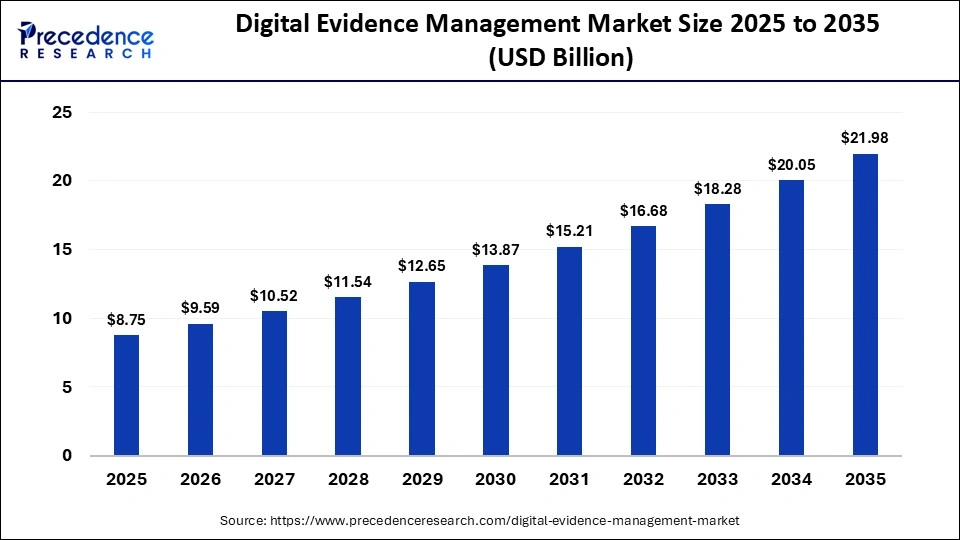
The global digital evidence management market size accounted for USD 8.75 billion in 2025 and is predicted to increase from USD 9.59 billion in 2026 to approximately USD 21.98 billion by 2035, expanding at a CAGR of 9.65% from 2026 to 2035. The market is expanding as law enforcement agencies, legal institutions, and enterprises increasingly rely on secure platforms to store, manage, and share digital files, such as video, audio, images, and case records. Growing adoption of body-worn cameras, surveillance systems, and cloud-based storage solutions is driving demand. Enhanced cybersecurity requirements, chain-of-custody compliance, and the need for efficient evidence retrieval further support market growth globally.
Key Takeaways
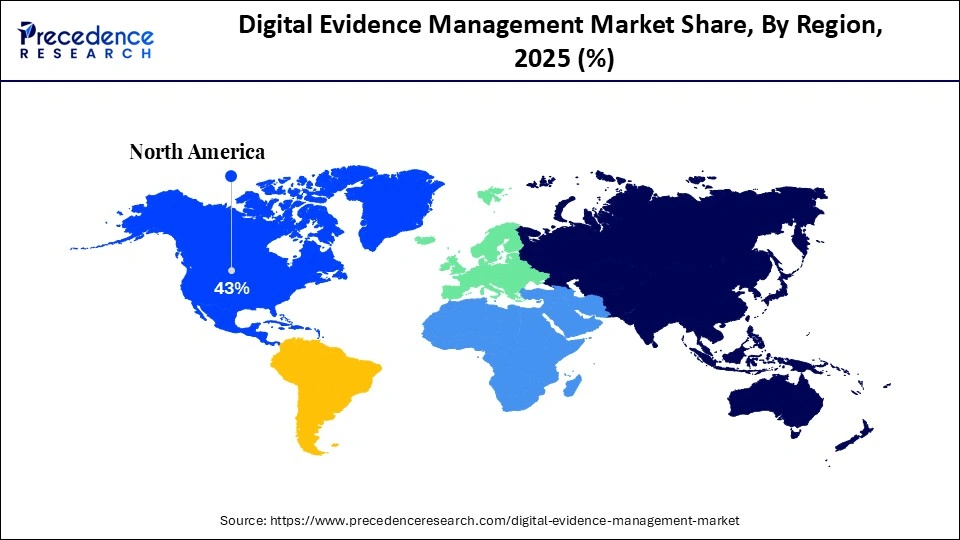
- North America led the digital evidence management market share of 43% in 2025.
- Asia-Pacific is expected to expand at the highest CAGR in the market between 2026 and 2035.
- By component, the software segment held a dominant revenue share of 43% in the market in 2025.
- By component, the services segment is growing at a notable CAGR between 2026 and 2035.
- By deployment mode, the cloud segment led the market in 2025.
- By deployment mode, the on premise segment is expected to expand rapidly in the upcoming period.
- By end user, the law enforcement agencies segment held a dominant market share of 41% in 2025.
- By end user, the criminal justice agencies segment is projected to grow at a solid CAGR of between 2026 and 2035.
How is the Digital Evidence Management Market Gaining Strategic Importance?
Digital evidence management refers to secure software platforms used to collect, store, organize, analyze, and share digital files such as surveillance footage, body-camera recordings, audio files, images, and electronic documents for legal and investigative purposes. The market is gaining strategic importance as agencies handle growing volumes of digital data and require secure cloud storage, automated chain-of-custody tracking, cybersecurity protection, and faster evidence retrieval to support transparent investigations and judicial processes.
How Can AI Integration Transform the Digital Evidence Management Market?
AI integration can significantly transform the digital evidence management industry by automating evidence sorting, tagging, and analysis across large volumes of video, audio, and image data. Technologies such as facial recognition, object detection, and speech-to-text transcription enable faster identification of critical information. AI-driven redaction tools also protect sensitive data before courtroom presentation. Predictive analytics can identify patterns across cases, improving investigative efficiency, reducing manual workload, and strengthening the accuracy and speed of legal proceedings.
Primary Trends Influencing the Digital Evidence Management Market
- Shift Toward Cloud-Based Evidence Platforms: Law enforcement agencies and legal institutions are increasingly adopting secure cloud-based systems instead of on-premise storage. Cloud deployment enables scalable data storage, remote access, automatic updates, and disaster recovery capabilities. It also reduces infrastructure costs while improving collaboration between departments, prosecutors, and courts, making digital evidence handling faster and more efficient.
- Integration of AI and Analytics: Advanced AI tools are being integrated to automatically tag, categorize, and analyze large volumes of video, audio, and image data. Features such as facial recognition, object detection, speech-to-text transcription, and pattern recognition help investigators locate critical evidence quickly. This reduces manual workload and improves case resolution speed.
- Growing Adoption of Body-Worn and In-Car Cameras: The increasing use of body-worn cameras, dashcams, and public surveillance systems is generating massive amounts of digital content. This surge in data requires structured evidence management systems that ensure secure storage, metadata tagging, and tamper-proof chain-of-custody tracking to maintain legal admissibility.
- Stronger Cybersecurity and Compliance Requirements: As digital evidence contains sensitive and confidential information, agencies are investing in enhanced encryption, multi-factor authentication, and strict access controls. Regulatory compliance, audit trails, and secure data-sharing frameworks are becoming critical to protect evidence integrity and prevent breaches.
- Interoperability with Judicial and Law Enforcement Systems: Modern digital evidence platforms are increasingly designed to integrate with records management systems, court databases, and case management software. Seamless data exchange reduces administrative delays, improves transparency, and ensures smoother coordination between investigators, prosecutors, and judicial authorities.
Market Scope
| Report Coverage | Details |
| Market Size in 2025 | USD 8.75 Billion |
| Market Size in 2026 | USD 9.59 Billion |
| Market Size by 2035 | USD 21.98 Billion |
| Market Growth Rate from 2026 to 2035 | CAGR of 9.65% |
| Dominating Region | North America |
| Fastest Growing Region | Asia Pacific |
| Base Year | 2025 |
| Forecast Period | 2026 to 2035 |
| Segments Covered | Component, Deployment Mode, End User, and Region |
| Regions Covered | North America, Europe, Asia-Pacific, Latin America, and Middle East & Africa |
Market Dynamics
Driver
Rising Use of Digital Policing Tools
Market growth can be attributed to an increase in the use of body-worn cameras, closed-circuit television (CCTV), smartphones, dashboard cameras, and digital forensics solutions that provide large amounts of data for the government to analyze.
Restraint
Data Privacy and Security Concerns
There could be limitations on market development due to data protection issues. This is because digital evidence includes private information about people's lives and criminal activity. Any data leak, breach, or mismanagement of evidence could have an impact on investigations.
Opportunity
Growing Adoption of Cloud-Based Evidence Platforms
The cloud-based digital evidence platforms present good growth opportunities for the company. The reason is that such platforms will enable agencies to hold big files, remotely access evidence, collaborate on a case, and even lower physical storage requirements.
Segmental Insights
Component Insights
Why Was the Software Segment Dominant in the Digital Evidence Management Market?
The software segment held the largest revenue share of 43% the market in 2025 because core platforms control evidence ingestion, storage, indexing, access control, and secure sharing. Agencies prioritize scalable cloud-based systems with automated chain-of-custody tracking, audit logs, encryption, and AI-powered search capabilities. Software solutions integrate with body cameras, surveillance systems, and court databases, enabling centralized management. Continuous updates, cybersecurity enhancements, and compliance features further strengthen demand for advanced evidence management software.
The services segment is expected to show lucrative growth in the market during the forecast period, due to the increasing demand for system integration, cloud migration, consulting, training, and ongoing technical support. Agencies require expert assistance to implement secure platforms, ensure compliance with legal standards, and manage large-scale data transitions. Continuous software updates, cybersecurity monitoring, and customization needs are further driving reliance on managed and professional service providers.
Deployment Mode Insights
How the Cloud Segment Dominated the Digital Evidence Management Market?
The cloud segment contributed the biggest revenue share of the market in 2025 because law enforcement agencies are increasingly shifting to centralized digital platforms that handle growing volumes of video, image, and audio files generated by body cameras and surveillance systems. Cloud deployment enables secure remote access, automated backups, encrypted storage, and faster inter-agency collaboration. It also reduces dependency on physical servers while improving scalability, disaster recovery readiness, and system-wide evidence synchronization.
The on premises segment is expected to be the fastest-growing segment over the studied years because many law enforcement and government agencies prioritize full control over sensitive data, prefer localized storage within secure infrastructure, and must comply with strict internal policies or national data protection laws. On-premises deployments also reduce reliance on external networks, minimize risk of third-party breaches, and integrate with legacy systems already used by security and judicial departments.
End User Insights
Which End User Segment Led the Digital Evidence Management Market?
The law enforcement agencies segment led the market share of 41% in 2025 because agencies generate and manage extensive volumes of digital evidence from body-worn cameras, dashcams, surveillance networks, and mobile forensic tools. Increased investments in centralized evidence platforms, automated chain-of-custody tracking, and secure data-sharing systems are strengthening adoption. Compliance requirements, courtroom admissibility standards, and the need for faster case processing continue to drive sustained demand within police and public safety departments.
The criminal justice agencies segment is expected to gain the highest market share between 2026 and 2035 because courts, prosecutors, and forensic departments are increasingly adopting digital evidence platforms to manage case files, video exhibits, and electronic records more efficiently. Growing digitization of legal proceedings, emphasis on secure evidence sharing between law enforcement and judicial bodies, and the need for transparent chain-of-custody documentation are driving this rapid uptake across the criminal justice ecosystem.
Regional Insights
What is the North America Digital Evidence Management Market Size?
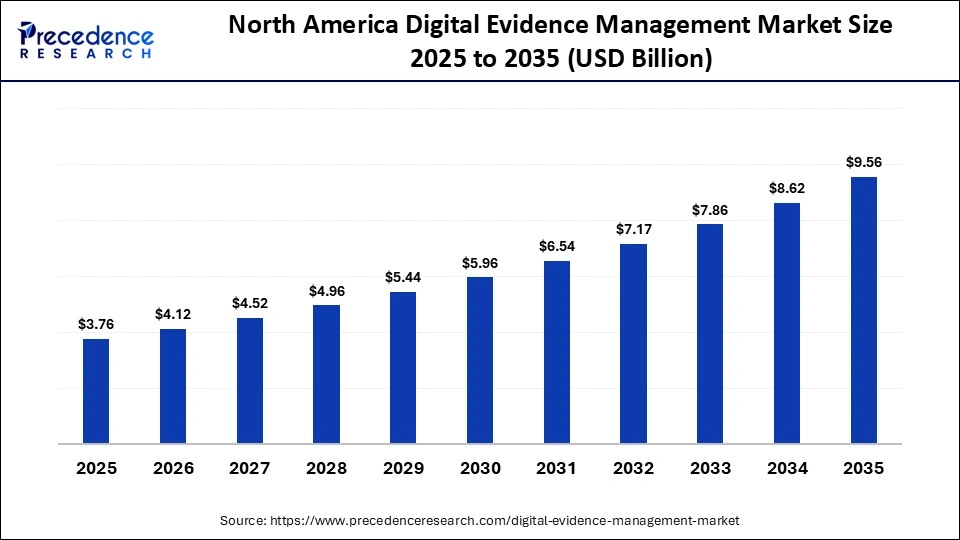
The North America digital evidence management market size is estimated at USD 3.76 billion in 2025 and is projected to reach approximately USD 9.56 billion by 2035, with a 9.78% CAGR from 2026 to 2035.
Why North America Dominated the Digital Evidence Management Market?
North America held a major revenue share of the market share of 43% in 2025, due to widespread adoption of body-worn cameras and surveillance technologies by police agencies, strong government funding for public safety digitalization, and advanced IT infrastructure supporting cloud and analytics integration. Strict legal requirements around evidence handling and chain-of-custody protocols drive demand for secure, scalable systems, while collaboration between law enforcement, prosecutors, and courts accelerates unified evidence workflows across the region.
U.S. Digital Evidence Management Market Size and Growth 2026 to 2035
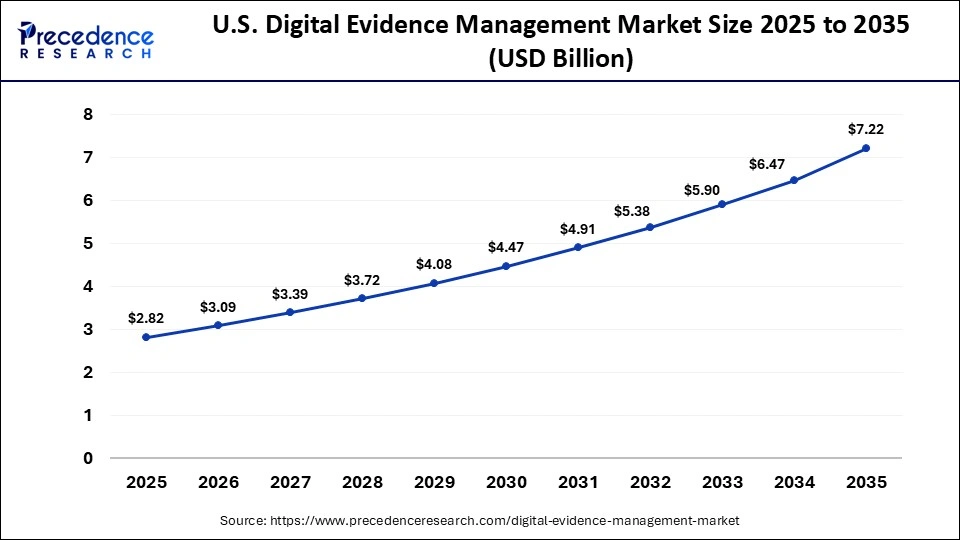
The U.S. digital evidence management market size is calculated at USD 2.82 billion in 2025 and is expected to reach nearly USD 7.22 billion in 2035, accelerating at a strong CAGR of 9.68% between 2026 and 2035.
U.S. Market Trends
In the U.S., the digital evidence management industry is shaped by widespread deployment of body-worn cameras, in-car systems, and public surveillance feeds that generate massive digital data. Law enforcement agencies are prioritizing secure, integrated platforms to streamline evidence ingestion, automated tagging, and chain-of-custody tracking. Strong federal and state funding for public safety technology, rising demand for cloud-based solutions, and emphasis on transparency in investigations are key drivers of national adoption.
Why is Asia-Pacific Experiencing the Fastest Growth in the Digital Evidence Management Market?
Asia-Pacific is expected to witness the fastest growth during the predicted timeframe, due to the rapid expansion of surveillance infrastructure, increasing deployment of body-worn cameras, and rising digital transformation initiatives within law enforcement and judicial systems. Governments across countries such as China, India, Japan, and Australia are modernizing public safety operations with integrated digital platforms. Growing urban populations, cross-border security concerns, cloud adoption, and improving cybersecurity frameworks are further accelerating regional demand for advanced evidence management solutions.
China Market Trends
China's market is being driven by widespread government mandates for standardized evidence handling and secure retention of body-worn camera and CCTV footage across provinces. Local law enforcement agencies are investing in domestic cloud and hybrid storage solutions that comply with Chinese cybersecurity and data sovereignty laws. There is also a strong focus on AI-powered evidence search and automated forensic tagging, helping reduce investigation time and minimize manual processing.
How Big is the Opportunity for the Growth of Europe in the Market?
Europe is expected to grow at a notable CAGR in the digital evidence management market in the foreseeable future, driven by stricter data governance and evidence integrity standards under initiatives like the EU's e-Justice Action Plan and GDPR-aligned security policies. Member states are investing in interoperable evidence platforms to support cross-border criminal investigations. Rising deployment of body-worn cameras and public surveillance networks, alongside demand for secure cloud and AI-enhanced analytics, is creating significant opportunities for advanced evidence management solutions.
France Market Trends
France has a rich history of technological innovations, making digital evidence management its next frontier. The increasing use of CCTV cameras, growing public investments in the digital sector, and evolving regulatory landscape contribute to market growth. The growing adoption of smartphones helps citizens thwart crime by capturing and sharing photos and videos. In France, the smartphone adoption is projected to reach 56.89 million by 2029.
Will the Middle East and Africa Grow in the Digital Evidence Management Market?
The Middle East and Africa region is expected to grow at a considerable CAGR in the upcoming period, due to government-led smart policing programs in the United Arab Emirates and Saudi Arabia, rising cybercrime investigations in South Africa and Nigeria, and expanding city-wide surveillance networks. Adoption is accelerating through cloud-hosted evidence repositories, AI-based video analytics, mobile evidence upload tools, and stricter digital chain-of-custody compliance frameworks across judicial systems.
UAE Market Trends
The growing awareness of digital evidence management, the rising adoption of advanced technologies, and favorable government policies propel the market in the UAE. According to new rules, Dubai's courts prefer 100% digital filing since the pre-pandemic era. This aligns with the government's Smart Dubai vision. Thus, numerous digital forensics and investigation service providers work to minimize damage, preserve critical evidence, and restore operations.
What are the Key Trends in the Digital Evidence Management Market in Latin America?
Latin America is expected to witness substantial growth in the market. This growth is driven by increasing urbanization, rising crime rates and the adoption of advanced technologies in law enforcement. Countries like Brazil and Mexico are leading players, as they are investing heavily in digital infrastructure to enhance public safety and security measures. The competitive landscape is evolving steadily, with both local and international players competing for market share.
Brazil Market Trends
Companies in the region are expanding their presence, offering innovative solutions tailored to the unique needs of the region. There is also a growing emphasis on smart city initiatives and public safety, which is further propelling the demand for digital evidence management systems.
Competitive Landscape
The digital evidence management market is moderately fragmented with robust competition among technology companies, cloud platforms, cybersecurity solutions providers, and law enforcement solutions vendors. Competitors are competing through product development, collaborations with public safety organizations, and integration with body-worn cameras, video surveillance systems, and forensic applications.
Cybercrime, digital forensics, and faster processing of digital evidence are leading players to automate their solutions and increase their levels of data security. High-level regulatory compliance, stringent data privacy requirements, and a significant level of trust deter new entrants into the market.
What are the Government Initiatives in the Digital Evidence Management Market?
- The U.S. Department of Justice established the Body-Worn Camera Policy & Implementation Program to facilitate digital evidence collection and management by law enforcement agencies.
- The Government of India has implemented the Interoperable Criminal Justice System (ICJS) 2.0 that aims at enhancing the process of sharing digital evidence, e-forensic, and conducting paperless investigations.
- The Uttar Pradesh government improved its cyber forensic capacity through mobile forensic vans and forensic tools that became an essential part of any investigation.
- The Japanese government has been backing up digital policing through the Digital Agency project that envisaged greater investments in cloud-based digital evidence management and cyber forensics systems.
- I4C in India collaborated with forensic institutes and provided training for cybersecurity and digital evidence investigation for police officials.
Digital Evidence Management Market Comapnies
- Axon Enterprise, Inc.
- Guardify
- Cellebrite
- Digital Ally, Inc.
- Hitachi, Ltd.
- IBM Corporation
- Motorola Solutions
- NICE Ltd.
- OpenText Corporation
- Oracle Corporation
- Panasonic Corporation
- Safe Fleet
- Tracker Products LLC
- Verint Systems Inc.
- VIDIZMO LLC
Industry Developments
Governments all over the world are increasingly recognizing the importance of investing in law enforcement technology in order to enhance public safety and security. This influx of funding helps to create opportunities for DEM solution providers to collaborate with law enforcement agencies and develop tailored solutions that meet their specific needs.
Law enforcement agencies are also increasingly prioritizing the implementation of advanced security protocols to safeguard digital evidence from unauthorized access and cyber threats. This trend underscores the importance of integrating strong security features into digital evidence management systems to ensure the integrity and confidentiality of digital evidence.
Recent Developments
- In March 2026, Cellebrite launched the AI-powered “Guardian Investigate” platform to help investigators manage digital evidence, track case activities, and improve collaboration across law enforcement agencies during complex investigations.
(Source: https://www.investing.com) - In February 2026, Motorola Solutions' SVX body-worn assistant and CommandCentral DEMS received FedRAMP High authorization, allowing federal agencies to adopt its secure, AI-enabled evidence management tools with the highest cloud security clearance, expanding its federal footprint for digital evidence solutions.
(Source: https://www.motorolasolutions.com) - In December 2025, Axon announced a major redesign of Axon Evidence with a revamped interface, improved navigation, search, metadata display, and admin experience. These updates streamline evidence workflows, make searching and organizing files more intuitive, and lay the foundation for future enhancements in case and community request management in 2026.
(Source: https://www.axon.com) - In June 2025, Milestone Systems introduced XProtect Evidence Manager, a scalable digital evidence solution that enhances evidence workflows and sharing without additional licensing. It enables hybrid cloud/on-premises storage and streamlines case organization. The platform supports secure, cross-agency sharing via password-protected links, helping agencies improve efficiency and reduce costs.
(Source: http://www.milestonesys.com) - In May 2025, Cellebrite rolled out its Spring 2025 release, featuring the Cellebrite Cloud foundation and expanded AI analytics across its forensic suite. The update enhanced media analysis, timeline review, automated transcription, translation workflows, and hybrid cloud integration, accelerating evidence review and investigation processes for law enforcement while maintaining secure data handling.
(Source: https://investors.cellebrite.com)
Segments Covered in the Report
By Component
- Hardware
- Software
- Evidence Collection, Storage, and Sharing
- Evidence Analytics and Visualization
- Evidence Security
- Services
- Digital Investigation and Consulting
- System Integration
- Support and Maintenance
- Training and Education
By Deployment Mode
- Cloud
- On-premise
By End User
- Law Enforcement Agencies
- Criminal Justice Agencies
- Others
By Region
- North America
- Europe
- Asia-Pacific
- Latin America
- Middle East & Africa
For inquiries regarding discounts, bulk purchases, or customization requests, please contact us at sales@precedenceresearch.com
Frequently Asked Questions





Ask For Sample
No cookie-cutter, only authentic analysis – take the 1st step to become a Precedence Research client
 Get a Sample




 sales@precedenceresearch.com
 Schedule a Meeting
