



Driving Simulator Market Size, Companies, Share, Vehicle Production Volume, Sales Performance, Export & Import Analysis, Technology Adoption, Competitive Positioning, and Demand Trends
Driving Simulator Market (By Vehicle Type: Passenger Cars, Commercial Vehicles; By Application: Training, Testing and Research; By Simulator Type: Compact Simulators, Full-Scale Simulators, Advanced Simulators; By End-User: Driving Schools and Training Centers, Automotive OEMs, Fleet Operators and Logistics, Academic and Research Institutions) - Global Industry Analysis, Size, Trends, Leading Companies, Regional Outlook, and Forecast 2026 to 2035
Source: https://www.precedenceresearch.com/driving-simulator-market
 Get a Sample
 Table Of Content


What is Driving Simulator Market Size in 2026?
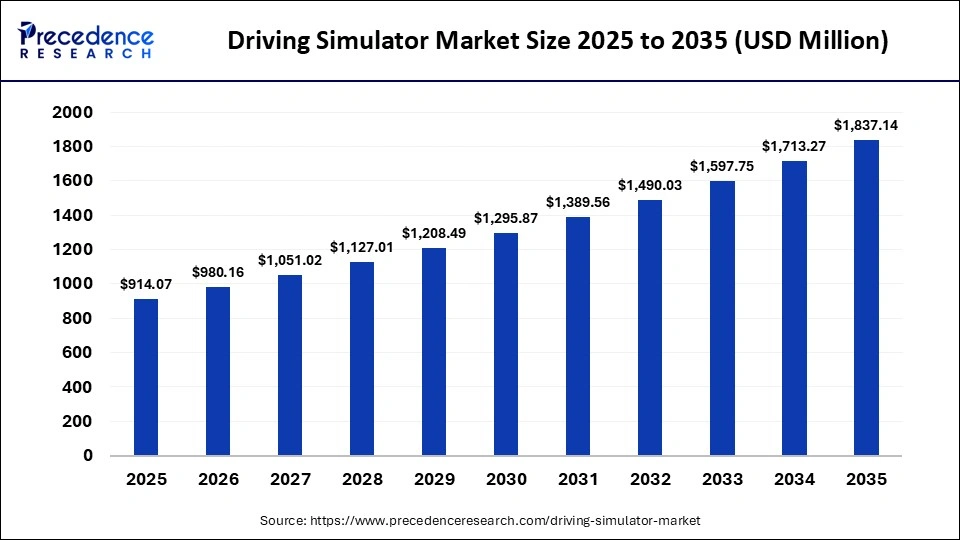
The global driving simulator market size was calculated at USD 914.07 million in 2025 and is predicted to increase from USD 980.16 million in 2026 to approximately USD 1837.14 million by 2035, expanding at a CAGR of 7.23% from 2026 to 2035. The market is on an upward trend owing to the growing demand for vehicle testing and driver training solutions, which are safe, economic, and affordable. The increasing road safety issues, technological advancements in the automotive industry, and the blistering emergence of autonomous vehicles are the most important growth drivers.
Key Takeaways
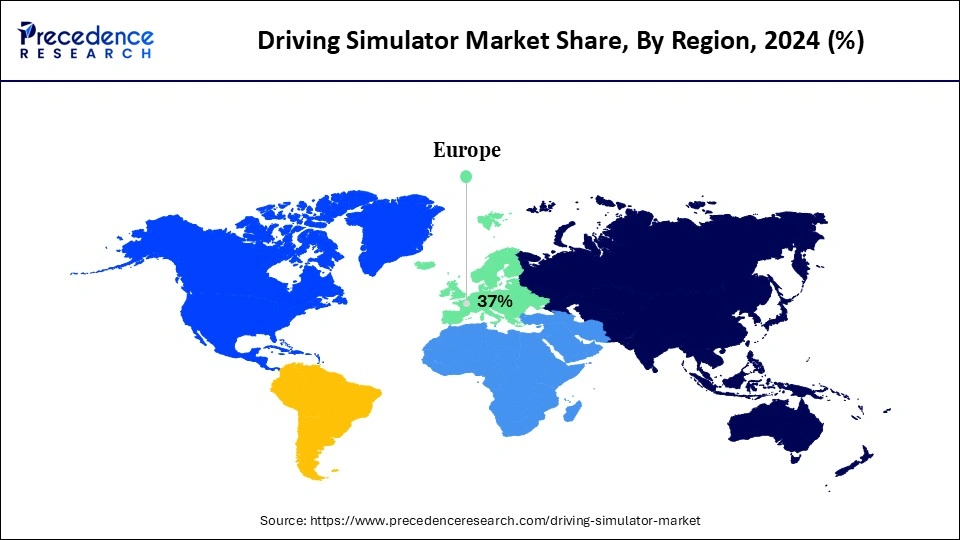
- Europe dominated the global driving simulator market with the largest market share of 37% in 2025.
- Asia-Pacific is expected to grow at the fastest CAGR in the market during the forecast period.
- By vehicle type, the passenger cars segment held a dominant position in the market in 2025.
- By vehicle type, the commercial vehicles segment is expected to grow at the fastest CAGR in the market between 2026 and 2035.
- By application type, the training segment led the global market in 2025.
- By application type, the testing and research segment is expected to grow with the highest CAGR in the market during the studied years.
- By simulator type, the compact simulators segment dominated the global market in 2025.
- By simulator type, the advanced simulators segment is expected to expand rapidly in the market in the coming years.
- By end-user, the driving schools and training centers segment held the largest market share in 2025.
- By end-user, the fleet operators and logistics segment is expected to witness the fastest growth in the coming years.
Driving Simulator: Accelerating Innovation through Virtual Mobility
The driving simulator market is growing at a steady pace due to the adoption of simulation-based testing and learning tools by both automotive manufacturers and training institutions. Simulators minimize risks in testing the real world and enhance the efficient development and compliance with regulations. The growth of high-fidelity simulation platforms is driven by the need to have an increased integration of advanced driver-assistance systems (ADAS) and autonomous technologies. An increase in defense, aviation-style simulation training models, and commercial fleet training programs is also encouraging market growth.
How AI is Transforming Driving Simulators?
The field of artificial intelligence (AI) is transformative in the work of present-day driving simulators because it allows modelling the behavior of traffic and the predictive generation of scenarios. AI algorithms improve sensor modelling to test the ADAS and self-driving cars. Machine learning (ML) algorithms can be used to process data on driver performance to enhance the results of safety training. Moreover, AI-based analytics streamline simulation platforms in terms of real-time flexibility and testing of large scenarios. AI and ML can mimic complex traffic, sensor data, and edge cases to accelerate AI development safely.
Driving Simulator Market Trends
- Autonomous Vehicle Validation: The complexity of self-driving and ADAS systems is growing and making high-precision simulation environments increasingly dependent on validation and compliance testing.
- Virtual Reality and Augmented Reality: A combination of virtual reality (VR) and augmented reality (AR) technologies increases the experience of immersive driver training and male simulation of car test cases.
- Cloud-Based Simulators: Cloud-based platforms support remote collaboration, scalable simulation environments, and real-time data sharing among other global R&D centers.
- Increasing Use in Training and Education: Simulators are becoming popular with commercial driving schools and fleet operators, as well as defense organizations, to minimize accidents and operations.
- AI and Data-Driven Analytics: State-of-the-art analytics systems offer significant driver performance and predictive safety measurements.
Market Scope
| Report Coverage | Details |
| Market Size in 2025 | USD 914.07 Million |
| Market Size in 2026 | USD 7.23 Million |
| Market Size by 2035 | USD 1837.14 Million |
| Market Growth Rate from 2026 to 2035 | CAGR of 7.23% |
| Dominating Region | Europe |
| Fastest Growing Region | Asia Pacific |
| Base Year | 2025 |
| Forecast Period | 2026 to 2035 |
| Segments Covered | Vehicle Type, Application Type, Simulator Type, End-User, and Region |
| Regions Covered | North America, Europe, Asia-Pacific, Latin America, and Middle East & Africa |
Segmental Insights
Vehicle Type Insights
Why the Passenger Cars Segment Dominated the Driving Simulator Market?
The passenger cars segment dominated the market in 2025, due to the increasing global production of passenger cars and the need for trained professionals. In the case of passenger vehicles, OEMs and the development of ADAS heavily depend on simulators. Passenger car simulators are mostly used in beginner driving courses and defensive driving courses at driving schools. Enhanced safety regulations and higher standards of licensing are also in favor of demand. The segmental growth is also attributed to continuous innovations in electric and connected passenger vehicles.
The commercial vehicles segment is expected to show the fastest growth over the forecast period, because of the rising logistics, e-commerce, and fleet growth all over the world. Training in safety, fuel efficiency, and hazard perception of truck and bus drivers is commonly done with simulators. An increase in regulatory pressure over heavy vehicle safety compliance increases the adoption. The increase in electric trucks and autonomous commercial vehicles also contributes to the need to develop advanced simulation testing. The demand among the fleet operators to use simulators to minimize costs associated with accidents is on the rise.
Application Type Insights
Which Application Type Segment Dominated the Driving Simulator Market?
The training segment contributed the biggest market share in 2025, since simulators have been adopted extensively in the driving schools, military agencies, and commercial fleet operators. They offer a secure environment to train for dangerous conditions on the road. Training through simulation tools saves fuel costs and wear on the vehicle. Simulation-based learning is becoming popular in governments when it comes to licensing programs. The integration of scalability and a standardized curriculum supports the dominance of segments.
The testing and research segment is expected to gain the highest market share between 2026 and 2035, because of the rapid progress in the sphere of ADAS and autonomous vehicles. OEMs use simulators to test the performance of sensors and their safety algorithms. The transition to electric and connected cars makes it more difficult to test vehicles. Virtual scenario modelling saves time-to-market and development costs. The partnership between auto companies and research centers promotes the growth of the segments.
Simulator Type Insights
How the Compact Simulators Segment Dominated the Driving Simulator Market?
The compact simulators segment registered its dominance over the global market in 2025 because of low prices and ease of installation. Compact units are used in driving schools and small training centers to learn basic driving. They take lesser space and need less maintenance as opposed to full-motion systems. Small units offer necessary amenities like steering feedback and simulation of visual art. They are cost-effective and can be used in large quantities in the emerging markets.
The advanced simulators segment is expected to witness the fastest growth in the market over the forecast period, as there is growing demand for high-fidelity motion platforms and immersive environments. These systems have been fitted with 360 ° images, VR, and multi-axis motion control. They are utilized to test complex scenarios by automotive OEMs and defense agencies. Representative analytics and real-time data capture, powered by AI leads to better training. An increase in funds spent on the development of autonomous vehicles increases the necessity of sophisticated platforms.
End-User Insights
Which End-User Segment Led the Driving Simulator Market?
The driving schools and training centers segment led the market in 2025, as driving schools play a vital role in training beginners and offering defensive driving courses. Simulation hours are increasingly being integrated into the licensing systems by regulatory bodies. Simulators save costs involved in operating the business, such as fuel, insurance, and vehicle maintenance. They allow guidance in bad weather and traffic conditions. Segment leadership is maintained by growing urbanization and increased new driver registration.
The fleet operators and logistics segment is expected to expand rapidly in the market in the coming years because of the increased attention to driver safety and efficiency. Driving simulators are used by logistics companies to teach drivers fuel-efficient and defensive driving skills. The increase in costs and insurance premiums associated with accidents stimulates the use of simulators. The growth of electric and autonomous fleets brings about a greater need for technology-related training. Fleet-level adoption is also enabled by continuous tracking and analytics.
Regional Analysis
Europe Driving Simulator Market Size and Growth 2026 to 2035
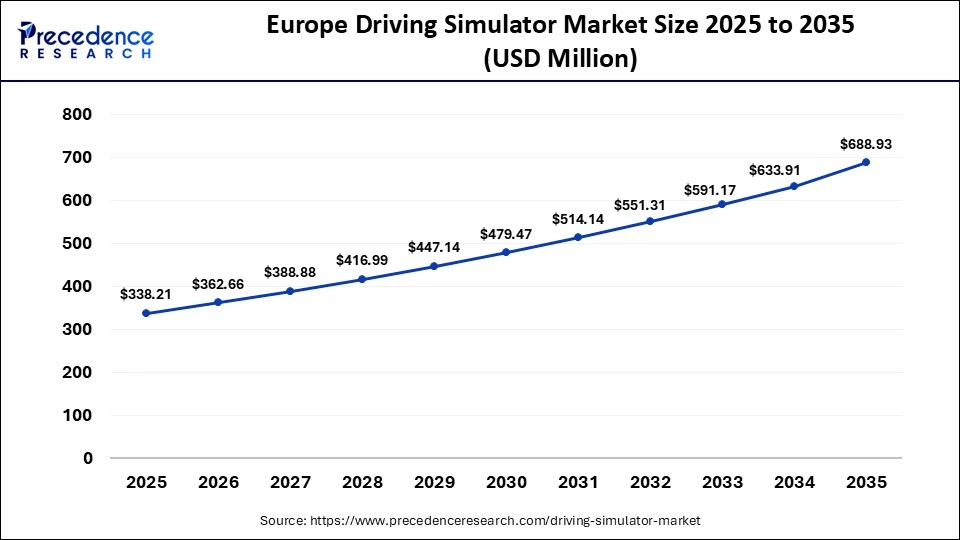
The Europe driving simulator market size is expected to be worth USD 688.93 million by 2035, increasing from USD 338.21 million by 2025, growing at a CAGR of 7.37% from 2026 to 2035.
Why Europe Dominated the Driving Simulator Market?
Europe held a major market share in 2025, due to the presence of automobile manufacturing and R&D facilities. The area boasts a few of the largest providers of simulator technology and automotive OEMs. Extensive regulatory laws on road safety promote simulator-based driving education and testing of vehicles. The high level of electric and autonomous vehicle creation contributes to demand.
Innovation programs supported by the government also promote the use of simulation technologies. An increasing focus on sustainability and online mobility is favorable to the market. The rising demand for safe and cost-effective vehicle testing and driver training solutions also contributes to market growth.
Country-Level Analysis
Germany is the leader on a country level since it has a good automotive sector and high-level research facilities. France is offering powerful transportation training programs and defense simulation applications. The United Kingdom is one of the countries that promotes growth with automotive innovation and testing. Italy and Sweden also show consistent change in automotive R&D. Nordic countries focus on the standards of road safety training.
Why is Asia-Pacific the Fastest-Growing Region in the Driving Simulator Market?
Asia-Pacific is expected to experience the fastest growth during the predicted timeframe, due to the increasing urbanization and production of vehicles. Government programs and awareness of road safety encourage training in a simulator. Increased investments in the production of electric vehicles intensify the need to have testing platforms. The development of logistics and transportation industries also contributes to the development of the market. Increased technological usage in the emerging economies enhances growth. The presence of cost-effective manufacturing also increases the regional competitiveness.
Country-Level Analysis
China is a regional leader in the Asia-Pacific, driven by mass production of automobiles and intelligent mobility projects. Japan plays the role of a developed automotive R&D and integration of robotics. India has great potential owing to the emerging demand in driver training and fleet growth. South Korea favors innovation in self-driving car testing. Southeast Asian countries are also modernizing the system of driver education.
Will North America Grow in the Driving Simulator Market?
North America is expected to grow at a notable CAGR in the foreseeable future, driven by technological innovations and high automotive research potential. The growth of autonomous and connected vehicles is intensifying, and this drives the need for simulators. The technological background in the region is enhanced by defense and aviation simulation skills. The increased attention to commercial fleet safety also enhances adoption. Safety standards set by the government promote structured driver training programs. Investments in AI and cloud-based technologies are increasing, promoting market growth.
Country-Level Analysis
The U.S. is at the forefront in North America because it has high spending on automotive research and development and the manufacturing of autonomous vehicles. The U.S. enjoys a good partnership between technology companies and the car manufacturers. The rising production of electric vehicles adds complexity to the testing. Safety regulations at the federal and state levels are in favor of the adoption of simulators. Canada is contributing to well-developed transportation research.
Driving Simulator Market Value Chain Analysis
- Raw Material Sourcing: High-grade materials such as metals, electronic parts, display panels, sensors, and materials of the motion platform are raw materials. Suppliers offer structural frames and enhanced, robust computing hardware.
Key Players: NVIDIA, Intel, Bosch, and Panasonic - Component Manufacturing: Manufacturing of components includes the making of motion systems, steering assemblies, control interfaces, visual displays, and computing units. Precision engineering has ensured that they have good force feedback and motion realism.
Key Players: Moog Inc, Thales Group, Siemens, and Continental AG - Vehicle Assembly and Integration: The step involves the integration of hardware, software platforms, VR systems, and AI-based analytics into a full simulator system.
Key Players: VI-grade, Ansible Motion, IPG Automotive, and Cruden BV. - Testing and Quality Control: Before they are deployed, simulators are calibrated, the scenario is tested, and hardware performance is tested. Sensor emulation and motion feedback are important to reliability.
Key Players: TUV SUD, SGS SA, Bureau Veritas, and UL Solutions - Distribution to Dealers and OEMs: Simulators are sold by manufacturers to OEMs of automobiles, defense, and training institutions. Long-term supply contracts are backed by strategic alliances with car manufacturers.
Key players: Bosch Engineering, Siemens Digital Industries, Thales, and CAE. - Retail Sales and Financing: Retail sales are mostly aimed at driving schools, fleet operators, and special training centers. High-cost simulators are now available to small institutions through leasing and financing options.
Key Players: NVIDIA, Intel, Bosch, and Panasonic
Recent Developments in the Driving Simulator Market
- In February 2026, Waymo released Waymo World Model, an even more advanced generative AI simulator that runs on Generative 3 of Google DeepMind. The system creates extremely realistic three-dimensional driving environments to test and certify autonomous cars. It emulates infrequent and complicated scenarios, enhancing the performance of safety testing and hastening the greater implementation of self-driving technology.
(source: https://waymo.com) - In June 2025, VI-grade launched Hexarev, an innovative driving simulation tool designed to enhance vehicle development processes. The Driver-in-the-loop (DIL) motion platform integrates real-time data analysis and immersive environments, allowing engineers to efficiently test and validate vehicle performance. It aims to improve simulation accuracy and accelerate the development of advanced automotive technologies.
Top Companies in the Driving Simulator Market
- ECA Group
- AV Simulation
- VI-Grade
- L3Harris Technologies
- Cruden
- Zen Technologies
- Ansible Motion
- XPI Simulation
- Virage Simulation
- AB Dynamics
- IPG Automotive
- AutoSim
- Tecknotrove Systems
- Tianjin Zhonggong Intelligent
- Beijing Ziguang Legacy Science and Education
- Beijing KingFar
- Fujian Couder Technology
- Shenzhen Zhongzhi Simulation
Segments Covered in the Report
By Vehicle Type
- Passenger Cars
- Commercial Vehicles
By Application
- Training
- Testing and Research
By Simulator Type
- Compact Simulators
- Full-Scale Simulators
- Advanced Simulators
By End-User
- Driving Schools and Training Centers
- Automotive OEMs
- Fleet Operators and Logistics
- Academic and Research Institutions
By Region
- North America
- Europe
- Asia-Pacific
- Latin America
- Middle East & Africa
For inquiries regarding discounts, bulk purchases, or customization requests, please contact us at sales@precedenceresearch.com
Frequently Asked Questions
Tags





Ask For Sample
No cookie-cutter, only authentic analysis – take the 1st step to become a Precedence Research client
 Get a Sample




 sales@precedenceresearch.com
 Schedule a Meeting
