



Earth Observation Satellite Market Trends, Companies, Contract Wins / Project Pipeline, Defense Contracts, Procurement Volume, Government Spending, Production Capacity, Competitive Positioning, and Growth Outlook
Earth Observation Satellite Market (By Orbit: LEO (Low Earth Orbit), MEO (Medium Earth Orbit), GEO (Geostationary Earth Orbit); By Solution: Imagery Data, Imagery Data Analytical Service; By Application: Urban Development, Mapping & Surveying, Agriculture, Environmental Monitoring, Natural Resource Exploration, Security & Intelligence, Disaster Management; By Technology: Optical Imaging, Radar Imaging Spectral Imaging, Thermal Imaging, LiDAR) - Global Industry Analysis, Size, Trends, Leading Companies, Regional Outlook, and Forecast 2026 to 2035
Source: https://www.precedenceresearch.com/earth-observation-satellite-market
 Get a Sample
 Table Of Content


What is the Earth Observation Satellite Market Size?
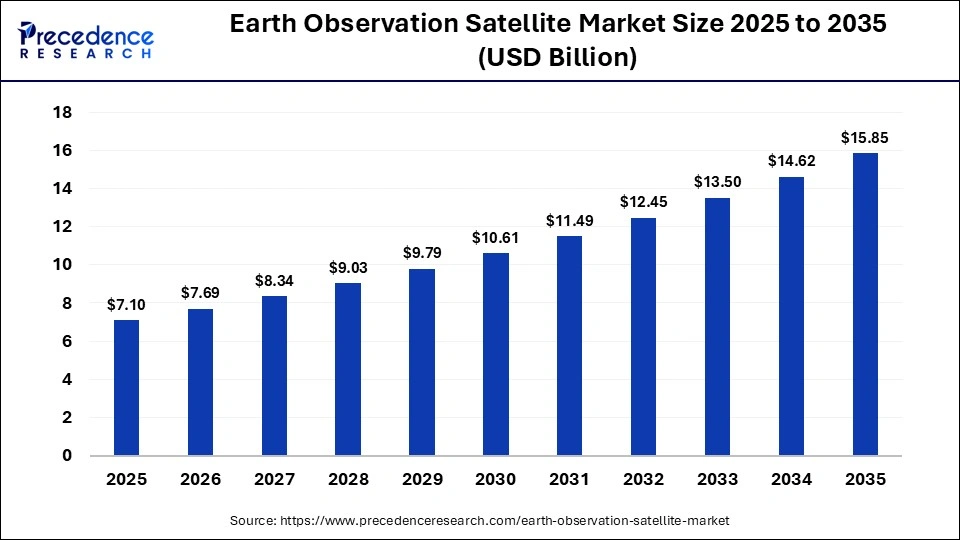
The global earth observation satellite market size was calculated at USD 7.10 billion in 2025 and is predicted to increase from USD 7.69 billion in 2026 to approximately USD 15.85 billion by 2035, expanding at a CAGR of 8.36% from 2026 to 2035. The satellite market in Earth observation is the frontier of space technology and data analytics, turning satellites from cameras built to be close to the Earth into a money-making enterprise to enable climate modeling, defense readiness surveillance, precisely control agriculture, and real-time geospatial decision making.
Key Takeaways
- By region, North America is holding the dominance of the market in 2025.
- By region, Asia-Pacific is expected to grow at a faster pace in the forecast period of 2026 to 2035.
- By orbit, the Low Earth Orbit (LEO) segment dominated the earth observation satellite market in 2025.
- By orbit, the Geostationary Earth orbit (GEO) segment is expected to grow rapidly in the forecast period of 2026 to 2035.
- By solution, the imagery data analytical service segment has dominated the satellite market share in 2025.
- By solution, the imagery data segment is expected to grow fast over the forecast period.
- By application, the security and intelligence segment has held dominance in the market in 2025.
- By application, the disaster management segment is expected to grow fast over the forecast period.
- By technology, the optical imaging segment has dominated the market share in 2025.
- By technology, the radar imaging segment is expected to grow at the fastest rate over the forecast period of 2026 to 2035.
What is the Earth Observation Satellite Market?
Earth Observation Satellite (EOS) relies heavily on utilizing a number of platforms such as satellites, aircraft, drones, and terrestrial sensors to acquire and analyze data related to our Earth. It houses a full sector based on image acquisition, analytics, and remote sensing, data transformation systems for governments, enterprises, and research institutions. It is from taking satellite and ground-level images, as well as drones. With the aid of advanced software programs, the data collected is gathered to present it in the form of reports or maps. Earth Observation uses are more in line with our climate monitoring, afforestation, and urban planning strategy to strengthen security.
Optical, radar, hyperspectral, and thermal imaging system technology allows a reliable real-time view of both the natural environment and human activities. Satellite technology is increasingly applied to combat natural disasters, protect national boundaries, and facilitate agricultural practices by governments that have already committed huge resources to invest in it. Such a knowledgeable way can be used to make decisions, and satellite data can be useful to enterprises in transport, telecommunications, and construction industries, among other sectors.
Market Trends of the Earth Observation Satellite Market
- AI-Driven Geospatial Intelligence: An integrated AI-powered analysis and visualization of natural fields enable advanced analytics of physical objects or structures at a faster resolution. This is part of a trend in AI-augmented analytics, accelerating the characterization of imagery used in farm, defense, and environmental management scenarios. With this in mind, these organizations are leaning on machine learning so that processes from object detection to crop classification to rapid disaster mapping can happen without needing any visual image interpretation at all.
- Increasing Emphasis on High-Revisit Small Satellite Constellations: The perturbations of the Earth Observation Satellite Market were primarily due to the very small satellite models. It seems like we're going from a few large satellites to clusters of tiny spacecrafts. Organizations are focusing on revisit frequency rather than resolution, letting customers gain near real-time visibility into supply chain activity, maritime activities, and weather changes.
- Advancements in High-Resolution Imaging Technology: The high-quality satellite imaging technology over the last few decades has shown the Earth observation data a lot more clearly and increased the accuracy. It's evolving so we can follow environmental changes, infrastructure evolution, and shifts in terrain structure. It has advantages across many sectors of life, including agriculture, urban construction, and military operations.
- Data-as-a-Service (DaaS) Supplanting Raw Imagery Sales: They are seeking information, not just seeing raw pixels. We historically worked with subscription geospatial providers who already preprocess data into simple dashboards and APIs. Many institutions have diversified the value-added analytical tools and capabilities to meet the growing market need for actionable, earth-observation data compared to traditional imagery to archive data.
- Impact of AI in the Earth Observation Satellite Market: Earth-tracking satellites have long been needed for monitoring weather patterns, natural disasters, and environmental changes. This potent fusion gives us a very effective way to quickly read Earth's evolving systems and an in-depth, real-time understanding of the environment and of how global events are experienced and responded to. Previously, data gathered by satellites would have to be returned to Earth for analysis. That said, particular satellites do have AI features on board. They are processing information right after receiving it and analyzing it.
- Having to analyze data at that speed would make changes in weather patterns: pollution levels, forests, and even glaciers move more quickly to be noticed.
- The processing speed enables faster: responses in the event of disasters, such as floods, fires, earthquakes, and so forth. AI can detect anomalies at the level of satellite imagery, which would go undetected by human eyes. On top of this, it assists in the management of data sets and in making improvements to them to limit errors. AI satellite technology, driven by artificial intelligence, is providing us with novel, timely insights that human intervention with previous attempts could not have achieved. One of the great strengths of Earth observation with AI-based satellite tracking is to continuously monitor the changes to weather patterns, ground movements, and historical incidents in the field of natural disasters that can be identified with the warning signs toward natural disasters during the time that emerging risks become apparent.
Market Scope
| Report Coverage | Details |
| Market Size in 2025 | USD 7.10 Billion |
| Market Size in 2026 | USD 7.69 Billion |
| Market Size by 2035 | USD 15.85 Billion |
| Market Growth Rate from 2026 to 2035 | CAGR of 8.36% |
| Dominating Region | Asia Pacific |
| Fastest Growing Region | North America |
| Base Year | 2025 |
| Forecast Period | 2026 to 2035 |
| Segments Covered | Orbit, Solution, Application, Technology, and Region |
| Regions Covered | North America, Europe, Asia-Pacific, Latin America, and Middle East & Africa |
Segment Insights
Orbit Insights
LEO (Low Earth Orbit)
The Low Earth Orbit (LEO) segment has dominated the earth observation satellite market in 2025. This dominance among commercial Earth observation deployments can be attributed in part to the fact that LEO satellites have shorter time intervals for reacquainting with their Earth images; in addition, they often require very small satellites themselves, and they can capture higher-resolution images that need less time than any human observer could pay. LEO satellites with lower altitudes give better visual quality: thus, much faster data transmission and improved image resolution than those that have to rely on satellite tracking and satellite observation.
GEO (Geostationary Earth Orbit)
The Geostationary Earth Orbit (GEO) segment is expected to grow rapidly in the forecast period of 2026 to 2035. GEO satellites maintain a constant position relative to Earth's surface, which is vital for continual regional monitoring. The spatial resolution of GEO platforms tends to be quite low in comparison to LEO systems, but they are highly effective for weather forecasting, climate analysis, large-scale environmental assessments, etc. Because governments prefer to keep an eye on critical domains, particularly in the case of meteorological systems, and those for early warning disaster management systems, GEO assets are in accordance.
Solution Insights
Imagery Data Analytical Service
The imagery data analytical service segment has dominated the satellite market in 2025. Data analytics solutions are essential in transforming collected satellite and sensor data into reports, which can help analysts carry out information analysis or even model future developments. They are also essential tools for identifying and visualizing trends. Decisions across sectors (agriculture, meteorology, security, and infrastructure development) are supported by the ability to access data.
Imagery Data
The imagery data segment is expected to grow fast over the forecast period. Raw imagery serves as the foundation of the Earth observation market. Government, defense, and mapping agencies receive satellite imagery to be analyzed and stored independently. Especially, high-resolution data are very required for some projects as border surveillance, infrastructure estimation, and land use planning applications. Despite the proliferation of analytical power, the retention and control of primary imagery is still very much a key strategic and commercial asset.
Application Insights
Security & Intelligence
The security and intelligence segment held dominance in the market in 2025. The two key factors driving this field are the increased demand for advanced situational awareness and rising geopolitical tensions. Observing critical areas keeps borders secure and maritime situational understanding clear. Furthermore, large commercial satellite companies are increasingly augmenting national capabilities. This is a clear indication of the trend toward dual-purpose Earth observation systems.
Disaster Management
The disaster management segment is expected to grow fast over the forecast period. The reliance on real-time satellite imagery during emergency response and recovery operations increases its rise. While both sectors utilize advanced satellite technologies, agriculture remains central to market leadership.
Technology Insights
Optical Imaging
The optical imaging segment has dominated the earth observation satellite market in 2025. Many fields are affected by this kind of information, including agriculture, urban planning, and environmental monitoring. High-resolution images. For this reason, optical imaging systems are unique among optical technologies in that they show highly detailed visual data, which is essential for a wide range of applications-for example, land use appraisal and disaster management. Nevertheless, they can only be operational during daylight or good weather conditions, so such continuous operations become limited and complementary technologies are integrated.
Radar Imaging
The radar imaging segment is expected to grow at the fastest rate over the forecast period of 2026 to 2035. This is underpinned by the unique benefits of all-weather imaging and surveillance at night, making it especially appealing to sectors requiring high-quality data in difficult conditions. Through synthetic aperture radar technology, this section is capable of generating ground imagery regardless of weather or lighting conditions. These sorts of capacities are essential for the likes of maritime surveillance, flood mapping, and defense monitoring.
Key Government Initiatives for the Earth Observation Satellite Market
|
Initiative |
Lead Agency |
Focus Area |
Goal |
|
NISAR Mission (NASA-ISRO SAR) |
NASA/ISRO |
Climate/Environment |
Provides high-resolution SAR data for global environmental monitoring and disaster management. |
|
Copernicus Expansion |
European Space Agency (ESA) |
Climate/Policy |
Enhances monitoring of CO2 emissions and urban growth with new Sentinel satellites. |
|
Private Sector Participation (IN-SPACe) |
India (IN-SPACe) |
Commercialization |
Promotes private players for high-res imagery and data analytics. |
|
Defense/ISR Constellations |
US/India/China |
National Security |
Develops AI-powered satellite grids for surveillance and military intelligence. |
Regional Insights
That growth is helped by increased spending on space technology and a strong private sector. Especially noteworthy is the successful integration of government contracts with venture-funded satellite innovations. High-resolution imagery, AI-powered data analytics platforms, and paid geospatial intelligence are already popular in sectors such as agriculture, insurance, and infrastructure monitoring.
In North America, the U.S. is dominating the earth observation satellite market. That dominance derives from large injections of capital into space and applications with national security implications. Commercial space ventures are expanding rapidly, and in tandem with cooperation with the private sector, there is an accelerating trend in satellite imaging and data analysis. It can also contribute to the smooth development of commercial space as the government gives support for open data projects and commercialization of space, opening up to the market, which is very encouraging to start a start-up in the earth observation industry.
This trend is supported by more budget allocations to disaster management, agricultural monitoring, and climate resilience. Governments throughout the region are developing new earth observation instruments, with the aim of protecting food systems, monitoring maritime areas, and dealing with the urban growth issue. Developments are prioritizing deployment of constellations and hyperspectral imaging technologies over reliance on classic optical systems.
The Chinese earth observation satellite market is rapidly growing in the Asia-Pacific. The nation's focus on strengthening national security, environmental monitoring, and agricultural productivity via satellite data is fueling demand for earth observation solutions. In concert with significant governmental spending, as well as in a nascent commercial space industry, these factors are setting China up to become a key player on the world earth observation stage.
How will Europe Notably Grow in the Earth Observation Satellite Market?
Europe is a notably growing region in the global market. This growth is due to significant investments in institutional programs like Copernicus, the rapid rise of private NewSpace firms, and the urgent need for monitoring climate change. Strict European regulations, such as the Common Agricultural Policy, the Regulation on Deforestation-free Products, and the Land Use, Land Use Change and Forestry regulation, mandate the use of these tools for compliance and monitoring. The increased adoption of SmallSat constellations and AI-driven image processing is enhancing revisit times and improving data analytics.
Germany Market Trends
Germany is shaping its industrial landscape by merging premier Synthetic Aperture Radar satellite manufacturing and DLR-backed AI innovations with a burgeoning NewSpace ecosystem, solidifying its role as a cornerstone of European space initiatives. From launching the Sentinel-1D satellite to enabling ICEYE's expansion and producing advanced MTG-S/Sentinel-4 hardware, fortifying its position as the high-precision backbone of European Earth observation.
How will Latin America Grow in the Earth Observation Satellite Market?
Latin America is witnessing significant growth driven by increasing demands for environmental monitoring, precision agriculture, and disaster management. The region heavily relies on commodity exports, which drives the need for satellite data to monitor crop health and optimize agricultural management. Countries like Brazil and Argentina are investing in domestic space capabilities and supporting local private firms, moving away from full reliance on foreign data for monitoring and communication.
Brazil Market Trends
Brazil is positioning itself as a regional environmental leader by achieving technological sovereignty in space, using indigenous satellites like the upcoming Amazonia-1B to monitor the Amazon and manage resources. Through initiatives like the SatVHR project and an expanded coastal monitoring network, the country is actively reducing its foreign reliance for critical deforestation and agricultural mapping efforts.
How will the Middle East and Africa Surge in the Earth Observation Satellite Market?
The Middle East and Africa are surging as a significant growth towards economic diversification, driven by high-resolution data needs for surveillance and environmental monitoring. Countries in the region are transitioning from hydrocarbon-dependent economies to technology-driven economies, with the space sector becoming a strategic focus. Investments are being made in sovereign capabilities to decrease reliance on foreign technology. Rising geopolitical tensions are further accelerating the demand for high-resolution imaging for border surveillance and maritime security.
Saudi Arabia Market Trends
Saudi Arabia is transforming from a consumer of space data to a regional powerhouse by investing billions in Low Earth Orbit (LEO) satellite technology, AI-driven analytics, and local manufacturing. Through these strategic investments, the Kingdom is building a sovereign Earth observation ecosystem designed to enhance smart city development, environmental sustainability, and infrastructure monitoring.
Earth Observation Satellite Market Companies
- Airbus Defence & Space
- BAE Systems plc
- ICEYE
- GeoOptics Inc.
- ImageSat International N.V.
- Capella Space
- L3Harris Technologies Inc.
- BlackSky
- Lockheed Martin Corporation
- Satellogic
- Maxar Technologies Inc.
- Northrop Grumman Corporation
- OHB System AG (OHB SE)
- Planet Labs
- Raytheon Technologies Corporation
- Thales Alenia Space
Recent Developments
- In February 2026, GalaxEye Space Technologies Pvt. Ltd. unveiled Mission Drishti, an AI-enabled Earth observation satellite designed to blend optical and radar imaging for all-weather, day-night monitoring. Featuring advanced onboard processing, the mission represents a shift toward smarter satellite data delivery for agriculture, disaster response, and environmental tracking.
- In February 2026, Pixxel Space Technologies Pvt. Ltd. partnered with Exotrail SAS to integrate advanced satellite thruster technology in future Earth observation missions. This collaboration aims to improve in-orbit maneuverability and mission flexibility, reflecting broader industry moves toward more agile, responsive satellite constellations.
Segments Covered in the Report
By Orbit
- LEO (Low Earth Orbit)
- MEO (Medium Earth Orbit)
- GEO (Geostationary Earth Orbit)
By Solution
- Imagery Data
- Imagery Data Analytical Service
By Application
- Urban Development
- Mapping & Surveying
- Agriculture
- Environmental Monitoring
- Natural Resource Exploration
- Security & Intelligence
- Disaster Management
By Technology
- Optical Imaging
- Radar Imaging
- Spectral Imaging
- Thermal Imaging
- LiDAR
By Region
- North America
- Europe
- Asia-Pacific
- Latin America
- Middle East & Africa
For inquiries regarding discounts, bulk purchases, or customization requests, please contact us at sales@precedenceresearch.com
Frequently Asked Questions





Ask For Sample
No cookie-cutter, only authentic analysis – take the 1st step to become a Precedence Research client
 Get a Sample




 sales@precedenceresearch.com
 Schedule a Meeting
