


Earthquake-Resistant Building Materials Market Size & Forecast, Segmentation Analysis, Technology & Innovation Analysis, Competitive Landscape, Market Share & Competitive Ranking, Geographic Landscape, White-Space Analysis, Future Outlook
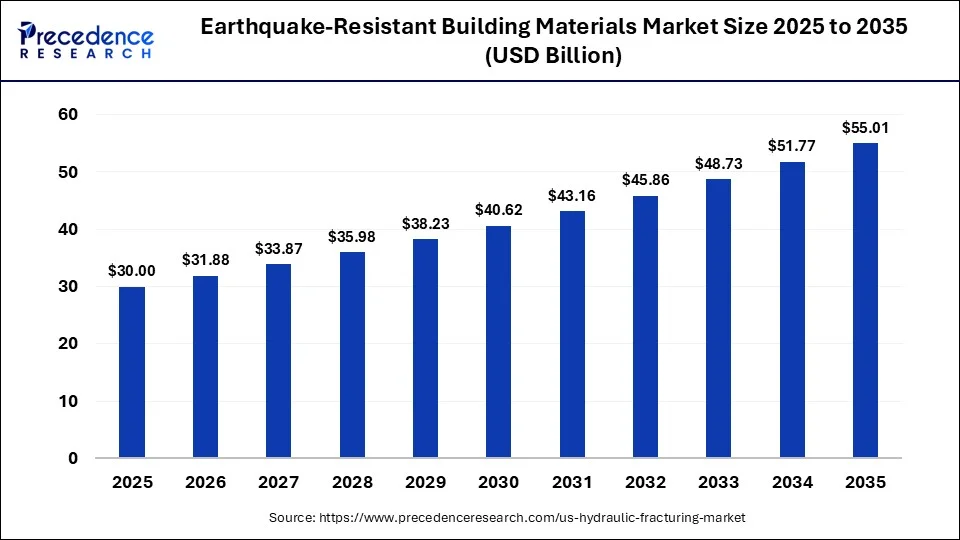
The earthquake-resistant building materials market reached USD 31.88 billion in 2026. The expansion is mainly influenced by the expanding construction industry, increased investment by governmental institutions, and the development of more durable building materials. These trends were analyzed by our Senior Researcher, Vidyesh Swar, to curate this report. His report benefits multiple stakeholders, including building material manufacturers, infrastructure developers, real estate developers, private equity firms, and seismic technology providers.
Source: https://www.precedenceresearch.com/earthquake-resistant-building-materials-market
 Get a Sample
 Table Of Content


Earthquake-Resistant Building Materials Market Size, Share, Trends, and Forecast Analysis 2035
The global earthquake-resistant building materials market size is forecasted to expand from USD 31.88 billion in 2026 to USD 55.01 billion by 2035, growing at a CAGR of 6.25% from 2026 to 2035.
Key Takeaways
- By material type, the reinforced concrete segment held the largest market share of 43.78% in 2026.
- The pricing of earthquake-resistant building material is based on factors such as the quality of the material, its mechanical properties, resistance to corrosion, durability, certification, and complexity of installation.
- Materials that are conventional are used for the reason that they are easily available, while seismic systems are used because of their technical abilities.
- The market's supply chain is divided between high-volume commodity inputs and lower-volume, technically differentiated systems.
- Competition is highly variant for different materials such as cement/concrete, structural steel, construction chemicals, fiber reinforced polymer (FRP) strengthening systems, seismic isolation systems, dampers and engineered structural components.
- Asia-Pacific holds a majority market share due to its construction activity and exposure to seismic risk.
What is the Significance of Earthquake-Resistant Building Materials?
Three structural trends that make up the global earthquake-resistant building materials market are the construction of new buildings in seismic-prone areas, focus on structural integrity, and upgrading of older structures constructed to obsolete standards. Depending on the estimates, the market boundaries may vary due to the inclusion or exclusion of reinforced concrete and steel from the market structure.
Reinforced concrete is a huge value category on the grounds that it is used extremely broadly in the home foundations, shafts, bolts, and shear dividers. Structural steel, fiber-reinforced polymers (FRPs), engineered wood, and specialized damping and isolation systems extend the market into higher-performance applications.
Coverage Highlights
- Global market size, historical trajectory and long-term forecast.
- Revenue contribution by material type, function and end-use sector.
- Demand across residential, commercial, industrial and public infrastructure projects.
- Adoption of seismic isolation, energy dissipation and structural strengthening systems.
- Regional differences in seismic risk, building standards and construction investment.
- Competitive positioning across material producers and specialist seismic technology suppliers.
How is the Earthquake-Resistant Building Materials Market Evolving?
The rate of revenue increase will be determined by the price of raw materials, the volume of projects, use of improved reinforcement, and the level of building rehabilitation. Physical volume alone is insufficient: a ton of conventional reinforcing steel and a specialized composite strengthening system have materially different unit economics and applications.
A robust forecast therefore needs to separate price-led growth from volume-led growth and distinguish routine construction from seismic-specific expenditure. Base-case estimates assume stable code adherence and infrastructure investment. Upside scenarios assume a rapid retrofit effort and higher adoption of engineered protection systems. Downside scenarios incorporate construction lags, public-budget pressures, and project approval delays.
Coverage Highlights
- Historical market revenue and base-year estimates.
- Forecast revenue through 2026 and 2035.
- Incremental revenue opportunity by region and material.
- New construction versus existing-building retrofitting.
- Revenue and volume trends for major material categories.
- Base, upside, and downside forecast scenarios.
Segmentation Analysis
Which Segments are Estimated to Drive Future Opportunities in the Market?
The market is best segmented across material type, seismic-protection function, application, end user, and distribution channel. Reinforced concrete is a core category, while structural steel provides ductility and structural frame flexibility. FRPs provide great strength-to-weight ratio for reinforcing existing structures, and engineered wood is related to light construction systems.
Market leadership for reinforced concrete was seen in 2026 in the material segment, which was reported to hold a revenue share of 43.78%. Structural steel and FRP need to be analyzed separately since their selection is dependent on the height of the building among other factors.
The complete analysis measures segment revenues, market shares, growth rates, and regional variations.
Market Dynamics
Drivers
The demand for earthquake-resistant building materials is fuelled by growth of cities, economic development in earthquake-prone regions, investment in public facilities, and the requirement to minimize any earthquake damages. Hospitals, schools, transport facilities, and other essential buildings have particularly strong incentives to improve structural performance.
Restraints
The main restraint is the initial cost of advanced solutions. FRP reinforcing, isolation joints, and dampers may need specialized engineering, testing, and installation skills. Thus, their economic worth is to be determined not just on the basis of initial cost compared to the conventional building materials but also in terms of reduced damage and downtime.
Opportunities
Opportunities are particularly attractive where older buildings require strengthening but demolition and reconstruction are impractical. Lightweight composites, high performance repair mortars, structural adhesives, and steel bracing could potentially be used to mitigate particular structural deficiencies.
Challenges
Risks are related to the uneven implementation, the retrofitting budget limits, the lack of well-trained installers, and the ignorance of the owners of the buildings. Even material selection cannot overcome bad design, bad detailing, or bad installation practices.
Key Coverage
- Growth drivers, cost restraints, and emerging opportunities.
- Regulatory enforcement and seismic-risk exposure.
- Retrofit economics and lifecycle-cost considerations.
- Adoption barriers for advanced materials.
- Procurement and construction-cycle risks.
What Does the Price Analysis of the Earthquake-Resistant Building Materials Market Indicate?
Price depends on material quality, their mechanical properties, corrosion resistance, strength, certificate standards, and on the installation complexity. Conventional reinforcement is typically benchmarked in currency per ton, concrete in currency per cubic metre, and FRP fabrics or plates in currency per square metre or kilogram. Pricing for seismic bearings and dampers is done on a component or system basis.
Comparing the price per ton of one material over another could be misleading. While the FRP would have cost more per ton of material than steel, its weight and relatively small cross section make it more efficient when installed in an occupied structure. Just like the case of seismic isolation systems that increase the cost of construction but minimize the load transmission in the structure.
Thus, the profitability of the market will depend on the value delivered by the system rather than material cost. Manufacturers having technical support and tested product systems may have better leverage on price as compared to those who offer commodities as the main offering.
Coverage Highlights
- Price benchmarks by material, grade, and application.
- Regional pricing and raw-material cost exposure.
- Installation, engineering and certification costs.
- Distributor margins and project procurement practices.
- Premium pricing for advanced reinforcement and seismic protection.
- Price outlook under different construction and commodity scenarios.
What is the Demand-Supply Analysis of Earthquake-Resistant Building Materials?
The industry depends on current distribution channels for cement, concrete aggregates, reinforcing bar, polymeric fibers, carbon and glass fibers, elastomers, structural adhesives, and precision-machined components. Readily available items are commercially distributed through broad industrial channels, and specialized earthquake-resistant systems are based more on skill.
Supply constraints can therefore arise even when raw materials are readily available. Approval, testing, manufacturing, and design delay times may influence the schedule of delivery of isolation and damping systems. For retrofit applications, access problems, as well as maintaining the building during construction, will add to implementation difficulties.
Demand is differently distributed across the world because some countries are more affected by earthquakes, have a higher density of population, spend more public money, and are more likely to implement law. Domestic production of standard components can be economically beneficial due to transportation expenses, while some components can be produced abroad due to their local scarcity.
Coverage Highlights
- Regional demand and production indicators.
- Installed manufacturing capacity for relevant material categories.
- Supply-chain bottlenecks and project lead times.
- Import dependence for specialized components.
- Capacity expansion and localization opportunities.
- Procurement risks and supplier qualification requirements.
How Does Engineering Integration Determine Where Value Accumulates?
The value chain starts from producers of raw materials through material processing, component manufacture, system design, distribution, installation, and structural inspection. Cost in cement and steel is obtained via economies of scale and efficiencies of production, where specialty materials obtain the value via performance capabilities, engineering capabilities and reliability.
More valuable opportunities come when materials become part of engineered systems. The use of FRP for reinforcement is based on bonding techniques and applications. Seismic isolation and Damping relies on the choice of components, structural analysis and proper installation.
The market's supply chain is therefore divided between high-volume commodity inputs and lower-volume, technically differentiated systems. Suppliers must be able to accommodate specification, installation, and quality control through the entire process of the project.
Coverage Highlights
- Raw materials, intermediate products, and finished systems.
- Manufacturing, distribution, and installation economics.
- Value capture across commodity and specialty suppliers.
- Supplier concentration and sourcing risks.
- Engineering, testing and quality-assurance requirements.
What are the Technological Innovations of Earthquake-Resistant Building Materials?
Innovation is concentrated in advanced composites, high-performance concrete, ductile reinforcement, seismic isolation bearings, energy dissipation devices, and structural monitoring. FRP systems are particularly relevant to retrofitting because they can strengthen selected structural elements without the weight and dimensional increase associated with some conventional strengthening techniques.
These techniques deal with a different issue since instead of making the structure stronger, they manipulate how energy is distributed through or dissipated in the structure during an earthquake. These methods are based on the structure, geology, performance needs, and economic considerations.
Digital structural assessment and monitoring can further support the identification of vulnerable buildings and the prioritization of interventions. However, technology adaptation faces constraints due to complexity of design, requirement for approvals, installation skills, and the requirement for performance demonstration against relevant standards.
Coverage Highlights
- FRP and fiber-reinforced cementitious strengthening.
- High-ductility concrete and reinforcement technologies.
- Seismic bearings, dampers and energy-dissipation systems.
- Structural monitoring and assessment tools.
- Innovation pipelines, partnerships and commercialization trends.
How Does Compliance Convert Seismic Safety Into a Procurement Requirement?
Building regulations and codes affect the choice of materials that resist earthquakes. In India, seismic design and existing building strengthening standards are important reference points for construction in relevant seismic zones. International compliance is contingent upon the particular requirements of jurisdiction, building utilization, and risk categorization.
To sellers, this is a matter of business; their products should conform to the requirements of the projects and any testing or approvals needed. To consumers, compliance is the ability to make coherent decisions on design, material, and installation.
Sustainability introduces yet another level. Strengthening an existing structure can sometimes extend its service life and reduce the need for demolition and replacement, although the environmental benefit depends on the intervention, material quantities, and remaining building life. Lifecycle assessment is therefore more informative than assuming every retrofit is automatically lower-carbon.
Coverage Highlights
- Seismic design and construction requirements by region.
- Testing, certification and material qualification.
- Structural retrofit and safety-audit requirements.
- Lifecycle durability and embodied-carbon considerations.
- Repair, rehabilitation and material-waste reduction.
Who are the Primary Customers in the Earthquake-Resistant Building Materials Market?
Residential buildings create an impact on reinforcing cement and strengthening steel, adobe, and masonry. Commercial and industrial buildings create an impact on special structures, bracing, and retrofitting. Hospitals, schools, emergency stations, and other essential infrastructure will have an impact on reasserting post-earthquake operations.
The procurement decision is probably based on product and system structural performance, product conformance and durability, the installed costs, installed time, and the ability of the supplier to supply technical information. The cost and time factors are more important to contractors and developers, but resilience could be more important to other customers.
Coverage Highlights
- Demand by building type and application.
- Purchasing criteria and material substitution.
- New-build versus retrofit procurement.
- Contractor, developer, and institutional buyer requirements.
- High-value applications and unmet technical needs.
How is Competition Divided Between Large Material Producers and Specialized Seismic-System Manufacturers?
The earthquake-resistant building materials market is broken up into interrelated groups that include cement and concrete products, structural steel, construction chemicals, FRP strengthening materials, seismic isolators, dampers, and engineered structural components. Competition differs significantly across these categories because conventional construction materials are primarily differentiated by production scale, consistency, and distribution, and specialized seismic solutions are evaluated on engineering performance, technical approvals, and project-specific requirements.
Competitive advantage can be achieved based on two different competencies: production and distribution economies of scale for regular materials and specialized engineering capabilities for seismic systems. The large-scale material manufacturer can rely on its established contractual network, wide range of supplies, and consistency in volume, while the specialist manufacturer will win based on its technical justification, specialization, and specific application solution. It is clear that the competencies cannot substitute one another; therefore, collaboration between the material producer, engineering company, and seismic system provider makes economic sense for sophisticated projects.
Competitive positioning is becoming more and more dependent upon a supplier's capability to match its material performance with the seismic needs of the project. By using their distribution capability and product portfolio, larger material manufacturers are able to leverage their advantage, where specialists can differentiate themselves through technical justification/approvals.
The comprehensive report takes a detailed analysis of competitive positioning among traditional material manufacturers and specialized seismic systems manufacturers through portfolio, production capacity, distribution, technical differentiation, project application, and partnerships. Where company-level data are available, the analysis can be structured into a competitive database covering company, product category, material or technology, geographic presence, manufacturing facilities, capacity, technical certifications, application focus, and year. They facilitate the ability to filter and benchmark among suppliers and product categories, thus supplementing the strategic report by providing a finer perspective on the strengths and weaknesses of competitors.
Tentative Leading Company Universe
The following companies are relevant participants in the broader material and seismic-protection ecosystem. Inclusion indicates product or technology relevance.
| Company | Headquarters | Market position/core strength |
| Sika AG | Switzerland | Construction chemicals, FRP strengthening and structural adhesives |
| Hilti Group | Liechtenstein | Anchoring, fastening and structural connection systems |
| Saint-Gobain | France | Construction materials and building systems |
| CEMEX | Mexico | Cement and ready-mix concrete |
| CRH | Ireland | Building materials and construction products |
| Holcim | Switzerland | Cement, concrete and building solutions |
| Heidelberg Materials | Germany | Cement, aggregates and concrete |
| BASF | Germany | Construction chemicals and specialty materials |
| Fosroc | United Kingdom | Concrete repair, grouts and construction chemicals |
| Mapei | Italy | Repair mortars, adhesives and construction chemicals |
| Nippon Steel | Japan | Structural steel and steel engineering |
| Tata Steel | India | Steel and construction-grade reinforcement |
| ArcelorMittal | Luxembourg | Steel products and structural applications |
| JFE Steel | Japan | Structural steel and advanced steel products |
| Bridgestone | Japan | Elastomeric seismic isolation bearings |
| Nitta Corporation | Japan | Elastomeric isolation technologies |
| Nippon Steel Engineering | Japan | Structural engineering and vibration-control systems |
| Kurashiki Kako | Japan | Vibration control and isolation products |
| Robinson Seismic | New Zealand | Seismic isolators and damping systems |
| Maurer SE | Germany | Structural bearings and seismic protection |
| Mageba | Switzerland | Structural bearings and seismic devices |
| Freyssinet | France | Structural engineering, strengthening and protection |
| Pultron Composites | New Zealand | Fiberglass reinforcement solutions |
| Richter Resilience | India | Seismic damping technology |
| Sanrachana Structural Strengthening | India | Structural strengthening and retrofitting |
Competitive Benchmarking
The strongest competitive positions may emerge from partnerships between material manufacturers, engineering firms, and installation specialists. The combined approach will reduce risk of specification and simplify project delivery for developers and infrastructure providers.
| Benchmarking factor | Large material producers | Specialist seismic suppliers |
| Manufacturing scale | High | Low to medium |
| Distribution reach | Broad | Often selective |
| Product differentiation | Material grades and performance | Engineered system performance |
| Technical support | Product and application support | Detailed project-specific engineering |
| Qualification barriers | Material and product standards | Testing, design approval and installation expertise |
| Pricing power | Influenced by commodity cycles | Influenced by specialization and project requirements |
| Growth opportunities | Infrastructure and construction volume | Retrofitting and advanced protection |
Why is Revenue Attribution More Difficult than Identifying Industry Leaders?
A reliable competitive ranking requires a clearly defined market boundary. Total company revenue cannot be treated as earthquake-resistant building materials revenue because diversified producers generate sales from many unrelated construction and industrial products.
Market share analysis must make a distinction between regular suppliers of materials and seismic systems suppliers. Although the latter are in low-volume markets, the former could derive their income from few, but highly skilled projects.
Coverage Highlights
- Estimated market shares where defensible data is available.
- Top-five and top-ten concentration by relevant product category.
- Material-specific revenue exposure and growth.
- Regional market positions and share movements.
- Clear separation of reported company revenue from estimated market-specific revenue.
What Does the Product Portfolio and Technology Benchmarking Indicate?
Business needs to offer complementary products such as reinforcement, adhesives, mortar repair, anchorages and coatings, portfolio breadth. Competitors in the specialized field of earthquake engineering compete on the basis of their performance in isolation, dampness, longevity, and system compatibility.
Benchmarking for technology includes looking at specs, testing and approvals, installation process and application. The number of patents is inadequate because commercialization is what makes a difference in market access.
Coverage Highlights
- Portfolio breadth across reinforcement and structural repair.
- Availability of specialized isolation and damping systems.
- Product qualification and testing capabilities.
- Application engineering and installation support.
- Gaps between standard products and advanced seismic requirements.
How Do Regional Demand Patterns and Local Manufacturing Capabilities Shape Competitive Advantage?
Asia Pacific holds strategic importance in the earthquake-resistant building materials market because of its construction activity and exposure to seismic risk. Japan has an ecosystem of seismic engineering and isolation systems, whereas India can be considered to offer opportunities in new construction, infrastructure development, and retrofitting of existing structures.
North America and Europe offer demand opportunities in code-compliant construction, institutional infrastructure, and rehabilitation. Nonetheless, the above provided information does not offer quantification of the regional market shares, capacity, and growth rates for the regions in question; therefore, a detailed evaluation at the market level is required.
Competitiveness in this case will depend on the demand potential and the possibility of manufacture, qualification, distribution, and installation of the equipment within the region. Production capacity must be evaluated based on the product category; that is, capacity for cement and steel manufacture is measured in tonnage, while that of the specialty seismic devices depends on unit production, qualified lines of production, engineering capacity, and time to deliver the equipment. This difference is because the availability of the volume of materials does not necessarily mean that the specialty seismic devices will be readily available.
Execution capability locally can be a determining factor in the market when project timing and technical qualification and installation experience become the basis of supplier selection. Both the manufacturers and buyers will be able to evaluate their options for importation against those of local production. In other words, the market offers a special opportunity: companies need to find the right mix of manufacturing investment, regional demand, import reliance, and construction project requirements.
The full report further compares regional demand patterns, manufacturing and distribution footprints, local versus imported specialized components, capacity expansion, production localization, and project delivery capabilities. Where data are available, this intelligence can also be structured into a regional manufacturing and competition dataset covering country, product category, facility location, production capacity, capacity utilization, local or imported supply, production-line qualification, delivery lead time, and distribution or installation coverage.
How Can Partnerships Accelerate Access to Specialized Technologies?
Strategic activity in this market is most relevant when it expands composite material capabilities, construction-chemical portfolios, structural engineering expertise, or access to new geographic markets. Collaborations can also involve connections between producers of the product and seismic system designs and constructions.
An extensive M&A assessment will entail investigating transaction amounts, acquisition dates, technology, geographic reach, and acquisition contribution to seismic-resilient applications. A complete and authenticated transaction dataset must be available before any deal valuations for individual markets are done.
What are the Company Profiles in the Earthquake-Resistant Building Materials Market?
Company profiles contain head office details, ownership, financial info, products and markets, production capacity, research activities and strategy news.
Companies can then be grouped into four commercially useful categories:
- Scale leaders: established producers of concrete, steel and construction materials.
- Technology leaders: providers of advanced composites, seismic isolation and damping.
- Application specialists: suppliers focused on structural repair, strengthening and retrofitting.
- Regional challengers: companies with local manufacturing, engineering relationships and distribution advantages.
Market position indicated by these classifications is a guide to classification of strategic roles, not validated market share ranking.
What are the Opportunities and Untapped Pools in the Earthquake-Resistant Building Materials Market?
Most promising white spaces include improved resilience of older buildings, improvement of infrastructure, introduction of enhanced reinforcement where there is a lack of space, and greater availability of professionally certified seismic protection systems.
From the supplier's perspective, white space can be measured using retrofit demand, availability of specialized equipment locally, certification shortages, installation capacity, and the cost of importing products. Measurement should account for project pipeline, buildings available for retrofitting, material intensity, and potential penetration rates.
How Does Technical Qualification Balance Commodity Competition?
| Competitive force | Indicative intensity | Rationale |
| Supplier power | Medium | Commodity inputs have alternatives, but specialized components may have fewer qualified suppliers. |
| Buyer power | Medium to high | Large developers and public agencies can negotiate pricing, subject to technical specifications. |
| Threat of new entrants | Medium | Conventional materials are accessible, but engineered seismic systems require expertise and validation. |
| Threat of substitutes | Medium | There are alternatives for strengthening techniques, but their applicability relies on structure design and performance considerations. |
| Competitive rivalry | High | Commodity suppliers compete on cost and scale, while specialists compete on technical differentiation. |
PESTLE and Market Attractiveness
The economic environment influences construction and financing of projects. Safety awareness and readiness to renovate occupied structures are among social aspects. Technological factors include advanced composite materials, seismic systems, and structural monitoring. The environmental factor influences the decision between renovation and rebuilding, while legal constraints define design and qualification of materials.
The market opportunity is greatest where earthquake exposure overlaps with construction, appropriate building codes, and financial access. In contrast, highly risky zones might be poorly developed in commercial terms due to weak enforcement, financial, or installation resources.
Which Factors will Drive the Next Phase of the Earthquake-Resistant Building Materials Market?
Until 2035, the industry will be impacted by the synergy of construction investments, increasing seismically related safety standards, and the requirement for reinforcing old construction infrastructure. Conventional concrete and steel reinforcement will still be essential in the process thanks to their logistical and manufacturing system and their use in construction.
Nevertheless, FRP, seismic isolation bearings, energy dissipation elements, and damping systems provide alternative growth prospects in projects where performance improvement is essential. The market's future growth will depend not only on the volume of new construction but also on the extent to which seismic resilience becomes a priority in existing building renovation and infrastructure rehabilitation. These form two parallel avenues of demand: material-intensive new projects and special retrofitting projects with their own specific engineering and business needs.
Adoption will accelerate or decelerate as local building codes and enforcement evolve, through exposure to earthquakes, government spending, and engineering resource availability. Under the base-case scenario, demand would grow steadily from seismic design requirements in new buildings and retrofit programs for at-risk existing buildings.
The upside case scenario may result from increased public expenditures on infrastructure, performance-based seismic engineering becoming widespread practice, and funding of retrofits. By contrast, inconsistencies in enforcement, project delays, and budget constraints may hinder the adoption of advanced technologies, particularly for those that demand more costly installation.
We are of the view that manufacturers cannot expect linear adoption dynamics in all materials and sectors; there will be strong business potential only in those places where regulations, risks of seismic damage, and economics of the project will together support investment.
Increasing competitive advantage will be based on demonstrating structural advantages of the technology while maintaining feasibility of installation and economic viability of the life cycle costs. Supplier considerations include the focus on technical cooperation with structural engineers and construction companies, local installation capability, product certification, and specialized retrofit solutions that cause minimal disturbance to the occupied structures.
In addition to this executive summary of market trends, the full report also analyzes the market prospects until 2035 from the points of view of material types, new construction and retrofit, demand dynamics by regions, regulations, technologies, alternatives, and other aspects. The report also considers the business considerations regarding conventional versus advanced materials and the identification of potentially high-growth application fields and priorities for strategy implementation that are necessary to turn growing demand for seismic resilience into sustainable sales.
Market intelligence information can be organized into an earthquake-resistant building materials database with a detailed breakdown according to the material, technology, application field, geography, project type, regulatory environment, price, suppliers, and annual market size estimates. Such a database will facilitate the comparison and benchmarking of the conventional materials and advanced seismic solutions as well as new construction and retrofit application markets.
Key Strategic Questions Addressed
- What is the global earthquake-resistant building materials market size and forecast through 2035?
- Which material categories account for the largest revenue pools?
- What kinds of categories provide maximum growth opportunities?
- How is demand different for new construction and retrofitting projects?
- Which applications generate the greatest demand for advanced seismic systems?
- How are project economics affected by material costs and installation difficulty?
- Where are the principal supply-chain and qualification bottlenecks?
- Which technologies are changing structural strengthening and seismic protection?
- How would regional construction standards affect the choice of building materials?
- Which firms have a presence in both regular building materials and seismic technology?
- How competitive is the market for each type of product?
- What strengths in production and distribution give competitive advantage?
- Where are the most attractive regional and application-level white spaces?
- What difference would regulation, infrastructure investments, and technology adoption make to market dynamics?
- What investments could enhance supplier positions up to 2035?
Earthquake-Resistant Building Materials Market Segments
By Material Type
- Reinforced Concrete
- Structural Steel
- Fiber-Reinforced Polymers
- Engineered Wood
- Seismic-Resistant Masonry
- Other Advanced Materials
By Function
- Structural Reinforcement
- Seismic isolation
- Energy Dissipation and Damping
- Structural Strengthening and Retrofitting
- Crack Prevention and Repair
- Foundation Strengthening
By Building Type
- Residential
- Commercial
- Industrial
- Institutional
- Public and Critical Infrastructure
By Construction Stage
- New Construction
- Renovation and Rehabilitation
- Seismic Retrofitting
By Component
- Beams and Columns
- Shear Walls
- Foundations
- Structural Frames
- Joints and Connections
- Non-Structural Restraint Systems
By End User
- Real Estate Developers
- Contractors
- Government Agencies
- Infrastructure Operators
- Industrial Facility Owners
- Institutional Building Owners
By Distribution Channel
- Direct Project Sales
- Building-Material Distributors
- Specialist Engineering Contractors
- Original Equipment and System Integrators
By Region
- North America
- Europe
- Asia Pacific
- Latin America
- Middle East and Africa
For inquiries regarding discounts, bulk purchases, or customization requests, please contact us at sales@precedenceresearch.com
Frequently Asked Questions





Ask For Sample
No cookie-cutter, only authentic analysis – take the 1st step to become a Precedence Research client
 Get a Sample




 sales@precedenceresearch.com
 Schedule a Meeting