



Electric Breast Pumps Market Size, Companies, Share, Patient Volume, Treatment Adoption Rates, Pricing Analysis, Regulatory Landscape, Competitive Positioning, and Demand Forecast
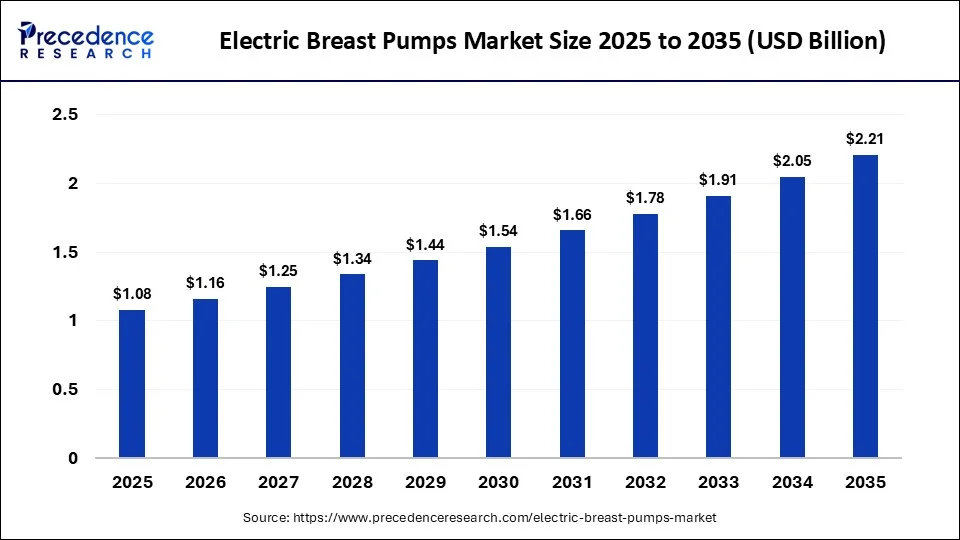
Rohan Patil, a Healthcare Industry Expert, highlights that the electric breast pumps market has reached USD 1.16 billion in 2026 and is on track to reach USD 2.21 billion by 2035, advancing at a CAGR of 7.40%. Key electric breast pumps market companies shaping the market include Medela AG, Koninklijke Philips NV, Pigeon Corporation, while major growth segments span product type, technology, portability, application, end user, distribution channel, price range, region.
Source: https://www.precedenceresearch.com/electric-breast-pumps-market
 Get a Sample
 Table Of Content


Electric Breast Pumps Market Size and Forecast 2026 to 2035
The global electric breast pumps market size accounted for USD 1.08 billion in 2025 and is predicted to increase from USD 1.16 billion in 2026 to approximately USD 2.21 billion by 2035, expanding at a CAGR of 7.40% from 2026 to 2035. The market is driven by growing participation of women in the worldwide workforce, which is accelerating the need for efficient, portable, and time-saving pumping solutions.
Key Takeaways
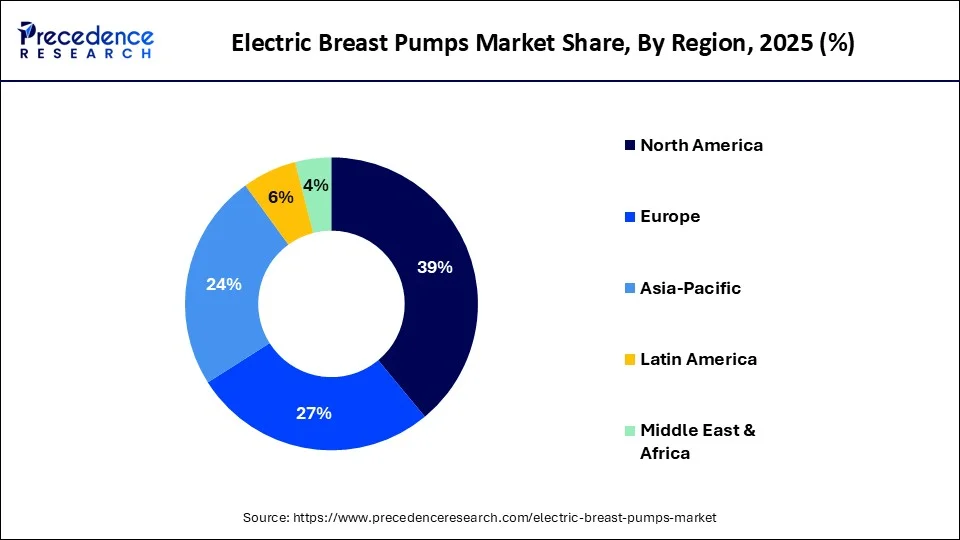
- North America led the electric breast pumps market by holding a major share of 39% in 2025.
- Asia-Pacific held a 24% share of the market in 2025 and is expected to grow at the fastest CAGR of 9.2% during the projection period.
- By product type, the double electric breast pumps segment held a dominant position in the market with a 39% share in 2025.
- By product type, the wearable electric breast pumps segment held a 12% share of the market in 2025 and is expected to grow at the fastest CAGR of 13.5% during the projection period.
- By technology, the closed system breast pumps segment dominated the market with a share of 72% in 2025 and is expected to grow at the fastest CAGR of 8.5% in the coming years.
- By technology, the open system breast pumps segment held a 28% share of the market in 2025 and is expected to grow at a CAGR of 3.8% during the projection period.
- By application, the personal use segment held a dominant position in the electric breast pumps market with a 79% share in 2025 and is expected to sustain its dominance with a CAGR of 7.8% over the studied period.
- By application, the hospital use segment held a 16% share of the market in 2025 and is expected to grow at a CAGR of 5.8% during the projection period.
- By end user, the individual mothers segment held a dominant position in the market with a 76% share in 2025 and is expected to grow at the highest CAGR of 7.9% in the coming years.
- By end user, the hospitals and maternity centers segment held a 15% share of the market in 2025 and is expected to grow at a CAGR of 5.5% during the projection period.
- By distribution channel, the e-commerce segment dominated the market with a share of 39% in 2025 and is expected to grow at the fastest CAGR of 10.2% in the coming years.
- By distribution channel, the retail pharmacies segment held a 24% share of the market in 2025 and is expected to grow at a CAGR of 5.8% during the projection period.
Market Overview
The electric breast pumps industry produces and sells motorized, automated devices utilized by lactating mothers to extract breast milk. The market mainly caters to working mothers, mothers of premature babies, and also those looking for convenient, efficient, and discreet paths to maintain milk supply. The market is driven by rising female workforce participation and increasing awareness of breastfeeding advantages. A major driver is the need for technological innovations, particularly discreet, wearable, hands-free pumps programmed for working mothers.
Electric Breast Pumps Market Trends
- Wearable pumps are increasing in popularity. Brands now provide discreet, lightweight, cord-free models which fit inside standard nursing bras, enabling mothers to multitask while commuting or working.
- Premium pumps now feature mobile application connectivity, enabling mothers to track milk volume, monitor pumping times, and even adjust suction patterns.
- Modern devices prioritize user comfort, thus featuring softer, customizable flange sizes, quiet motors, and hospital-grade suction settings.
Market Report Coverage and Key Metrics
| Report Coverage | Details |
| Market Size in 2025 | USD 1.08 Billion |
| Market Size in 2026 | USD 1.16 Billion |
| Market Size by 2035 | USD 2.21 Billion |
| Market Growth Rate from 2026 to 2035 | CAGR of 7.40% |
| Dominating Region | North America |
| Fastest Growing Region | Asia Paicfic |
| Base Year | 2025 |
| Forecast Period | 2026 to 2035 |
| Segments Covered | Product Type, Technology, Portability, Application, End User, Distribution Channel, Price Range, and Region |
| Regions Covered | North America, Europe, Asia-Pacific, Latin America, and Middle East & Africa |
Market Dynamics
Drivers
Rising Employment Rates
Rising female employment is a significant market driver because working mothers need to maintain infant feeding schedules while balancing professional responsibilities. The rising popularity of wearable, hands-free electric pumps enables mothers to express milk while commuting and working at their desks without interrupting daily activities. Favorable corporate alongside governmental lactation mandates demand employers to offer breaks and private spaces, thus, making it highly practical for working mothers to utilize these electric devices.
Restraint
High Cost of Premium Models
The high cost of premium electric breast pumps restricts accessibility and widespread adoption. The initial apparatus bought is just the beginning. Users must regularly replace accessory kits, valves, and even membranes to maintain hygiene and suction, adding recurring costs that discourage long-term investment. In low- and middle-income economies, the high upfront cost makes premium electric pumps entirely inaccessible for much of the population, forcing mothers to depend on manual expression.
Opportunity
Technological Advancements & Design
Technological advancements and innovative design are the main catalysts transforming the market. By resolving major pain points such as immobility, discomfort, and thus, lack of data, these updates expand the user base, drive acceptance among working mothers, and command premium pricing, thus boosting overall market revenue. Smart, Bluetooth-enabled pumps sync with mobile applications to now track milk output, map pumping sessions, and offer data-driven insights to help mothers reach their breastfeeding goals. These features integrate breast pumps into wider maternal health ecosystems.
Market Segmentation Analysis
Product Type Insights
Why Did the Double Electric Breast Pumps Segment Lead the Electric Breast Pumps Market?
The double electric breast pumps segment held a dominant position in the market with a 39% share in 2025, driven by higher milk expression efficiency for working mothers. They cut pumping time in half while maximizing milk output. Moreover, by expressing from both breasts simultaneously, the stimulation naturally raises prolactin, a milk-making hormone. Modern options also provide hands-free, wearable designs that let busy mothers multitask at work or home.
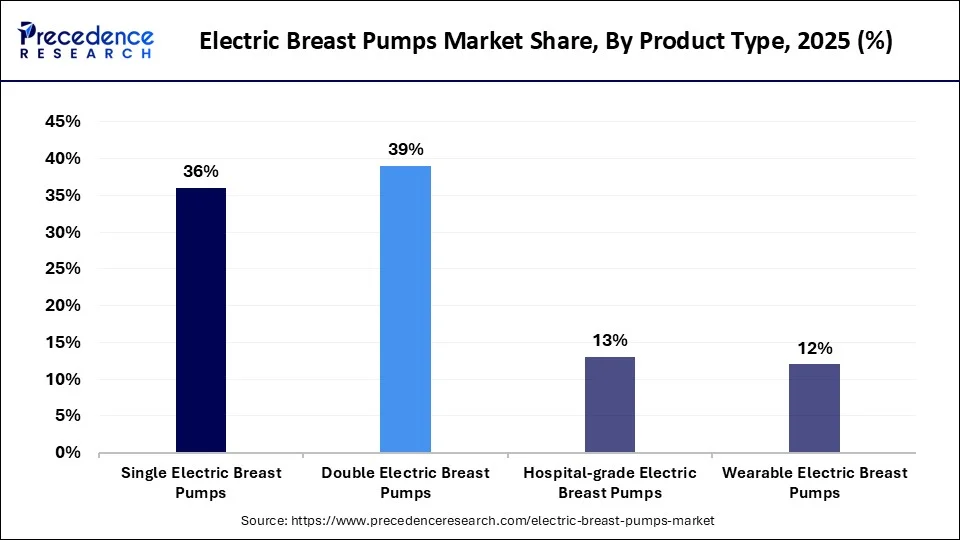
The wearable electric breast pumps segment held a 12% share of the market in 2025 and is expected to grow at the fastest CAGR of 13.5% during the projection period. This is mainly due to the growing need for hands-free and discreet pumping. They provide ultimate freedom and discretion. By removing cumbersome external tubes and heavy motors, these compact, all-in-one apparatuses fit directly inside a standard nursing bra, enabling mothers to pump hands-free while working, traveling, or doing chores.
The single electric breast pumps segment held the second-largest market share of 36% in 2025 and is expected to grow at a CAGR of 5.9% during the projection period. This is preferred by occasional users because of the affordability. Most modern single electric pumps run on rechargeable batteries or USB power. Many models can fit right into a standard nursing bra, alongside granting new mothers the freedom to multitask or work while pumping.
Technology Insights
Which Technology Segment Dominated the Electric Breast Pumps Market?
The closed system breast pumps segment dominated the market with a share of 72% in 2025 and is expected to grow at the fastest CAGR of 8.5% in the coming years. This is due to superior hygiene and lower contamination risk. A specialized barrier or backflow protector prevents breast milk from entering the tubing or motor. This design guarantees maximum hygiene, makes cleaning easier by eliminating the demand to wash tubing, and enables multiple users in hospital-grade rentals.
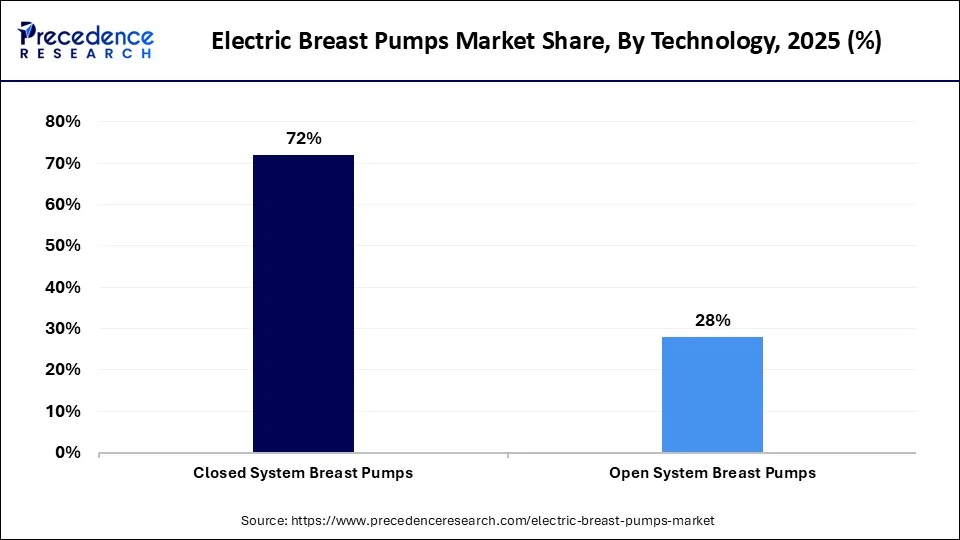
The open system breast pumps segment held a 28% share of the market in 2025 and is expected to grow at a CAGR of 3.8% during the projection period. This is due to the gradual replacement by closed-system devices. Open-system electric pumps are generally more budget-friendly than complex, closed-system hospital-grade variants, making them highly accessible to a wider range of mothers. With the growth of working mothers, electric breast pumps offer a practical solution for maintaining milk supply while away from the baby, providing flexibility to pump discreetly.
Application Insights
How the Personal Use Segment Led the Electric Breast Pumps Market?
The personal use segment led the market with a 79% share in 2025 and is expected to expand rapidly with a CAGR of 7.8% over the studied period, driven by growing employment among breastfeeding mothers. Innovations have eliminated the demand for dangling tubes, large tabletop motors, and tangled cords. Devices such as the Momcozy Breast Pump M5, the Wearable Electric Breast Pump, or Philips Hands-Free fit directly into a nursing bra, enabling users to commute, work, or care for other children while pumping.
Electric Breast Pumps Market Share, By Application, 2025 (%)
| Application | 2025 | 2035 | CAGR (%) |
| Personal Use | 79 | 82 | 7.80% |
| Hospital Use | 16 | 14 | 5.80% |
| NICU (Neonatal Intensive Care Unit) | 5 | 4 | 5.30% |
The hospital use segment held a 16% share of the market in 2025 and is expected to grow at a CAGR of 5.8% during the projection period. This is mainly due to the continued need in maternity wards. Unlike standard personal pumps, hospital-grade devices have stronger, commercial-quality motors. They mimic a baby's natural suckling rhythms, triggering faster let-downs and rising milk volume. Hospital-grade models provide highly adjustable suction strengths and cycle speeds, enabling mothers to customize pumping to their exact comfort level and prevent pain or engorgement.
The NICU (Neonatal Intensive Care Unit) segment held a 5% share of the market in 2025 and is expected to grow at a CAGR of 5.3% during the projection period. This is due to a specialized fund for premature infants. Mother's milk is now viewed as a vital medical intervention. It significantly lowers the risk of conditions such as necrotizing enterocolitis and sepsis. Hospital-grade devices are important for initiating and even sustaining milk supply when premature or critically ill infants cannot feed directly at the breast.
End User Insights
Why Did the Individual Mothers Segment Dominate the Electric Breast Pumps Market?
The individual mothers segment held the largest market share of 76% in 2025 and is expected to witness the fastest growth with a CAGR of 7.9% during the forecast period, driven by increasing awareness and even home pumping adoption. Modern "wearable" pumps now fit directly inside a nursing bra without external tubes or cords. This gives mothers the freedom to pump discreetly while traveling, working, or doing chores. Electric motors extract milk much faster than manual pumps, making them essential for mothers who pump regularly.
Electric Breast Pumps Market Share, By End User, 2025 (%)
| End User | 2025 | 2035 | CAGR (%) |
| Individual Mothers | 76 | 80 | 7.90% |
| Hospitals & Maternity Centers | 15 | 12 | 5.50% |
| Lactation Clinics | 5 | 5 | 6.70% |
| Neonatal Care Centers | 4 | 3 | 5.20% |
The hospitals and maternity centers segment held a 15% share of the market in 2025 and is expected to grow at the fastest CAGR of 5.5% during the projection period. This is mainly because of the stable procurement of hospital-grade pumps. Hospitals now heavily suggest hospital-grade pumps to mothers of critically ill or premature infants. Early and frequent pumping is associated with better lactation outcomes. With more women re-entering the workforce, maternity centers and lactation consultants encourage electric pumps so mothers can sustain their milk supply and even comfortably store milk.
The lactation clinics segment held a 5% share of the market in 2025 and is expected to grow at a CAGR of 6.7% during the projection period. This is due to the growth of breastfeeding support services. New hands-free and discreet models fit directly inside a standard nursing bra. They sync with apps to track output, making them highly popular among working mothers. Moreover, frequent pumping with electric dual pumps is highly effective at signaling the body to raise milk production, which is a major draw for moms facing low supply.
Distribution Channel Insights
Which Distribution Channel Segment Led the Electric Breast Pumps Market?
The e-commerce segment accounted for the highest market share of 39% in 2025 and is expected to grow at the fastest CAGR of 10.2% in the coming years. This is due to expanding online shopping and product availability. Tech-savvy parents are drawn to "smart" electric pumps. Many premium models connect to mobile apps through Bluetooth to track milk output, monitor pumping duration, and control suction or massage modes right from a smartphone.
Electric Breast Pumps Market Share, By Distribution Channel, 2025 (%)
| Distribution Channel | 2025 | 2035 | CAGR (%) |
| Retail Pharmacies | 24 | 20 | 5.80% |
| Hospital Pharmacies | 13 | 11 | 5.30% |
| Specialty Baby Stores | 17 | 14 | 5.90% |
| E-commerce | 39 | 49 | 10.20% |
| Direct Sales | 7 | 6 | 5.50% |
The retail pharmacies segment held a 24% share of the market in 2025 and is expected to grow at a CAGR of 5.8% during the projection period. This is due to the strong offline accessibility. In many regions, healthcare laws and insurance mandates, like the ACA in the United States, cover the expense of breast pumps. Pharmacies serve as direct supply hubs, streamlining the insurance verification along with the redemption process so moms can get hospital-grade motors at little to no out-of-pocket cost.
The specialty baby stores segment held a 17% share of the market in 2025 and is expected to grow at a CAGR of 5.9% during the projection period. This is due to the product demonstrations influencing purchases. This is due to the growth of hands-free wearable designs, increased workplace flexibility, and technology that mimics a baby's natural nursing. These features enable mothers to multitask without being tethered to a wall outlet.
Market Regional Analysis: North America, Europe, Asia-Pacific
Which Factors Drive the Electric Breast Pumps Market in North America?
North America held a major market share of 39% in 2025. This is due to the high breastfeeding awareness and favorable reimbursement policies. With a high rate of women returning to the workforce shortly after childbirth, electric and wearable pumps provide working mothers the efficiency and even convenience required to maintain milk production while juggling professional schedules.
U.S. Electric Breast Pumps Market Size and Growth 2026 to 2035
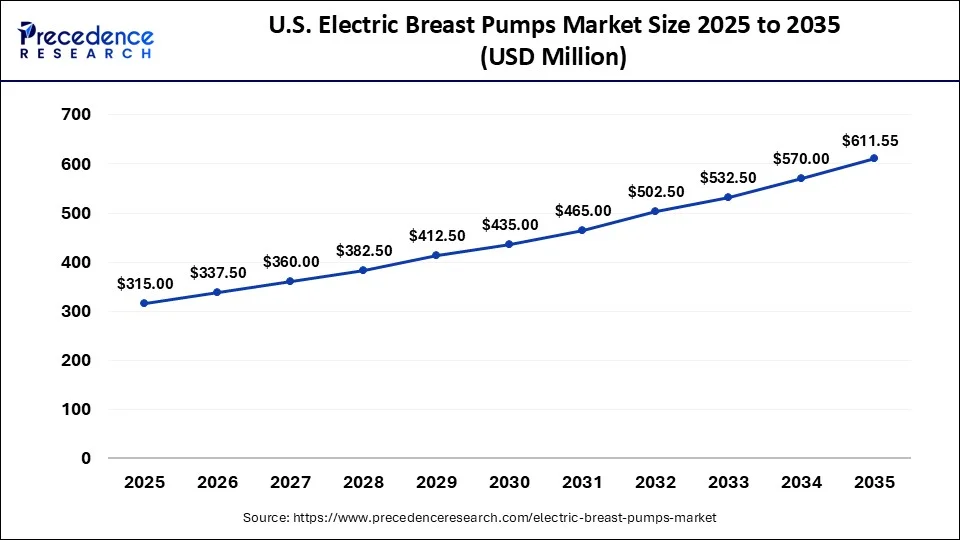
The U.S. electric breast pumps market size was evaluated at USD 315 million in 2025 and is projected to reach around USD 611.55 million by 2035, growing at a CAGR of 6.86% from 2026 to 2035.
U.S. Market Analysis
U.S. electric breast pumps have seen explosive expansion due to a combination of federal insurance mandates, growing female workforce participation, and vast technological innovations such as wearable, app-connected devices. These drivers have thus transformed breast pumps from basic clinical tools into important lifestyle accessories.
Europe: The Second-Largest Market
Europe held the second-largest market share of 27% in 2025 and is expected to grow at a notable CAGR of 6.7% during the projection period, driven mainly by strong maternal healthcare infrastructure, a growth in the female workforce, supportive maternal leave policies, and continuous technological advancements. Moreover, educational campaigns by health organizations regarding the long-term immunological and nutritional benefits of breast milk have encouraged mothers to use electric pumps for longer durations.
UK Market Analysis
The UK market is driven by a rise in maternal workforce participation along with increased societal knowledge of breastfeeding benefits. Electric pumps allow family members, partners, or caregivers to share in the feeding process. This provides mothers greater personal freedom and enhances postpartum mental health by easing the sole responsibility of direct feeding.
Asia-Pacific: The Fastest-Growing Region
Asia-Pacific held a 24% share of the electric breast pumps market in 2025 and is expected to grow at the fastest CAGR of 9.2% during the projection period, driven by rising birth rates in developing economies and rising disposable incomes. Heavy investments in healthcare and research have now yielded more portable, quieter, and comfortable electric pumps. Innovations such as wearable, discreet pumps and Bluetooth-integrated smart devices have vastly enhanced the user experience and spurred adoption in urban markets.
China Market Analysis
The Chinese market is driven by the growing number of working mothers, rising disposable income, and increased knowledge of infant nutrition. Health is heavily encouraged by Chinese healthcare professionals and government initiatives, encouraging more mothers to breastfeed.
What Drives the Electric Breast Pumps Market in Latin America?
Latin America held a 6% share of the market in 2025 and is expected to grow at a significant CAGR of 7% during the projection period, driven by expanding access to maternal healthcare products. Moreover, there is a strong, rising preference for "closed-system" pumps, and even hands-free and smart-connected devices, which provide greater mobility and efficiency for busy mothers.
Brazil Market Analysis
The market in Brazil is driven by the rising participation of women in the workforce, expanding e-commerce networks, and a raise in dual-income households. As more Brazilian women balance demanding careers with motherhood, electric and hands-free breast pumps offer the necessary flexibility to express and store milk seamlessly.
How is the Opportunistic Rise of the Middle East and Africa in the Electric Breast Pumps Market?
The Middle East and Africa held a 4% share of the market in 2025 and are expected to grow at a notable CAGR of 7.6% during the projection period, driven by improving maternal care services and retail penetration. The change from traditional manual or bulky plug-in pumps to portable, rechargeable, hands-free electric wearable devices, like those by brands such as Elvie and Momcozy, has made pumping highly discreet and even comfortable.
Saudi Arabia Market Analysis
Electric breast pumps are increasing in popularity across Saudi Arabia as more women enter the workforce and seek convenient, technology-based solutions to balance motherhood with professional responsibilities. Portable, wearable, and app-connected models are in particularly high demand as they enable mothers to express milk discreetly and on the go. The change toward hands-free, battery-operated, and whisper-quiet models enables mothers to pump discreetly at work, during travel, or while maintaining daily errands.
Market Competitive Landscape: Leading Companies and Strategies
The electric breast pumps market is moderately consolidated, with leading firms such as Medela AG, Lansinoh Laboratories, Ameda AG, Pigeon Corporation, Spectra Baby USA, Ardo Medical, Elvie, Willow, and Motif Medical competing via continuous innovation and product differentiation. Market participants aim on developing wearable, hands-free, quieter, and app-connected pumps to enhance user convenience and comfort. Strategic initiatives, including mergers, acquisitions, collaborations with hospitals and insurers, and expansion into emerging markets, strengthen competitive positioning. Investments in R&D, digital health integration, along with direct-to-consumer distribution channels, remain major strategies for sustaining market share and improving brand loyalty.
Electric Breast Pumps Market Companies
- Medela AG
- Koninklijke Philips NV
- Pigeon Corporation
- Ameda Inc.
- Willow Innovations
- Elvie
- Spectra Baby
- LuvLap
- Royal Philips
- Promom
- Momcozy
Recent Developments Electric Breast Pumps Market (2025-2026)
- In March 2026, Medela declared the Canadian start of two new innovative breast pumps: Pump In Style Pro+ and Freestyle™ Mini Hands-free. These new solutions reflect Medela's continued commitment to science-backed, mother-centric design by combining trusted performance with modern convenience for today's families.(Source: https://www.globenewswire.com)
- In August 2025, Philips declared the launch of its biggest innovation - the Philips Avent Hands-free Breast Pump - in India. Further, it was unveiled at an exclusive event in the presence of Masaba Gupta - a renowned fashion designer, actor, entrepreneur, and new mother herself - who is the face of this campaign.(Source: https://www.philips.co.in)
Segments Covered in the Report
By Product Type
- Single Electric Breast Pumps
- Double Electric Breast Pumps
- Hospital-grade Electric Breast Pumps
- Wearable Electric Breast Pumps
By Technology
- Closed System Breast Pumps
- Open System Breast Pumps
By Portability
- Corded Electric Breast Pumps
- Battery-powered Electric Breast Pumps
- Rechargeable Electric Breast Pumps
By Application
- Personal Use
- Hospital Use
- NICU (Neonatal Intensive Care Unit)
By End User
- Individual Mothers
- Hospitals & Maternity Centers
- Lactation Clinic
- Neonatal Care Centers
By Distribution Channel
- Retail Pharmacies
- Hospital Pharmacies
- Specialty Baby Stores
- E-commerce
- Direct Sales
By Price Range
- Economy
- Mid-range
- Premium
By Region
- North America
- Latin America
- Europe
- Asia-pacific
- Middle and East Africa
For inquiries regarding discounts, bulk purchases, or customization requests, please contact us at sales@precedenceresearch.com
Frequently Asked Questions





Ask For Sample
No cookie-cutter, only authentic analysis – take the 1st step to become a Precedence Research client
 Get a Sample




 sales@precedenceresearch.com
 Schedule a Meeting
