



Electronic Control Access Systems Market Trends, Companies, Revenue / Sales Performance, Manufacturing Yield, Fab Capacity, Export & Import Dynamics, Supply Chain Analysis, Competitive Landscape, and Growth Forecast
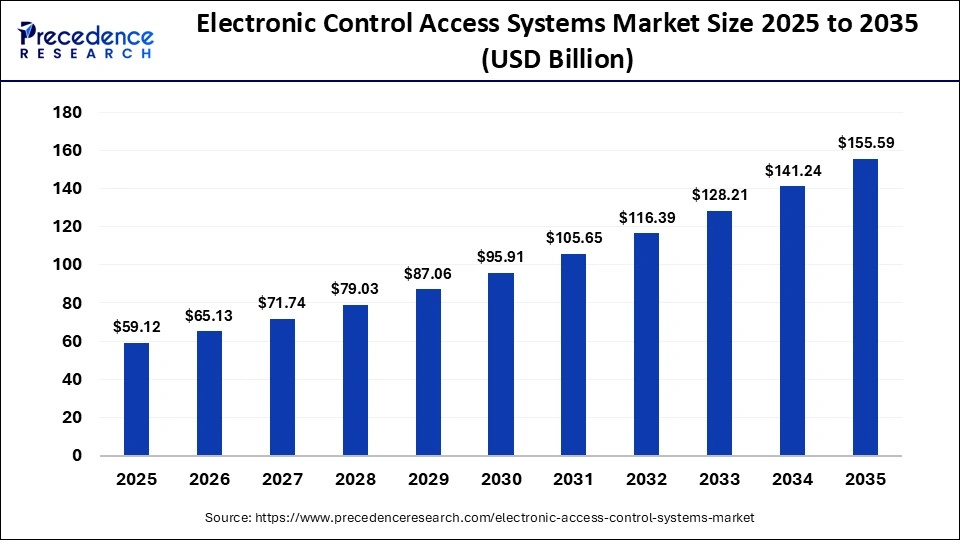
According to semiconductor and electronics specialist Laxmi Narayan, the electronic control access systems market is valued at USD 65.13 billion in 2026 and is forecast to reach USD 155.59 billion by 2035, reflecting a CAGR of 10.16%. Leading electronic control access systems market companies, including Johnson Controls International plc, Honeywell International Inc., ASSA ABLOY AB, Bosch Security Systems (Robert Bosch GmbH), Siemens AG., are strengthening their presence across key segments such as By Type, By Component, By End User, By Technology.
Source: https://www.precedenceresearch.com/electronic-control-access-systems-market
 Get a Sample
 Table Of Content


What is the Electronic Control Access Systems Market Size in 2026?
The global electronic control access systems market size accounted for USD 59.12 billion in 2025 and is predicted to increase from USD 65.13 billion in 2026 to approximately USD 155.59 billion by 2035, expanding at a CAGR of 10.16% from 2026 to 2035. The market is driven by growing demand for smart, secure access solutions across numerous industries.
Key Takeaways
- North America led the market with the highest market share of 38% in 2025.
- The Asia Pacific is projected to grow at the fastest rate in the market during the forecast period.
- By type, the card-based access control segment held the largest market share of 48% in 2025.
- By type, the biometric access control segment is anticipated to expand at the fastest rate over the forecast period.
- By component, the hardware segment maintained a leading position in the market with a 55% share in 2025.
- By component, the software segment is expected to grow at the fastest rate during the forecast period.
- By end user, the commercial segment dominated the global market with a 42% share in 2025.
- By end user, the residential segment is projected to grow at the fastest rate in the coming years.
- By technology, the wired systems segment accounted for a major revenue share of 60% in 2025.
- By technology, the wireless systems segment is expected to grow at the fastest rate during the forecast period.
Market Overview
The electronic control access systems market includes security solutions that manage and monitor access to both physical and digital assets in commercial, residential, and government sectors. These systems combine security technologies like biometrics, cloud computing, IoT, and AI to provide users with a safe and effective way to manage access. Modern security systems feature mobile access controls, multi-factor authentication, and cloud-based platforms that enable remote access, better monitoring, and greater system flexibility. The market is expanding rapidly as companies aim to create safe environments while improving operational efficiency and adopting digital technologies that ensure secure access systems.
How is AI Impacting the Electronic Control Access Systems Market?
Electronic access control systems are being revolutionized through the integration of AI and IoT technologies. AI-driven systems are changing the way security systems operate by enabling predictive security, facial recognition, and behavior analysis. By using these technologies, it is possible to respond quickly and accurately. The use of AI-driven analytics enables continuous monitoring of users and the rapid identification of suspicious behavior. Therefore, firms can amplify the defense against intrusion and human error and guarantee a greater safety level.
Electronic Control Access Systems Market Trends
- There is a growing adoption of cloud platforms across industries, driven by organizations' need to enable remote access, ensure real-time security operations, and reduce infrastructure costs.
- The integration of AI into electronic control access systems is rising. The integration of fingerprint and facial recognition systems with AI-powered behavioral analytics enhances fraud prevention and enables seamless, touchless authentication across commercial, residential, and government facilities.
- Expansion of smart infrastructure boosts the market. Smart infrastructure systems improve operational efficiency, strengthen security, and enhance user experience by integrating access control with IoT-enabled devices such as lighting, HVAC, and surveillance systems.
Market Scope
| Report Coverage | Details |
| Market Size in 2025 | USD 59.12 Billion |
| Market Size in 2026 | USD 65.13 Billion |
| Market Size by 2035 | USD 155.59 Billion |
| Market Growth Rate from 2026 to 2035 | CAGR of 10.16% |
| Dominating Region | North America |
| Fastest Growing Region | Asia-Pacific |
| Base Year | 2025 |
| Forecast Period | 2026 to 2035 |
| Segments Covered | Type, Component, End User, Technology, and Region |
| Regions Covered | North America, Europe, Asia-Pacific, Latin America, and Middle East & Africa |
Market Dynamics
Drivers
Increasing Adoption of Biometric and Cloud-Based Solutions
The increasing demand for enhanced security has driven the widespread adoption of biometric systems and cloud-based electronic access control solutions. These systems offer advanced protection while enabling seamless and efficient identity verification. Additionally, the growing popularity of cloud-based access control is supported by its ability to integrate with IoT-enabled security systems and centralized management platforms, allowing businesses to scale operations and improve overall efficiency.
Restraint
High Implementation and Maintenance Costs
The primary barrier to the adoption of electronic access control systems is the high cost of implementation and maintenance. Technologies such as biometric readers, AI-based facial recognition, smart locks, and cloud-based platforms require significant upfront investment, making them less accessible to micro and small businesses. In addition to initial setup expenses, organizations must account for hardware procurement, software development, system integration, cybersecurity measures, and ongoing updates, all of which contribute to a higher total cost of ownership.
Opportunity
Demand for Smart and AI-Driven Solutions
The growing demand for enhanced security is creating significant opportunities for the adoption of smart, AI-driven IoT solutions. Continuous monitoring through IoT devices enables real-time data collection and improved visibility across multiple locations. Cloud-based systems further support this by providing a centralized platform for organizations to monitor and manage security operations from a single interface. Additionally, remote access capabilities offer greater flexibility, while a centralized approach improves coordination across security processes and ensures consistency in security standards.
Segment Insights
Type Insights
Electronic Control Access Systems Market Share, By Type, 2025-2035 (%)
| Type | 2025 | 2035 |
| Card-Based Access Control | 48.00% | 40.00% |
| Biometric Access Control | 22.00% | 30.00% |
| Keypad-Based Access Control | 18.00% | 14.00% |
| Mobile-Based Access Control | 12.00% | 16.00% |
The Card-Based Access Control Segment Held a 48% Share of the Market in 2025
The card-based access control segment dominated the electronic control access systems market with the largest share of 48% in 2025. This is because organizations often prefer card-based access control systems for their affordability and easy installation. These systems find application in commercial environments, such as office spaces and retail centers, and government offices. These systems enable businesses to track and control access points, which results in better resource management at their facilities.
The biometric access control segment held a 22% share of the market in 2025 and is expected to grow at the fastest rate in the coming years, driven by organizations' shift toward advanced authentication methods. Improvements in the accuracy and usability of technologies such as facial recognition, fingerprint scanning, and iris recognition have significantly enhanced their adoption. As commercial and government facilities face increasing and urgent security threats, organizations are prioritizing the implementation of more reliable and sophisticated security solutions, such as biometric access control systems.
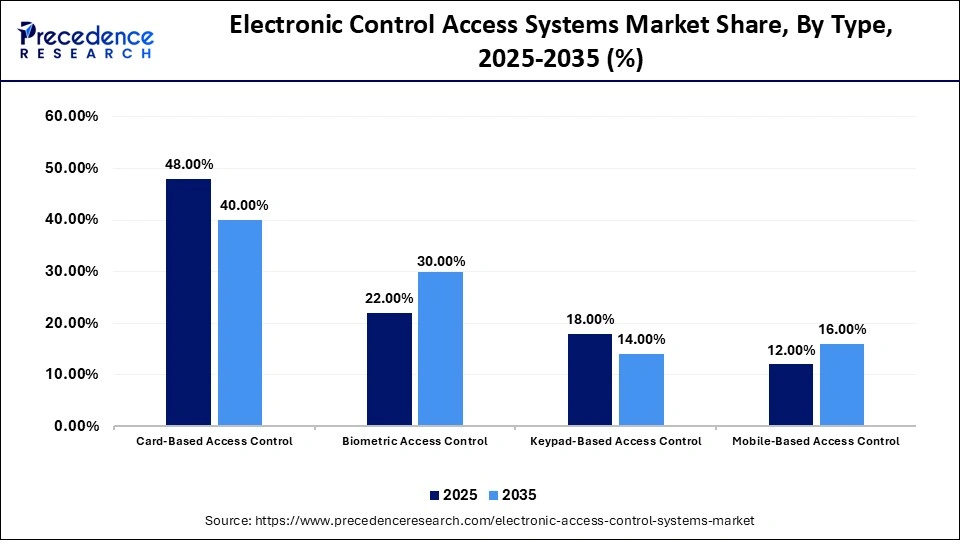
The keypad-based access control segment held about 18% share of the market in 2025, driven by its cost-effectiveness and simplicity. Keypad-based access control systems require minimal installation and maintenance, making them particularly suitable for small businesses and residential settings. Additionally, users can easily update or change PIN codes without the need for hardware replacement, enhancing convenience and flexibility.
The mobile-based access control segment held a 12% share of the market in 2025 due to the widespread adoption of smartphones and the increasing preference for convenient, contactless authentication methods. Its integration with cloud-based platforms also enables remote access management and scalability, allowing organizations to efficiently control multiple entry points from any location.
Component Insights
Electronic Control Access Systems Market Share, By Component, 2025-2035 (%)
| Component | 2025 | 2035 |
| Hardware | 55.00% | 48.00% |
| Software | 25.00% | 32.00% |
| Services | 20.00% | 20.00% |
The Hardware Segment Dominate the Market with a 55% Share in 2025
The hardware segment held a dominant position in the electronic control access systems market with a major share of 55% in 2025. This is because of the increased demand for physical security infrastructure. Hardware solutions such as readers, controllers, locking systems, and sensors are the backbone of access control systems. Organizations continue to invest heavily in these devices to establish secure and reliable infrastructure, as they form the foundation for implementing advanced security solutions.
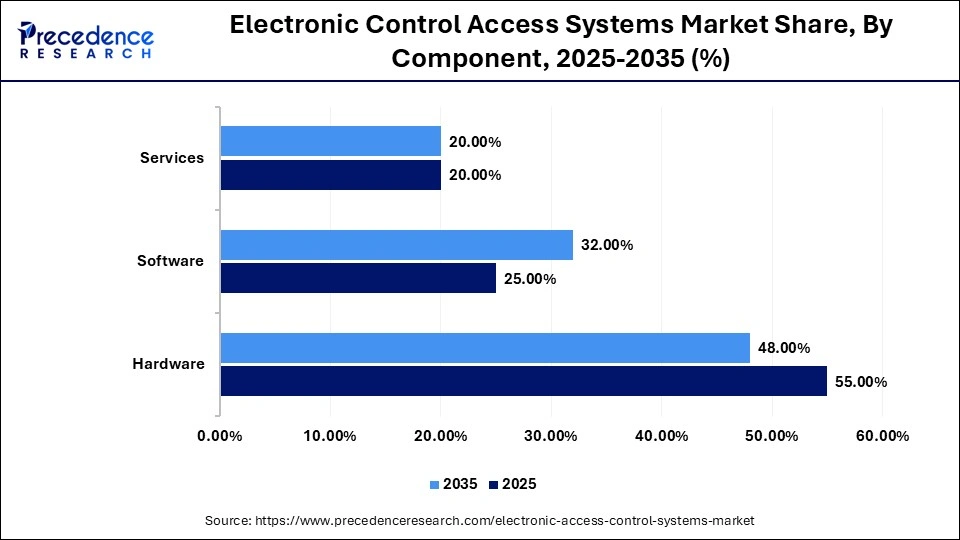
The software segment held a 25% share of the market in 2025 because more people started using cloud-based platforms, AI-driven analytics, and centralized access control systems. The software system allows users to monitor systems in real time and manage systems from remote locations while making decisions based on collected data. The growing need for centralized management, real-time monitoring, and data analytics in access control systems also drives the adoption of software.
The services segment held a 20% share of the market in 2025, driven by demand for installation, maintenance, and system integration services. Professional services help organizations deploy and operate access control systems effectively, while regular maintenance reduces downtime and enhances performance. System integration services further enable businesses to connect hardware with software platforms, improving overall productivity and operational efficiency.
End User Insights
Why Did the Commercial Segment Dominate the Electronic Control Access Systems Market?
The commercial segment held a dominant position in the market while holding a major share of 42% in 2025. This is mainly due to the widespread adoption of electronic access control systems in offices, retail stores, and hospitality businesses. These facilities use such systems to manage employee and visitor access across all entry points. The integration with existing infrastructure ensures seamless operation across multiple locations, driving adoption in the sector.
The government & defense segment held a 28% share of the market in 2025, driven by the demand for high-security and advanced surveillance systems. To protect sensitive assets and critical data, these organizations implement sophisticated, multi-layered security solutions that combine biometric authentication with AI-powered surveillance systems.
Electronic Control Access Systems Market Share, By End User, 2025-2035 (%)
| End User | 2025 | 2035 |
| Commercial | 42.00% | 38.00% |
| Government and Defense | 28.00% | 27.00% |
| Residential | 18.00% | 24.00% |
| Industrial | 12.00% | 11.00% |
The residential segment held a 18% share of the market in 2025, driven by the growth of smart home technology and increasing security concerns. Homeowners are increasingly adopting solutions such as smart locks, mobile access control, and biometric security systems, as they provide enhanced monitoring and greater control over home security.
The industrial segment held a 12% share of the market in 2025, driven by the need for facility protection and employee supervision. Access control systems safeguard assets and personnel in manufacturing plants, warehouses, and logistics centers, while integration with attendance tracking and safety protocols enhances operational efficiency. Industrial environments require robust and scalable solutions to manage large volumes of employees and visitors effectively.
Technology Insights
Electronic Control Access Systems Market Share, By Technology, 2025-2035 (%)
| Technology | 2025 | 2035 |
| Wired Systems | 60.00% | 52.00% |
| Wireless Systems | 40.00% | 48.00% |
The Wired Systems Segment Captured a 60% Share of the Market in 2025
The wired systems segment dominated the global market with a share of 60% in 2025 because of their reliable performance and high-security protection. Facilities such as government, defense, and large commercial complexes prefer wired solutions for their stable, low-latency connections and resistance to external interference. Additionally, the straightforward integration process allows organizations to connect existing security infrastructure with new technologies seamlessly.
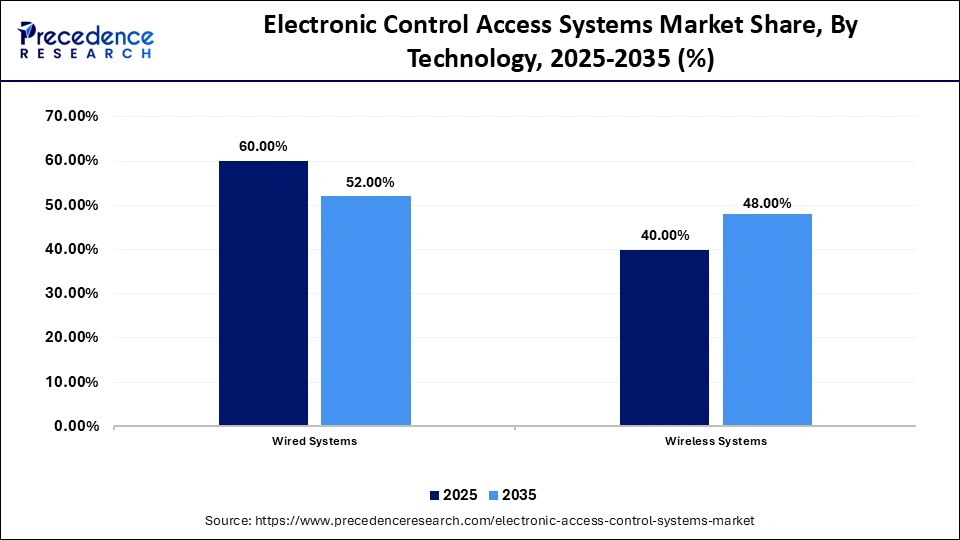
The wireless systems segment held a 40% share of the market in 2025 and is expected to grow at the fastest rate in the coming years because of its high performance and scalability. Wireless systems can be seamlessly integrated with IoT solutions, providing remote access capabilities. Wireless solutions permit organizations to install their systems in both new constructions and existing structures because they do not require extensive wiring. These systems enable users to access their functions through mobile devices while providing them with real-time monitoring capabilities.
Region Insights
North America Electronic Control Access Systems Market Size and Growth 2026 to 2035
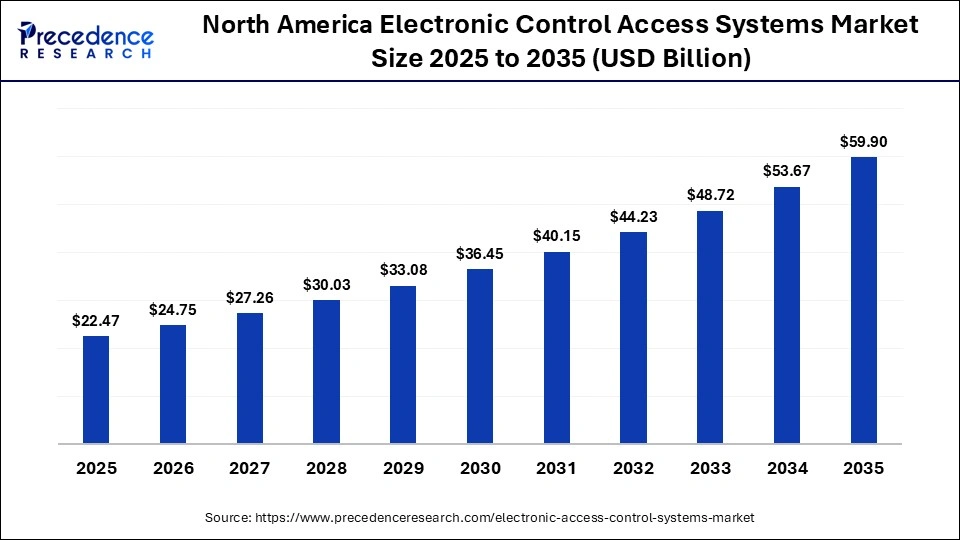
The North America electronic control access systems market size is estimated at USD 22.47 billion in 2025 and is projected to reach approximately USD 59.90 billion by 2035, with a 10.30% CAGR from 2026 to 2035.
Why Did North America Lead the Electronic Control Access Systems Market?
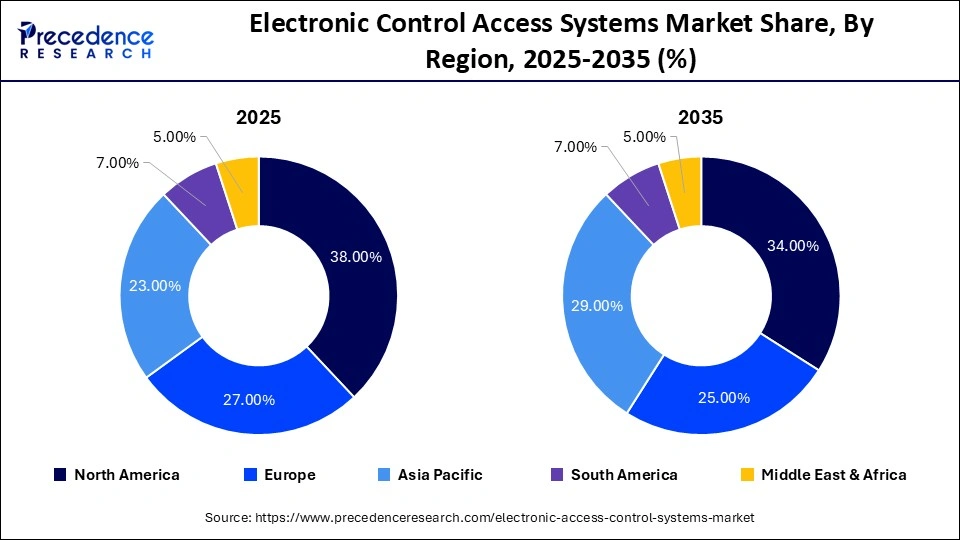
North America led the global electronic control access systems market with a share of 38.0% in 2025 because the commercial, residential, and government sectors implemented advanced security technologies. The region is at the forefront of developing advanced access control systems. The region benefits from a high concentration of major market players and technology innovators. With the growing trend of smart buildings and high adoption of the Internet of Things, there is a rising demand for security solutions to protect valuable assets. Organizations across the region have been adopting advanced access control solutions because the government mandates compliance with workplace safety standards, cybersecurity laws, and public security protocols.
U.S. Electronic Control Access Systems Market Size and Growth 2026 to 2035
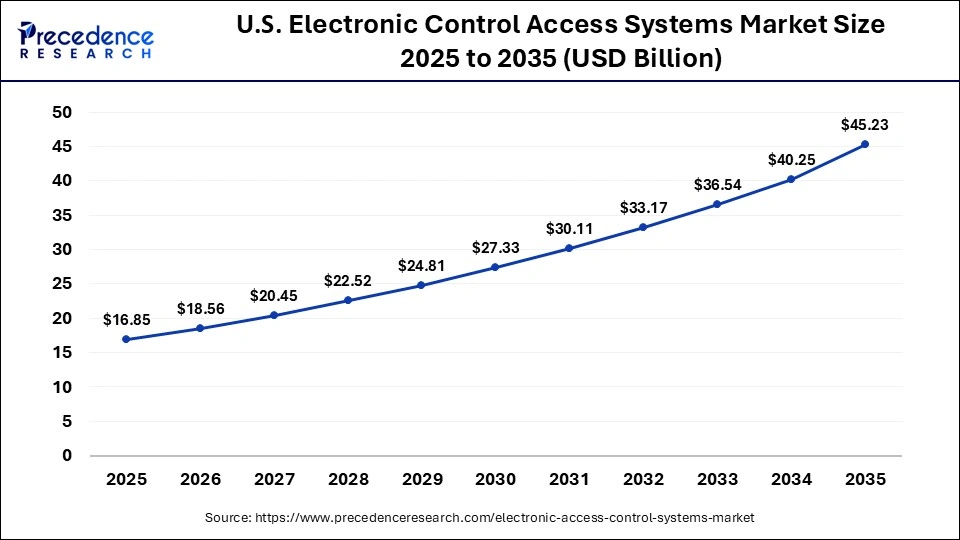
The U.S. electronic control access systems market size is calculated at USD 16.85 billion in 2025 and is expected to reach nearly USD 45.23 billion in 2035, accelerating at a strong CAGR of 10.38% between 2026 and 2035.
U.S. Market Analysis
The U.S. market is experiencing strong growth as businesses deploy card-based and biometric access systems across offices, healthcare facilities, retail centers, and government institutions. Companies are developing unified solutions that integrate hardware, software, and cloud-based analytics to manage multiple access points efficiently. The country maintains regional dominance due to widespread technological adoption, along with national initiatives in digital transformation, artificial intelligence, and smart infrastructure development.
Why is Asia Pacific Experiencing the Fastest Growth in the Electronic Control Access Systems Market?
Asia Pacific is expected to grow at the fastest rate in the market throughout the forecast period, driven by rapid urbanization, expansion of industrial facilities, and the development of smart buildings. With densely populated commercial, industrial, and critical areas facing increasing security threats, there is a growing demand for advanced access control solutions. By leveraging IoT networks, AI analytics, cloud platforms, and predictive security, organizations across the region can efficiently manage multiple access points while ensuring robust protection.
China Market Analysis
The market in China is growing due to government investment in digital security projects, the development of smart city initiatives, and large-scale infrastructure projects. Offices, shopping centers, hotels, and distribution centers are adopting biometric technologies, mobile solutions, and wireless systems to safeguard assets and streamline operations. Electronic access control systems have become essential in industrial settings, enabling organizations to manage both workforce operations and facility security efficiently.
How is the Opportunistic Rise of Europe in the Electronic Control Access Systems Market?
Europe held a 27% share of the market in 2025 and is expected to grow at a significant rate over the projection period, driven by rising adoption of security solutions across commercial, industrial, and government sectors. The expansion of smart buildings, digital transformation initiatives, and widespread implementation of IoT solutions are driving the market. AI-powered cloud access control systems enhance operational efficiency and security by enabling centralized management, real-time monitoring, and threat detection. Additionally, the demand for intelligent emergency control and alarm systems is rising due to the growth of modern buildings, smart infrastructure, and energy-efficient solutions.
Germany Market Analysis
The market in Germany is experiencing steady growth due to significant investments in commercial, industrial, and government facilities. Security management systems facilitate the deployment of biometric, mobile, and wireless access solutions that integrate seamlessly with existing wired infrastructure. With ongoing industrialization, modernization of public infrastructure, and a growing focus on protecting employees and facilities, Germany continues to prioritize advanced access control solutions.
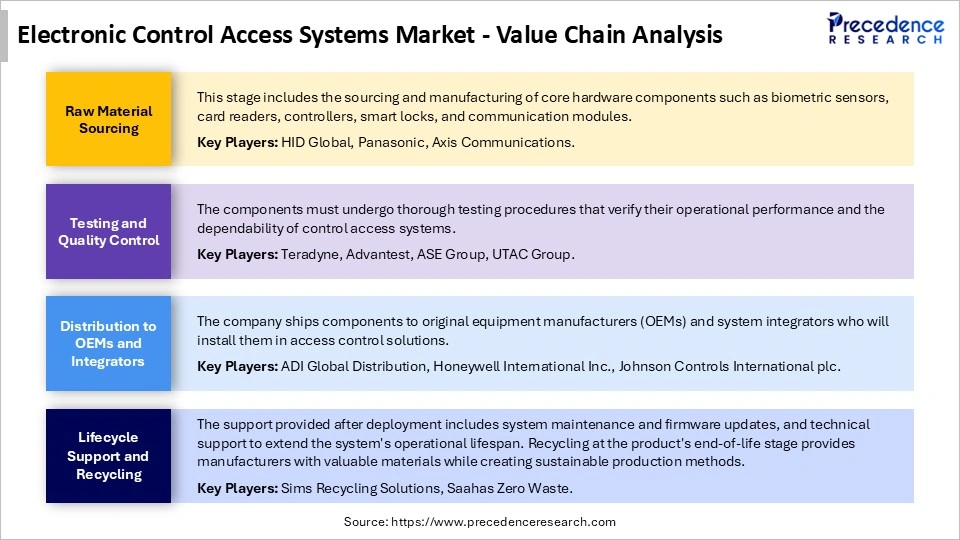
Electronic Control Access Systems Market Supply Chain Analysis
Electronic Control Access Systems Market Companies
- Johnson Controls International plc
- Honeywell International Inc.
- ASSA ABLOY AB
- Bosch Security Systems (Robert Bosch GmbH)
- Siemens AG
- HID Global Corporation
- dormakaba Holding AG
- Allegion plc
- Axis Communications AB
- NEC Corporation
- Thales Group
- Identiv, Inc.
- Suprema Inc.
- ZKTeco Co., Ltd.
- Panasonic Corporation
Recent Developments
- In August 2025, ASSA ABLOY acquired SiteOwl, a U.S.-based cloud platform for physical security lifecycle management, which enables better access control infrastructure management for integrators, service providers, and end users. This integration streamlines digital lifecycle management while establishing ASSA ABLOY as a leader in digital security transformation.(Source: https://www.assaabloy.com)
- In June 2025, Suprema expanded its Access Control Unit portfolio with the CoreStation 20 (CS-20) and Door Interface (DI-24), which can handle 500,000 users through their PoE+ and encrypted communication capabilities. The modules enhance system security while providing two essential advantages for advanced access control systems: better deployment options and improved scalability.(Source: https://www.supremainc.com)
- In January 2025, Nedap introduced AEOS Certificate Management and Device Certificate Management, which made AEOS the first access control system to enable complete certificate management from server to device reader. The system provides security improvements through its unique digital certificate allocation system, which protects AEOS users from cyber threats and unauthorized system access. (Source: https://www.nedap.com)
Segments Covered in the Report
By Type
- Card-Based Access Control
- Biometric Access Control
- Keypad-Based Access Control
- Mobile-Based Access Control
By Component
- Hardware
- Controllers
- Readers
- Locks
- Software
- Services
By End User
- Commercial
- Government & Defense
- Residential
- Industrial
By Technology
- Wired Systems
- Wireless Systems
By Region
- North America
- Latin America
- Europe
- Asia-pacific
- Middle and East Africa
For inquiries regarding discounts, bulk purchases, or customization requests, please contact us at sales@precedenceresearch.com
Frequently Asked Questions





Ask For Sample
No cookie-cutter, only authentic analysis – take the 1st step to become a Precedence Research client
 Get a Sample




 sales@precedenceresearch.com
 Schedule a Meeting
