



eVTOL and Advanced Air Mobility Market Trends, Leading Companies, Company Revenue / Sales Performance, Procedure Volume, Healthcare Spending, Technology Adoption, Reimbursement Analysis, Competitive Landscape, and Growth Outlook
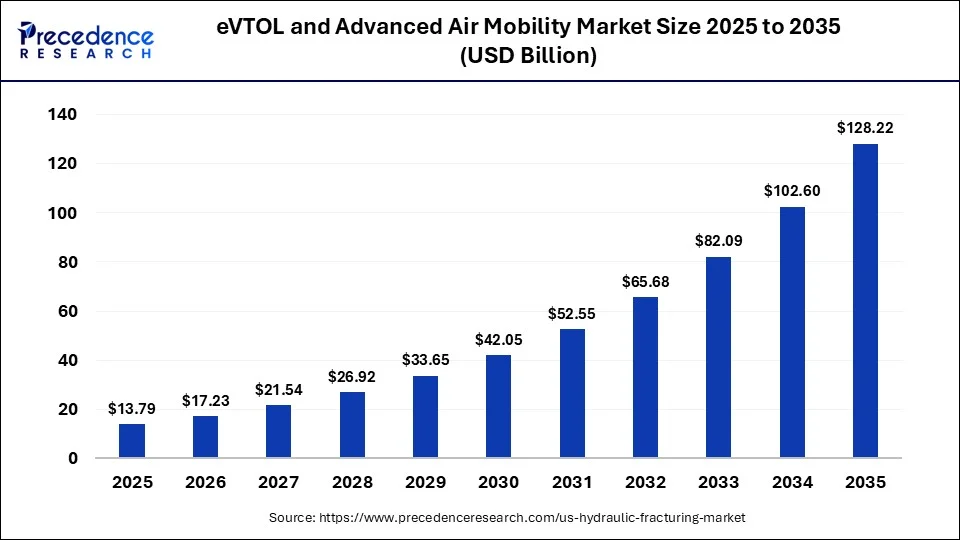
The eVTOL and advanced air mobility market is valued at USD 17.23 billion in 2026 to USD 128.22Â billion by 2035, growing at a CAGR of 24.98% from 2026 to 2035. at a CAGR of 24.98%. A new era of aircraft demonstration, certification, and early commercial passenger and cargo aviation is fuelling the market. Our senior research analyst, Laxmi Narayan, analyzed these trends and curated this report. His analysis supports stakeholders across aerospace, aviation, transportation, infrastructure, technology, investment, and mobility sectors in understanding competitive developments, commercialization strategies, and emerging opportunities.
Source: https://www.precedenceresearch.com/evtol-and-advanced-air-mobility-market
 Get a Sample
 Table Of Content


eVTOL and Advanced Air Mobility Market Size, Share, Trends, and Growth Forecast 2035
The eVTOL and advanced air mobility market is forecasted to expand from USD 17.23 billion in 2026 to USD 128.22 billion by 2035, growing at a CAGR of 24.98% from 2026 to 2035. Advanced air mobility and the eVTOL industry are moving to a new generation of aviation in the aerospace industry. This industry continues to develop electric aircraft from technology demonstration to commercialization. Our senior research analyst, Laxmi Narayan, has over 5 years of experience analyzing markets across technology-based industries. He has observed a key shift in how eVTOL developers, airlines, airports, technology firms, and infrastructure providers are developing an eVTOL ecosystem. Furthermore, the growth of vertiports, charging stations, air traffic management solutions, certification processes, and digital operations is also boosting the market's further growth of the market.
Key Takeaways
- By aircraft type, the multirotor eVTOL segment led the market with a share of 18.65% in 2025.
- By propulsion type, the battery-electric segment led the market with a 49.85% share in 2025.
- By component, the electric motors and propulsion segment captured a major revenue share of 18.45% in 2025.
- By application, the passenger air mobility segment captured the largest market share of 34.85% in 2025.
- By capacity, the single-seater segment led the market with a share of 9.85% in 2025.
- EHang delivered 169+ EH216 units and completed 83,000+ flights across 21 countries, highlighting strong early commercial deployment.
- EASA's 2025 framework provided clearer certification and operational guidelines for eVTOL and advanced air mobility integration in Europe.
- Joby, Archer, Eve, and Vertical Aerospace continued advancing certification milestones, with commercial entry targeted between 2026 and 2028.
- Archer progressed FAA certification, expanded flight testing, and maintained USD 1.8 billion liquidity to support planned U.S. air taxi operations.
- Eve advanced its certification program with a full-scale prototype test campaign and planned nearly 300 flights to gather validation data.
The eVTOL and advanced air mobility (AAM) market is much wider than just electric vertical takeoff and landing aircraft. Because it includes all the other technologies, such as electric propulsion and energy systems, avionics, flight-control technologies, charging infrastructure, vertiports, digital fleet-management platforms, and commercial mobility services. The industry is slowly shifting from prototype development. This is putting more effort into aircraft certification, flight testing, aircraft manufacturing, infrastructure deployment, and the introduction of initial commercial services.
The market size is expected to grow from USD 13.79 billion in 2025 to USD 128.22 billion by 2035, with the assumption of a 24.98% CAGR.
Expert Analyst View - Market Overview
The forecast is based on a larger shift from an aircraft-development business to an entire aircraft, infrastructure, and operations business. Successful prototype flights are succeeding with certification, scaling of production, pilot and operational needs, construction of vertiports, charging infrastructure, and integrating with existing airspace, all emerging as critical factors. In the USA, the powered-lift pilot and rule of the practice (POP) for the FAA took place in 2024. Their AAM implementation program is concentrating on scaling AAM operations at one location or more.
Market Segmentation By Aircraft Type
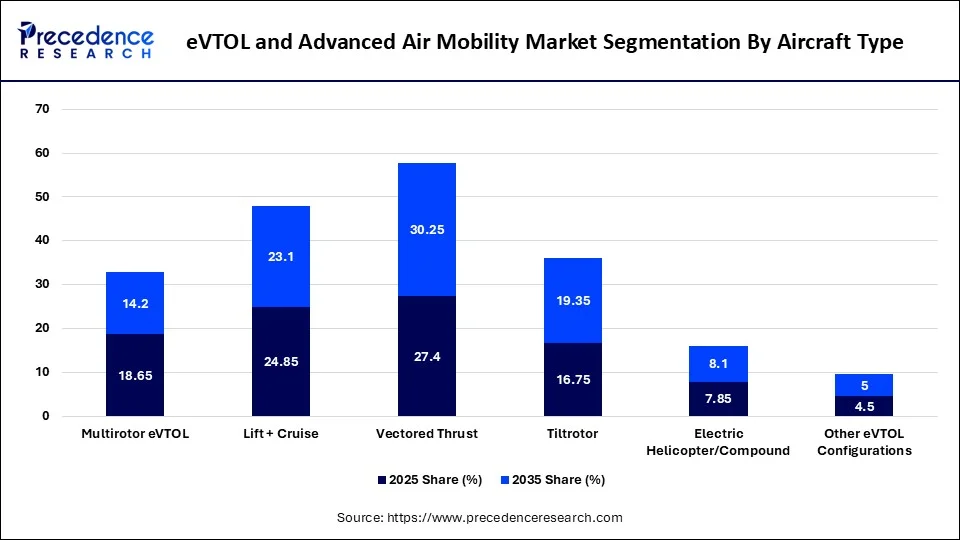
Vectored-thrust aircraft were the largest category in 2025 (27.40%), and by 2035 are expected to reach 30.25% at a 26.15% CAGR. Further rising due to their ability to achieve vertical lift along with efficient forward flight for achieving long haul for carrying more passengers. The fastest growth comes from the range/speed advantage of tiltrotor aircraft, which increases from 16.75% to 19.35% at a CAGR of 27.10%.
Expert Analyst View - Aircraft Type
Developers are moving away from a focus entirely on short-range transport in urban airspace and focusing on the decisions between range and airport-to-city options, with vectored-thrust and tiltrotor systems gaining ground while traditional multirotor systems lose ground as the market grows exponentially.
Market Segmentation By Propulsion Type
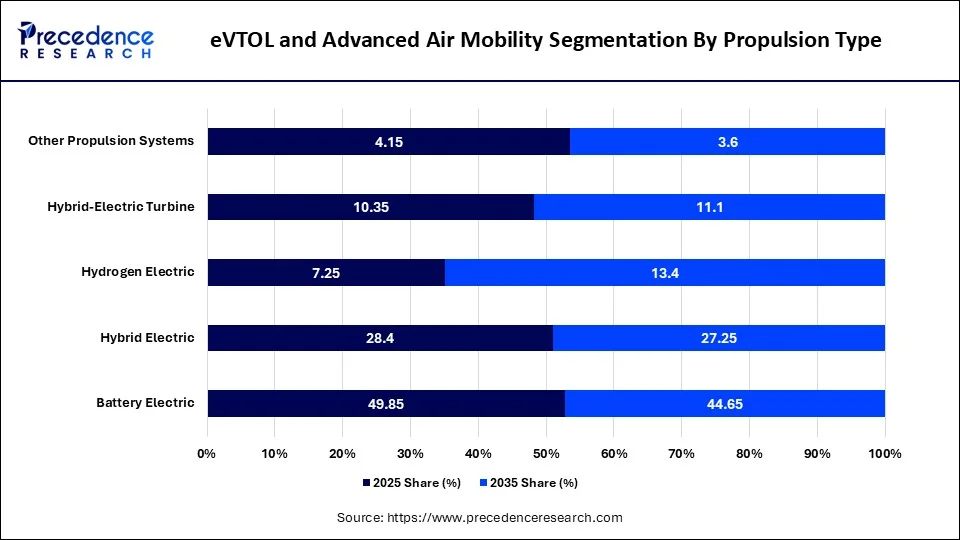
The largest market share is held by battery electric propulsion in 2025 at 49.85%. This is projected to reach 44.65% by 2035 at a 23.80% CAGR, which is by far the lowest in the market. This type of propulsion system is closest to commercialization today, with missions growing in number and diversity. In 2025, hybrid-electric systems represent 28.40%, although the figure tapers off slightly to 27.25% at 24.55% CAGR, signifying continued relevance for issues and challenges with the need for longer range than batteries alone.
Expert Analyst View - Propulsion Type
Battery electric propulsion is still well tied to the industry's first plans for commercial propulsion. Hybrid and hydrogen propulsion technologies similarly are being given room to grow. Due to aircraft range, payload, reserve energy, and operational restrictions at the same time. The provided numbers thus represent a trend of diversification of propulsion sources until 2035 and not a market based on one single architecture. Furthermore, vertical aerospace uses a hybrid-electric strategy as part of its overall aircraft design strategy.
Market Segmentation By Component
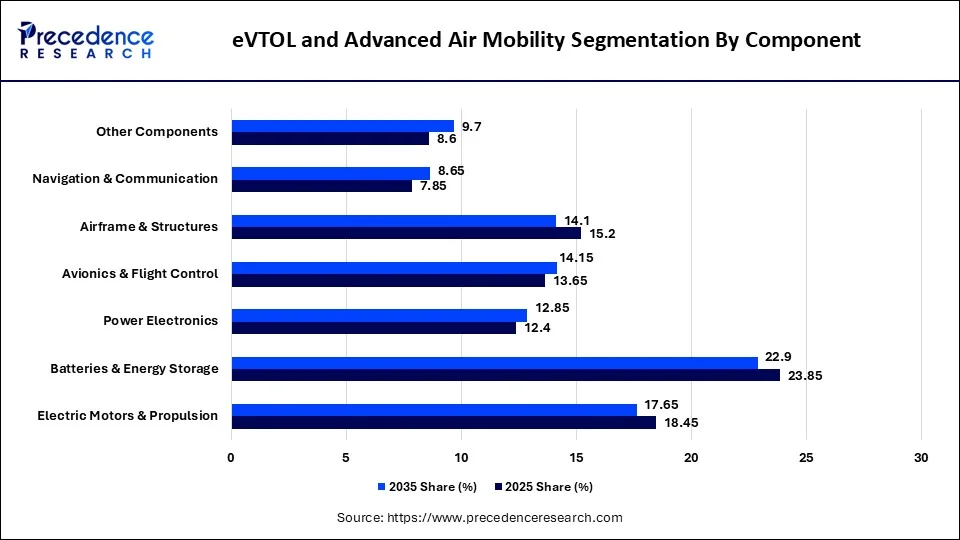
The largest category is batteries and energy storage with a market share of 23.85% in 2025 and 22.90% in 2035, at a 24.55% CAGR. Owing to the increasing demand for high energy densities for aircraft to be able to cover increased distances. Electric motors and propulsion are right on its heels at 18.45% (dipping to 17.65% at 24.50% CAGR) as high-power electric propulsion is developed.
Expert Analyst View - Component
Aerospace supply chains no longer drive component requirements. Thus, aircraft certification and aviation safety requirements are a strong influence. Batteries, the thermal-management system, electric motors, sensors, power electronics, and flight-control software must all work together as "highly reliable" systems that are safety-critical for flight. Aerospace-grade parts manufacturers can benefit from the opportunities. This environment offers components for aerospace applications, plus meets the volume requirements of commercial aircraft.
Market Segmentation By Application
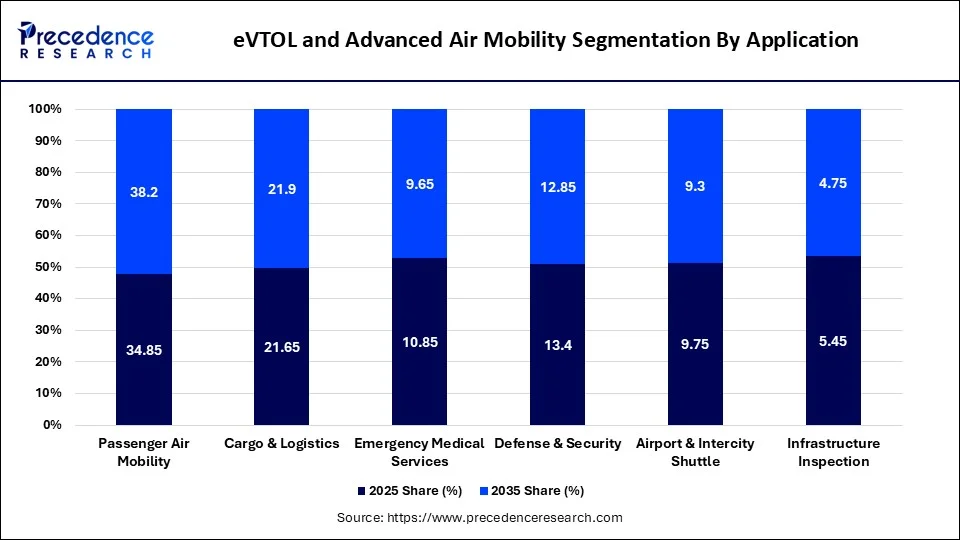
Passenger air mobility is the largest application category, held a 34.85% market share in 2025 and is projected to reach 38.20% by 2035 at a 26.10% CAGR. Stating that urban and regional air-taxi services sit at the commercial center of this market. Rapid delivery and autonomous use cases were pushing cargo and logistics towards the second-largest application as it grew from 21.65% to 21.90% in the projected period. Defense and security applications accounted for 13.40% of the market in 2025, and will further fall to 12.85% at a CAGR of 23.85%. This is being driven by specialized mission or logistics needs, rather than extensive commercial scale-up.
Expert Analyst View - Application
While cargo, logistics, and medical services provide significant operating opportunities, transportation is becoming AAM's main commercial offering. These applications have unique requirements for passenger handling, routing, scheduling, and payload. The 2026 eIPP showcases FAA's evaluation of AAM in a variety of operations, such as passenger, cargo, automation, and medical-response missions across multiple regions in the U.S., further highlighting the industry's exploration of AAM in a variety of realistic mission types beyond just urban air-taxi services.
Market Segmentation By Vehicle Capacity
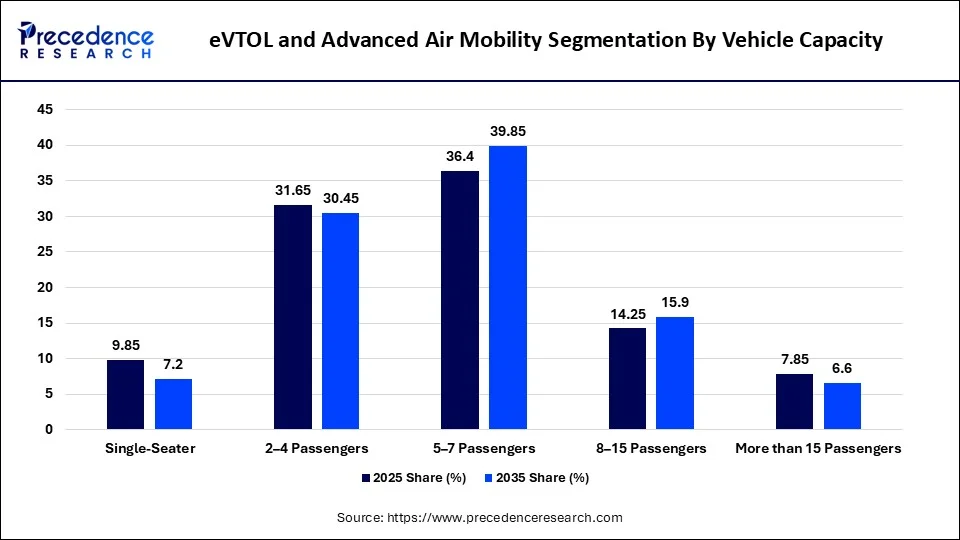
Major existing concepts of air taxis follow a standard of around 20 passengers. The passenger range of 5 - 7 dominated the market with 36.40% of the total market share by 2025. Further reaching 39.85% of market share by 2035 at a 26.05% CAGR. The 2- to 4-seat wide-body class will be the first step in air-taxi service, with 31.65% in 2025 and a 24.50% CAGR, while larger cabins rise and come to dominate the air-taxis market in 2025. The 8-15 passenger category has the highest CAGR of 26.20 and it is expected to be used in the future for regional and shuttle services.
Expert Analyst View - Vehicle Capacity
The favourable situation of 5-7 passenger aircraft indicates industry efforts to balance a vehicle's passenger size, economics of operation, range, and energy needs. This attribute also applies to many existing concepts of air-taxi in use. Furthermore, larger 8-15 passenger aircraft are becoming the focus for airport transfers, intercontinental operations, and a larger new flow of mobility services.
Market Segmentation By Mode of Operation
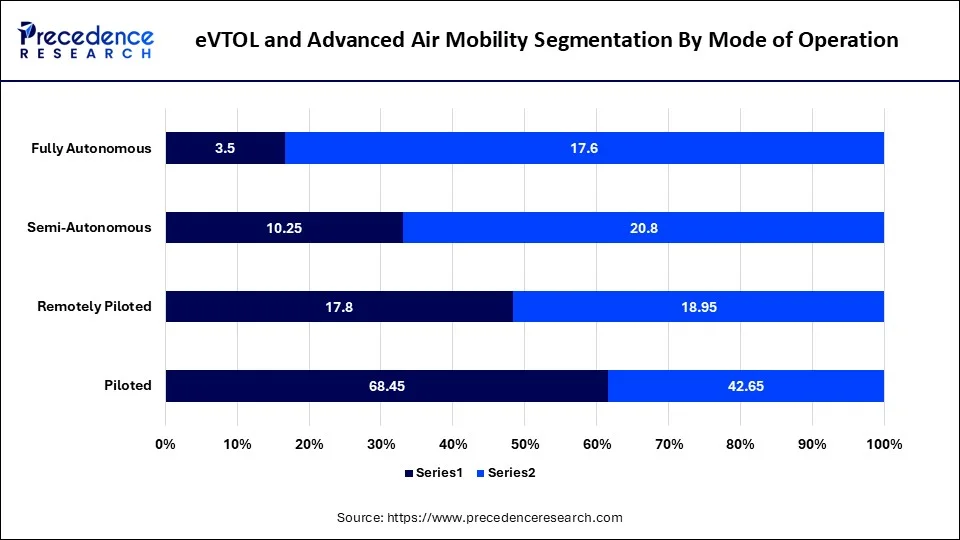
Piloted aircraft dominated the market in 2025 at 68.45% of market share, with the lowest CAGR in the table at 17.20%. Although having the smallest base in the market, fully autonomous operation has the highest CAGR for this total segment at 42.10%, indicating automation as one of the key technologies that will define the future of the market.
Expert Analyst View - Mode of Operation
One of the biggest long-term impacts that we can expect on the AAM industry is automation. The transition will be enabled, however, by making progress in a number of areas simultaneously, from certification to detect-and-avoid systems, through communications and the integration of the airspace, to remote supervision and operational safety. Micro-operations are also under the umbrella of concepts being tested under the FAA's 2026 eIPP, providing opportunities to gather operational data to support development of standards.
Market Segmentation By End User
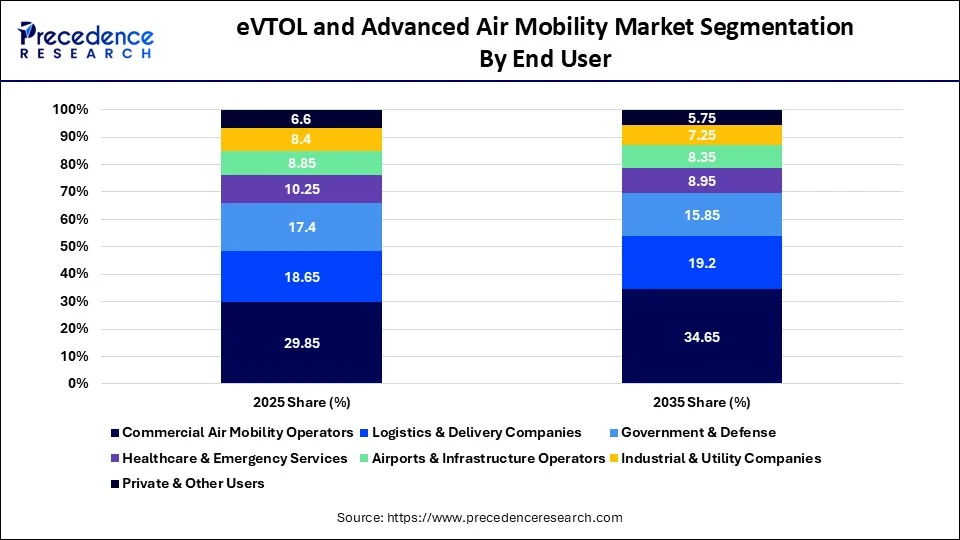
Commercial air mobility operators comprise the biggest end-user segment in the air mobility market. They accounted for 29.85% of the market share in 2025 and are expanding at a 26.85% CAGR to 34.65% of the market share in 2035. Thereby playing an integral role in the market's growth. The second-largest segment, logistics and delivery companies, is busy with rapid cargo delivery, which rose from 18.65% to 19.20% from 2025 to 2035, at a 25.45% CAGR.
Expert Analyst View - End User
As companies bring eVTOLs to market and their focus shifts to mobility services, the role of commercial operators is growing in significance. Joby has explained complementary business models, including direct aircraft sales and air-taxi operations, and has established partnerships around the world for aircraft and services. The trend focuses on the rising dominance of aircraft operations, maintenance, facilities, and line services over aircraft manufacture.
Market Segmentation By Infrastructure
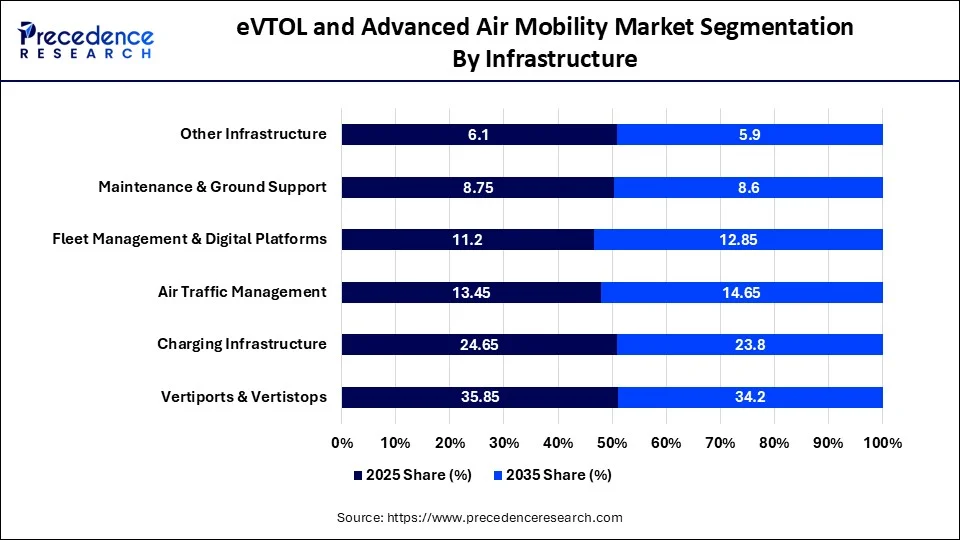
The vertiports & veristops segment claimed the highest percentage of infrastructure demand at 35.85% in 2025. This will reach 34.20% in 2035, reflecting owing to a CAGR of 24.45%, as the physical backbone of any expansion of passenger network demand. Air traffic management infrastructure's growth rate of 27.35% moves up from 13.45% to 14.65% to become the second highest in the table, following increased urgency around airspace integration in the air navigation market.
Expert Analyst View - Infrastructure
AAM infrastructure is moving from single-site physical infrastructure to becoming an interconnected infrastructure running way. The features of vertiports will include charging, passenger processing, aircraft turnaround, maintenance, fleet management, and coordination with the adjacent airspace. The FAA's implementation framework addresses infrastructure, airspace, and operational integration similarly as connected requirements to attain scaled AAM operations as well.
Regional Market Analysis
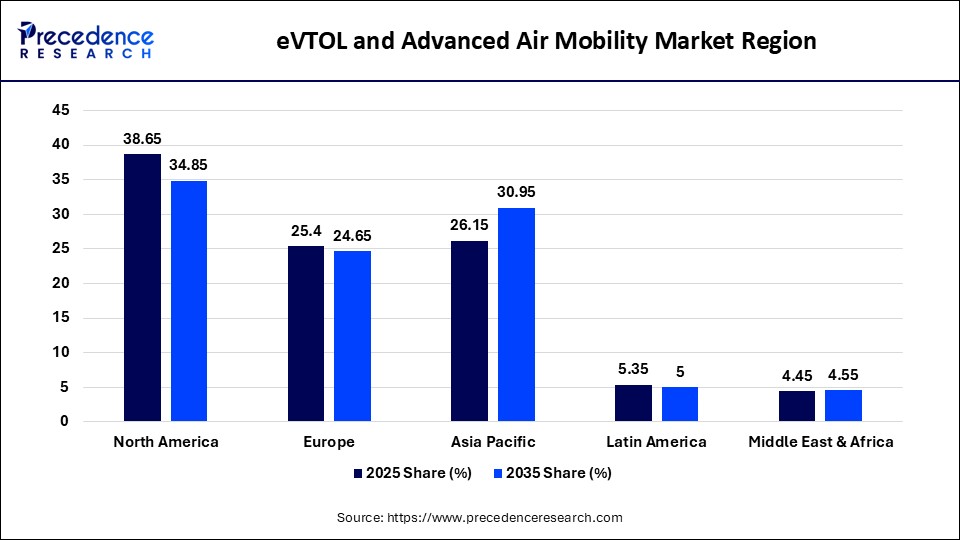
North America was the biggest regional market in 2025. This is expected to grow at a 23.85% CAGR, with the lowest share of 34.85% in 2035, while the other regions are growing on a smaller base. Asia Pacific region leads the growth at 26.80% CAGR and is poised to grow its market share from 26.15% to 30.95%, driven by manufacturing capacity and urban mobility demand.
Expert Analyst View - North America
The Aerospace Industry in North America is bolstered by the depth of the industry, level of certification, investment climate, and the presence of government-sponsored AAM programmes. The FAA in March 2026 chose eight eIPP projects from states and metropolitan areas for passenger, cargo, medical, regional, and autonomous operations. Archer, BETA, Electra, Joby, Wisk, and others are selected industry participants.
In July 2026, the FAA issued an additional medical-transport flight approval to BETA Technologies and United Therapeutics. The activity shows the process of government-industry programs fostering a shift from regulatory planning to practical operational testing at AAM.
Expert Analyst View - Europe
A specific regulatory framework will be created for innovative air mobility in Europe. In July 2025, EASA published new acceptable means of compliance and guidance material for operations that make use of manned VTOL-capable aircraft. The framework covers operational safety, ATM integration, and implementation of national authorities', manufacturers ', and operators requirements.
The regulatory achievements lay a new foundation for future AAM operations throughout Europe. They are also increasingly underscoring the importance of strategy and safety, and coordination of different aviation stakeholders in certification.
Expert Analyst View (APAC)
The Asia Pacific is the region with the highest growth in the supply chain CAGR, as well as the highest market share growth to 2035. China has developed prototype designs in some specific pilotless eVTOL applications. EHang said it would achieve its CAAC type certification in 2023, production certification in 2024, and operator certificates from two commercial operating entities in 2025.
By the end of 2025, EHang claims to have delivered over 169 EHang 216 series units, of which 164 have been sold in China, and performed over 83,000 total flights in 21 countries. AAM development roadmap is also under development in Japan with support from the government. In March 2026, Japan's Ministry of Land, Infrastructure, Transport and Tourism convened the 12th public-private AAM council meeting and released the present roadmap after the experience at the Osaka-Kansai Expo.
Expert Analyst View - Middle East & Africa
The Middle East is maturing premium mobility, tourism, airport connectivity, and smart city developments as AAM priorities. Dubai has become an important place for plans for international commercialization. One agreement Joby secured was with the Roads and Transport Authority in Dubai, and they have shared plans for Dubai's initial four vertiports.
Certification & Regulatory Landscape
Continued regulatory and certification pressure will be a certain constraint on the rate of AAM commercialisation.
U.S.
The pilot-certification and operational requirements for new-powered-lift aircraft were set out by the FAA's October 2024 powered-lift final rule, along with a framework for integrating powered-lift aircraft into the existing aviation system. The term powered-lift refers to the first all-new category of civil aircraft in the U.S. since helicopters entered the market in the 1940s," said the FAA.
The 2026 eIPP provides an additional dimension in the testing of the operations. Of which the FAA was able to choose eight to implement, ranging from passenger, cargo, medical, regional, and even autonomous uses.
Europe
The 2025 framework by EASA came with a complement of compliance and guidance documents for manned VTOL-capable aircraft and innovative air mobility operations. It adds to the clarity on what's involved in getting aircraft into operations and what the requirements of the operational environment are like, as well as on their integration with European aviation systems.
Certification Progress
| Company | Aircraft | Latest Key Milestone |
| Joby Aviation | Joby eVTOL | Approximately 75% through Stage 4 certification as of June 2026 |
| Archer Aviation | Midnight | FAA Means of Compliance fully accepted in January 2026 |
| Eve Air Mobility | Eve 100 | Transition flight achieved in August 2026 |
| Vertical Aerospace | Valo | Certification target remains 2028 |
| EHang | EH216-S | CAAC TC, PC, and operator certification achieved |
Joby claimed in June 2026 that it had completed some 75% of the fourth stage of the FAA certification. In January 2026, Archer said that its Means of Compliance was fully accepted by the FAA, and it entered the 4th phase of implementation. Eve successfully flew its maiden manned segment flight in August 2026, in which it attained the highest ground speed of 30 knots. Vertical Aerospace says it expects to certify its Valo in 2028.
Expert Analyst View - Certification & Regulatory Landscape
Certification is more of a competitive capability than a regulatory one. The certification process is affected by the aircraft design, battery safety, propulsion redundancy, flight-control system, software verification, manufacturing quality, and testing infrastructure. The commercialization stage of companies therefore differs between those with mature certification programs, conforming aircraft, qualified suppliers, and existing aerospace production systems and the aircraft developers who are more concerned with prototype development.
Company Intelligence
Joby Aviation
Joby has taken important steps towards completing the FAA certification process. As of June 2026, the company said it'd finished or substantially finished the first three steps towards certification, and is 75% finished with the fourth.
The company is also increasing its manufacturing activity. By May 2026, Joby says it has produced over 2.5 times the composite amount as it did a year ago and has parts for an additional conforming aircraft in the works. It had a manufacturing footprint of nearly 1.5 million square feet in Ohio. Joby also has international commercial-development partnership agreements in place, the most recent of which it announced with Dubai's RTA. Also, a 2025 MOU with Abdul Latif Jameel for up to 200 aircraft and services valued at a total of around $1 billion in Saudi Arabia.
Expert Analyst View
Joby's growth illustrates how commercialising AAM is integral. To enable a large-scale mobility network to operate efficiently, the advancement of aircraft certification, manufacturing capacity, infrastructure development, operator partnerships, and approvals by various regulatory entities is required to move forward simultaneously.
Archer Aviation
The Archer Midnight is a development devoted mainly to the use of an air taxi. In January 2026, the FAA received the aircraft's full Means of Compliance; piloted flight tests started in June 2025, according to its 2025 annual filing. Archer also identified ~$1.8 billion in liquidity at Q1'26, as forecasted to deploy its first U.S. micro-IPP operations in 2026.
Expert Analyst View
As per our senior researcher, Aditi Shivarkar, the roadmap that Archer is charting is not only for passenger air mobility, but for defence and autonomous-aircraft opportunities as well. The company can utilise and leverage its aircraft, propulsion, and autonomy solutions for several emerging aviation applications.
Eve Air Mobility
In December 2025, Eve flew the first test of its full-scale uncrewed eVTOL prototype. The company was anticipating a little less than 300 flights in 2026 to provide more data for certification.
The prototype has made 59 successful flights and over 2 hours and 27 minutes of flight time by the end of May 2026. The first semi-conversion flight took place in August of 2026. Eve is also currently working towards certification in a number of other countries, such as Brazil, the U.S., and Europe. In July 2026, the company applied for the start of the EASA type certificate validation.
Expert Analyst View
Eve's approach is not limited to aircraft design. It includes aircraft certification, aviation operations, services, airspace solutions, and urban air mobility. This more comprehensive approach has seen an increased focus on the development of broad fleet management, digital operations, and infrastructure beyond those of the aircraft.
Vertical Aerospace
Vertical Aerospace's Valo aircraft is a development that is based on a previous project called the VX4. Valo aircraft is a development from Vertical Aerospace that's part of the VX4 development program. The second full-scale prototype started flight testing in 2024. This has already completed a flight during the thrustborne stage in January 2025 and a piloted flight during the wingborne stage in May 2025. In December 2025, the company built a third full-scale prototype. Vertical has set its sights on the 2028 certification, established manufacturing facilities in line with that aspiration, and, with early manufacturing beginning, protected by the 2028 certification facilities, in January.
Expert Analyst View
Vertical's development program clearly shows how much capital and manufacturing is needed for eVTOL certification. Before going into commercial-scale production, developers have to develop several conforming aircraft, qualified suppliers, production systems, production controls, and flight-testing programs.
EHang
The other commercialisation approach is pilotless eVTOLs, and eHang is at the forefront of that effort. In October 2023, it was certified as a type (EH216-S), in 2024 for production and in March 2025 for operators. By the end of 2025, EHang has already completed over 83,0 flying hours in 21 different countries, delivering 169 EH216-series aircraft.
Expert Analyst View - Company Intelligence
The progress of EHang shows how AAM commercialisation is emerging in different regulatory and operational routes in key markets. The regulatory approach to piloted powered-lift vehicles and the progressive adoption of autonomous flight is different in the U.S. and Europe from the approach taken by China, which is pilotless flight.
Investment & Ecosystem Indicators
| Indicator | Company/Authority | Latest Data |
| FAA eIPP selected projects | FAA | 8 |
| eIPP proposals received | FAA | >30 |
| Joby composites production | Joby | >2.5× prior-year level |
| Joby Ohio manufacturing footprint | Joby | ~1.5 million sq. ft. |
| Joby Saudi aircraft/services MOU | Joby | Up to 200 aircraft / ~$1B |
| EHang 2025 eVTOL deliveries | EHang | 169 |
| EHang cumulative flight footprint | EHang | >83,000 flights |
| Eve 2026 prototype flight target | Eve | ~300 flights |
Combined, this certification, made-to-order production, and delivery data, as outlined above, span from the FAA's eIPP project selection to Joby's production footprint. Further, Eve's production and manufacturing cadence to EHang's manufacturing and production volumes suggest an ecosystem moving into an industrialization stage, not an early-stage prototyping stage. Investment in both aircraft research and development and production plants, aircraft conformance, certification tests and charging systems, vertiports and (digital) operations platforms, and the government-industry pilot programs is growing in the coming years.
Expert Analyst View - Investment & Ecosystem Indicators
As per our senior researcher, Aman Singh, investment activity is clearly in the transition towards a stage of industrialisation for AAM. The money is no longer put into the development and research of aircraft alone. Investment is now growing in manufacturing, conforming aircraft, certification testing, charging systems, vertiports, digital operations, and government-industry pilot programs are all emerging areas of investment.
This extended ecosystem will open up opportunities for aerospace suppliers, battery manufacturers, infrastructure providers, software suppliers, operators, airports, energy companies, as well as aviation-service businesses.
Buyer Intelligence
| Buyer Group | Primary Purchase Priorities | Relevant Solutions |
| Air Mobility Operators | Aircraft economics, range, reliability, passenger capacity | eVTOL aircraft |
| Airlines | Fleet integration, safety, passenger experience | Passenger eVTOL |
| Logistics Companies | Payload, range, autonomy, operating cost | Cargo eVTOL |
| Airports | Connectivity, turnaround time, infrastructure | Vertiports, shuttles |
| Governments | Safety, regional connectivity, emergency response | AAM aircraft and infrastructure |
| Defense Organizations | Payload, endurance, autonomy, mission flexibility | Dual-use eVTOL |
| Healthcare Providers | Speed, payload, reliability | Medical transport |
| Infrastructure Operators | Charging, throughput, aircraft turnaround | Charging and vertiports |
| Fleet Operators | Uptime, predictive maintenance, software | Fleet-management platforms |
AAM buyers evaluate a materially different set of priorities depending on their role in the ecosystem. Operators of air vehicles for mobile services are concerned about aircraft economy, range, reliability, and the capacity of the assortment of passengers for whom the route will serve. Thus, these factor states whether the route is economically viable when operating commercially on a large scale. On the other hand, cargo eVTOL is based on its economic attributes, and logistics companies focus on payload, range, autonomy, and operating cost. Governing bodies and defense agencies consider safety, regional connectivity, emergency response, payload, endurance, and mission flexibility. These criteria are suited to dual-use aircraft and public-service applications rather than commercial passenger economics.
Expert Analyst View - Buyer Intelligence
The wide range of factors involved in an AAM procurement process is in contrast to a traditional aircraft acquisition process. The time required for charging the batteries, their durability, the number of pilots required, the regulation's acceptance, and the compatibility of the vertiports are all factors in the purchase decision that buyers should evaluate. The reliability and turnaround times of the fleet will also impact the effectiveness of using limited infrastructure and aircraft capacity by operators.
Key Growth Drivers
Certification Progress
The regulatory frameworks in the U.S. and Europe are clarifying, and the process will be smoother towards commercial operation of AAMs.
Battery & Propulsion Improvements
The significant increase in battery energy density, electric motor technology, power electronics, and in situ thermal control will enable improved aircraft range, payload, efficiency, and operating performance.
Urban Congestion
As traffic on roads becomes increasingly problematic in cities, alternative forms of transport are more sought after on routes long enough to warrant them.
Regional Connectivity
Lift-plus-cruise and vectored-thrust aircraft can potentially connect airports, business centers, and secondary cities without conventional runway infrastructure.
Autonomous Flight
The fact that the 42.10% CAGR that is being provided for a fully autonomous operation shows the great opportunity that lies within the realm of automation.
Cargo & Medical Applications
The initial uses of AAM are in cargo delivery services and medical transportation. The services can work in parallel to passenger air taxi services and may exist under conditions that are different from passenger air taxi services. Further facilitating opportunities for gaining experience in operation before passenger networks can gain experience.
Government Support
Government programs are playing an increasing role as a catalyst for commercialisation. Thus, the involvement of the public sector in aircraft testing, regulation, infrastructure planning and operational development has grown, as seen in the U.S. eIPP, Europe's innovative air mobility framework and the AAM roadmap in Japan.
Key Market Challenges
| Challenge | Impact on Market |
| Aircraft certification | Can delay commercial launch |
| Battery energy density | Limits range and payload |
| Battery safety | Critical for certification and public acceptance |
| Vertiport availability | Determines network scalability |
| Charging turnaround | Directly affects fleet utilization. |
| Airspace integration | Requires coordination with existing aviation |
| Autonomous certification | More complex safety-case requirements |
| Manufacturing scale-up | Requires aerospace-grade production systems |
| Capital intensity | Certification and production require substantial funding. |
| Public acceptance | Influences urban deployment |
| Operating economics | Determines long-term commercial viability |
Delayed certification of aircraft continues to be a major challenge to overcome in order to maintain the pace of commercial launch over an entire fleet program. There is also a need for airspace integration because AAM operations cannot be conducted in isolation from existing commercial and general aviation. Scale-up and capital intensity are another such set of constraints, as the aircraft needs to be certified before it can be manufactured. Also, heavy continued investment is required to build all of the systems needed for the aircraft manufacturing process well before any revenue starts.
Expert Analyst View - Key Market Challenges
The most significant barrier to the industry is the need to move to sustainable commercial economics when the technology is technically achievable. An initial flight to a successful prototype does not qualify a new transportation company.
Strategic Outlook 2026-2035
The provided forecast reflects significant growth and scale-up of the eVTOL and advanced air mobility market from USD 13.79 billion in 2025 to nearly USD 128.22 billion in 2035. This development in growth demonstrates that AAM is maturing from an emerging aviation technology into an overall commercial transportation enterprise.
The market's center of gravity is gradually shifting across several dimensions:
- Aircraft: Industry transitioning from prototype development and initial flight to certified aircraft for repeatable commercial flights.
- Propulsion: Battery-electric systems continue to be the foundation for early deployments, and hybrid-electric and hydrogen-based systems have created interest in those applications that demand longer range and increased payload.
- Operations: AAM operations are developing from traditional piloted systems to increasingly automated systems, and autonomous operations are a development area still further down the road.
- Applications: Beyond technology demonstrations, the market is progressing towards the transportation of people, goods, medical services, ground transportation from airports, and regional mobility.
- Infrastructure: Vertiports are now growing into an integrated hard infrastructure that includes charging, disembarking, servicing, ATC, and digital systems provided for the fleet.
- Geography: North America has held a strong foothold in the market, whereas the Asia Pacific region is becoming significant with the intensive focus of government programs and programs, aircraft certification, commercial pilots, and increased investments.
- Business model: The increasing development of new business models that involve more than just the aircraft, as businesses seek to focus on a wider range of aircraft, infrastructure, software, fleet operations, and mobility services.
North America will remain the largest regional product market while Asia Pacific is expected to grow at a CAGR of 26.80%. This region accounts for 30.95% of the market by 2035, up from 26.15%. EHang is already developing a commercial certification route for its pilotless eVTOLs in China, while Japan is backing AAM development via its government roadmap.
The competition is thus expanding beyond just aircraft design. Key factors that will impact the competitive landscape of companies by 2035 include fleet deployment progress, aircraft performance, manufacturing production capacity, battery and propulsion technology, and autonomous-flight capabilities.
Final Expert Analyst View
I believe that, by taking the leap from technology validation to commercial flights, the eVTOL and AAM market is moving into an important transition. The development of aircraft is starting to move together with the infrastructure that is ready for commercial operation. As seen in the power-lift framework in the U.S., the eIPP 2026 program in Europe, and AAM programs and aircraft development in the Asia Pacific region.
Opportunities are developing for 5-7 passenger aircraft, vectored-thrust and tiltrotor aircraft, advanced electric propulsion, higher-energy-density batteries, autonomous flight, and digital fleet management, as well as integration into AIRM and passenger air-mobility networks, for manufacturers and ecosystem participants. In the longer term, it will depend upon the progress the technologies make from certification and demonstration flights to reliable, high-utilization commercial use. The second phase of the market will then rely as much on the development of an efficient, safe, and commercial-scale aircraft. As it will on the development of the necessary accompanying services around the aircraft to perform those tasks.
Expert Insights
Aerospace manufacturers, airlines, infrastructure providers, and mobility companies are preparing for commercial operations. I foresee further demand for certified aircraft, dependable battery and propulsion technology, high-throughput charging stations, and intelligent and complex traffic management technology. Companies with robust certification programs, a history of reliable production of aircraft, and the ability to grow their production capacity. Their experience creates a strong network of partnerships spanning all airport, vertiport, aircraft regulator, and mobility functions will be ready to engage in the growing market. Successful flight testing to a reliable commercial service is a growing competitive edge.
Our Experts
- The report's analytical framework was laid out by the senior research analyst, Laxmi Narayan, who created the methodology, performing necessary market segmentation, regional trend analysis, competitor analysis, technology analysis, and forecasts.
- Aman Singh, a senior researcher, gathered and verified information for regulatory reasons, company statements, data on the development of aircraft, investment activity, production forecasts, and other quantitative information that was sourced independently, which contributed to the robust evidence to draw from the market estimations.
- Aditi Shivarkar, a senior researcher, reviewed the complete research document, performed quality checks, validated findings, refined content, corrected inconsistencies, and finalized the report, ensuring accuracy and clarity.
eVTOL and Advanced Air Mobility Market Segmentation
By Aircraft Type
- Multirotor eVTOL
- Lift + Cruise
- Vectored Thrust
- Tiltrotor
- Electric Helicopter/Compound
- Other eVTOL Configurations
By Propulsion Type
- Battery Electric
- Hybrid Electric
- Hydrogen Electric
- Hybrid-Electric Turbine
- Other Propulsion Systems
By Component
- Electric Motors & Propulsion
- Batteries & Energy Storage
- Power Electronics
- Avionics & Flight Control
- Airframe & Structures
- Navigation & Communication
- Other Components
By Application
- Passenger Air Mobility
- Cargo & Logistics
- Emergency Medical Services
- Defense & Security
- Airport & Intercity Shuttle
- Infrastructure Inspection
- Other Applications
By Vehicle Capacity
- Single-Seater
- 2–4 Passengers
- 5–7 Passengers
- 8–15 Passengers
- More than 15 Passengers
By Mode of Operation
- Piloted
- Remotely Piloted
- Semi-Autonomous
- Fully Autonomous
By End User
- Commercial Air Mobility Operators
- Logistics & Delivery Companies
- Government & Defense
- Healthcare & Emergency Services
- Airports & Infrastructure Operators
- Industrial & Utility Companies
- Private & Other Users
By Infrastructure
- Vertiports & Vertistops
- Charging Infrastructure
- Air Traffic Management
- Fleet Management & Digital Platforms
- Maintenance & Ground Support
Other Infrastructure
By Region
- North America
- Europe
- Asia Pacific
- Latin America
- Middle East & Africa
For inquiries regarding discounts, bulk purchases, or customization requests, please contact us at sales@precedenceresearch.com
Frequently Asked Questions





Ask For Sample
No cookie-cutter, only authentic analysis – take the 1st step to become a Precedence Research client
 Get a Sample




 sales@precedenceresearch.com
 Schedule a Meeting
