



Extractable and Leachable (E&L) Testing Services Market, Global Market Size, Segmentation, Regional Analysis, Country-Level Opportunity Analysis, Regulatory and Standards Landscape
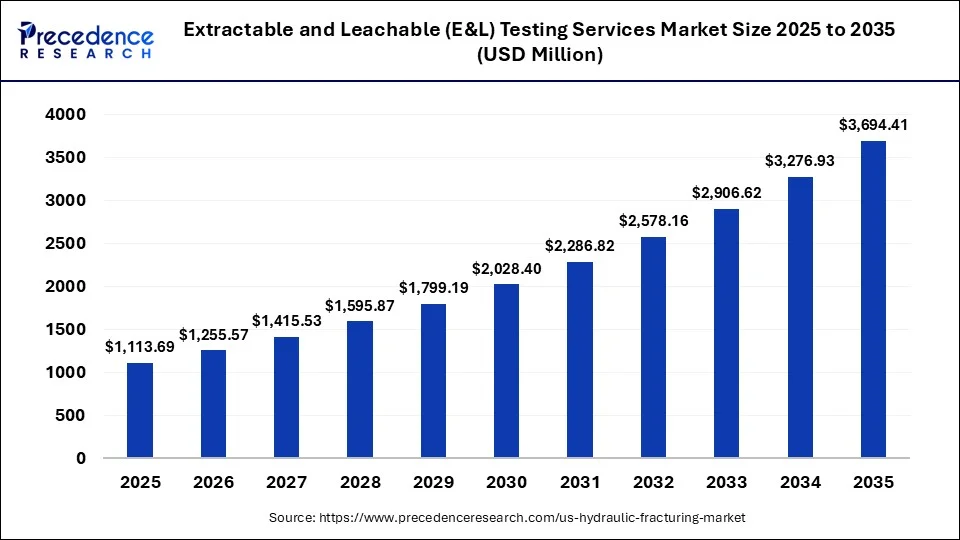
The extractable and leachable (E&L) testing services market reached USD 1,113.69 million in 2025. The market growth is attributed to stringent regulatory policies and the growing development of innovative medical devices. These trends were evaluated by our Senior Research Analyst, Deepa Pandey, to curate this well-researched report. Her analysis benefits pharmaceutical producers, distributors, medical professionals, and stakeholders in performing competitive analysis and informed decision-making.
Source: https://www.precedenceresearch.com/extractable-and-leachable-testing-services-market
 Get a Sample
 Table Of Content


Extractable and Leachable (E&L) Testing Services Market Size, Trends, Share and Innovations
The extractable and leachable (E&L) testing services market is forecasted to expand from USD 1,255.57 million in 2026 to USD 3,694.41 million by 2035, growing at a CAGR of 12.74% from 2026 to 2035. The development of advanced leachables and extractables analysis methodologies is facilitating the analysis of complicated materials and the detection of impurities at very low concentrations, which aligns with the current needs of the clients. Deepa Pandey, our Senior Research Analyst, who has over 5 years of experience in the healthcare and medicine industry, identified that the widening range of applications and advancements in chemistries and methodologies for identifying compounds and assessing the risks they pose to patients is benefiting the market.
Key Takeaways
- By service type, the leachables testing services segment led the market with a 27.4% share in 2025.
- By product type, the pharmaceutical packaging and container-closure systems segment accounted for the major revenue share of 31.85% in 2025.
- By material type, the polymer and plastic components segment dominated the market with a 32.65% share in 2025.
- By end user, the pharmaceutical companies segment led the market with a 37.85% share in 2025.
- By region, North America held the major revenue share of 38.65% in 2025.
- Eurofins has over 100 specialized E&L researchers and has over 2 decades of experience in E&L analytical testing.
- Eurofins BPT has a spectral database that consists of reference spectra for over 1,500 non-volatile compounds.
- Nelson Labs has a reference library that consists of over 1,000 compounds that are relevant to trace impurity testing in polymers and rubbers.
- There have been significant structural changes driven by standardization of regulations and standards, which has been complemented by the ICH Q3E
- Guidelines for Leachables and Extractables by the FDA.
- Asia Pacific has significant growth potential because of expansion of the pharmaceutical and biopharmaceutical manufacturing ecosystem and maturation of regulations.
What was the Size of the Extractable and Leachable (E&L) Testing Services Market in 2025?
The extractable and leachable (E&L) testing services market accounted for USD 1,113.69 million in 2025 and is expected to grow at a CAGR of 12.74% from 2026 to 2035. It covers analytical chemistry, chemical categorization, toxicology analysis, policy consultations, and testing services. E&L testing services find applications in identification, characterization, quantification, and analysis of substrates that have the possibility of migrating from pharmaceutical packaging, container enclosures, drug delivery equipment, production tools, one-time-use systems, and materials used in medical devices.
Expert Analyst View - Market Outlook
E&L testing is expanding beyond conventional specialty packaging activity to include product and process quality assessment in base packaging, drug delivery equipment, production-contact substrates, and medical devices. The most important shift is towards risk- and lifecycle-based E&L projects. The draft ICH Q3E framework clearly includes manufacturing parts and devices, packaging, and delivery equipment components, and emphasizes the evaluation and management of leachables to ensure patient safety and product quality. This will propel the demand for laboratories that integrate analytical chemistry, unidentified substrate detection, toxicology, and policy consultation rather than just testing services.
Segmentation Analysis
Which Service Type Accounted for the Major Revenue Share in 2025?
Source: Precedence Research Database
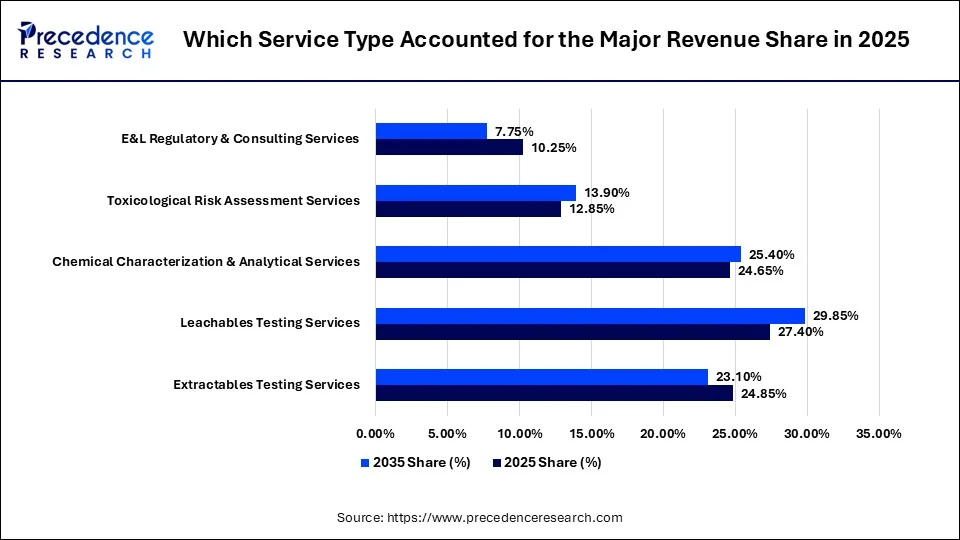
Leachables testing services segment led the market with a 27.4% share in 2025 and is expected to expand at a CAGR of 13.75% during the forecast period. The chemical characterization and analytical services segment also held a significant share of 24.65% and is expected to grow to 25.4% by 2035 because the intricacies involved in substrates is growing, which requires the identification of familiar, unfamiliar, and unexpected compounds.
Expert Analyst View - Service Type
The market is shifting towards comprehensive E&L testing workflows rather than specialized extraction research. Extractables hold their importance for substrate selection and evaluation, but leachables, toxicology evaluation, and regulatory understanding are gaining significance in the role of deciding the market value of the service. USP <1664> gives information about the evaluation of leachables to understand substrates migrating from packaging and delivery systems and assess their possible effects on medication safety, efficacy, and quality. The high CAGR of the leachable testing services segment is a testament to the fact that testing is increasingly based on the real-world exposure of drugs.
Which Product Type Dominated the Market in 2025?
| Product Type | 2025 Share (%) | 2035 Share (%) | CAGR | Growth Factor |
| Pharmaceutical Packaging & Container-Closure Systems | 31.85% | 28.90% | 11.65% | Extensive use across drug packaging |
| Drug-Delivery Systems | 24.20% | 25.35% | 13.25% | Growth of complex delivery platforms |
| Biopharmaceutical/Single-Use Systems | 22.75% | 26.85% | 14.75% | Rapid adoption of single-use technologies |
| Medical Devices | 15.65% | 14.80% | 12.10% | Increasing polymeric device complexity |
| Other Product-Contact Systems | 5.55% | 4.10% | 9.25% | Specialized manufacturing-contact applications |
Source: Precedence Research Database
The pharmaceutical packaging and container-closure systems segment held the highest market share of 31.85% in 2025 and is expected to grow at a CAGR of 11.65% from 2026 to 2035. This segment benefits from its widespread use for drug packaging. The share of this segment is expected to reduce to 28.9% by 2035 as the biopharmaceutical/single-use systems segment is expected to expand at the highest CAGR of 14.75% during the forecast period, which is being rapidly adopted in single-use techniques.
Expert Analyst View - Product Type
The primary applications of E&L testing are expanding beyond conventional vials, bottles, and closures. The number of polymeric contact surfaces in biopharmaceutical production has increased because of single-use bags, tubing, connectors, filters, and assemblies. Extractables Portal of BioPhorum also demonstrates this change, as suppliers and consumers are exchanging standard extractables data to a greater degree for single-use systems to enable quick evaluation of substrates used in products. Drug-delivery equipment offers significant potential for market growth, as intricate combination products can have various polymers, elastomers, coatings, adhesives, lubricants, and other substances.
Which Material Type Led the Market in 2025?
Source: Precedence Research Database
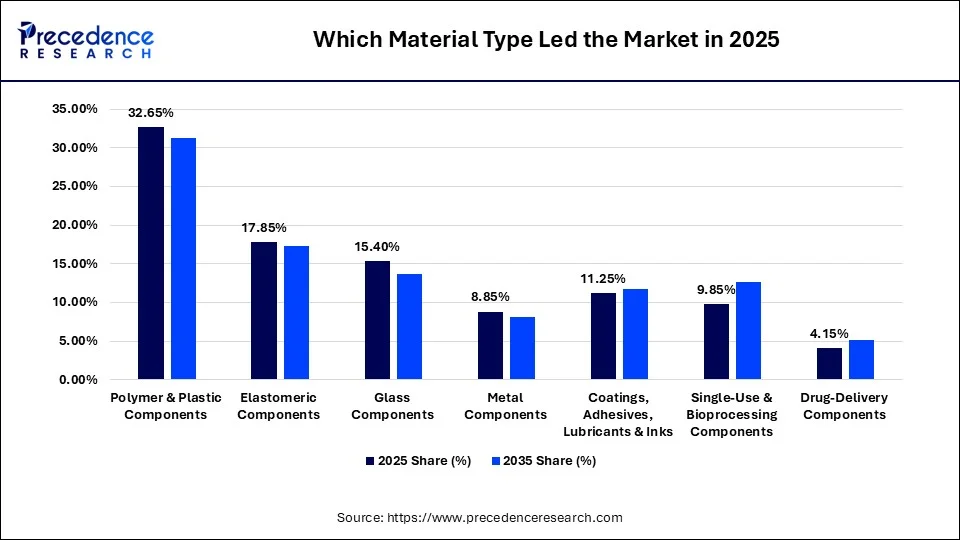
The polymer and plastic components segment dominated the market with a 32.65% share in 2025 and is expected to expand at a CAGR of 12.25% during the forecast period. Such components are widely used in packaging and various devices. The single-use and bioprocessing components segment is expected to grow at the highest CAGR of 16.05% from 2026 to 2035, propelling its share from 9.85% in 2025 to 12.7% in 2035. This segment benefits from the expansion of the disposable manufacturing ecosystem.
Expert Analyst View - Material Type
Multi-substrate materials create a need for E&L testing to possess multi-specialty analytical capabilities. Product contact materials usually comprise polymers, elastomers, metals, coatings, adhesives, and residues after processing. USP <1031> provides data on the toxicology assessment of chemicals detected via extractables and leachables evaluation and the biocompatibility analysis of pharmaceutical packaging materials. The potential for service providers goes beyond compound identification to material categorization, source detection, toxicology studies, and qualification based on risk.
Which Analytical Technique was Utilized the Most in 2025?
| Analytical Technique | 2025 Share (%) | 2035 Share (%) | CAGR | Growth Factor |
| Chromatography-Based Techniques | 48.75% | 46.10% | 12.10% | Broad organic compound characterization |
| Elemental Analysis | 16.25% | 15.45% | 12.20% | Detection of elemental impurities |
| Spectroscopic Techniques | 20.15% | 19.65% | 12.45% | Structural and material characterization |
| Other Analytical Techniques | 14.85% | 18.80% | 15.80% | High-resolution and complementary characterization |
Source: Precedence Research Database
The chromatography-based techniques segment held the major revenue share of 48.75% in 2025 and is expected to expand at a CAGR of 12.1% during the forecast period. This segment continues to play an important role in the characterization of volatile, semi-volatile, and non-volatile organic compounds. The elemental analysis segment continues to have a significant demand because of its important role in the detection of elemental impurities. Spectroscopic techniques are useful for structural and material analysis.
Expert Analyst View - Analytical Techniques
The analytical teams are increasingly prioritizing wide, non-targeted chemical characterization over targeted compound evaluation. The medical-equipment chemical-analysis guidelines by the FDA say that non-targeted analysis is a method in which chemicals present in extracts are detected and partially quantified when the entire chemical composition is not available. It allows the use of targeted analysis to completely quantify expected substrates. An advanced E&L laboratory usually integrates:
- GC-MS / headspace GC-MS
- LC-MS/MS
- LC-HRMS
- ICP-MS
- NMR
- FTIR
- Ion chromatography
- TOC
- targeted quantitative approaches
- non-targeted screening
- spectral databases and computational detection
The growing intricacies involving recognition of unknown compounds are driving the demand for high-resolution mass spectrometry and complementary analytical systems.
Which End User Dominated the Market in 2025?
Source: Precedence Research Database
The pharmaceutical companies segment led the market with a 37.85% share in 2025 and is expected to grow at a CAGR of 11.85% during the forecast period. The share of this segment is expected to decrease as the biopharmaceutical companies segment and the contract manufacturers (CMOs/CDMOs) are expected to grow at higher CAGRs and gain share from 2026 to 2035. The growth of the biopharmaceutical companies segment can be attributed to the development of biologics and next-generation therapies. The contract manufacturers (CMOs/CDMOs) segment is expected to grow at the highest CAGR of 14.45% during the forecast period because of growing demand for outsourced manufacturing.
Expert Analyst View - End User
The end user environment is increasingly shifting towards biopharma and outsourced manufacturing. Biologics and next-generation therapies typically need intricate production-contact materials and one-time-use setups, which results in a need for a higher number of materials for characterization. CMOs/CDMOs can benefit from the maintenance of standardized E&L datasets and vendor qualification projects, as it allows them to produce multiple products across different clients and setups. Eurofins BioPharma Product Testing noted that it has employed over 100 specialized E&L researchers, conducts hundreds of controlled extraction studies every year, and maintains a spectral database that consists of reference spectra for over 1,500 non-volatile compounds.
Which Testing Stage Held the Highest Share in 2025?
| Testing Stage | 2025 Share (%) | 2035 Share (%) | CAGR | Growth Factor |
| Product Development | 29.85% | 31.40% | 13.35% | Early material and component qualification |
| Preclinical & Clinical Development | 24.65% | 25.10% | 12.95% | Increasing regulatory characterization |
| Regulatory/Pre-Commercialization | 19.85% | 18.90% | 12.20% | Submission and qualification requirements |
| Commercial/Lifecycle Management | 25.65% | 24.60% | 12.25% | Routine monitoring and change assessment |
Source: Precedence Research Database
The product development segment led the market with a 29.85% share in 2025 and is expected to grow at the highest CAGR of 13.35% during the forecast period. This segment benefits from the growing need for timely material and component suitability. The commercial/lifecycle management segment also held a significant share of 25.65% in 2025 due to the consistent need for regular monitoring and change evaluation. The preclinical and clinical development segment is expected to grow at a healthy rate because of the rising requirement for regulatory analysis.
Expert Analyst View - Testing Stage
Early-phase E&L testing is gaining strategic significance due to the fact that the decision of selecting material taken during development affects regulatory workflows, stability projects, and commercial timelines. USP <1663> highlights that extractables evaluation involves the maintenance of a balance between scientific analysis, resource distribution, and risk control. Q6A guidelines of the FDA say that extractables data should be taken into consideration during development and should be revisited when there are updates in container-closure systems and formulations. This opens doors for laboratories to become joint developers and assist clients in selecting materials and components before the beginning of pricey late-stage procedures.
Regional Analysis
Which Region Dominated the Market in 2025?
Source: Precedence Research Database
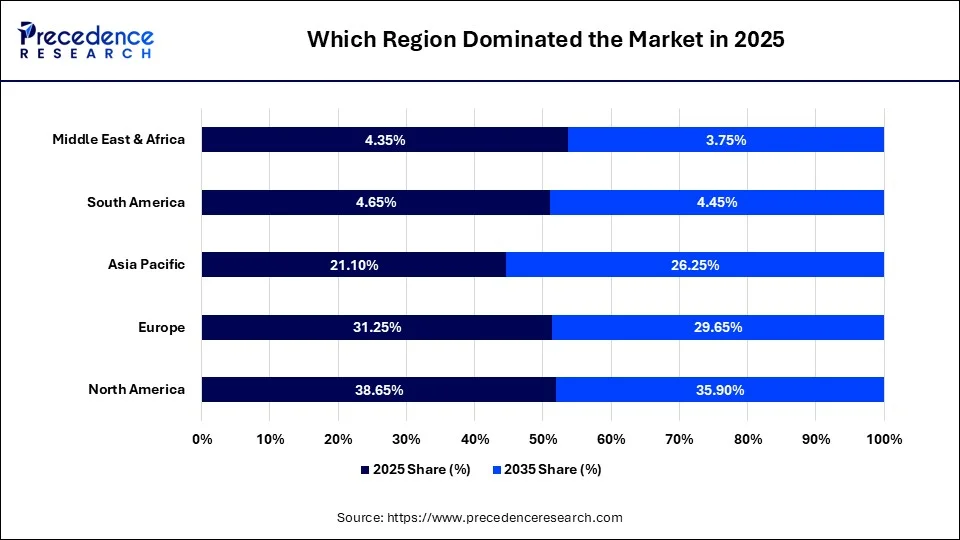
North America led the market with a 38.65% share in 2025 and is expected to expand at a CAGR of 11.85% from 2026 to 2035. The share of this region is expected to decrease to 35.9% by 2035, as Asia Pacific is expected to grow at the highest CAGR of 15.25% during the same period and leap from a 21.1% share in 2025 to a 26.25% share in 2035. North America has an established pharmaceutical and analytical environment, and the market growth in Asia Pacific is being driven by expanding manufacturing operations in the pharmaceutical and biopharmaceutical sectors.
Expert Analyst View – Regional
North America and Europe have a mature ecosystem of pharmaceutical companies and analytical laboratories, and have regulatory prowess. Asia Pacific has the highest potential for growth as the production capability in pharmaceutical and biopharmaceutical industries is increasing, alongside the maturing of regulatory requirements and outsourced testing capacity. In this region, China, India, Singapore, South Korea, and Japan have the best opportunity because of the active generation of demand for chemical analysis and E&L recognition.
Which Areas Can Various Countries Capitalize on to Maximize Market Growth?
| Country | Opportunity Area | Key E&L Demand |
| United States | Mature pharmaceutical and medical-device ecosystem | Packaging, devices, biologics, combination products |
| Canada | Biopharma and medical devices | Packaging and chemical characterization |
| Germany | Advanced pharma manufacturing | CCS, polymers, devices, regulatory testing |
| Switzerland | Biologics and high-value pharma | Single-use systems, biologics, toxicology |
| United Kingdom | Pharma and life sciences | Analytical and regulatory services |
| France | Pharmaceutical manufacturing | Packaging and product-contact systems |
| Ireland | Large pharma manufacturing base | Container closure and process-contact materials |
| Italy | Pharma and devices | Packaging and device chemical characterization |
| China | Rapid manufacturing expansion | Biologics, packaging, single-use systems |
| Japan | Mature pharma and devices | Drug delivery and packaging |
| South Korea | Biopharma expansion | Single-use systems and biologics |
| India | Generic pharma and CDMO growth | Packaging, devices, process-contact materials |
| Singapore | Biologics manufacturing hub | Single-use bioprocessing and advanced therapies |
| Australia | Biopharma and medical technology | Chemical characterization and toxicology |
| Brazil | Regional pharmaceutical manufacturing | Packaging and device testing |
| Saudi Arabia | Local pharmaceutical manufacturing | Packaging and manufacturing systems |
| UAE | Emerging life-science manufacturing | Packaging and medical-device testing |
Source: Precedence Research Database
The U.S. has a well-established pharmaceutical and medical devices environment generating consistent demand for packaging, devices, biologics, and combination formulations. Canada has a developed biopharma and medical devices sector which has the potential to propel market growth in terms of packaging and chemical characterization. Germany has advanced manufacturing capabilities that will enable regulatory testing and the development of CCS, polymers, and devices. Ireland and Japan have well-established manufacturing ecosystems that would propel the modernization of existing E&L testing infrastructure at a significant rate. China is undergoing significant expansion in manufacturing capabilities, which will facilitate market growth in terms of biologics, packaging, and single-use systems.
Expert Analyst View - Country Opportunity
The countries with large pharmaceutical manufacturing bases, high-quality biologics manufacturing, and well-defined policy frameworks hold very good positions in the market. The fastest growth would probably come from Asian production centers where pharmaceutical manufacturing is increasing, and global regulatory requirements are being increasingly adopted in development projects. India and China have an opportunity to grow through external laboratories because pharmaceutical firms and CDMOs can outsource dedicated high-resolution analytical tasks rather than having to develop comprehensive in-house E&L infrastructure.
How do Regulatory and Standards Environments Influence the Market?
| Framework/Standard | Relevance to E&L |
| USP <1663> | Extractables assessment for pharmaceutical packaging/delivery systems |
| USP <1664> | Leachables assessment for pharmaceutical packaging/delivery systems |
| USP <1665> | Plastic components/systems used in pharmaceutical and biopharmaceutical manufacturing |
| ICH Q3E | Holistic risk-based framework for extractables and leachables |
| ICH Q3D | Elemental impurities |
| ICH M7 | DNA-reactive/mutagenic impurities |
| ISO 10993-18 | Chemical characterization of medical-device materials |
| ISO 10993-17 | Toxicological risk assessment of medical-device constituents |
| FDA Chemical Analysis Guidance | Analytical chemistry for medical-device biocompatibility |
| PQRI Recommendations | E&L thresholds and best practices |
Source: Precedence Research Database
The level of integration in regulations is increasing to keep up with the development of highly sophisticated substrates. In November 2025, the FDA released the draft ICH Q3E Guideline for Extractables and Leachables, which provides a comprehensive framework for E&L evaluation and control. As of now, it is a draft and not ready to be implemented. ISO 10993-18:2020, which received confirmation in 2025, is relevant to medical devices. The recognized standards database of the FDA has also recognized ISO 10993-18 through its 2022 amendment. ISO 10993-17:2023 provides a framework for toxicology threat evaluation for constituents recognized through chemical analysis, including extractable and leachable substrates.
Expert Analyst View - Regulatory Environment
Regulatory standardization is one of the most significant factors that will propel the demand for E&L testing. The growth of Q3E can prompt pharmaceutical companies to shift towards more synchronized, threat-based, and lifecycle-aligned E&L projects. Regulatory prowess can provide an edge to service providers due to the fact that clients need much more than just analytical outcomes. They need substantial interpretation of:
- compound identity;
- exposure;
- analytical evaluation thresholds;
- toxicological thresholds;
- patient population;
- route of administration;
- duration of exposure;
- material composition;
- manufacturing updates; and
- regulatory submission needs.
What Approaches Do Various Companies Adopt to Stay Competitive?
Eurofins BioPharma Product Testing
Eurofins BPT is a prominent specialty provider of E&L services and has an ecosystem of over 100 specialized E&L researchers, has more than 2 decades of experience, and conducts hundreds of controlled extraction studies each year. The Eurofins Extractables Index consists of reference spectra for over 1,500 non-volatile compounds. The company has a presence in base packaging, biologics, single-use assemblies, and consumables and provides various services spanning extractables, leachables, toxicology, methodology advancement, and regulatory assistance.
Strategic Relevance: Eurofins BPT has wide pharmaceutical and biopharmaceutical coverage and a capable ecosystem for unknown compound recognition and comprehensive toxicology evaluation.
Nelson Labs
Nelson Labs provides E&L testing for pharmaceuticals, medical devices, and production systems. It has a significant presence in the pharmaceutical sector, which includes various key areas such as extractables, leachables, container-closure testing, stability, elemental impurities, and analytical chemistry. The company notes a reference dataset that contains over 1,000 compounds that are relevant for trace impurity testing in polymers and rubbers. The European center of the company in Leuven, Belgium, is FDA-registered, ISO 17025 accredited, and EU GMP certified. Nelson Labs is compatible with chemical analysis and toxicology evaluation guidelines for medical devices defined by ISO 10993-17 and ISO 10993-18.
Strategic Relevance: The company has significant prowess in E&L specialization, medical device testing, pharmaceutical testing, toxicology, and worldwide regulatory assistance.
Intertek
Intertek offers E&L testing in pharmaceutical packaging, bioprocess materials, drug delivery systems, and implantable medical devices. The company has significant potential for analytical testing from various sources, such as antioxidants, plasticizers, dyes, metal catalysts, and polymer degradation products.
Strategic Relevance: The company has a diverse testing platform that helps to connect pharmaceutical, bioprocess, and medical device chemical assessment.
Expert Analyst View - Company Intelligence
Pharmaceutical companies are capitalizing on their strong areas to stay competitive while simultaneously developing advanced testing infrastructure and technologies to enable the adoption of next-generation approaches and stay compliant with the latest regulatory landscape. The key differentiator is the capability to efficiently test sophisticated materials with multiple compounds and categorize them according to exposure and risk.
Which Areas Will Have the Most Influence on the Competition?
| Capability | Competitive Importance |
| Controlled extraction studies | Core extractables testing |
| GC-MS / HS-GC-MS | Volatile and semi-volatile compounds |
| LC-MS/MS | Non-volatile compounds |
| LC-HRMS | Unknown-compound characterization |
| ICP-MS | Elemental impurities |
| NMR | Structural elucidation |
| Toxicology | Safety qualification |
| Spectral databases | Faster compound identification |
| Single-use systems testing | High-growth biopharma segment |
| Medical-device chemical characterization | Expanding regulatory demand |
| Regulatory consulting | Submission and compliance support |
| GMP analytical methods | Commercial-stage leachables monitoring |
Source: Precedence Research Database
Controlled extraction research is vital for primary extractables testing, and GC-MS / HS-GC-MS has significant relevance for volatile and semi-volatile compounds. LC-MS/MS and LC-HRMS can provide an edge in non-volatile compounds and unknown compound analysis, respectively. Toxicology is vital for safety assessment, and spectral databases enable rapid compound recognition. Regulatory consulting prowess will facilitate submission and compliance assistance, and GMP analytical approaches help with commercial-phase leachables monitoring.
What are the Operational and Industry Figures Relevant to the Market?
| Indicator | Reported Figure/Development | Market Relevance |
| Eurofins dedicated E&L scientists | 100+ | Specialized analytical workforce |
| Eurofins E&L experience | 20 years | Established testing expertise |
| Eurofins non-volatile reference spectra | 1,500+ | Unknown-compound identification |
| Nelson Labs reference standards | 1,000+ | Trace-compound identification |
| Nelson Labs global laboratory locations | 13 | International testing infrastructure |
| Nelson Labs scientists/technicians/service specialists | 500+ | Broad testing capacity |
| BioPhorum standardized extractables ecosystem | Main global suppliers/integrators | Single-use material transparency |
| FDA-recognized ISO 10993-18 | Current with Amendment 1 | Medical-device chemical characterization |
| ICH Q3E | Draft public consultation | Global E&L harmonization |
Source: Precedence Research Database
Nelson Labs reported that it has over 500 researchers, technicians, and service specialists across 13 worldwide laboratory locations for its medical device testing operations. Extractables Portal of BioPhorum also shows the market shift towards harmonized extractables information exchange among single-use-system vendors and consumers. Eurofins BPT has more than 2 decades of experience in E&L testing. FDA-recognized ISO 10993-18 provides standards regarding medical device chemical analysis through its Amendment 1.
Expert Analyst View - Operational Landscape
According to Aditi Shivarkar, our Senior Researcher, factors that provide a competitive edge in E&L testing are shifting from primary laboratory capability to analytical prowess and compound recognition infrastructure. Large spectral and reference datasets, high-resolution instrumentation, toxicology prowess, and regulatory inference can decrease the timelines to recognize unknown compounds and prepare justifiable reports.
Which Factors Affect the Decision of Buyers?
| Buyer Group | Primary Requirement | Purchase Driver | Key Selection Criteria |
| Pharmaceutical R&D | Material qualification | Development risk reduction | Analytical breadth, turnaround |
| CMC Teams | Regulatory-ready characterization | Submission support | Documentation, compliance |
| Quality Assurance | Product safety | Risk control | Method validation, traceability |
| Packaging Teams | Container-closure assessment | Material qualification | Extractables profile |
| Biopharma Manufacturing | Single-use assessment | Process safety | Polymer knowledge, scalability |
| CDMOs | Multi-client testing | Client/regulatory requirements | Turnaround, global standards |
| Medical Device R&D | Chemical characterization | Biocompatibility | ISO 10993 capability |
| Regulatory Affairs | Submission documentation | Approval | Regulatory interpretation |
| Toxicology Teams | Exposure assessment | Patient safety | Compound identity and exposure data |
| Procurement | Outsourced analytical capacity | Cost and reliability | Price, turnaround, accreditation |
Source: Precedence Research Database
Risk control, affordability, accurate material qualification, and affordability are some of the important factors that boost the revenue of organizations operating in relevant areas. The capacity for outsourced analytical testing is vital for procurement, and cost-effectiveness and reliability can be a differentiator. Exposure evaluation is a critical requirement for toxicology departments, and patient safety is necessary to drive adoption. CDMOs usually have to perform E&L testing for multiple clients, and their success depends on their ability to cater to the needs of their customers and adhere to regulations.
Expert Analyst View - Buyer Intelligence
According to Aman Singh, our Senior Researcher, E&L testing is a B2B service that demands significant technical prowess, and the buyers typically assess providers based on analytical capability, scientific credibility, and regulatory expertise, not just on price. Some of the most vital procurement criteria include:
- breadth of analytical platforms;
- unknown-compound recognition;
- toxicological expertise;
- relevant regulatory experience;
- turnaround time;
- GMP/GLP/ISO accreditation where applicable;
- reference-compound libraries;
- experience with the appropriate dosage form/device;
- ability to support lifecycle updates; and
- quality of regulatory data.
What are Some of the Important Drivers of Market Growth?
Rise in single-use bioprocessing
Single-use bags, tubing, connectors, filters, and assemblies bring various potential sources of extractables in biologics production.
Development of biologics and advanced therapies
Intricate biologics and next-generation therapies drive the demand for sensitive chemical analysis and product-contact material control.
Growing Regulatory Standardization
The draft ICH Q3E framework is propelling the industry towards a more integrated method for E&L testing.
Sophisticated drug delivery systems
Prefilled syringes, inhalers, autoinjectors, transdermal systems, and other combination equipment can comprise many polymers, elastomers, adhesives, and coatings.
Next-generation analytical instrumentation
High-resolution MS, enhanced spectral databases, and complementary analytical technologies are boosting the capability of recognition of unknown compounds.
Lifecycle Management
Supplier, formulation, and production changes and packaging updates can create novel chemical analysis needs.
More emphasis on toxicological threat
E&L testing is shifting from checking the presence of compounds to analyzing patient exposure and safety significance.
Expert Analyst View - Key Growth Drivers
The development of advanced technologies has caused significant changes in testing workflows as well as the nature of the materials that need to be evaluated. The requirements of clients are also changing and are now more aligned with factors with higher real-world importance. The changes in policies are also driving a structural change in the E&L testing ecosystem.
What are Some of the Important Market Challenges?
| Challenge | Impact |
| Unknown-compound identification | Can extend study timelines |
| Complex material compositions | Increases analytical workload |
| Very low detection thresholds | Requires sensitive instrumentation |
| Long-term leachables studies | Can extend development timelines |
| Toxicological data gaps | Makes qualification difficult |
| Multiple regulatory frameworks | Requires specialized expertise |
| Material/supplier changes | Can trigger repeat assessments |
| Single-use system complexity | Increases component-level testing |
| High-resolution equipment costs | Raises laboratory investment |
| Limited standardized datasets | Can complicate comparison across suppliers |
Source: Precedence Research Database
There are various technological and regulatory obstacles that can limit the pace and efficiency of testing operations. The recognition of unknown compounds can increase research duration, and sophisticated material composition can cause a rise in analytical burden. There are certain gaps in toxicology documentation that can make qualification difficult, and material and vendor fluctuations can cause repeat evaluations. High-resolution equipment can be pricey, which creates a need for high upfront capital investment.
Expert Analyst View - Market Challenges
According to Aditi Shivarkar, our Senior Researcher, the biggest technical obstacle is unknown compound recognition and toxicology analysis at very low concentrations. The medical device research program by the FDA specifically identifies uncertainty related to clinical significance, exposure calculation, and chemical analysis approaches as consistent regulatory-technology obstacles. The issue is aggravated when a product consists of multiple materials and additives. Laboratories that can connect analytical outcomes to material composition, production history, intended usage, and patient exposure have an edge over laboratories that focus only on detection.
Strategic Market View
The E&L testing services market is transforming from dedicated analytical testing to a comprehensive pharmaceutical product safety and regulatory service. The standout structural change is the integration of chemical analysis, toxicology threat evaluation, and regulatory consulting. This is especially visible in the draft ICH Q3E framework, which provides a holistic methodology for evaluation and leachables control.
The segmentation shows that single-use bioprocessing is the strongest growth driver, with a CAGR of 16.05% for single-use and bioprocessing components. This is complemented by the growing use of disposable manufacturing systems in the manufacturing of biologics and the rise in harmonized exchange of extractables data among suppliers and users. Another important opportunity is advanced drug delivery, because delivery systems are becoming more and more intricate. This increases the number of material interfaces, coatings, elastomers, adhesives, and lubricants, creating additional chemical analysis needs. From a competitive point of view, providers that can offer the following comprehensive E&L lifecycle will have an edge:
Material analysis → controlled extraction → analytical screening → unknown recognition → leachables research → toxicological evaluation → regulatory analysis → validated monitoring approach.
Experts Insights
According to Aman Singh, our Senior Researcher, the market is advancing because of advancements in infrastructure and methodologies to identify unknown compounds and assess patient risk. Asia Pacific has significant growth potential because of a rise in the pharmaceutical and biopharmaceutical production ecosystem and the development of the regulatory landscape.
Our Experts
The primary market research process was carried out by Deepa Pandey, Senior Research Associate, who also designed the methodology and did market segmentation, regional trend analysis, buyer intelligence, competitive analysis, and forecasts, laying the foundation for the analytical part of the report.
Aman, Head of Research, has gathered and checked regulatory policies, company financial information, information on extractables and leachables testing, production information, commodity price information, and various other quantitative information sources, which were obtained independently, thereby increasing the quality of evidence supporting the calculations of the market values.
Aditi, VP Research, has validated and refined the research material, verified facts, corrected inconsistencies, and completed the research document, making it accurate and to the point.
Extractable and Leachable (E&L) Testing Services Market Segments Covered in This Report
By Service Type
- Extractables Testing Services
- Leachables Testing Services
- Chemical Characterization & Analytical Services
- Toxicological Risk Assessment Services
- E&L Regulatory & Consulting Services
By Product Type
- Pharmaceutical Packaging & Container-Closure Systems
- Drug-Delivery Systems
- Biopharmaceutical/Single-Use Systems
- Medical Devices
- Other Product-Contact Systems
By Material Type
- Polymer & Plastic Components
- Elastomeric Components
- Glass Components
- Metal Components
- Coatings, Adhesives, Lubricants & Inks
- Single-Use & Bioprocessing Components
- Drug-Delivery Components
By Analytical Technique
- Chromatography-Based Techniques
- Elemental Analysis
- Spectroscopic Techniques
- Other Analytical Techniques
By End User
- Pharmaceutical Companies
- Biopharmaceutical Companies
- Medical Device Manufacturers
- Contract Manufacturers (CMOs/CDMOs)
- Packaging & Component Manufacturers/Research Organizations
By Testing Stage
- Product Development
- Preclinical & Clinical Development
- Regulatory/Pre-Commercialization
- Commercial/Lifecycle Management
By Region
- North America
- US
- Canada
- Mexico
- Rest of North America
- South America
- Brazil
- Argentina
- Rest of South America
- Europe
- Western Europe
- Germany
- Italy
- France
- Netherlands
- Spain
- Portugal
- Belgium
- Ireland
- UK
- Iceland
- Switzerland
- Poland
- Rest of Western Europe
- Eastern Europe
- Austria
- Russia & Belarus
- Turkiye
- Albania
- Rest of Eastern Europe
- Asia Pacific (APAC)
- China
- Taiwan
- India
- Japan
- Australia and New Zealand
- ASEAN Countries (Singapore, Malaysia)
- South Korea
- Rest of APAC
- Middle East and Africa (MEA)
- GCC Countries
- Saudi Arabia
- United Arab Emirates (UAE)
- Qatar
- Kuwait
- Oman
- Bahrain
- South Africa
- Egypt
- Rest of MEA
- GCC Countries
For inquiries regarding discounts, bulk purchases, or customization requests, please contact us at sales@precedenceresearch.com
Frequently Asked Questions





Ask For Sample
No cookie-cutter, only authentic analysis – take the 1st step to become a Precedence Research client
 Get a Sample
.webp)



 sales@precedenceresearch.com
 Schedule a Meeting
