



Fantasy Sports Market Trends, Companies, Revenue / Sales Performance, Subscriber Growth, Pricing Strategies, Cloud Adoption, Infrastructure Expansion, Competitive Landscape, and Industry Outlook
Fantasy Sports Market (By Sports Type: Football, Cricket, Basketball, Baseball, Hockey, Kabaddi, Esports, Others; By Platform: Mobile Applications, Web-based Platforms; By Game Type: Daily Fantasy Sports, Season-long Fantasy Sports; By Revenue Model: Entry Fees, Advertising, Premium Subscriptions, Sponsorships & Partnerships, In-app Purchases; By User Type: Casual Players, Professional Players; By Demographics: Below 25 Years, 25-40 Years, Above 40 Years) - Global Industry Analysis, Size, Trends, Leading Companies, Regional Outlook, and Forecast 2026 to 2035
Source: https://www.precedenceresearch.com/fantasy-sports-market
 Get a Sample
 Table Of Content


What is the Fantasy Sports Market Size in 2026?
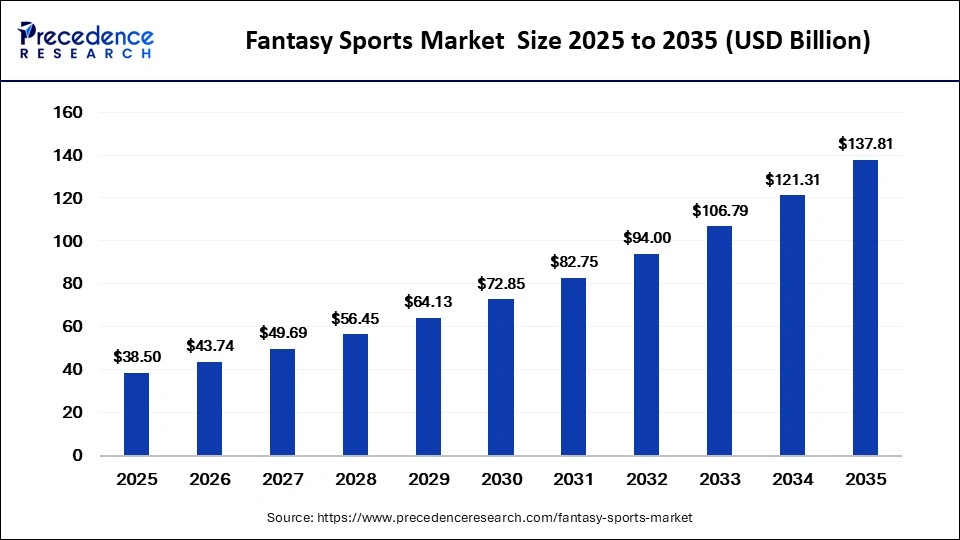
The global fantasy sports market size accounted for USD 38.50 billion in 2025 and is predicted to increase from USD 43.74 billion in 2026 to approximately USD 137.81 billion by 2035, expanding at a CAGR of 13.60% from 2026 to 2035. The market growth is attributed to rising mobile-first engagement, real-time sports analytics integration, and increasing monetization through digital fantasy gaming platforms.
Key Takeaways
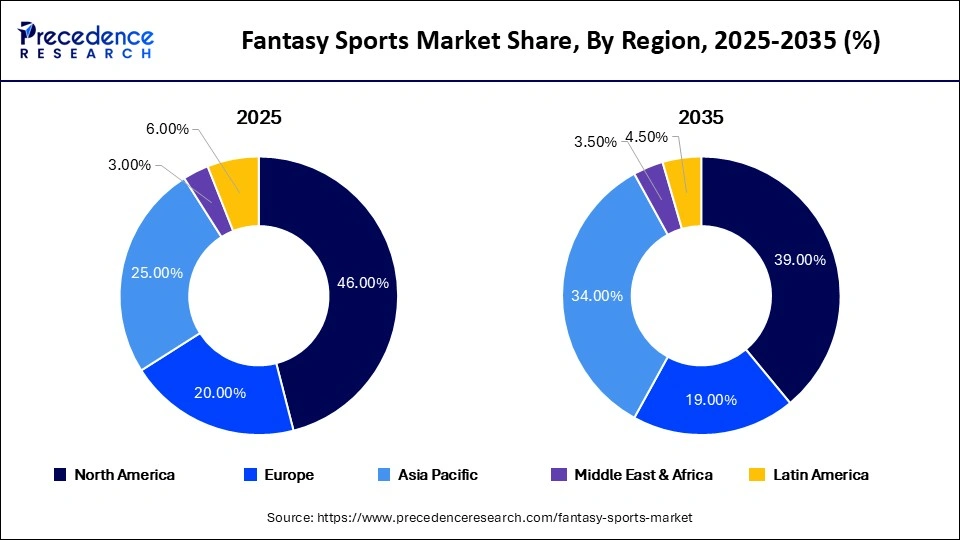
- North America dominated the market with 46% of the fantasy sports market share in 2025.
- Europe held the second-largest market share of 20% in 2025 and is expected to register a significant growth of 10.5% CAGR during 2026 and 2035.
- By sports type, the football segment contributed the highest market share of 32% in 2025.
- By sports type, the cricket segment held a 28% share of the market in 2025 and is expected to grow at a significant CAGR of 18% in between 2026 and 2035.
- By platform, the mobile applications segment held a major market share of 78% in 2025.
- By platforms, the web-based platforms segment held a 22% share in 2025 and is expected to register a significant growth of 6.5% CAGR during 2026 and 2035.
- By game type, the daily fantasy sports (DFS) segment contributed the highest market share of 64% in 2025.
- By game type, the season-long fantasy sports segment contributed 36% to the fantasy sports market in 2025 and is expected to grow at a CAGR of 9% over the projected period.
- By revenue model, the entry fees segment contributed the highest market share of 48% in 2025.
- By revenue model, the advertising segment held a 22% share of the market in 2025 and is expected to grow at a significant CAGR of 10% between 2026 and 2035.
- By user type, the casual players segment contributed the highest market share of 72% in 2025.
- By user type, the professional players segment held a 28% share of the market in 2025 and is expected to grow at the fastest CAGR of 17% between 2026 and 2035.
Market Overview
Rapid expansion of mobile-first digital engagement with real-time sports data and AI-driven analytics platforms, transforming how users interact with live sports ecosystems, is driving the market. The ICC reports that cricket activity has grown following a positive trend, directly contributing to the growth of fantasy cricket participation in international tournaments.
FIFA reported record global viewership of football events, adding to the army of loyal fans who enjoy fantasy football through mobile application. Furthermore, the well-established fantasy sports infrastructure and evidence of successful integration with the NFL and NBA have resulted in strong DAU/MAU growth across platforms.
Impact of Artificial Intelligence on the Fantasy Sports Market
Artificial intelligence (AI) is transforming the fantasy sports industry by changing how users build teams, interact with live matches, and make spending decisions. Platforms use AI models to analyse player statistics in real time, playing conditions, and historical data, and make recommendations for each team within seconds.
This enhances customer choice-making and boosts involvement as new users depend on data-driven tips rather than in-depth sports knowledge. Moreover, the AI algorithms can also support in detecting suspicious gameplay, bot activity, and multi-accounting, further fostering trust within competitive sessions.
Market Trends
- Second-Screen Sports Entertainment Integration: Fantasy apps are evolving into full sports entertainment ecosystems instead of standalone gaming apps. Enhanced fantasy feeds with live commentary, creator content, and interactive sports information into player-friendly dashboards. This transformation is not just making fantasy platforms match apps; it's making them continuous engagement media platforms.
Growth Factors
- Rising Gamification of Live Sports Consumption: Rising gamification features across live sports broadcasts are boosting user engagement by integrating fantasy scoring layers directly into real-time viewing experiences.
- Boosting Social Fantasy and Community Engagement Networks: Boosting social interaction features within fantasy platforms is increasing user retention through peer competition, group leagues, and community-driven challenges.
Explosive User Growth and Mobile Engagement Accelerating Global Fantasy Sports Market Expansion
- India was one of the fastest-growing markets for fantasy users in 2024 and is on the verge of crossing 300 million users by 2025, mainly due to the presence of various cricket tournaments like the Indian Premier League in the market.
- During Q1 2025, PrizePicks was one of the most successful fantasy sports mobile uptrends in the U.S. Weekly downloads reached around 355,000, and weekly downloads were close to 2.4 million on weekends during a big event.
- Sleeper sustained consistent monthly active users of approximately 1.6 million during 2024 while strengthening user retention through community-based fantasy league features and integrated chat functionality. (Sensor Tower)
Market Scope
| Report Coverage | Details |
| Market Size in 2025 | USD 38.50 Billion |
| Market Size in 2026 | USD 43.74 Billion |
| Market Size by 2035 | USD 137.81 Billion |
| Market Growth Rate from 2026 to 2035 | CAGR of 13.60% |
| Dominating Region | North America |
| Fastest Growing Region | Europe |
| Base Year | 2025 |
| Forecast Period | 2026 to 2035 |
| Segments Covered | Sports Type, Platform, Game Type, Revenue Model, User Type, Demographics, and Region |
| Regions Covered | North America, Europe, Asia-Pacific, Latin America, and Middle East & Africa |
Market Dynamics
Drivers
Mobile-First Adoption Driving Scalable Growth
Increasing mobile-first adoption, projected to strengthen global user participation, continues to boost the market in the coming years. The penetration of smartphones enables quick acceptance from new users in emerging markets and in developed areas. Platform payments are now made easier with mobile wallets and payment rails like UPI for low-volume and frequent transactions. Moreover, the growing real-time sports data integration, anticipated to improve user decision accuracy, strengthens platform competitiveness across global markets.
Restraint
Regulatory Fragmentation Limiting Scalability
Regulatory uncertainty across regions, projected to limit structured market expansion in the market, is anticipated to hinder the market growth. Different countries have different legal frameworks, making it problematic for fantasy platforms to operate. Additionally, the restricted intense market competition, anticipated to fragment user bases in the market, is likely to compress average revenue per user.
Opportunity
Expansion of Esports and Virtual Formats Creating Opportunities
Spurring esports and virtual sports expansion is likely to diversify participation formats, thus further creating immense opportunities for the market in the coming years. Fantasy contests are introduced by operators that are associated with esports contests or simulations of sports. Running virtual leagues continuously keeps the engagement going in the absence of any real-world sports calendar. Rising global sports consumption, anticipated to expand user base growth, continues to fuel fantasy participation across regions.
Segmental Insights
Sports Type Insights
Fantasy Sports Market Share, By Sports Type, 2025-2035 (%)
| Sports Type | 2025 | 2035 | CAGR (%) |
| Football | 32.00% | 30.00% | 11.00% |
| Cricket | 28.00% | 32.00% | 18.00% |
| Basketball | 14.00% | 13.00% | 10.20% |
| Baseball | 8.00% | 6.00% | 7.00% |
| Hockey | 5.00% | 4.00% | 6.00% |
| Kabaddi | 4.00% | 5.00% | 16.50% |
| Esports | 6.00% | 8.00% | 22.00% |
| Others | 3.00% | 2.00% | 5.00% |
The Football Segment Dominated the Market with 32% of Market Share in 2025
The football segment dominated the fantasy sports market with a share of 32% in 2025, supported by deeply structured ecosystems across the NFL and European leagues. High engagement intensity in the U.S. with the sport during the NFL season is driven by its involvement in fantasy football. The convergence of sports betting platforms and live analytics services, such as those in football, offers another layer of value and strength to its position in the industry.
The cricket segment held a 28% share of the market in 2025 and is expected to grow at a significant CAGR of 18% between 2026 and 2035, propelled by the Indian market through engagement cycles around IPL tournaments. According to the Internet and Mobile Association of India (IAMAI), more than 225 million people are active on fantasy cricket websites. Dream11, My11Circle, and MPL are the keys to this business with their mobile-first formats and instant score-saving services.
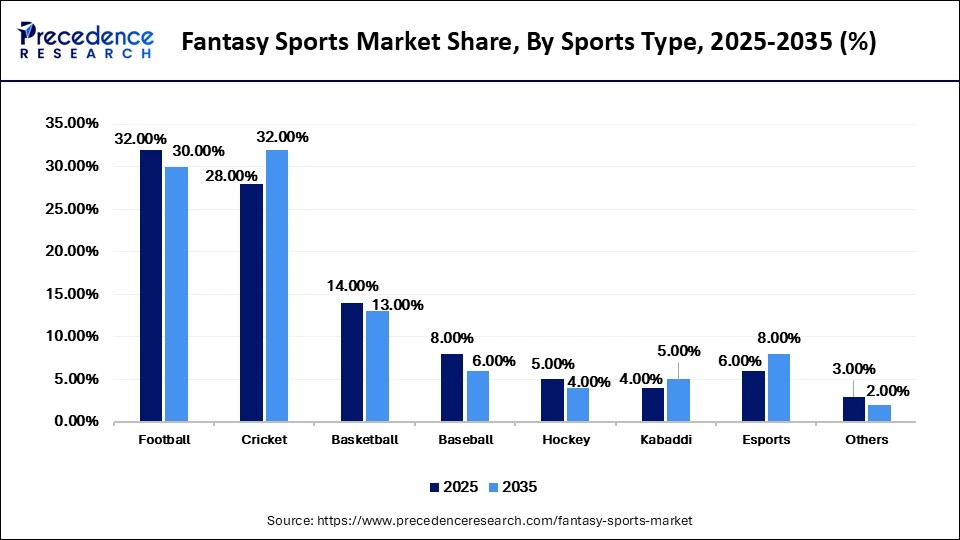
The basketball segment held 14% of the market share in 2025 and is expected to register a significant growth of 10.2% CAGR during 2026 and 2035, due to the NBA's global popularity and structured statistical ecosystem. The advantages of the NBA's data-rich makeup allow detailed scoring models that incorporate points, assists, rebounds, and efficiency data. This statistic intensity enhances involvement from analytics-driven users.
The baseball segment contributed 8% to the market in 2025 and is expected to grow at a CAGR of 7% over the projected period, driven by long seasonal structures and extensive statistical datasets available for player evaluation. The American Gaming Association notes that baseball fantasy engagement is relatively steady among those who are regular customers.
The esports segment held 6% of the market share in 2025 and is expected to grow at the fastest CAGR of 22% during the forecast period, due to the rapid development of the global entertainment, media, and technology ecosystem. The availability of multiplayer online games and the increasing craze among the younger population boost the segment's growth.
Platform Insights
Fantasy Sports Market Share, By Platform, 2025-2035 (%)
| Platform | 2025 | 2035 | CAGR (%) |
| Mobile Applications | 78.00% | 84.00% | 15.50% |
| Web-based Platforms | 22.00% | 16.00% | 6.50% |
The Mobile Applications Segment Dominated the Market with 78% of Market Share in 2025
The mobile applications segment dominated the fantasy sports market with a share of 78% in 2025 and is expected to grow rapidly with a CAGR of 15.5% during the forecast period, driven by smartphone-first user behavior and digital payment integration. Mobile fantasy sports devices score significant and rapid traction in new markets, with over 6.9 billion fantasy sports sessions around the world happening on mobile devices in 2025. Moreover, the mobile apps also enhance engagement by regularly delivering new streaming, analytics, and social interaction technologies.
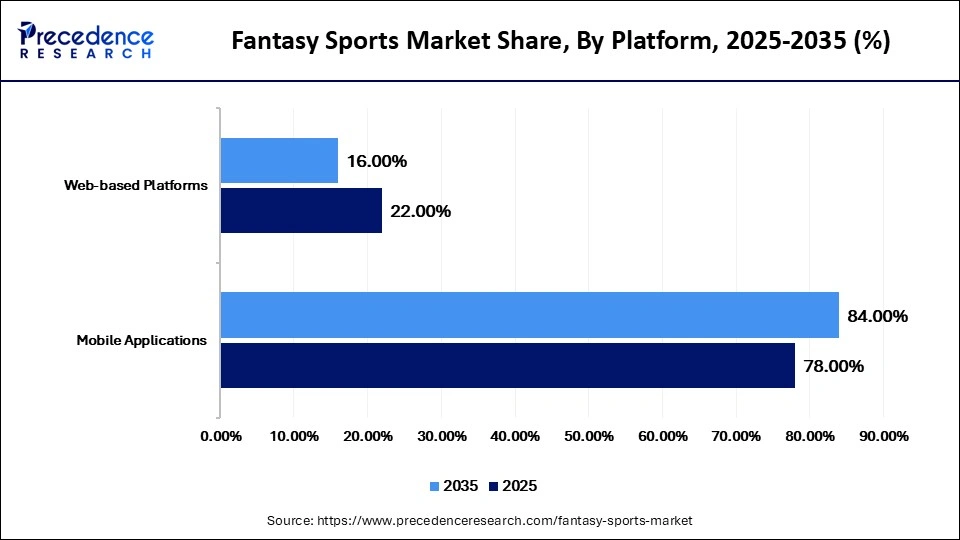
The web-based platforms segment held a 22% share of the market in 2025 and is expected to grow at a significant CAGR of 6.5% between 2026 and 2035, as web platforms remain critical for high-complexity fantasy strategy execution and analytics-heavy users. Desktop platforms are still vital for analytical users, particularly when they are creating many drafts or handling multiple league management tasks.
Game Type Insights
Fantasy Sports Market Share, By Game Type, 2025-2035 (%)
| Game Type | 2025 | 2035 | CAGR (%) |
| Daily Fantasy Sports (DFS) | 64.00% | 69.00% | 15.20% |
| Season-long Fantasy Sports | 36.00% | 31.00% | 9.00% |
The Daily Fantasy Sports (DFS) Segment Dominated the Market with 64% of Market Share in 2025
The daily fantasy sports (DFS) segment dominated the fantasy sports market with a share of 64% in 2025 and is expected to grow at the highest CAGR of 15.2% over the studied period, as players' sessions are short-term, and they spend more per session. Instant lineups, live scoring, and fast-closing matches are the elements that enable DFS sites like DraftKings, FanDuel, and Dream11 to structure formats. Users prefer the DFS for its real-time sports consumption pattern, particularly at high games where decisions are made within minutes.
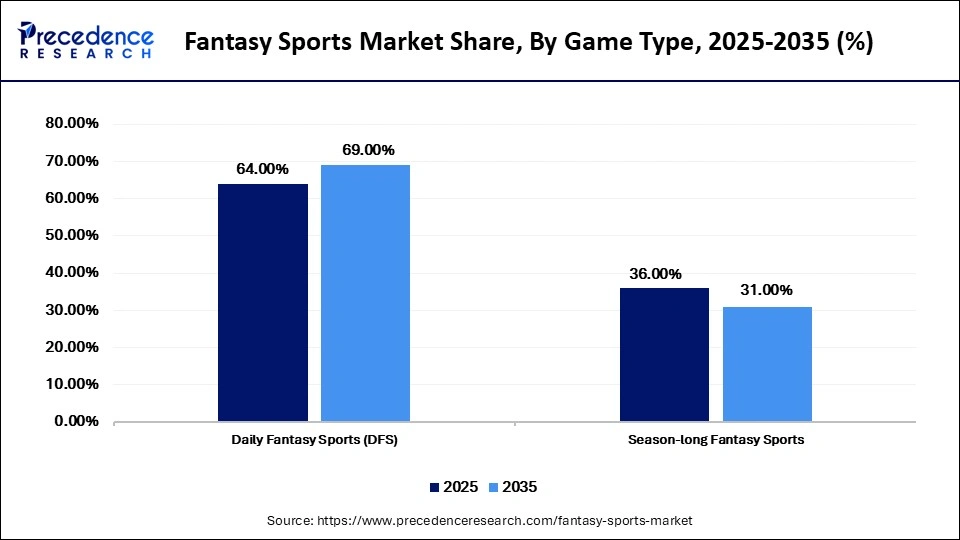
The season-long fantasy sports segment held a 36% share of the market in 2025 and is expected to grow at a significant CAGR of 9% from 2026 to 2035, due to slower adaptation to fast-paced digital consumption behavior. This format has retained popularity with traditional fans craving longer engagements, which are spread out over a whole season. Season-long formats are also very dependent on community leagues that foster more sustained involvement in a league from friends and professional networks.
Revenue Model Insights
The Entry Fees Segment Dominated the Market with 48% of Market Share in 2025
The entry fees segment dominated the fantasy sports market with a share of 48% in 2025, due to the high frequency of consumers using paid competitions and more indirect forms of engagement with the game through tournaments. During major events like the IPL 2025, NFL 2025 season weeks, and NBA playoffs, platforms like Dream11, DraftKings, and FanDuel handle millions of transactions per event.
The advertising segment held a 22% share of the market in 2025 and is expected to grow at a significant CAGR of 10% between 2026 and 2035, supported by digital sports engagement growth. The revenue from sports brands, betting partnerships, fintech integrations, and in-app ads is the major source of income for platforms. By 2025, the Interactive Advertising Bureau (IAB) trends report that digital sports ads are still growing, with the mounting time spent on mobile use inside fantasy apps.
Fantasy Sports Market Share, By Revenue Mode, 2025-2035 (%)
| Revenue Mode | 2025 | 2035 | CAGR (%) |
| Entry Fees | 48.00% | 50.00% | 14.00% |
| Advertising | 22.00% | 20.00% | 10.00% |
| Premium Subscriptions | 12.00% | 14.00% | 16.50% |
| Sponsorships & Partnerships | 10.00% | 10.00% | 12.50% |
| In-app Purchases | 8.00% | 6.00% | 9.50% |
The premium subscriptions segment held a 12% share in 2025 and is expected to register the fastest growth with a CAGR of 16.5% during 2026 and 2035, as demand for advanced analytics and AI deployment on gameplay continues to climb. DraftKings and ESPN Fantasy Line do offer subscription options that include predictive insights, lineup optimization, and injury probability models. This puts premium subscriptions as the fastest-growing high-margin revenue in the fantasy space.
The sponsorships and partnerships segment contributed 10% to the market in 2025 and is estimated to grow at a CAGR of 12.5% over the projected period, driven by strong collaboration between fantasy platforms, sports leagues, and digital brands. Many companies have fantasy campaigns jointly branded with Visa, Mastercard, and other major service providers, increasing the visibility for millions of people.
User Type Insights
The Casual Players Segment Dominated the Market with 72% of Market Share in 2025
The casual players segment dominated the fantasy sports market with a share of 72% in 2025, due to simplified app access and free-to-play games. According to the Internet and Mobile Association of India (IAMAI) in 2025, casual engagement is the biggest segment of the first-time fantasy users, particularly in mobile-first economies. Enhanced consumption through social and entertainment close relationship with the internet also dominated among casual users.
Fantasy Sports Market Share, By User Type, 2025-2035 (%)
| User Type | 2025 | 2035 | CAGR (%) |
| Casual Players | 72.00% | 68.00% | 12.00% |
| Professional Players | 28.00% | 32.00% | 17.00% |
The professional players segment held a 28% share of the market in 2025 and is expected to grow at the fastest CAGR of 17% between 2026 and 2035, owing to the growth in monetization opportunities and the adoption of more advanced analytics in gameplay. It is mainly comprised of the high-frequency users who play in multiple contests each day through the various platforms.
Regional Insights
North America Fantasy Sports Market Size and Growth 2026 to 2035
The North America fantasy sports market size was exhibited at USD 17.71 billion in 2025 and is projected to be worth around USD 54.03 billion by 2035, growing at a CAGR of 11.80% from 2026 to 2035.
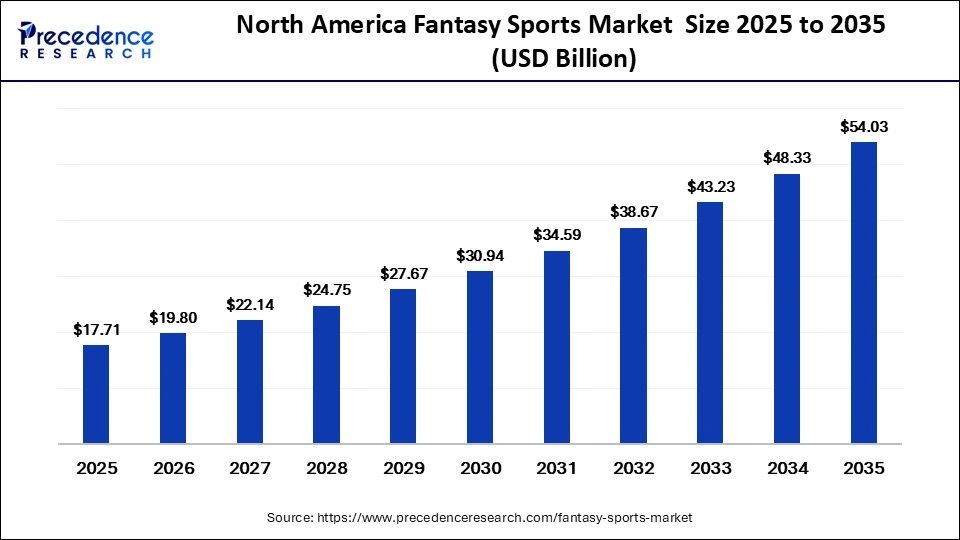
North America Dominated the Market with 40% of the Fantasy Sports Market Share in 2025
North America held a major market share of 43% in 2025, due to the deeply embedded sports ecosystems built around the NFL, NBA, MLB, and NHL. According to the Fantasy Sports & Gaming Association (FSGA), there were more than 60 million fantasy sports users in the United States in 2025. Moreover, the expansion of regulated betting and the growth of digital sports further solidify regulated approaches to monetization, facilitating the market growth in this region.
U.S. Fantasy Sports Market Size and Growth 2026 to 2035
The U.S. fantasy sports market size was evaluated at USD 13.28 billion in 2025 and is projected to reach around USD 40.54 billion by 2035, growing at a CAGR of 11.89% from 2026 to 2035.
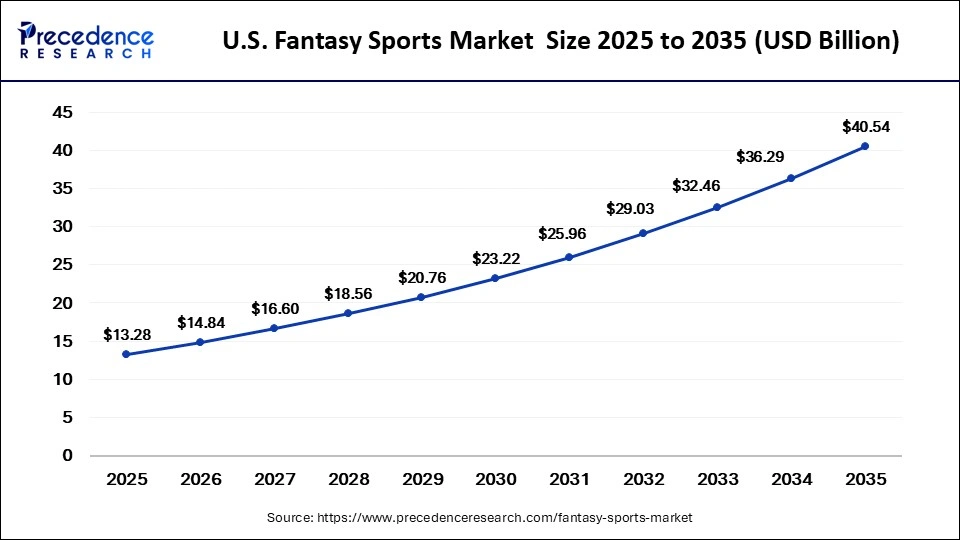
U.S. Driving North America's Fantasy Sports Leadership in 2025
The U.S. leads the market due to its well-developed professional sports system and cutting-edge electronic gaming construction. Strong convergence between the fantasy game and regulated sports betting can also boost cross-platform engagement intensity, thus facilitating the market in this region.
How is Europe Growing in the Fantasy Sports Market?
Europe held 20% of the market share in 2025 and is expected to grow at a CAGR of 10.5% over the projected period, supported by strong football-centric engagement patterns across major leagues. Mobile saturation ensures engagement by apps, which includes users between the ages of 18 and 34. Samsung Electronics and Apple ecosystems further enhance the smooth adoption of fantasy on mobile devices.
United Kingdom Leading Europe's Fantasy Sports Expansion
The UK is a major contributor to the market due to increased engagement in fantasy sites like Fantasy Premier League at UEFA Champions League games. This combination of football dominance, digital maturity, and regulated gaming structure positions the UK as Europe's primary fantasy sports hub.
Will Asia-Pacific Grow in the Fantasy Sports Market?
Asia-Pacific held the second-largest market share of the market in 2025 and is expected to grow at a 30.5% CAGR between 2026 and 2035, driven by strong mobile-first adoption and cricket-driven engagement. Asia Pacific's mobile scale, esports integration, and payments services infrastructure make it the fastest-growing region in the global markets.
India Powering Asia-Pacific's Rapid Fantasy Sports Growth
In India, the market is due massive fan audience of the sport, and by embracing digitalization in a mobile-first approach. The integration of the entire sports culture into cricket, digital payments, and mobile infrastructure positions India as a primary growth driver of the global market.
Fantasy Sports Market Value Chain Analysis
- Sports Data Acquisition & Content Licensing
The foundation of the fantasy sports ecosystem depends on real-time sports data feeds, official league statistics, and licensed content distribution. This stage ensures accurate player performance tracking and standardized scoring inputs across multiple sports formats.
Key Players: Sportradar, Stats Perform, Genius Sports, ESPN, IMG Arena
- Platform Development & Game Operations
Fantasy operators design digital platforms, game mechanics, contest structures, and scoring algorithms that define user engagement.
Key Players: DraftKings, FanDuel, Dream11, Yahoo Fantasy Sports, Flutter Entertainment
- Cloud Infrastructure, AI Analytics & Payment Processing
This stage supports real-time data processing, predictive analytics, personalization engines, and secure financial transactions. It enables scalability during high-traffic sports events while ensuring seamless entry fee payments, rewards distribution, and user experience optimization.
Key Players: Amazon Web Services, Microsoft Azure, Google Cloud, OpenAI, PayPal, Visa, Mastercard, Stripe
- User Engagement, Marketing & Monetization Ecosystem
The final stage focuses on user acquisition, retention, community building, and revenue generation through advertising, sponsorships, and partnerships. It strengthens long-term platform growth through social engagement, influencer marketing, and sports league collaborations.
Key Players: Meta Platforms, Google Ads, Reddit, Discord, NFL, NBA, ICC, Warner Bros. Discovery
Fantasy Sports Market Companies
- DraftKings Inc.
- FanDuel Group
- Dream11
- Yahoo Fantasy Sports
- ESPN Fantasy Sports
- CBS Sports Fantasy
- Sleeper
- Underdog Fantasy
- MPL (Mobile Premier League)
- PrizePicks
- Fantrax
- RealFevr
- MyTeam11
- BalleBaazi
- League11
Recent Developments
- In April 2026, Junglee Games, a subsidiary of Flutter Entertainment, launched the Zuvo app after exiting India's real-money gaming sector following the implementation of the Promotion and Regulation of Online Gaming Act, 2025 (PROGA), which banned online games involving monetary stakes, including fantasy sports and rummy platforms.(Source: https://g2g.news)
- In March 2026, DraftKings announced an expanded long-term growth strategy focused on AI deployment, operational efficiency, and increasing participation in the projected USD 55-80 billion sports gaming industry opportunity expected by 2030.(Source: https://www.businesswire.com)
Segments Covered in the Report
By Sports Type
- Football
- American Football
- Soccer
- Cricket
- Basketball
- Baseball
- Hockey
- Kabaddi
- Esports
- Others
By Platform
- Mobile Applications
- Web-based Platforms
By Game Type
- Daily Fantasy Sports (DFS)
- Season-long Fantasy Sports
By Revenue Model
- Entry Fees
- Advertising
- Premium Subscriptions
- Sponsorships & Partnerships
- In-app Purchases
By User Type
- Casual Players
- Professional Players
By Demographics
- Below 25 Years
- 25-40 Years
- Above 40 Years
By Region
- North America
- Latin America
- Europe
- Asia-pacific
- Middle and East Africa
For inquiries regarding discounts, bulk purchases, or customization requests, please contact us at sales@precedenceresearch.com
Frequently Asked Questions
Tags





Ask For Sample
No cookie-cutter, only authentic analysis – take the 1st step to become a Precedence Research client
 Get a Sample




 sales@precedenceresearch.com
 Schedule a Meeting
