



Fast Curing Nitrile Butadiene Rubber Market Trends, Leading Companies, Company Revenue / Sales Performance, Plant Utilization, Production Volume, Pricing Dynamics, Supply Chain Performance, Competitive Landscape, and Industry Growth
The fast curing nitrile butadiene rubber market reached USD 979.85 million in 2027. The market growth is attributed to the increasing rubber consumption and the rising demand for fast curing rubbers in several industrial applications. These trends were evaluated by our Senior Research Analyst, Vidyesh Swar, to curate this report. His report benefits multiple stakeholders, including rubber manufacturers, raw material suppliers, industry experts, private equity firms, and distributors.
Source: https://www.precedenceresearch.com/fast-curing-nitrile-butadiene-rubber-market
 Get a Sample
 Report Description


Fast Curing Nitrile Butadiene Rubber Market Size, Trends, Share, and Innovations 2036
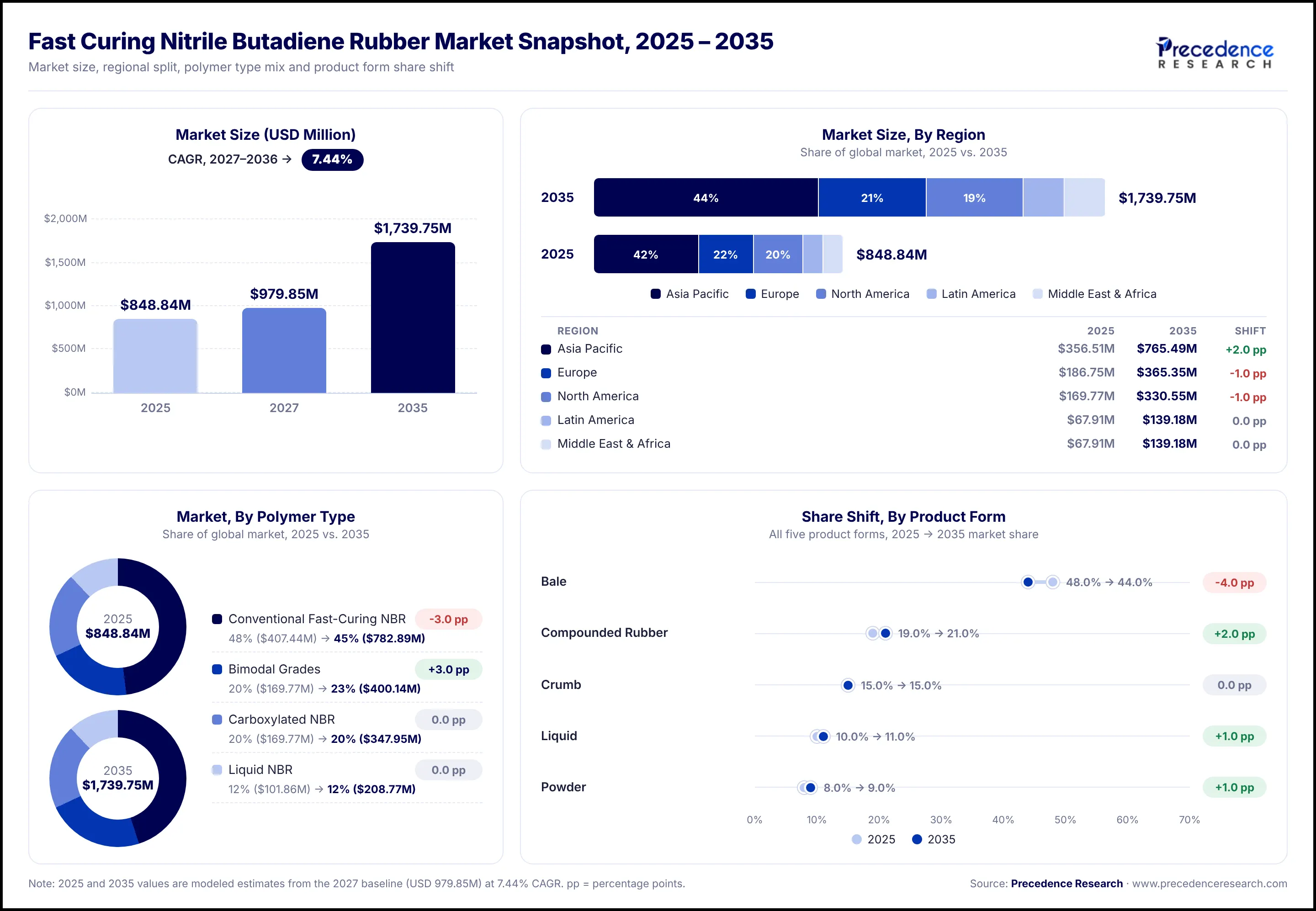
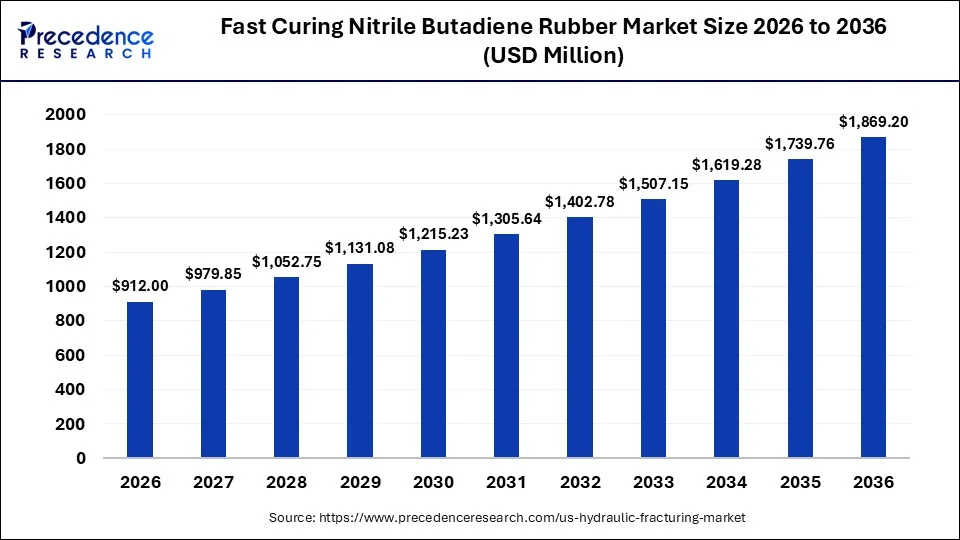
The fast-curing nitrile butadiene rubber market is anticipated to rise from USD 979.85 million in 2027 to USD 1,869.20 million by 2036, registering a CAGR of 7.44% over the 2027-2036 forecast period.
Key Takeaways
Market Size & Growth Outlook
- Market size in 2026: USD 912.00 million
- Estimated market size in 2027: USD 979.85 million
- Projected market size by 2036: USD 1,869.20 million
- CAGR (2027–2036): 7.44%
Regional Market Spotlight
- Asia-Pacific share in 2026: 42.00%
- Europe share in 2026: 22.00%
- North America share in 2026: 20.00%
Segmental Spotlight
- Conventional Fast-Curing NBR share in 2026: 48.00%
- Bale product form share in 2026: 48.00%
- Seals and O-rings application share in 2026: 25.00%
Fast Curing Nitrile Butadiene Rubber Market Size 2026 to 2036
The fast-curing nitrile butadiene rubber industry is witnessing growing demand due to increasing industrial manufacturing activities and the need for improved production efficiency. Rising adoption of specialized rubber materials in automotive components, industrial seals, hoses, and molded products is expected to support industry expansion throughout the forecast period.
Will Productivity-Led Demand Outpace Conventional NBR Growth?
This trajectory suggests a market in which demand growth is supported by industrial production, vehicle component manufacturing, equipment maintenance, and the substitution of slower processing formulations where the economics justify conversion.
However, an increase in revenue does not always translate into profitability. Acrylonitrile and butadiene prices, energy costs, freight charges, and regional capacity utilization are factors that affect NBR prices. Faster-curing grades must therefore be evaluated using both value and volume indicators.
Annual revenue, expected tonnage, average price, regional shares, and the effect of raw material cost variations on pricing will all be included in the comprehensive analysis. The base case, upside, and downside scenarios need to be based on differences in industrial production, auto production, qualification rates, and specialty adoption rates.
Coverage Highlights
- Historical market value and annual growth.
- Revenue, volume, and average selling price estimates.
- Incremental opportunity by application and region.
- Base-case, upside, and downside scenarios.
- Sensitivity to feedstock costs and end-market demand.
Which Grades and Uses Generate Maximum Demand Value?
Fast-curing NBR is best assessed across polymers characteristics, product form, finished application, and end-use industry. These parameters indicate various sources of value; chemistry sets the performance boundaries, processing indicates productivity, and the use determines qualification and willingness to pay.
Seals and O-rings are important because oil and fuel resistance, dimensional stability, and compression performance are central to their function. Resistance to fluids and mechanical forces is an important quality in hoses. Belts and molding represent fields where the ability to run faster will increase throughput on the production lines.
Two possible grades to consider are bimodal and carboxylated grades, because the former are good for processing, while the latter have better strength and abrasion resistance properties. This information must not be confused with a universal conclusion that a specific grade will always cure faster. Formulations and procedures are crucial.
The report emphasizes the market's largest and fastest-growing revenue and volume segments in addition to providing a broad overview of the industry.
Coverage Highlights
- Product type and polymer chemistry segmentation.
- Application-level revenue and volume shares.
- End-use industry growth and demand contribution.
- Product form and customer channel analysis.
- Highest-value and emerging specialty applications.
- Regional segment forecasts and adoption patterns.
Fast Curing Nitrile Butadiene Rubber Market Segments Analysis
Fast Curing Nitrile Butadiene Rubber Market by Polymer Type 2026 Share & Size
| Segments | 2026 Share | Market Value (USD Million) |
| Conventional Fast-Curing NBR | 48.00% | 437.75 |
| Bimodal Grades | 20.00% | 182.4 |
| Liquid NBR | 12.00% | 109.44 |
| Carboxylated NBR | 20.00% | 182.4 |
Source: Expert Interview, Secondary Sources, Precedence Research Database, Precedence Research Analysts and Researcher.
Conventional fast-curing NBR leads due to its established industrial use and compatibility with standard rubber processing applications.
Fast Curing Nitrile Butadiene Rubber Market by Product Form 2026 Share & Size
| Segments | 2026 Share | Market Value (USD Million) |
|---|---|---|
| Bale | 48.0% | 437.75 |
| Crumb | 15.0% | 136.80 |
| Powder | 8.0% | 72.96 |
| Liquid | 10.0% | 91.20 |
| Compounded Rubber | 19.0% | 173.28 |
Source: Expert Interview, Secondary Sources, Precedence Research Database, Precedence Research Analysts and Researcher.
Bale rubber leads due to its suitability for conventional compounding operations and established industrial supply chains
Fast Curing Nitrile Butadiene Rubber Market by Application 2026 Share & Size
| Segments | 2026 Share | Market Value (USD Million) |
| Hoses | 15.00% | 136.8 |
| Seals and O-rings | 25.00% | 228 |
| Belts | 12.00% | 109.44 |
| Cables | 7.00% | 63.84 |
| Molded and Extruded Products | 16.00% | 145.92 |
| Adhesives and Sealants | 8.00% | 72.96 |
| Gloves | 10.00% | 91.2 |
| Foamed Products | 7.00% | 63.84 |
Source: Expert Interview, Secondary Sources, Precedence Research Database, Precedence Research Analysts and Researcher.
Seals and O-rings lead because NBR offers oil resistance, durability, and reliable sealing performance in industrial and automotive equipment.
Fast Curing Nitrile Butadiene Rubber Market by End-Use Industry 2026 Share & Size
| Segments | 2026 Share | Market Value (USD Million) |
| Automotive and Transportation | 30.00% | 273.59 |
| Mechanical Engineering | 25.00% | 228 |
| Oil and Gas | 15.00% | 136.8 |
| Mining and Metallurgy | 10.00% | 91.2 |
| Construction | 10.00% | 91.2 |
| Medical and Other Industries | 10.00% | 91.2 |
Source: Expert Interview, Secondary Sources, Precedence Research Database, Precedence Research Analysts and Researcher.
Automotive and transportation lead due to demand for oil-resistant seals, hoses, gaskets, and vibration-control components.
Fast Curing Nitrile Butadiene Rubber Market by Consumer Type 2026 Share & Size
| Segments | 2026 Share | Market Value (USD Million) |
| Rubber Compounders | 35.00% | 319.19 |
| Component Manufacturers | 30.00% | 273.59 |
| OEM Suppliers | 20.00% | 182.4 |
| Industrial Product Manufacturers | 15.00% | 136.8 |
Source: Expert Interview, Secondary Sources, Precedence Research Database, Precedence Research Analysts and Researcher.
Rubber compounders lead because they purchase NBR as a raw material for formulation, processing, and production of specialized rubber compounds.
Fast Curing Nitrile Butadiene Rubber Market by Region 2026 Share & Size
| Segments | 2026 Share | Market Value (USD Million) |
| North America | 20.00% | 182.4 |
| Europe | 22.00% | 200.64 |
| Asia-Pacific | 42.00% | 383.03 |
| Latin America | 8.00% | 72.96 |
| Middle East and Africa | 8.00% | 72.96 |
Source: Expert Interview, Secondary Sources, Precedence Research Database, Precedence Research Analysts and Researcher.
Asia-Pacific leads due to its substantial rubber manufacturing base, automotive production, and demand from industrial component manufacturers.
What are the Main Drivers and Challenges of the Fast Curing Nitrile Butadiene Rubber Market?
The primary drivers of expansion are increased manufacturing economics and throughput. Better production scheduling, reduced work-in-process inventories, and increased productivity using current molding equipment are all possible with improved curing cycles. The benefit is particularly relevant to high-volume seals, hoses, gaskets, and molded components.
There are three factors that continue to be relevant. The first is that the price variations of acrylonitrile and butadiene would influence the cost of producing the polymers. The second factor is that scorch resistance, stability, and consistency must not be compromised by any improvements made to the curing process. Lastly, there are steps involved in changing a tried-and-true formula.
There is potential in developing custom-made products for molding and high-speed industrial applications. There is a risk in the use of another kind of elastomer due to temperature and chemical exposure issues.
The commercial test is the customer's total cost per acceptable component, not polymer price alone. A better grade may be desirable if it increases output, reduces rejections, and preserves component life.
Coverage Highlights
- Growth drivers, restraints, and adoption barriers.
- Raw material exposure and cost pass through.
- Manufacturing productivity and reject-rate economics.
- Substitution risks from alternative elastomers.
- Customer qualification and compound development cycles.
What Does the Pricing Analysis of the Fast Curing Nitrile Butadiene Rubber Market Indicate?
Price determination for fast-curing NBR depends on several parameters such as the amount of acrylonitrile, Mooney viscosity, method of polymerization, molecular structure, consistency of grades, quantity of order, and terms of the contract. Premiums may be applicable if the special grades provide certain performance advantages, but there cannot be any premium price per kilogram justifiable on a worldwide scale.
A good pricing policy differentiates between pricing of base polymers and the added benefit of quick curing. It should involve a comparison of the total cost per kilogram of polymer delivered against the cost of formulation of compound, curing, energy use, production speed, waste generation, and testing.
Key Coverage
- Grade-specific and regional price benchmarks.
- Contract versus spot purchasing.
- Raw-material and energy cost exposure.
- Specialty-grade price premiums.
- Processor economics and price elasticity.
- Gross-margin sensitivity and price outlook.
Where Could Regional Manufacturing Create Supply Advantages?
The feedstock availability, polymerization process, energy cost, technical know-how, and client proximity influence the economics of NBR production. The lead time, landed cost, and ability to deliver reliable specialty grades to the client are all influenced by regional differences in these factors.
Asia-Pacific is strategically important because of its manufacturing ecosystem and expanding industrial demand. North America and Europe offer established customer bases for engineered rubber components and technically specified materials. Nevertheless, regional demand leadership does not necessarily indicate leadership in fast-curing-grade capacity.
The full assessment distinguishes total NBR nameplate capacity from capacity technically suitable for specific fast-curing products. Production efficiency, product portfolio, plant utilization, inventory management, order lead times, import dependency, and expansion plans are all considered. This distinction is essential because nominal NBR capacity cannot automatically be treated as immediately available fast-curing supply.
Coverage Highlights
- Regional production and consumption estimates.
- Specialty-grade capacity and utilization.
- Supply-demand balances and regional bottlenecks.
- Imports, exports, and landed cost comparisons.
- Capacity additions and localization opportunities.
Where is Fast-Curing NBR Value Captured?
The value chain starts from acrylonitrile and butadiene, goes through polymerization and finishing processes, and continues up to formulation of compounds, manufacture of components, distribution, and customer qualification. The potential for higher value realization is contingent upon the combination of polymer uniformity with performance aspects.
Value differentiation is based on factors such as molecular weight distribution, acrylonitrile content, viscosity, polymer structure, curability compatibility, and curing speed versus scorchariness. Faster curing is not only a polymer intrinsic feature; compound formulation and process have a significant effect on the vulcanization performance.
Sustainability is primarily an operational and materials challenge. Saving of energy, reducing waste, increasing the lifespan of parts/components, and minimizing wastage of raw materials can result in improved economics in relation to lifecycle costs of fast curing products. But one cannot assume the environmental benefits, particularly in cases where fast curing requires alteration of additives or process conditions.
Coverage Highlights
- Feedstock-to-component value chain economics.
- Polymer and compounding technology differentiation.
- R&D, patents, and product development activity.
- Processing energy, scrap, and lifecycle considerations.
- Technical service and customer qualification requirements.
Will Traditional Elastomers Companies Be Able to Compete With Specialty Elastomers Companies?
Competition in the fast curing nitrile butadiene rubber market spans integrated chemical producers, established synthetic rubber manufacturers, regional suppliers, and specialty elastomer businesses. However, production scale and broad NBR portfolio availability do not, by themselves, establish competitive leadership in fast-curing grades.
Consistency of polymer performance, reliable performance in delivery, technical expertise related to specific applications and the ability to satisfy their customers' needs for proper curing and processing will be important. Available information does not provide specific figures regarding revenue, market shares, production capabilities and sales by grades for each individual fast-curing NBR supplier. Competitive advantage will probably lie in the ability to offer consistent manufacturing process, strong formulation expertise, supply reliability and customer qualification.
The already established suppliers could leverage their advantages such as existing manufacturing capabilities, relationships with customers and wide range of products, but specialty-grade newcomers and regional suppliers could use their advantages in development for specific applications, responsiveness and technical expertise. However, they could become potential competitive advantages, not proved yet to show that certain supplier gains market share. It would boil down to how capable they will be of meeting cure performance specifications in certain applications without compromising on quality and product delivery efficiency.
The strategic implication is that broad NBR market presence should be distinguished from demonstrated leadership in fast-curing grades. Customers would find qualified performance and reliable delivery of the goods more important than having a diversified portfolio, thus giving the manufacturers a possibility to demonstrate their capabilities. On the contrary, manufacturers that cannot provide any evidence regarding grade-related performance or dependable delivery could find it challenging to transform manufacturing scale into an advantage within the market.
The full report also covers the competitive landscape, the product portfolio positioning, the capability of fast-curing grades, the application coverage, the manufacturing presence, customer support strengths, and competitive gaps. Information about the supplier, grade of the product, application, geography, manufacturing plant, capacity (revealed), technical specifications, and year can add value to the analysis through inclusion in the company-level database. Where there is no information about the revenue, capacity, or market share specific to fast-curing grades, the corresponding information should be marked as undisclosed or not verified.
Tentative Leading Company Universe
| Company | Headquarters | Market position and core strengths |
| ARLANXEO | Netherlands | Synthetic elastomers and industrial rubber |
| Zeon Corporation | Japan | Specialty nitrile and other performance elastomers |
| JSR Corporation | Japan | Synthetic rubber and specialty polymer technology |
| Kumho Petrochemical | South Korea | Synthetic rubber manufacturing scale |
| LG Chem | South Korea | Integrated petrochemicals and polymer production |
| TSRC Corporation | Taiwan | Synthetic rubber and elastomer materials |
| Versalis | Italy | Petrochemicals and synthetic elastomers |
| SIBUR | Russia | Petrochemical integration and polymer supply |
| PetroChina | China | Integrated petrochemicals and synthetic materials |
| Sinopec | China | Petrochemical production and downstream integration |
| Nitriflex | Brazil | Nitrile rubber and specialty elastomers |
| Trinseo | United States | Specialty materials and synthetic rubber |
| Apcotex Industries | India | Synthetic latex and specialty rubber |
| Synthos | Poland | Synthetic rubber and polymer materials |
| Dynasol Group | Spain | Synthetic elastomers and rubber solutions |
| LG International | South Korea | Potential distribution and trading relevance; direct production status requires verification |
| Reliance Industries | India | Petrochemical integration; specific fast-curing NBR exposure requires verification |
| ENEOS Materials | Japan | Synthetic rubber and polymer technologies |
| Goodyear Chemical | United States | Rubber materials and specialty polymer capabilities |
| Shandong Yanggu Huatai Chemical | China | Rubber chemicals and curing-system-related materials; direct NBR production status requires verification |
Some companies have established relevance to nitrile rubber or adjacent elastomer value chains, while others require verification of direct product participation. Competitive database for the last round of competition separates polymer producers from compounders, distributors, rubber-chemical producers, and materials competitors.
Competitive assessment involves evaluation of:
- Scale and Integration: Availability of feedstock, economies of scale, and supply reliability.
- Product Breadth: Range of products in terms of acrylonitrile content, viscosity, polymers, and specialties.
- Technical Differentiation: Cure uniformity, scorch resistance, processability, and performance.
- Customer Access: OEM qualification, compounder relationships, application engineering, and distribution.
- Regional Positioning: Manufacturing location, logistics, lead times, and local technical support.
Leadership Concentrated in a Small Group of Producers?
Publicly visible information does not establish a reliable, comparable market share table for fast-curing NBR alone. Company-wide chemical revenue and total synthetic rubber revenue cannot be used as substitutes for sales of this specific product category.
Estimating each supplier's pertinent fast-curing NBR revenue, separating internal consumption from external sales, and comparing the results to total market revenue are all important components of a robust ranking. As specialized grades have the potential to achieve higher average selling prices than normal grades, there is a need for distinction between market share and value share as well.
The resulting assessment should quantify the top five and top ten suppliers, the remaining market, and changes in competitive position. It would be incorrect to assert any exact market share percentages or market leaders until such a reconciliation is achieved.
Coverage Highlights
- Estimated supplier revenue and market shares where supportable.
- Top-five and top-ten concentration.
- Volume versus value-based rankings.
- Specialty-grade portfolio and geographic exposure.
- Share-gain opportunities and competitive vulnerabilities.
Which Capabilities Matter Most to Long-Term Advantage?
| Benchmark Dimension | Leading Capability | Strategic Significance |
| Feedstock integration | Strong | Can reduce exposure to input-cost volatility |
| Specialty-grade breadth | Strong | Supports more customer applications |
| Cure-performance consistency | Strong | Reduces production variability and qualification risk |
| Application engineering | Strong | Helps customers optimize compound and process performance |
| Geographic reach | Strong | Improves supply reliability and customer responsiveness |
| Cost competitiveness | Strong | Supports price resilience and margin protection |
| Sustainability performance | Emerging differentiator | Can strengthen customer value propositions |
These are analytical benchmarking criteria, not verified company-specific ratings. Only after taking into account data pertaining to products, capacity, customer reachability, and technical skill can the suppliers' position as leaders, good, average, or emerging be fully evaluated.
The principal strategic divide is likely to be between producers competing primarily on scale and price and suppliers competing through specialized grades, processing consistency, and technical collaboration. The latter can defend premiums where customer qualification is demanding, and production downtime is costly.
Product Portfolio and Technology Benchmarking: Can Specialty Chemistry Provide Justifiable Differentiation?
Traditional NBR, carboxylated grades, liquid grades, powder versions, and other relevant specialized grades are compared as part of the portfolio benchmarking process. Not all products with the use of a liquid grade or a carboxylated grade will automatically indicate faster curing time. Technology assessment is based on publicly available information regarding grades, suitability for applications, launches, patents, and R&D.
Technology assessment focuses on publicly documented grade specifications, application suitability, product launches, patent activity, R&D priorities, and commercial validation. Useful technical indicators include acrylonitrile content, Mooney viscosity, tensile strength, elongation, abrasion resistance, compression set, scorch time, and optimum cure time.
Portfolio gaps include those situations where the customer needs both fast molding cycle time and low temperature flexibility, or needs to balance oil resistance with mechanical toughness. These gaps could represent an opportunity to build a partnership.
Which Regions Allow Producers to Increase Reliability and Delivered Cost?
There is more to regional competitiveness than just being close to demand. Numerous factors, such as feedstock integration, operating efficiency, specialty-grade capabilities, freight exposure, and local technical service, affect the cost and reliability of supply.
The benchmarking framework is used to compare production facilities, relevant NBR capacity, specialty-grade capabilities, utilization, announced expansions, and regional distribution networks. It avoids treating total synthetic rubber capacity as equivalent to fast-curing NBR capacity.
Asia-Pacific merits particular attention for manufacturing and end-use demand, while North America and Europe remain important for established industrial and automotive applications. National comparisons should point out areas where local supply, import substitution, or regional technical cooperation could provide a corporate advantage.
Could Technological Relationships Minimize Switching Risks?
Rubber compounders and component manufacturers are central to the purchasing process. Criteria used will be curing efficiency, viscosity, mechanical properties, uniformity from one batch to another, cost per delivered unit, availability, and formulating characteristics. The technical linkages may be able to provide assistance in development of the compound and overcome production difficulties.
Distributors will still be required where small amounts are necessary. Cost of switching is different for different applications. Requalification is likely to be more demanding for safety-critical or tightly specified components than for less demanding general-purpose molded goods. The study should therefore distinguish customer retention based on technical qualification from retention based mainly on price and availability.
Will Consolidation Speed Up Specialty Elastomer Investments?
An analysis of strategic changes over the past three years must be made, considering the necessary modifications to NBR capabilities, product introductions, partnerships, geographical expansion, and technology alliances for particular applications.
Broader chemical sector acquisitions should not automatically be classified as fast-curing NBR transactions. The commercial importance of each invention depends on how well it can deliver increased production capacity, specialized technology, customer access, or local supplies.
There is also an exclusive transactions analysis which provides the name of the acquirer, target firm, year of acquisition, value disclosed, and assets involved. Where no material directly relevant transaction can be confirmed, the analysis states that limitation rather than infer consolidation from unrelated corporate activity.
Which Suppliers are Best Positioned for Future Growth?
In addition to providing a uniform evaluation of headquarters, ownership, business operations, pertinent product grades, manufacturing footprint, R&D, and global reach, company profiles should give priority to participants with documented fast-curing NBR exposure.
Each profile should distinguish company-wide financial performance from market-specific performance. Total revenue, EBITDA, and R&D spending are useful measures of corporate scale, but they do not establish the profitability of fast-curing NBR products unless the relevant contribution can be isolated.
Strategic positioning should classify companies into the following categories based on verified evidence:
- Scale Leaders: Producers with significant relevant capacity and cost advantages.
- Technology Leaders: Suppliers with differentiated polymer architectures and application-specific performance.
- Regional Leaders: Producers with strong local supply and customer relationships.
- Application Experts: Companies serving technically difficult niches.
- New Competitors: Players adding to their product range or extending geographically.
This analysis will identify their strengths, weaknesses, opportunities for growth, and strategies without putting them into some unfounded market classification.
Where Can Higher-Value Growth Be Captured by Suppliers?
The most promising opportunities are likely to emerge where customers place a high value on processing efficiency, reliability, and specialized performance.
Automotive seals and molded components: Faster processing can boost production throughput if durability, oil resistance, and compression set remain within specification.
Industrial hoses and belts: Opportunities for reliable performance, wear resistance, and process optimization in high-volume component manufacturing
Oilfield and demanding industrial applications: Specialized fluid resistance and application engineering can support differentiated products where equipment reliability is commercially critical.
Regional suppliers, application-specific grades, and technical partnerships with compounders offer further prospects. Rather than assigning revenue from speculation to each possibility, quantification should connect addressable client numbers to achievable penetration rates, reasonable price premiums, and qualification durations.
What Effects Do Price Competition, Entry Barriers, and Supplier Power Have On Profitability?
| Competitive Force | Preliminary Assessment | Strategic Rationale |
| Supplier power | Medium-High | Feedstock volatility and availability can influence costs |
| Buyer power | Medium-High | Large compounders can negotiate pricing and qualify alternatives |
| Threat of new entrants | Medium | Polymer technology, capital requirements, and qualification create barriers |
| Threat of substitutes | Medium-High | Alternative elastomers may replace NBR in applications with different performance requirements |
| Competitive rivalry | High | Product consistency, pricing, service, and technical differentiation influence purchasing |
These are preliminary analytical assessments rather than quantified industry measurements. Region, grade, client size, and application all affect the actual force intensity.
Which External Factors Could Affect the Returns on Investments?
Tariff duties, prices, and raw material availability can all be impacted by political and commercial developments. Energy prices, capital expenditures, industrial production, and automobile manufacturing are all impacted by economic considerations. While regulations may establish product standards and worker and environmental safety, innovations may improve polymer consistency and processing efficiency.
Environmental factors will be increasingly inclined toward resource efficiency, waste minimization, and transparency regarding material compositions. Their effect on fast-curing NBR will depend on application-specific requirements and the availability of technically suitable alternatives.
Overall market attractiveness is moderate to attractive, subject to grade-level economics and competitive positioning. Growth potential is encouraged by industrial applications and factory productivity requirements, but returns are still impacted by the cost of technical certification, customer bargaining power, and raw material cycles.
Will Specialty Grades Outperform Standard NBR Through 2036?
In the base situation, businesses selectively utilize quicker curing grades when productivity gains outweigh the price premium, and industrial and automotive demand rises.
In the upside scenario, faster automation of molding process, better industrial production and successful creation of specialty grades accelerate the market growth.
In the downside scenario, low industrial production, rise in raw material costs, competition and slow qualification of clients limit revenue and margins.
The strongest future positions are likely to belong to suppliers that combine consistent product quality, relevant manufacturing capability, application engineering, and dependable regional supply. Future profit pools will depend on the ability to demonstrate measurable customer savings not simply to market a product as fast-curing.
Key Strategic Questions
- Which polymer types and product forms command the greatest commercial value?
- Which applications are driving the fastest growth and greatest demand pools?
- How much economic value can customers obtain from shorter curing cycles?
- What effects do energy, freight, butadiene, and acrylonitrile have on price and margins?
- Where are the principal regional supply-demand imbalances?
- Which manufacturers have verified participation in fast-curing NBR specifically?
- How concentrated is the market, and which suppliers are gaining competitive advantage?
- Which product and technology capabilities create defensible differentiation?
- How important are OEM qualification, technical service, and distributor relationships?
- Where are import substitution and regional manufacturing opportunities most attractive?
- Which adjacent elastomers pose the greatest substitution risks?
- Which capacity expansion, partnerships, and acquisitions can change the competition landscape?
- What are the areas of highest potential for growth going forward?
Fast Curing Nitrile Butadiene Rubber Market Segments
By Polymer Type
- Conventional fast-curing NBR
- Bimodal Grades
- Liquid NBR
- Carboxylated NBR
By Product Form
- Bale
- Crumb
- Powder
- Liquid
- Compounded Rubber
By Application
- Hoses
- Seals and O-rings
- Belts
- Cables
- Molded and Extruded Products
- Adhesives and Sealants
- Gloves
- Foamed Products
By End-Use Industry
- Automotive and Transportation
- Mechanical Engineering
- Oil and Gas
- Mining and Metallurgy
- Construction
- Medical and Other Industries
By Consumer Type
- Rubber Compounders
- Component Manufacturers
- OEM Suppliers
- Industrial Product Manufacturers
By Region
- North America
- Europe
- Asia-Pacific
- Latin America
- Middle East and Africa
For inquiries regarding discounts, bulk purchases, or customization requests, please contact us at sales@precedenceresearch.com
Frequently Asked Questions





Ask For Sample
No cookie-cutter, only authentic analysis – take the 1st step to become a Precedence Research client
 Get a Sample




 sales@precedenceresearch.com
 Schedule a Meeting
