



Generative AI Chatbot Market Size, Share and Trends 2026 to 2035
Generative AI Chatbot Market (By Component: Software Platforms & Chatbot Engines, Services; By Deployment Mode: Cloud-based, On-premise, Hybrid; By Model Type: LLM-based Proprietary Models, Custom-tuned transformers, Domain-specific generative models, Third-party/Public LLM Integrations, Open models (open-source + API), Licensed commercial LLMs, Hybrid/Multi-source LLM Frameworks; By End-User: IT & Telecom, BFSI, Retail & E-commerce, Healthcare & Life Sciences, Travel, Hospitality & Transportation, Manufacturing, Media & Entertainment, Government & Public Sector) - Global Industry Analysis, Size, Trends, Leading Companies, Regional Outlook, and Forecast 2026 to 2035
Source: https://www.precedenceresearch.com/generative-ai-chatbot-market
 Get a Sample
 Table Of Content


What is the Generative AI Chatbot Market Size?
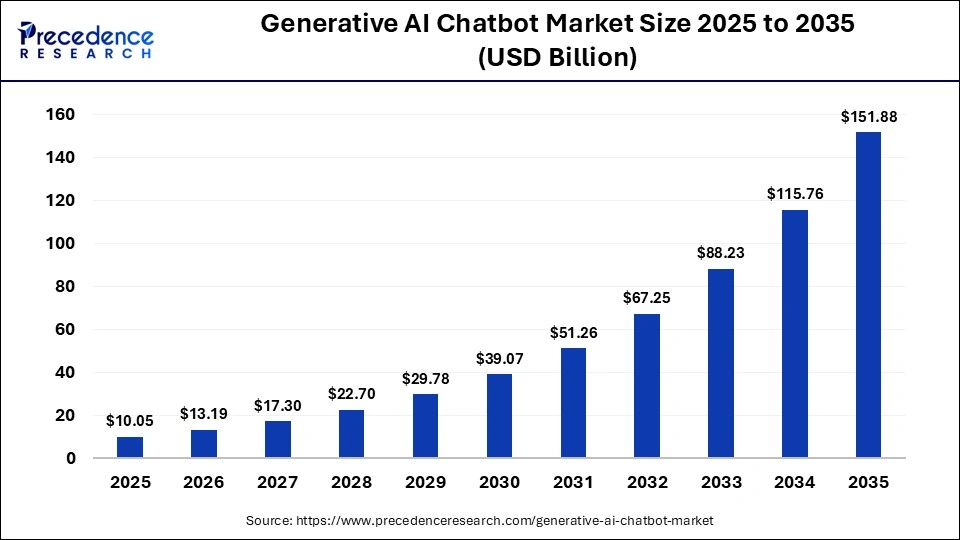
The global generative AI chatbot market size was calculated at USD 10.05 billion in 2025 and is predicted to increase from USD 13.19 billion in 2026 to approximately USD 151.88 billion by 2035, expanding at a CAGR of 31.20% from 2026 to 2035. The generative AI chatbot market is driven by rising demand for automated, personalized customer support and rapid adoption of AI across industries.
Market Highlights
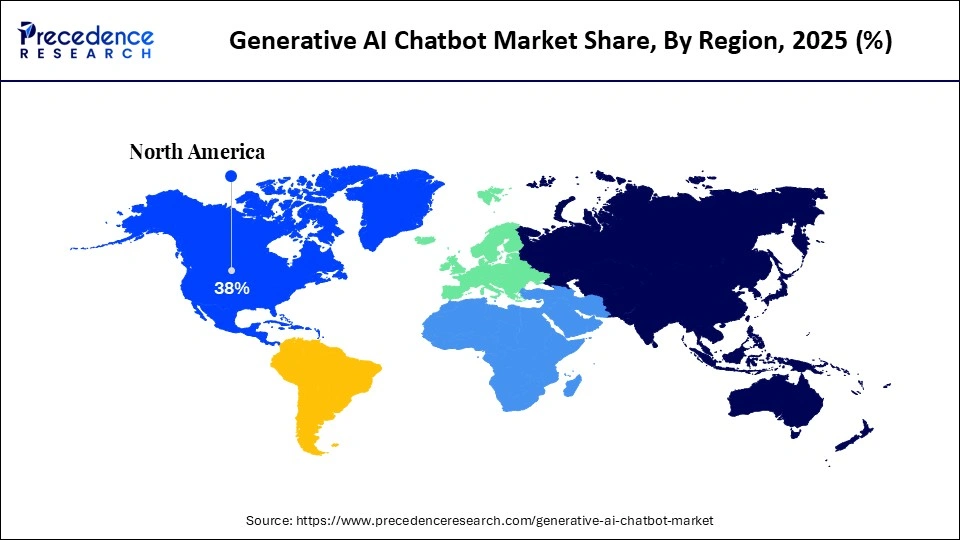
- By region, North America dominated the global generative AI chatbot market with a 38% share in 2025.
- By region, Asia Pacific is expected to grow at the fastest CAGR in the market during the forecast period.
- By component, the software platforms & chatbot engines segment held the largest market share of 66% in 2025.
- By component, the services segment is expected to grow at the fastest CAGR in the market between 2026 and 2035.
- By deployment mode, the cloud-based segment held a major market share of 62% in 2025.
- By deployment mode, the hybrid segment is expected to grow at the highest CAGR during the studied years.
- By model type, the third-party/public LLM integrations segment registered its dominance in the market while holding a share of 47% in 2025.
- By model type, the LLM-based proprietary models segment is expected to expand at the fastest CAGR over the forecast period.
- By end-user, the IT & telecom segment dominated the market with a share of 21% in 2025.
- By end-user, the healthcare & life sciences segment is expected to grow at the highest CAGR between 2026 and 2035.
Redefining Conversations & Customer Experience: How Innovation Is Transforming the Generative AI Chatbot Market
The global generative AI chatbot market comprises software platforms, APIs, and services that enable automated, conversational interactions using generative artificial intelligence. These chatbots leverage natural language understanding (NLU), deep learning, and large language models to generate human-like responses across customer support, sales enablement, knowledge discovery, employee self-service, virtual assistance, and domain-specific query resolution.
These chatbots are increasingly integrated into customer service and sales operations, allowing organizations to engage users more efficiently. By leveraging natural language understanding, contextual awareness, and adaptive learning, generative AI chatbots deliver coherent, scalable, and personalized experiences across digital platforms. The market is primarily driven by rising demand for enhanced customer experience, the growing need to reduce operational costs through automation, and the accelerated adoption of AI-powered decision support tools in enterprises.
Why Are Multimodal AI Chatbots Considered a Breakthrough in Generative AI?
Multimodal AI chatbots are considered a breakthrough because they extend the capabilities of traditional chatbots beyond text-based interactions, allowing systems to process and respond to multiple input types, including text, voice, images, and documents. This capability is powered by the integration of natural language processing, computer vision, speech recognition, and deep learning models. As a result, organizations are able to automate more complex workflows, such as customer onboarding, technical troubleshooting, insurance claims processing, and e-commerce product support. Multimodal chatbots enhance user interactions by creating more natural, conversational, and human-like experiences, reducing friction in digital communication, and improving overall customer engagement.
Generative AI Chatbot Market Trends
- Enhanced Customer Interactions: Organizations are increasingly deploying generative AI chatbots to deliver real-time, personalized interactions with customers. These chatbots help reduce operational costs, improve service accuracy, and streamline service efficiency across industries such as e-commerce, banking, telecommunications, healthcare, and travel.
- Multilingual and Voice-Enabled Capabilities: Companies are implementing multilingual and voice-activated AI chatbots to expand global reach, cater to diverse user bases, and enhance accessibility. These solutions help maintain consistent, high-quality service across regions and digital platforms while supporting inclusivity and a seamless customer experience.
- Internal Enterprise Adoption: Generative AI chatbots are increasingly used internally to support functions such as HR, IT helpdesk, sales enablement, and employee training. By automating repetitive workflows, these chatbots accelerate enterprise productivity, reduce reliance on traditional customer service resources, and optimize operational efficiency.
Marekt Scope
| Report Coverage | Details |
| Market Size in 2025 | USD 10.05 Billion |
| Market Size in 2026 | USD 13.19 Billion |
| Market Size by 2035 | USD 151.88 Billion |
| Market Growth Rate from 2026 to 2035 | CAGR of 31.20% |
| Dominating Region | North America |
| Fastest Growing Region | Asia Pacific |
| Base Year | 2025 |
| Forecast Period | 2026 to 2035 |
| Segments Covered | Component, Deployment Mode, Model Type, End-User, and Region |
| Regions Covered | North America, Europe, Asia-Pacific, Latin America, and Middle East & Africa |
Segment Insights
Component Insights
Why Did the Software Platforms & Chatbot Engines Segment Lead the Market?
The software platforms & chatbot engines segment led the generative AI chatbot market with a 66% share in 2025. This leadership is attributed to the fact that these platforms provide the foundational infrastructure for conversational intelligence, including conversational UI engines, intent recognition systems, response generation modules, and context management frameworks. Advanced platforms also incorporate pre-trained language models, orchestration layers, analytics dashboards, and compliance tools, which streamline development and reduce deployment time. Adoption of these platforms has been further accelerated by the growing demand for omnichannel engagement across websites, mobile apps, and messaging platforms, enabling organizations to reach customers wherever they interact.
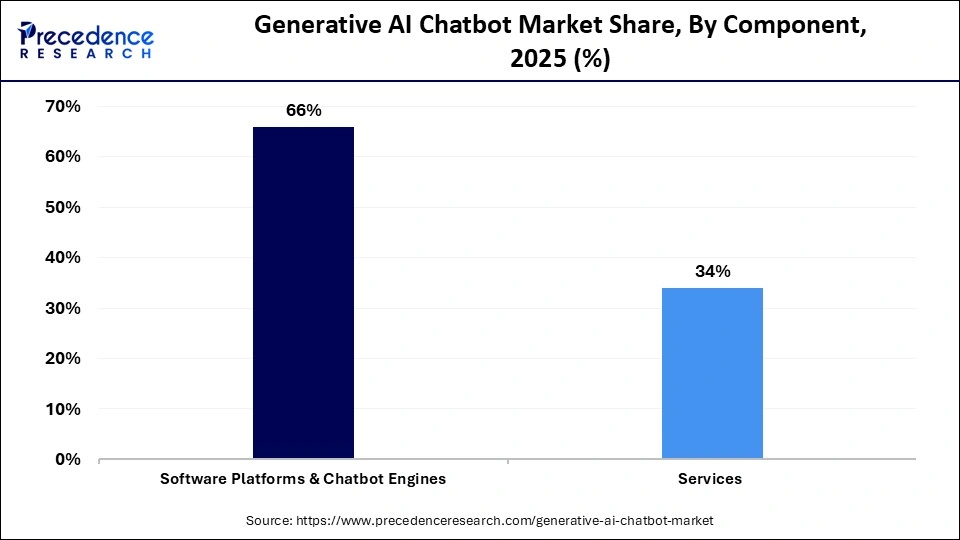
The services segment is expected to grow at the fastest CAGR in the market between 2026 and 2035. This is because organizations increasingly require professional services to implement and integrate AI systems, train custom models, perform prompt engineering, and optimize long-term performance. The growing complexity of chatbot use, driven by multilingual capabilities, industry-specific compliance requirements, data security standards, and integration with legacy systems, has further increased the demand for specialized services. Service providers play a critical role in ensuring that AI models are accurate, industry-relevant, and compliant in sectors such as banking, healthcare, and e-commerce.
Deployment Mode Insights
What Made Cloud-based the Leading Segment in the Market?
The cloud-based segment led the global market with a share of 62% in 2025, driven by its scalability, cost-effectiveness, and rapid deployment capabilities. Cloud infrastructure provides organizations with high-performance computing resources necessary for training and running large language models without substantial upfront capital investment. Enterprises benefit from flexible pricing, automatic software updates, and seamless integration with cloud-native analytics, data storage, and AI development tools. Cloud deployment also enables global accessibility, ensuring consistent chatbot performance across regions and time zones. Additionally, cloud platforms simplify experimentation, allowing businesses to test new features, models, and conversational flows with minimal operational risk.
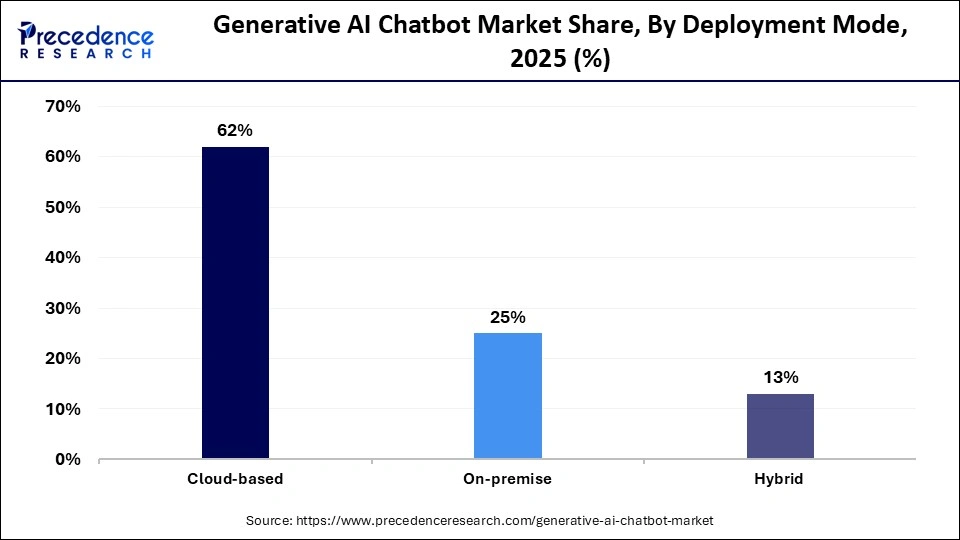
The hybrid segment is expected to grow at the highest CAGR in the upcoming period, as this model allows organizations to process sensitive data and critical workloads on-premises while leveraging cloud infrastructure for scalability and high-performance AI computation. Hybrid solutions are particularly attractive to sectors such as banking, healthcare, government, and defense, where data sovereignty and regulatory compliance are crucial. Additionally, hybrid deployment supports gradual cloud migration, enabling enterprises to modernize legacy systems without disrupting ongoing operations.
Model Type Insights
Why Did the Third-Party/Public LLM Integrations Segment Lead the Market?
The third-party/public LLM integrations segment led the generative AI chatbot market with a 47% share in 2025 because it allows organizations to leverage pre-trained, state-of-the-art language models without the time, cost, and technical expertise required to build proprietary models. Third-party LLMs provide a robust foundation for accuracy, multilingual support, and continuous vendor-driven upgrades, making them highly reliable for enterprise use. Integration-friendly APIs allow organizations to seamlessly embed conversational intelligence into applications, enabling faster time-to-market for chatbot solutions. Additionally, these providers offer built-in safety layers, monitoring tools, and regular model updates, which help reduce maintenance costs and ensure compliance with evolving standards.
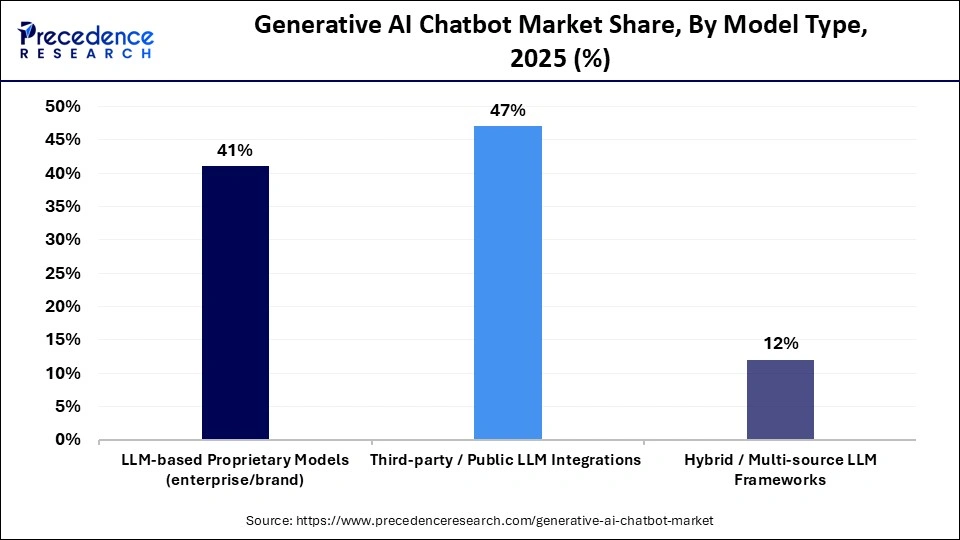
The LLM-based proprietary models segment is expected to grow at the fastest rate in the market over the forecast period. This is because organizations are recognizing the strategic importance of training domain-specific models tailored to internal knowledge bases, customer behavior, and business workflows. Proprietary models offer greater control over data privacy, intellectual property, and regulatory compliance, which is critical for sectors handling sensitive information such as banking, healthcare, and legal services. Additionally, these models provide deeper contextual understanding for specialized applications like clinical decision support, legal research, and technical customer service, enabling more precise, relevant, and reliable interactions compared to generic third-party models.
End-User Insights
Why Did the IT & Telecom Segment Lead the Generative AI Chatbot Market?
The IT & telecom segment led the market by holding a major revenue share of 21% in 2025 due to its early adoption of automation and digital service delivery. Telecom operators and IT service providers manage high volumes of customer interactions related to billing, network issues, service upgrades, and technical troubleshooting. Generative AI chatbots help these organizations automate routine queries, reduce call center workloads, and provide real-time technical support at scale. Additionally, IT companies leverage chatbots internally to support employees, DevOps processes, and knowledge management, further enhancing operational efficiency.
The healthcare & life sciences segment is expected to expand at the fastest CAGR over the forecast period. This is because healthcare organizations are increasingly deploying chatbots to enhance patient engagement and improve operational efficiency. Hospitals, clinics, and pharmaceutical companies are using AI chatbots for appointment scheduling, symptom assessment, prescription guidance, clinical trial recruitment, and patient education. The growing adoption of telemedicine and digital health platforms is further accelerating the implementation of chatbots, enabling healthcare providers to deliver timely, personalized, and scalable care.
Region Insights
How Big is the North America Generative AI Chatbot Market Size?
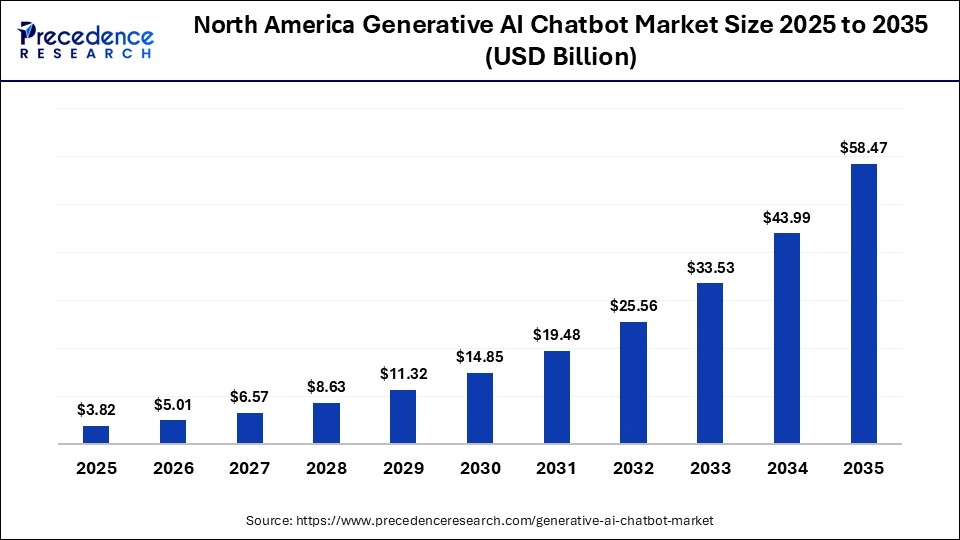
The North America generative AI chatbot market size is estimated at USD 3.82 billion in 2025 and is projected to reach approximately USD 58.47 billion by 2035, with a 31.37% CAGR from 2026 to 2035.
What Made North America the Dominant Region in the Global Generative AI Chatbot Market?
North America registered dominance in the market by capturing a major revenue share of 38% in 2025 and is expected to sustain its position in the upcoming period. This is because of the early adoption of AI technology and ongoing innovations in artificial intelligence. The region is home to a large number of global AI innovators and cloud service providers. The region benefits from a well-developed digital infrastructure, supporting the widespread adoption of advanced generative AI chatbot systems across industries such as banking, retail, healthcare, telecommunications, and e-commerce. Growth is further fueled by favorable government policies, targeted financing initiatives, and AI-focused innovation centers, which encourage investment, experimentation, and rapid deployment of AI technologies.
What is the Size of the U.S. Generative AI Chatbot Market?
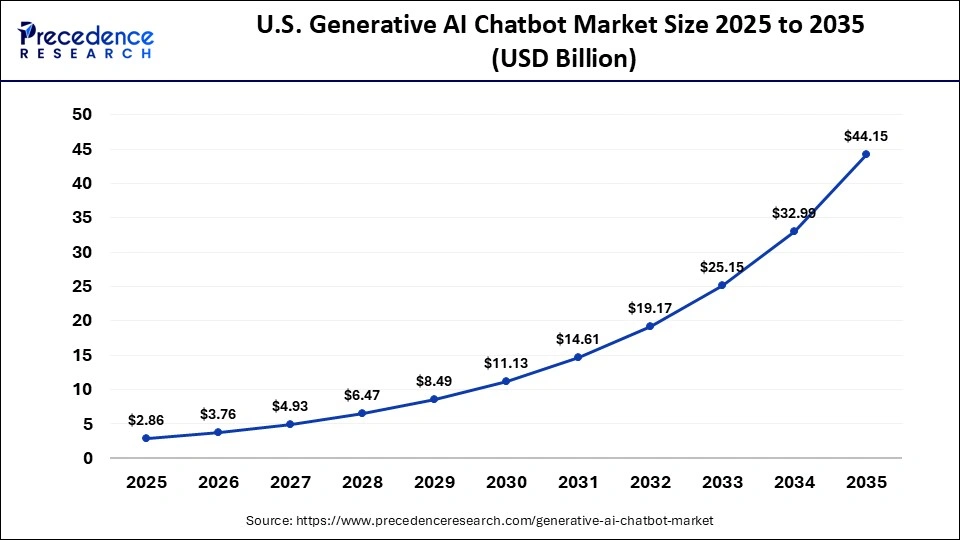
The U.S. generative AI chatbot market size is calculated at USD 2.86 billion in 2025 and is expected to reach nearly USD 44.15 billion in 2035, accelerating at a strong CAGR of 31.48% between 2026 and 2035.
U.S Generative AI Chatbot Market Analysis
The U.S. is a major contributor to the North American generative AI chatbot market, driven by high innovation rates, strong venture capital support, and widespread enterprise adoption. Leading technology corporations and AI startups in the U.S. are at the forefront of developing advanced language models, chatbots, and industry-specific AI solutions. A well-established cloud computing ecosystem facilitates seamless integration and large-scale deployment of AI-powered chatbots. Additionally, ongoing investment in AI research, talent development, and digital transformation initiatives supports the country's leadership position in the market.
Why is Asia Pacific Considered the Fastest-Growing Region in the Generative Ai Chatbot Market?
Asia Pacific is expected to witness the fastest growth during the predicted timeframe. The region benefits from a large base of internet and smartphone users, providing an ideal platform for chatbots to engage with customers across digital channels. The proliferation of generative AI chatbots in e-commerce enables retailers to manage high volumes of customer inquiries, provide real-time product support, process digital payments, and enhance order-tracking experiences. In addition, enterprises in banking, telecommunications, travel, and healthcare are adopting chatbots to reduce operational costs and improve service availability, driving rapid market expansion across the region.
China Generative AI Chatbot Market Trends
The market in China is growing, supported by its large digital consumer base and advanced technological infrastructure. The country's robust e-commerce ecosystem promotes the use of chatbots for virtual shopping assistance, order management, customer support, and personalized product recommendations. Beyond retail, the deployment of chatbots is rapidly expanding into banking, education, healthcare, and government services, reflecting the broadening scope of applications and accelerating overall market growth in China.
Recent Developments
- In December 2024, Five9 would add a bi-directional presence feature to its Microsoft Teams integration, enabling Five9 agents and Microsoft Teams users to see one another and engage more easily in real-time availability. The improvement also increased the effectiveness of the communication of the contact center and simplified the process of call transfer or consultation with the back-office specialists.(Source: https://www.callcentrehelper.com)
- In November 2024, Cognigy released Agentic AI in its Cognigy.AI platform to improve customer service by combining its conversational AI engine with advanced large language models. The dynamic orchestration facilitated by agentic AI meant that the automation of customer engagement using context-aware interaction could be achieved, as well as the support operation being more effective.(Source: https://www.cognigy.com)
- In November 2024, Avaamo released the first GenAI-based quality assurance solution to contact centers, AutoQA, which is able to assess customer interactions in all of its channels. AutoQA was an application of generative AI that allowed analyzing conversations and, thus, facilitating quality monitoring in a better way than conventional means.(Source: https://www.einpresswire.com)
Who are the Major Players in the Global Generative AI Chatbot Market?
The major players in the generative AI chatbot market include OpenAI (U.S.), Google (U.S.), Anthropic (U.S.), Microsoft (U.S.), Meta (U.S.), Amazon (U.S.), Salesforce (U.S.), Jasper (U.S.), Writesonic (U.S.), Kuki.ai (U.S.), Replika (U.S.), AI21 Labs (Israel), Avaamo (U.S.), Kore.ai (U.S.), and Cognigy (Germany).
Segments Covered in the Report
By Component
- Software Platforms & Chatbot Engines
- Conversational UI engines
- Reply generation & intent processing
- Context management modules
- Services
- Implementation & integration
- Custom training & prompt engineering
- Managed services & support
By Deployment Mode
- Cloud-based
- On-premise
- Hybrid
By Model Type
- LLM-based Proprietary Models (enterprise/brand)
- Custom-tuned transformers
- Domain-specific generative models
- Third-party / Public LLM Integrations
- Open models (open-source + API)
- Licensed commercial LLMs
- Hybrid / Multi-source LLM Frameworks
By End-User
- IT & Telecom
- BFSI
- Retail & E-commerce
- Healthcare & Life Sciences
- Travel, Hospitality & Transportation
- Manufacturing
- Media & Entertainment
- Government & Public Sector
By Region
- North America
- Europe
- Asia-Pacific
- Latin America
- Middle East & Africa
For inquiries regarding discounts, bulk purchases, or customization requests, please contact us at sales@precedenceresearch.com
Frequently Asked Questions





Ask For Sample
No cookie-cutter, only authentic analysis – take the 1st step to become a Precedence Research client
 Get a Sample




 sales@precedenceresearch.com
 Schedule a Meeting
