



Generative AI in Cybersecurity Market Size, Share and Trends 2026 to 2035
Generative AI in Cybersecurity Market (By Type: Threat Detection & Analysis, Adversarial Defense, Insider Threat Detection, Network Security, Others; By Technology: Generative Adversarial Networks (GANs), Variational Autoencoders (VAEs), Reinforcement Learning (RL), Deep Neural Networks (DNNs), Natural Language Processing (NLP), Others; By End-use: Banking, Financial Services, And Insurance (BFSI), Healthcare & Life Sciences, Government & Defense, Retail and e-Commerce, Manufacturing & Industrial, IT & Telecommunications, Energy & Utilities, Others) - Global Industry Analysis, Size, Trends, Leading Companies, Regional Outlook, and Forecast 2026 to 2035
Source: https://www.precedenceresearch.com/generative-ai-in-cybersecurity-market
 Get a Sample
 Table Of Content


What is the Generative AI in Cybersecurity Market Size?
The global generative AI in cybersecurity market size is accounted at USD 2.45 billion in 2025 and predicted to increase from USD 2.99 billion in 2026 to approximately USD 17.15 billion by 2035. The market is expanding at a solid CAGR of 21.48% over the forecast period 2026 to 2035. Complex patterns in data can be found and analyzed by generative AI, which enhances the identification of sophisticated cyber threats that conventional techniques might overlook. This drives the growth in the generative AI in cybersecurity market.
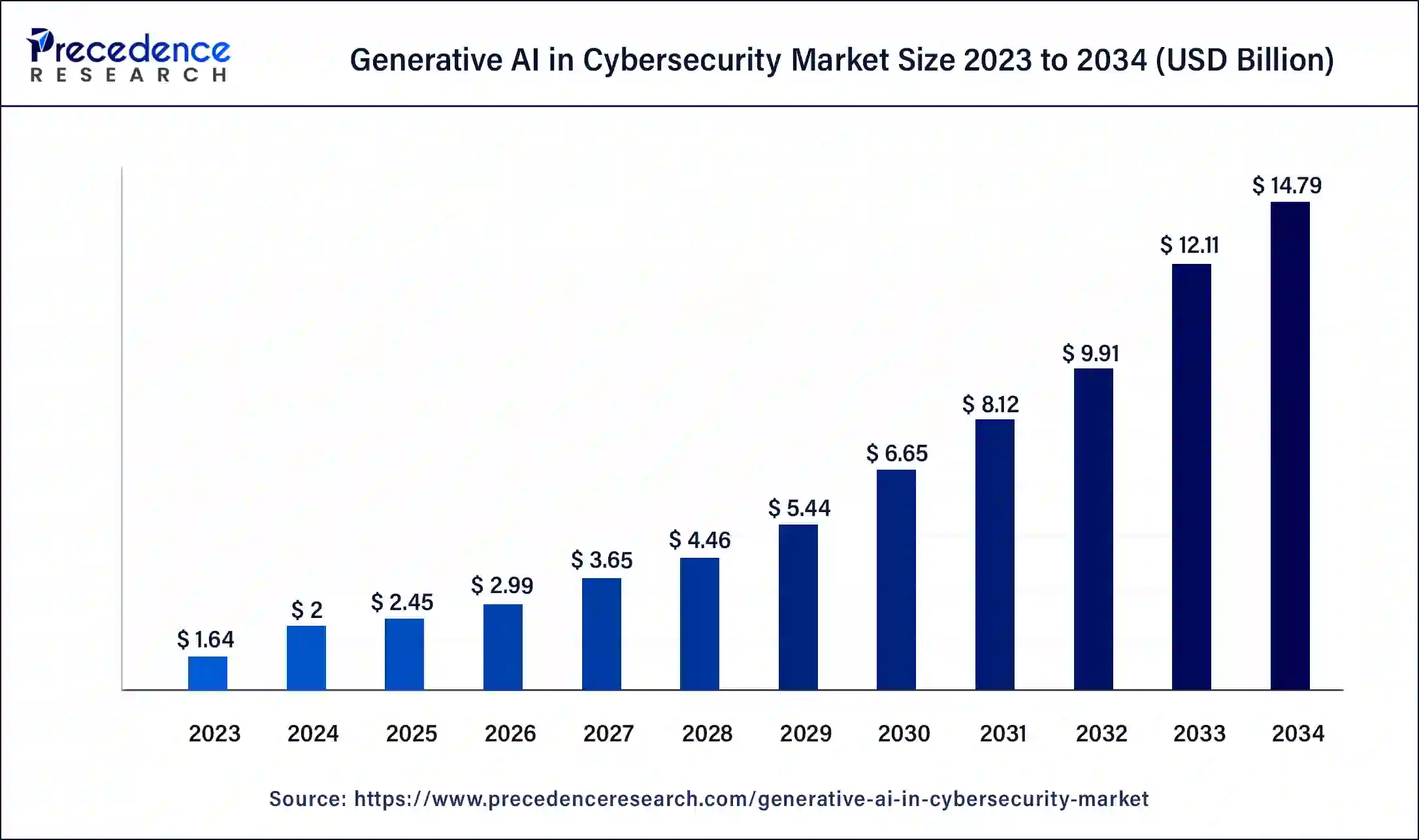
Generative AI in Cybersecurity Market Key Takeaway
- The global generative AI in cybersecurity market was valued at USD 2.45 billion in 2025.
- It is projected to reach USD 17.15 billion by 2035.
- The generative AI in cybersecurity market is expected to grow at a CAGR of 21.48% from 2026 to 2035.
- North America dominated the generative AI in cybersecurity market with the largest revenue share of 37% in 2025.
- Asia Pacific is expected to host the fastest-growing market during the forecast period.
- By type, the threat detection & analysis segment has contributed more than 40% of revenue share in 2025.
- By type, the network security segment is expected to grow at the fastest rate in the market over the forecast period.
- By technology, the generative adversarial networks (GANs) segment has recorded more than 33% of revenue share in 2025.
- By technology, the reinforcement learning (RL) segment is expected to grow at the fastest rate in the market over the forecast period.
- By end use, the banking, financial services, & insurance (BFSI) segment has held a major revenue share of 30% in 2025.
- By end use, the healthcare & life sciences segment is expected to grow at the fastest rate in the market over the forecast period.
What is the Significance of Generative AI in Cybersecurity?
Cybersecurity tasks, including anomaly detection, malware identification and analysis, automated penetration testing, threat detection and response, and security analytics, are all performed with the help of generative AI. Deep learning, natural language processing (NLP), and generative adversarial networks are a few of the techniques used to simulate attacks, find trends in cybersecurity data, and strengthen defenses. The necessity for sophisticated defense mechanisms, the complexity of cyberattacks, and the rise in cyber threats are all predicted to drive significant growth in the generative AI in cybersecurity market. With its proactive protection mechanisms and ability to respond to changing cyber threats more quickly, generative AI has the potential to completely change cybersecurity.
Both new and established businesses are creating generative AI solutions for cybersecurity. Their main goal is to incorporate artificial intelligence into current cybersecurity frameworks to enable real-time threat detection and response. Though promising, the generative AI in cybersecurity market confronts obstacles, including the necessity for strong data privacy and security safeguards, the possibility of AI-generated attacks, and ethical considerations. The application of AI to anticipate and stop cyberattacks, the combination of AI with conventional cybersecurity tools, and developments in explainable AI to improve confidence and openness in AI-driven security choices are some future prospects.
Generative AI in Cybersecurity Market Growth Factors
- By examining patterns and abnormalities in huge datasets, generative AI can automate the detection of novel and changing dangers. This feature improves overall cybersecurity posture and speeds up response times.
- Generative models powered by AI can mimic attack situations and spot possible holes in networks and systems. By taking a proactive stance, businesses can fortify their defenses before actual adversaries take advantage of vulnerabilities.
- The ability to continuously learn from fresh data allows generative AI to modify its defense tactics. This flexibility is essential for fending against more complex cyberattacks that change with time.
- By spotting anomalous activity and possible intrusions, AI-powered generative models can improve access control systems through improved user authentication processes.
- The generative AI in cybersecurity market increases operational efficiency by freeing up cybersecurity personnel to focus on more strategic projects by automating routine operations like log analysis, threat prioritization, and incident response.
- Professionals in cybersecurity are in limited supply globally. This gap can be filled by the generative AI in cybersecurity market, which can strengthen current teams and make them more capable of handling more difficult jobs.
- Endpoint detection and response (EDR) systems, threat intelligence platforms, and SIEM (Security information and event management) systems are just a few examples of cybersecurity technologies that generative AI can easily connect with and improve.
- With its strong security features and audit logs, generative AI can help enterprises stay compliant with increasingly strict cybersecurity laws.
Generative AI in Cybersecurity Market Trends
- Security Operation Centers (SOC) Automation
The security operations centers are being revolutionized by generative AI, which automates the threat detection, incident response, and investigation processes. This reduces the amount of work on the analyst, increases efficiency, accuracy, and speed of response. - Predictive Threat Detection and Prevention
AI is not only transforming cybersecurity into reactive and proactive prevention. The early warning of threats like zero-day vulnerabilities is found in modern models and can be utilized to complete proactive protection strategies and more resilient security frameworks. - Phishing and Social Engineering Protection by AI
Generative AI tools are being put in place to identify advanced phishing and social engineering attacks. These solutions look into trends and activities in order to eradicate highly targeted and dynamic cyber threats.
Generative AI in Cybersecurity Market Outlook
- Global Expansion: A rise in the need for more advanced defenses against wider, complex cyber threats is propelling further growth.
- Major Investor: In November 2024, the Tel Aviv-based cybersecurity startup Twine raised $12 million in seed funding for its AI agent, "Alex,".
- Startup Ecosystem: In July 2024, Noma Security, which offers a platform for managing AI risk and raised $100 million in a Series B round.
Market Scope
| Report Coverage | Details |
| Market Size by 2035 | USD 17.15 Billion |
| Market Size in 2025 | USD 2.45 Billion |
| Market Size in 2026 | USD 2.99 Billion |
| Market Growth Rate from 2026 to 2035 | CAGR of 21.48% |
| Largest Market | North America |
| Base Year | 2025 |
| Forecast Period | 2026 to 2035 |
| Segments Covered | Type, Technology, end use, and Regions |
| Regions Covered | North America, Europe, Asia-Pacific, Latin America, and the Middle East & Africa |
Market Dynamics
Driver
Automation of routine tasks
With its ability to analyze enormous volumes of data, such as system logs, network traffic, and user behavior, AI can automate the detection of possible threats. By starting predetermined procedures like isolating impacted systems, blocking suspicious activity, or notifying cybersecurity professionals, the generative AI in cybersecurity market can help in quickly responding to security problems. The amount of human labor needed for these processes can be decreased by using AI algorithms to automate vulnerability assessments and prioritize remediation operations based on risk assessment. To guarantee ongoing monitoring and compliance, routine processes like log analysis, security policy enforcement, and configuration management can be automated. Based on past data and trends, AI models are able to anticipate possible security breaches, enabling preemptive steps to be taken to stop assaults before they happen.
Restraint
Ethical implications
The generative AI in cybersecurity market can reinforce biases seen in training data, which could result in discrimination or unjust treatment when making cybersecurity decisions. Large volumes of personal data may be processed by AI algorithms used in cybersecurity, which, if not managed securely, could lead to privacy breaches. It can be difficult to assign blame for AI-generated decisions in cybersecurity situations, particularly when mistakes or harms happen. The transparency standards may be challenged by the opacity of AI algorithms, which might make it challenging for stakeholders to comprehend and audit cybersecurity decisions. Malicious attacks may target AI itself, possibly making use of holes in AI systems to compromise cybersecurity measures. In order to address these ethical issues, laws must be carefully considered, AI methods must be transparent, bias must be mitigated, and strong cybersecurity measures must be in place to protect against threats associated with AI.
Opportunity
Adaptive security measures
Applying artificial intelligence algorithms to examine system and user behavior and spot abnormalities that might point to security vulnerabilities. In order to identify and address risks as they materialize, continuous network traffic monitoring and real-time analysis of application activity and system logs must be performed. Putting in place AI-driven access restrictions that stop illegal access attempts by modifying permissions in response to user behavior and risk profiles. The generative AI in cybersecurity market leverages past security events to enhance their threat detection capabilities and modify defenses accordingly. Automating incident response procedures with AI includes putting questionable files in quarantine, blocking malicious IP addresses, and starting cleanup procedures. Artificial intelligence models that use past data and current patterns to predict possible future attacks, enabling the implementation of proactive security measures.
Segment Insights
Type Insights
The threat detection & analysis segment held the largest share of the generative AI in cybersecurity market in 2025. Unusual patterns in user behavior, system logs, or network traffic that can point to a possible threat can be found using AI models. It is possible to teach generative AI algorithms to identify patterns and signs of well-known malware or its variants. Artificial intelligence is able to identify phishing attempts—which often aim to trick users into disclosing sensitive information by examining emails, URLs, and user interactions. AI is able to recognize typical system or network behavior patterns and notify system administrators of any deviations that might point to malicious activities. AI can forecast possible future risks or weaknesses by evaluating past data and trends. This enables proactive solutions to be implemented.
The network security segment is expected to grow at the fastest rate in the generative AI in cybersecurity market over the forecast period. Network traffic patterns can be analyzed by generative AI models, which can then identify anomalies that might point to possible intrusions or threats. Based on past data, they can also forecast potential attack vectors in the future. Artificial Intelligence can detect anomalies that may indicate unapproved entry or malevolent activity in a network by analyzing the standard behaviors of people and equipment inside it. AI-driven systems offer a proactive protection strategy by constantly adjusting security protocols and defenses in real time based on threats that are discovered. The response time from threat identification to containment or mitigation can be shortened by using generative AI to automate response actions. By spotting suspect login attempts and finding patterns of acceptable user activity, AI can boost authentication systems.
Technology Insights
The generative adversarial networks (GANs) segment held the largest share of the generative AI in cybersecurity market in 2025. Cybersecurity researchers are actively examining generative adversarial networks, especially for applications that involve threat and anomaly detection, and they are creating synthetic data for model training. To enhance training datasets for cybersecurity machine learning models, GANs can produce synthetic data that closely resembles real data. In adversarial contexts, where a network (generator) attempts to trick another network (discriminator) by producing realistic data, GANs are used to train models. The robustness of models against adversarial attacks can be strengthened by this adversarial training. In order to facilitate secure data sharing and analysis, GANs can produce synthetic data that protects privacy while maintaining the statistical characteristics of the original data.
The reinforcement learning (RL) segment is expected to grow at the fastest rate in the generative AI in cybersecurity market over the forecast period. By gaining knowledge from interactions with environments, recognizing unusual behaviors, and gradually increasing detection accuracy, reinforcement learning can be used to train models to adapt dynamically to changing threats. By automating decision-making procedures like incident response and mitigation, reinforcement learning enables systems to discover the best ways to respond to cyber threats. By continuously learning and modifying settings based on real-time data and feedback, reinforcement learning algorithms can optimize security policies and guarantee strong defense mechanisms. By learning from past data and current cybersecurity patterns, RL can help optimize risk assessment and management tactics and enhance decision-making under ambiguity. Organizations can test and develop their defenses against prospective cyber-attacks proactively by using simulations driven by reinforcement learning to imitate hostile behaviors.
End-use Insights
The banking, financial services, & insurance (BFSI) segment held the largest share of the generative AI in cybersecurity market in 2025. Because of its extreme sensitivity to data security and privacy, the banking, financial services, and insurance (BFSI) industry is a key player in the generative AI in the cybersecurity market. By anticipating possible weaknesses, enhancing incident reaction times, and more efficiently identifying and responding to threats, generative AI might improve cybersecurity in BFSI. It can also help create reliable systems for fraud detection and authentication. The requirement to safeguard confidential financial information and uphold client confidence is what motivates this industry to use generative AI.
The healthcare & life sciences segment is expected to grow at the fastest rate in the generative AI in cybersecurity market over the forecast period. Healthcare institutions handle enormous volumes of private patient information. Strong cybersecurity solutions that shield this data from breaches and unauthorized access can be developed with the aid of generative AI. Clinical trials and pharmaceutical development are just two of the many research activities that are involved in the fields of healthcare and life sciences. It is crucial to defend research data and intellectual property against cyberattacks, and generative AI can strengthen security protocols to do so. Generative AI systems are able to anticipate future attack patterns and learn from previous instances, allowing them to adapt to emerging cyber threats. This ability to adapt is especially helpful in healthcare environments where new vulnerabilities might appear quickly.
Regional Insights
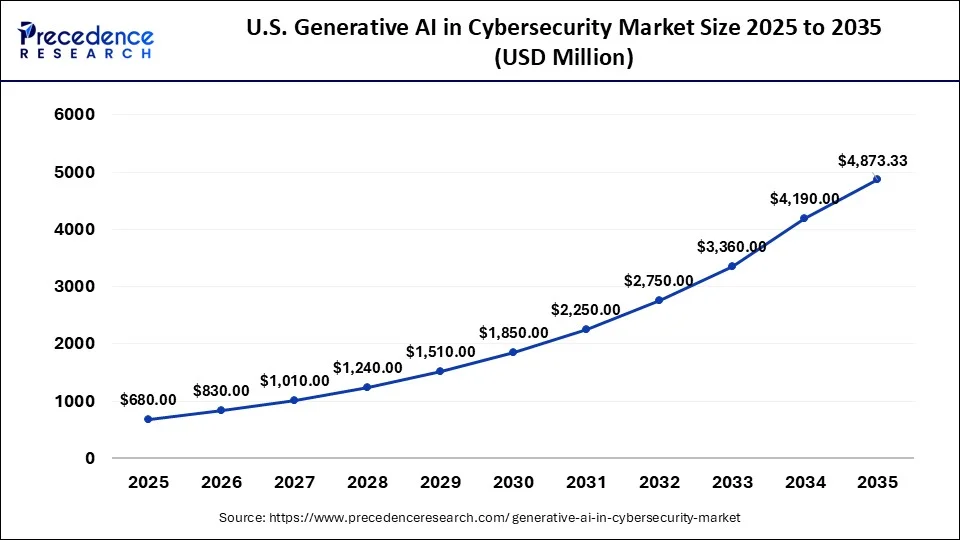
What is the U.S. Generative AI in Cybersecurity Market Size?
The U.S. generative AI in cybersecurity market size is exhibited at USD 680 million in 2025 and is projected to be worth around USD 4,873.33 million by 2035, poised to grow at a CAGR of 21.77% from 2026 to 2035.
What Made North America Dominant in the Market in 2025?
North America held the largest share of the generative AI in cybersecurity market in 2025. Because it may improve threat detection, response capabilities, and overall cybersecurity posture, generative AI is becoming more and more popular in the North American cybersecurity sector. It uses artificial intelligence algorithms to mimic human decision-making processes, assisting with anomaly identification and pattern recognition and even producing countermeasures for possible threats. In situations when standard approaches would not be sufficient to handle the constantly changing panorama of cyber threats, this technology is especially helpful. The development and use of generative AI for cybersecurity applications is greatly aided by North America's status as a center for technical innovation and cybersecurity solutions.
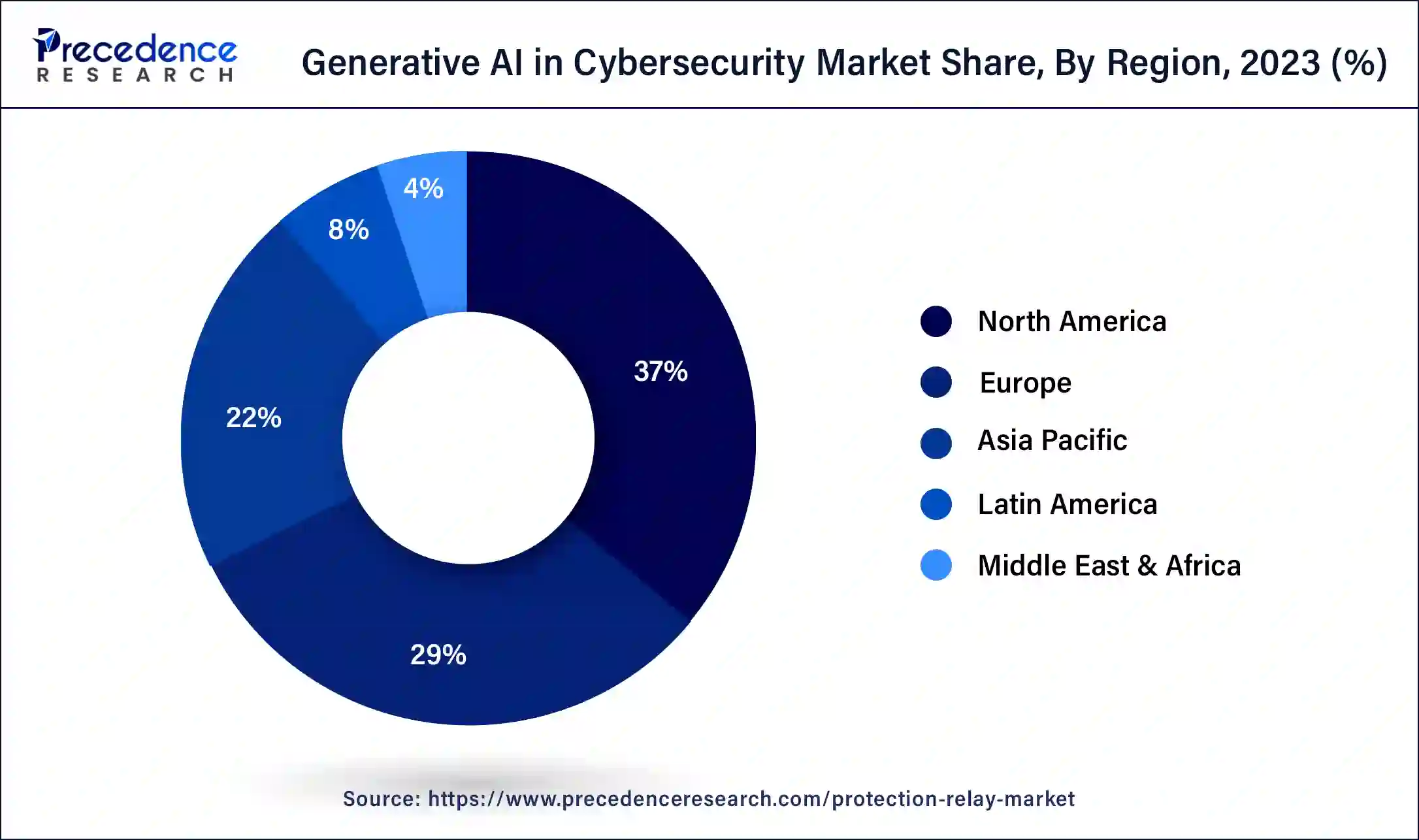
Asia Pacific is expected to host the fastest-growing generative AI in cybersecurity market during the forecast period. The Asia Pacific market for generative AI in cybersecurity is exhibiting considerable development potential. This is being driven by a number of factors, including rising cyber threats, businesses implementing AI-based security solutions, and government efforts to improve cybersecurity. The digital change being embraced by the region's different economies is also driving the need for enhanced cybersecurity solutions. Using AI's capabilities to improve proactive defensive measures, key applications include threat identification, anomaly detection, and automated reaction systems.
Government Support & Business Implementations are Promoting the ASAP
Immersion of Autonomous AI Agents: U.S. Market Trend
The U.S. market is stepping towards the "agentic AI" trend, where AI systems support independent detection, planning, and responding to threats. These agents robustly serve as "digital employees" in a Security Operations Center (SOC). In March 2025, Microsoft announced 11 Security Copilot agents, empowered by AI, to escalate threat response.
Exploration of Proactive Cyber Defense: Japan Market Trend
In early 2025, the Japanese government was involved in rolling out a "Proactive Cyber Defense" bill. This legislation focused on enabling the preemptive neutralization of probable cyberattacks, a shift from Japan's previous traditional reactive stance. Also, the Japan AI Safety Institute is collaborating internationally to actively develop guidelines, evaluate tools, and data sets for AI safety.
Persistent ENISA Guidance is Driving Europe
Europe has been impacted by a notable expansion in the generative AI in cybersecurity market. This progression, prominently led by the emergence of the European Union Agency for Cybersecurity (ENISA), continues tracking and assessing the particular limitations and opportunities linked with GenAI. It is also fostering the use of privacy-enabled commercial AI models hosted within the EU to ensure data sovereignty and compliance with regulations, including GDPR.
Expanded Adoption & Investment: German Market Trend
In June 2025, a study was published that 91% of German companies view generative AI as vital to their business model, with 82% planning to raise their AI budgets, over half by at least 40%. This shows a robust push for integrating AI into core operations, like cybersecurity. The emerging GenAI tools, such as GitHub Copilot, German firms are emphasizing approaches to scan and validate AI-generated code for possible vulnerabilities and ensure compliance with security and privacy standards.
Will the Middle East and Africa Grow in the Generative AI in Cybersecurity Market?
The Middle East and Africa are expected to grow at a significant CAGR during the forecast period. Investments in safe infrastructure and data security are also leading to stable development in the area. The oil and gas industry data security threats and smart city initiatives are contributing to the necessity to apply AI-based cybersecurity and industrial system control.
Nigeria Market Trends
In Nigeria, there is an increase in mobile-based security threats as a result of the swift growth in digital finances. The uses of AI in securing transactions, securing the cloud, and mitigating gaps in cybersecurity abilities through training and adopting state-of-the-art technologies are all put into practice.
How Is Latin America Performing in the Generative AI in Cybersecurity Market?
Latin America is expected to grow at a remarkable CAGR during the forecast period. Latin America is growing due to the increase in cyber threats, digitalization, and remote working. AI-based cybersecurity tools are being embraced by organizations, with the support from public and private investments. Advancements in connectivity technology has also led to the use of generative AI for cybersecurity purposes.
Brazil Market Trends
Brazil is a nation where AI cybersecurity tools are highly utilized and are geared towards fraud detection and phishing prevention. Firms are also investing in adversarial AI defense to curb AI-based security system attacks.
Generative AI in Cybersecurity Market Companies
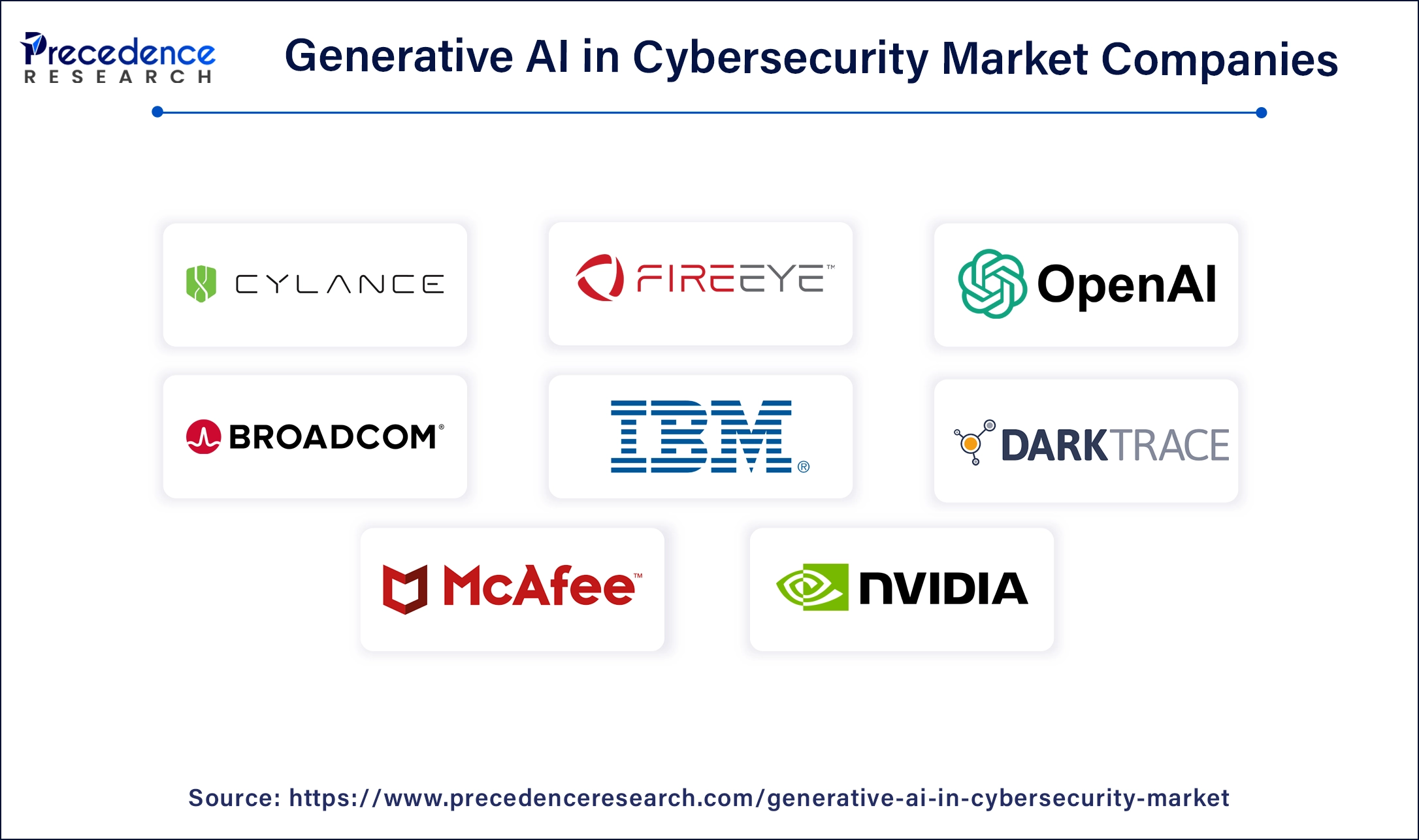
- IBM Corp.- It has facilitated IBM Security QRadar Suite, IBM Guardium AI Security, IBM watsonx.governance, and specialized IBM Consulting Cybersecurity Services.
- OpenAI- A major company offers its powerful Large Language Models (LLMs), like the GPT series (e.g., GPT-4, GPT-4o), and corresponding APIs.
- NVIDIA Corporation- It is a full-stack platform of hardware, software, and pre-built AI workflows that bolster generative AI.
- McAfee Corp.- A leader uses generative AI in its consumer cybersecurity products to eliminate AI-assisted threats, mainly through its McAfee Smart AI technology.
- FireEye- It offers its AI and machine learning capabilities are integrated into the Trellix XDR (Extended Detection and Response) platform.
Other Major Key Players
- Broadcom Inc.
- Darktrace
- Cylance
Recent Developments
- In November 2025, OpenAI's Aardvark, an agentic AI agent utilizing GPT-5, focuses on cybersecurity by identifying software vulnerabilities preemptively. Mimicking human security researchers, it reads and analyzes code, conducts tests, and employs various tools to suggest effective solutions before hackers can exploit weaknesses. (Source: https://aibusiness.com)
- In July 2025, Accenture and Microsoft co-invested in generative AI-driven cyber solutions to enhance threat mitigation and cost optimization. A report reveals 90% of organizations are unprepared for AI-related cyber threats, prompting collaboration to advance cybersecurity across four key areas. (Source: https://newsroom.accenture.com)
- In June 2024, the first solution offering full Generative AI visibility in the MDR sector was introduced by eSentire, Inc., the Authority in Managed Detection and Response (MDR), today announcing its continued leadership in the generative AI cybersecurity market. eSentire's MDR for GenAI Visibility solution leverages security telemetry from an organization's network and log data sources to offer daily insights into how GenAI technology is used within the organization, including the most popular AI applications, the users of the technology, the prompts, and the shared files.
- In April 2024, Google Cloud announced new cybersecurity, data analytics, and generative AI credentials and courses to help match talent with in-demand tech positions across sectors and industries. The U.S. Department of Treasury, Rackspace, Jack Henry, and Purdue Global are among the launch employer partners that are assisting learners in advancing their careers through the new training.
Segment Covered in the Report
By Type
- Threat Detection & Analysis
- Adversarial Defense
- Insider Threat Detection
- Network Security
- Others
By Technology
- Generative Adversarial Networks (GANs)
- Variational Autoencoders (VAEs)
- Reinforcement Learning (RL)
- Deep Neural Networks (DNNs)
- Natural Language Processing (NLP)
- Others
By End-use
- Banking, Financial Services, And Insurance (BFSI)
- Healthcare & Life Sciences
- Government & Defense
- Retail and e-Commerce
- Manufacturing & Industrial
- IT & Telecommunications
- Energy & Utilities
- Others
By Geography
- North America
- Asia Pacific
- Europe
- Latin America
- Middle East & Africa
For inquiries regarding discounts, bulk purchases, or customization requests, please contact us at sales@precedenceresearch.com
Frequently Asked Questions





Ask For Sample
No cookie-cutter, only authentic analysis – take the 1st step to become a Precedence Research client
 Get a Sample




 sales@precedenceresearch.com
 Schedule a Meeting
