



High Content Screening (HCS) Market Trends, Companies, Revenue / Sales Performance, Subscriber Growth, Pricing Strategies, Cloud Adoption, Infrastructure Expansion, Competitive Landscape, and Industry Outlook
High Content Screening (HCS) Market (By Product Type: Instruments, Reagents & Consumables, Software & Services; By Application: Drug Discovery & Development, Primary & Secondary Screening, Target Identification & Validation, Toxicology Testing, Phenotypic/Stem Cell/Cancer Research & Others; By End User: Pharmaceutical & Biotechnology Companies, Contract Research Organizations (CROs), Academic & Research Institutes, Other Users) - Global Industry Analysis, Size, Trends, Leading Companies, Regional Outlook, and Forecast 2026 to 2035
Source: https://www.precedenceresearch.com/high-content-screening-market
 Get a Sample
 Table Of Content


What is the High Content Screening (HCS) Market Size?
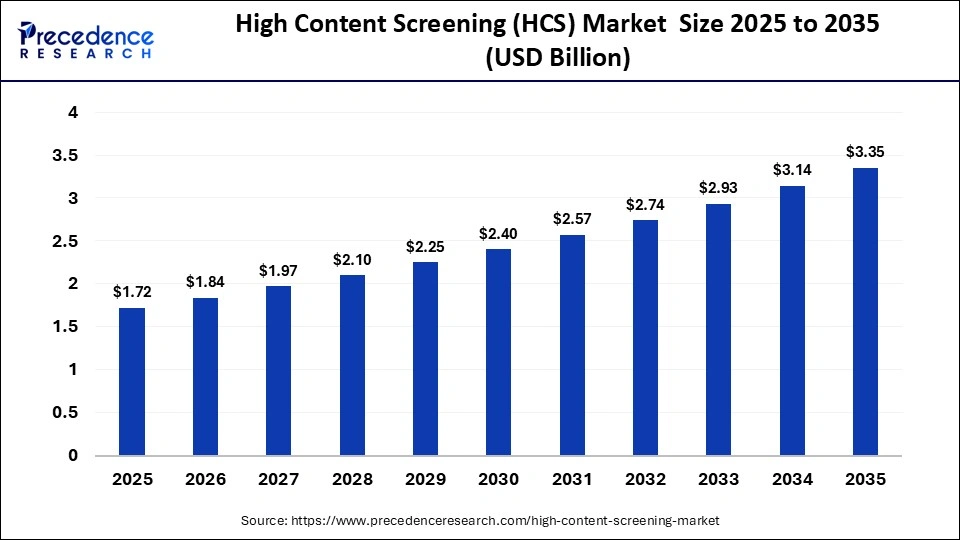
The global high content screening (HCS) market size was calculated at USD 1.72 billion in 2025 and is predicted to increase from USD 1.84 billion in 2026 to approximately USD 3.35 billion by 2035, expanding at a CAGR of 6.90% from 2026 to 2035.The market growth is attributed to increasing adoption of automated, AI-enabled high-content imaging platforms that streamline phenotypic screening and accelerate drug discovery workflows.
Market Highlights
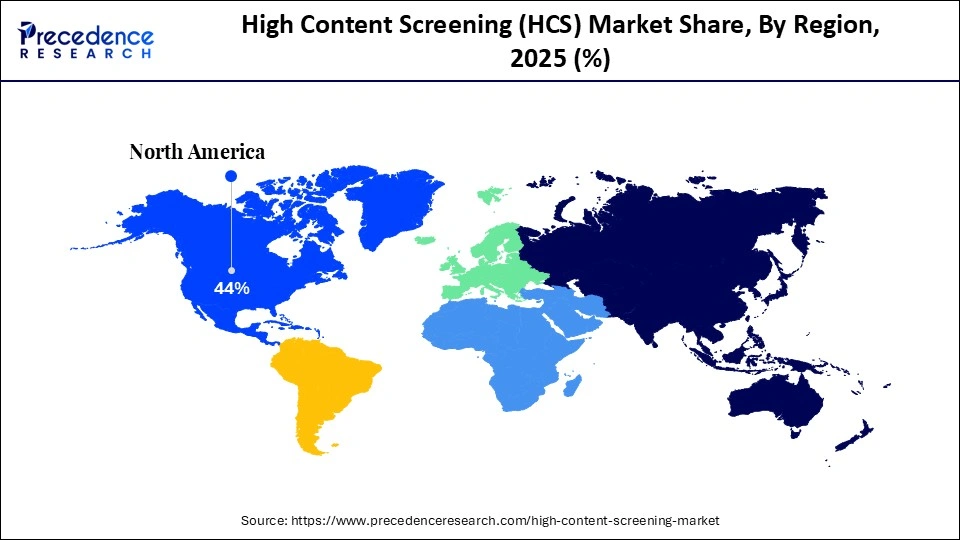
- North America dominated the market with a share of approximately 44% in 2025.
- Asia-Pacific is expected to grow at the fastest CAGR of 8% between 2026 and 2035.
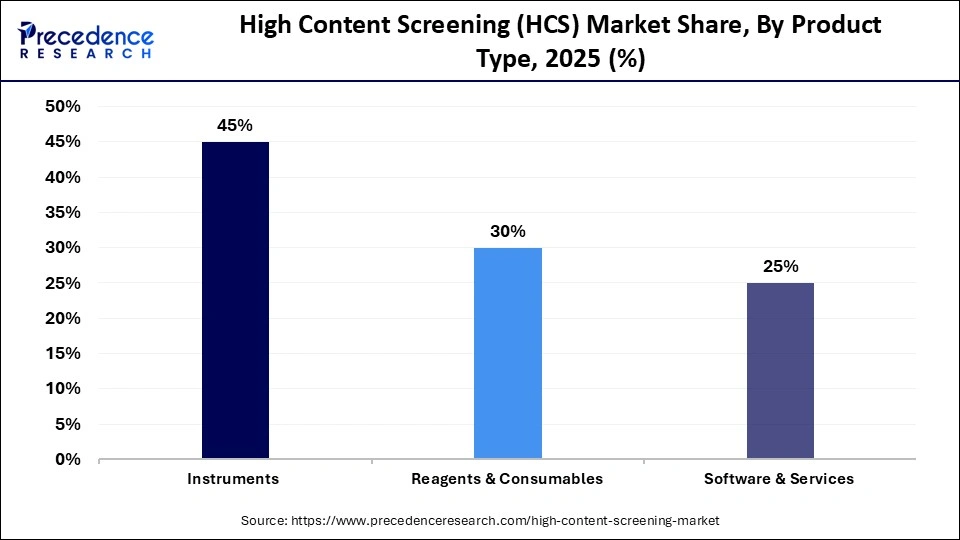
- By product type, the instruments segment contributed the highest revenue share of approximately 45% in the high content screening (HCS) market in 2025.
- By product type, the software & services segment is expected to grow at a strong CAGR of 6.7% between 2026 and 2035.
- By application, the drug discovery & development segment held a major market share of approximately 49% in 2025.
- By application, the toxicology testing segment is expected to expand at a notable CAGR of 6.8% from 2026 to 2035.
- By end user, the pharmaceutical & biotechnology companies segment captured the highest market share of approximately 50% in 2025.
- By end user, the contract research organizations (CROs) segment is poised to grow at a healthy CAGR of 7% between 2026 and 2035.
What is the High Content Screening (HCS) Market?
High Content Screening (HCS) is an advanced cell-based analysis technique combining automated microscopy, high-throughput screening, and image analysis to quantitatively assess cellular responses across multiple parameters. It is widely applied in drug discovery, toxicity testing, phenotypic screening, and cell biology research to identify effects of compounds on cell function and phenotype. HCS platforms integrate instruments, reagents, software, and data analytics to accelerate biological insights and improve decision-making in pharmaceutical, biotech, academic, and CRO settings.
The growing investment in public biomedical research funding propels the adoption of HCS technologies as governments and global health bodies push for more predictive and efficient drug discovery tools. Major public research agencies continue to allocate tens of billions of dollars annually to life sciences research. Furthermore, the increase in public funding for biomedical innovation in the Asia-Pacific region is increasing the global adoption.
High Content Screening (HCS) Market Growth Factors
- Expansion of Phenotypic Drug Discovery: The shift away from target-centric screening is driving broader adoption of HCS platforms capable of capturing complex cellular responses.
- Rising Use of AI in Life Sciences Labs: Rapid integration of machine learning in biology workflows is boosting demand for high-content image datasets generated by HCS systems.
- Growth of iPSC and 3D Cell Models: Increasing use of physiologically relevant cell models is propelling the need for multi-parametric imaging beyond conventional HTS readouts.
- Escalating Safety: Related Drug Attrition Costs: Pharmaceutical companies are fuelling HCS adoption to detect toxicity and safety signals earlier in preclinical pipelines.
Impact of AI on the High Content Screening (HCS) Market
Artificial intelligence (AI) revolutionizes the market through the improvement of the process of capturing, analyzing, and interpreting complex cellular data. Millions of high-resolution images are processed in seconds using AI algorithms. This allows the accurate recognition of cellular phenotypes that cannot be readily detected using traditional analytical methods. Furthermore, adaptive screening workflows refine experimental conditions in real time depending upon observed cellular responses and are also supported by the integration of AI.
High Content Screening (HCS) Market Trends
- Single Cell Multi-omics Integration Fuels Advanced Phenotypic Profiling: HCS instruments that tie high-resolution imaging to single-cell transcriptomics and proteomics attract investment from precision medicine labs. The phenotype of images in relation to molecular signatures has the potential to expand the scope of application beyond a conventional screen. This interdepartmental integration appeals to new end-users and increases high-value platform adoption.
- Cell Therapy & Immuno Oncology Screening Expands Market Footprint: High-content imaging in biotech companies has been used to measure engineered immune cell behavior on tumor models, leading to new screening uses. HCS allows the comprehensive study of cell-cell interaction processes and dynamic immune responses, which are not provided by standard assays. This trend opens dedicated markets in cell therapy R&D and strengthens long-term demand for instruments.
- Transforming the HCS Market: Key Innovations Powering Precision Phenotypic Screening: In FY2024–FY2025 filings, Danaher, Thermo Fisher Scientific, Revvity (formerly PerkinElmer), and Becton Dickinson collectively reported over USD 20 billion in annual life-science instrument revenue, with advanced imaging, cell analysis, and automation platforms representing a core product category manufactured primarily in the U.S. Agilent Technologies (U.S.) reported around USD 6.95 billion in annual revenue reported in 2025, supporting exported analytical and imaging software and tools that contribute to AI-enabled analysis in high-content workflows.
- In January 2025, Molecular Devices introduced the ImageXpress HCS.ai High-Content Screening System with proprietary AI-powered image analysis software, indicating mainstream adoption of deep-learning enabled analytics in commercial HCS platforms by leading OEMs.
- In 2024–2026, HCS adoption has grown for advanced biological models, including 3D cell cultures and organoids, enabling more physiologically relevant screening that better predicts clinical outcomes than traditional 2D assays.
Market Scope
| Report Coverage | Details |
| Market Size in 2025 | USD 1.72 Billion |
| Market Size in 2026 | USD 1.84 Billion |
| Market Size by 2035 | USD 3.35 Billion |
| Market Growth Rate from 2026 to 2035 | CAGR of 6.90% |
| Dominating Region | North America |
| Fastest Growing Region | Asia Pacific |
| Base Year | 2025 |
| Forecast Period | 2026 to 2035 |
| Segments Covered | Product Type, Application, End User, and Region |
| Product Type,Regions Covered | North America, Europe, Asia-Pacific, Latin America, and Middle East & Africa |
Segmental Insights
Product Type Insight
Why Did the Instruments Segment Dominate the High Content Screening (HCS) Market?
The instruments segment dominated the market with a share of approximately 45% in 2025, due to its central role in enabling automated, high-resolution cellular imaging across drug discovery and toxicology workflows.
The pharmaceutical and biotechnology laboratories focused on capital investment in state-of-the-art confocal and widefield imaging to facilitate large-scale screening by phenotypics. Furthermore, government-funded screening programs and public research centers strengthened procurement volumes by upgrading legacy microscopy systems to fully automated high-content platforms.
The software & services segment is expected to grow at the fastest CAGR of 6.7% in the coming years, owing to the growing image complexities and volumes of data created by current screening campaigns. Image analysis using AI leads to high-dimensional datasets that are provided by advanced analytics platforms, which support machine learning, cloud computing, and scalable data management.
Moreover, research organizations now emphasize analytical flexibility and long-term data usability over one-time hardware acquisition, facilitating market growth.
Application Insights
Which Application Segment Dominated the High Content Screening (HCS) Market?
The drug discovery & development segment held the largest revenue share of approximately 50% in 2025, due to its strong dependence on phenotypic screening to sharpen early-stage decision-making and reduce downstream failure risk. Drug pipelines are becoming more dependent on multi-parametric cellular data to connect exposure of compounds to functional biological cellular outcomes. The increasing investments by government and private bodies also support the use of HCS in drug discovery.
High-content imaging facilitates the diagnosis of morphology, protein localization, cell-cycle effects, and pathway modulation in a single workflow. Massive pharma discovery centers and academic screening facilities extend the use of HCS in oncology, neuroscience, and rare disease discovery. The Microscopy Society of America (MSA) highlighted in 2025 that advances in automated fluorescence microscopy significantly improved reproducibility and throughput in drug screening laboratories. Additionally, these factors positioned drug discovery as the primary application anchor across screening workflows.
The toxicology testing segment is expected to expand significantly in the market with a CAGR of 6.8% in the coming years, owing to increasing regulations and scientific interests in early risk identification of safety. High-content imaging enables the measurement of cytotoxicity, mitochondrial dysfunction, oxidative stress, and organ-specific injury markers in human-relevant cell models simultaneously.
Toxicology screening programs supported by government and academic consortia are expected to screen thousands of chemicals per year through image-based in vitro platforms to enhance hazard prediction. Furthermore, the adoption is likely to rise across environmental toxicology, chemical safety, and combination drug testing programs. CROs continue to expand dedicated toxicity imaging capabilities to support sponsor-led safety evaluations.
End User Insights
Which End User Segment Led the High Content Screening (HCS) Market?
The pharmaceutical & biotechnology companies segment led the market with a share of approximately 50% in 2025, due to their direct control over early-stage research pipelines and internal screening infrastructure. Hundreds of parallel phenotypic experiments were routinely run every quarter by large biopharma organizations using automated HCS systems built into workflows of lead optimization. Moreover, continuous system upgrades toward higher-throughput confocal and spinning-disk architectures reinforced long-term dependency on internal HCS infrastructure among pharmaceutical & biotechnology companies.
The contract research organizations (CROs) segment is expected to witness the fastest growth in the market with a CAGR of 7.0% over the forecast period, as more phenotypic screening campaigns are being completely implemented by CROs serving early-stage biotech and virtual pharma sponsors.
CRO labs are now completing 24/7 automated pipelines of imaging services that allow turnover of assays in toxicology, CRISPR-based functional screens, and translational biomarker research. Furthermore, the vendors such as Molecular Devices, Nikon, and Zeiss highlighted increased CRO demand for systems optimized for high-content plus flow-imaging hybrid workflows, particularly in immuno-oncology and cell therapy screening.
Regional Insights
Why North America Dominated the High Content Screening (HCS) Market?
North America held a major revenue share of approximately 40% in the market in 2025, due to the concentration of large-scale pharmaceutical R&D hubs, advanced imaging vendors, and mature automation ecosystems operating in tight coordination. North America conducts a large number of high-content imaging campaigns, with the majority of them in the areas of oncology, neuroscience, and immunology.
HCS workflows are incorporated into the academic medical centers' pipelines of genomics and proteomics, and the multi-parameter assays throughput was improved. Furthermore, the research funding by federal programs under NIH and NCI programs stimulates increased phenotypic screens, facilitating earlier target validation and mechanistic research.
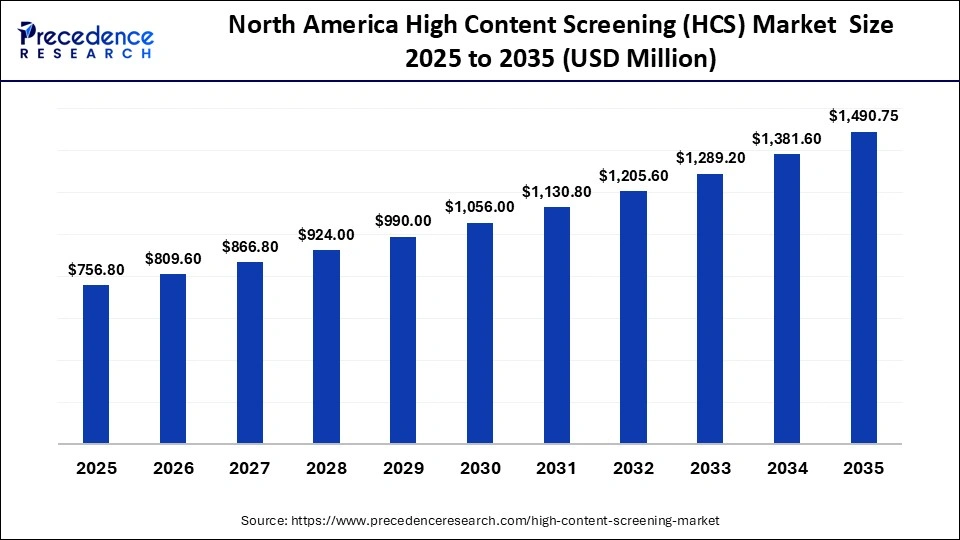
The North America high content screening (HCS) market size is estimated at USD 576.80 million in 2025 and is projected to reach approximately USD 1,490.75 million by 2035, with a 7.01% CAGR from 2026 to 2035.
What is the Size of the U.S. High Content Screening (HCS) Market?
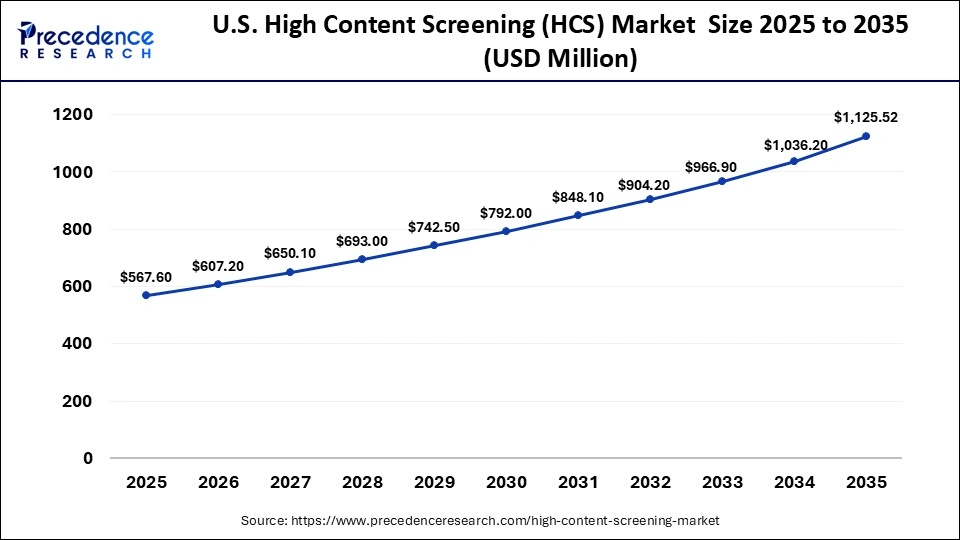
The U.S. high content screening (HCS) market size is calculated at USD 567.60 million in 2025 and is expected to reach nearly USD 1125.52 million in 2035, accelerating at a strong CAGR of 7.09% between 2026 and 2035.
U.S. – North America's High Content Screening Hub
U.S. leads the market in North America, owing to its intensive concentration of pharmaceutical discovery locations, excellent microscopy, and extensive research financing. In 2025, large U.S. research centers and biotech centers conducted significant expansions of automated high-content imaging initiatives. This is intended to facilitate large-scale phenotypic and mechanism-directed screens.
Several key players, such as Thermo Fisher Scientific, Genedata, and Danaher Life Sciences, are the major contributors of the market in the U.S. Furthermore, the cumulative momentum sustained the leadership role of the U.S. in deploying cutting-edge cellular analysis systems and reinforced its central position in North America's HCS market growth.
How is Asia-Pacific Growing in the High Content Screening (HCS) Market?
Asia-Pacific is expected to witness the fastest growth with a CAGR of 8.0% during the predicted timeframe, driven by the higher rates of pharmaceutical R&D, widening biologic pipelines, and government-supported infrastructure projects in China, India, South Korea, and Singapore. High-content imaging is incorporated in regional biotech companies to compete on the international scene in oncology, metabolic disorders, and immunology. Additionally, the university-CRO-pharma partnerships improved HCS assay development and interpretation of phenotypic data training, thus facilitating the market in this region.
China – Emerging Laboratory Innovation Hub in Asia Pacific
China is leading the charge in the Asia-Pacific region, owing to its specific investments in the infrastructure of life sciences, a growing biotech ecosystem, and the accelerated use of automated imaging methods. Moreover, the use of strategic alliances with the imaging providers and standardized AI analytics platforms enhanced scalability and made China the leading nation, promoting the next-generation HCS.
Which Factors Drive the High Content Screening (HCS) Market in Europe?
Europe accounted for a significant market share in the High Content Screening (HCS) Market. The region's growth is driven by the rapid healthcare infrastructure development, rising R&D investment in life sciences, strong presence of pharmaceutical companies, and widespread adoption of cell-based assays. The region is increasingly adopting automated microscopy systems, Artificial Intelligence (AI) for image analysis, and 3D cell-based assays, critical for driving drug discovery.
Germany Security Market Trends
Germany holds a notable share of the market. The high concentration of major biotech and pharmaceutical companies drives demand for advanced screening platforms that focus on high-content screening for toxicity profiling and compound testing. Moreover, the strategic collaborations among academic institutions, research centers, and industry players drive the development of novel high-content screening (HCS) technologies.
Which Factors Are Responsible for Propelling the Growth of the High Content Screening (HCS) Market in the Middle East and Africa?
The Middle East and Africa region is witnessing remarkable market growth. The growth of the region is driven by the rising presence of pharmaceutical & biotech companies, the rise in pharmaceutical R&D funding, increasing focus on personalized medicine, the rising prevalence of chronic diseases, and the rising investment in the establishment of advanced research hubs. The region also benefits from robust public-private research partnerships, fostering innovation in drug discovery.
UAE High Content Screening (HCS) Market Trends
The country is expected to experience considerable growth. The substantial investments in medical cities, biotechnology parks, and laboratories are driving the adoption of automated imaging and screening technologies. Additionally, the growing demand for faster, automated, and precise drug discovery is anticipated to drive the need for High Content Screening (HCS) platforms.
High Content Screening (HCS) Market Value Chain Analysis
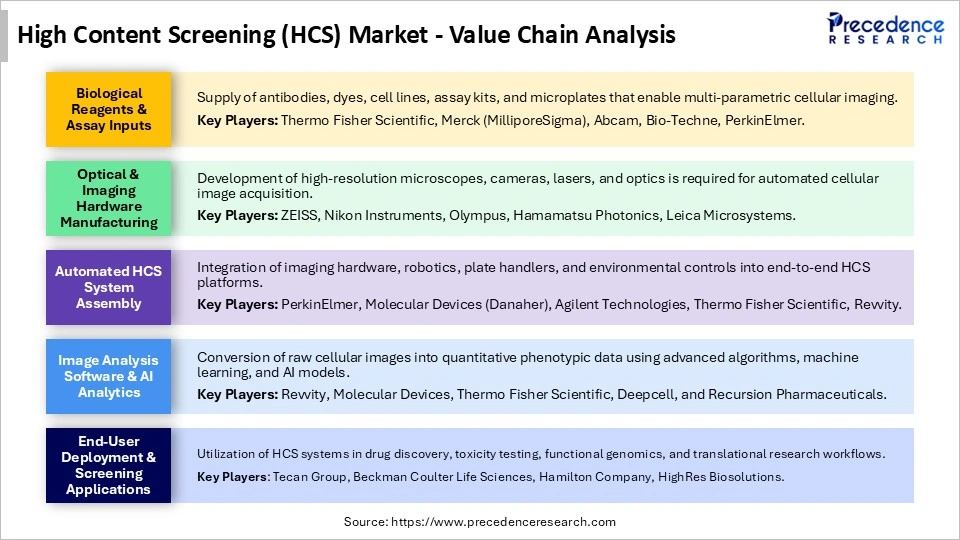
Who are the Major Players in the Global High Content Screening (HCS) Market?
The major players in the high content screening (HCS) market include Thermo Fisher Scientific Inc., Danaher Corporation, Becton, Dickinson and Company (BD), PerkinElmer Inc., Agilent Technologies, Inc., Carl Zeiss AG, Merck KGaA, GE Healthcare, Bio-Rad Laboratories, Inc., Tecan Trading AG, Yokogawa Electric Corporation, Nikon Corporation, Sartorius AG, Corning Incorporated, Revvity, Inc.
Recent Developments
- In February 2026, Revvity, Inc. announced the launch of multiple discovery platforms and technologies at SLAS2026, which are designed to accelerate high-throughput drug discovery workflows. These innovations made their debut at the conference in Boston from February 7 to 11. Highlights include the Opera Phenix OptIQ high-content screening system, the EnVision Nexus One multimode plate reader, and the AssayMate workstation, along with other recently introduced solutions that cover areas such as sample preparation, screening, advanced imaging, and lab automation. (Source: https://ir.revvity.com)
- In January 2026, Molecular Devices, LLC, a leading life science solutions provider and part of Danaher Corporation (NYSE: DHR), announced a strategic collaboration with London-based lab automation innovator Automata. The partnership aims to integrate Molecular Devices' imaging and detection systems with Automata's LINQ platform, creating fully connected, AI-ready research workflows.(Source: https://www.moleculardevices.com)
- In October 2025, the HCS-3DX platform introduced automated analysis for 3D cell cultures, or spheroids, leveraging AI-powered image processing and sample selection. The system enables high-precision, large-scale screening of complex cellular models in significantly reduced timeframes.(Source: https://www.news-medical.net)
Segments Covered in the Report
By Product Type
- Instruments
- Reagents & Consumables
- Software & Services
By Application
- Drug Discovery & Development
- Primary & Secondary Screening
- Target Identification & Validation
- Toxicology Testing
- Phenotypic/Stem Cell/Cancer Research & Others
By End User
- Pharmaceutical & Biotechnology Companies
- Contract Research Organizations (CROs)
- Academic & Research Institutes
- Other Users
By Region
- North America
- Europe
- Asia-Pacific
- Latin America
- Middle East & Africa
For inquiries regarding discounts, bulk purchases, or customization requests, please contact us at sales@precedenceresearch.com
Frequently Asked Questions





Ask For Sample
No cookie-cutter, only authentic analysis – take the 1st step to become a Precedence Research client
 Get a Sample




 sales@precedenceresearch.com
 Schedule a Meeting
