



High Temperature Insulation Materials Market Size, Share and Trends 2026 to 2035
High Temperature Insulation Materials Market (By Material Type: Fiberglass, Ceramic Fibre, Mineral Wool, Vacuum-Formed Insulating Products, Polyurethane Foam, Polystyrene, Insulating Fire-Bricks (IFB), Other Material Types (Aerogel Blankets, Microporous Panels, etc.); By Application: Insulation, Industrial Equipment, Other Applications (Building and Fire-Protection, etc.); By End-use Industry: Petrochemicals, Industrial, Power Generation, Transportation, Electrical and Electronics, Construction, Other End-use Industries (Metal Processing, etc.)) - Global Industry Analysis, Size, Trends, Leading Companies, Regional Outlook, and Forecast 2026 to 2035
Source: https://www.precedenceresearch.com/high-temperature-insulation-materials-market
 Get a Sample
 Table Of Content


What is High Temperature Insulation Materials Market Size?
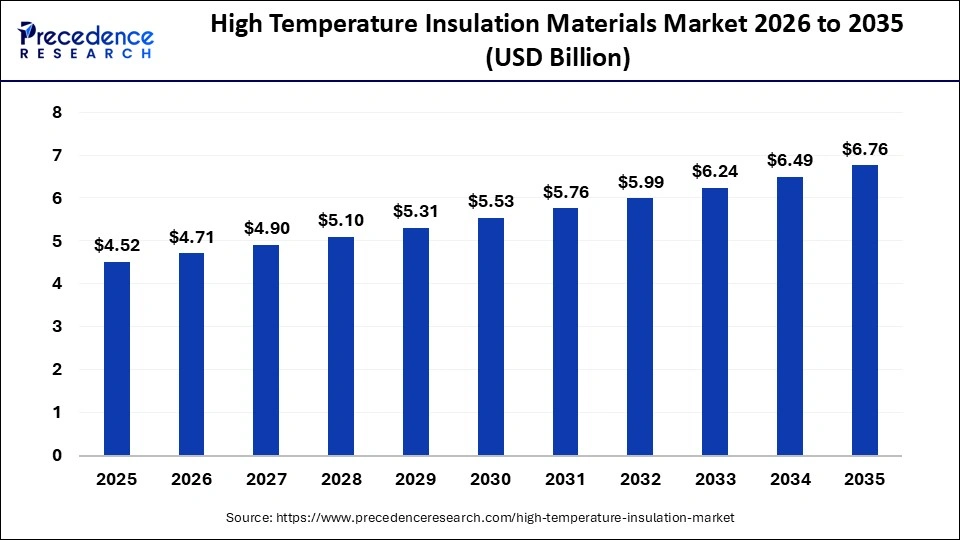
The global high temperature insulation materials market size is calculated at USD 4.52 billion in 2025 and is predicted to increase from USD 4.71 billion in 2026 to approximately USD 6.76 billion by 2035, expanding at a CAGR of 4.11% from 2026 to 2035. The high-temperature insulation materials market is driven by rising energy-efficiency needs and increasing adoption in high-heat industrial applications.
Market Highlights
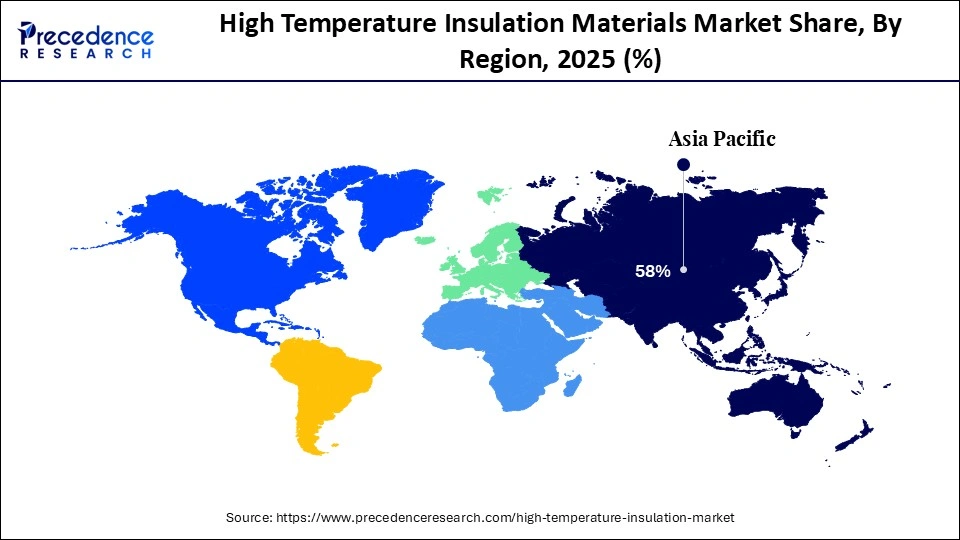
- Asia Pacific accounted for the largest share of 58% in 2025.
- By region, North America is expected to grow ay the fastest CAGR between 2026 and 2035.
- By material type, the ceramic fibre segment held a significant share in 2025.
- By material type, the other material types (aerogel blankets, microporous panels, etc.) segment is growing at a considerable CAGR between 2026 and 2035.
- By application, the industrial equipment segment contributed the biggest market share in 2025.
- By application, the insulation segment is expanding at a solid CAGR between 2026 and 2035.
- By end-use industry, the petrochemicals segment contributed the highest market share in 2025.
- By end-use industry, the electrical and electronics segment is growing at a healthy CAGR between 2026 and 2035.
Redefining Efficiency and Resilience: How Innovation Is Transforming the High Temperature Insulation Materials Market
The high-temperature insulation materials market is a critical market, which finds application in various industries doing business in extreme thermal environments such as petrochemicals, metallurgy, ceramics, generation, foundries, and industrial production. This material, which consists of ceramic fibers, insulating firebricks, microporous insulation, and aerogels, is meant to be resistant to heat and not to lose its energy, equipment wear and tear, and occupational hazards. With the world's industrial systems becoming modern, there is a need to have modern-day thermal management solutions that will enhance efficiency, reduce operating costs, and meet the safety and environmental standards that are increasingly becoming more stringent.
The high-temperature insulation materials market is driven by the growth of industrialization, the escalating energy-saving goals, and the escalating investments in thermal equipment improvements in the manufacturing industries that require heavy-duty production. With the industry trying to cut down on the heat loss and fuel usage as well as meeting the requirements of reducing emissions, the advanced insulation becomes essential in making the operations in accordance with the world standards of sustainability. Moreover, the shift in the direction of lightweight and environmentally friendly insulation materials provokes the technological competition among the manufacturers, leading to constant innovations and the extension of the scope of the market. The development of infrastructure in developing economies, the fast growth of the chemical and metal processing industry, and the modernization of power-generating facilities are the factors that contribute to demand.
Key AI Integration in the High Temperature Insulation Materials Market
The introduction of Artificial Intelligence into the high-temperature insulation materials market is changing the landscape in a very rapid way, as it is redesigning the way materials are developed, tested, fabricated, and implemented in an industrial system. AI-driven predictive analytics is one of the most important applications that allow manufacturers to optimize the fiber composition, minimize inconsistencies in porosity, and maximize thermal resistance more accurately than in the case of traditional trial-and-error techniques. AI-powered digital twins recreate full heating systems, furnaces, reactors, kilns, etc., and enable industries to test the insulation before construction.
Operating conditions, AI-powered condition-monitoring software is used in operation environments to track the heat flow, identify the early symptoms of insulation breaking down, and provide maintenance teams with real-time recommendations, enhancing safety and decreasing thermal accidents. Further, AI will enhance the predictions of supply chains, on-site quality, and automated production patterns to ensure that production is consistent with accelerating the delivery process.
High Temperature Insulation Materials Market Outlook
- Industry Growth Overview: The high temperature insulation materials market has a good momentum, with the industries trying to be energy efficient, thermally stable, and emissions are being kept at a low level. The increased use of sophisticated furnaces and manufacturing systems that are heat-intensive has continued to drive the need to achieve better and long-lasting insulation solutions.
- Major Investors: The major organizations, like Morgan Advanced Materials, 3M, Unifrax, and RHI Magnesita, are heavily investing in highly advanced fiber and lightweight refractory systems. These players are focused on R&D in order to emerge with sustainable and low-conductivity material, which is safe and efficient in operations.
- Startup Ecosystem: New entrants in the market have been launching products, including aerogel insulation, nanomaterial composites, and high-temperature fibers that can be recycled. These are early-stage innovators who are working on smart thermal monitoring systems and modular panels of insulation that can be used in industries quickly.
Market Scope
| Report Coverage | Details |
| Market Size in 2025 | USD 4.52 Billion |
| Market Size in 2026 | USD 4.71 Billion |
| Market Size by 2035 | USD 6.76 Billion |
| Market Growth Rate from 2026 to 2035 | CAGR of 4.11% |
| Dominating Region | North America |
| Fastest Growing Region | Asia Pacific |
| Base Year | 2025 |
| Forecast Period | 2026 to 2035 |
| Segments Covered | Material Type, Application, End-use Industry, and region |
| Regions Covered | North America, Europe, Asia-Pacific, Latin America, and Middle East & Africa |
Segment Insights
Material Type Insights
Why is the Ceramic Fibre Segment Expected to Grow Fastest Share of the High Temperature Insulation Market?
The ceramic fibre segment holds a major share of the high temperature insulation materials market in 2025, due to its excellent thermal resistance, low thermal conductivity, and lightweight structure. It is widely used in furnaces, kilns, boilers, reactors, and industrial processing equipment operating under extreme temperatures. The market growth is further driven by its performance, versatility, and reliability over time in the different industrial processes. Its dominance is further strengthened by the increasing demand for petrochemicals, power generation, aerospace, and metal processing. 
The other material types (aerogel blankets, microporous panels, etc.) segment is expected to grow at a significant CAGR during the studied period in the high temperature insulation materials market because they deliver superior thermal performance with minimal thickness. These materials are increasingly adopted where space constraints, weight reduction, and high energy efficiency are critical. Aerogel blankets are finding application in aerospace, electronics, renewable energy, and EV production, and microporous panels are used to insulate with a thin layer over retrofitting old equipment.
Application Insights
What Made the Industrial Equipment Segment Lead the High Temperature Insulation Market?
The industrial equipment segment accounted for a considerable revenue share in the high temperature insulation materials market in 2025, as these materials are essential for maintaining thermal efficiency and protecting machinery from extreme heat. Furnaces, boilers, heat exchangers, reactors, kilns, and industrial ovens extensively use these materials to reduce energy consumption and improve operational reliability. The use of ceramic fibres, microporous panels, and aerogel blankets is becoming more popular in industries to provide highly precise thermal control in high-temperature activities. 
The insulation segment is expected to witness the fastest growth in the high temperature insulation materials market with a CAGR over the forecast period. High temperature insulation materials help minimize heat loss, improve process stability, and maintain safe operating conditions across industrial facilities. Demand is increasing in manufacturing plants, power stations, refineries, and chemical processing units where thermal efficiency directly influences operating costs. With the growing focus on environmental awareness and low cost of operation, the insulation segment is expected to grow at a high rate, achieving an increasing market share and supplementing the leading industrial equipment application.
End Use Industry Insights
Why did the Petrochemicals Segment Dominate the High Temperature Insulation Market?
The petrochemicals segment led the global high temperature insulation materials market in 2025, due to continuous exposure to extreme operating temperatures. Refineries, processing units, storage facilities, and pipelines rely on advanced insulation to improve thermal efficiency, enhance worker safety, and reduce energy losses. Stringent environmental laws and the requirement to comply with emission reduction requirements further encourage the implementation of advanced insulation in petrochemical facilities. The high demand is supported by the expansion of petrochemical production in the Asia Pacific, North America, and the Middle East.
The electrical and electronics segment is expected to witness the fastest growth in the high temperature insulation materials market, with a CAGR over the forecast period due to increased demand for heat-resistant materials in semiconductors, power electronics, EV battery systems, and high-power devices. The high temperature insulation materials provide thermal protection, improve equipment reliability, and help maintain consistent operating temperatures during manufacturing processes. Ceramic fibres, aerogel blankets, and microporous panels are the high-performance insulation materials that are required to ensure thermal stability in electronic component equipment with compact and high-temperature aspects.
Regional Insights
What Factors Made the Asia Pacific Region the Dominant Region in the Market?
Asia Pacific dominated the high temperature insulation materials market in 2025, due to rapid industrialization, expanding manufacturing activities, and large scale infrastructure development. Strong demand from steel, ceramics, cement, power generation, petrochemicals, and metal processing industries drives continuous consumption of insulation products. The governments within the region are also encouraging energy-saving technologies and emission-cut policies, as well as urging companies to replace the old system with high-performance insulation materials. The increasing investment in electric vehicles, electronics, and renewable energy infrastructure enhances long-term adoption of high temperature insulation materials in the region.
- In June 2025, Armacell completed the opening of its new factory in Pune, India on 11 June 2025. The opening was an important growth in the production capacity of the company and expanded its market share in the insulation business in the Asia-Pacific region.
Asia Pacific High Temperature Insulation Materials Market Size and Growth 2026 to 2035
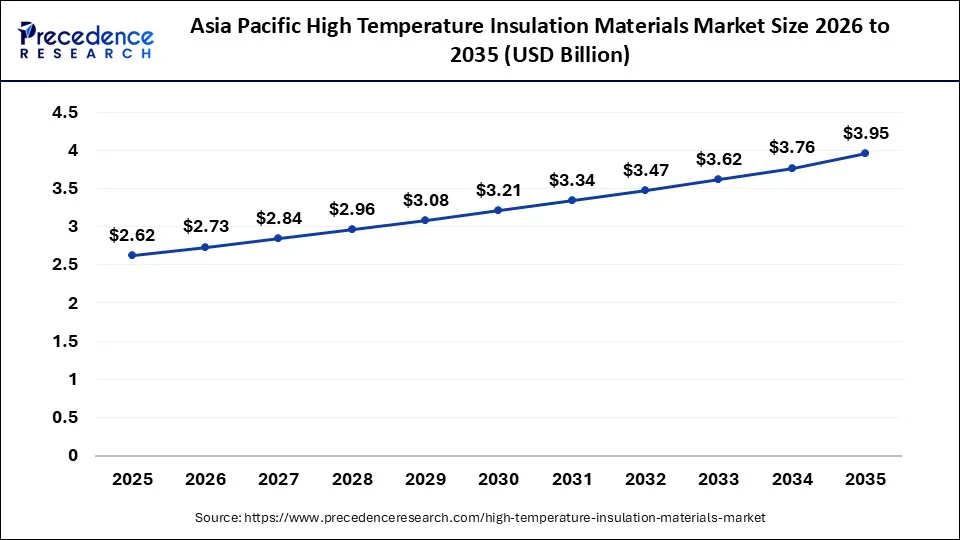
The Asia Pacific high temperature insulation materials market size was expected to be worth USD 3.95 billion by 2035, increasing from USD 2.62 billion by 2025, growing at a CAGR of 4.19% from 2026 to 2035
China High Temperature Insulation Materials Market Trends
China represents the largest share of the high temperature insulation materials market in the Asia Pacific in 2025. The growth is driven by its extensive manufacturing sector and significant production of steel, cement, glass, and chemicals. Increasing emphasis on energy conservation encourages the adoption of advanced high temperature insulation materials. China is an important producer of EVs, semiconductor fabrication, and battery production markets, which require high accuracy of thermal control and lightweight insulation. The high pressure of the government to achieve carbon-neutrality goals is increasing the pace of transition to high-performance insulation materials, which are substituting the old refractory systems.
Which Factors Influence the Fastest Growth of the North American Market?
North America is expected to grow at the fastest CAGR in the high temperature insulation materials market during the forecast period. The growth is supported by rising investments in energy efficient manufacturing, aerospace, petrochemicals, and advanced industrial processing. Strict environmental regulations encourage industries to reduce heat loss and improve operational efficiency through high performance insulation. Increasing implementation of retrofitting old industrial infrastructure with new insulations such as ceramic fibre, aerogels, and microporous panels drives the demand in the region. Growing investment in renewable energy, hydrogen technologies, and high-temperature battery systems is further increasing demand and contributing to the growth of the market.
U.S. Market Trends
The United States represents the largest share of the high temperature insulation materials market in North America. The growth is due to its well-established manufacturing, oil and gas, aerospace, and power generation industries. The initiative of the country towards carbon mitigation and industrial sustainability causes industries to switch to lightweight, high-performance insulation solutions to replace the old refractory system. With the continued modernization of industries that use high-temperature operations, the U.S. is still the economic powerhouse of the insulation materials market in North America.
Which Factors Made Europe a Significantly Growing Region in the Market?
Europe is expected to grow at a considerable CAGR in the upcoming period in the high temperature insulation materials market. The growth is driven by strict carbon reduction targets and widespread adoption of energy efficient industrial technologies. Industries including steel, cement, glass, chemicals and power generation continue to invest in insulation solutions to lower energy consumption and operating costs. The increasing need to use sustainable manufacturing methods, alongside the emphasis on the minimization of carbon footprints, increases the upgrades to the current facilities.
Germany Market Trends
Germany leads the European high temperature insulation materials market in 2025 due to its advanced industrial base and strong presence in automotive, steel, chemicals, and engineering sectors. Manufacturers prioritize high temperature insulation to improve production efficiency, reduce emissions, and comply with stringent environmental regulations. Ongoing investments in industrial automation energy efficient production facilities continue to support consistent demand for insulation materials. Further expansions in the aerospace, auto, and chemical industries contribute to the market growth.
UK High Temperature Insulation Materials Market Trends
The UK market is recording progressive growth with industries considering high-performance insulation solutions in order to reduce energy intensity in their processes and energy-saving operations. The concern of the government in terms of net-zero and attention to applying energy-saving technologies supports the substitution of the traditional system of refractory by modern ceramic fibers, aerogel, and microporous panels. Lightweight, customizable, and durable insulation solutions help in the modernization of the industry and lower the cost of operation. Further expansions in aerospace, auto, and chemical industries remain in place, which enhances growth.
What are the Advancements in the Market in Latin America?
Latin America held a considerable share of the high temperature insulation materials market in 2025, as industrial sectors expand and energy efficiency becomes a greater priority. Investments in mining, cement, metals, chemicals, and oil refining are increasing demand for high temperature insulation materials that improve operational safety and reduce energy losses. The market has benefited from the technological advancements, the rising consciousness towards energy saving, and the emphasis on the reduction of the operation downtime and maintenance expenses of the industrial plants.
Brazil Market Trends
Brazil accounts for the largest share of the Latin American high temperature insulation materials market in 2025, supported by its large industrial base and expanding steel, mining, petrochemical, and cement industries. Industrial companies are investing in modern insulation systems to improve process efficiency and lower fuel consumption. Growing emphasis on sustainable manufacturing, industrial upgrades, and operational cost reduction continues to drive demand for high temperature insulation materials in industrial projects. Increasing investments in industrial infrastructure, regulatory efforts to control pollution, and sustainable operations are also increasing demand.
What are the Key Trends in the Market in the Middle East and Africa Region?
The Middle East & Africa held a notable share of the high temperature insulation materials market in 2025, due to growing investments in oil and gas, petrochemicals, power generation, and heavy industrial infrastructure. High temperature insulation materials are increasingly used to improve thermal efficiency, protect equipment, and reduce energy consumption in demanding operating environments. The increasing government efforts to modernize its industrial plants, and the introduction of new chemical and metal processing plants are driving up the demand for advanced insulation materials.
Saudi Arabia Market Trends
Saudi Arabia represents the leading market within the Middle East and Africa high temperature insulation materials market in 2025, owing to continuous investments in petrochemical plants, oil refineries, power generation facilities, and industrial development projects. The country's industrial diversification strategy is increasing the need for reliable thermal insulation materials that improve energy efficiency and operational performance. Expansion of manufacturing zones, infrastructure projects, and energy intensive industries is expected to sustain demand for high temperature insulation materials.
Value Chain Analysis of the High Temperature Insulation Materials
- Raw Material Supply & Sourcing: The upstream part of the value chain concerns the processing of raw materials, including ceramic fibers, calcium silicate, and refractory aggregates. These are basic inputs supplied by mineral and chemical producers to function in high-temperature conditions.
Key players: Morgan Thermal Ceramics, Unifrax, RHI Magnesita. - Manufacturing & Processing: Specialized processes, including heat treatment, integrative processes to include binders, and precision cutting, are important to HTI products. These are value-adding stages by virtue of raising thermal resistance, mechanical strength, and safety profiles.
Key players: Saint-Gobain, 3M, Isolite Insulating Products. - Distribution & End-Use Integration: The finished HTI products are dispatched towards their destinations through a global supply network to industrial users in energy, aerospace, iron & steel, glass, and cement.
Key players: Promat, Koei Chemical, Thermal Ceramics.
Competitive Landscape
The high temperature insulation materials market is highly competitive, with global and regional manufacturers competing through product quality, thermal performance, durability, and application-specific solutions. Companies continue investing in research and development to introduce lightweight, energy efficient, and environmentally compliant insulation materials for industries such as steel, cement, glass, petrochemicals, aerospace, and power generation. Strategic partnerships, acquisitions, and capacity expansions further help in strengthening market presence.
For sustained future growth in the high temperature insulation materials market, companies should focus on developing low emission and recyclable insulation materials, improving thermal efficiency and expanding manufacturing capacity in high growth regions.
Top Vendors in High Temperature Insulation Materials Market & Their Offerings
- Morgan Advanced Material: Leader in the provision of ceramic fiber, microporous, and refractory insulation (fibers, modules, boards) suitable for furnaces and other heavy industrial processes.
- Aspen Aerogels, Inc: Specializes in aerospace-grade aerogel-based insulation in the form of blankets, in addition to microporous insulation, particularly for energy, oil and gas, and high-efficiency industrial uses.
- Promat International NV: Supply of refractory insulation boards, microporous products, and high-temperature fire-resistant materials to suit industrial furnaces and other safety-critical installations.
- 3M Company: Provides high-temperature ceramic fibers and insulation materials with thermal resistance and long life, and durability.
- Unifrax LLC: Provides high-performance refractory ceramic fibers, low-bio persistent fibers, and modular insulation systems to energy-intensive industries.
- ADL Insulflex Inc.: Specializes in extreme-heat protection through fireproof sleeves, blankets, and fabrics designed to withstand molten splashes.
- Zircar Zirconia, Inc.: Offers high-purity zirconia fibers and textiles capable of operating at extreme temperatures up to 2200°C.
- Unifrax LLC: Manufactures ceramic fiber blankets, boards, and papers specifically for industrial fire protection and furnace linings.
- Almatis GmbH: Focuses on premium alumina-based specialty materials used in refractories for the steel and glass industries.
- Rath Group: Offers a comprehensive portfolio of refractory bricks and ceramic fibers for lining industrial kilns and furnaces.
- Aspen Aerogels, Inc.: Produces specialized aerogel insulation blankets known for having the lowest thermal conductivity in extreme environments.
- Hi-Temp Insulation, Inc.: Delivers customized insulation components and fabricated blankets for the power generation and aerospace sectors.
- Insulcon Group: Supplies heat-resistant textiles, gaskets, and sealing solutions for high-temperature process industries.
- Isolite Insulating Products Co., Ltd.: Manufactures ceramic fiber products and insulating firebricks primarily for the industrial kiln market.
- Pacor Inc.: Acts as a fabricator of removable insulation jackets and aerogel blankets for industrial equipment maintenance.
- Promat International NV: Provides microporous insulation boards and high-performance calcium silicate products for heavy industry.
- Pyrotek: Offers thermal barriers and molten metal handling solutions specifically designed for aluminum and glass processing.
- M.E. SCHUPP Industriekeramik GmbH: Specializes in high-temperature kiln components and heating elements for laboratory and industrial furnaces.
Recent Developments
- In October 2025, Carlisle Companies Inc. stated that it had agreed to acquire the enlarged polystyrene (EPS) insulation part of PFB Holdco, Inc. The acquisition enhanced the insulation lines at Carlisle and gave it a boost into the building material market.
- In October 2025, Knauf Insulation and Texnopark signed a deal to purchase the Rock Mineral Wool insulation unit of the company. The takeover had a state-of-the-art Tashkent, Uzbekistan, plant with electric melting technology that has minimized the emission of carbon dioxide. (Source: https://www.knaufinsulation.com)
- In September 2025, Armacell unveiled the ArmaGel XG system of aerogel insulation products. This new product diversified the Armacell aerogel-based products as far as thermal insulation of high-performance is concerned. (Source: https://www.armacell.com)
Segments Covered in the Report
By Material Type
- Fiberglass
- Ceramic Fibre
- Mineral Wool
- Alkaline Earth Silicate (AES)
- Aluminum Silicate Wool (ASW) or Refractory Ceramic Fibre (RCF)
- Polycrystalline Wool or Fibre (PCW)
- Long Fibre
- Vacuum-Formed Insulating Products
- Polyurethane Foam
- Polystyrene
- Insulating Fire-Bricks (IFB)
- Other Material Types (Aerogel Blankets, Microporous Panels, etc.)
By Application
- Insulation
- Industrial Equipment
- Other Applications (Building and Fire-Protection, etc.)
By End-use Industry
- Petrochemicals
- Industrial
- Power Generation
- Transportation
- Electrical and Electronics
- Construction
- Other End-use Industries (Metal Processing, etc.)
By Region
- North America
- Europe
- Asia-Pacific
- Latin America
- Middle East and Africa
For inquiries regarding discounts, bulk purchases, or customization requests, please contact us at sales@precedenceresearch.com
Frequently Asked Questions





Ask For Sample
No cookie-cutter, only authentic analysis – take the 1st step to become a Precedence Research client
 Get a Sample




 sales@precedenceresearch.com
 Schedule a Meeting
