



Human Centric Lighting Market Trends, Companies, Revenue / Sales Performance, Manufacturing Yield, Fab Capacity, Export & Import Dynamics, Supply Chain Analysis, Competitive Landscape, and Growth Forecast
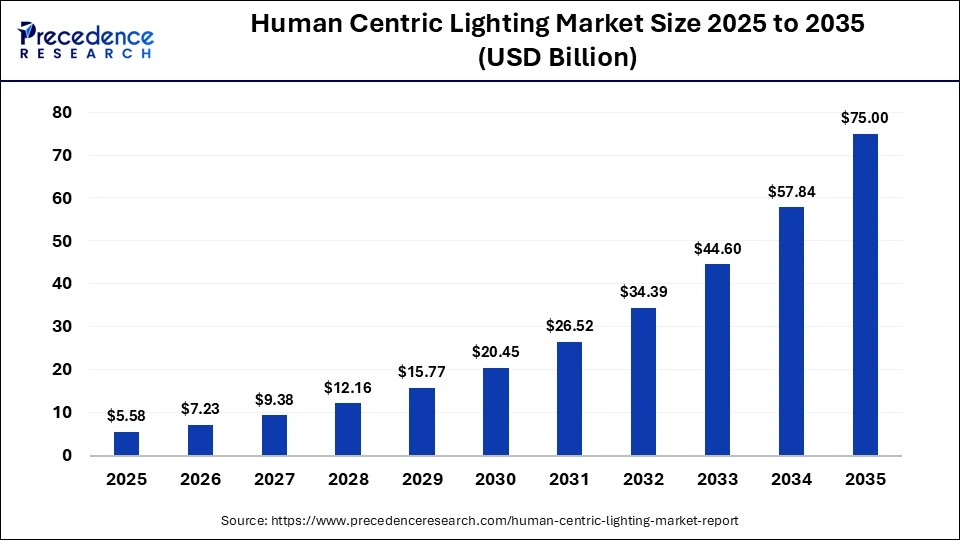
According to semiconductor and electronics specialist Laxmi Narayan, the human centric lighting market is valued at USD 7.23 billion in 2026 and is forecast to reach USD 75.00 billion by 2035, reflecting a CAGR of 29.68%. Leading human centric lighting market companies, including Cree Lighting USA LLC, Eaton Corporation, Fagerhults Belysning AB, Helvar, Hubbell Lighting, LEDVANCE GmbH are strengthening their presence across key segments such as By Product, By Installation Type, By Application.
Source: https://www.precedenceresearch.com/human-centric-lighting-market
 Get a Sample
 Table Of Content


What is the Human Centric Lighting Market Size in 2026?
The global human centric lighting market size was calculated at USD 5.58 billion in 2025 and is predicted to increase from USD 7.23 billion in 2026 to approximately USD 75.00 billion by 2035, expanding at a CAGR of 29.68% from 2026 to 2035.The market is experiencing unprecedented growth, driven by the growing demand for sophisticated lighting systems and rapid infrastructure development.
Key Takeaways
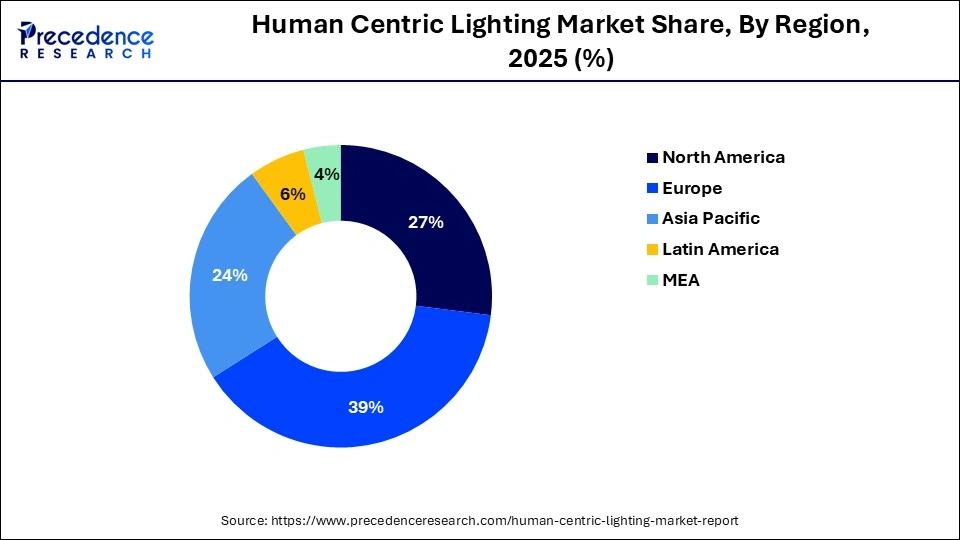
- Europe dominated the global market with the largest share of 39% in 2025.
- Asia Pacific is expected to expand at the fastest CAGR between 2026 and 2035.
- By product, the fixtures segment accounted for the biggest market share of 36% in 2025.
- By product, the services segment is expected to grow at the fastest CAGR between 2026 and 2035.
- By installation type, the new installation segment contributed the major market share of 68% in 2025.
- By installation type, the retrofit segment is expected to expand at the fastest growth rate between 2026 and 2035.
- By application, the commercial segment contributed the highest market share 60% in 2025.
- By application, the residential segment is expected to grow at the highest CAGR from 2026 to 2035.
Market Overview
Human centric lighting (HCL) is a technology that goes beyond illumination to create a perfect synchrony between body, mind, and light. Human centric lighting (HCL) refers to lighting systems that are designed to align with human circadian rhythms by enhancing alertness during the day and supporting relaxation in the evening. Unlike traditional lighting systems, which focus on illumination levels, this innovative approach integrates dynamic lighting adjustments to mimic natural daylight changes.
How is AI Impacting the Human Centric Lighting Market?
As technology continues to evolve, the integration of Artificial Intelligence (AI) emerges as a game changer and is significantly accelerating the growth of the human centric lighting market. AI integration significantly improves the efficiency and functionality of human centric lighting (HCL), which accelerates the adoption in commercial, residential, and healthcare sectors. AI efficiently analyzes environmental data and human presence to automatically adjust color temperature and intensity in real time to align circadian rhythms. In offices, AI integration optimizes lighting for alertness in the morning and relaxation in the afternoon. AI integrated lighting systems can reduce energy usage and ensure environmental compliance.
What are the Emerging Trends in the Market?
- The growing adoption of human centric lighting across key sectors such as hospitals, factories, educational institutions, and corporate offices to enhance the productivity and well-being of employees is driving the market.
- The rapid urbanization, along with the significant investment in sustainable and intelligent infrastructure, is expected to contribute to the overall growth of the market.
- Stringent regulations regarding employee well being are compelling the adoption of human-centric lighting systems in work environments.
- The growing need for energy efficient solutions is driving the shift toward controllable LED systems, which is expected to accelerate the growth of the market during the forecast period. When combined with smart lighting systems, HCL can automatically adjust based on natural daylight availability, which assists in lowering energy consumption and increasing operational efficiency.
Market Scope
| Report Coverage | Details |
| Market Size in 2025 | USD 5.58 Billion |
| Market Size in 2026 | USD 7.23 Billion |
| Market Size by 2035 | USD 75.00 Billion |
| Market Growth Rate from 2026 to 2035 | CAGR of 29.68% |
| Dominating Region | Europe |
| Fastest Growing Region | Asia-Pacific |
| Base Year | 2025 |
| Forecast Period | 2026 to 2035 |
| Segments Covered | Product, Installation Type , Application, and Region |
| Regions Covered | North America, Europe, Asia-Pacific, Latin America, and Middle East & Africa |
Market Dynamics
Drivers
Growing Focus on Improving Employee Wellbeing
The increasing need to improve employee well being and boost productivity is expected to boost the demand for human-centric lighting systems. In commercial spaces, these systems mimic the natural 24-hour cycle of sunlight to support the human circadian rhythm, enhancing employee health, well-being, and productivity. HCL provides an optimal lighting environment that increases concentration, reduces fatigue, boosts energy levels, and prevents absenteeism.
Restraint
High Cost
The high cost associated with the human-centric lighting systems is expected to hamper the market's growth. In addition, increased complex integration into existing infrastructures may restrict the growth of the market during the forecast period.
Opportunities
Rising Adoption of Advanced LED Lighting
The increasing adoption of advanced LED lighting is projected to offer lucrative opportunities in the market during the forecast period.The widespread adoption of LED lighting allows for intelligent controls, spectral tuning, and IoT connectivity. The sophisticated HCL systems use tunable white LED technology for smooth adjustments in correlated color temperature (CCT) and brightness. By automatically adjusting color temperature (cool to warm) and intensity, it improves sleep, mood, and concentration in schools, hospitals, corporate offices, and homes.
Segment Insights
Product Insights
Why Did the Fixtures Segment Dominate the Human Centric Lighting Market?
The fixtures segment dominated the market with the largest share in 2025 because lighting fixtures are the primary medium through which dynamic, adjustable, and biologically optimized lighting is delivered in homes, offices, and commercial spaces. Fixtures integrate advanced technologies such as tunable white LEDs, sensors, and smart controls, making them essential for implementing human-centric lighting solutions. Their widespread application and ability to directly influence occupant comfort, productivity, and well-being have driven the segmental growth.
The services segment is expected to grow at the fastest rate in the coming years because companies increasingly require design, installation, and maintenance support to implement complex, adaptive lighting systems effectively. Services such as lighting audits, system integration, and consulting ensure optimal performance, energy efficiency, and compliance with health-focused lighting standards. Additionally, the rise of smart and connected lighting solutions has boosted demand for ongoing technical support and software updates, driving growth in this segment.
Installation Type Insights
Human Centric Lighting Market Share, By Installation Type, 2025 (%)
| Installation Type | 2025 |
| New installation | 68% |
| Retrofit | 32% |
Why Did the News Installation Segment Dominate the Human Centric Lighting Market?
The new installation segment dominated the market in 2025 because most adoption occurs during the construction of new buildings or major renovations, where lighting systems can be designed and integrated from the ground up. Installing human-centric lighting in new projects allows for optimal placement, wiring, and control integration, ensuring maximum effectiveness and energy efficiency. Additionally, growing construction activities in commercial, residential, and healthcare sectors have further strengthened demand for new installations over retrofits.
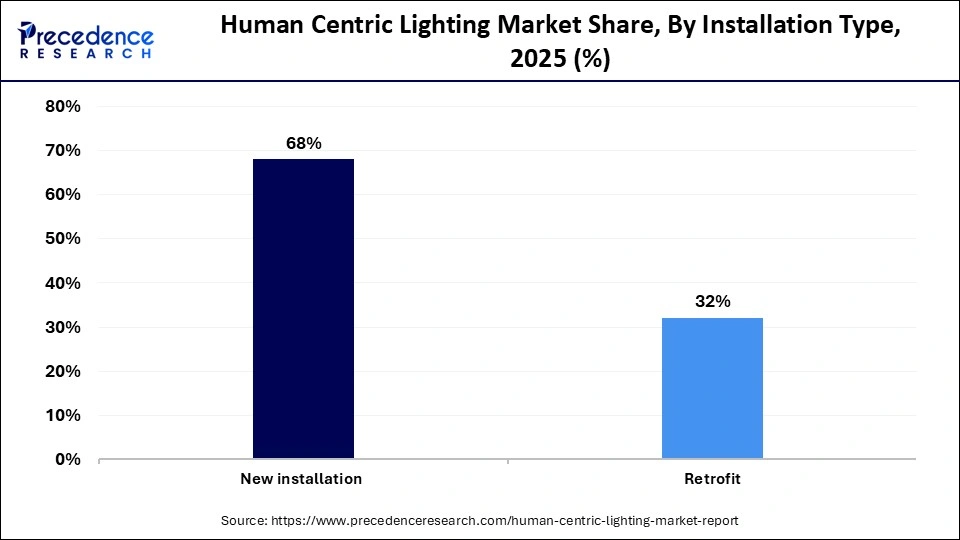
The retrofit segment is expected to grow at the fastest CAGR during the projection period because many existing buildings are upgrading to energy efficient, biologically optimized lighting without undergoing full reconstruction. Retrofit solutions allow easy integration of tunable LED fixtures, smart controls, and sensors into existing infrastructure, reducing costs and disruption. Increasing awareness of employee productivity, wellness, and energy savings in offices, healthcare facilities, and commercial spaces is driving the adoption of retrofit projects.
Application Insights
Human Centric Lighting Market Share, By Application, 2025 (%)
| Application | 2025 |
| Residential | 40% |
| Commercial | 60% |
Why Did the Commercial Segment Dominate the Human Centric Lighting Market?
The commercial segment dominated the human centric lighting market with a major share in 2025. This is because offices, retail spaces, and hospitality environments prioritize lighting that enhances productivity, comfort, and customer experience. Human-centric lighting in commercial settings improves employee well-being, reduces fatigue, and supports circadian rhythms, which drives adoption. Additionally, large-scale commercial projects often have higher budgets and a greater focus on energy efficiency and smart lighting integration, further reinforcing the segment's dominance.
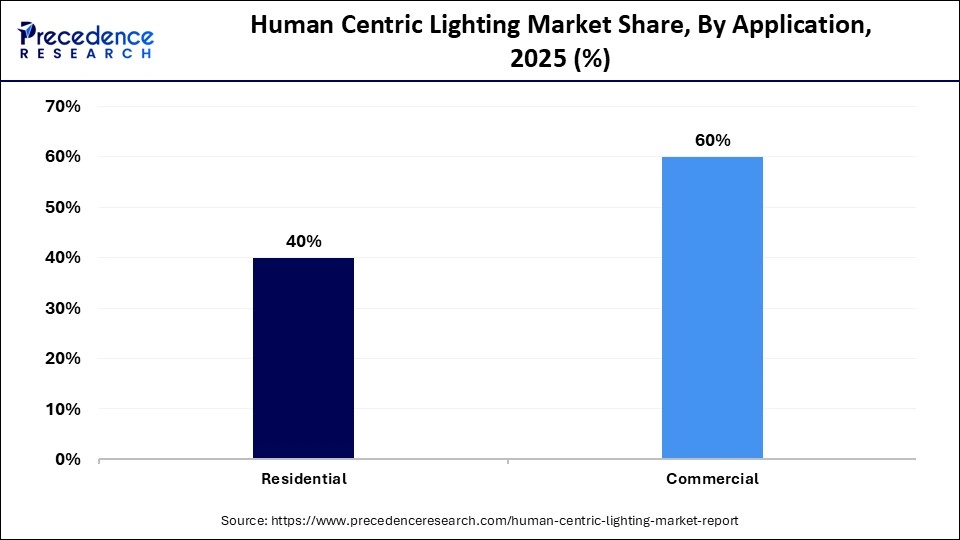
The residential segment is expected to grow at a rapid pace in the coming years, as homeowners increasingly seek lighting solutions that improve comfort, mood, and overall well-being. Tunable and smart lighting systems allow residents to adjust brightness and color temperature to match daily routines and circadian rhythms. Rising awareness of health benefits, along with the growing adoption of smart home technologies, is driving demand for human-centric lighting in residential settings.
Regional Insights
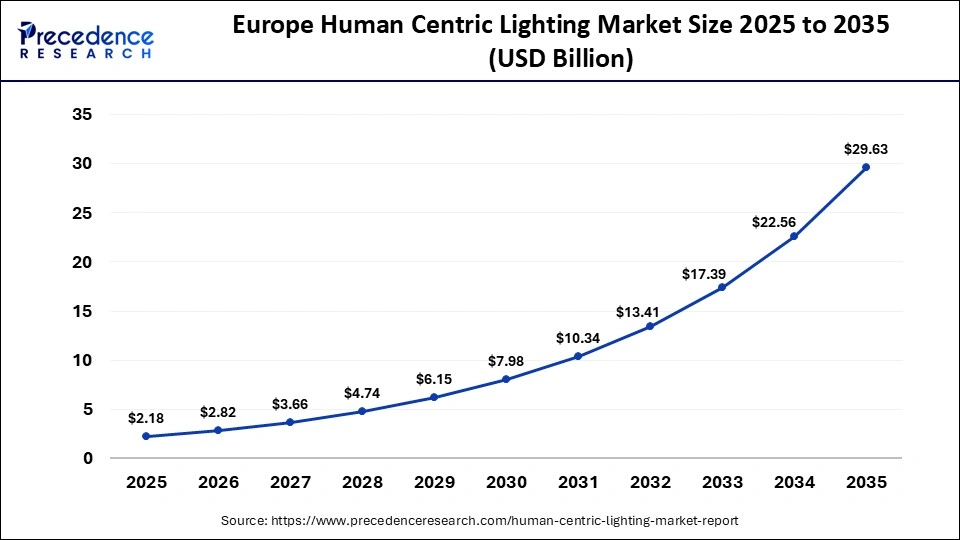
Europe Human Centric Lighting Market Size and Growth 2026 to 2035
The Europe human centric lighting market size has grown strongly in recent years. It will grow from USD 2.18 billion in 2025 to USD 29.63 billion in 2035, expanding at a compound annual growth rate (CAGR) of 29.82% between 2026 and 2035.
What Made Europe the Leading Region in the Human Centric Lighting Market?
Europe led the human centric lighting market with the largest share in 2025 due to strict regulations and standards promoting energy efficiency, occupant well-being, and sustainable building practices. Strong adoption of smart building technologies, combined with high awareness of lighting's impact on health and productivity, has driven widespread implementation in offices, healthcare facilities, and commercial spaces. Additionally, the presence of key lighting manufacturers and innovative research in the region supports the development of advanced human centric lighting solutions, reinforcing Europe's market leadership.
Germany Human Centric Lighting Market Analysis
Germany is a major contributor to the European human centric lighting market due to its advanced industrial and commercial infrastructure, high adoption of smart building technologies, and strong emphasis on energy efficiency and sustainability. The country's strict regulations on building standards and workplace wellness further encourage the implementation of human-centric lighting solutions. Additionally, Germany is home to leading lighting manufacturers and research institutions, driving innovation and large-scale adoption across commercial and residential sectors.
How is the Opportunistic Rise of Asia Pacific in the Human Centric Lighting Market?
Asia Pacific is expected to grow at the fastest rate in the market throughout the forecast period. This is mainly due to rapid urbanization, growing development of commercial buildings, and increasing adoption of smart building technologies. Expanding awareness of energy efficiency, employee wellness, and the health benefits of circadian lighting is driving demand in offices, healthcare, and hospitality sectors. Additionally, government initiatives supporting sustainable construction and the presence of a large consumer base for smart home solutions create significant growth opportunities in the region.
China Human Centric Lighting Market Analysis
The market in China is growing due to rapid urbanization, expanding commercial and residential construction, and widespread adoption of smart building and home automation technologies. Growing awareness of energy efficiency, health, and wellness benefits of human-centric lighting is driving demand across offices, healthcare facilities, and homes. Additionally, supportive government initiatives for sustainable infrastructure and a large manufacturing base for lighting products further strengthen China's market leadership in the region.
Why is North America Emerging as a Strategic Hub for Human Centric Lighting Market?
The North America region is expected to grow at a significant CAGR between 2026 and 2035, due to the increasing smart building uptake in commercial construction. Adaptive illumination control networks are progressing in the footsteps of smart lighting systems to improve workplace productivity.
U.S. Becoming North America's Lighting Powerhouse
The U.S. is a major contributor to the North American market, as campuses use adaptive lighting to boost employee productivity in offices across the country. Circadian lighting technologies, which enhance patient recovery outcomes, are incorporated into healthcare buildings, with a notable and positive change in these outcomes.
Why Is the Middle East & Africa Strengthening Its Position in the Human Centric Lighting Market?
The Middle East and Africa region is expected to register significant growth in the market during 2026 and 2035, driven by rapid regional smart city investments. The integration of intelligent light in urban environments goes hand-in-hand with digital building technologies, with their implementation accelerating quickly.
Saudi Arabia Emerging as a Major Human Centric Lighting Adoption Region
Saudi Arabia is a major player in the Middle East and Africa market, owing to the fact that smart city investments are rapidly expanding, leading to the lighting of its cities. Premium hotels in Dubai are taking a short leap into experiential lighting systems as part of the hospitality sector's rapid expansion.
Which Factors Drive the Human Centric Lighting Market in Latin America?
The Latin America region is estimated to grow at a notable CAGR over the projected period, due to the growing demand for urban modernization. The lighting scenario is increasingly changing with the modernization of infrastructure. Dynamic lighting systems are adopted to connect with customers to support market growth in retail expansion in the coming years.
Brazil Becoming Latin America's Largest Big Data Analytics Growth Engine
Brazil leads the regional Latin America market, propelled by booming urban centers, and smart lighting that enhances job productivity in commercial offices is picking up speed. Foreign investments promote smart building and lighting technology upgrades to regional expansion. Regional expansion is promoted by upgrading smart building and lighting technology through foreign investments.
Competitive Landscape
The human centric lighting market continues to be moderately fragmented as lighting and technology companies from across the globe play a major role in the market. Installation complexity and system integration requirements are high across the world, which imposes high entry barriers. Software-powered lighting and automation platforms are increasingly used by technology companies to boost their footprint on a global level.
Cree Lighting USA LLC, Eaton Corporation, and Fagerhults Belysning AB are players specialising in adaptive lighting solutions in healthcare and commercial applications. CoDevelopment Partnerships speed the pace of new-product development among light manufacturers and technology suppliers worldwide. Smart lighting portfolios and geographic market expansions are greatly increased through mergers and acquisitions.
Human Centric Lighting Market Companies
- Cree Lighting USA LLC
- Eaton Corporation
- Fagerhults Belysning AB
- Helvar
- Hubbell Lighting
- LEDVANCE GmbH
- ACUITY BRANDS, INC.
- Legrand SA
- Lutron Electronics Co., Inc
- Schneider Electric
- Signify Holding
- Trilux Group
- Wipro Lighting
- Zumtobel
Recent Developments
- In January 2024, Hyundai Mobis Co. unveiled a system that changes car interior lights depending on a driver's mood and physical condition to improve driving safety. The company has created a human-centric lighting system for the future mobility environment. This system senses a user's biorhythm and driving environment to automatically adjust the color, brightness, and display of automotive interior lights as required. This advanced system improves drivers' satisfaction by reinterpreting the function and purpose of car interior lighting to meet future mobility trends, which heavily focus on personalized user experience (UX). (Source: https://www.kedglobal.com)
- In December 2025, SUNROOOF, a brand specializing in scientifically developed daylight solutions, announced the launch of its e-commerce platform to enable access to premium human-centric lighting for commercial, residential, and institutional environments in India & UAE. This platform enables customers to explore a thoughtfully curated portfolio of daylighting solutions specifically designed to elevate mood, enhance productivity, regulate day-to-day rhythms, and improve overall well-being. In a remarkable trajectory, SUNROOOF has achieved INR 15 crore revenue within just 12 months and is targeting to achieve INR 50 crore this year, driven by its expansion into larger markets and high-value projects.(Source: https://mediabrief.com)
Segments Covered in the Report
By Product
- Fixtures
- Controllers
- Sensors
- Drivers
- Microcontrollers
- Others
- Software
- Services
By Installation Type
- New Installation
- Retrofit
By Application
- Residential
- Commercial
- Education
- Office
- Healthcare
- Industrial
- Others
By Region
- North America
- Latin America
- Europe
- Asia-pacific
- Middle and East Africa
For inquiries regarding discounts, bulk purchases, or customization requests, please contact us at sales@precedenceresearch.com
Frequently Asked Questions





Ask For Sample
No cookie-cutter, only authentic analysis – take the 1st step to become a Precedence Research client
 Get a Sample




 sales@precedenceresearch.com
 Schedule a Meeting
