



Industrial Dust Collector Market Size, Key Companies, Company Production Capacity, Manufacturing Efficiency, Production Output, Supply Chain Metrics, Cost Structure, Company Expansion Strategies, and Growth Opportunities
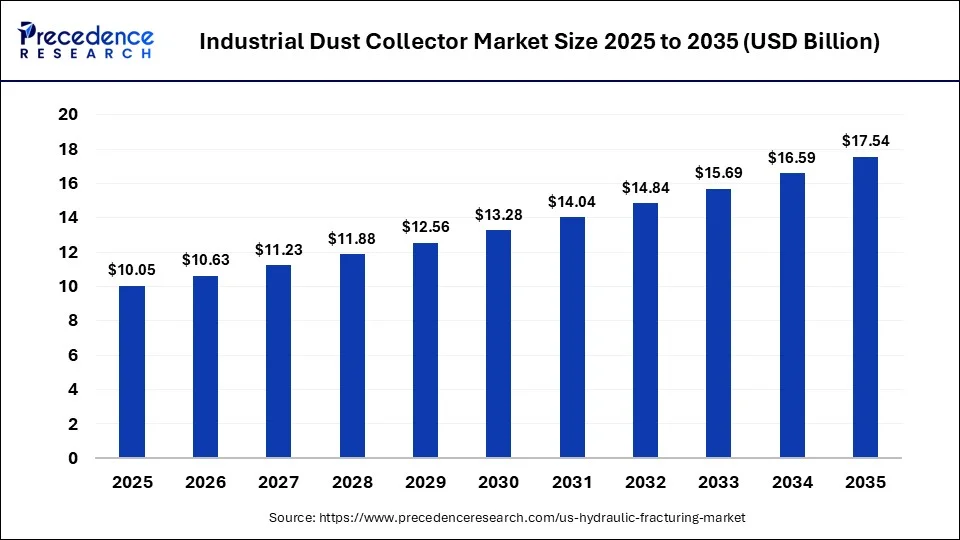
The industrial dust collector market accounted for around USD 10.63 billion in 2026. The market growth is being driven by the expansion of the manufacturing ecosystem in various dust-intensive sectors in emerging economies and the tightening of regulations regarding worker safety and environmental emissions. These trends were evaluated by our Senior Research Analyst, Laxmi Narayan, to curate this well-researched report. His analysis benefits machinery manufacturers, distributors, industry researchers, and stakeholders in conducting competitive analysis and making well-informed decisions.Â
Source: https://www.precedenceresearch.com/industrial-dust-collector-market
 Get a Sample
 Table Of Content


Industrial Dust Collector Market Trends, Growth, and Market Size Analysis 2035
The industrial dust collector market is forecasted to expand from USD 10.63 billion in 2026 to USD 17.54 billion by 2035, growing at a CAGR of 5.73% from 2026 to 2035. Many emerging economies are boosting their heavy industry manufacturing capacities, which includes cement, mining, and steel, thus benefiting the large-volume dust collector ecosystem. Laxmi Narayan, our Senior Research Analyst, has over 5 years of experience in the machinery and equipment industry. According to him, buyer priorities are extending beyond dust collection capability to include power efficiency, emission control, longer lifecycles and lower ownership costs.
Asia Pacific contributed to around 37.1% of global revenue in 2025, making it the largest regional demand center, while China was the leading individual country market within the region. The market has significant structural diversity: large stationary baghouses and electrostatic precipitators cater to the needs of cement, mining, steel and power plants, while compact cartridge systems are being increasingly used for metalworking, pharmaceutical, food processing, welding, woodworking and advanced manufacturing. Baghouse collectors accounted for around 25.8% of 2025 revenue, while cartridge collectors are expected to grow at the fastest rate in the equipment segment. Fixed installations represented approximately 67.1% of revenue, showing the consistent dominance of plant-integrated systems.
The full study distinguishes new equipment, retrofit/replacement demand, filtration media, installation, maintenance, and digital monitoring, allowing investors and suppliers to recognize where equipment revenue ends and recurring aftermarket value begins.
Key Takeaways
- The industrial dust collector market is projected to grow from USD 10.63 billion in 2026 to USD 17.54 billion by 2035, registering a 5.73% CAGR during 2026-2035.
- Asia Pacific accounted for approximately 37.1% of global industrial dust collector revenue in 2025, making it the largest regional market.
- Baghouse collectors held around 25.8% of market revenue in 2025, while cartridge collectors are projected to be the fastest-growing equipment segment.
- Fixed installations represented approximately 67.1% of market revenue, highlighting the dominance of plant-integrated dust collection systems.
- Dry dust collection systems generated approximately 66.2% of 2025 revenue, while wet dust collection was valued at around USD 3.43 billion and is projected to grow at approximately 6.4% CAGR through 2035.
- The India industrial dust collector market was valued at approximately USD 642.9 million in 2025 and is projected to reach around USD 1.29 billion by 2033, expanding at a 9.2% CAGR.
- The estimated five-largest suppliers Nederman, Donaldson, Parker, Camfil, and ANDRITZ collectively accounted for approximately 20.4% of the market under one 2025 market definition.
- Nederman held an estimated 5.1% market share in 2025, followed by Donaldson at 5.0%, Parker at 4.0%, Camfil at 3.8%, and ANDRITZ at 2.5%.
- Donaldson reported USD 914.2 million in 2025 Industrial Filtration Solutions sales, while its broader Industrial Solutions segment generated approximately USD 1.10 billion.
- Nederman's Extraction & Filtration Technology division generated SEK 2.649 billion in 2025 sales and SEK 362 million in adjusted EBITA, representing a 13.7% adjusted EBITA margin.
Key Coverage
- 2025 market value: ~USD 10.02 billion
- 2033 forecast: ~USD 15.03 billion
- 2026-2033 CAGR: ~5.31%
- Asia Pacific share: ~37.1%
- Baghouse share: ~25.8%
- Fixed-installation share: ~67.1%
- Cartridge technology identified as a major high-growth pool
- Detailed country, application, technology and competitive analysis
What Was the Size of the Industrial Dust Collector Market in 2025?
The market increased from approximately USD 10.05 billion in 2025 to USD 17.54 billion in 2035, implying roughly USD 5 billion of incremental annual revenue opportunity by 2035 relative to the 2026 base. Alternative market definitions that do not consider integrated equipment categories, aftermarket components, and certain pollution-control technologies produce materially smaller market values; the research therefore explicitly defines the addressable market to avoid double counting.
The fluctuations in demand are not expected to be as high as those in consumer-based volatility circumstances. Growth is being driven by industrial capacity expansion, replacement of aging filtration machinery, tighter particulate-emission needs, occupational exposure controls and expansion of dust-intensive production in upcoming economies.
The full forecast model provides 2021-2033 historical and forecast series, regional contribution, segment-level CAGR, absolute-dollar opportunity, penetration assumptions and base/upside/downside scenarios.
Key Coverage
- Historical market reconstruction
- 2024-2025 market progression
- 2030 and 2033 forecasts
- Absolute incremental opportunity
- Regional and country forecasts
- Equipment versus replacement demand
- Base/upside/downside scenarios
Why Did Baghouses Account for the Major Revenue in 2025?
The market divides most meaningfully by collector type, filtration mechanism, mobility, airflow capacity, cleaning technology, and end-use industry. Baghouse systems continue to be the most prominent individual equipment category, reflecting their usability for high dust loading and large air volumes. Cartridge collectors are growing at a higher rate owing to the fact that they offer compact footprints, high filtration efficiency and simpler maintenance for applications where plant space is constrained.
By mechanism, dry systems contributed to around 66.2% of 2025 revenue, while wet systems represented a smaller but faster-growing base; wet dust collection was estimated at approximately USD 3.43 billion in 2025, with a projected CAGR of roughly 6.4% through 2033.
By application, cement, mining, steel and power continue to be crucial high-volume markets, whereas pharmaceuticals, food processing, electronics, battery manufacturing and precision metalworking open doors for higher-value opportunities for compact, high-efficiency and contamination-controlled systems.
Key Coverage
- Baghouse, cartridge, ESP, cyclone and wet scrubber
- Dry versus wet
- Fixed versus portable
- Pulse-jet and alternative cleaning
- Cement, mining, steel, power, food, pharma and manufacturing
- Capacity/airflow segmentation
- Regional segment shares and CAGRs
How is the Regulatory Landscape Influencing the Market?
The strongest driver of demand is the rising cost of uncontrolled particulate emissions and workplace dust exposure. Combustible dust brings additional risk factors because collection systems must control not only emissions but also ignition, explosion propagation, and secondary dust accumulation. Regulatory and consensus frameworks consequently shape collector architecture, explosion protection, duct configuration, monitoring and maintenance.
Industrialization in Asia, particularly manufacturing, mining, cement, metals, pharmaceuticals, and food processing, and modernization of equipment are propelling the growth of the market. Older collectors often consume more energy, have higher maintenance costs, and lack continuous performance monitoring.
Some of the important growth restraints include high initial CAPEX, engineering intricacies, installation downtime, energy usage from fans and compressed-air cleaning, and maintenance needs.
Key Coverage
- Regulation-driven replacement
- Industrial capacity expansion
- Worker-safety requirements
- Combustible-dust risk
- Energy and maintenance costs
- Retrofit versus greenfield demand
- Customer procurement-cycle analysis
Which Factors are Influencing the Prices of Equipments?
Industrial dust collection is mainly project-priced rather than commodity-priced. Indian-market examples that are publicly quoted range from roughly ₹40,000-₹50,000 for smaller 3,000-5,000 CFM units to approximately ₹3-4 lakh for 5,000-10,000 CFM cartridge or pulse-jet systems, while larger centralized systems can exceed ₹10 lakh-₹25 lakh per installation before full plant integration. These public quotations are indicative, not directly comparable because fan capacity, filtration area, ductwork, controls, explosion protection and installation scope vary substantially.
This is the reason why pricing follows $/CFM, $/airflow capacity, filtration area, system complexity and total installed cost, rather than a single standardized ASP. Premium systems come with steeper prices where customers require ATEX/NFPA-compatible explosion protection, pharmaceutical containment, high-efficiency media or digital monitoring.
The full analysis benchmarks equipment pricing by capacity, configuration, geography and application and separates equipment ASP, installation cost, replacement media, service revenue and lifecycle cost.
Key Coverage
- Equipment ASP benchmarks
- $/CFM and capacity economics
- Regional pricing
- Cartridge versus baghouse economics
- Filter-media costs
- Installation and commissioning
- Energy and maintenance cost
- Lifecycle/TCO analysis
Will Aftermarket Economics and Smart Filtration Shift Value Capture Away From One-Time Dust Collector Equipment Sales?
The industrial dust collector value chain is increasingly expanding from just equipment fabrication into system engineering, installation, replacement filtration, monitoring and maintenance, creating multiple sources of revenue across the asset lifecycle. Unlike standardized industrial equipment, dust-collection projects need site-specific airflow calculations, duct balancing, dust characterization, filtration-media selection and, for combustible applications, explosion-protection engineering. Our analysis points to the fact that this engineering intensity decreases pure price-based competition and enables suppliers with application prowess and well-developed infrastructure to access greater opportunities to secure recurring revenue.
Our analysis indicates that aftermarket filtration and service capabilities are becoming an increasingly important differentiator as customers are giving priority to net cost of ownership and not just initial equipment price. Replacement filters, preventive maintenance, pressure monitoring, and system optimization can generate recurring revenue after the initial collector installation, while lower-pressure-drop media and optimized pulse cleaning can decrease fan and compressed-air consumption for customers. In our view, this moves the competitive emphasis from just supplying a collector to managing filtration performance, energy consumption and equipment uptime over the asset lifecycle. Suppliers who have the ability to combine equipment with recurring consumables, technical service and monitoring are consequently better positioned to enhance customer relationships and decrease exposure to cyclical new-project demand.
Technology is complementing this shift. Pleated high-efficiency media, automated pulse cleaning, explosion protection, differential-pressure monitoring, airflow measurement and condition-based maintenance are shifting dust collection toward increasingly data-enabled operation. Connected systems can track parameters such as differential pressure, airflow, compressed-air consumption, particulate levels and filter condition, creating the basis for earlier maintenance intervention and more efficient filter replacement. According to our Senior Researcher, Aditi Shivarkar, digital monitoring will be commercially important where customers operate massive installed bases or face high downtime and compliance expenditures, but adoption is likely to remain more gradual among smaller facilities where equipment simplicity and upfront costs are still dominant purchasing criteria.
The full report quantifies the value chain from steel, filter media, fans, motors, valves and controls through collector manufacturing, engineering, installation and commissioning to replacement media, monitoring and maintenance, including component-cost exposure, supplier concentration, manufacturing economics, engineering and installation margins, aftermarket potential and technology adoption by application and geography. The underlying intelligence can also be structured into a market database tracking company, product type, filtration technology, airflow capacity, application, geography, installed equipment, replacement-media demand, monitoring capability, service offering and technology adoption status, enabling supplier benchmarking and identification of aftermarket and smart-filtration opportunities across individual market segments.
Changes in the Regulatory Landscape
Regulation increasingly influences collector specifications, not just requiring an end-of-pipe solution. Combustible-dust controls often need engineered containment, explosion relief or suppression, grounding, housekeeping, and appropriately designed collection systems.
European industrial-emissions requirements and strengthening particulate controls drive the demand for high-efficiency filtration and emissions monitoring. Sustainability is moving purchasing criteria toward lower fan power, reduced compressed-air consumption, longer filter life, and fewer replacement cycles.
Key Coverage
- Industrial-emissions requirements
- Combustible-dust standards
- Occupational exposure
- ATEX/NFPA considerations
- Particulate monitoring
- Energy efficiency
- Filter-life optimization
- Lifecycle sustainability
How are the Priorities of Buyers Influenced According to the Industry and the Application?
Large cement, mining, steel and power operators typically assess systems on airflow reliability, emissions performance, uptime, maintenance cost and total installed cost. Pharmaceutical and food producers give greater importance to contamination control, hygienic design and safe filter replacement. Metalworking and welding applications increasingly give higher priority to compact systems and localized extraction.
The purchasing process is therefore shaped by technicalities, with OEM qualification, application engineering, site surveys, airflow calculations and commissioning capability creating switching obstacles. Retrofit projects also generate recurring replacement-media and service opportunities.
The full study quantifies application revenue, CAGR, customer type, procurement model, technical specifications, switching barriers and unmet requirements.
Key Coverage
- Cement and mining
- Steel and metals
- Power generation
- Food and beverage
- Pharmaceuticals
- Chemical processing
- Woodworking
- Welding and fabrication
- Battery/electronics manufacturing
How is Technology, Engineering, and Aftermarket Network Shaping the Competitive Landscape?
The competitive landscape combines global filtration platforms with regional specialists. One recent market estimate places the five largest participants at approximately 20.4% combined share, showing the high levels of fragmentation in the broader market; individual shares vary significantly depending on whether the definition includes ESPs, scrubbers, integrated systems and aftermarket products.
The most important competitive trend is the shift toward full-lifecycle solutions rather than standalone collector sales. Some of the important differentiators include filtration media, application engineering, controls, monitoring, replacement parts and service networks.
Tentative Leading Company Universe
| Company | Headquarters | Market Position | Core Strength |
| Donaldson Company | U.S. | Global leader | Industrial filtration |
| Parker Hannifin | U.S. | Global platform | Filtration & aftermarket |
| Camfil | Sweden | Global specialist | Cartridge filtration |
| Nederman | Sweden | Global specialist | Industrial air filtration |
| CECO Environmental | U.S. | Global environmental supplier | Air pollution control |
| Thermax | India | Regional/global | APC & industrial systems |
| FLSmidth | Denmark | Process-industry specialist | Cement/mining |
| ANDRITZ | Austria | Global engineering player | Process filtration |
| Babcock & Wilcox | U.S. | Power/APC specialist | Emission control |
| Sumitomo Heavy Industries | Japan | Industrial engineering | APC systems |
| Hamon | Belgium | APC specialist | Industrial emission control |
| KC Cottrell | South Korea | China/APAC specialist | ESP/APC |
| Kelin Environmental Protection Technology | China | Process-equipment specialist | Dust collection |
| Schenck Process | Germany | Dust-control specialist | Bulk-material filtration |
| Sly Environmental | U.S. | Specialist | Baghouse systems |
| Imperial Systems | U.S. | Specialist | Dust/fume collection |
| Airflow Systems | U.S. | Specialist | Industrial air filtration |
| Plymovent | Netherlands | Global filtration | Fume/dust extraction |
| AAF International | U.S. | Specialist | Industrial filtration |
| Keller Lufttechnik | Germany | Specialist | Industrial extraction |
| Filtermist | U.K. | Specialist | Oil mist/fume/dust |
| Micronics Engineered Filtration | U.S. | Specialist | Bags & aftermarket |
| Dust control | Sweden | Filtration specialist | Source extraction |
| Martin Engineering | U.S. | Bulk-material specialist | Dust-management systems |
| Dürr | Germany | Industrial systems | Air pollution control |
The full report provides detailed profiles for the 25-company universe covering headquarters, ownership, founding year, employees, revenue, relevant filtration exposure, profitability, R&D, CAPEX, product portfolio, applications, manufacturing footprint, innovation, acquisitions and strategic risks.
The strategic positioning framework differentiates market leaders, scale leaders, technology leaders, regional leaders, application specialists and emerging challengers rather than applying a single composite score.
Particular attention is given to the economic difference between suppliers focused on large one-time EPC projects and companies with significant replacement-media, service, monitoring and recurring aftermarket exposure.
This universe is tentative rather than a definitive ranking and is constructed around product relevance, application exposure, technology, manufacturing capability, geographic reach, and strategic importance.
Which Companies Accounted for the Most Revenue Share in 2025?
The most recent estimates indicate that no single supplier holds a dominant global market share. One 2025 estimate places Nederman at approximately 5.1%, Donaldson at 5.0%, Parker at 4.0%, Camfil at 3.8%, and ANDRITZ at 2.5%, with the five collectively at about 20.4%. These figures should be interpreted as market-definition-specific estimates rather than audited company-reported shares.
The full report builds company-level share approximations using equipment exposure, relevant revenue, application participation, and geographic presence, with explicit confidence ranges rather than artificial precision.
Key Coverage
- Top-5 and Top-10 share
- CR4/CR5/CR10
- Estimated individual shares
- Share gain/loss
- Global versus regional suppliers
- Market concentration by application
- Country-level competitive structure
Which Factors are Shaping the Competitive Landscape?
Donaldson noted USD 914.2 million of 2025 Industrial Filtration Solutions sales, and the broader Industrial Solutions segment generated USD 1.10 billion. The company's industrial-filtration sales grew by 1.5%, with new dust-collection demand in Europe and the U.S. contributing to performance.
Nederman's Extraction & Filtration Technology division achieved SEK 2.649 billion in 2025 sales and SEK 362 million in adjusted EBITA, producing a 13.7% adjusted EBITA margin. The division illustrates the economics of bringing together equipment, filtration and service-oriented offerings.
The complete benchmarking framework compares revenue, relevant filtration exposure, growth, margins, portfolio breadth, application coverage, geographic reach, manufacturing, digital capability, distribution, aftermarket, and M&A activity.
How are Modern Technologies and Applications Influencing the Market?
Portfolio comparison differentiates broad suppliers from specialists in baghouses, cartridges, ESPs, cyclones, wet scrubbers, source extraction, and replacement media. High-value differentiation increasingly comes from filter-media architecture, pressure-drop reduction, compact footprints, and explosion protection.
For example, advanced cartridge systems can offer extremely high filtration efficiency while reducing footprint; certain commercial configurations offer up to 10,000 m³/h airflow per module, while specialized pharmaceutical configurations can achieve 99.5% efficiency at MPPS for specified filter configurations.
Digital differentiation is also rising. Connected platforms monitor differential pressure, airflow, compressed-air pressure, pulse-valve condition, and particulate trends, allowing predictive rather than purely calendar-based maintenance.
Which Geographies Offer the Strongest Combination of Market Scale, Industrial Growth and Competitive Opportunity?
Asia Pacific contributed to around 37.1% of global industrial dust collector revenue in 2025, making it the largest regional demand pool, and China was the largest individual regional market. India stands out for its high growth rate: the market was estimated at USD 642.9 million in 2025 and is projected to reach approximately USD 1.29 billion by 2033, representing a 9.2% CAGR during 2026-2033. Our analysis points to the fact that Asia Pacific brings together scale as well as industrial expansion, creating a broader opportunity base than mature regions where replacement demand and well-developed installed bases play a larger role.
According to our Senior Researcher Aman Singh, geographic competition is being increasingly influenced by the interaction between market growth, local manufacturing economics and service capabilities and not just equipment pricing. Global suppliers are better suited to cater to the needs of multinational customers and technically complex projects, while regional suppliers can stay competitive through lower-cost manufacturing, application customization, swift installation and localized aftermarket assistance. We believe this creates competitive models according to the region: high-growth industrial markets can reward localization and service density, whereas mature markets tend to give greater importance to technology, compliance, energy efficiency and lifecycle performance.
According to our Senior Researcher Aditi Shivarkar, the standout insight is that regional expansion strategies need to balance demand potential with the ability to establish a credible local delivery and service footprint. Manufacturing presence, distributor network, engineering prowess, installation capacity, and replacement-filter assistance can materially shape supplier competitiveness, especially where dust-collection systems need site-specific engineering. This is why the report compares China, India, Japan, South Korea, Southeast Asia, North America, Europe and the Middle East across market size, growth, industrial demand drivers, supplier structure, manufacturing footprint and distribution/service coverage.
The full analysis also benchmarks local versus multinational supplier participation, regional market shares, competitive landscape, production localization, distributor networks, service coverage and application-specific opportunities, enabling evaluation of where suppliers can gain share through localization, technology differentiation or aftermarket expansion. The same intelligence can be structured into a geographic competitive database tracking country, market size, CAGR, supplier type, manufacturing footprint, distributor presence, service coverage, technology focus, application mix and competitive positioning, allowing users to filter and benchmark regional opportunities at country and supplier level.
Which Factors Constitute the Entry Barrier in the Market?
Large systems are seldomly sold as standardized boxes. Manufacturing capability must be combined with engineering, fan sizing, duct design, control systems, filter selection and commissioning. This creates meaningful obstacles despite relatively lesser barriers to entry for smaller collectors.
Direct sales hold significant importance in major engineered projects, while distributors and integrators are more important in fragmented metalworking, woodworking and small-to-medium manufacturing markets.
Key Coverage
- Manufacturing facilities
- Capacity and utilization
- Vertical integration
- Localization
- Direct versus distributor channels
- OEM relationships
- Application engineering
- Service networks
- Customer concentration
What are Some of the Important Strategic Developments in the Market?
M&A activity increasingly focuses on aftermarket filtration, industrial air technology, digital monitoring, and geographic distribution. A major 2025 transaction involved Parker Hannifin agreeing for the acquisition of Filtration Group for USD 9.25 billion; Filtration Group was expected to generate around USD 2 billion in sales in 2025, with approximately 85% of sales from aftermarket activities. The acquisition was completed in August 2026.
The acquisition strategy of Nederman has also expanded its technology and geographic presence; its acquisition history includes RoboVent, Aagaard, Duroair, and other industrial filtration businesses. The Duroair transaction, for example, implied an enterprise value of approximately CAD 11 million, with a potential earn-out of up to CAD 4 million.
Micronics' 2024 acquisition of Action Filtration further illustrates the attractiveness of replacement-filter and aftermarket capabilities.
Key Coverage
- 2024-2026 acquisitions
- Deal values
- Target revenue
- Aftermarket strategy
- Geographic expansion
- Technology acquisitions
- Vertical integration
- Future M&A themes
Which Areas Have the Strongest Potential to Drive Market Growth
The white spaces with highest value include:
- Cartridge collectors, supported by faster projected growth than traditional baghouse systems.
- India, where the market is projected to roughly double between 2025 and 2033.
- Smart monitoring, where differential-pressure and particulate data can convert equipment into a connected service platform.
- Battery, electronics, and precision manufacturing, where fine-particle control and compact footprints are gaining importance.
- Aftermarket filtration, where recurring replacement demand can generate more predictable revenue than new-equipment cycles.
- Energy-efficiency upgrades, particularly lower-pressure-drop media and optimized pulse cleaning.
The full study evaluates each opportunity by revenue pool, CAGR, penetration gap, geography, application, and competitive intensity.
Market Fragmentation Trends
| Force | Assessment | Market-specific rationale |
| Supplier power | Medium | Filter media, fans, motors and controls are important but generally multi-sourced |
| Buyer power | Medium–High | Large industrial customers run technical tenders and negotiate project pricing |
| New entrants | Medium | Equipment fabrication is accessible, but engineering, certification and installed-base credibility are harder |
| Substitutes | Low–Medium | Process redesign and wet suppression can substitute in selected applications, but filtration remains essential across many processes |
| Rivalry | High | Global suppliers, regional fabricators and application specialists compete across overlapping segments |
How Will Regulation and Industrial Investment Benefit the Market?
- Political: industrial-emissions enforcement and manufacturing localization affect investment.
- Economic: cement, mining, steel, power and manufacturing CAPEX influence large-system demand.
- Social: worker exposure and workplace air quality boost demand for source extraction.
- Technological: smart sensors, advanced media and lower-pressure-drop systems move competition toward lifecycle economics.
- Legal: particulate, occupational-safety and combustible-dust requirements influence system specifications.
- Environmental: lower emissions, energy efficiency and reduced filter waste are increasingly influencing procurement decisions.
The market is therefore structurally lucrative for technically differentiated suppliers, while commoditized low-end equipment faces higher price pressure. The full analysis assesses attractiveness separately by technology, geography, application and customer type, including growth, margin potential, entry barriers, competition and CAPEX needs.
Which Factors Will Significantly Influence the Growth of the Market in Future?
Under the base case, the global market reaches around USD 15 billion by 2033, with roughly 5% yearly growth. The best-case scenario involves rapid industrial CAPEX, strengthened particulate standards, and faster replacement of inefficient equipment; the worst-case scenario involves delayed industrial projects, weaker manufacturing investment and prolonged price competition.
By 2030-2035, the competitive differentiators are expected to increasingly revolve around energy consumption per unit of airflow, filter life, remote monitoring, predictive maintenance, explosion protection, modularity and recurring aftermarket revenue rather than just collector hardware.
The full forecast is not limited to revenue CAGR and also examines technology adoption, application growth, regional shifts, pricing, margins, capacity, M&A, future profit pools and strategic priorities.
Experts Insights
According to our Senior Researcher Aman Singh, tightening emission and worker dust exposure regulations are significantly influencing the prioritized equipment design. The expansion of the dust-intensive manufacturing ecosystem in high-growth regions is driving the demand for industrial dust collectors. The intricacies regarding tightening regulations and growing needs for sustainability are creating significant technical entry barriers, which limit the level of fragmentation in the market.
Our Experts
- The primary market research process was carried out by Laxmi Narayan, Senior Research Associate, who also designed the methodology and did market segmentation, regional trend analysis, buyer intelligence, competitive analysis, and forecasts, laying the foundation for the analytical part of the report.
- Aman Singh, Head of Research, has gathered and checked regulatory policies, company financial information, production information, commodity price information, and various other quantitative information sources, which were obtained independently, thereby increasing the quality of evidence supporting the calculations of the market values.
- Aditi Shivarkar, VP Research, has validated and refined the research material, verified facts, corrected inconsistencies, and completed the research document, making it accurate and to the point.
Industrial Dust Collector Market Segments Covered in This Report
By Collector Type
- Baghouse
- Cartridge
- ESP
- Cyclone
- Wet Scrubber
By Mechanism
- Dry
- Wet
By Mobility
- Fixed
- Portable
By End Use
- Cement
- Mining
- Steel & Metals
- Power
- Food & Beverage
- Pharmaceuticals
- Chemicals
- Woodworking
- Welding & Fabrication
- Battery & Electronics
- Other Manufacturing
By Demand Type
- New Installation
- Retrofit
- Replacement
By Region
- North America
- Europe
- Asia Pacific
- Latin America
- Middle East & Africa
For inquiries regarding discounts, bulk purchases, or customization requests, please contact us at sales@precedenceresearch.com
Frequently Asked Questions





Ask For Sample
No cookie-cutter, only authentic analysis – take the 1st step to become a Precedence Research client
 Get a Sample




 sales@precedenceresearch.com
 Schedule a Meeting
