



Industrial Filters Market Trends, Companies, Revenue / Sales Performance, Manufacturing Yield, Fab Capacity, Export & Import Dynamics, Supply Chain Analysis, Competitive Landscape, and Growth Forecast
Industrial Filters Market (By Filter Type: Air Filters, Liquid Filters, Dust Collectors, Others; By Media Type: Fiberglass, Activated Carbon; By Mechanism: Mechanical Filtration, Electrostatic Filtration, Chemical Filtration, Membrane Filtration, Centrifugal Separation; By Application Industry: Semiconductor & Electronics, Non-cleanroom Applications, Pharmaceutical & Biotechnology, Food & Beverage, Chemical & Petrochemical, Oil & Gas, Power Generation, Metals & Mining, Automotive & Aerospace, HVAC & Building Systems, Textiles; By End Use Environment: High-Chemical-Load Zones, By Sales Channel: OEMs (Original Equipment Manufacturers), Aftermarket/Replacement Sales, Distributor/Dealer Sales, E-commerce) - Global Industry Analysis, Size, Trends, Leading Companies, Regional Outlook, and Forecast 2026 to 2035
Source: https://www.precedenceresearch.com/industrial-filters-market
 Get a Sample
 Table Of Content


What is the Industrial Filters Market Size?
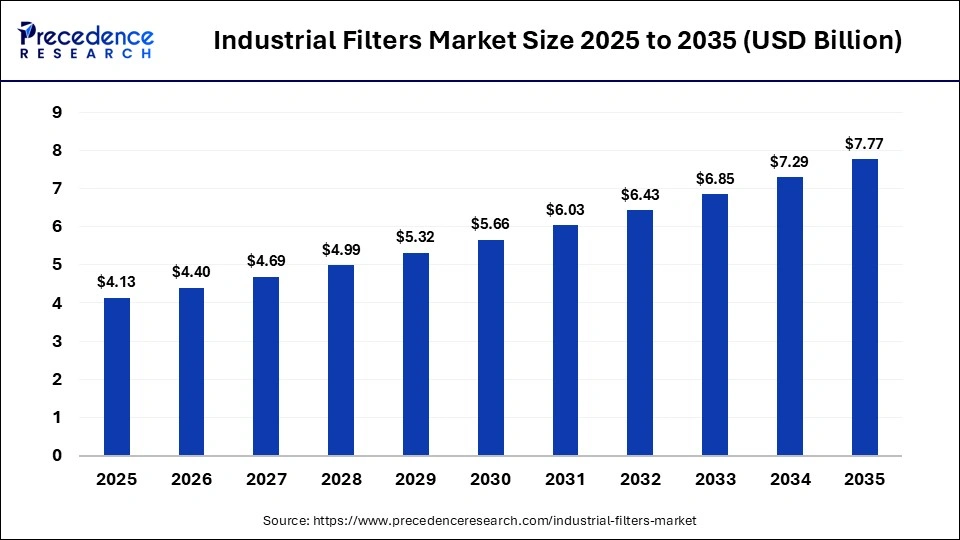
The global industrial filters market size was calculated at USD 4.13 billion in 2025 and is predicted to increase from USD 4.40 billion in 2026 to approximately USD 7.77 billion by 2035, expanding at a CAGR of 6.52% from 2026 to 2035. The global industrial filters market is growing due to increasing regulatory pressure on air and water quality, driving adoption of filtration systems across manufacturing, energy, and processing industries. Rising industrialization, along with greater focus on equipment protection, process efficiency, and worker safety, is further strengthening demand for advanced filtration solutions worldwide.
Market Highlights
- The Asia-Pacific led the market by holding the largest market share in 2025.
- By filter type, air filters have dominated the industrial filters market in 2025.
- By filter type, dust collectors are the fastest-growing segment between 2026 and 2035.
- By media type, non-woven fabrics have dominated the market as of 2025.
- By media type, nanofibers and composites is poised to grow at a strong CAGR between 2026 and 2035
- By mechanism, mechanical filtration segment is leading the market in 2025.
- By mechanism, membrane filtration segment is growing at a notable CAGR between 2026 and 2035.
- By application industry, HVAC and building systems have dominated the market in 2025.
- By application industry, the semiconductor and electronics segment is expanding at a solid CAGR between 2026 and 2035.
- By end use environment, clean rooms have dominated the market in 2025.
- By end use environment, high chemical load zones segment is growing at a healthy CAGR between 2026 and 2035.
- By sales channel, aftermarket and replacement sales dominate the market in 2025.
- By sales channel, e-commerce is expected to grow at a strong CAGR between 2026 and 2035.
Market Overview
The industrial filtration market is a sector that focuses on eliminating impurities and contaminants from liquids and gases in industrial processes. Utilizing a diverse range of technologies, including reverse osmosis and microfiltration, it caters to various industries such as oil and gas, pharmaceuticals, and even manufacturing. Market growth is boosted by factors such as industrialization, stringent environmental mandates, technological advancements, and improvements in filtration systems that help in enhancing efficiency. Significant trends such as the integration of IoT and the emphasis on sustainable solutions are also shaping the market's landscape.
What Is the Impact of AI on the Industrial Filters Market?
Artificial Intelligence is completely revolutionizing the global industrial filters market by introducing automation, predictive insights, and greater precision in process management. AI systems are driving the development of smart filters that can automatically adapt to changing industrial conditions. These smart filters can track pollutants and humidity as well as temperature fluctuations and adjust their performance accordingly to ensure consistent filtration efficiency. Machine learning algorithms can also analyze real-time data and predict membrane fouling, optimize transmembrane pressures, and extend the membranes' life span, thus reducing downtime. AI tools can also assist in supply chain and inventory management by helping predict demand fluctuations across multiple industries and regions. This helps manufacturers and distributors to maintain optimal inventory levels and also reduce waste. It also uses AI powered image recognition to check for any defects, ensuring reliability and consistency.
- Additionally, another notable trend in the market is the integration of smart technologies such as the IoT into filtration systems. These technologies facilitate real-time monitoring, predictive maintenance, and enhanced filtration efficiency.
What Are the Key Industrial Filters Market Trends?
- The increasing adoption of advanced filtration technologies, including nanofiltration and ultrafiltration, is transforming the market by offering higher efficiency, improved contaminant removal, and enhanced sustainability. These technologies enable precise separation of particles, bacteria, and dissolved solids, making them ideal for applications such as water treatment, pharmaceuticals, food and beverage processing, and chemical manufacturing.
- The expansion of manufacturing in emerging economies is leading to a surge in demand for industrial filtration systems, as industries are compelled to prioritize operational efficiency, regulatory compliance, and contamination control. Rapid industrialization in sectors such as food and beverage, pharmaceuticals, chemicals, automotive, and electronics is increasing the need for high-performance filtration solutions to maintain product purity, equipment longevity, and workplace safety.
- The industrial filtration market is witnessing an increasing demand for sustainable, biodegradable, and recyclable materials. Discussions on environmental impacts has pushed the utilization of renewable resources, encouraging companies to create filters that align with ecological goals. Companies like Pall Corporation are increasingly integrating eco-friendly materials into their filtration systems.
Market Scope
| Report Coverage | Details |
| Market Size in 2025 | USD 4.13 Billion |
| Market Size in 2026 | USD 4.40 Billion |
| Market Size by 2035 | USD 7.77 Billion |
| Market Growth Rate from 2026 to 2035 | CAGR of 6.52% |
| Dominating Region | Asia Pacific |
| Base Year | 2025 |
| Forecast Period | 2026 to 2035 |
| Segments Covered | Filter Type, Media Type, Mechanism, Application Industry, End Use Environment, Sales Channel, and Region |
| Regions Covered | North America, Europe, Asia-Pacific, Latin America, and Middle East & Africa |
Segmental Insights
Filter Type Insights
Which Filter Type Has Dominated the Global Industrial Filters Market in 2025?
Air filters have dominated the market this year because of their crucial role in maintaining indoor air quality, meeting regulatory standards, and ensuring safety across various industries such as food and beverage, manufacturing, and pharmaceuticals. Rising concerns about air quality and safety are further pushing this segment ahead. This segment witnessed a boom right after the Covid-19 pandemic, as defense against pollutants was a priority.
Dust collectors are set to be the fastest-growing segments in the forecasted period. This growth is because they offer a specialized solution for industries that deal with heavy particulate emissions like cement, metalworking, mining, and even woodworking. These dust collectors are specially equipped for high-volume dust capture and disposal, ensuring compliance with stringent safety and environmental regulations. Furthermore, dust collectors deliver long-term cost savings and energy-efficient solutions, making them a popular choice in the market.
Media Type Insights
Which Media Type Has Dominated the Market in 2025?
Non-woven fabrics have dominated the market as of this year due to their cost-effectiveness, versatile nature, and widespread adoption across various industries. They provide high dust-holding capacity, durability, and efficiency while simultaneously being cheaper than advanced composites or nanofibers. Additionally, their large pore size distribution makes them a popular choice for general industrial air filtration, liquid filtration, and even gas filtration. This is especially beneficial for large-scale industries such as automotive manufacturing, power generation, and even cement.
Nanofibers and composites are set to be the fastest-growing segment in the coming years. This is because they can deliver superior filtration efficiency and a longer lifespan and also support the global shift towards sustainability and energy efficiency. These materials can capture fine dust particles, making them a popular choice for industries like pharmaceuticals, food and beverage, and electronics, where ultra-clean environments are mandatory.
Mechanism Insights
Which Mechanism Is Leading the Global Industrial Filters Market?
Mechanical filtration is leading the market in 2025. This dominance is due to its simplicity, cost efficiency, and adaptive nature across various types of industries. It operates by physically trapping particles through non-woven fabrics, meshes, or even pleated materials, making it a reliable and low-maintenance solution for filtration processes. The advantage of this segment lies in its low operational complexity and universal compatibility, thus making it a default choice for bulk filtration.
Membrane filtration is the fastest-growing segment as of this year. This fast growth is due to its precision and ability to filter out both micro- and nanoscale particles, making it a popular choice in water treatment, pharmaceuticals, and even food and beverage. Membrane filters are able to separate contaminants on a molecular level, enabling advanced processes like reverse osmosis, ultrafiltration, and nanofiltration. The increasing global demand for ultrapure water and sterile processing environments is driving this segment forward.
Application Industry Insights
Which Application Industry Has Dominated the Global Industrial Filters Market?
HVAC and building systems have dominated the market this year. This dominance is due to the sheer scale of demand across commercial and residential as well as industrial domains. This segment witnesses a continuous usage in offices, malls, hospitals, airports, and even factories, as all these places rely on optimum air filtration for health, safety, and energy efficiency. Moreover, the Covid-19 pandemic has heightened awareness about clean air and indoor air quality, further increasing the demand for advanced filters.
The semiconductor and electronics segment is seen to be the fastest-growing segment this year. This growth is fueled by stringent cleanroom requirements, which are necessary for chip fabrication and electronic component assembly. Even the smallest airborne particles can damage or compromise microchips, making air filtration systems an indispensable ally.
End-Use Environment Insights
Which End User Is Leading in the Market in 2025?
Clean rooms have dominated the market this year due to their vital role in industries such as pharmaceuticals, biotechnology, food processing, and electronics. Clean rooms demand filters that are capable of trapping submicron particles, microbes, and volatile organic compounds in order to meet ISO and GMP standards. Every clean room depends on multistage HEPA and ULPA filtration systems, which ensures a consistent market demand.
High chemical load zones are expected to be the fastest-growing segment in the period between 2026 and 2035. These zones include petrochemical refineries, chemical plants, mining facilities and wastewater treatment plants. These zones require strict and thorough occupational safety requirements that mandate proper air and liquid filtration in order to protect themselves against hazardous emissions and toxic chemical particles. Moreover, with the rise of specialty chemicals, battery materials, and renewable energy processing, these chemical load zones are increasingly requiring next-gen filter media and advanced systems, further pushing the segment forward.
Sales Channel Insights
Which Sales Channel Dominated the Market in 2025?
Aftermarket and replacement sales dominate the market in 2025. This dominance is because filters are consumable products that have a finite life span. These filters require timely replacement and maintenance in order to meet regulatory standards and ensure efficiency. This creates a cyclical stream of revenue, making this segment the backbone of the market. Furthermore, OEMs and specialized distributors have strong service networks that ensure long term supply contracts, further giving a steady and guaranteed demand.
E-commerce is set to be the fastest-growing segment, due to a shift in digital procurement and the need for a streamlined purchase in B2B markets. Companies are moving towards online sourcing as it is faster, transparent, and cost-effective due to bulk buying. Companies can conduct real-time price comparisons and make decisions that benefit them. Additionally, manufacturers are also leveraging e-commerce channels to bypass intermediaries and directly connect with end users.
Regional Insights
Why Is Asia-Pacific Leading the Global Industrial Filters Market As Well as Being the Fastest-Growing Region in the Market?
The Asia Pacific region is the dominant as well as the fastest-growing region in the global industrial filters market in 2025 and is estimated to hold this position during the forecast period. This growth is due to the rapid industrialization and urbanization in countries like China, India, and Southeast Asia. The market is also driven by a surge in industrialization, biopharmaceutical manufacturing, water treatment development, and biotech hubs. Various governments across countries are also actively supporting local production through grants, incentives, and subsidies to aid industry growth.
The region benefits from a strong regulatory system, rapid technological advancements, and well-established research and development centers, encouraging companies to adopt advanced filtration systems. The region also has a high share of the market due to the fact that regional firms are focusing primarily on developing new, innovative products. The region's stable economic growth and high disposable income levels enable industries to invest in premium filtration solutions to enhance operational efficiency and product quality.
China Industrial Filters Market Analysis
China has emerged as a dominant player in the industrial filters market. This dominance is due to its strong pharmaceutical ecosystem, advanced research and development capacities and a strong regulatory environment that gives priority to efficiency, quality, safety, and scalability. The country continuously experiments with new technologies and quickly commercializes its products, leading to faster market penetration.
The country's stringent environmental regulations and focus on sustainability further drive the demand for innovative filtration solutions to mitigate pollution and meet compliance standards. The presence of major filtration equipment manufacturers and suppliers in the country contributes to its dominance in the market. These companies leverage advanced research and development capabilities to continuously improve filtration technologies, offering cutting-edge solutions tailored to the diverse needs of industries. Additionally, key sectors including automotive, pharmaceuticals, and chemicals invest in efficient filtration technologies in order to reduce emissions and comply with regulations. The market is also witnessing advances in filtration materials and digital monitoring tools, which help companies improve operational efficiency and meet regulatory demands.
Through all these factors, we can see how the country is dominant not just because of its size, but also because it has proven itself in terms of performance and innovation, making it a global leader in the market today.
Why is Demand for Industrial Filters Increasing Across North America's Industries?
North America is expected to be the fastest-growing region during the forecast period. It is driven by strict environmental regulations (EPA), fast industrial expansion, and the demand for high-efficiency, sustainable technology. Stricter EPA guidelines, along with regional safety standards, compel industries to update to advanced air filtration systems.
U.S. Market Trends
It includes the acceptance of high-performance nanofibers, smart IoT-driven systems, and increased need in the HVAC, pharmaceutical, and data center sectors. High-performance filters, like nanofiber and composite materials, are in need of boosting efficiency, alongside AI-driven predictive maintenance and IoT-enabled sensors that provide real-time monitoring to reduce downtime.
How Are Regulatory Policies Impacting the Industrial Filters Market in Europe?
Europe is expected to show significant growth during the forecast period. Mandatory adherence to BAT requires industries to update, favoring advanced filters that decrease particulate matter and hazardous emissions, mainly in manufacturing and energy. Regulations now encourage, and in some cases mandate, energy-efficient filtration systems and those supporting recycled material use.
Germany Market Trends
The German market is driven by Industry 4.0 digitalization, strict environmental regulations, and sustainability demands. Manufacturers are shifting from standard products to custom, pre-assembled, and application-specific filtration solutions to meet unique operational demands.
How is Innovation Shaping the Future of Industrial Filters in Latin America?
Latin America is expected to show notable growth during the forecast period. The adoption of smart, IoT-enabled filters is rising in industries such as mining and chemical processing to enable real-time performance monitoring and predictive maintenance. AI-powered systems can detect filter clogging and forecast failures, potentially reducing maintenance costs.
Brazil Market Trends
The Brazilian market includes the rising need for air and liquid filtration in pharmaceuticals and food or beverage, stringent environmental regulations, and the acceptance of smart, Industry 4.0-compatible filtration systems. Moreover, integration of IoT, AI-powered analytics and digital twins for predictive maintenance, is accelerating, mainly in transmission and industrial monitoring. Adoption of advanced filter media, like nanofibers and nonwoven materials, is increasing to enhance filtration efficiency and reduce waste.
Can MEA's Industrial Filters Market Meet Rising Environmental Regulations?
The Middle East and Africa region is expected to grow at a considerable CAGR in the upcoming period. The adoption of high-efficiency particulate air and even Ultra-Low Particulate Air filters is increasing, mainly for controlling particulate matter and enhancing indoor air quality. Sectors like oil and gas, petrochemicals, manufacturing, and construction are driving the need for industrial filter cartridges to mitigate environmental impact and even meet sustainability goals.
UAE Market Trends
The UAE market is driven by rapid industrialization, energy needs, and strict environmental regulations. Increasing focus on eco-friendly, biodegradable filter materials along with high-performance pleated or high-flow filter cartridges to boost water reuse in industrial processes, mainly in oil & gas and power generation.
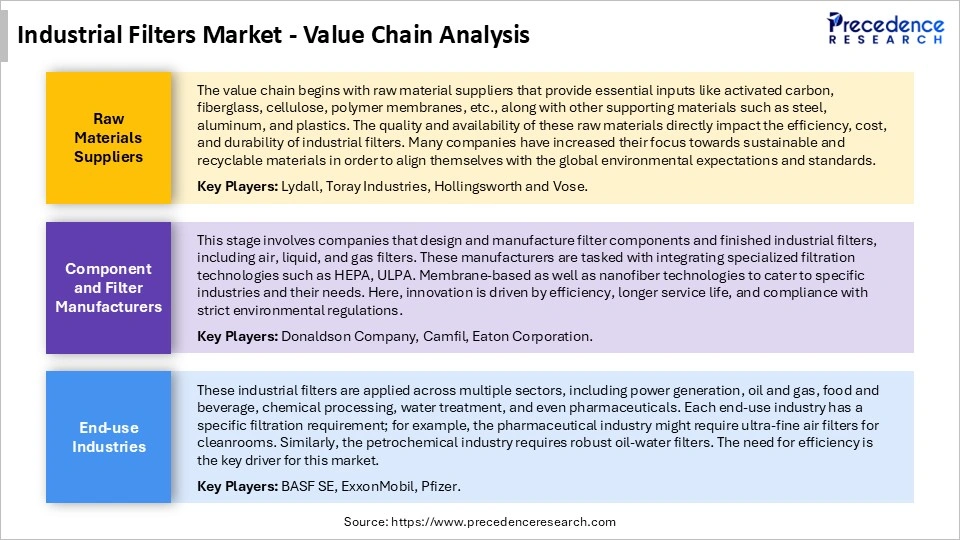
Industrial Filters Market Value Chain Analysis
Top Companies and Their Offerings
- 3M Company: 3M Company's offerings involve high-performance filter cartridges, bag filters, membrane technologies, and specialized separation systems designed to enhance efficiency, protect equipment, and meet regulatory standards.
- Alfa Laval Inc.: Alfa Laval Inc. aims for automated self-cleaning filters, high-performance membrane filtration systems, and custom separation technology. These systems mainly serve industries needing industrial wastewater treatment, cooling water protection, and process purification, targeting to maximize uptime, efficiency, and resource recovery.
- Donaldson Company, Inc.: Donaldson Company, Inc. provides a comprehensive range of industrial filtration solutions, which includes dust, fume, and mist collectors, compressed air or gas purifiers, liquid filters, and gas turbine systems. It offers advanced air, oil, and liquid filtration to industries such as manufacturing, food & beverage, and aerospace.
- Filtration Group: Filtration Group provides a comprehensive portfolio of industrial filtration solutions designed to enhance operating processes, improve productivity, and increase sustainability across industries such as power generation, marine, and manufacturing.
Who are the Major Players in the Global Industrial Filters Market?
The major players in the industrial filters market include 3M Company, Alfa Laval Inc., Donaldson Company, Inc., Filtration Group, Freudenberg Filtration Technologies SE & Co. KG, Pall Corporation, Camfil, Alfa Laval AB, Cummins Inc., and Eaton Corporation.
Recent Developments
- In 2025, Donaldson Company, Inc. partnered with Daimler Truck North America to support the Freightliner SuperTruck III project, which is funded by the U.S. Department of Energy funds. This initiative aims to improve the efficiency of heavy-duty trucks. Donaldson will provide advanced filtration technology for the truck's hydrogen fuel cell systems and other vehicle subsystems, reinforcing its position in next-generation commercial vehicle platforms that focus on sustainable transportation and emissions reduction. (Source: https://www.bing.com)
- In April 2025, R-Zero, a U.S.-based health and sustainability technology company, received an award for their smart HVAC filters at the Data Center World 2025. These filters stand out because they combine high-efficiency performance with the airflow efficiency of lower-rated filters. This means that they significantly reduce energy consumption without compromising air quality. This is a major breakthrough for industries like data centers, healthcare, and commercial buildings that operate on high-demand HVAC systems.(Source: https://www.bing.com)
Segments Covered in the Report
By Filter Type
- Air Filters
- HEPA Filters
- ULPA Filters
- Pre-Filters (Panel, Pleated)
- Bag Filters
- Electrostatic Filters
- Activated Carbon Filters
- V-Bank Filters
- Liquid Filters
- Cartridge Filters
- Membrane Filters
- Disc Filters
- Depth Filters
- Gas Filters
- Particulate Filters
- Adsorber Filters
- Coalescing Filters
- Oil & Fuel Filters
- Hydraulic Filters
- Lube Oil Filters
- Diesel/Gasoline Fuel Filters
- Dust Collectors
- Cyclone Separators
- Fabric Filters (Baghouse)
- Wet Scrubbers
- Electrostatic Precipitators (ESPs)
- Others
- Magnetic Filters
- Self-cleaning Filters
- Centrifugal Filters
By Media Type
- Fiberglass
- Activated Carbon
- Metal
- Nonwoven Fabrics
- Polymer
- Polypropylene
- Polyester
- PTFE
- Cellulose
- Ceramic
- Others (e.g., nanofibers, composites)
By Mechanism
- Mechanical Filtration
- Electrostatic Filtration
- Adsorptive Filtration
- Chemical Filtration
- Membrane Filtration
- Centrifugal Separation
By Application Industry
- Semiconductor & Electronics
- Cleanroom Filtration Applications
- HEPA & ULPA Filters
- Fan Filter Units (FFUs)
- Point-of-use Gas Filters
- Chemical Vapor Filtration Systems
- Laminar Flow Units
- Tool Exhaust Filters
- Process-specific Air Filters
- Liquid Filtration
- Non-cleanroom Applications
- General facility HVAC
- Waste gas treatment
- Cooling water filtration
- Cleanroom Filtration Applications
- Pharmaceutical & Biotechnology
- Cleanroom & Aseptic Environment Filtration
- Sterile Air Filtration
- Solvent & Liquid Media Filtration
- Food & Beverage
- Ingredient Filtration (Water, Oil, Syrups)
- Compressed Air Filtration
- CIP System Filtration
- Chemical & Petrochemical
- Catalyst Recovery Filters
- Acid/Gas Filtration
- Solvent Purification
- Oil & Gas
- Produced Water Filtration
- Hydraulic & Lubricant Filtration
- Natural Gas Separation
- Power Generation
- Turbine Intake Air Filters
- Cooling Tower Water Filters
- Boiler Feedwater Filtration
- Metals & Mining
- Dust Collection
- Process Slurry Filtration
- Equipment Oil Filtration
- Automotive & Aerospace
- Paint Booth Filters
- Engine Testing Air Filtration
- Process Fluid Filtration
- HVAC & Building Systems
- Commercial/Industrial HVAC Filters
- Data Center Air Filtration
- Hospital & Laboratory Ventilation
- J. Pulp & Paper
- Process Water Filtration
- Chemical Additive Filtration
- Airborne Dust Control
- Textiles
- Lint and Dust Collection
- Air Circulation Filtration
- Dye/Wash Water Filtration
By End Use Environment
- Cleanrooms (ISO Class 1-9)
- High-Temperature Environments
- High-Chemical-Load Zones
- Corrosive Environments
- Moisture-Prone Zones
By Sales Channel
- OEMs (Original Equipment Manufacturers)
- Aftermarket/Replacement Sales
- Distributor/Dealer Sales
- E-commerce
By Region
- North America
- Latin America
- Europe
- Asia-pacific
- Middle and East Africa
For inquiries regarding discounts, bulk purchases, or customization requests, please contact us at sales@precedenceresearch.com
Frequently Asked Questions
Tags





Ask For Sample
No cookie-cutter, only authentic analysis – take the 1st step to become a Precedence Research client
 Get a Sample




 sales@precedenceresearch.com
 Schedule a Meeting
