



Industrial Vacuum Cleaner Market Trends, Companies, Revenue / Sales Performance, Manufacturing Yield, Fab Capacity, Export & Import Dynamics, Supply Chain Analysis, Competitive Landscape, and Growth Forecast
Industrial Vacuum Cleaner Market (By Product Type: Wet Industrial Vacuum Cleaners, Dry Industrial Vacuum Cleaners, Combined Wet and Dry Industrial Vacuum Cleaners; By Power Source: Electric-powered Industrial Vacuum Cleaners, Pneumatic-powered Industrial Vacuum Cleaners; By Application: Manufacturing & Industrial Plants, Automotive, Food Processing, Pharmaceuticals, Chemicals, Others; By End-Use: Heavy Industries, Light Industries, Food & Beverage, Pharmaceutical, Chemical & Petrochemical, Others) - Global Industry Analysis, Size, Trends, Leading Companies, Regional Outlook, and Forecast 2026 to 2035
Source: https://www.precedenceresearch.com/industrial-vacuum-cleaner-market
 Get a Sample
 Table Of Content


What is the Industrial Vacuum Cleaner Market Size in 2026?
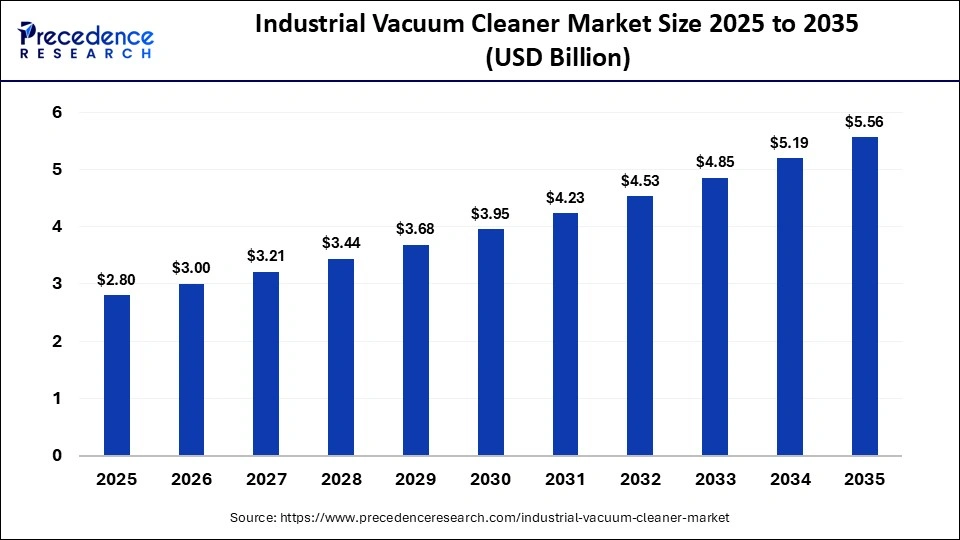
The global industrial vacuum cleaner market size accounted for USD 2.80 billion in 2025 and is predicted to increase from USD 3.00 billion in 2026 to approximately USD 5.56 billion by 2035, expanding at a CAGR of 7.10% from 2026 to 2035. The industrial vacuum cleaner market is driven by rising demand for workplace safety, strict dust control regulations, and the adoption of efficient cleaning technologies.
Key Takeaways
- North America dominated the industrial vacuum cleaner market with a share of 35% in 2025.
- Asia Pacific is expected to grow at the fastest CAGR of 9% during the forecast period.
- By product type, the dry industrial vacuum cleaners segment held a dominant position in the market, accounting for a 50% share in 2025.
- By product type, the wet industrial vacuum cleaners segment is the second-largest shareholder and is expected to grow at a CAGR of 6% between 2026 and 2035.
- By power source, the electric-powered industrial vacuum cleaners segment held a 75% share of the market in 2025.
- By power source, the pneumatic-powered industrial vacuum cleaners segment is expected to grow at a 8% CAGR between 2026 and 2035.
- By application, the manufacturing & industrial plants segment accounted for a 40% share of the market in 2025.
- By application, the automotive segment is the second-largest shareholder and is expected to grow at a CAGR of 6% between 2026 and 2035.
- By end-use, the heavy industries segment led the global market with a share of 45% in 2025.
- By end-use, the light industries segment is the second-largest shareholder and is expected to grow at a 7% CAGR between 2026 and 2035.
Market Overview
Industrial vacuum cleaners are widely used in heavy-duty operations across industries, such as manufacturing, construction, food processing, and pharmaceuticals, where the primary challenge is the effective removal of dust, debris, and hazardous substances. These vacuum cleaners are robustly built, high-suction units with advanced filtration, such as HEPA filters, and are designed to withstand continuous operation in harsh environments. The market is experiencing steady growth, driven by increased attention to workplace safety and hygiene. Stringent state regulations on removing dust and maintaining air quality are also boosting the market. Additionally, rapid industrialization and infrastructure growth in developing economies are further fueling demand for cleaning solutions.
How is AI Influencing the Industrial Vacuum Cleaner Market?
Artificial intelligence is significantly impacting the market by enabling features such as real-time performance monitoring, predictive maintenance, and automated decision-making. AI-driven sensors can detect dust concentrations, filter health, and equipment health, significantly decrease downtime and enhance efficiency. Furthermore, integration with IoT infrastructure enables centralized data management and analysis, helping facility managers track utilization patterns and optimize cleaning services. These technologies improve productivity and workplace safety by maintaining stable dust control.
Industrial Vacuum Cleaner Market Trends
- Rise of Cordless and Battery-Operated Systems: The adoption of cordless and battery operated industrial vacuum cleaners is rapidly increasing. These systems offer enhanced mobility and flexibility, making them ideal for diverse working environments, particularly in construction sites and remote industrial locations where power access may be limited.
- Advancements in Filtration Technologies: The integration of advanced filtration media, such as HEPA and multi-stage filtration systems, is significantly improving air quality. These technologies help industries comply with stringent safety and environmental regulations, particularly in sensitive sectors such as pharmaceuticals and food processing.
- Integration of Smart Technologies: The incorporation of smart technologies, including IoT connectivity and automated start-stop functions, is boosting operational efficiency. These features enable real-time performance monitoring, predictive maintenance, and seamless integration with other industrial equipment, resulting in more streamlined and user-friendly operations.
Market Scope
| Report Coverage | Details |
| Market Size in 2025 | USD 2.80 Billion |
| Market Size in 2026 | USD 3.00 Billion |
| Market Size by 2035 | USD 5.56 Billion |
| Market Growth Rate from 2026 to 2035 | CAGR of 7.10% |
| Dominating Region | North America |
| Fastest Growing Region | Asia Pacific |
| Base Year | 2025 |
| Forecast Period | 2026 to 2035 |
| Segments Covered | Product Type, Power Source, Application, End-Use, and Region |
| Regions Covered | North America, Europe, Asia-Pacific, Latin America, and Middle East & Africa |
Market Dynamics
Drivers
Rising Regulatory Pressure for Workplace Safety and Hygiene
Stringent hygiene and occupational safety legislation are compelling industries to invest in high-end cleaning equipment, which drives the industrial vacuum cleaner market. In sectors such as manufacturing, pharmaceuticals, and food processing, regulatory authorities mandate strict compliance with air quality and cleanliness standards. Failure to meet such standards might result in fines, penalties, and reputational damage, prompting organizations to adopt solid and efficient cleaning systems. High-quality filtration systems like the HEPA filters in industrial vacuum cleaners enable businesses to control dust, hazardous materials, and contaminants, ensuring a safe working environment.
Restraint
High Initial Investment
The high initial cost of industrial vacuum cleaners remains a significant constraint, particularly for small and medium-sized enterprises (SMEs). These machines often require substantial capital investment due to their advanced features, durability, and sophisticated filtration systems. For budget-constrained SMEs, allocating resources to such equipment can be challenging, leading many to rely on traditional or less efficient cleaning methods. This hesitation to invest in modern solutions slows the adoption of advanced cleaning technologies and, in turn, limits overall market penetration.
Opportunity
Technological Advancements and the Development of Smart Cleaning Solutions
The industrial vacuum cleaner market holds significant growth potential, driven by ongoing technological transformation, particularly the integration of automation and intelligent solutions. The rising demand for battery-powered and cordless vacuum cleaners is further creating opportunities for portable and flexible cleaning applications across various industries. Additionally, rapid industrialization and infrastructure development present substantial untapped potential for manufacturers. The growing emphasis on sustainability is also encouraging the development of energy-efficient and environmentally friendly vacuum systems, further supporting market expansion.
Segment Insights
Product Type Insights
Industrial Vacuum Cleaner Market Share, By Product Type, 2025-2035 (%)
| Product Type | 2025 | 2035 | CAGR (%) |
| Wet Industrial Vacuum Cleaners | 30.00% | 28.00% | 6.00% |
| Dry Industrial Vacuum Cleaners | 50.00% | 52.00% | 7.00% |
| Combined Wet and Dry Industrial Vacuum Cleaners | 20.00% | 20.00% | 8.00% |
Dry Industrial Vacuum Cleaners Held a 50% Share of the Market in 2025
The dry industrial vacuum cleaners segment dominated the industrial vacuum cleaner market with a share of 50% in 2025. This is because of their widespread use in handling dust, powder, and other dry materials. Sectors such as manufacturing, construction, cement, and metal processing produce vast amounts of dry waste that subsequently require efficient and unremitting cleaning solutions. Dry can be customized to offer a lot of suction power, a large storage capacity, and efficient filters that are best at producing clean and safe working conditions.
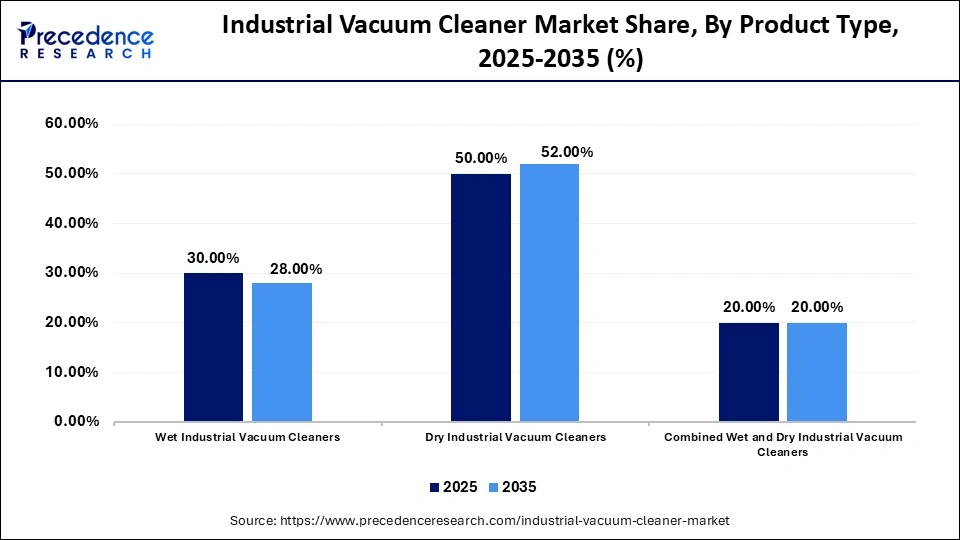
The wet industrial vacuum cleaners segment held a 30% market share in 2025 and is expected to grow at a CAGR of 6% during the projection period, driven by the increasing concern over de-polluting liquid spills and wet waste. Liquid waste is common in the food & beverage, pharmaceutical, and chemical processing industries, and specialized equipment is required to ensure efficient cleaning up of such wastes. Wet vacuum cleaners are known to be equipped with moisture-resistant parts and durable tanks.
The combined wet and dry industrial vacuum cleaners segment held a 20% share of the market in 2025 and is expected to grow at the fastest CAGR of 8% during the forecast period, driven by the fact that they are able to manage both liquid and solid wastes. These dual-functional solutions are highly applicable in industries with diversified cleaning demands. These vacuum cleaners are in high demand in industries such as construction, manufacturing, and automotive to handle mixed waste, such as dust, sludge, and liquid spills.
Power Source Insights
Industrial Vacuum Cleaner Market Share, By Power Source, 2025-2035 (%)
| Power Source | 2025 | 2035 | CAGR (%) |
| Electric-powered Industrial Vacuum Cleaners | 75.00% | 74.00% | 6.50% |
| Pneumatic-powered Industrial Vacuum Cleaners | 25.00% | 26.00% | 8.00% |
The Electric-Powered Industrial Vacuum Cleaners Segment Led the Market in 2025
The electric-powered industrial vacuum cleaners segment led the industrial vacuum cleaner market with the highest share of 75% in 2025. This is because of their high efficiency, high reliability, and wide applicability in various industries. They are heavily used in manufacturing plants, commercial constructions, and warehouses because of their capability to efficiently remove dust. Their ease of maintenance, enhanced energy efficiency, and low operating costs make them the preferred choice.
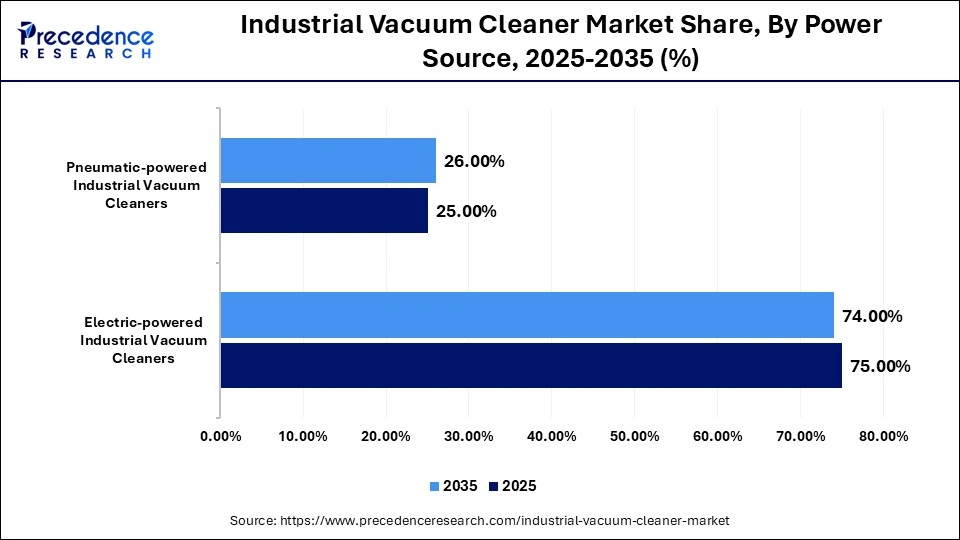
The pneumatic-powered industrial vacuum cleaners segment held a 25% share of the market in 2025 and is expected to grow at the fastest CAGR of 8% during the projection period. This is primarily due to their widespread use in risky and dangerous industrial conditions. They operate using compressed air instead of electricity, and such systems are extremely safe in explosive conditions. Their spark-free design significantly reduces the risk of ignition, making them well-suited for use in hazardous environments where strict safety standards must be maintained.
Application Insights
The Manufacturing & Industrial Plants Segment Held a 40% Market Share in 2025
The manufacturing & industrial plants segment dominated the industrial vacuum cleaner market with a major share of 40% in 2025. This dominance is driven by the critical need for efficient dust, waste, and particulate control in large-scale production environments. These plants operate with heavy machinery and constant production lines, which produce large quantities of industrial waste and require effective cleaning systems. Strict environmental and occupational safety regulations necessitate the use of industrial vacuum cleaners, as they minimize the downtime of the equipment.
The automotive segment held a 15% share of the market in 2025 and is expected to grow at a CAGR of 6% in the upcoming period, driven by the growing utilization of industrial vacuum cleaners in the process of automobile manufacturing and maintenance. Auto manufacturing is an activity that entails cleaning of parts of vehicles, machines, and paint booths precisely to ensure good-quality products. An upsurge in vehicle production is also boosting the demand for industrial vacuum cleaners.
Industrial Vacuum Cleaner Market Share, By Application, 2025-2035 (%)
| Application | 2025 | 2035 | CAGR (%) |
| Manufacturing & Industrial Plants | 40.00% | 38.00% | 7.20% |
| Automotive | 15.00% | 14.50% | 6.00% |
| Food Processing | 12.00% | 13.50% | 8.00% |
| Pharmaceuticals | 10.00% | 10.50% | 7.50% |
| Chemicals | 8.00% | 7.00% | 5.50% |
| Others | 15.00% | 17.00% | 8.00% |
The food processing segment held a 12% market share in 2025 and is expected to grow at the fastest CAGR of 8% during the projection period, driven by high hygiene standards and sanitation standards. Industrial vacuum cleaners are popularly used in food processing plants to clean the food processing, packaging, and storage equipment to meet the food safety standards. A wet and dry vacuum system is important in handling the particles of food, liquid overflow, and the risk of contamination.
The pharmaceuticals segment held a 10% share of the market in 2025 and is expected to grow at a significant CAGR of 7.5% during the projection period, driven by the necessity to have contamination-free controlled environments of production. VAC industrial cleaners have a significant role in ensuring sterility by removing all the fine dust, chemical residues, and airborne particles. Pharmaceutical manufacturing facilities are regulated by strict regulatory standards and high-efficiency filtration systems. The growing focus on safety and efficacy of pharmaceutical products also boosts the demand for industrial vacuum cleaners.
End-Use Insights
Heavy Industries Held a 45% Share of the Industrial Vacuum Cleaner Market in 2025
The heavy industries segment registered its dominance in the global market by holding a major share of 45% in 2025 due to their extensive use in large-scale production facilities such as steel, cement, mining, and machinery production. These industries generate huge volumes of dust, metals, and industrial waste, which require regular and effective cleaning solutions. Industrial vacuum cleaners are required to keep the machinery, production lines, and floors clean, thereby creating less wear on equipment and keeping workplaces safe.
The light industries segment held a 25% market share in 2025 and is expected to grow at a CAGR of 7% during the forecast period, driven by the increased need for precision and cleaning in various sectors. Light industries, such as electronics and assembly, use industrial vacuum cleaners to ensure cleanliness and precision in manufacturing processes. The rising production of electronic devices significantly drives the demand for efficient cleaning solutions.
Industrial Vacuum Cleaner Market Share, By End-Use, 2025-2035 (%)
| End-Use | 2025 | 2035 | CAGR (%) |
| Heavy Industries | 45.00% | 43.00% | 6.00% |
| Light Industries | 25.00% | 26.00% | 7.00% |
| Food & Beverage | 15.00% | 16.50% | 8.20% |
| Pharmaceutical | 10.00% | 10.50% | 7.50% |
| Chemical & Petrochemical | 5.00% | 5.50% | 6.00% |
The food & beverage segment held a 15% share of the market in 2025 and is expected to grow at the fastest CAGR of 8.2% during the projection period, driven by stringent hygiene and sanitation requirements. Industrial vacuum cleaners are extensively used in food production facilities, processing lines, and packaging plants to maintain cleanliness and comply with food safety standards. Additionally, rising consumer demand for safe and high-quality processed foods is encouraging manufacturers to adopt advanced cleaning solutions.
The pharmaceutical segment held a 10% share of the market in 2025 and is expected to grow at a notable CAGR of 7.5% during the projection period. This growth is driven by the critical need to prevent contamination in cleanroom and production environments. Industrial vacuum cleaners play a vital role in removing fine dust, chemical residues, and airborne particles. Furthermore, pharmaceutical facilities are subject to strict regulatory standards, requiring the use of high-efficiency filtration systems, including HEPA-based vacuum solutions, to ensure compliance and maintain product integrity.
Regional Insights
North America Industrial Vacuum Cleaner Market Size and Growth 2026 to 2035
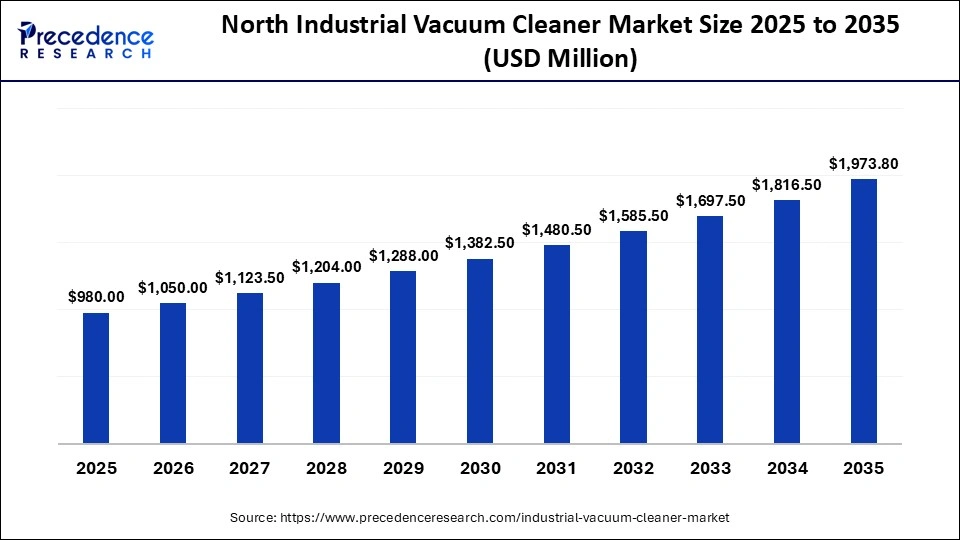
The North America industrial vacuum cleaner market size is estimated at USD 980.00 million in 2025 and is projected to reach approximately USD 1,973.80 million by 2035, with a 7.25% CAGR from 2026 to 2035.
North America Led the Global Industrial Vacuum Cleaner Market in 2025
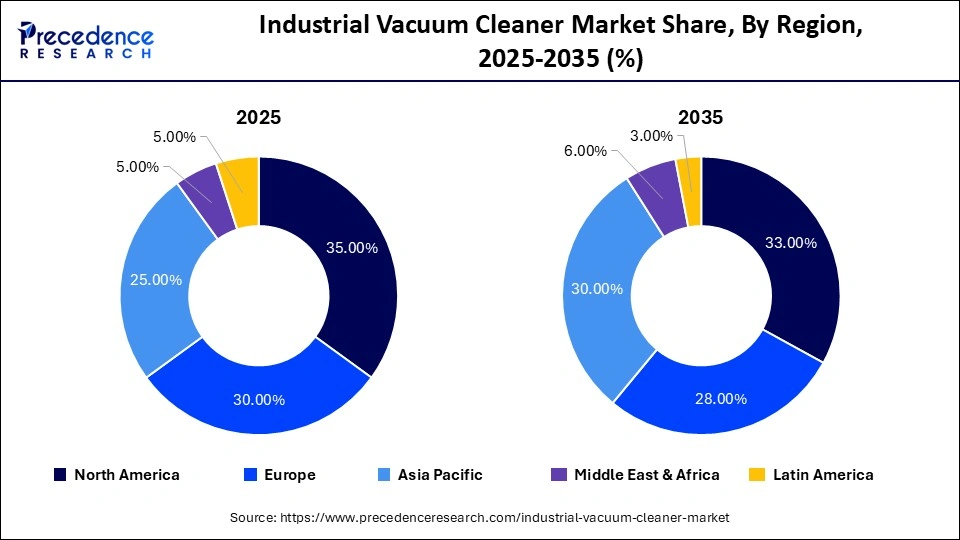
North America dominated the industrial vacuum cleaner market with a share of 35% in 2025. This leadership is attributed to its strong industrial base, widespread adoption of advanced cleaning technologies, and stringent workplace safety regulations. The region's well-established manufacturing sector relies heavily on efficient dust and debris control systems to maintain operational efficiency and compliance. The region boasts well-developed automotive, healthcare, hospitality, retail, and manufacturing industries, driving the demand for industrial vacuum cleaners.
U.S. Industrial Vacuum Cleaner Market Size and Growth 2026 to 2035
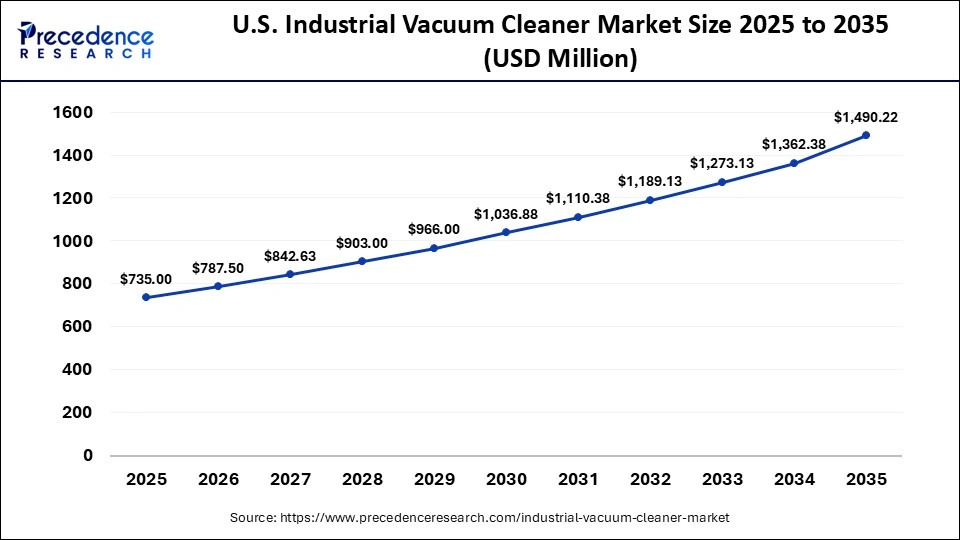
The U.S. industrial vacuum cleaner market size is calculated at USD 735.00 million in 2025 and is expected to reach nearly USD 1,490.22 million in 2035, accelerating at a strong CAGR of 7.32% between 2026 and 2035.
U.S. Market Analysis
The U.S. is a leader in the North American market, driven by strong demand across industries such as manufacturing, healthcare, hospitality, retail, and construction. Advanced cleaning solutions are essential in these sectors to maintain high standards of hygiene, safety, and operational efficiency, particularly in large and complex environments. Additionally, the regulatory landscape, especially standards set by the Occupational Safety and Health Administration (OSHA), is encouraging industries to adopt modern cleaning equipment. Compliance with these regulations helps organizations minimize workplace hazards and ensure a safer working environment.
Europe: The Second-Largest Market
Europe held the second-largest market share of 30% in 2025 and is expected to grow at a notable CAGR of 6% during the projection period, driven by a high level of industrial automation, stringent workplace hygiene regulations, and a strong focus on sustainability. Key end-user industries, including automotive, pharmaceutical, food processing, and manufacturing, are demanding efficient cleaning systems to ensure compliance with environmental and safety standards. Additionally, the region is witnessing increased adoption of robotic cleaning technologies and automation, particularly in large-scale facilities such as airports, hospitals, and shopping centers.
UK Market Analysis
The UK is a major player in the European industrial vacuum cleaner market, driven by demand from the healthcare, retail, manufacturing, and construction sectors. Growing awareness of workplace hygiene, coupled with stringent regulatory frameworks, is encouraging businesses to adopt advanced industrial cleaning solutions. Additionally, the expansion of commercial spaces such as offices and shopping malls, along with ongoing infrastructure redevelopment, is further fueling demand for high-performance vacuum systems.
How is the Opportunistic Rise of Asia Pacific in the Industrial Vacuum Cleaner Market?
Asia Pacific is expected to grow at the fastest CAGR of 9% during the projection period, driven by rapid industrialization, urbanization, and infrastructure development. The manufacturing, construction, and pharmaceutical sectors are expanding quickly in countries such as China, India, and Japan, creating strong demand for efficient dust and debris management solutions. Growing awareness of workplace safety and hygiene standards is further encouraging the adoption of advanced industrial vacuum systems. Additionally, increasing commercial development, including hospitals, shopping centers, and office spaces, is elevating the importance of cleanliness and indoor air quality across the region.
China Market Analysis
The market in China is growing rapidly, supported by high rates of urbanization and increasing industrialization. The rapid expansion of industries such as electronics, automobile, and construction is boosting the demand for industrial vacuum cleaners. Moreover, the growing concerns over air pollution are encouraging industries to use efficient cleaning solutions.
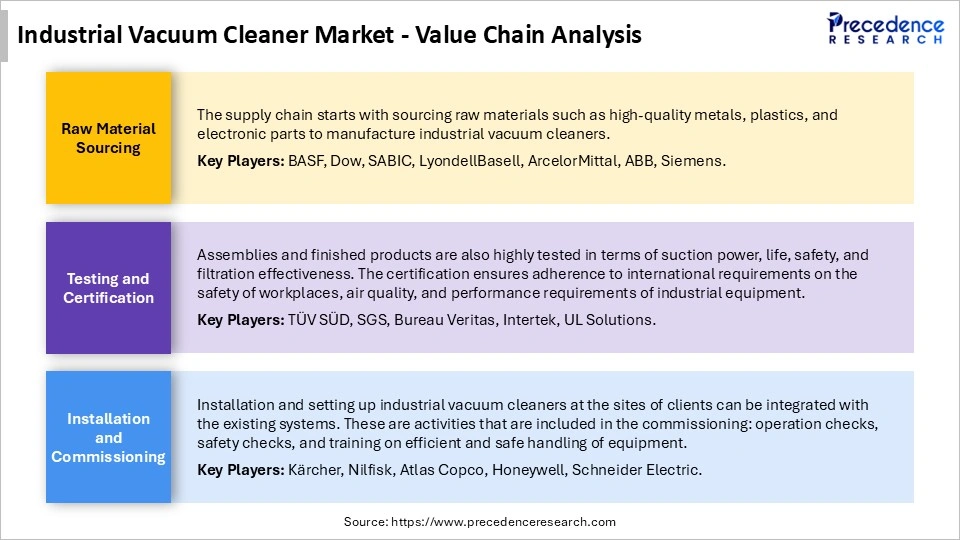
Industrial Vacuum Cleaner Market Value Chain Analysis
Industrial Vacuum Cleaner Market Companies
- Nilfisk Group
- Karcher GmbH
- Shop-Vac Corporation
- Pentair Plc
- Alto-Shaam, Inc.
- Advanced Vacuum Systems, Inc.
- Fimap S.r.l.
- Dustcontrol AB
- The Eureka Company
- VAC-U-MAX
- Kaercher North America
- Bortek Industries, Inc.
- ICAN INDUSTRY Co., Ltd.
- EXAIR Corporation
- Comac Corporation
Recent Developments
- In February 2026, Xerowaste Solutions launched a new product line of industrial battery-powered vacuum cleaners with lithium iron phosphate-powered batteries, which have a longer run time, are safer, and are less expensive to maintain. The Cordless Comzu model has good suction power similar to the other wired tools and can be used to clean both wet and dry.(Source: https://finance.yahoo.com)
- In November 2025, Nilfisk launched VP25, an industrial robotic vacuum targeting large businesses (hotel, office, retail) in large buildings. Its autonomous system is based on LiDAR sensors and smart navigation to map the environment, navigate around objects, and provide uniform cleaning capabilities over a variety of floor types.(Source: https://www.issa.com)
Segments Covered in the Report
By Product Type
- Wet Industrial Vacuum Cleaners
- Dry Industrial Vacuum Cleaners
- Combined Wet and Dry Industrial Vacuum Cleaners
By Power Source
- Electric-powered Industrial Vacuum Cleaners
- Pneumatic-powered Industrial Vacuum Cleaners
By Application
- Manufacturing & Industrial Plants
- Automotive
- Food Processing
- Pharmaceuticals
- Chemicals
- Others
By End-Use
- Heavy Industries
- Light Industries
- Food & Beverage
- Pharmaceutical
- Chemical & Petrochemical
- Others
By Region
- North America
- Latin America
- Europe
- Asia-pacific
- Middle and East Africa
For inquiries regarding discounts, bulk purchases, or customization requests, please contact us at sales@precedenceresearch.com
Frequently Asked Questions





Ask For Sample
No cookie-cutter, only authentic analysis – take the 1st step to become a Precedence Research client
 Get a Sample




 sales@precedenceresearch.com
 Schedule a Meeting
