






 Request Consultation
Infectious disease immunoassays are transforming diagnostics with faster and more accurate pathogen detection. This blog highlights advancements such as microfluidics, nanotechnology, and multiplex platforms enhancing performance. It also covers their growing role in point-of-care testing and modern healthcare systems.
In the realm of medical diagnostics, infectious disease immunoassays are diagnostic techniques for detecting and identifying various pathogens responsible for affecting human health. During an attack by infectious agents, the human body triggers an immune response to combat the attack by releasing specific antigens or antibodies. Immunoassays detect the presence of these antigens and antibodies associated with infectious agents.
Glimpse of Traditional Immunoassays
Traditional immunoassays are established diagnostic tools, but they are limited by their need for long incubation periods, large sample volumes, and multistep protocols. These limitations hinder their adoption in field-based applications and urgent care settings. These assays rely on the specific binding of an antibody to its antigen. Most conventional immunoassays are referred to as singleplex, which detect only a single analyte at a time, which is inefficient for diagnosis. Healthcare systems have evolved through personalized treatments, real-time monitoring, and early detection, and have raised the need for innovative approaches. Novel advancements improve automation, throughput, and adaptability to new diagnostic needs. They also retain the specificity of antigen-antibody reactions.
- Radioimmunoassays (RIA): These assays involve radioactively labelled substances for the quantitative detection of drugs and hormones in biological samples. They are highly sensitive, and their dependency on radioactive materials raised concerns about safety and operational challenges.
- Western Blotting: It is another classic immunoassay method that combines electrophoresis with antigen-antibody detection. It aims to identify specific proteins in complex mixtures. Even though this technique offers high specificity, it is not ideal for rapid and high-throughput testing.
- Enzyme-Linked Immunosorbent Assay (ELISA): This technique involves enzyme linked antibodies instead of radioactive labels. ELISA is widely used to detect hormones, autoantibodies, and infectious agents, specifically in research laboratories and clinical diagnostics. The different diagnostic needs are met by variants, such as indirect ELISA, direct ELISA, sandwich ELISA, and competitive ELISA.
What is the Infectious Disease Immunoassay Market Size in 2026?
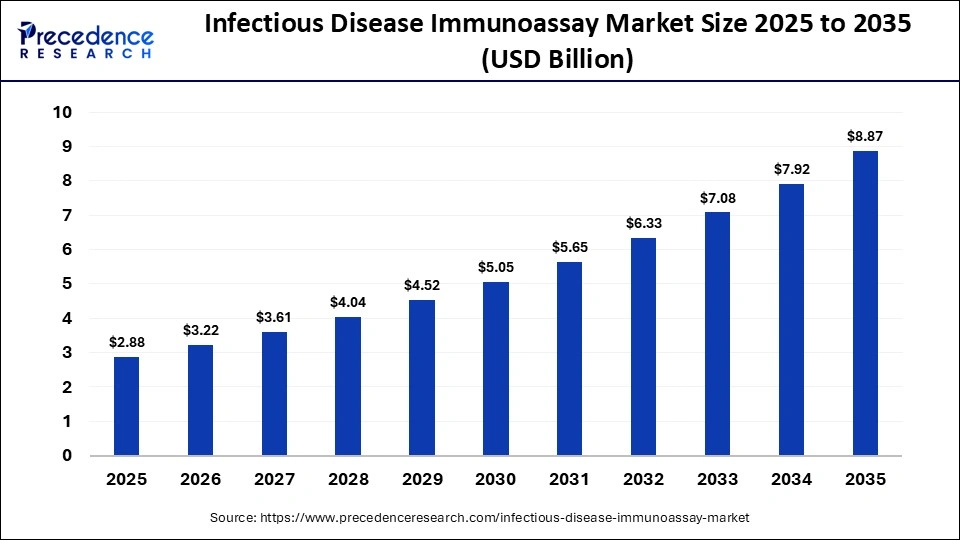
The global infectious disease immunoassay market size was accounted for USD 2.88 billion in 2025 and is anticipated to increase from USD 3.22 billion in 2026 to approximately USD 8.87 billion by 2035, expanding at a CAGR of 11.90% from 2026 to 2035.The rising prevalence of infectious diseases, the urgent need for diagnosis, prevention, and treatment, and the expansion of diagnostic centers upsurge the importance of immunoassays.
Get a Free Sample Report with Key Market Trends: https://www.precedenceresearch.com/sample/8237
Novel Immunoassay Platforms
Emerging trends, like surface modification techniques and bioconjugation chemistry, contribute to the development of novel immunoassay platforms. Moreover, some novel detection methods include optical, electrochemical, and mass spectrometry-based techniques. They have enabled more sensitive and specific measurements and expanded the detection capabilities of immunoassays. The field of immunodiagnostics is advancing due to the integration of microfluidics, nanotechnology, multiplexing, and advanced detection methods. They have improved specificity, sensitivity, and throughput, while reducing cost and complexity. These advancements have opened doors for personalized medicine, early detection of diseases, diagnostics, and point-of-care testing.
Advancements in Microfluidics Applied to Immunoassay Platforms
Microfluidics deals with the science of manipulating fluids in microscale channels, and is transforming immunoassay design. Microfluidic immunoassays are referred to as lab-on-a-chip systems. They potentially offer faster reaction times, reduced reagent consumption, and high-throughput automation. They offer portability and speed and are beneficial in point-of-care diagnostics.
Microfluidic platforms can integrate multiple analytical steps, such as sample preparation, mixing, incubation, washing, and detection, into a single and compact device. This ability reduces human error and enhances assay reproducibility. This makes it ideal for adoption in outside traditional laboratory settings.
Microfluidic devices enable parallel processing and simultaneous analysis of analytes or multiple samples. It is important in clinical workflows, such as cancer biomarker profiling and infectious disease screening, which deliver rapid results from multiple tests. These techniques and related devices offer scalability and compatibility with automation, which makes them ideal for high-throughput applications.
Latest advancements include the fabrication of microfluidic chips from biocompatible, cost-effective materials, such as glass, polydimethylsiloxane (PDMS), and paper. Paper-based microfluidic devices are a less expensive and disposable alternative for field diagnostics in low-resource settings. These devices are widely used in lateral flow and colorimetric assays.
Significance of Nanotechnology in Enhancing Immunoassay Performance
Nanotechnology is a powerful tool for enhancing the sensitivity and miniaturization of immunoassays. It revolves around gold nanoparticles, magnetic nanoparticles, and quantum dots, which possess excellent optical, magnetic, and electrical properties that deliver improved detection limits and enable signal amplification. Various immunoassay formats, such as lateral flow tests and ELISA variants, are integrated with these materials. Ongoing research makes efforts to address challenges associated with nanoparticle cost, biocompatibility, and reproducibility to enable wider clinical research.
- Gold Nanoparticles: They possess strong surface plasmon resonance properties, which make them popular to produce visually detectable color changes upon antigen-antibody binding. They are ideal for point-of-care testing and enable rapid and visually interpretable results without requiring complex instrumentation. The biocompatibility of gold nanoparticles supports the assay development.
- Quantum Dots: They are known as semiconductor nanocrystals, and have excellent tunable fluorescence and photostability. These properties make them suitable for multiplex assays. They are used in fluorescence immunoassays to perform simultaneous detection of multiple biomarkers with high resolution and sensitivity. There are concerns about cost and toxicity that have limited the widespread adoption of quantum dots.
- Magnetic Nanoparticles: They have introduced immunomagnetic separation techniques in which target analytes are isolated from complex biological matrices. These techniques increase specificity, and particles are used through external magnetic fields. They allow automated sample processing and integration with microfluidic devices.
Advantages of Multiplex Immunoassay Platforms
Multiplex immunoassays have transformed diagnostic science by enabling the simultaneous detection and quantification of multiple analytes within a single biological sample. Multiplex platforms reduce sample volume requirements, increase testing efficiency, and lower reagent and labor costs. It is important in clinical applications to evaluate several biomarkers in autoimmune diseases, cancer, and infectious disease profiling.
The bead-based suspension array, such as the Luminex xMAP technology, is one of the most widely used multiplex immunoassay formats. This method enables high-throughput analysis and measures dozens of analytes in a single run.
- Planar Protein Microarrays: This technique is ideal for thousands of measurements on a single chip. It offers powerful tools for the study of systems biology and biomarker discovery. It needs complex image analysis software and deals with challenges like spot-to-spot variability.
- DNA Barcoded Immunoassays: These assays are gaining traction for research and early-stage diagnostics. It provides extremely sensitive and multiplexed readouts. These platforms are under research and development for routine clinical use. They need highly controlled conditions to avoid cross-contamination.
Novel Strategies in Surface Chemistry and Bioconjugation Techniques
Surface chemistry and bioconjugation techniques play important roles in enhancing the sensitivity, performance, and reproducibility of immunoassay platforms. The nature and quality of the surface interface impact the orientation, stability, and activity of biomolecules. Some of the advancements in surface chemistry are thiol-gold chemistry for gold-coated substrates, click chemistry, which is a highly efficient and specific method for bioconjugation. The copper-catalyzed azide-alkyne cycloaddition (CuAAC) reaction is ideal to conjugate aptamers or antibodies to biosensors, nanoparticles, or microarray surfaces without affecting their biological activity. The nanostructured materials and functional polymers employed in surface engineering enhance the sensitivity of immunoassays.
Various materials, such as carbon nanotubes, graphene oxide, and polymer brushes, are used for their tunable surface properties. Researchers are widely integrating these surfaces in electrochemical and optical immunosensors to ensure ultra-sensitive detection for clinical biomarkers. Advanced surface chemistry and bioconjugation strategies have led to improved robustness, functionality, and applications of modern immunoassay platforms.
| Sr. No. | Immunoassay Platform | Technology Used | Strengths | Time-to-Result | Applications |
| 1 | Quantum Dot Assays | Nanoparticle Fluorescence | High sensitivity, multiplexing | 30 min | Cancer biomarkers, infectious diseases |
| 2 | SERS-based Immunoassays | Raman Signal Amplification | Single-molecule detection, label-free | 20-60 min | Toxins, pathogens, biomarker discovery |
| 3 | Microfluidic Chips | Lab-on-a-Chip | Low reagent use, automation, fast results | 10-20 min | Point-of-care, hormone and inflammation panels |
| 4 | Smartphone Biosensors | Optical/ Electrochemical Detection | Portability, real-time monitoring | 5-15 min | Infectious disease, maternal health |
| 5 | Multiplex ELISA | Bead-based Arrays | Multiple analytes, high-throughput | 2-3 hrs | HIV, hepatitis, autoimmune and cancer markers |
| 6 | BD Veritor | Lateral Flow + Optical Reader | FDA-approved, portable, easy to use | 15 min | COVID-19, RSV, Influenza |
| 7 | Abcam FirePlex | Hydrogel Bead + Fluorescent Barcoding | 65+ targets, small sample volume | 1.5 hrs | Cytokine profiling, research biomarker panels |
Conclusion
In summary, lateral flow devices, microfluidic lab-on-a-chip systems, and smartphone-integrated biosensors have reduced the long-standing barriers in traditional immunoassays, such as time and complexity. These advanced platforms improve and support rapid diagnostic decision-making. They deliver clinical results in as little as 5-15 minutes, with reduced dependency on the operator and increased preference for minimal sample volume. These capabilities make these tests and techniques ideal for point-of-care diagnostics in remote and low-resource settings.
Multiplexing technology plays a pivotal role in clinical practice, which includes various platforms, such as Luminex xMAP, multiplex ELISA kits, and FirePlex. They allow simultaneous detection of multiple biomarkers from a single patient sample. This technique is useful in screening diseases, such as hepatitis, HIV, and cancers. Multiplexing introduced detailed cytokine profiling, personalized cancer monitoring, and autoimmune diagnostics. The development of novel immunoassay platforms contributes to high-throughput, cost-effective, and decentralized diagnostic systems.
Expert Advise
According to our analysis, infectious disease immunoassays are emerging tools for early and rapid detection, owing to the shifting trend toward point-of-care diagnostics. Immunoassays offer high sensitivity and specificity compared to other conventional tests. The integration of AI into immunoassays leads to high throughput, accuracy, and workflow efficiency. Emerging economies, such as China, India, Africa, and Southeast Asia, are the highest consumers of immunoassays due to high numbers of disease outbreaks in these regions. Hence, government bodies support the indigenous development and use of infectious disease immunoassays by strengthening local healthcare ecosystems.
About the Authors

Aditi Shivarkar
Aditi, Vice President at Precedence Research, brings over 15 years of expertise at the intersection of technology, innovation, and strategic market intelligence. A visionary leader, she excels in transforming complex data into actionable insights that empower businesses to thrive in dynamic markets. Her leadership combines analytical precision with forward-thinking strategy, driving measurable growth, competitive advantage, and lasting impact across industries.



Aman Singh
Aman Singh with over 13 years of progressive expertise at the intersection of technology, innovation, and strategic market intelligence, Aman Singh stands as a leading authority in global research and consulting. Renowned for his ability to decode complex technological transformations, he provides forward-looking insights that drive strategic decision-making. At Precedence Research, Aman leads a global team of analysts, fostering a culture of research excellence, analytical precision, and visionary thinking.

Piyush Pawar
Piyush Pawar brings over a decade of experience as Senior Manager, Sales & Business Growth, acting as the essential liaison between clients and our research authors. He translates sophisticated insights into practical strategies, ensuring client objectives are met with precision. Piyush’s expertise in market dynamics, relationship management, and strategic execution enables organizations to leverage intelligence effectively, achieving operational excellence, innovation, and sustained growth.