






 Request Consultation
Introduction to the South Korea Content Delivery Network (CDN) Market
Investments in manufacturing, lab demonstrations, regional customer experience, and global services represent a strategic change from traditional outsourcing to building integrated, high-value global ecosystems. This holistic approach enables businesses to scale operations, accelerate digital transformation, and then shorten time-to-market.
South Korea leads as a premier digital economy due to a deliberate synergy between government-backed infrastructure rollouts, early 5G adoption, along with a digitally demanding, tech-savvy populace. With a rapidly aging workforce, the acceptance of AI, edge computing, and robotics is deemed existential to drive productivity gains across the wider economy.
Leading Chinese CDN providers for example, Alibaba Cloud and Tencent Cloud, are establishing Points of Presence (PoPs) in South Korea to decrease latency and enhance content delivery. By localizing edge infrastructure, they allow seamless cross-border e-commerce, gaming, and streaming, serving as a vital bridge between mainland China, South Korea, and the wider Asia-Pacific. By deploying redundant architecture across East Asia, firms improve fault tolerance so that if a regional node goes offline, traffic is seamlessly re-routed via alternate routes in Japan, Hong Kong, or Southeast Asia.
Understanding the Growth of the South Korean CDN Market
South Korea’s CDN industry is evolving rapidly, boosted by world-class 5G penetration and explosive data growth. Providers are changing from traditional content delivery networks into integrated edge computing and security, combined with cloud-native service platforms to meet surging digital demands. As enterprises adopt hybrid and multi-cloud strategies, the need is shifting toward Software-Defined Wide Area Networks (SD-WAN) and even secure access service edge (SASE) solutions. Moreover, stricter data residency regulations and increasing cyber threats mean robust, zero-trust cybersecurity services, which includes DDoS mitigation and API protection, are thus standard offerings in the Korean market.
Growing internet traffic and technological advancements are rapidly expanding the global Content Delivery Network (CDN) market. Together, these forces enable domestic providers to capture regional, data-compliant traffic, while international providers scale massive, low-latency global networks for seamless, real-time media along with cloud computing applications.
Content Delivery Network (CDN) Market Size and Forecast 2026 to 2035
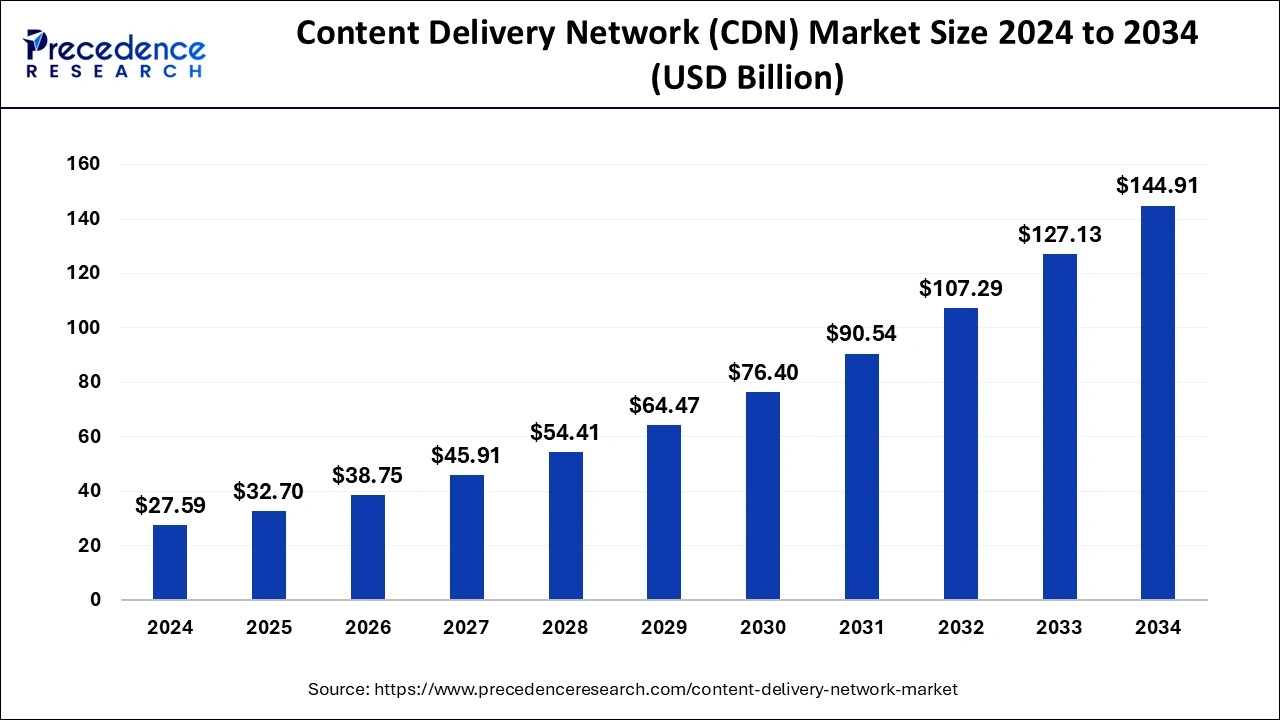
The global content delivery network (CDN) market was valued at USD 32.70 billion in 2025 and is projected to grow from USD 38.75 billion in 2026 to approximately USD 164.06 billion by 2035, registering a CAGR of 17.50% during the forecast period from 2026 to 2035.
Get a Free Sample Report with Key Market Trends: https://www.precedenceresearch.com/sample/2659
Why South Korea Is a Strategic CDN Market
South Korea’s world-leading telecommunications infrastructure, highlighted by nationwide 5G, massive average download speeds exceeding 1,000 Mbps, along with aggressive digital economy initiatives, makes it a prime environment for CDN investments. Moreover, expanding enterprise cloud adoption and widespread IoT utilization create immense, localized demand for low-latency digital services. As enterprises and consumers integrate technologies such as AI, 8K video, AR/VR, and smart factory automation, the demand for edge computing and low-latency communication becomes critical. CDNs are essential to reduce packet loss and maintain real-time interactivity.
Rising Demand for Cross-Border Content Delivery
International enterprises demand specialized cross-border Content Delivery Network (CDN) services to navigate strict data regulations, such as China’s Cybersecurity Law and cross-border data limits, bypass severe internet congestion, like the "Great Firewall", and even bridge fragmented network peering between regions, thus ensuring low latency and data sovereignty. Cross-border retailers depend on edge computing to accelerate dynamic content, process regional payment gateways in real-time, and manage sudden traffic spikes during massive sale events, for example, Singles' Day. Dedicated route optimization ensures that Chinese users can access global storefronts without latency-induced cart abandonment.
Factors Driving CDN Infrastructure Expansion
These technologies form the foundational pillars of modern digital infrastructure. They are deeply intertwined, thus creating a continuous feedback loop where advancements in one area accelerate the need for the others.
- Edge Caching: Content Delivery Networks (CDNs) and edge computing assist in caching content geographically closer to end users. This removes network bottlenecks, prevents congestion, and reduces the "time to first token" for seamless streaming experiences.
- AI-Native Networks: Telecoms and enterprises are deploying agentic AI along with native generative AI to automate network troubleshooting, improve performance, and manage millions of connected endpoints.
Overview of Chinese CDN Companies Expanding Internationally
China’s leading CDN and edge cloud providers, such as Alibaba Cloud, Tencent Cloud, Baidu, and EdgeNext, have built extensive global networks. This is driven by rapid expansion in digital media, artificial intelligence, and cloud computing; these firms scaled globally by leveraging massive domestic traffic volumes, strategic overseas acquisitions, and robust infrastructure investments. Chinese providers expanded from localized nodes to building expansive Points of Presence (PoPs) globally. Providers such as EdgeNext actively accelerated their international reach by acquiring overseas assets, such as ChinaCache’s international operations.
Evolution of China's CDN Industry
The rapid evolution of China's CDN ecosystem and even cloud infrastructure is a deliberate response to the demands of the world's largest digital user base, strict national data localization policies, and a push by the government to boost the global footprint of Chinese technology champions. Platforms such as WeChat rely on ecosystems of mini-programs, which require microsecond-level latency, dynamic real-time communication (RTC), and even highly efficient edge caching.
Expansion Strategies Across Asia-Pacific
Chinese CDN providers expand worldwide to reduce latency and bypass international internet chokepoints. They achieve this by establishing Points of Presence (PoPs) in major international hubs, and securing peering agreements with regional telecom operators, alongside building robust cloud infrastructures to guarantee high-speed, localized delivery for multinational enterprises. Further, Chinese CDNs deploy advanced dynamic content packaging (DCP), DRM (Digital Rights Management), and adaptive media streaming to enhance the end-user experience for B2B and B2C services. By managing diverse global traffic natively, they optimize streaming and web-loading times regardless of the user’s device or network.
Leading Chinese CDN Companies Expanding in South Korea
Major Chinese technology and CDN providers, such as Alibaba Cloud, Tencent Cloud, and BaishanCloud, are thus strengthening their presence in South Korea to capture the region's robust digital economy. Chinese CDNs use massive global edge networks combined with proprietary route-optimization algorithms. Further, by leveraging direct peering with local South Korean ISPs, they guarantee rapid content delivery for high-bandwidth applications like live streaming, e-commerce, and cloud gaming.
Alibaba Cloud CDN
Alibaba Cloud integrates its global infrastructure with an AI-native architecture to deliver scalable, localized enterprise solutions. Major elements include its Agent Native Cloud to support enterprise AI deployments and its expanded footprint, which includes a second data center in South Korea, to meet rising local need for resilient, low-latency cloud services.
Tencent Cloud CDN
Tencent Cloud is aggressively expanding in South Korea, thus acting as a strategic bridge for Korean enterprises and digital media firms targeting global markets. Their comprehensive suite of AI, streaming, and even edge-native technologies delivers localized performance at a global scale.
Huawei Cloud CDN
Huawei Cloud provides enterprises with a comprehensive, AI-native cloud infrastructure programmed to drive intelligent, secure, and regionless digital transformation. By merging advanced AI capabilities, global edge ecosystems, and robust cybersecurity, it provides agile, high-performance IT solutions that empower businesses worldwide.
Baidu AI Cloud CDN
Baidu AI Cloud offers an integrated enterprise digital infrastructure combining edge computing, Model-as-a-Service (MaaS) platforms, and even intelligent traffic routing. Its "chip-cloud-model-agent" strategy assists businesses in the Asia-Pacific (APAC) region in deploying generative AI at scale while significantly reducing inference costs.
Wangsu Science & Technology (Wangsu CDN)
Wangsu is China's largest independent CDN and even edge computing provider. It operates a robust global infrastructure programmed to tackle complex network environments. The company improves digital delivery via powerful edge security, advanced media streaming, and localized enterprise expansion strategies spanning crucial global markets such as South Korea.
UCloud
UCloud operates as a neutral cloud provider, thus delivering highly scalable infrastructure designed for global enterprise needs. Their ecosystem features end-to-end AI compute, robust hybrid cloud architectures, edge computing, and a growing presence in emerging international markets.
Kingsoft Cloud
Kingsoft Cloud offers robust, AI-optimized cloud infrastructure, deriving its revenue from CDN and edge computing services. Thus, it powers high-performance workloads across the Asia-Pacific (APAC) region via integrated cloud ecosystems, strategic enterprise solutions, and even proprietary content delivery networks.
South Korea Market Trends Influencing Chinese CDN Expansion
Chinese CDN providers, such as Alibaba Cloud and Tencent Cloud, are rapidly expanding in South Korea, collaborating with local integrators, for example, GS Neotek, to provide high-speed, cost-efficient edge infrastructure. This push is driven by the increase in cross-border e-commerce, booming digital entertainment, and the vast data demands of modern tech stacks. The growth of generative AI and AI-ready databases demands immense computational power and data distribution at the edge. Further, advanced CDN services offload computational stress from central servers, accelerating AI inference delivery along with managing heavy model updates seamlessly.
Cloud Computing and Multi-Cloud Adoption
Enterprises increasingly deploy multi-cloud architectures thus by leveraging cloud-agnostic deployment patterns, for example, containers, to avoid vendor lock-in, ensure regional compliance, and use best-of-breed services. To connect and accelerate these distributed environments, organizations utilize global Content Delivery Networks (CDNs), software-defined secure networking, along with intelligent application acceleration.
Modern enterprise traffic consists of highly distributed microservices across clouds. CDNs and even intelligent routing algorithms interconnect cache nodes to bypass congested public networks and then find the fastest path to origin servers.
AI Applications Increasing Edge Computing Demand
Generative AI, machine learning, and real-time analytics demand low-latency edge infrastructure, as waiting for data to travel to a distant, centralized cloud introduces critical delays. Processing data directly at the source, the "edge", guarantees split-second, mission-critical reflexes, preserves network bandwidth, and then keeps sensitive information secure. Generative AI inference needs to load massive neural network weights into memory. By running compressed, optimized models via techniques such as quantization and pruning on local edge devices, systems achieve the necessary throughput without overwhelming network pipes.
Growth of Online Gaming and Digital Entertainment
South Korea’s robust digital ecosystem drives extreme need for high-performance CDNs. Factors such as ultra-low-latency requirements for real-time multiplayer gaming, massive global streaming data for esports, alongside concurrent viewer spikes on platforms such as TVING, and massive digital media exports compel providers to depend on edge computing to prevent lag and scale efficiently. With the South Korean gaming sector accounting for a majority of its digital content exports, game publishers frequently deploy gigabytes of patches, assets, and downloadable content (DLC) to a global player base. Moreover, high-performance CDNs act as distributed content repositories, thus pushing heavy downloads to the edge of the network and offloading stress from the origin servers.
Expansion of Cross-Border E-Commerce
Growing digital commerce between China and South Korea increases the need for secure, scalable, and low-latency content delivery solutions because platforms must handle massive cross-border traffic, localized web content, and even real-time transactions. Cross-border digital transactions demand handling sensitive personal and financial data across international jurisdictions. Further, secure content delivery networks equipped with Web Application Firewalls (WAF), DDoS protection, and bot mitigation are crucial to protect against cyber threats and handle regulatory compliance.
Competitive Landscape of the South Korean CDN Market
Evaluating CDN and edge compute footprints demands a close look at how specialized Chinese vendors such as Alibaba Cloud, Tencent Cloud, BaishanCloud, balance their domestic dominance with overseas growth against entrenched global players such as Akamai, Cloudflare, AWS, and Fastly, operating in South Korea.
Cybersecurity Services
- Global Competitors: Akamai and Cloudflare are industry standards for enterprise-grade, massive DDoS mitigation along with application-layer protection (WAF) in South Korea. Cloudflare's fused edge-security platform is greatly popular among regional e-commerce players.
- Chinese Providers: Companies such as Tencent and Alibaba Cloud possess robust, state-of-the-art security suites built to withstand the rigorous, and multi-terabit DDoS attacks prevalent in Mainland China. Further, they bring this high-capacity scrubbing capability directly to their edge nodes in South Korea.
The South Korean CDN market benefits from the nation’s advanced IT infrastructure and is driven by high-bandwidth demands in gaming, e-commerce, and media streaming; the sector features a robust blend of homegrown enterprise vendors like CDNetworks and global hyperscalers such as Cloudflare.
Comparison Based on Global Network Infrastructure
CDN providers differ heavily in how they build their infrastructure. Providers such as Cloudflare and Akamai depend on vast, globally dispersed edge networks, while options such as Google Cloud CDN and Amazon CloudFront leverage massive, privately owned hyperscale backbones.
Latency depends directly on server compute power, physical distance, and protocol efficiency, for example, HTTP/3 and TLS 1.3.
- Google Cloud CDN: Focuses heavily on latency optimization by routing traffic entirely via Google's premium, privately-owned global fiber backbone rather than the public internet.
- Fastly: Optimizes time-to-first-byte (TTFB) and API response times via instant cache purges and powerful edge computing, thus significantly speeding up dynamic content.
- Azion & CDNetworks: Employ dynamic route optimization, identifying the fastest path between the client, middle-mile, and origin, to decrease latency for non-cacheable data.
Comparison Based on Cloud Platform Integration
CDNs act as the worldwide distributed edge layer for modern IT infrastructure. They ingest, cache, and filter data at hundreds of points of presence (PoPs) globally, drastically reducing latency. They integrate seamlessly with broader cloud environments to deliver content efficiently, thus enforce edge security, and accelerate data processing. CDNs manage AI acceleration and edge compute, pulling AI-generated content closer to the user. Edge computing environments within CDNs, such as Cloudflare Workers or AWS Lambda@Edge, run lightweight machine learning inference locally. Thus, CDNs cache dynamically generated, AI-personalized responses to serve recurring prompts in milliseconds. They also offload heavy assets, such as AI models and computer vision media, to the edge so central AI infrastructure, like AWS Bedrock or Google Vertex AI, is only queried when necessary.
Comparison Based on Enterprise and Industry Solutions
Cloud providers, such as AWS, Azure, and Akamai, design industry-specific solutions to overcome unique performance, security, and even scalability bottlenecks. Instead of a one-size-fits-all approach, they offer targeted architectures so businesses can meet compliance standards, manage volatile traffic, and optimize costs.
- Gaming demands ultra-low latency, real-time multiplayer servers, and thus, massive global scale during peak traffic. Dedicated gaming edge architectures ensure rapid patch downloads alongside smooth gameplay close to the user.
- Financial Services need strict regulatory compliance (PCI-DSS, GDPR) and ironclad security. Providers offer isolated environments, real-time fraud detection, and zero-downtime transactional databases.
- E-Commerce focuses on handling sudden traffic spikes during sales and stopping malicious bot attacks. Cloud providers supply intelligent load balancing, fast asset caching, along with secure payment processing.
- Software-as-a-Service (SaaS) demands multitenant architectures that can scale infinitely as the provider’s customer base grows. Providers handle the underlying infrastructure, enabling SaaS companies to focus entirely on software development.
Strategic Partnerships Supporting Market Expansion
Chinese CDN and cloud providers, for example, Alibaba and Tencent, partner with South Korean entities by integrating their edge nodes directly into local telecom networks, thus peering at domestic internet exchanges and collaborating with local MSPs, for example, GS Neotek, to seamlessly route heavy gaming, e-commerce, and media traffic across the APAC region. By depending on established channel partners and telcos, Chinese CDNs leverage pre-existing enterprise client lists in South Korea. They provide streamlined onboarding and compliant ICP filing support for Mainland China, removing regulatory friction for Korean companies while growing their own market share.
Partnerships with Telecommunications Providers
Collaborations with telecom operators involve partnerships with hyperscalers, like AWS, Google, or Microsoft, and network vendors, such as Nokia and Ericsson, to build distributed edge clouds. These alliances process data closer to end-users to decrease latency, prevent network congestion, and boost overall service reliability.
Collaborations with Cloud Service Providers
Content Delivery Network (CDN) providers along with cloud hyperscalers partner to blend edge delivery with core compute. These collaborations, such as Akamai’s integration with AWS, Azure, and Google Cloud, or Cloudflare’s developer platforms, offer global scale, reduce data transfer costs, and optimize network traffic while enabling seamless transitions between on-premises and cloud architectures. CDN providers have collaborated with or acquired enterprise networking and cybersecurity companies to deliver comprehensive SASE solutions. This merges CDN infrastructure with SD-WAN, DNS firewalls, and even micro-segmentation, replacing traditional hub-and-spoke networking with zero-trust edge security.
Enterprise Digital Transformation Partnerships
Collaborations between Content Delivery Networks (CDNs), cloud providers, along with systems integrators empower businesses to scale content and accelerate applications by pushing computing closer to the end-user. These alliances offer built-in security, offload origin servers, and optimize data routing for global users. Edge computing partnerships deliver single-digit millisecond latency required for multiplayer server synchronization, live-ops, and cloud gaming.
Technology Innovations Driving CDN Competition
Leading Content Delivery Network (CDN) providers differentiate themselves by converging traditional delivery with distributed cloud architectures. Thus, they leverage AI and edge-native environments to change from static content caching to dynamic, secure, and programmable edge execution. AI models determine historical traffic and user behavior to predict requested objects. Providers push content to the edge before requests are made, drastically reducing Time to First Byte (TTFB). CDNs enforce granular, user-specific access controls. Applications along with internal resources are hidden from the public internet and demand user authentication at the edge before access is granted.
Artificial Intelligence for Intelligent Traffic Management
AI transforms network operations by replacing manual, static configurations with automated, continuous, closed-loop optimization. Thus, together, these five core technologies predict issues, reroute traffic, secure the system, and even deliver content seamlessly, dramatically reducing latency and downtime across modern networks alongside transportation infrastructures.
Edge Computing and Distributed Cloud Infrastructure
Distributed edge computing removes the physical distance between data generation along with processing. By bringing computational resources, like micro-data centers and AI inferencing nodes, physically closer to devices and users, it removes the round-trip latency to centralized cloud servers, enabling systems to execute split-second actions.
Integrated Security and Content Protection
Modern Content Delivery Networks (CDNs) integrate advanced security capabilities because they function at the network edge, thus making them the first line of defense to inspect and clean traffic before it ever reaches your core infrastructure. By combining performance optimization with robust cyber defense, a secure CDN platform eliminates the demand for fragmented third-party add-ons, reduces computing strain on backend servers, and even blocks evolving digital threats at scale.
Industry Applications Driving CDN Demand in South Korea
Advanced Content Delivery Networks (CDNs) offer the vital edge infrastructure required to mitigate latency, absorb volumetric attacks, along with ensure global scalability. They process web traffic at the closest possible network point, fundamentally driving digital transformation, customer experience, as well as operational resilience across modern enterprises.
Online retail demands fast load times to maximize conversion rates. CDNs offload traffic surges during flash sales, thereby securely delivering dynamic, personalized catalogs to shoppers. Telehealth and e-learning platforms depend on continuous, uninterrupted access. CDNs distribute rich media and live session content from the nearest edge server to ensure worldwide uptime and quality.
CDNs significantly decrease the physical distance data must travel, lowering latency and even accelerating Time to First Byte (TTFB). Fast load times prevent cart abandonment, decrease video buffering, and enhance user retention. By serving localized, high-speed content, organizations deliver frictionless and premium digital experiences to global audiences.
Media, Streaming, and Entertainment
Modern digital distribution heavily depends on distributed edge networks to ensure scalability, low latency, and then high availability. To succeed, platforms must process data effectively across various use cases. High-fidelity music streaming, which includes lossless audio formats such as FLAC, requires consistent, high-throughput delivery with zero audio stuttering. CDNs achieve this via localized points of presence (PoPs) and optimized caching strategies. By serving continuous streams from servers nearest to the consumer, platforms minimize buffering and network congestion while managing strict DRM and encryption protocols.
Gaming and Interactive Applications
Ultra-low latency content delivery prevents "input lag" along with desynchronization between player actions and on-screen rendering. Because modern gaming demands instant, round-trip data exchanges, even a tiny delay of ≈ 50 ms can ruin a session. Render graphics remotely. Ultra-low latency is needed so button presses stream to the cloud, update the game state, and then stream visual feedback back to the device fast enough to feel such as a local console.
Financial Services and Digital Banking
For financial institutions, modernizing digital infrastructure is important to remain competitive. Institutions use integrated API gateways, AI-based fraud detection, global content delivery, automated regulatory compliance pipelines, and mobile SDKs to build secure, frictionless, and high-performance banking services. Moreover, modern systems combine real-time decisioning engines with behavioral biometrics to continuously monitor user intent. Rather than depending solely on passwords, banks deploy continuous threat modeling, step-up authentication, and analysis of inherent user behaviors, like mouse movements, typing speed, and device telemetry, to prevent synthetic identity theft and account takeovers.
E-Commerce and Retail
Building a successful e-commerce ecosystem depends on five core pillars: optimizing site speed, personalizing user journeys, streamlining global logistics, securing payments, and scaling infrastructure during demand surges. Machine learning algorithms determine historical browsing behavior, past purchases, and contextual data, like time of day or regional weather, to dynamically adjust your store's landing pages, search results, along with up-sell or cross-sell suggestions. Integrating Customer Relationship Management (CRM) combined with Customer Data Platform (CDP) tools consolidates a shopper's profile across web, mobile apps, and brick-and-mortar stores to guarantee a cohesive, relevant experience.
Challenges Facing Chinese CDN Companies in South Korea
Market expansion demands navigating a complex matrix of global challenges. Balancing these means weighing the requirement for localized agility against the costs of global scale. Companies must actively work technological investments with regional constraints to build trust and avoid commoditization. Moreover, data localization laws necessitate in-country data processing. They utilize multi-cloud strategies and even regional cloud hubs that process data locally while still enabling centralized business intelligence.
Leading providers in technology, telecom, along with supply chain are driving growth by replacing isolated vendor models with collaborative partner ecosystems. They are localizing services to work with regional preferences and leveraging real-time data to automate operations, changing their focus to orchestrated resilience and continuous innovation.
Regulatory and Data Governance Requirements
Compliance in South Korea is mainly governed by the Personal Information Protection Act (PIPA). Organizations must obtain explicit informed consent for data collection, appoint a Chief Privacy Officer (CPO), informed consent for data collection, enforce strict data minimization and encryption, and notify both the PIPC and the affected users immediately in the event of a breach. Further, recent PIPA amendments place ultimate liability directly on the business owner or representative. For qualifying entities, the appointment and dismissal of the CPO must be accepted by the Board of Directors and then reported directly to the Personal Information Protection Commission (PIPC).
Competition from Global CDN Providers
The competitive challenges in the digital delivery market stem from overlapping services along with shifting value domains. Established CDNs, regional cloud providers, and even local telecom operators compete aggressively over infrastructure deployment and data localization compliance, alongside customer experience management. Regional cloud providers challenge global hyperscalers by catering directly to strict data localization and even digital sovereignty mandates, thus making them the preferred choice for government and financial sectors. They provide localized support and highly tailored, regionalized infrastructure that meets specific in-country regulatory demands and then avoids the geopolitical concerns associated with foreign tech dominance.
Future Outlook for Chinese CDN Expansion in South Korea
Chinese CDN companies in South Korea face a highly strategic future. Success depends on adapting their massive-scale infrastructure to fund AI-native networking, sovereign cloud initiatives, edge AI, 6G development, intelligent cybersecurity, cloud-native applications, and digital infrastructure investments. As South Korea drives 6G initiatives and AI-native network projects, cross-border CDNs, for example, Alibaba, Tencent, and Huawei, must replace traditional content delivery architectures with deep-learning-driven networks that can forecast traffic, dynamically provision bandwidth, and route data optimally.
AI and Edge Computing Will Accelerate CDN Innovation
AI-powered networking, autonomous traffic management, intelligent caching, and distributed cloud platforms redefine content delivery by changing systems from reactive to predictive. By continuously determining traffic in real time, these technologies proactively cache content, optimize routing, and balance server loads, drastically lowering latency and even bandwidth costs compared to traditional, static infrastructures. Machine learning algorithms continuously determine global traffic telemetry to automatically tune routing protocols, like BGP, in real time. This enables the network to predict congestion, avoid bottlenecks, and guarantee ultra-low latency for demanding workflows such as AI inferencing and video streaming.
Regional Digital Collaboration Will Support Long-Term Growth
Enterprise cloud adoption, the growth of digital commerce, and next-generation networks in South Korea provide a lucrative proving ground for Chinese CDN providers. By leveraging strategic business collaborations, these providers can meet local enterprise demands for scalable, low-latency infrastructure. South Korea's highly connected, fast-paced digital commerce, along with booming OTT entertainment sectors, require ultra-low latency. Chinese CDN providers are capitalizing on this by bringing built-for-scale media and even e-commerce solutions. They excel at managing high traffic spikes and guaranteeing data routing directly to emerging Asian markets, including China.
Conclusion: Chinese CDN Providers Are Strengthening Their Presence in South Korea's Digital Infrastructure
Chinese CDN and cloud firms are rapidly expanding in South Korea, leveraging advanced cloud infrastructure, AI-powered networking, edge computing, and strategic partnerships. Leading providers such as Alibaba Cloud and Tencent Cloud have established dedicated data centers in the Seoul metropolitan area to meet strict local data sovereignty requirements and decrease latency for bandwidth-heavy industries such as gaming, media, and e-commerce.
Chinese tech giants are introducing integrated AI-agent portfolios, machine learning studios, along with localized large language models to the Korean market. For example, Tencent Cloud collaborates with local digital service and gaming enterprises to offer AI-native creative studios and productivity automation.
Continued investments in intelligent content delivery, cloud integration, cybersecurity, and enterprise digital transformation are essential drivers that will shape the competitive landscape and guarantee long-term growth across the South Korean Content Delivery Network (CDN) market.
Government-backed mandates, like the Digital-Platform Government cloud-first initiatives, are accelerating the change toward hybrid and multi-cloud models, then compelling CDN providers to bundle edge-compute capabilities directly into delivery offerings.
About the Authors

Aditi Shivarkar
Aditi, Vice President at Precedence Research, brings over 15 years of expertise at the intersection of technology, innovation, and strategic market intelligence. A visionary leader, she excels in transforming complex data into actionable insights that empower businesses to thrive in dynamic markets. Her leadership combines analytical precision with forward-thinking strategy, driving measurable growth, competitive advantage, and lasting impact across industries.



Aman Singh
Aman Singh with over 13 years of progressive expertise at the intersection of technology, innovation, and strategic market intelligence, Aman Singh stands as a leading authority in global research and consulting. Renowned for his ability to decode complex technological transformations, he provides forward-looking insights that drive strategic decision-making. At Precedence Research, Aman leads a global team of analysts, fostering a culture of research excellence, analytical precision, and visionary thinking.

Piyush Pawar
Piyush Pawar brings over a decade of experience as Senior Manager, Sales & Business Growth, acting as the essential liaison between clients and our research authors. He translates sophisticated insights into practical strategies, ensuring client objectives are met with precision. Piyush’s expertise in market dynamics, relationship management, and strategic execution enables organizations to leverage intelligence effectively, achieving operational excellence, innovation, and sustained growth.