






 Request Consultation
Clinical AI governance frameworks are essential for ethical and compliant AI deployment in hospitals and digital health. By combining data oversight, model validation, automated monitoring, and ethical review, healthcare providers can reduce clinical risk, improve transparency, and ensure AI-driven decisions align with patient safety standards. Governance structures are now central to scalable, responsible AI adoption, enabling innovation in predictive analytics, precision medicine, and AI-assisted clinical workflows.
Artificial intelligence (AI) is rapidly transforming clinical care, from diagnostic imaging and predictive analytics to clinical decision support and personalized medicine. On the other hand, as healthcare organizations continue to expand the application of AI models in hospitals, labs, and digital health solutions, the necessity of strong governance frameworks has arguably become more important. Clinical AI models work in high-stakes settings in which any errors in their operation, bias, or a lack of control can have a direct impact on patient safety and clinical outcomes.
The emergence of clinical AI model governance reflects this growing demand for structured oversight mechanisms. This increases the need to establish more formal mechanisms of control over AI systems to make them transparent, compliant, and trustworthy. Regulators, technology vendors, and healthcare providers are beginning to pay more attention to governance tools that have complete control over the entire AI model's life cycle.
Recent changes in regulations and the world policy discourse are expediting this movement. The introduction of new healthcare AI policy frameworks, together with regulations, including the AI Act, by the European Union. Organized AI policy checklists released in 2025 focus on transparency, accountability, and risk management in the deployment of AI systems in clinical settings.
Such policies underscore the necessity of governance systems that would be able to harmonize innovation, patient safety, and law. The governance of clinical AI as a strategic pillar of responsible digital transformation has become a key value source, as sophisticated algorithms can deliver value without undermining ethical, regulatory, and operational principles.
Why Governance is Becoming the Backbone of Clinical AI Deployment?
Healthcare AI applications operate in one of the most sensitive technological environments. As opposed to consumer AI tools, clinical AI systems examine medical records, test images, laboratory data, and genomic data to help physicians make crucial decisions in life. In the absence of organized control, these systems may cause risks associated with data privacy, bias, model drift, and unintended clinical consequences.
AI governance models attempt to reduce the occurrence of these risks by creating transparent oversight systems and accountability frameworks. These frameworks guarantee the regulatory compliance of AI systems, their transparent operation, and the constant validation of AI systems over the lifecycle. Cross-disciplinary committees of clinicians, data scientists, regulatory specialists, and ethicists are frequent components of governance programs. This can review the performance of models and the ethical aspects before clinical implementation.
According to healthcare specialists, to ensure patient trust and clinical integrity, governance is necessary. AI models based on partial or biased data can deliver incorrect predictions or strengthen healthcare inequalities. Formal policies regarding governance thus need to be strongly data validated, biases observed, and measures of transparency to guarantee fair clinical performance.
This trend of AI adoption, primarily focused on governance, is transforming the healthcare technology ecosystem. Hospitals are increasingly adopting AI lifecycle management platforms, model audit systems, and regulatory compliance tools to ensure that clinical algorithms remain safe and effective over time.
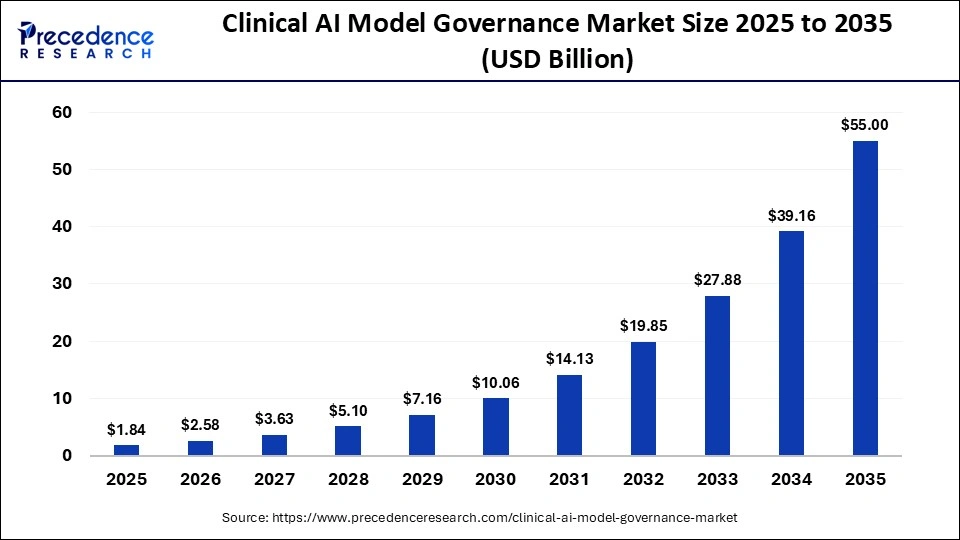
What is the Clinical AI Model Governance Market Size in 2026?
The global clinical AI model governance market size accounted for USD 1.84 billion in 2025 and is predicted to increase from USD 2.58 billion in 2026 to approximately USD 55.00 billion by 2035, expanding at a CAGR of 40.46% from 2026 to 2035.
Key Components of Clinical AI Model Governance
Effective governance requires comprehensive oversight across the entire lifecycle of AI models. Health institutions are embracing governance systems that incorporate technical, ethical, and regulatory restrictions.
Core Governance Pillars
|
Governance Domain |
Strategic Role in Clinical AI Deployment |
|
Data Governance |
Ensures high-quality, representative, and secure patient datasets for AI training |
|
Model Validation |
Verifies clinical accuracy, reliability, and safety before deployment |
|
Regulatory Compliance |
Aligns AI tools with healthcare regulations and medical device standards |
|
Monitoring and Auditability |
Tracks real-time model performance and identifies model drift |
|
Ethics and Bias Management |
Detects algorithmic bias and ensures equitable patient outcomes |
Data governance forms the foundation of the governance ecosystem. Clinical AI models have high requirements for large amounts of medical data, such as electronic health records and genomic data. Absence of effective data governance plans can lead to AI models inheriting biases or inconsistencies that compromise clinical accuracy.
Model validation and continuous monitoring are equally important. AI applications implemented in clinical settings should be subject to continuous review of the performance of the applications to identify any drift or time-related degradation. Governance platforms will comprise automated monitoring tools that are able to monitor model performance measures, anomalies, and real-time alerts. Additionally, these governance layers guarantee the safety, transparency, and accountability of clinical AI systems throughout their operation lifecycle.
Drivers Accelerating the Adoption of Clinical AI Model Governance
Several technological, regulatory, and operational factors are driving the rapid adoption of clinical AI model governance.
- Rising Adoption of AI in Healthcare: Healthcare organizations are using AI models more to help with diagnostics, predictive analytics, clinical documentation, and workflow optimization. AI systems are increasingly implemented in hospitals, potentiating the need to be governed to align their oversight and performance.
- Growing Focus on Responsible AI: The ethical use of AI is a priority for healthcare organizations to overcome issues surrounding AI bias and patient well-being. Governance platforms help healthcare providers to assess AI decisions, trace training data, and apply explainable AI mechanisms.
Key Market Insights
- North America currently leads the market due to strong regulatory frameworks and advanced healthcare infrastructure.
- Europe is experiencing rapid adoption as healthcare organizations prepare for AI regulatory requirements.
- Asia-Pacific is witnessing strong growth driven by expanding digital health initiatives and AI investments.
Technological Innovations Supporting Clinical AI Governance
The governance ecosystem is evolving rapidly as healthcare organizations integrate advanced technologies to manage AI systems more effectively.
Emerging Governance Technologies
- AI Lifecycle Management PlatformsThese platforms oversee the entire AI lifecycle, including model development, validation, deployment, and monitoring.
- Automated Model MonitoringReal-time monitoring tools detect performance degradation and alert governance teams when models require retraining.
- Federated Learning GovernanceFederated learning frameworks allow healthcare institutions to collaborate on AI training without sharing sensitive patient data.
- AI Audit Trails and LoggingAudit systems maintain detailed records of model decisions and data usage, supporting regulatory compliance.
New governance frameworks presented in research initiatives in 2025-2026 have included identity registries, runtime policy enforcement, and lifecycle management controls in order to enforce auditable and compliant AI systems across their lifecycle of operation. Such technological advancements are helping healthcare organizations shift away from experimental AI projects and move to fully managed and scalable AI deployments.
Strategies Healthcare Organizations Use to Strengthen AI Governance
Healthcare providers are adopting a variety of strategies to build robust governance frameworks for clinical AI systems.
Key Governance Strategies
- Establishing AI Oversight CommitteesMany hospitals are creating multidisciplinary governance boards consisting of clinicians, data scientists, legal experts, and ethicists.
- Implementing Model Lifecycle PoliciesGovernance teams are introducing structured procedures for model validation, approval, deployment, and retirement.
- Investing in AI Literacy ProgramsHealthcare organizations are training clinicians and administrators to understand AI capabilities, risks, and governance principles.
- Deploying Governance Technology PlatformsHospitals are integrating governance software tools that automate monitoring, auditing, and compliance reporting.
These governance strategies allow healthcare institutions to scale AI adoption while maintaining transparency, accountability, and clinical safety.
Challenges Facing the Clinical AI Governance Ecosystem
Despite its growing importance, clinical AI governance faces several technical and operational challenges.
Key Governance Risks
- Model Transparency LimitationsMany advanced AI models operate as “black boxes,” making it difficult for clinicians to interpret their decision processes.
- Data FragmentationHealthcare data is often stored across multiple systems, complicating data governance and model training processes.
- Resource ConstraintsSmaller healthcare institutions may lack the resources required to implement comprehensive governance programs.
- Rapid Technology EvolutionAI technologies are evolving faster than governance frameworks, creating gaps in oversight mechanisms.
Addressing these challenges requires continuous collaboration among healthcare providers, regulators, and technology developers.
The Future of Clinical AI Governance
The future stage of AI implementation in healthcare will probably be related to the maturity of governance systems. Clinical AI models are more autonomous and able to perform complex decision-making tasks. Governance structures have to be developed to allow the responsible implementation of AI models.
Recent studies have suggested AI governance maturity models that assist health care organizations in assessing their preparedness for AI adoption within various governance areas. Systems of future governance are also predicted to be combined with AI-based audit tools, automated compliance monitoring, and real-time tracking of performance. Such abilities are expected to also help healthcare institutions to have a consistent oversight and facilitate innovation.
In the coming years, the governance of AI in clinical environments is expected to become the base layer of the digital infrastructure of healthcare. Thus, with AI systems being both safe and ethical, and aligned with clinical best practices.
Conclusion
The clinical AI model governance industry is emerging as a critical enabler of responsible AI adoption in healthcare. An increase in the use of clinical AI systems in the industry, hospitals, research institutions, and digital health companies is leading to the development of governance frameworks to oversee risk and keep regulatory compliance and patient trust. Furthermore, with proper governance tactics in place, health institutions will be able to make AI systems transparent, provide precise clinical information, and remain ethical.
These models allow medical professionals to embrace the transformative nature of AI without jeopardizing patient safety and clinical integrity. Clinical AI governance in the next decade is expected to be the key element of the future of healthcare innovation. Those organizations that invest early in governance capabilities will be better placed to scale AI responsibly to open new opportunities for precision medicine, predictive healthcare, and data-driven clinical decision-making.
Expert Advise
Our experts at Precedence Research suggest that clinical AI model governance requires a multidisciplinary approach to focus on risk mitigation, accountability, and clinical trust. A clinical AI steering committee needs to be formed that includes representatives from IT, legal, healthcare, and ethical practices to oversee AI lifecycle management from evaluation to ongoing monitoring and decommissioning.
Clinicians, especially in emerging economies, are becoming aware of responsible AI practices for patient well-being, treatment outcomes, and the overall integrity of healthcare systems. Thus, clinical AI model governance revolutionizes the healthcare sector, opening multiple opportunities for a standardized and ethical ecosystem.
About the Authors

Aditi Shivarkar
Aditi, Vice President at Precedence Research, brings over 15 years of expertise at the intersection of technology, innovation, and strategic market intelligence. A visionary leader, she excels in transforming complex data into actionable insights that empower businesses to thrive in dynamic markets. Her leadership combines analytical precision with forward-thinking strategy, driving measurable growth, competitive advantage, and lasting impact across industries.



Aman Singh
Aman Singh with over 13 years of progressive expertise at the intersection of technology, innovation, and strategic market intelligence, Aman Singh stands as a leading authority in global research and consulting. Renowned for his ability to decode complex technological transformations, he provides forward-looking insights that drive strategic decision-making. At Precedence Research, Aman leads a global team of analysts, fostering a culture of research excellence, analytical precision, and visionary thinking.

Piyush Pawar
Piyush Pawar brings over a decade of experience as Senior Manager, Sales & Business Growth, acting as the essential liaison between clients and our research authors. He translates sophisticated insights into practical strategies, ensuring client objectives are met with precision. Piyush’s expertise in market dynamics, relationship management, and strategic execution enables organizations to leverage intelligence effectively, achieving operational excellence, innovation, and sustained growth.