






 Request Consultation
Why Sustainability Has Become a Strategic Priority Across the Modern Data Center Value Chain
Rapid growth in cloud computing, artificial intelligence, along with hyperscale infrastructure drives a massive data center boom, causing a sharp rise in environmental footprints. Sustainability now goes far beyond saving electricity. Moreover, it covers whole-lifecycle impacts like carbon emissions, water use, supply chain resilience, and even electronic waste. Managing these risks is a strategic business priority for balancing digital growth with environmental limits.
Digital Transformation Is Accelerating Global Data Center Expansion
The massive rise in cloud services, AI workloads, enterprise digitalization, and even edge computing is driving record data center investments globally, led by surging energy demands, specialized hardware spending, and vast regional construction booms. Companies keep moving apps and data to the cloud. This shift needs bigger data centers to manage everyday web traffic and storage. Data centers need vast amounts of electricity. Investors now fund green energy projects to power these massive facilities cleanly. Edge servers bring data processing closer to users. Thus, this cuts down on lag for smart devices and local apps.
Sustainability Expectations Now Extend Beyond Energy Efficiency
Environmental performance is measured via interconnected metrics that shift focus from isolated operations to full life-cycle impact. Carbon emissions, water consumption, along with resource efficiency form the baseline quantitative metrics, while circular economy practices and supply chain sustainability offer the structural frameworks to reduce these footprints from end to end. It is evaluated by metrics such as material circularity rates, waste diversion from landfills, and the share of recycled or remanufactured inputs.
Managing Sustainability Risks Has Become Essential for Long-Term Business Growth
Organizations must proactively identify environmental, operational, regulatory, along with supply chain risks to prevent catastrophic downtime, control spiraling financial costs, and maintain critical data availability. Data centers face mounting threats from extreme weather, equipment failures, strict legal mandates, and even fragile global logistics. Extreme weather events threaten physical infrastructure and power grids. Rising temperatures increase cooling demands and water scarcity risks. Moreover, new data privacy laws bring heavy fines for non-compliance. Environmental mandates enforce strict restrictions on energy and water usage.
Data Center Market Size and Forecast 2025 to 2035
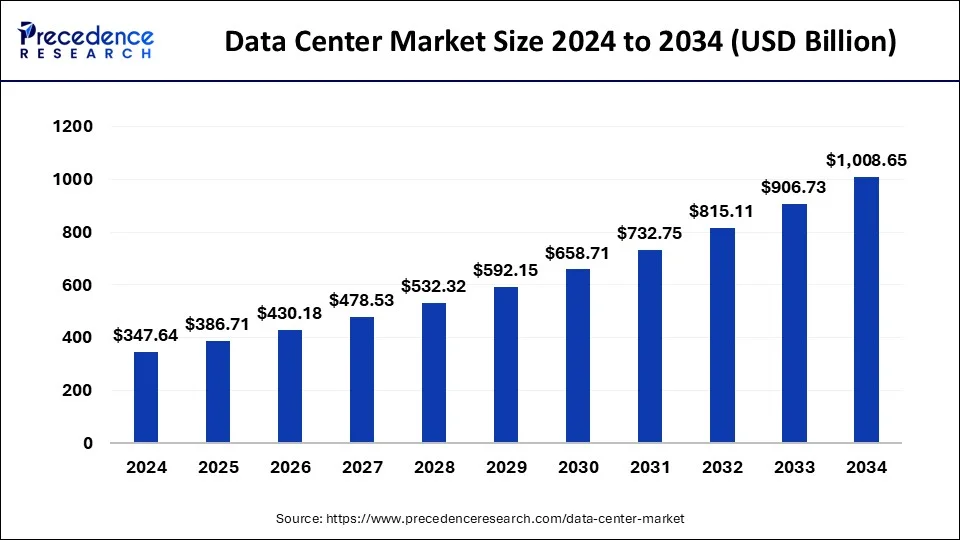
The global data center market was valued at USD 386.71 billion in 2025 and is projected to grow from USD 430.18 billion in 2026 to approximately USD 1,103.70 billion by 2035, registering a CAGR of 11.06% during the forecast period from 2026 to 2035. Market growth is driven by the rising adoption of cloud computing and artificial intelligence (AI), coupled with the rapid expansion of digital data generation across industries worldwide.
Get a Free Sample Report with Key Market Trends: https://www.precedenceresearch.com/sample/3531
Understanding the Complete Data Center Value Chain and Its Sustainability Challenges
The data center value chain spans raw material sourcing, equipment manufacturing, construction, operation, maintenance, upgrades, and even end-of-life recycling. Sustainability risks emerge at every single stage of this lifecycle. Addressing these challenges demands coordinated action among technology vendors, energy providers, infrastructure developers, governments, and recycling organizations.
Raw Material Extraction Creates the First Sustainability Challenges
Mining critical minerals, metals, and rare earth elements for tech hardware creates environmental and social risks via severe ecosystem destruction, water depletion and toxic pollution, and severe human rights violations. Clearing forests and digging open pits destroys wildlife areas and ruins local ecosystems. Thus, miners face unsafe tunnels, toxic dust, and heavy machinery without proper safety gear. Heavy machinery and chemical processing release greenhouse gases and even toxic dust into the air. Local communities and indigenous groups lose their homes, farms, and ancestral lands to new mines.
Manufacturing and Infrastructure Development Contribute to Embedded Carbon Emissions
Producing IT hardware and data center infrastructure led significantly to lifecycle emissions through the extraction of rare materials, global supply chain transport, high-energy manufacturing processes, and heavy fossil fuel use in the production of steel, concrete, and silicon chips. Mining and refining rare earth elements, copper, and aluminum demand heavy machinery and toxic chemical processing. Cleanrooms and fabrication plants run 24/7, consuming massive amounts of power. Steel mills burn coal and use extreme heat to forge data center frames and shells.
Operations and End-of-Life Management Shape Long-Term Sustainability Performance
Energy consumption, equipment upgrades, electronic waste management, along with recycling practices heavily drive the environmental footprint of data centers. Together, these factors dictate carbon emissions, resource depletion, combine with toxic pollution across the lifecycle of digital infrastructure. Servers, storage arrays, and heavy air-conditioning or liquid-cooling systems demand continuous, massive amounts of electricity, accounting for a notable share of global power grids. Manufacturing new servers requires intensive mining of rare earth minerals and high energy use, thus, depleting natural resources before the equipment is even plugged in.
Rising Energy Demand Is Increasing Sustainability Risks for Global Data Center Operators
AI models, cloud computing, high-performance computing, along with digital services, drive up electricity demand because they demand massive data centers, intensive server processing, and constant cooling systems. Balancing growing computer needs with green energy, stable power grids, and high efficiency is hard because data centers need massive power, renewable sources change constantly, and traditional grids struggle to keep up.
AI and High-Performance Computing Are Increasing Electricity Consumption
Advanced computing workloads demand significantly more power and energy than traditional applications because they process massive datasets, perform complex parallel mathematical operations, along with run continuous deep learning algorithms. These intensive demands are driven by parallel processing, massive data movement, and even dense infrastructure. Tasks like AI training and scientific simulations run billions of calculations simultaneously across thousands of cores. High power use creates extreme heat, which demands large cooling systems that consume even more electricity.
Renewable Energy Procurement Is Becoming a Competitive Advantage
Data center operators are rapidly moving from passive carbon offsets to active energy engineering, boosted by massive artificial intelligence workloads. To secure continuous power, they use three main strategies: long-term power purchase agreements (PPAs), on-site generation, and even direct clean energy partnerships. Firms shift from annual carbon accounting to 24/7 carbon-free energy matching. This requires hourly alignment between clean generation along with facility consumption. Advanced software blends on-site generation, battery storage, and local utility grids to maintain absolute uptime.
Grid Reliability and Energy Security Influence Sustainable Growth
Increasing power need creates major challenges for electricity infrastructure and long-term operational resilience by causing equipment strain, accelerating grid aging, and even increasing blackout risks. Key issues include transformer overload, voltage instability, and supply-demand imbalances. Higher electricity usage makes transformers run hotter. This shortens their lifespan and leads to sudden failures. Substations handle more load than they were built for. Thus, this raises the risk of local equipment fires or shutdowns.
Water Management Is Emerging as a Critical Sustainability Challenge for Data Centers
Data center cooling drives massive water consumption, usually millions of gallons daily per facility, primarily via evaporative loss in cooling towers. This strains municipal supplies in water-scarce regions, prompting a shift toward closed-loop liquid designs, recycled greywater reuse, and stricter municipal efficiency mandates. Moreover, it submerges entire servers in thermally conductive, non-conductive dielectric liquids, virtually removing evaporative water loss.
Cooling Systems Account for Significant Water Consumption
Traditional cooling systems use large volumes of water via evaporative cooling towers, where heat is removed via water evaporation and direct thermal transfer. This process demands a continuous water supply for makeup water, blowdown management, along with heat dissipation to keep industrial plants and large buildings running safely.
Water Scarcity Is Influencing Future Data Center Site Selection
Geographic water availability increasingly affects investment decisions for new facilities by driving site selection toward water-secure regions, thus raising capital costs for advanced treatment infrastructure, and introducing regulatory or operational risks. Firms now evaluate long-term basin stress, local water pricing, and community competition before breaking ground. Companies avoid high-stress watersheds and prioritize locations with reliable municipal or groundwater supplies. Corporations factor in local public opposition and social license to operate in water-scarce communities.
Advanced Cooling Technologies Support More Sustainable Water Management
Liquid cooling, closed-loop layouts, and water-efficient systems decrease environmental impact by conserving freshwater resources, cutting energy consumption, and also preventing chemical pollution. They achieve this via direct heat transfer, continuous fluid recycling, and the elimination of open evaporative cooling towers.
Carbon Emissions Across the Data Center Lifecycle Require Comprehensive Decarbonization Strategies
Data center sustainability demands measuring Scope 1, Scope 2, and Scope 3 emissions to address total environmental impact. Key areas involve direct site fuel use, operational electricity consumption, and even comprehensive supply chain footprints. Lifecycle management looks beyond power usage effectiveness (PUE) to capture embedded carbon across every phase of infrastructure.
Operational Carbon Emissions Remain a Major Sustainability Focus
Electricity generation causes high operational emissions as most power plants still burn fossil fuels such as coal, gas, and oil. This process releases massive amounts of carbon dioxide, and global power requirements keep growing while clean energy growth still works to catch up.
Supply Chain Emissions Often Exceed Operational Environmental Impacts
Manufacturing servers, networking equipment, batteries, along with cooling infrastructure, creates a large amount of embedded carbon because these processes demand energy-intensive material extraction, high-heat fabrication, and even complex global supply chains. Making these high-tech items uses intense amounts of power and rare resources long before the hardware ever turns on.
Lifecycle Carbon Accounting Supports Better Sustainability Decisions
Organizations use lifecycle assessments (LCAs) to track emissions by measuring the Scope 1, 2, and 3 carbon footprints of a product from raw material extraction via manufacturing and use, all the way to end-of-life disposal or recycling. This data-driven approach highlights hotspots, guides eco-design choices, and even pinpoints supply chain inefficiencies. Companies map out the exact scope of the assessment, whether it is cradle-to-gate or cradle-to-grave. Thus, software models convert this raw data into specific environmental footprints, such as greenhouse gas emissions or water use.
Sustainable Supply Chain Management Is Reducing Environmental and Operational Risks
Modern procurement strategies prioritize supplier transparency, responsible sourcing, and carbon reporting to handle risk, ensure compliance, and protect brand value. These practices rely on end-to-end data visibility, active vendor collaboration, along with rigorous metrics to align operational purchasing with wider corporate governance and climate targets. Transparent supply networks expose weak links, labor violations, or environmentally hazardous facilities before they result in sudden shutdowns or public scandals.
Responsible Sourcing Supports Sustainable Infrastructure Development
Organizations evaluate suppliers on sustainability by deploying structured frameworks, third-party verifications, along with continuous metrics tracking. Key evaluation methods include self-assessment questionnaires, on-site audits, and even third-party ESG ratings platforms like EcoVadis.
Supplier Transparency Improves Sustainability Reporting
Green purchasing strategies strengthen operational resilience and regulatory compliance by decreasing supply chain disruptions, avoiding legal penalties, and enhancing resource efficiency. These methods secure stable material flows as well as lower environmental risks. Green sourcing lowers the chance of raw material shortages from climate damage or resource depletion. Green purchasing assists firms meet local and global environmental laws before deadlines.
Circular Economy Principles Are Transforming Data Center Equipment Lifecycle Management
Extending equipment life, refurbishing servers, recovering materials, reusing components, and recycling e-waste reduce environmental impacts by cutting carbon emissions, saving natural resources, along with lowering toxic waste. These circular economy practices are vital because they minimize resource consumption, decrease greenhouse gases, and even cut electronic waste in the tech industry.
Equipment Refurbishment Extends Infrastructure Lifecycles
Upgrading and reusing IT equipment decreases new manufacturing by extending device lifespans, cutting raw material extraction, and lowering electronic waste. Key ways this works include conserving critical minerals, preventing premature factory production, along with shrinking overall supply chain footprints.
Electronic Waste Recycling Recovers Valuable Critical Materials
Responsible recycling diverts solid waste away from disposal sites, capturing valuable commodities such as steel, copper, and aluminum through systematic sorting and processing. This practice shrinks the physical volume of trash in landfills, prevents toxic leakage into local soil and groundwater, and even feeds purified materials back into industrial supply chains.
Circular Business Models Support Long-Term Sustainability Goals
Asset recovery, reuse, and remanufacturing enhance both the planet and profits by lowering material waste, cutting production costs, reducing carbon emissions, and opening new revenue streams.
Artificial Intelligence Is Improving Sustainability Monitoring Across Data Center Operations
Intelligent technologies optimize facility operations by using machine learning, predictive analytics, and digital twins to automate energy loads, prevent equipment failure, and even track real-time emissions. These tools shift management from reactive fixes to continuous, data-based sustainability strategies. Digital twins simulate different cooling layouts to identify airflow blockages or hot spots without risking live equipment downtime.
AI Optimizes Energy Consumption in Real Time
Intelligent algorithms continuously optimize data center efficiency by dynamically balancing workloads, cooling systems, along with power utilization. Key mechanisms include predictive load shifting, real-time thermal tuning, and even dynamic power capping. These methods reduce energy waste and lower operational costs. Algorithms forecast need spikes and shift non-urgent batch tasks to off-peak hours. Cooling plant flow rates and chiller temperatures scale dynamically with current heat loads. Systems restrict peak power draws per rack during high-demand grid periods.
Predictive Maintenance Reduces Equipment Failures and Resource Waste
Predictive analytics minimizes downtime and extends equipment lifespan by using IoT sensors, machine learning algorithms, and real-time condition monitoring. This data-driven approach enables facilities to shift from reactive repairs to targeted, scheduled interventions. You can explore how major industrial frameworks apply this via platforms such as SAP Predictive Maintenance or insights from IBM.
Digital Twins Support Sustainable Infrastructure Planning
Virtual modeling enables organizations to improve facility performance by creating digital twins, running simulation scenarios, and even testing operational adjustments. These tools help teams identify bottlenecks, decrease energy usage, and test layouts safely.
Regulatory Compliance and ESG Reporting Are Driving Sustainable Data Center Operations
Transparent environmental reporting and ESG performance have changed from voluntary corporate philanthropy into core drivers of global commerce. Governments, investors, and customers now need rigorous emissions disclosures and sustainability metrics because hidden ecological and social risks directly threaten financial stability and brand survival.
Governments Are Expanding Environmental Reporting Requirements
Sustainability regulations now demand infrastructure operators offer comprehensive environmental disclosures, aiming on climate risks, greenhouse gas emissions, and resource usage. Key frameworks include the Corporate Sustainability Reporting Directive, the Task Force on Climate-related Financial Disclosures, and even local ESG mandates. Governments and global bodies want to stop greenwashing. They need clear data to reach net-zero goals. Infrastructure projects have a massive footprint. Regulators now treat environmental transparency as a basic rule, not an extra choice.
Investors Prioritize ESG Performance in Infrastructure Investments
Strong sustainability performance attracts capital and enhances long-term value by lowering risk, lowering costs, and meeting rising investor demand. Firms that focus on environmental, social, and governance (ESG) factors usually secure better funding terms and stronger market stability.
Transparent Sustainability Reporting Builds Stakeholder Confidence
Standardized environmental reporting strengthens trust by ensuring data is clear, comparable, and verifiable, which removes guesswork and prevents greenwashing. It builds confidence across groups by creating a single, reliable baseline for environmental impact.
Collaborative Partnerships Are Accelerating Sustainability Across the Data Center Ecosystem
Ecosystem cooperation unites cloud providers, utilities, renewable developers, hardware makers, builders, governments, and tech firms. Together, they tackle shared green goals via joint power agreements, standardized efficiency metrics, and co-located data centers. This teamwork speeds up innovation and scales green impacts. Moreover, massive green projects need huge funds. Partnerships split the financial burden among many players. Tech companies team up with utilities to match power use with local clean energy supply in real time.
Technology Providers and Operators Are Developing Joint Sustainability Solutions
Collaboration drives innovation in energy efficiency, cooling technologies, along with infrastructure optimization by pooling expertise, sharing high costs, and even accelerating testing. Key drivers include cross-sector R&D, data sharing platforms, along with public-private partnerships. These combined efforts help teams create better systems faster than working alone. Partners work production goals to build uniform, low-energy hardware. Teams use shared test centers to build next-generation green liquid and air cooling systems.
Renewable Energy Partnerships Reduce Long-Term Environmental Impact
Utilities and renewable energy providers support cleaner data center operations via green tariffs, power purchase agreements (PPAs), and grid-scale storage integration. These frameworks enable facilities to source reliable, low-carbon electricity while managing peak computing loads. Moreover, local utilities design special rate structures so data centers can buy bundled renewable power straight from standard utility portfolios. Data centers dynamically lower non-critical workloads during high-stress grid events, assisting utilities in balancing intermittent renewables.
Industry Collaboration Accelerates Sustainability Standards
Shared best practices promote environmental consistency by setting common standards, reducing trial-and-error costs, along with building trust across the industry. They align firms on eco-friendly goals, clear measurement methods, and dependable operational routines.
Emerging Technologies Are Reshaping Sustainable Data Center Infrastructure
Modern data centers use sustainable innovations such as modular builds, liquid cooling, and hydrogen power to decrease environmental harm while scaling capacity. These technologies cut carbon footprints, lower water waste, and also stabilize power grids.
Advanced Cooling Technologies Improve Operational Sustainability
Next-generation cooling solutions cut electricity and water use by replacing inefficient air fans along with water-guzzling evaporative towers with closed-loop liquid systems, immersion techniques, and smart microfluidics. These innovations improve heat transfer directly at the component level. Coolants flow straight to processors, removing heat instantly and even lowering total energy demand. Air-cooled heat exchangers reject heat to the ambient air without drinking municipal water supplies.
Modular Infrastructure Supports More Resource-Efficient Expansion
Modular construction minimizes material waste and enhances deployment flexibility through factory-controlled precision, standardized design, and even component reuse. Key factors include off-site prefabrication, standardized modules, along with disassembly potential. Machines cut raw materials to exact sizes. Workers use leftover pieces for other parts. Workers drop pre-made boxes into place. Moreover, construction time drops by half compared to normal building.
Clean Energy Technologies Strengthen Sustainable Infrastructure
Renewable power, energy storage, and alternative energy systems lower carbon footprints by replacing fossil fuels, removing the intermittency of green energy, and decentralizing generation. Together, they cut direct emissions, avoid grid transmission losses, and remove the need for carbon-heavy backup generators. Localized microgrids and on-site arrays reduce long-distance transmission losses. Batteries hold excess solar or wind energy produced during peak generation times for usage when weather conditions drop.
Regional Sustainability Strategies Differ Across Global Data Center Markets
Sustainability priorities vary across the globe based on distinct regional drivers. North America, Europe, Asia-Pacific, Latin America, and the Middle East & Africa each face unique conditions. They differ in energy resources, regulations, climate risks, and infrastructure maturity.
North America Is Expanding Renewable-Powered Hyperscale Infrastructure
Cloud providers and hyperscale operators are investing deeply in renewable energy and efficiency technologies via large-scale clean energy power purchase agreements, on-site backup innovations, and advanced liquid cooling systems. Companies such as Amazon, Microsoft, and Google lead these efforts to power massive data centers sustainably. Firms match hourly electricity needs with regional zero-carbon generation. Machine learning models adjust data center cooling fans and airflow in real time.
Europe Continues to Lead Through Strong Sustainability Regulations
Environmental legislation and carbon reduction targets drive European data center development by mandating strict energy efficiency standards, thus pushing for renewable energy sourcing and increasing transparency reporting. It demands that large data centers in the EU publicly report their energy performance, water usage, and waste heat recovery data. Expansion shifts toward regions with abundant green energy, such as Scandinavia, or areas with robust grid capacity.
Asia-Pacific Is Balancing Rapid Digital Growth With Environmental Responsibility
Fast-growing digital economies are integrating sustainability into expanding infrastructure by adopting green data centers, using renewable energy grids, and implementing circular supply chains. These efforts decrease carbon footprints and power future tech growth responsibly.
The Future of Sustainable Data Centers Will Depend on Innovation, Collaboration, and Lifecycle Risk Management
Sustainability is now a defining factor for global data centers, demanding that organizations address environmental risks across the entire value chain via green energy, circular economies, and lifecycle management, rather than just focusing on operational efficiency. Companies build resilient, future-ready data centers by combining renewable energy, circular economy methods, and also smart infrastructure. These practices lower carbon footprints, cut waste, and guarantee long-term stability against climate and resource risks.
Sustainability Will Become a Core Driver of Competitive Advantage
Environmental leadership builds a strong foundation for operational resilience, regulatory compliance, customer trust, and long-term profitability by lowering risks and creating new value. Leaders cut costs with smart resource usage, avoid fines by meeting green rules, win loyal buyers who care about the planet, and then protect their supply chains from climate shocks.
Digital Infrastructure Growth Must Align With Responsible Resource Management
Balancing technological innovation with environmental stewardship will shape future infrastructure investments by prioritizing smart resource use, cutting carbon emissions, along with building resilient systems. Major factors driving this shift include smart grids, green materials, and AI-based monitoring.
Integrated Sustainability Strategies Will Define the Next Generation of Data Centers
Long-term data center success demands managing sustainability risks across the entire value chain, covering raw material sourcing, infrastructure retirement, along with resource recovery. This approach ensures operational resilience, reduces environmental footprints, and even meets evolving global regulations.
About the Authors

Aditi Shivarkar
Aditi, Vice President at Precedence Research, brings over 15 years of expertise at the intersection of technology, innovation, and strategic market intelligence. A visionary leader, she excels in transforming complex data into actionable insights that empower businesses to thrive in dynamic markets. Her leadership combines analytical precision with forward-thinking strategy, driving measurable growth, competitive advantage, and lasting impact across industries.



Aman Singh
Aman Singh with over 13 years of progressive expertise at the intersection of technology, innovation, and strategic market intelligence, Aman Singh stands as a leading authority in global research and consulting. Renowned for his ability to decode complex technological transformations, he provides forward-looking insights that drive strategic decision-making. At Precedence Research, Aman leads a global team of analysts, fostering a culture of research excellence, analytical precision, and visionary thinking.

Piyush Pawar
Piyush Pawar brings over a decade of experience as Senior Manager, Sales & Business Growth, acting as the essential liaison between clients and our research authors. He translates sophisticated insights into practical strategies, ensuring client objectives are met with precision. Piyush’s expertise in market dynamics, relationship management, and strategic execution enables organizations to leverage intelligence effectively, achieving operational excellence, innovation, and sustained growth.