






 Request Consultation
Extremity tissue expanders are advancing reconstructive surgery by enabling controlled and effective tissue growth. This blog highlights innovations in biomaterials, device design, and regenerative integration. It also covers clinical applications, benefits, and future trends shaping limb reconstruction.
Modern surgical practices are increasingly embracing tissue expanders for the extremities. Tissue expanders are currently becoming a popular way for surgeons to reconstruct the extremity and restore its functionality. The devices allow clinicians to create more volume of soft tissue without having to use donors. They give a tactical method of treating congenital injuries, traumas, and post-oncology deficiency of soft tissue.
Extremity tissue expanders are designed to be highly adaptable, capable of conforming to complex anatomical structures while maintaining consistent expansion pressure. Their application has transformed reconstructive surgery as they have given surgeons the opportunity to make an accurate soft tissue coverage. Most of the new advancements in biomaterials and design are rendering procedures quicker, safer, and more foreseeable.
Surgeons are currently giving preference to equipment that combines biocompatible substances, spacious designs, and non-invasive positioning strategies. It is aimed at achieving optimal patient outcomes and reducing post-surgical pain and time. Such a direction can be explained by the increasing role of patient-centered care in reconstructive surgery.
Scientific Principles Behind Tissue Expansion Technology
Tissue expansion is a fundamental surgical principle based on the skin and soft tissue’s inherent capacity for growth. The response of the tissue to the gradual mechanical stretching done gradually is the production of new cells and extra components of the extracellular matrix. This phenomenon makes it possible to cover big defects without distant donor sites.
The pathogenesis is based on cell proliferation, angiogenesis, and the change of the extracellular matrix. Extremity tissue expanders are intended to use these processes, providing controlled pressure that has the effect of promoting even tissue growth. The increase in material science has enabled manufacturers to make the best out of different tissue types and anatomical regions of expansion rates.
What is the Extremity Tissue Expanders Market Size in 2026?
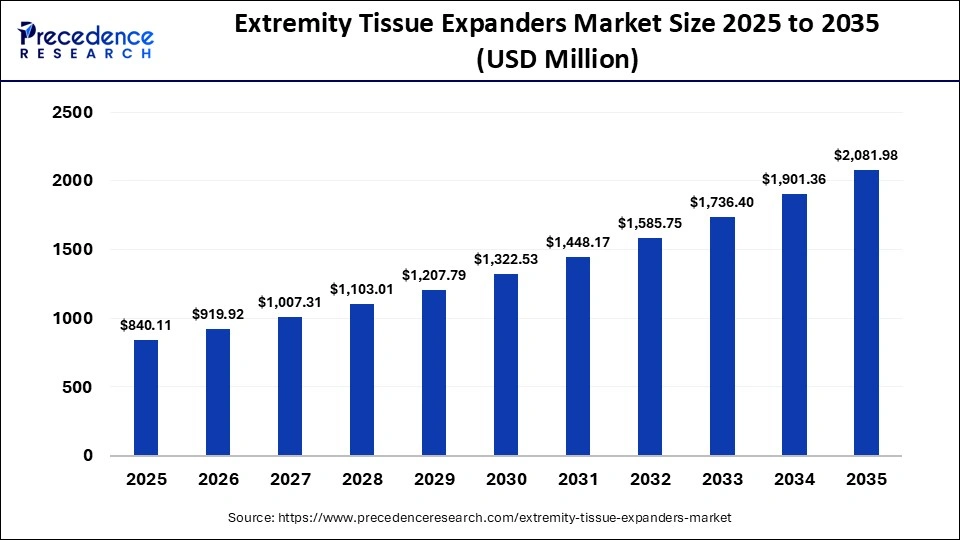
The global extremity tissue expanders market size was valued at USD 840.11 million in 2025 and is expected to grow from USD 919.92 million in 2026 to approximately USD 2081.98 million by 2035, registering a CAGR of 9.50% from 2026 to 2035. The growth is attributed to the increasing adoption of advanced tissue expansion technologies and the rising demand for complex extremity reconstructive surgeries.
Get a Free Sample Report with Key Market Trends: https://www.precedenceresearch.com/sample/8235
Evolution of Extremity Tissue Expanders
Tissue expansion technology has developed considerably during the last few decades. Initial designs were also fairly primitive and involved hand-inflation by external ports. Current devices have integrated injection ports, adjustable inflation rates, and ergonomic shapes that fit the anatomy of the extremity.
The latest developments are self-inflating expanders which employ osmotic or hydrogel expansion without repetitive injections. Such designs enhance patient comfort, minimize clinic visits, and enable more frequent generation of tissues. The use of these devices proves the rising complexity of the extremity reconstruction solutions.
Material improvements have also contributed to the evolution of tissue expanders. Biocompatible polymers with high performance have become the norm and offer durability, flexibility, and less risk of immune response. These materials are used to make sure that the expander is enduring pressure without causing much discomfort to patients.
Clinical Applications Across Reconstructive Surgery
Extremity tissue expanders are currently used in a broad range of reconstructive surgery cases. They are used by trauma surgeons in the management of large soft tissue deficits caused by accidents, burns, or crush injuries. There is controlled expansion, and it covers the exposed tendons, nerves, and joints, enhancing functional and cosmetic outcomes.
Oncological repair is commonly used in the extremities after removing tumors using expanders. Surgeons can also pre-stretch tissue around resection sites, eliminating the use of complex flap procedures. The resultant tissue offers superior color and texture matching, which reduces donor site morbidity.
Tissue expansion techniques are also applicable in the congenital correction of deformities such as syndactyly and limb hypoplasia. Surgeons enhance the aesthetics and functionality of the extremities of pediatric patients by creating more skin and soft tissue gradually. There is no doubt that care and monitoring play a central role in such situations because growing tissues are fragile.
Design Innovations Driving Clinical Effectiveness
The effectiveness of extremity tissue expanders depends largely on their design and adaptability. The shapes of modern devices are contoured, which spreads the pressure uniformly and decreases the stress on tissues. Integrated ports aid in the accurate inflation of the area without having to undergo repeated invasive surgeries, reducing the risk of infection.
Self-expanding expanders are a new development that exploits osmotic pressure or hydrogel expansion to achieve gradual, continuous growth. This results in a decrease in clinic visits and makes expansion more consistent in more difficult areas of the body. There is enhanced comfort for the patients, and surgeons have predictable coverage of complex defects.
The performance of these devices has also been increased by advanced surface coating and a biocompatible membrane. The changes minimize capsule formation, inflammation, and tissue attachment, leading to a better quality of the regenerated tissue. There is some clinical experience that coated expanders lead to easier integration and post-operative outcomes.
Preoperative Planning and Personalized Solutions
Extremity reconstruction requires careful preoperative planning for success. The three-dimensional MRI or CT scans help surgeons outline the mapping of the tissue expansion requirements. Online simulations forecast the results of expansion, enabling expander position and inflation guidelines to be customized.
Personalized expanders are gaining more popularity, especially with irregular body parts. Specialized machines are able to shape to different limb morphologies and allow even tissue to expand with fewer complications. In the development of such personalized solutions, the partnership of surgeons, biomedical engineers, and device manufacturers is imperative.
Postoperative Management and Recovery
Successful postoperative treatment is essential in order to optimize the advantages of extremity tissue expanders. Monitoring of tissue perfusion, inflammation, and early signs of infection continuously promotes patient safety. Any anomalies may be addressed in time to ensure that complications are avoided and expansion efficiency is ensured.
Physical therapy often accompanies expansion procedures to maintain joint mobility and prevent stiffness. Tissue elasticity is guaranteed by controlled activity, and it adds to functional recovery. The rehabilitation protocols are modified to the needs of the patient, considering the area of anatomy and level of expansion. Surgeons state the necessity of keeping the hygiene and preventing the trauma of the expanded tissue.
Integration With Regenerative Medicine and Bioactive Materials
Regenerative medicine methods are becoming more combined with tissue expanders to enhance healing. There is an exploration of bioactive coating, integration of growth factors, and delivery of stem cells to hasten the process of vascularization and integration of tissues. New research indicates that the participation of expanders with a growth factor release system has the potential to improve angiogenesis and shorten the time of healing.
This method is especially effective in fragile patients or regions with impaired vascularity. Bioactive strategies are currently shifting their focus to clinical feasibility trials after the laboratory work. Stem cell-enhanced expanders have an added regenerative capability by adding progenitor cells into the tissue microenvironment. These cells are capable of differentiating into relevant tissue types, enhancing structural and functional recovery. There are initial clinical experiences that suggest increased integration and decreased fibrosis with the method.
Challenges in Adoption and Clinical Practice
Extremity tissue expanders have a number of clinical and operational issues despite their benefits. Infection, extrusion, or asymmetrical growth of the device continues to happen even with design and material innovation. Strict aseptic practices and close attention to the devices are the risk mitigation strategies.
Patient compliance may influence the success of the treatment, especially in young and old patients. Follow-up systems, education, and support systems should be followed properly to make sure that expansion protocols are adhered to. Surgeons should consider behavioral and lifestyle factors that can affect the outcome.
Adoption is also affected by economic factors. Although expanders decrease the necessity to use complex grafting procedures, start-up costs and resources needed to monitor these expanders may be huge. The operational efficiency of hospitals and patient-centered outcomes are the two variables that hospitals need to strike a balance between in the case of including these devices.
Technological Trends Shaping the Market
New technologies are setting new frontiers in the development, implementation, and monitoring of extremity tissue expanders. Smart expanders with inbuilt sensors are being designed to give real-time feedback on tissue tension, perfusion, and pressure distribution. Predictive analytics and artificial intelligence are used to streamline expansion plans. These systems use patient-specific factors and records to prescribe an individual inflation rate. Clinical decision support systems minimize problems and enhance predictability.
Additive manufacturing techniques, including 3D printing, are enabling highly customized expanders tailored to individual anatomy. These gadgets can reach high levels of conformity, even expansion, and enhanced integration after the operation. Bespoke production is a significant development in extremity reconstruction.
Future Directions and Innovation Opportunities
The future generation of extremity tissue expanders will probably incorporate multimodal regenerative approaches. Combination devices using growth factors, stem cells, and bioactive scaffolds are also being studied and applied in improved tissue regeneration. Surgery is minimized using minimally invasive placement techniques. The percutaneous and laparoscopic insertional techniques reduce the recovery time and post-operative pain with no decline in expansion before the operation.
It is anticipated to integrate with imaging and wearable monitoring systems to improve post-operative management. Live feed allows the surgeon to regulate expansion rates using physiologically responsive feedback. This accuracy model reduces complexities and maximizes results.
Conclusion: Pioneering Regenerative Approaches in Extremity Reconstruction
Extremity tissue expanders are an innovation in reconstructive surgery with a combination of mechanical and biological acumen. They are capable of regulated tissue growth, enabling more specific, efficient, and patient-centered results.
Combination with regenerative medicine, bioactive materials, and intelligent technologies is progressing to increased clinical opportunities. Continuous innovations will offer much better safety, quicker recovery, and better functional and aesthetic outcomes. These instruments represent a larger tendency to customized, biologically knowledgeable surgical therapy. These advanced scaffolds will continue to play a leading role in the future of extremity reconstruction to produce results that would have been deemed impossible before.
Expert Advise
According to Precedence Research, advancements in regenerative medicine, the increasing number of surgeries, and the latest innovations in medical devices potentiate the demand for extremity tissue expanders. Ongoing research focuses on determining the expanding applications of tissue expanders for a wide range of chronic conditions and surgeries. The future of extremity tissue expanders is promising, driven by their integration with wearable devices and inbuilt sensors.
About the Authors

Aditi Shivarkar
Aditi, Vice President at Precedence Research, brings over 15 years of expertise at the intersection of technology, innovation, and strategic market intelligence. A visionary leader, she excels in transforming complex data into actionable insights that empower businesses to thrive in dynamic markets. Her leadership combines analytical precision with forward-thinking strategy, driving measurable growth, competitive advantage, and lasting impact across industries.



Aman Singh
Aman Singh with over 13 years of progressive expertise at the intersection of technology, innovation, and strategic market intelligence, Aman Singh stands as a leading authority in global research and consulting. Renowned for his ability to decode complex technological transformations, he provides forward-looking insights that drive strategic decision-making. At Precedence Research, Aman leads a global team of analysts, fostering a culture of research excellence, analytical precision, and visionary thinking.

Piyush Pawar
Piyush Pawar brings over a decade of experience as Senior Manager, Sales & Business Growth, acting as the essential liaison between clients and our research authors. He translates sophisticated insights into practical strategies, ensuring client objectives are met with precision. Piyush’s expertise in market dynamics, relationship management, and strategic execution enables organizations to leverage intelligence effectively, achieving operational excellence, innovation, and sustained growth.