






 Request Consultation
Machine automation controllers are transforming modern industries by enabling smart, efficient, and connected operations. This blog explores key controller types such as PLCs, PACs, DCS, and CNCs along with their benefits and applications. Discover how automation is shaping the future of industrial performance and innovation.
Machine automation controllers are the driving force behind modern industrial systems. From improving production efficiency to enabling real-time decision-making, these controllers play a critical role in transforming traditional manufacturing into smart, connected operations. As industries move toward Industry 4.0 and beyond, understanding different types of automation controllers becomes essential.
What is the Machine Automation Controller Market Size in 2026?
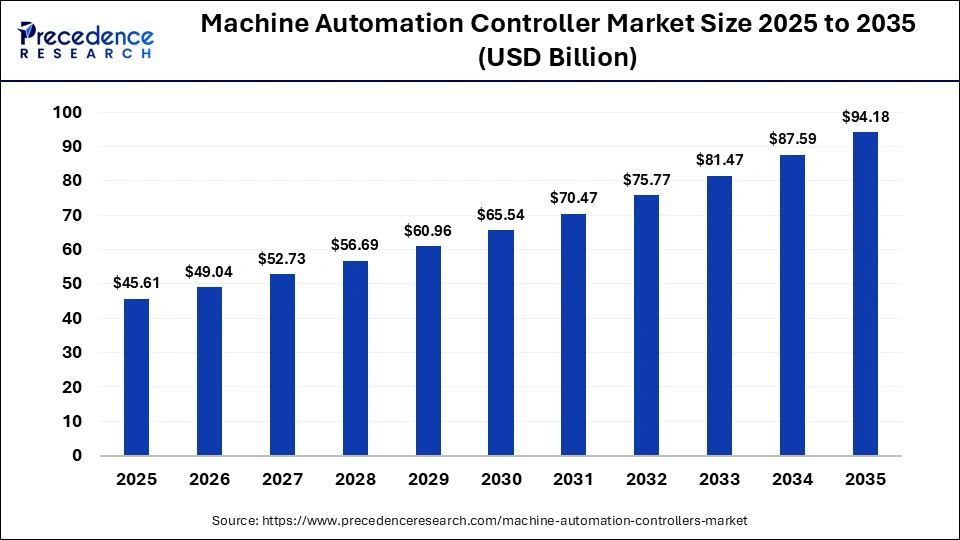
The global machine automation controller market size was valued at USD 45.61 billion in 2025 and is predicted to increase from USD 49.04 billion in 2026 to approximately USD 94.18 billion by 2035, expanding at a CAGR of 7.52% from 2026 to 2035. Increased productivity, improved accuracy, reduced operational costs, and enhanced safety are key drivers of market growth.
Get a Free Sample Report with Key Market Trends: https://www.precedenceresearch.com/sample/8228
Decoding Machine Automation: A Guide to Different Controller Types
Programmable Logic Controllers
Programmable logic controllers (PLCs) are industrial computers designed to control and monitor machinery and processes through customized programming. Initially developed for the automobile manufacturing industry, PLCs replaced traditional hard-wired relay systems with a more flexible, rugged, and efficient solution.
Before PLCs were invented in the late 1960s, hardwired relay systems were widely used to control industrial processes. However, with the introduction of PLCs, the industry experienced a major shift as these systems delivered game-changing benefits to organizations across the world. Unlike older relay-based systems, PLCs can be easily reprogrammed, allowing industries to adapt quickly to changing production needs. They operate using multiple inputs and outputs to execute complex control functions with high accuracy.
Merits:
- Easy to reprogram compared to older relay systems that require manual rewiring, making the process time-consuming and less flexible.
- Do not have moving parts, which allows them to operate more reliably over a long period of time.
- Provide enhanced control and monitoring capabilities, enabling them to handle complex logic and precise timing operations.
- Simultaneously manage multiple inputs and outputs, improving overall system efficiency and performance.
Programmable Automation Controllers
Programmable automation controllers (PACs) are used to describe any type of automation controller that incorporates higher-level instruction and advanced computing capabilities. PACs are digital computers designed to hold and execute embedded programs, making them highly suitable for modern industrial automation systems that require both control and data processing.
Merits:
- Dramatically increase production and overall output
- Lower associated operational costs
- Improve the work environment for employees by engaging them intellectually in production processes, reducing human involvement in repetitive or hazardous tasks and enhancing workplace safety.
- The design and function of programmable automation processes offer manufacturers greater diversity and flexibility in production
- Well-suited for low and medium-volume batch production of parts and components.
Distributed Control System
Distributed control systems (DCS) are computerized systems used to automate industrial equipment in both continuous and batch processes, while reducing risk to humans and the environment. DCS systems utilize advanced control algorithms, such as PID control, to ensure precise and accurate process management across industrial operations.
Merits:
- Provide improved process control through an advanced control algorithm for precise and accurate operations.
- Offer high scalability and allow the system to expand and handle larger and more complex processes.
- Enable remote access through computers or mobile devices for monitoring and controlling processes.
- Include a redundancy feature, such as a controller and server, which improves system reliability and helps prevent downtime.
- Ensure flexibility, allowing configuration across a wide range of processes and compatibility with various input and output devices.
- Support improved data collection and analysis, enabling better process optimization.
- Enhanced safety by implementing a safety interlock and alarm system.
- Allow easy integration with systems, SCADA, PLCs, and MES for comprehensive control.
- Features a modular design for easy maintenance, upgrade, and part replacement.
Soft PLC
A Soft PLC integrates the functionalities of traditional PLCs with those of data loggers, communication gateways, and additional components like human-machine interfaces (HMIs) and web servers. It represents a software-driven variant of a PLC that operates on standard computing hardware. Soft PLCs function on general-purpose platforms, including industrial PCs or embedded systems. This design enables enhanced scalability, cost-effectiveness, and seamless integration with IT and cloud-based systems, rendering them suitable for Industry 4.0/5.0 applications.
Merits:
- Assists in lowering production expenses compared with conventional PLC solutions, resulting in reduced installation and maintenance costs. Therefore, they are typically more affordable.
- Accommodates various programming languages, providing benefits such as simplified configuration and updates.
- Presents enhanced security features that align with contemporary industry standards.
Motion Controller
Motion controllers function as the specialized, high-speed computational core of an automated machine, acting as the central nervous system that governs and synchronizes all mechanical movements.
Merits:
- Effective management of speed and position enhances product consistency.
- Aids in the synchronization of axes, leading to reduced cycle times and improved machine coordination.
- Optimizes various processes related to packaging machines, robotic waste separation, assembly lines, and material handling systems.
- Adjust parameters rather than requiring mechanical changes.
Computerized Numerical Controllers (CNCs)
CNCs serve as the primary control unit of a CNC machine, interpreting digital machining commands and transforming them into accurate mechanical movements. It oversees the motion of the axes, spindle velocity, feed rates, tool alterations, and additional functions like coolant circulation and safety interlocks. In the absence of an effective controller, even the most sophisticated CNC machine is unable to produce consistent, high-quality results.
Merits:
- Operate continuously for 24 hours each day.
- Generate jobs with greater accuracy and precision compared to other manual machines.
- Implement changes effortlessly, thereby minimizing delay time.
- Need fewer personnel to operate these machines, resulting in reduced labor costs.
- Possess the ability to produce intricate designs with high precision in a brief period.
- Integrated modern design software can eliminate the necessity of creating a prototype or model before commencing a project, ultimately saving both time and money in the long term.
Challenges and Limitations in Machine Automation Controllers
In today’s competitive industrial landscape, machine automation controllers are a boon to various sectors in improving productivity and ensuring consistency and safety. However, they face certain limitations, such as high investments, issues related to system integration, and a lack of skilled workforce. These limitations hamper efficiency, accuracy, and productivity.
Automation in industries requires high upfront costs for hardware, software, and skilled manpower. This limits the affordability for many small- and medium-sized businesses. Moreover, the integration of old systems with modern automation controllers is complex, leading to communication errors, inefficiencies, and downtime. The increasing use of automated controllers also carries a risk of cybersecurity threats, such as hacking, malware, and unauthorized access.
However, the public and private sectors are making constant efforts to deal with such challenges and frame a robust regulatory guideline to promote the widespread adoption of machine automation controllers. Regular training and upskilling staff, preventive maintenance, and strong cybersecurity policies are other trends to address complexities related to machine automation controllers.
Trailblazing Tomorrow: Global Innovations in Motion
In 2025, the Asia-Pacific contributes largely to machine automation controllers, supported by a substantial presence of manufacturing, electronic, automotive, and process industries in India. The region's dominant position is attributed to the aggressive development of its manufacturing sector, government initiatives, and increasing labor costs, which create strong business cases for automation. This has resulted in significant demand from process industries, automotive manufacturing, semiconductor fabrication, pharmaceuticals, and food and beverage processing, all of which reinforce market leadership.
Concurrently, innovation in India is also playing a vital role in the evolution of automation technology. Team Nexus AI designed a system that enables users to articulate machine control logic in natural language, which is subsequently transformed into structured text code, serving as a contemporary alternative to traditional ladder logic programming.
China holds a leading position, underpinned by its scale in semiconductor and automotive production. Increased capital expenditure on AI‑driven automation and high‑speed machine controllers potentiates the development of machine automation controllers. Chinese automakers such as BYD and battery manufacturer CATL are significantly ramping up automation to expand EV cell production. Furthermore, AI-driven machine vision technology has been seamlessly integrated into an automation system, allowing information from the vision system to facilitate advanced real-time machine control.
North America is anticipated to experience the fastest growth over the coming years, fueled by strong demand from the advanced manufacturing and processing sectors. The U.S. benefits from its extensive industrial base and significant investment in automation at the implementation level. Additionally, Audi has adopted AI-driven automation for optical inspection, utilizing the Siemens portfolio. The objective is to automate the identification and elimination of weld spatter on vehicle bodies through a customer-trained AI algorithm and high-resolution imaging.
The integration of automation, intelligence, and regional dynamics is not only improving productivity but also establishing new standards for precision, flexibility, and operational excellence as industries increasingly adopt smarter systems. The machine automation controller will continue to be central to this transformation, fostering a more interconnected and efficient industrial future.
Expert Advise
According to our report, machine automation controllers are becoming an indispensable component in modern manufacturing systems. This is driven by shifting trends for industries from manual to automated processes and the need for real-time process monitoring. The rise of Industry 4.0 and the integration of IoT sensors enable predictive maintenance and improved productivity. Emerging economies, such as China, India, Southeast Asia, Brazil, the UAE, and Saudi Arabia, are at the forefront of embracing automation in various sectors, supported by government initiatives and funding policies. All these aspects drive the demand for machine automation controllers.
About the Authors

Aditi Shivarkar
Aditi, Vice President at Precedence Research, brings over 15 years of expertise at the intersection of technology, innovation, and strategic market intelligence. A visionary leader, she excels in transforming complex data into actionable insights that empower businesses to thrive in dynamic markets. Her leadership combines analytical precision with forward-thinking strategy, driving measurable growth, competitive advantage, and lasting impact across industries.



Aman Singh
Aman Singh with over 13 years of progressive expertise at the intersection of technology, innovation, and strategic market intelligence, Aman Singh stands as a leading authority in global research and consulting. Renowned for his ability to decode complex technological transformations, he provides forward-looking insights that drive strategic decision-making. At Precedence Research, Aman leads a global team of analysts, fostering a culture of research excellence, analytical precision, and visionary thinking.

Piyush Pawar
Piyush Pawar brings over a decade of experience as Senior Manager, Sales & Business Growth, acting as the essential liaison between clients and our research authors. He translates sophisticated insights into practical strategies, ensuring client objectives are met with precision. Piyush’s expertise in market dynamics, relationship management, and strategic execution enables organizations to leverage intelligence effectively, achieving operational excellence, innovation, and sustained growth.