



Machine Automation Controller Market Size, Key Companies, Company Market Share, Equipment Production Volume, Sales Performance, Manufacturing Cost, Export & Import Trends, Competitive Positioning, and Market Analysis
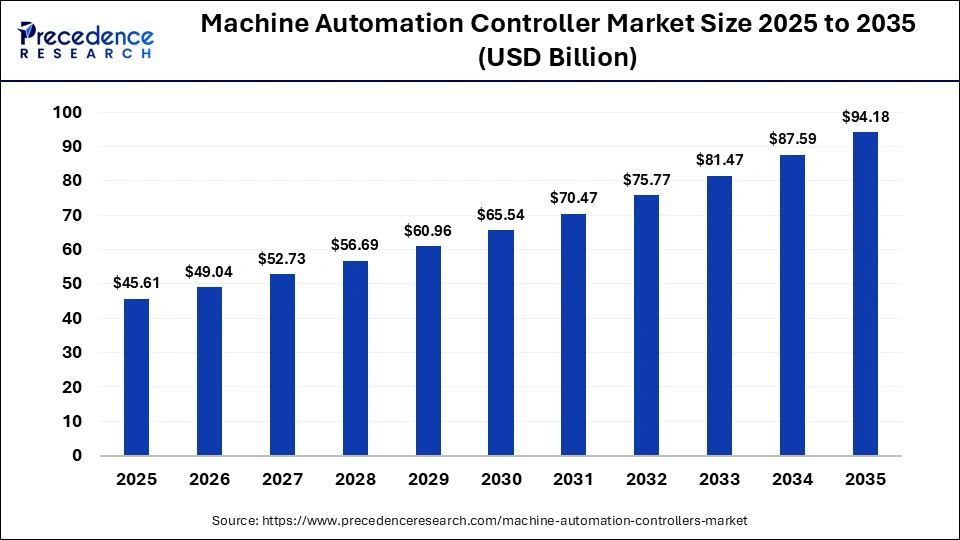
Laxmi Narayan, who specializes in the machinery and equipment industry, assesses the machine automation controller market at USD 49.04 billion in 2026 and expects it to reach USD 94.18 billion by 2035, expanding at a CAGR of 7.52%. Machine automation controller market companies including remain prominent players, with demand concentrated across segments such as By Controller Type, By Machine Operation Type, By End Use Industry.
Source: https://www.precedenceresearch.com/machine-automation-controller-market
 Get a Sample
 Table Of Content


What is the Machine Automation Controller Market Size in 2026?
The global machine automation controller market size was calculated at USD 45.61 billion in 2025 and is predicted to increase from USD 49.04 billion in 2026 to approximately USD 94.18 billion by 2035, expanding at a CAGR of 7.52% from 2026 to 2035. Increased productivity, improved accuracy, reduced operational costs, and enhanced safety are key drivers of market growth.
Key Takeaways
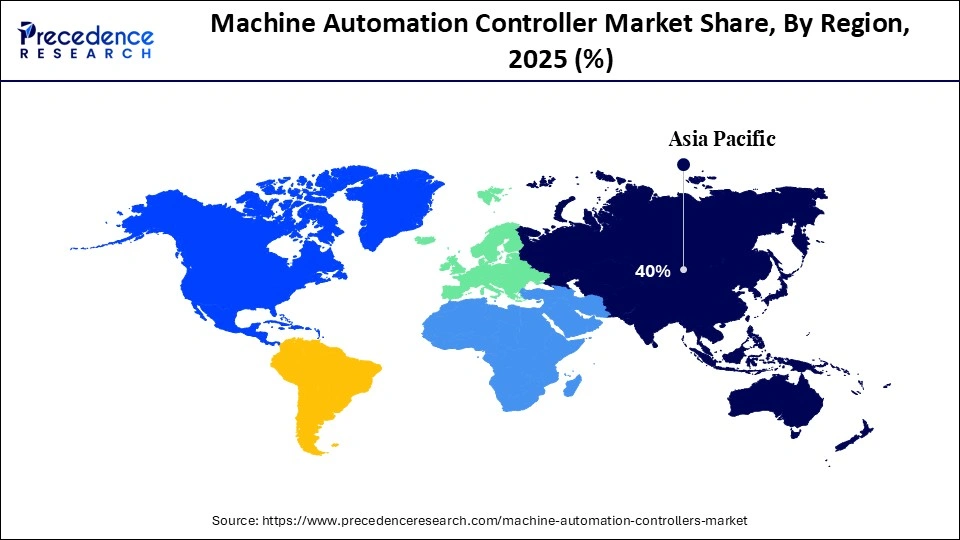
- Asia-Pacific contributed the biggest market share of 40% in 2025.
- North America is expected to grow at the fastest CAGR in the market during the forecast period.
- By controller type, the distributed control systems (DCS) segment held a dominant position in the market in 2025.
- By controller type, the programmable automation controllers (PAC) segment is expected to be the fastest-growing segment in the foreseen period.
- By machine operation type, the discrete manufacturing segment led the global market in 2025.
- By machine operation type, the batch process segment is expected to grow with the highest CAGR in the market during the studied years.
- By end-use industry, the oil and gas segment held the largest market share in 2025.
- By end-use industry, the power generation and utilities segment is expected to expand rapidly in the market in the coming years.
Machine Automation Controller Market Overview
Machine automation controllers (MACs) are extensively utilized in manufacturing, automated production lines, machinery, smart buildings, and energy management. Introduced as an evolution of conventional industrial controller concepts, they are relatively recent entrants to the industrial market and exist on a spectrum that includes programmable logic controllers, programmable automation controllers, and newer MACs. These controllers integrate high-speed performance and sophisticated functionality with the safety, reliability, and maintainability essential in industrial settings, which is propelling their widespread adoption.
Impact of Artificial Intelligence on Machine Automation Controllers
In advanced manufacturing environments, artificial intelligence (AI) and machine learning (ML) are increasingly applied to improve automation systems. It plays a key role by securely collecting raw, high-fidelity data directly from machines. This data is stored locally and used to build correlation models that support real-time monitoring of machine parameters and enable immediate corrective action. These controllers also embed advanced AI functions directly into control systems, allowing operators to use machine-level insights in real time.
As a result, AI controllers can quickly and accurately detect brief equipment irregularities and feed this information back to the control system. Beyond enabling trend monitoring at the machine level, this functionality helps prevent quality defects on high-speed production lines, thereby contributing to market expansion.
Machine Automation Controller Market Trends
- Adoption of Robotics for Operational Efficiency: Increasing demand for precision and efficiency is driving the integration of robotics across industries. Automated systems are increasingly being utilized to handle both complex and repetitive tasks, ensuring consistent output, enhancing productivity, and streamlining operations.
- Focus on Energy-Efficient Automation: The growing emphasis on energy efficiency in the machine automation controller industry is driving companies to prioritize solutions that optimize performance while minimizing energy consumption, aligning with sustainability goals and regulatory requirements.
- Growing Focus on Cybersecurity in Automation: The increasing emphasis on cybersecurity in automation systems is becoming crucial as rising connectivity elevates the risk of cyber threats. This is driving the need for secure, reliable, and resilient industrial operations.
Market Scope
| Report Coverage | Details |
| Market Size in 2025 | USD 45.61 Billion |
| Market Size in 2026 | USD 49.04 Billion |
| Market Size by 2035 | USD 94.18 Billion |
| Market Growth Rate from 2026 to 2035 | CAGR of 7.52% |
| Dominating Region | Asia-Pacific |
| Fastest Growing Region | North America |
| Base Year | 2025 |
| Forecast Period | 2026 to 2035 |
| Segments Covered | Controller Type, Machine Operation Type, End Use Industry, and Region |
| Regions Covered | North America, Europe, Asia-Pacific, Latin America, and Middle East & Africa |
Market Dynamics
Drivers
Rising Demand for Efficient and Predictive Automation
The demand for intelligent machine controllers is driven by manufacturers' need to optimize increasingly complex production processes, minimize unplanned downtime through predictive capabilities, and consistently improve product quality, thereby enhancing overall efficiency, competitiveness, and return on automation investments.
Restraint
High Cost and Workforce Impact Challenges
High initial setup and maintenance costs limit adoption among small and medium sized businesses. Additionally, increased automation can render certain labor roles redundant, reducing job opportunities and creating workforce resistance that restrains overall market growth.
Opportunity
Growth in Smart and Industry 4.0 Applications
Emerging fields such as smart factories, autonomous driving, and smart cities are accelerating Industry 4.0 and digital transformation. These developments are creating substantial growth opportunities for the machine automation controllers industry, particularly in advanced, data driven industrial and infrastructure applications.
Segment insights
Controller Type Insights
The Distributed Control Systems (DCS) Segment Dominated the Market in 2025
The distributed control systems (DCS) segment held the largest machine automation controller market share in 2025, due to their improved flexibility, reliability, and scalability. A DCS is a computerized system that automates industrial equipment used in continuous and batch processes, while reducing risks to people and the environment.
DCS enables real time monitoring, which is crucial for maintaining process efficiency and safety. By distributing control across multiple nodes, these systems minimize the risk of a single point of failure, thereby enhancing operational reliability. A DCS monitors and controls thousands of control loops in real time and supports applications such as production scheduling, preventive maintenance planning, and information exchange, all of which contribute to market growth.
The programmable automation controllers (PACs) segment is expected to show the fastest growth over the forecast period. PACs integrate advanced control functions, robust network connectivity, device interoperability, and enterprise data integration into a single, compact controller, capabilities traditionally associated with PLC or PC-based automation platforms.
PACs broadly refer to automation controllers that support higher-level instructions. Owing to these capabilities, PACs have become a preferred choice for modern industrial applications, particularly in Industry 4.0 environments, thereby accelerating their market adoption.
Machine Operation Type Insights
The Discrete Manufacturing Segment Led the Market in 2025
The discrete manufacturing segment led the machine automation controller market in 2025 because it produces tangible, countable goods, ranging from small components like nuts to large assemblies such as automobiles. These products can be easily observed, handled, and quantified. Discrete manufacturing is widely used in the automotive, aerospace, defense, industrial equipment, and electronics industries.
Discrete manufacturing is a production method focused on creating distinct items from separate parts. Examples include automobiles, high tech electronics, medical devices, appliances, and airplanes. Currently, discrete manufacturers maintain or enhance their competitive edge by adopting digital tools and systems, including discrete manufacturing software solutions, which is driving market growth.
The batch processing segment is expected to gain the highest market share between 2026 and 2035. Batch processing refers to a technique in which several items are produced simultaneously in a single batch. This method is distinguished by its flexibility, enabling manufacturers to create products that cater to different customer requirements. Furthermore, this flexibility encompasses the capability to reconfigure equipment, thereby facilitating the production of a variety of product lines, which in turn fosters market growth.
End Use Industry Insights
The Oil and Gas Segment Contributed the Highest Market Share in 2025
The oil and gas segment accounted for the highest machine automation controller market share in 2025, driven by its significant reliance on DCS, the comparatively high worth of control installations for each facility, and the ongoing integration of advanced automation technologies. Throughout the value chain, encompassing exploration, production, refining, and distribution, automation is essential for optimizing operations, reducing costs, and improving safety. Operators in the oil and gas industry are increasingly utilizing IoT-enabled sensors, predictive and self-learning systems to enhance productivity, along with expert systems and AI to address the challenges posed by skilled labor shortages.
The power generation and utilities segment is expected to witness the fastest growth in the market over the forecast period, driven by the increasing adoption of automation controllers to enhance asset management and operational reliability across the power industry. By automating critical processes, these controllers help reduce the likelihood of human error, thereby improving the overall stability of power systems.
Automation controllers also enable faster and more accurate detection of faults and failures compared with manual monitoring, minimizing downtime and maintaining continuous service. In addition, they significantly improve the accuracy and efficiency of load forecasting with advanced algorithms and data analytics. These capabilities support better planning, optimized resource utilization, and more resilient grid operations, collectively contributing to the strong growth outlook for this segment.
Regional insights
Asia Pacific Machine Automation Controller Market Size and Growth 2026 to 2035
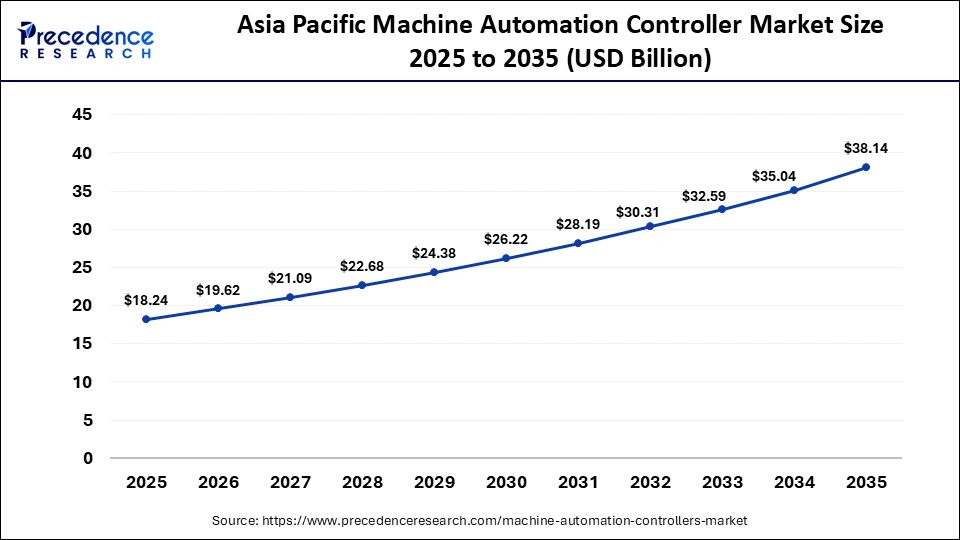
The Asia Pacific machine automation controller market size is expected to be worth USD 38.14 billion by 2035, increasing from USD 18.24 billion by 2025, growing at a CAGR of 7.66% from 2026 to 2035.
Why Asia Pacific Dominated the Machine Automation Controller Market?
Asia Pacific held a major market share in 2025, bolstered by a significant presence of manufacturing, electronics, automotive, and process industries in China, Japan, South Korea, Taiwan, and the ASEAN nations. The demand for advanced automation controllers is further amplified by highly automated production systems, exemplified by Toyota's efforts to improve production line efficiency. Moreover, government initiatives aimed at modernizing manufacturing infrastructure are consistently driving increased investments in automation.
China Market Trends
China holds a leading position, underpinned by its scale in semiconductor and automotive production. Increased capital expenditure on AI driven automation and high speed machine controllers is driving robust market growth. Chinese automakers such as BYD and battery manufacturer CATL are significantly ramping up automation to expand EV cell production, reinforcing Asia-Pacific's leadership in the global market.
How is North America Growing in the Machine Automation Controller Market?
North America is expected to experience the fastest growth during the predicted timeframe, driven by robust demand from advanced manufacturing and processing industries. Emerging sectors are making significant investments in the modernization of outdated manufacturing infrastructure, which facilitates the adoption of controllers. Additionally, automation controllers are essential in robotics, CNC machines, motion control systems, and intelligent production lines. Organizations are allocating resources to research and development to enhance AI-driven algorithms that optimize processes and ensure quality assurance.
U.S. Market Trends
The U.S. leads the North American market, driven by rapid innovation in automation technologies and the integration of AI. Growing adoption of edge computing enables real time, highreliability operations by reducing latency and strengthening data security, which is vital for mission critical applications in sectors such as aerospace and defense. This shift toward AI enabled, edge based automation is consolidating the U.S. lead and is expected to sustain robust market growth over the forecast period.
Machine Automation Controller Market Value Chain Analysis
- Raw Material Sourcing
Entails sourcing precision electronic parts, specialized metals, and sophisticated software layers for advanced controllers.
Key Players: Digicon Automation Pvt. Ltd. and Prima Automation Pvt. Ltd.
- Component Fabrication and Machining
Covers building precise internal electronic architectures and durable external housings to meet demanding industrial requirements.
Key Players: Lubi Electronics, ABB Ltd., and Mitsubishi Electric.
- Testing and Certification
Verifies the controller's reliability, safeguards human operators, and ensures adherence to relevant international trade regulations.
Key Players: SGS SA, Masibus, Systema, and SMEClabs.
- Installation and Commissioning
Transforms the physical controller into a machine's operational brain, where mistakes risk damage and safety hazards.
Key Players: Igus India, Messung Industrial Automation, and Probotix.
- Distribution and Sales
Proceed via a mature hybrid channel, balancing direct manufacturer participation with an extensive technical partner network.
Key Players: IPCS Machine Automation, Aeron Automation Solutions, and Unimech Automation.
- Maintenance and After-Sales Service
Concentrates on maximizing uptime and lengthening hardware lifecycles, which generally range from 10 to 20 years.
- Product Lifecycle Management
PLM forms a closed loop, linking R&D and field data to oversee 15 25 year lifecycles.
Machine Automation Controller Market Companies
- Siemens AG
- ABB Ltd.
- Schneider Electric SE
- Rockwell Automation, Inc.
- Mitsubishi Electric Corporation
- Honeywell International Inc.
- Emerson Electric Co.
- Omron Corporation
- FANUC Corporation
- Yokogawa Electric Corporation
- Beckhoff Automation GmbH
- Robert Bosch (Bosch Rexroth)
- Keyence Corporation
- Delta Electronics, Inc.
- Yaskawa Electric Corporation
Recent Developments
- In March 2026, a group of Indian students from Nexus AI created a platform based on AI that streamlines the programming of industrial PLCs, and were awarded the Gold Cup at the Mitsubishi Electric Cup. The system allows users to describe machine control logic in natural language.(Source: https://www.thehansindia.com)
- In October 2025, Rockwell Automation launched the Allen-Bradley Micro820 L20E controllers, enhancing its Micro800 portfolio with a compact, higher performance solution aimed at simplifying system integration and speeding up commissioning. Based on the established LC20 platform, the L20E controllers are engineered to deliver improved performance across multiple parameters.(Source: https://www.arcweb.com)
- In September 2025, Trio Motion Technology introduced the first controllers in its new Motion PLC range, delivering advanced motion control performance while retaining the functionality and simplicity of a PLC. The system combines high-performance motion control over EtherCAT plus logic and I/O expansion, enabling faster, simpler machine development.(Source: https://roboticsandautomationnews.com)
Segments Covered in the Report
By Controller Type
- Programmable Logic Controllers (PLC)
- Programmable Automation Controllers (PAC)
- Distributed Control Systems (DCS)
- Industrial PC-Based Controllers (IPC/Soft PLC)
- Dedicated Motion Controllers
- CNC Controllers
By Machine Operation Type
- Discrete Manufacturing
- Batch Process
- Continuous Process
By End Use Industry
- Automotive
- Electronics and Semiconductors
- Food and Beverage Processing
- Chemicals and Petrochemicals
- Oil and Gas
- Pharmaceuticals and Biotechnology
- Power Generation and Utilities
- Metals and Mining
- Packaging
- Water and Wastewater Treatment
- Others
By Region
- North America
- Latin America
- Europe
- Asia-pacific
- Middle and East Africa
For inquiries regarding discounts, bulk purchases, or customization requests, please contact us at sales@precedenceresearch.com
Frequently Asked Questions





Ask For Sample
No cookie-cutter, only authentic analysis – take the 1st step to become a Precedence Research client
 Get a Sample




 sales@precedenceresearch.com
 Schedule a Meeting
