






 Request Consultation
Micro location technology is redefining indoor positioning with high-precision tracking and real-time visibility. This blog highlights key technologies such as BLE, UWB, RFID, and Wi-Fi shaping modern location intelligence. It also covers applications across industries and the growing role of AI in enhancing accuracy and efficiency.
Micro-location technology represents an accurate indoor positioning system that identifies, monitors, and guides individuals or assets within structures or confined spaces with an accuracy ranging from 1 to 3 meters, or even at the centimeter level. Security is a vital aspect of micro-location technologies. To combat various types of location spoofing or relay attacks, even sophisticated cryptographic methods may prove inadequate. What is essential is a meticulous co-design of wireless technology alongside cryptographic capabilities. We are exploring various technologies to facilitate micro-location that fulfils these criteria and invite new partners to join us in this endeavour.
Bluetooth Low Energy
Bluetooth Low Energy (BLE) is a version of Bluetooth, introduced with Bluetooth 4.0, designed specifically for low-power devices such as wearables, watches, and medical sensors.
- Low-power mesh networking: BLE enables mesh connections between Bluetooth devices while maintaining very low power consumption.
- Power efficiency: BLE minimizes energy use by keeping the radio off as much as possible and transmitting small amounts of data at low transfer speeds.
- Cost-effectiveness: BLE modules and chipsets are generally low-cost compared with similar wireless technologies, driven by high adoption rates and strong market competition.
- Open documentation: Key BLE specification documents are freely available for download from the official Bluetooth website (Bluetooth.com), making the technology more accessible.
Large developer and user base: BLE provides developers with access to a broad and growing ecosystem of compatible devices and users, expanding the potential reach of their applications.
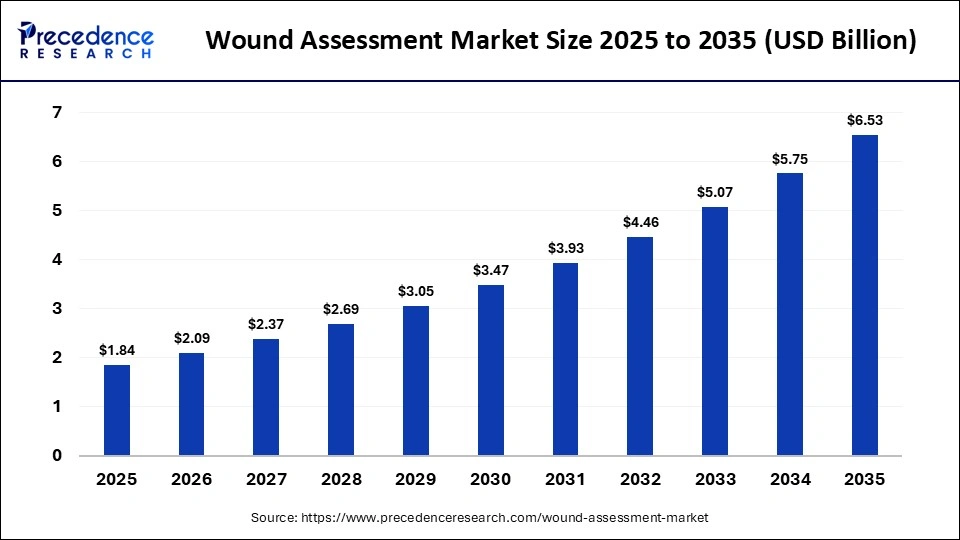
What is the Wound Assessment Market Size in 2026?
The global wound assessment market size was calculated at USD 1.84 billion in 2025 and is predicted to increase from USD 2.09 billion in 2026 to approximately USD 6.53 billion by 2035, expanding at a CAGR of 13.50% from 2026 to 2035. A number of important factors support robust market growth, including the rise of chronic wounds, technological advancements in wound care, and a heightened emphasis on patient-centered healthcare solutions.
Get a Free Sample Report with Key Market Trends: https://www.precedenceresearch.com/sample/8240
Ultra-Wideband
Ultra-wideband (UWB) is a wireless communications technology characterized by very high bandwidth (channel bandwidths over 500 MHz) and ultra-short pulses. It typically operates over a wide frequency range from approximately 3.1 to 10.6 GHz, with carrier frequencies above 2.5 GHz.
- Low power, short range: UWB is an ultra‑low power, short‑range wireless technology that can be used to transmit data and capture highly accurate location and directional information.
- Signal technique: UWB uses pulse‑pattern–based radio technology, sending out extremely short pulses with widths of only a few nanoseconds, which enables precise ranging and positioning.
- Anti-loss and tracking applications: Attaching UWB tags to personal belongings (such as keys, bags, or equipment) helps prevent them from being lost by enabling highly accurate tracking.
- Integration into consumer devices: Since 2019, UWB modules have increasingly been integrated into smartphones, tablets, smartwatches, and smart speakers, expanding the ecosystem of UWB‑enabled devices.
- Secure, hands‑free access control: UWB can be used to safely unlock residences (e.g., condominiums) and secure areas in offices and factories that previously relied on PINs, physical keys, or IC cards. Users can keep their smartphone or other UWB‑enabled device in their pocket or bag and still gain access, thanks to UWB’s high‑precision ranging and strong security features.
- Hands‑free secure payments: UWB supports hands‑free, secure payment systems in supermarkets, convenience stores, restaurants, and other commercial facilities by leveraging smartphones and other devices equipped with UWB modules.
Radio Frequency Identification
Radio Frequency Identification (RFID) is a non-contact technology that enables fast information exchange and data storage using radio waves. It is a form of wireless communication that uses electromagnetic or electrostatic coupling in the radio frequency portion of the electromagnetic spectrum to uniquely identify objects or people. RFID systems use radio frequency signals to search, identify, track, and communicate with items and individuals.
- Inventory management: RFID tracks inventory in real time, reducing errors and increasing operational efficiency.
- Asset tracking: RFID monitors the location and status of assets, preventing loss and optimizing utilization.
- Supply chain management: RFID improves visibility and accuracy when tracking products throughout the supply chain.
- Access control: RFID is used in security systems to grant or restrict access to buildings, rooms, or devices.
- Retail: RFID enables efficient stock management, theft prevention, and enhanced customer experience through smart shelves and automated checkouts.
- Healthcare and safety use cases: RFID ensures critical medical equipment is easily located and efficiently used. It monitors patient movement to detect when patients leave beds or experience falls. It tracks staff location to improve workflow, safety, and resource allocation. It also helps ensure patients receive the correct medications and medical devices and prevents the distribution of counterfeit drugs and medical devices. It also supports continuous patient monitoring and provides data for electronic medical record (EMR) systems.
Industries that require real-time visibility, traceability, and efficiency are increasingly integrating RFID into their operations, from automated warehouse receiving to patient tracking in healthcare.
Wi-Fi Positioning System
Wi-Fi is a radio frequency technology that supports wireless communication and the detection and tracking of individuals, devices, and assets. It utilizes existing Wi-Fi access points for indoor positioning, particularly valuable when GPS signals are weak, such as indoors or in crowded urban areas. The upcoming Wi-Fi 7 aims to enhance these capabilities further. Wi-Fi positioning leverages the installed access points by analyzing interactions through metrics like signal strength and timing, using sensors to identify various devices such as smartphones and wearables within indoor environments.
- Law enforcement and security: Wi-Fi systems enhance situational awareness, incident response, and monitor secure areas.
- Road safety: Wi-Fi technology tracks vehicles and related assets in connected environments.
- Personnel tracking: Wi-Fi locates staff in large facilities to improve safety, coordination, and productivity.
- Asset tracking: Wi-Fi tools monitor valuable equipment, tools, and inventory in real time.
- Situational awareness: Wi-Fi provides a live view of where people and assets are within critical environments (e.g., campuses, industrial sites, event venues).
- Mobile ad‑hoc networks: Wi-Fi systems support dynamic, decentralized communication and positioning in temporary or mission‑critical deployments.
Near Field Communication
Near Field Communication (NFC) is a set of short-range wireless technologies, typically requiring 4 cm or less to initiate a connection. It is designed for quick, simple, and secure data exchange between nearby devices. NFC typically uses 128‑bit or higher encryption to help ensure the security and privacy of transactions.
- NFC enables the sharing of small payloads of data: Communication occurs via electromagnetic radio fields, allowing two devices to establish a connection by simply being brought close together.
- Reader/Writer mode: A reader/writer is an NFC‑enabled device that reads data from or writes data to NFC tags.
- Coordinates information: Two or more NFC devices, and certain non‑NFC devices that interact via NFC tags.
- Peer‑to‑Peer (P2P) mode: P2P mode allows two NFC‑enabled devices to exchange information directly (e.g., sharing contact info, links, or small files by tapping phones together).
- Payments and transactions: NFC‑enabled devices can replace physical cards or cash for many types of transactions (e.g., contactless payments at retail stores or transit gates).
- Content and value sharing: Users can share content, goods, and money with friends and family more easily by granting access to their NFC‑enabled device (e.g., sending payment, passes, or tickets).
- Marketing and advertising: Advertisers can use NFC tags in posters, product packaging, or kiosks to deliver targeted ads and information directly to consumers’ NFC‑enabled devices when tapped.
- Security considerations and risks: Because NFC‑enabled phones are frequently used for payments, there is a risk of digital pickpocketing if security is weak or users are careless.
Global Positioning System
The Global Positioning System (GPS) is a navigation system that uses satellites, a receiver, and algorithms to synchronize location, velocity, and time data for air, sea, and land travel.
- Real-time vehicle tracking: GPS enables continuous monitoring of vehicle locations.
- Route optimization: GPS helps plan and adjust routes to reduce travel time and fuel consumption.
- Operational efficiency: GPS supports fleet management, logistics, and dispatch operations with accurate location data.
- Accuracy considerations: A high-precision GPS receiver provides significantly greater accuracy than standard mobile phone GPS, which is critical for professional and industrial applications.
- Mining and surveying: Mining operations rely on GPS to survey areas before starting excavation, improving planning, safety, and resource utilization.
Military applications and M‑code: Due to its encrypted M‑code signal, the U.S. military relies on GPS in a unique, highly secure way. M‑code helps ensure continuous access to positioning data and improves resilience against jamming and interference, enhancing reliability in contested environments.
Infrared Sensors
Infrared (IR) sensors are a specific type of motion sensor that detect IR radiation (heat) emitted by objects, people, or animals.
- Physical security and intrusion detection: One of the primary use cases for IR sensors is in physical security systems, particularly for intrusion detection (e.g., motion detectors in alarm systems).
- Night vision applications: IR technology is widely used in night vision equipment when there is not enough visible light to see unaided. IR cameras and goggles detect infrared radiation, allowing users to see in low-light or no‑light conditions.
- Temperature measurement (radiation thermometers): IR sensors are used in radiation thermometers (IR thermometers) to measure temperature without direct contact. The temperature reading depends on both the temperature and material properties (emissivity) of the object being measured.
- Infrared tracking and homing systems: IR tracking or IR homing refers to missile guidance systems that operate using IR electromagnetic radiation emitted by a target. The missile’s sensors detect the target’s IR signature and use it to track and home in on the target’s position.
Ultrasound-based Positioning
Ultrasound positioning technology uses high‑frequency sound waves, typically above 20 kHz, to determine the location of objects with high precision.
- Effectiveness for indoor navigation: It is particularly effective for indoor navigation, where traditional GPS often fails due to signal obstruction by walls, ceilings, and other structures.
- High positioning accuracy: A key advantage of ultrasound positioning is its ability to pinpoint locations with remarkable accuracy. By precisely measuring the time‑of‑flight of ultrasonic signals, these systems can calculate the distance to an object with very high precision, often within just a few centimetres.
- Real-time location updates: Ultrasound positioning systems provide real‑time location updates, with refresh rates as frequent as once per second. This rapid response time is crucial for tracking moving objects and enabling immediate feedback in interactive applications.
- Adaptability across environments and sectors: Ultrasonic positioning is highly adaptable to different environments and use cases.
Hybrid Positioning System
A hybrid positioning network is a sophisticated system designed to deliver highly accurate and reliable location information by integrating multiple positioning technologies.
Multi-technology integration: The network combines several positioning techniques to improve accuracy and robustness, including received signal strength indicator (RSSI), time-of-flight, and UWB. By fusing these methods, the system achieves a high degree of precision in position estimation.
Indoor-outdoor seamless positioning: Innovative hybrid solutions can seamlessly locate users both indoors and outdoors. One example is the fusion of LoRa (Long Range radio) and Wi‑Fi fingerprints, which enables continuous, reliable positioning across different environments and coverage conditions.
- Higher accuracy than single‑technology systems.
- Improved reliability and coverage across complex environments.
- Flexibility to tailor positioning performance to specific use cases and deployment constraints.
As industries move toward smarter, connected ecosystems, micro-location solutions will play a pivotal role, bringing everything together because many hands make light work.
Expert Advise
Micro-location technology enables real-time asset tracking, navigation, and safety monitoring that is used across various sectors, including retail and healthcare. The integration of IoT and real-time analytics into micro location technology enables smart factories, warehouse automation, and workforce safety monitoring. The future of micro-location technology is promising, driven by AI-powered location intelligence, autonomous robots, and the convergence of multiple technologies like BLE, UWB, Wi-Fi, and AI. Moreover, the development of smart cities and the growing demand for real-time visibility encourage investors to invest in micro location technology.
About the Authors

Aditi Shivarkar
Aditi, Vice President at Precedence Research, brings over 15 years of expertise at the intersection of technology, innovation, and strategic market intelligence. A visionary leader, she excels in transforming complex data into actionable insights that empower businesses to thrive in dynamic markets. Her leadership combines analytical precision with forward-thinking strategy, driving measurable growth, competitive advantage, and lasting impact across industries.



Aman Singh
Aman Singh with over 13 years of progressive expertise at the intersection of technology, innovation, and strategic market intelligence, Aman Singh stands as a leading authority in global research and consulting. Renowned for his ability to decode complex technological transformations, he provides forward-looking insights that drive strategic decision-making. At Precedence Research, Aman leads a global team of analysts, fostering a culture of research excellence, analytical precision, and visionary thinking.

Piyush Pawar
Piyush Pawar brings over a decade of experience as Senior Manager, Sales & Business Growth, acting as the essential liaison between clients and our research authors. He translates sophisticated insights into practical strategies, ensuring client objectives are met with precision. Piyush’s expertise in market dynamics, relationship management, and strategic execution enables organizations to leverage intelligence effectively, achieving operational excellence, innovation, and sustained growth.