






 Request Consultation
Rotator cuff injuries can be painful and limiting, but innovative treatments like PRP injections, stem cell therapy, and robotic rehabilitation are changing the game. This blog explains how patients can regain shoulder strength and mobility faster than ever before.
What is a Rotator Cuff Injury?
A rotator cuff injury happens when any of the rotator cuff tendons are inflamed or partially torn. The rotator cuff is a group of four muscles and their tendons that surround the shoulder joint and help lift and rotate the arm while keeping the shoulder stable. These injuries usually occur as a result of repetitive overhead movements, traumas, degenerative aging, or sports activities.
Common Types of Rotator Cuff Injuries
- Tendinitis: This occurs when the rotator cuff tendons become inflamed due to overuse, often causing pain and stiffness in the shoulder.
- Bursitis: In this condition, the small fluid-filled sac (bursa) that cushions the shoulder joint becomes swollen, leading to discomfort and limited movement.
- Partial Tear: A partial tear happens when only a portion of the tendon is damaged, which can weaken the shoulder and cause pain during certain movements.
- Full-Thickness Tear: This is the most severe type, where the tendon is completely detached from the bone, often requiring surgical intervention to restore function.
Why are Rotator Cuff Injury Treatments Gaining Traction?
The demand for rotator cuff injury treatments is on the rise, driven by the rising incidence of shoulder injuries, sports-related traumas, and an aging population. Rotator cuff traumas represent some of the most frequent musculoskeletal disorders that involve the shoulder joint and typically demand a set of physiotherapy, medication, biologics, and surgery.
The global rise in patients due to aging populations, sports injuries, work-related strains, and lifestyle-related musculoskeletal disorders is driving the demand for rotator cuff injury treatments. As a result, hospitals, orthopedic clinics, and ambulatory surgical centers are increasingly adopting advanced surgical equipment, biologics, and rehabilitation therapies to meet the growing demand. This trend is accelerating innovation and expanding treatment options for patients worldwide.
What is the Rotator Cuff Injury Treatment Market Size in 2026?
The global rotator cuff injury treatment market size accounted for USD 1.39 billion in 2025 and is predicted to increase from USD 1.47 billion in 2026 to approximately USD 1.39 billion by 2035, expanding at a CAGR of 5.37% from 2026 to 2035.
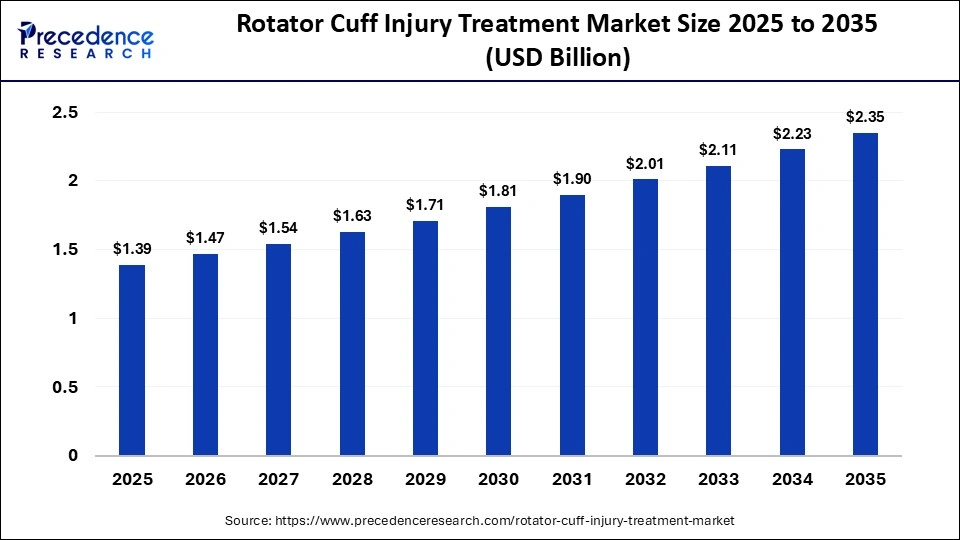
Exploring Next-Gen Treatments: Revolutionizing Rotator Cuff Recovery
- Biologic Therapies: Treatments like platelet-rich plasma (PRP) injections and stem cell therapy help accelerate tendon healing and reduce inflammation naturally.
- Minimally Invasive Surgery: Arthroscopic repair uses small incisions and advanced imaging, reducing recovery time and minimizing scarring compared to traditional open surgery.
- Advanced Scaffold Implants: Bioengineered tendon scaffolds support tissue regeneration for large or complex tears that cannot heal on their own.
- Robotic-Assisted Rehabilitation: Robotics and smart exoskeletons guide precise shoulder exercises, improving mobility and reducing the risk of re-injury.
- Shockwave Therapy: High-energy acoustic waves stimulate tendon repair and relieve chronic shoulder pain without surgery.
- 3D-Printed Orthopedic Devices: Customized braces and supports designed through 3D printing enhance tendon alignment and support during recovery.
- Regenerative Medicine Techniques: Innovative approaches using growth factors and cell-based therapies are being developed to restore tendon function more effectively.
Expert Opinion: Insights on Rotator Cuff Injury Treatment
According to the healthcare industry’s expert from Precedence Research, rotator cuff injuries remain one of the leading causes of shoulder pain, impacting athletes, aging populations, and individuals engaged in physically demanding activities. The treatment landscape has evolved significantly due to technological advancements and growing awareness of early diagnosis. Minimally invasive arthroscopic procedures are now widely adopted, enabling precise tendon repair with smaller incisions, reduced post-operative complications, and faster recovery times compared to traditional open surgery.
Our expert also emphasizes the increasing role of regenerative and biologic therapies, including platelet-rich plasma (PRP) injections and stem cell applications, which aid tendon healing and reduce inflammation, particularly in partial tears or early-stage injuries. Advanced rehabilitation protocols complement these interventions, allowing patients to regain shoulder strength and mobility more efficiently.
Precedence Research further points out that delayed diagnosis often leads to worsened injuries and prolonged recovery, making early medical intervention critical. The integration of AI-assisted diagnostics and imaging tools is improving detection rates and guiding personalized treatment plans. Overall, a combination of surgical innovation, biologic therapies, and structured rehabilitation is shaping the future of rotator cuff care, offering patients safer, faster, and more effective recovery outcomes.
What’s Holding Back Rotator Cuff Treatment Adoption?
- High Cost of Surgical Procedures: Rotator cuff surgery can be expensive, especially in countries without strong healthcare reimbursement systems. The cost of medications and post-operative care can also limit access for many patients worldwide.
- Post-Surgical Complications: Surgery carries risks such as tendon re-tears, infections, or shoulder stiffness. These potential complications can sometimes discourage patients from opting for surgical treatment.
- Delayed Diagnosis: Many individuals ignore shoulder pain or mistake it for a simple muscle strain, which delays proper treatment. Late diagnosis can worsen the injury and make recovery more difficult.
Top Trends Driving the Surge in Rotator Cuff Injury Treatments
- Growth of Sports Medicine: The rise of professional sporting leagues, recreational sports, and increased physical fitness activities worldwide has led to more shoulder injuries. Rotator cuff injuries are particularly common in athletes and individuals performing repetitive overhead movements. Sports medicine clinics play a vital role in early diagnosis and specialized treatment, helping prevent long-term damage.
- Augmented Adoption of Orthopedic Surgery, Robotic, and AI: Robotic-assisted surgeries are improving the precision of rotator cuff repairs, reducing complications, shortening surgical times, and enhancing patient outcomes. AI-based diagnostic tools, especially MRI analysis, allow radiologists to detect tendinopathies earlier, enabling timely interventions and more effective treatments.
- Growing Outpatient Surgical Surgery Requirement: Ambulatory surgical centers are increasingly preferred for rotator cuff treatments due to lower costs, shorter hospital stays, faster recovery, and reduced strain on healthcare systems. Many minimally invasive rotator cuff surgeries can now be safely performed as outpatient procedures, making treatment more accessible and convenient.
Shoulder Health Across the Globe: Regional Approaches to Rotator Cuff Care
- North America: Innovation Through CollaborationRotator cuff injury treatment in North America thrives on strong partnerships between medical device companies, hospitals, and research institutions. Government-backed healthcare programs and extensive insurance coverage support the adoption of advanced surgical techniques and rehabilitation therapies, improving patient outcomes across the region.
- Europe: Research and Healthcare Investment Driving ProgressIn Europe, the growth of rotator cuff care is fueled by collaborative initiatives among universities, hospitals, and medical equipment manufacturers. Countries like Germany, the UK, and France benefit from government healthcare investments and academic-clinical partnerships, encouraging innovation and improving access to advanced orthopedic treatments.
- Asia Pacific: Rapid Growth Through Infrastructure and CollaborationAsia Pacific is experiencing significant progress in rotator cuff treatment thanks to increased healthcare investments and partnerships with global orthopedic firms. Countries such as India, China, and Japan are enhancing hospital infrastructure and adopting advanced surgical and rehabilitation approaches, expanding access to quality shoulder care.
- Latin America: Expanding Access Through Healthcare InitiativesThe accessibility to rotator cuff injury treatment in Latin America is growing as governments and private healthcare providers invest in hospital infrastructure and orthopedic care programs. Countries such as Brazil, Mexico, and Argentina are focusing on expanding access to minimally invasive surgeries and rehabilitation therapies, while collaborations with international orthopedic firms are helping introduce advanced treatment technologies. Public healthcare programs and insurance schemes are gradually improving patient access to quality rotator cuff care across the region.
- Middle East & Africa: Advancing Care Through Investments and PartnershipsThe Middle East and Africa are witnessing progress in rotator cuff treatment through rising healthcare investments and partnerships with global medical technology providers. Nations like Saudi Arabia, the UAE, and South Africa are developing specialized orthopedic centers equipped with modern surgical and rehabilitation technologies.
From Surgery to Rehab: Companies Transforming Rotator Cuff Treatment
|
Company |
Product Name |
Product Type |
Purpose / Key Features |
|
CONMED Corporation |
BioBrace® RC System |
Bioinductive Implant Delivery System |
An arthroscopic delivery system that is meant to enhance the rotator cuff repair procedure by bioreabsible implant that offers mechanical support and biological healing. |
|
Smith+Nephew |
REGENETEN™ Bioinductive Implant |
Collagen Implant |
Bioinductive collagen implant that induces tendon-like tissue formation and improves healing. |
|
Smith+Nephew |
HEALICOIL™ Knotless Suture Anchor |
Suture Anchor Implant |
An anchor system created in an open architecture to favor bone growth and superior tendon-to-bone healing. |
|
Arthrex Inc. |
Next-Generation Rotator Cuff Repair Device |
Minimally Invasive Surgical Device |
An FDA-cleared device that is supposed to enhance surgical results and shorten the time of recovery for the patient. |
|
DePuy Synthes (Johnson & Johnson) |
Bioabsorbable Tendon Fixation Device |
Tendon Fixation Implant |
High technology bioabsorbable implant that is destined to be applied in tendon reattachment and supplementation of healing following rotator cuff repair. |
Significant Government Programs Supporting Rotator Cuff Injury Treatment
- Musculoskeletal Disorders Research FundingThe European Union’s Horizon Europe program has allocated approximately €95.5 billion (2021–2027) for research and innovation, including projects focused on advanced orthopedic repair technologies and regenerative medicine. These investments are driving the development of new surgical techniques, implants, and biologic therapies for conditions like rotator cuff injuries.
- Increased Public Healthcare InsuranceGovernments worldwide are expanding healthcare coverage to improve access to orthopedic treatments. For example, India’s Ayushman Bharat initiative provides healthcare to 500 million people, including orthopedic surgeries and rehabilitation. Such programs make rotator cuff repair surgeries more accessible in both public and private hospitals.
- National Sports Medicine and Injury Prevention ProgramsOrganizations like the American Orthopaedic Society of Sports Medicine (AOSSM) provide research grants and educational programs to advance the prevention and treatment of sports-related injuries, including shoulder injuries. These programs enhance training for doctors and support clinical research in rotator cuff repair and rehabilitation, ultimately improving patient care.
In Closing
The demand for rotator cuff injury treatments has been steadily increasing due to aging populations, rising sports participation, and the prevalence of shoulder injuries worldwide. Advances in minimally invasive surgery, rehabilitation technologies, and regenerative medicine are significantly improving patient recovery and overall treatment outcomes. Healthcare providers are using arthroscopic surgery, biologic therapies, and advanced rehabilitation programs to deliver personalized and effective care. With a growing focus on early diagnosis, injury prevention, and cutting-edge surgical techniques, rotator cuff treatment is poised for robust growth in the coming years.
About the Authors

Aditi Shivarkar
Aditi, Vice President at Precedence Research, brings over 15 years of expertise at the intersection of technology, innovation, and strategic market intelligence. A visionary leader, she excels in transforming complex data into actionable insights that empower businesses to thrive in dynamic markets. Her leadership combines analytical precision with forward-thinking strategy, driving measurable growth, competitive advantage, and lasting impact across industries.



Aman Singh
Aman Singh with over 13 years of progressive expertise at the intersection of technology, innovation, and strategic market intelligence, Aman Singh stands as a leading authority in global research and consulting. Renowned for his ability to decode complex technological transformations, he provides forward-looking insights that drive strategic decision-making. At Precedence Research, Aman leads a global team of analysts, fostering a culture of research excellence, analytical precision, and visionary thinking.

Piyush Pawar
Piyush Pawar brings over a decade of experience as Senior Manager, Sales & Business Growth, acting as the essential liaison between clients and our research authors. He translates sophisticated insights into practical strategies, ensuring client objectives are met with precision. Piyush’s expertise in market dynamics, relationship management, and strategic execution enables organizations to leverage intelligence effectively, achieving operational excellence, innovation, and sustained growth.