






 Request Consultation
Single-loop controllers are essential for precise control of critical process variables in industrial automation. This blog explores their types, applications, and benefits across industries. Discover how these controllers enhance efficiency, reliability, and modern smart factory operations.
Overview of Single-Loop Controllers and Their Significance in Industries
In today’s fast-evolving industrial landscape, precision, efficiency, and reliability are no longer optional; they are essential. Single-loop controllers play a critical role in achieving these goals by enabling accurate control of key process variables such as temperature, pressure, and flow. Whether in manufacturing plants, power generation facilities, or chemical processing units, these controllers ensure stable operations, minimize errors, and enhance overall system performance. Their simplicity, cost-effectiveness, and robustness make them a foundational component of modern industrial automation.
Single-loop controllers are essential industrial electronic devices designed to regulate a single process variable, such as temperature, pressure, flow, or level, to a desired setpoint. They continuously monitor process conditions and adjust outputs based on feedback, ensuring stable and accurate control. Due to their simplicity, reliability, and flexibility, these controllers are widely used across both process and discrete industries.
They play a vital role in sectors such as oil & gas, chemicals, food & beverage, water and wastewater treatment, pharmaceuticals, power generation, and general manufacturing. With the integration of smart technologies and IoT-enabled systems, single-loop controllers now offer enhanced monitoring, diagnostics, and predictive maintenance capabilities. This evolution makes them indispensable in modern industrial environments focused on efficiency, automation, and operational excellence.
What is the Single Loop Controller Market Size in 2026?
The global single loop controller market was valued at USD 4.11 billion in 2025 and is projected to grow from USD 4.33 billion in 2026 to approximately USD 6.85 billion by 2035, registering a CAGR of 5.24% during the forecast period from 2026 to 2035. The growth of the market is driven by increasing demand for precise and automated process control across various industries.
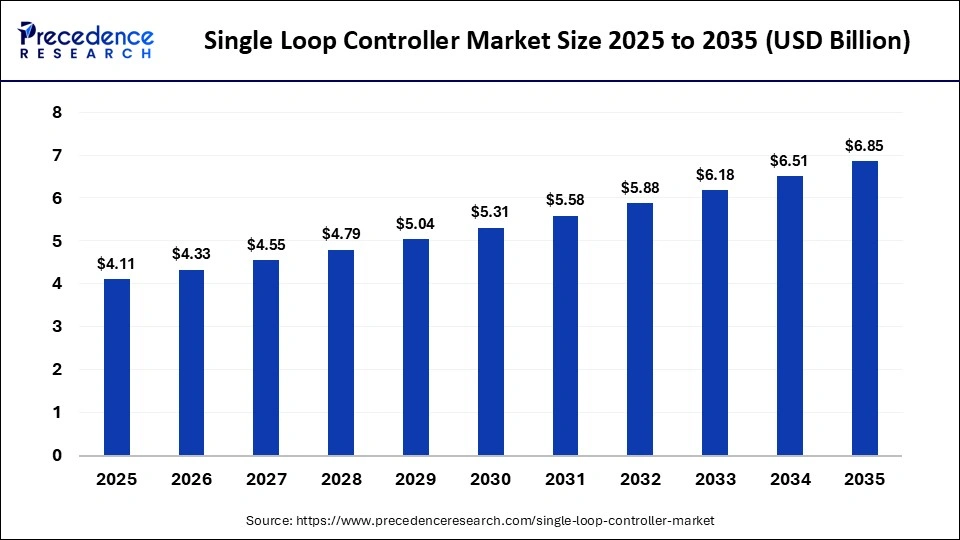
Get a Free Sample Report with Key Market Trends: https://www.precedenceresearch.com/sample/8231
Breakthrough Controller Technologies Reshaping Industrial Operations
- PID Controllers: These controllers are popular because of their flexibility and stability, which help them to hold their setpoints under different process conditions. They accurately control temperature, pressure, flow, and level, as well as functions such as auto-tuning, disturbance rejection, and provide steady process operation in continuous and discrete controls.
- Programmable Controllers: These controllers merge logic and restricted sequencing incorporated amidst simple control and more sophisticated automation. They may be tailored to suit processes, are batch-friendly, and are suitable in industries that require moderate flexibility and not the complexity of full PLC systems.
- Smart Controllers: Smart controllers are designed with advanced communication protocols, diagnostics, and data logging capabilities, enabling remote monitoring and seamless connectivity. They support real-time monitoring, predictive maintenance, and system optimization, allowing industries to enhance efficiency and reliability. As a result, these controllers play a crucial role in improving performance and minimizing downtime in automated production and processing environments.
Driving Efficiency: Applications Across Key Industries
- Manufacturing Industry: Single-loop controllers are widely used in thermal treatment ovens, molding machines, industrial ovens, and packaging lines to maintain precise setpoints. This ensures consistent product quality, enhances process efficiency, and supports automated production while minimizing downtime caused by manual adjustments or unstable process conditions.
- Food & Beverage Industry: In the food and beverage industry, controllers play a critical role in processes such as pasteurization, sterilization, fermentation, and cooking. By maintaining consistent temperature and flow, they improve product safety, quality, shelf life, and energy efficiency while ensuring compliance with food processing standards.
- Water & Wastewater Treatment Industry: Controllers are essential for managing pumping systems, chemical dosing, and pressure control in water and wastewater treatment plants. They ensure process stability, reduce resource wastage, and enable safe, reliable operations in both municipal and industrial continuous treatment systems.
- Pharmaceutical Industry: In pharmaceutical manufacturing, controllers provide precise regulation of process conditions to ensure product consistency and regulatory compliance. They maintain accurate temperature, pressure, and flow during drug production, formulation, and packaging, minimizing deviations that could impact safety and efficacy.
- Power Generation Industry: Controllers are used to manage thermal processes, boiler operations, and cooling systems in power generation facilities. They optimize energy usage, stabilize process variables, and enhance efficiency, ensuring consistent and reliable power output across fossil fuel, renewable, and combined heat and power systems.
Top Players Engaged in Manufacturing Single-Loop Controllers
- ABB Ltd.: ABB is a global leader in automation, offering high-performance single-loop controllers and integrated control systems for both process and discrete industries. Its solutions enhance operational efficiency, reliability, and seamless integration with broader automation ecosystems.
- Honeywell International Inc.: Honeywell provides a wide range of single-loop controllers equipped with advanced control algorithms, IoT connectivity, and remote monitoring capabilities. These solutions ensure precise process control, optimization, and improved reliability across various industrial applications.
- Siemens AG: Siemens offers robust industrial controllers, including single-loop controllers, designed for integration into comprehensive automation systems. Widely used in manufacturing and production environments, their solutions support smart factory initiatives and ensure stable, efficient operations.
- Schneider Electric SE: Schneider Electric delivers advanced temperature, pressure, and process controllers tailored for industrial automation. Their solutions improve process stability, support digital transformation, and promote energy-efficient operations across multiple industries.
- Yokogawa Electric Corporation: Yokogawa specializes in high-performance loop controllers for continuous process industries such as chemicals, oil & gas, and utilities. Their offerings are known for precision, reliability, and consistent process performance.
Key Forces Driving the Adoption of Single-Loop Controllers
- Automation and Industry 4.0: The rise of automation and Industry 4.0 is driving the need for advanced control systems with enhanced connectivity and real-time monitoring capabilities. Integration with industrial networks enables continuous optimization, reduces downtime, and supports smarter, data-driven decision-making in production and process environments.
- Focus on Energy Saving and Cost Reduction: Single-loop controllers help maintain optimal process conditions, reducing energy losses and improving overall efficiency. They enable industries to lower utility costs, minimize material waste, and enhance productivity while ensuring operations remain within safe and regulatory limits.
- Demand for Retrofit and Replacement: Traditional analog and pneumatic controllers are increasingly being replaced with modern digital solutions that offer greater precision and diagnostic capabilities. This transition improves reliability, reduces maintenance requirements, and allows seamless integration with advanced automation and Industrial IoT systems.
- Rise of IoT-Enabled Smart Factories: The adoption of IoT-enabled controllers is transforming industrial operations through remote monitoring, predictive maintenance, and enhanced connectivity. These smart systems collect and analyze real-time data, enabling proactive decision-making and minimizing unexpected downtime in automated industrial environments.
Challenges and Barriers in the Adoption of Single-Loop Controllers
- Technological Complexity: Sophisticated controllers can be set up, tuned, and maintained only by skilled personnel. The difficulty of the interface between controllers and other automation systems or networked environments may be an obstacle to facilities that do not have trained operators or a well-developed support infrastructure.
- Competition from Multi-Loop Control Systems: In many industries, multi-loop controllers or PLC-based systems are preferred due to their broader functionality and ability to manage multiple variables simultaneously. This can limit the adoption of single-loop controllers, especially in complex processes where flexibility and integrated control are critical.
- Cost Pressure: High-performance single-loop controllers can be expensive, and pricing pressure from local manufacturers further intensifies market competition. Organizations must carefully evaluate the return on investment, balancing upfront costs with long-term operational benefits before adopting advanced control solutions.
The Road Ahead for Single-Loop Controller Technology
- Intelligent Factory Incorporation: Single-loop controllers are increasingly becoming key components of connected production ecosystems, enabling cloud-based monitoring, data analytics, and automated process optimization. Enhanced connectivity supports predictive maintenance, reduces downtime, and boosts overall efficiency in industrial operations.
- Growth in Emerging Regions: Rapid industrialization and infrastructure development in Asia Pacific and other emerging markets are driving strong demand for effective control solutions. These controllers help expand automated processes and production capacities across diverse industries, fueling regional industrial growth.
- Focus on Energy and Environmental Efficiency: Controllers designed with energy-saving features are gaining popularity as industries strive to meet efficiency and sustainability standards. By optimizing resource usage, reducing emissions, and maintaining high process performance, these solutions support both operational efficiency and environmental objectives.
Expert Opinion
According to our industry experts, single-loop controllers remain a cornerstone of industrial automation due to their simplicity, reliability, and cost-effectiveness. They provide precise control over critical process variables such as temperature, pressure, flow, and level, ensuring operational stability, consistent product quality, and reduced downtime. For enterprises, these controllers are particularly valuable in sectors like oil & gas, chemicals, food & beverage, pharmaceuticals, water treatment, and power generation, where even minor process deviations can lead to substantial financial and operational impacts.
The ongoing shift toward Industry 4.0 and IoT-enabled smart factories has elevated the strategic importance of single-loop controllers, as connected systems enable real-time monitoring, predictive maintenance, and optimized resource utilization. While multi-loop and PLC-based systems offer broader functionality, single-loop controllers continue to be a pragmatic investment for businesses seeking high efficiency, lower maintenance costs, and rapid deployment in both legacy and modernized industrial setups.
Wrapping Up
Single-loop controllers represent a dynamic and essential segment of industrial automation, providing precise regulation of critical process variables such as temperature, pressure, flow, and level across industries. Widely used in oil & gas, chemicals, food & beverage, pharmaceuticals, water treatment, power generation, and manufacturing, these controllers ensure operational efficiency, product quality, and process reliability. The growth of industrial automation, Industry 4.0 adoption, IoT integration, and the shift from legacy analog systems to digital solutions are all driving increased demand.
Modern connected, diagnostic, predictive, and smart controllers allow real-time monitoring and process optimization, further enhancing efficiency and reducing downtime. However, adoption may be constrained by technological complexity, competition from multi-loop and PLC systems, and cost pressures. Despite these challenges, leading automation companies continue to innovate, offering advanced controllers that support energy savings, streamlined operations, and the development of future-ready industrial processes.
About the Authors

Aditi Shivarkar
Aditi, Vice President at Precedence Research, brings over 15 years of expertise at the intersection of technology, innovation, and strategic market intelligence. A visionary leader, she excels in transforming complex data into actionable insights that empower businesses to thrive in dynamic markets. Her leadership combines analytical precision with forward-thinking strategy, driving measurable growth, competitive advantage, and lasting impact across industries.



Aman Singh
Aman Singh with over 13 years of progressive expertise at the intersection of technology, innovation, and strategic market intelligence, Aman Singh stands as a leading authority in global research and consulting. Renowned for his ability to decode complex technological transformations, he provides forward-looking insights that drive strategic decision-making. At Precedence Research, Aman leads a global team of analysts, fostering a culture of research excellence, analytical precision, and visionary thinking.

Piyush Pawar
Piyush Pawar brings over a decade of experience as Senior Manager, Sales & Business Growth, acting as the essential liaison between clients and our research authors. He translates sophisticated insights into practical strategies, ensuring client objectives are met with precision. Piyush’s expertise in market dynamics, relationship management, and strategic execution enables organizations to leverage intelligence effectively, achieving operational excellence, innovation, and sustained growth.