






 Request Consultation
Swarm intelligence is revolutionizing artificial intelligence by enabling decentralized, self-organizing systems inspired by nature. It enhances optimization, decision-making, and automation across industries like healthcare, robotics, and smart cities.
In 1989, when researchers Gerardo Beni and Jing Wang first introduced the concept of swarm intelligence, they drew inspiration not from machines, but from nature itself. Imagine a flock of birds changing direction in perfect harmony, or a colony of ants finding the shortest path to food without any central command. This system, though made up of simple individuals, demonstrates a powerful truth: collective behavior can lead to highly optimized decisions.
At its core, swarm intelligence is the idea that many small, independent agents, whether insects, animals, or even digital entities, can work together to solve complex problems more efficiently than a single centralized system. It is decentralized, adaptive, and remarkably resilient. Each unit follows simple rules, yet together they create intelligent, dynamic outcomes.
Today, this natural philosophy has found a new identity within artificial intelligence (AI), from collaborative drone systems that move as a unified force to cover vast terrains to precision agriculture, where fields are monitored and treated with targeted accuracy. Swarm intelligence is quietly reshaping industry. Its applications extend across healthcare, defense, and commercial sectors, where real-time coordination and collective decision-making have become essential.
Key Swarm Intelligence Algorithm Models
Particle Swarm Optimization (PSO)
Particle swarm optimization (PSO) is a population-based algorithm in which a collection of individual particles moves iteratively throughout a defined search space. At each step, the algorithm evaluates the objective function for every particle and subsequently updates their velocities based on this evaluation. This process continues as particles traverse the space and the algorithm continuously reevaluates their objective functions.
The inspiration for PSO stems from observing the collective behavior of natural swarms, such as flocks of birds or swarms of insects. As a stochastic, population-based optimization technique, PSO leverages principles of swarm intelligence to tackle complex optimization problems. It is particularly effective in scenarios where the search space is large, nonlinear, or partially unknown, and where traditional deterministic methods often fail.
Applications of Particle Swarm Optimization
- Healthcare: PSO is applied in intelligent diagnosis, disease detection using medical robots, medical image segmentation, and disease classification to improve accuracy and efficiency in medical decision-making.
- Environmental Monitoring: It supports wild vegetation and agricultural environmental monitoring, flood control and routing, water quality monitoring, and pollutant concentration monitoring systems, enabling better ecosystem management.
- Industrial: PSO optimizes solutions for economic dispatch problems in power systems, Phasor Measurement Units (PMUs) placement, daily electrical load allocation, deployment of wireless sensor networks (WSNs), predicting product defects, and microgrid design and operation.
- Commercial: The algorithm aids in the prediction of cost and price, risk assessment, and profit calculation, enhancing financial and business decision-making.
- Smart City: PSO contributes to traffic flow prediction, vehicle routing problems, traffic signal timing optimization, path planning, and transportation network design, supporting efficient urban mobility and planning.
Ant Colony Optimization (ACO)
Ant colony optimization (ACO) is a metaheuristic optimization method inspired by the foraging behavior of ants. Developed in the early 1990s by Marco Dorigo, ACO models how real ants collectively find the shortest path to food without central control. By leveraging simple behaviors and cooperation, ACO iteratively improves solutions over time, making it effective for complex optimization problems across diverse domains.
Applications of Ant Colony Optimization (ACO)
- Edge Computing: Edge task scheduling in multi-edge environments, load balancing across heterogeneous edge nodes, task migration optimization, real-time IoT data processing, latency-sensitive application management, cloud–edge collaborative computing, resource allocation in dynamic environments, network traffic routing and optimization, smart city and large-scale IoT systems, and energy-efficient edge computing.
- Agriculture: Agricultural machinery path optimization, logistics and order allocation of agricultural products, environmental monitoring using optimized sensor networks, groundwater monitoring and pollution control, and watershed management, including urban drainage design.
- Sign Language Recognition: Feature selection for sign language recognition (SLR), redundant data reduction in high-dimensional datasets, optimization of feature combinations for classification accuracy, weight assignment and feature importance optimization, and computational efficiency improvements in SLR systems.
- Commercial: Feature selection in SLR, high-dimensional data optimization, reduction of redundant information, enhancement of classification accuracy, and minimization of computational load.
Artificial Bee Colony (ABC)
The artificial bee colony (ABC) algorithm, developed by Karaboga in 2005, is inspired by the collective foraging behavior of honey bees. Grounded in swarm intelligence principles such as self-organization and division of labor, ABC provides a flexible and efficient metaheuristic framework for solving complex optimization problems.
Applications of Artificial Bee Colony
- Healthcare: Representation, examination, and indexing of medical information; designing tools to support research applications and decision-making systems; integrating cognitive and medical sciences with application software; and providing a platform for research and scientific applications in the medical community.
- Supply Chain and Logistics: Optimization of logistics operations, including route planning, inventory management, and resource allocation.
- Biomedical Engineering: Application in medical device optimization, diagnostics, and healthcare system improvements.
- Image Processing: Enhancing image analysis, segmentation, and feature extraction techniques.
- Machine Learning and Data Mining: Feature selection, high-dimensional data optimization, and model performance improvement.
- Engineering Optimization: Design optimization, resource allocation, and operational efficiency improvements in engineering systems
Limitations of Swarm Intelligence
- Unpredictability of Emergent Behavior: The swarm's overall behavior can be challenging to forecast or manage, as it emerges from numerous simple local interactions rather than a centralized strategy. Minor alterations in agent interactions can lead to significantly different results.
- Scalability and Resource Challenges: Increasing the number of agents can create bottlenecks in communication, hinder coordination, and require considerable computational or energy resources, complicating the efficient operation of large swarms in real-time scenarios.
- Suboptimal Solutions in Complex or Dynamic Environments: Swarm intelligence frequently depends on local information, which can result in "good enough" solutions rather than optimal global solutions, and the ability to adapt to swiftly changing conditions may be limited.
- IoT-specific Limitations and Integration Complexity: Many IoT devices have limited computational capabilities and storage, making it difficult to implement swarm intelligence algorithms effectively at scale. Additionally, IoT ecosystems consist of diverse hardware, communication protocols, and data sources, presenting challenges for integration. Current research mainly addresses routing, power management, and data management, highlighting the need to explore broader SI methods for unresolved IoT challenges.
What is the Swarm Intelligence Market Size in 2026?
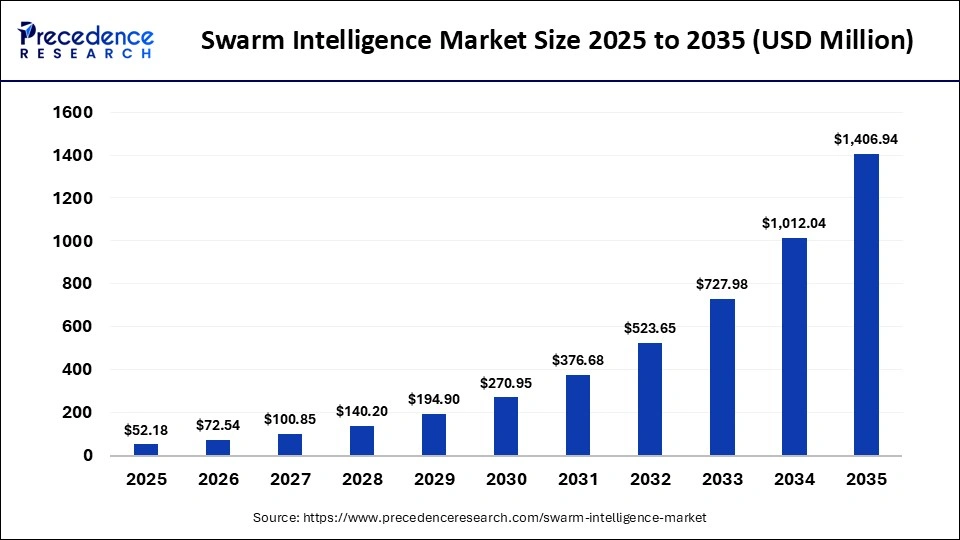
The global swarm intelligence market was valued at USD 52.18 million in 2025 and is projected to grow from USD 72.54 million in 2026 to approximately USD 1,406.94 million by 2035, registering a CAGR of 39.02% during the forecast period from 2026 to 2035. The market growth is driven by expanding IT infrastructure and rapid digitalization, along with the flexible, decentralized, responsive, and self-organizing nature of IoT-driven systems.
Get a Free Sample Report with Key Market Trends: https://www.precedenceresearch.com/sample/8211
Innovation Landscape: Expanding Role of Swarm Intelligence
Across the evolving landscape of AI, swarm intelligence is steadily finding its place within a growing number of innovations. Organizations such as SIRB AI are gaining recognition for developing AI-powered autonomous systems. With a strong focus on intelligent, swarm-based, operator-centric, mission-driven solutions through integration with TII, such initiatives are supported by robust scientific research, infrastructure, and domain expertise.
At the same time, new frameworks are being introduced to further advance swarm intelligence, drawing from the collective behaviors observed in birds, fish, and bees. This development reflects a broader shift towards decentralized and adaptive AI models. In parallel, swarm intelligence algorithms are also being explored in areas such as web composition, where they help identify efficient combinations of services tailored to user requirements. Additionally, emerging open-source projects like MiroFish are attracting attention within the developer community, highlighting the growing interest in and experimentation with swarm-based approaches.
Worldwide Expansion of Swarm Intelligence Technology
The global momentum of swarm intelligence continues to build, driven by multiple factors that each contribute uniquely to its expansion. North America has established a strong position in the swarm intelligence market, supported by rapid technological advancement, increased AI investment, and a growing emphasis on automation across industries. The U.S. remains central to this progress, backed by venture capital funding, defense initiatives, and the rising adoption of autonomous systems in logistics, robotics, and aerospace.
At the same time, the Asia-Pacific region is emerging as the fastest-growing market, fueled by rapid industrialization, accelerating urbanization, and large-scale smart city initiatives. Government-backed programs promoting AI and automation are further strengthening this growth, with countries such as China, Japan, and India investing significantly in robotics innovation, industrial automation, and digital infrastructure.
In Europe, structured research efforts are also shaping the trajectory of swarm intelligence. Initiatives like E-Swarm, supported by the European Research Council under the European Union’s advanced grant program, are focused on building scientific foundations, engineering methodologies, and practical tools for developing swarm intelligence systems across regions, including the United Kingdom, Europe, the United States, and Asia.
The continued focus on defense and advanced technologies highlights the expanding global footprint of swarm intelligence.
What once belonged to the rhythm of nature is now guiding the future of intelligent systems, proving that sometimes the smartest solutions emerge not from one mind, but from many working as one.
Expert Advise
Swarm intelligence represents a paradigm shift from centralized control to decentralized, self-organizing systems, inspired by the natural behaviors of birds, bees, and fish. Advanced technologies, such as machine learning, genetic algorithms, or neural networks, are increasingly leveraged into swarm intelligence to enhance efficiency, improve functionalities, and overcome limitations of standalone systems. Visual analytics tools are also incorporated to help understand agent behavior, debug systems, and communicate insights to stakeholders. Thus, by leveraging swarm intelligence, organizations can solve next-generation challenges, related to AI, robotics, and complex systems.
About the Authors

Aditi Shivarkar
Aditi, Vice President at Precedence Research, brings over 15 years of expertise at the intersection of technology, innovation, and strategic market intelligence. A visionary leader, she excels in transforming complex data into actionable insights that empower businesses to thrive in dynamic markets. Her leadership combines analytical precision with forward-thinking strategy, driving measurable growth, competitive advantage, and lasting impact across industries.



Aman Singh
Aman Singh with over 13 years of progressive expertise at the intersection of technology, innovation, and strategic market intelligence, Aman Singh stands as a leading authority in global research and consulting. Renowned for his ability to decode complex technological transformations, he provides forward-looking insights that drive strategic decision-making. At Precedence Research, Aman leads a global team of analysts, fostering a culture of research excellence, analytical precision, and visionary thinking.

Piyush Pawar
Piyush Pawar brings over a decade of experience as Senior Manager, Sales & Business Growth, acting as the essential liaison between clients and our research authors. He translates sophisticated insights into practical strategies, ensuring client objectives are met with precision. Piyush’s expertise in market dynamics, relationship management, and strategic execution enables organizations to leverage intelligence effectively, achieving operational excellence, innovation, and sustained growth.