



Swarm Intelligence Market Trends, Companies, Revenue / Sales Performance, Subscriber Growth, Pricing Strategies, Cloud Adoption, Infrastructure Expansion, Competitive Landscape, and Industry Outlook
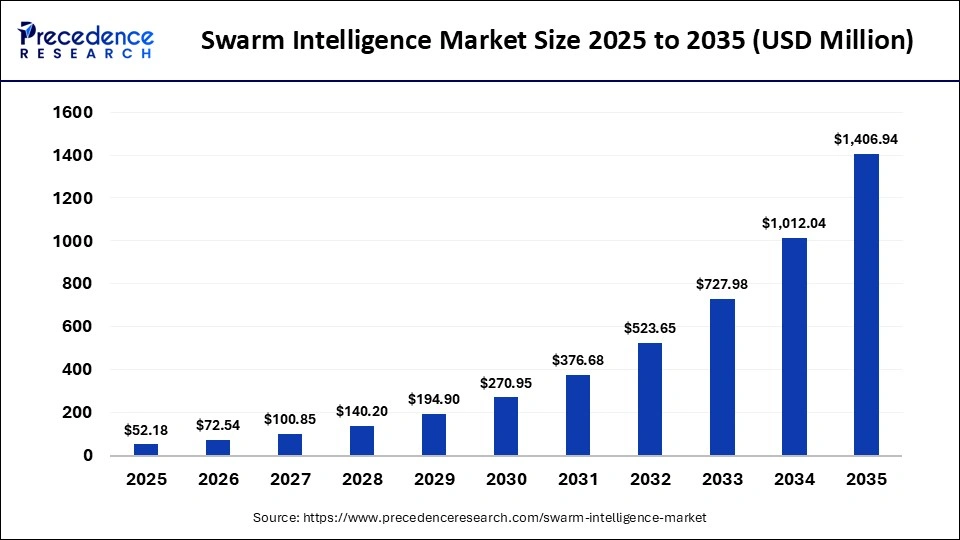
ICT industry specialist Shivani Zoting estimates the swarm intelligence market at USD 52.18 million in 2026, with continued technology adoption expected to take the market to USD 1406.94 billion by 2035 at a CAGR of 39.02%. Leading swarm intelligence market providers such as Unanimous AI, Swarm Technology, Hydromea, Sentien Robotics, DoBots are expanding their capabilities across segments including By Model, By Capability, By Application, By Region.
Source: https://www.precedenceresearch.com/swarm-intelligence-market
 Get a Sample
 Table Of Content


What is the Swarm Intelligence Market Size in 2026?
The global swarm intelligence market size was calculated at USD 52.18 million in 2025 and is predicted to increase from USD 72.54 million in 2026 to approximately USD 1406.94 million by 2035, expanding at a CAGR of 39.02% from 2026 to 2035. The increasing IT infrastructure and rapid digitalization, combined with the flexible, decentralized, responsive, and self organizing nature of IoT driven systems, are key factors driving market growth.
Key Takeaways
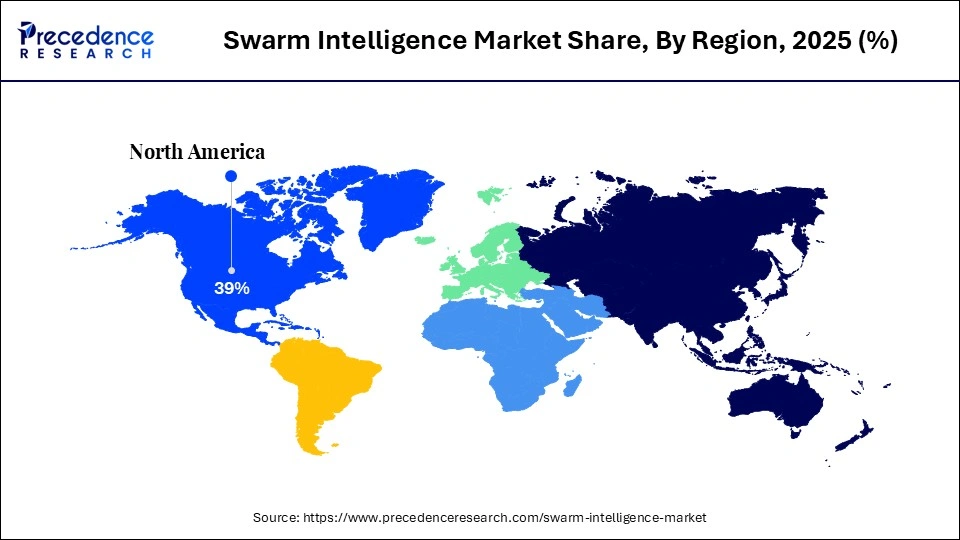
- North America led the swarm intelligence market with the highest market share of 39% in 2025.
- Asia-Pacific is expected to be the fastest-growing region in the forecasted period.
- By model, the particle swarm optimization (PSO) segment led the market in 2025.
- By model, the ant colony optimization (ACO) segment is expected to grow at the fastest CAGR in the market between 2026 and 2035.
- By capability, the routing segment held a dominant position in the market in 2025.
- By capability, the optimization segment is expected to grow with the highest CAGR in the market during the studied years.
- By application, the robotics segment held the largest market share in 2025.
- By application, the drones segment is expected to expand rapidly in the market in the coming years.
What is the Swarm Intelligence Market?
Swarm intelligence is a form of collective learning and decision-making that emerges from decentralized, self-organized systems. Inspired by how birds, bees, fish, and ants behave in groups, it applies similar principles within artificial intelligence (AI) to perform large-scale analysis and reach collective conclusions. In military drones, swarm intelligence enables the coordinated operation of multiple UAVs with minimal human intervention.
Beyond defense, it is being explored for planetary mapping, data mining, medical nanobots targeting tumors, and enhanced financial decision-making. As a research area, swarm intelligence has attracted strong interest across many disciplines because it offers powerful tools for solving complex problems through the collective action of distributed agents.
How is AI Transforming the Swarm Intelligence Market?
AI is transforming swarm intelligence by enhancing problem-solving capabilities, thereby improving decision-making capabilities and optimization. By integrating AI and machine learning (ML) algorithms, systems can dynamically adjust their behavior based on data, creating hybrid approaches that leverage structured collaboration and data-driven learning. AI and ML can analyze vast amounts of environmental data and predict traffic patterns or battery consumption. Additionally, they reduce bottlenecks and enhance scalability while preserving data privacy.
Swarm Intelligence Market: Key Trends
- Swarm Intelligence in Healthcare: In healthcare, emerging research highlights swarm intelligence driven hybrid frameworks, such as brain tumor classification models, as a key future trend that will improve diagnostic accuracy and advance intelligent medical imaging solutions.
- Swarm Intelligence Enhancing IoT Systems: Rising IoT adoption is driving demand for swarm intelligence, which enables efficient device coordination, optimized behavior, and seamless collaboration, thereby enhancing reliability and performance across interconnected systems.
- Retail Transformation through Swarm Intelligence: Swarm intelligence is emerging in retail to streamline inventory, dynamic pricing, and logistics while leveraging real-time insights, helping businesses enhance efficiency, responsiveness, and competitive positioning.
Market Scope
| Report Coverage | Details |
| Market Size in 2025 | USD 52.18 Million |
| Market Size in 2026 | USD 72.54 Million |
| Market Size by 2035 | USD 1406.94 Million |
| Market Growth Rate from 2026 to 2035 | CAGR of 39.02% |
| Dominating Region | North America |
| Fastest Growing Region | Asia Pacific |
| Base Year | 2025 |
| Forecast Period | 2026 to 2035 |
| Segments Covered | Model, Capability, Application, and Region |
| Regions Covered | North America, Europe, Asia-Pacific, Latin America, and Middle East & Africa |
Swarm Intelligence Market Dynamics
Drivers
Decentralized and Adaptive Swarm Capabilities.
Swarm intelligence has a collaborative, adaptable, flexible, decentralized, responsive, and self-organized nature, along with its ability to share vital insights without compromising confidentiality or privacy, and to adapt and reorganize to compensate for faults and continue operating even when individual agents fail, supporting its market adoption and acting as a key driver for the market.
Restraint
Unpredictability in Swarm System
The main market restraint is the unpredictability of emergent behavior in swarm systems. Because they rely on local interactions between simple agents, overall outcomes are hard to predict or control. In drone swarms, small rule conflicts can trigger unexpected movements, inefficiencies, or collisions. Troubleshooting is difficult without centralized logic, so vendors must rely on extensive simulations and iterative real-world testing, increasing time, cost, and risk and slowing broader market adoption.
Opportunity
Emerging Trends of Robotics
Swarm robotics can enable fleets of drones to collaboratively map disaster zones or inspect infrastructure without human oversight. Some marketplace companies adapt warehouse robots integrated with swarm principles to optimize item retrieval. The increasing use of autonomous driving cars also drives the future of swarm intelligence. These cars leverage swarm intelligence to coordinate traffic flow in real time, reducing congestion.
Segment Insights
Model Insights
Which Model Segment Dominated the Swarm Intelligence Market?
The particle swarm optimization (PSO) segment dominated the market in 2025, driven by its broad use across industries such as robotics, telecommunication, and data mining. PSO is a stochastic, population-based optimization method inspired by natural swarm intelligence and is particularly effective for complex optimization problems involving large, non-linear, or poorly understood search spaces where deterministic techniques often fail. Its appeal stems from its relatively simple implementation, with few control parameters, and its faster convergence compared with many traditional algorithms, which together have accelerated its adoption in the market.
The ant colony optimization (ACO) segment is expected to show the fastest growth over the forecast period, driven by ACO's unique ability to solve routing and scheduling problems, which are becoming increasingly critical in logistics and transportation. ACO is a nature-inspired algorithm modeled on how real ants collectively discover the shortest path to food without central control. It excels at handling large and complex search spaces where traditional methods often fail. By continuously learning from previous solutions and adapting over time, ACO is poised to play a key role in driving market expansion.
Capability Insights
Why Did the Routing Segment Dominate the Swarm Intelligence Market?
The routing segment accounted for the highest revenue share in the market in 2025, driven by its role in enabling efficient navigation and movement coordination, which is essential for logistics, autonomous vehicles, and drone operations. Swarm intelligence tackles routing challenges by emulating the collective behavior of natural systems, such as ant colonies and bird flocks, to identify optimal paths in complex networks. By harnessing decentralized, self-organizing mechanisms inspired by nature, swarm-intelligence-based route optimization is a key factor promoting the growth of the routing segment.
The optimization segment is expected to gain the highest market share between 2026 and 2035, driven by increasing demand for better resource allocation and greater efficiency across industries. By leveraging bio-inspired algorithms, this capability addresses complex optimization challenges, substantially improving both operational performance and resource management. Sectors with highly dynamic and time-sensitive requirements, such as finance and emergency response, are particularly well positioned to benefit from swarm intelligence's capacity to react rapidly and collectively to evolving conditions.
Application Insights
Which Application Segment Led the Swarm Intelligence Market?
The robotics segment led the market in 2025, driven by the ability of swarms to self-organize and perform collective tasks without central oversight, making them especially well-suited for applications such as search and rescue missions, warehouse management, agricultural automation, space exploration, and environmental monitoring. By leveraging advances in automated systems and AI, swarm robotics supports the execution of complex operations that would be difficult for individual units to manage alone, while enhancing redundancy and adaptability. As a result, swarm-intelligence-based robotics delivers robust, scalable, and flexible solutions capable of operating in diverse, dynamic environments, which in turn drives overall market growth.
The drones segment is expected to witness the fastest growth in the market over the forecast period, driven by rising demand for aerial surveillance, delivery services, and environmental monitoring. Swarm-enabled drones can operate collaboratively, greatly improving effectiveness and expanding use cases, especially in defense and security. Using distributed AI, each drone acts as an intelligent node within a self-organizing system, boosting scalability, resilience, and responsiveness and accelerating the adoption of swarm-intelligence-based drones.
Regional Insights
North America Swarm Intelligence Market Size and Growth 2026 to 2035
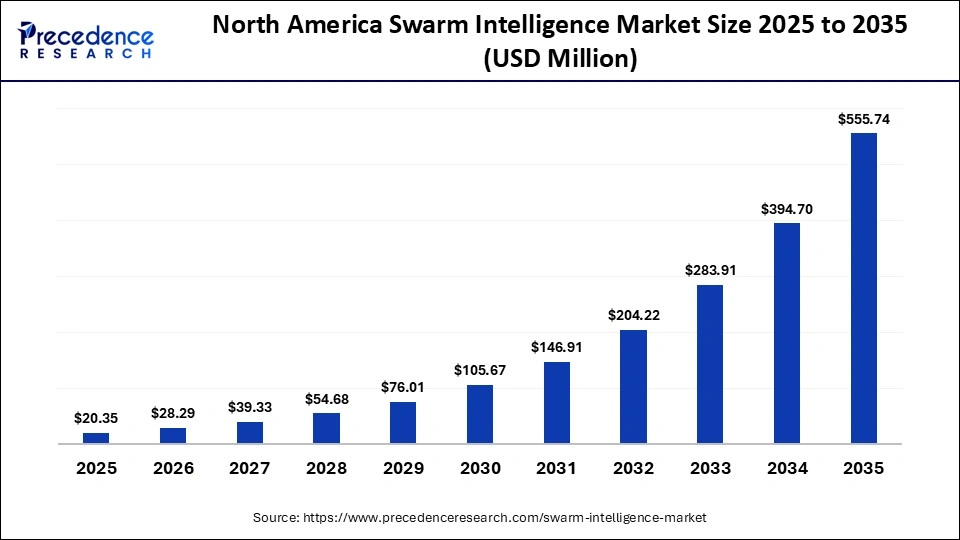
The North America swarm intelligence market size is estimated at USD 20.35 million in 2025 and is projected to reach approximately USD 555.74 million by 2035, with a 39.20% CAGR from 2026 to 2035.
Why North America Dominated the Swarm Intelligence Market?
North America established its dominance in the market in 2025. This leadership is driven by rapid technological advancements, increased AI investment, and a strong emphasis on automation across multiple industries. Supportive regulations, along with innovation- and research-focused initiatives, further accelerate market expansion, positioning North America as a key player globally.
Demand is also being boosted by the growing need for efficient logistics optimization, smart manufacturing, and real-time decision-making systems. Additionally, the emergence of digital troops, next-generation military formations where autonomous land, air, and sea platforms operate as an integrated system, is strengthening the case for swarm intelligence adoption.
U.S. Swarm Intelligence Market Size and Growth 2026 to 2035
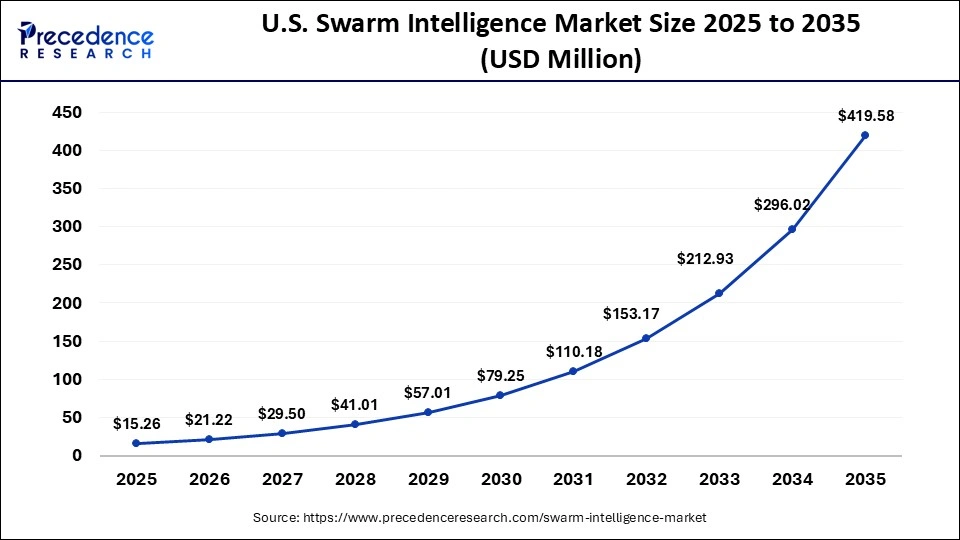
The U.S. swarm intelligence market size is calculated at USD 15.26 million in 2025 and is expected to reach nearly USD 419.58 million in 2035, accelerating at a strong CAGR of 39.29% between 2026 and 2035.
U.S. Market Trends
Within the region, the U.S. plays a pivotal role and shows leadership in the region, propelled by robust venture capital funding, defense-led AI programs, and rising deployment of autonomous systems in logistics, robotics, and aerospace. Continuous improvements in algorithmic efficiency are improving scalability and sustainability, making swarm intelligence solutions more practical to deploy and further supporting market growth.
How is Asia-Pacific Growing in the Swarm Intelligence Market?
Asia-Pacific is expected to experience the fastest growth during the predicted timeframe. This momentum is driven by rapid industrialization, accelerating urbanization, and extensive smart city programs, supported by government initiatives that promote AI and automation. As countries across the region pursue digital transformation, swarm intelligence is emerging as a core technology for process optimization, data-driven decision-making, and overall operational efficiency. Its inherent versatility and adaptability make it well-suited to the Asia-Pacific's diverse and fast-changing business environment, fueling adoption across manufacturing, logistics, and smart city ecosystems.
China Market Trends
China leads the market in Asia-Pacific, driven by the increasing investments in robotics, industrial automation, and digital infrastructure, which is turning the region into a major hub for swarm intelligence deployment. A strong emphasis on AI development and smart manufacturing also boost the market.
Why Did Europe Dominate the Swarm Intelligence Market?
Europe region is expected to grow at a significant rate of market share between 2026 and 2035, due to the rapid growth of collaborative robotic research in Europe. The distributed process of the NVIDIA and Intel AI chip market further bolstered the market growth of scalable swarm computing architectures in the region.
Germany Accelerating Swarm Intelligence Innovation Across Europe
Germany is a major contributor to the European market, as it aggressively invested in autonomous manufacturing infrastructure and industrial AI early on. The country has more than 449 robots for every 10,000 manufacturing workers, which means that there were coordinated robotic intelligence systems in place in automotive factories, and these were scaled up and deployed. (Source: https://ifr.org/ifr-press-releases)'
Why is the Middle East & Africa Emerging Rapidly in the market?
The Middle East and Africa region is expected to register significant growth in the market during 2026 and 2035, driven by the growing push in the region for smart infrastructure modernization.
Saudi Arabia Becoming a Key Swarm Intelligence Hub in the Middle East & Africa
Saudi Arabia is a major player in the Middle East and Africa market, owing to the strong investments in smart infrastructure and autonomous technologies of swarm intelligence. In 2026, Saudi Arabia will dedicate almost USD 100 billion to collaborative investment programs in AI, smart cities, and advanced digital infrastructure to facilitate autonomous systems integration initiatives. (Source: https://www.irecruit.co)
Why Is Latin America Strengthening Its Position in the Swarm Intelligence Market?
The Latin America region is estimated to grow at a strong CAGR over the projected period, owing to the robust growth in the logistics sector, the agricultural sector, and the mining sector, leading to greater investments in automation. E-commerce firms integrated more collaborative picking systems that enhance the efficacy and integrity of deliveries into expansive e-commerce networks.
Brazil Emerging Strongly in the Latin American
Brazil leads the regional Latin America market, propelled by the use of decentralized AI and swarm robotics expanded across various fields, including agriculture, logistics, and industrial automation.
Competitive Landscape
The Swarm Intelligence Market remains semi-consolidated with rising global competition. The advanced swarm deployments are dominated by major AI and robotics companies. Entry barriers remain high because there are a lot of algorithm design requirements. NVIDIA and Microsoft contributed a substantial amount to the distributed AI and edge computing landscape. IBM enhanced its industrial AI platforms for applications involving real-time swarm optimization.
Competitive positioning is rapidly changing with strategic positioning, partnering, and acquisitions. Cloud vendors add swarm intelligence to scalable AI infrastructure. Collaborations with other academic institutions, such as MIT, Stanford, and Carnegie Mellon, have a positive effect on growing the velocity of innovations. The future direction of competition would move toward “collaborative” AI-Robotics Ecosystems across the world.
Swarm Intelligence Market Companies
- Unanimous AI
- Swarm Technology
- Hydromea
- Sentien Robotics
- DoBots
- SwarmFarm
- ConvergentAI
- Shield AI
- Valutico
- Kim Technologies
- Robert Bosch GmbH
- NVIDIA Corporation
- Amazon.com Inc.
- Intel Corporation
- Lockheed Martin
Recent Developments
- In March 2026, a newly released open-source artificial intelligence project called MiroFish drew attention among developers and technology observers after appearing on trending charts on GitHub, where it swiftly gathered thousands of stars from the developer community. The swarm intelligence engine created a simulated digital environment populated by thousands of independent AI agents that interacted with each other in parallel.(Source: https://www.moneycontrol.com)
- In January 2026, the Department of War launched a transformative Artificial Intelligence Acceleration Strategy that extended its lead in military AI deployment and established the U.S. as the world's undisputed AI-enabled fighting force. Swarm Forge was introduced as a competitive mechanism to iteratively discover, test, and scale novel ways of fighting with and against AI-enabled capabilities, combining America's elite warfighting units with elite technology innovators.(Source: https://www.war.gov)
Segments Covered in the Report
By Model
- Ant Colony Optimization (ACO)
- Particle Swarm Optimization (PSO)
- Others
By Capability
- Optimization
- Routing
- Scheduling
- Clustering
By Application
- Robotics
- Drones
- Human Swarming
By Region
- North America
- Latin America
- Europe
- Asia-pacific
- Middle and East Africa
For inquiries regarding discounts, bulk purchases, or customization requests, please contact us at sales@precedenceresearch.com
Frequently Asked Questions
Tags





Ask For Sample
No cookie-cutter, only authentic analysis – take the 1st step to become a Precedence Research client
 Get a Sample




 sales@precedenceresearch.com
 Schedule a Meeting
