






 Request Consultation
Targeted data centers are transforming digital infrastructure by optimizing systems for specific workloads such as AI, edge computing, and real-time analytics. They deliver higher efficiency, performance, and scalability compared to traditional data centers.
The global data center landscape is undergoing a profound transformation driven by specialization, efficiency, and workload-specific optimization. Traditional data centers were created as a generalized infrastructure environment. That could handle a large variety of enterprise applications. The fast development of artificial intelligence (AI), high-performance computing (HPC), streaming platforms, and real-time analytics is transforming the infrastructure needs in industries.
To meet this movement, specifically built data centers are targeted, which are designed to handle a defined workload with unprecedented performance and efficiency. Such data centers are not generic compute environments anymore, but rather highly tuned environments that are specific to operational needs.
Between AI training clusters and financial trading platforms, edge computing nodes and hyperscale cloud regions, each of them represents a different philosophy of architecture. This change is indicative of a larger discovery in the world of technology. Workloads do not have the same impact, and infrastructure needs to scale to achieve specific computational, latency, and energy efficiency needs.
The End of One-Size-Fits-All Infrastructure Design
For many years, data centers were built on standardized architecture with a focus on scalability and flexibility rather than on specialization. The operators constructed facilities and created one that would support various workloads. They may include enterprise resource planning systems or web hosting environments. Although such a method allowed wide compatibility, it usually led to inefficiencies in the case of specialized workloads.
These varied needs illuminate the constraints of orthodox architecture models. Compromised performance, escalated energy usage, and workload inefficiencies tend to be the results of the attempt to provide support to all workloads in a single generalized environment. Targeted data centers can solve this problem by matching workload characteristics to the design of the infrastructure. These facilities do not focus on maximization of flexibility but emphasize precision, efficiency, and optimization of performance.
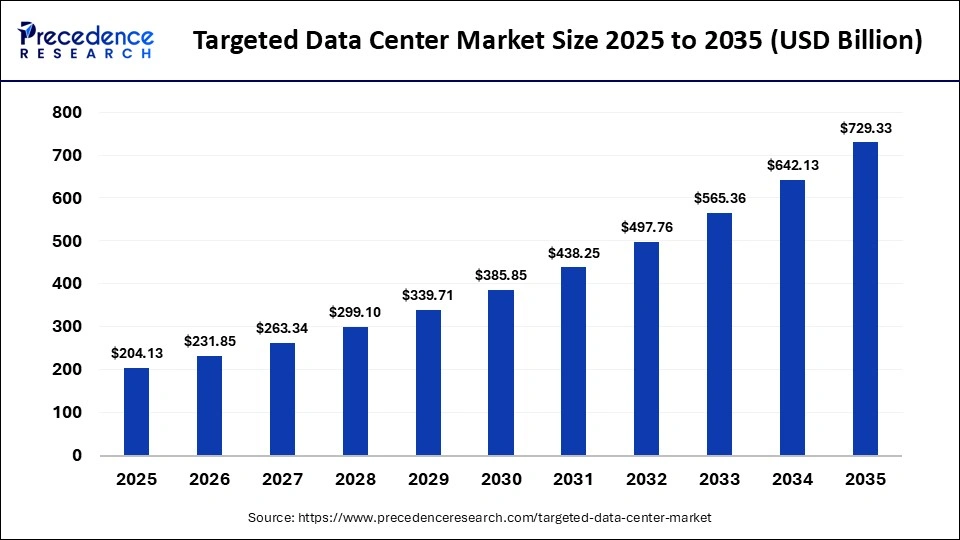
What is the Targeted Data Center Market Market Size in 2026?
The global targeted data center market was valued at USD 204.13 billion in 2025 and is projected to grow from USD 231.85 billion in 2026 to approximately USD 729.33 billion by 2035, registering a CAGR of 13.58% during the forecast period from 2026 to 2035. The market growth is driven by the rapidly increasing demand for AI workloads, cloud services, and high-performance, low-latency infrastructure.
Get a Free Sample Report with Key Market Trends: https://www.precedenceresearch.com/sample/8212
What Defines a Targeted Data Center?
A designed data center is not determined by size or capacity but by its pre-determined use in a direction. Every aspect of the facility, from hardware configuration to cooling systems and network architecture, is optimized to support a particular category of workloads.
Core Design Principles of Targeted Data Centers
| Design Element | Purpose in Targeted Environments |
| Compute Architecture | Tailored to workload requirements such as AI, analytics, or transactional systems |
| Cooling Systems | Optimized for heat profiles generated by specific hardware configurations |
| Network Topology | Designed to support latency-sensitive or high-throughput applications |
| Energy Management | Aligned with the power consumption patterns of targeted workloads |
| Location Strategy | Selected based on proximity requirements or regulatory considerations |
An AI-oriented data center can launch the use of GPU-intensive clusters that are liquid-cooled to accommodate thermal-intensive outputs. On the other hand, a financial data facility that is latency sensitive may be more focused on distance to large trading centers and install ultra-low-latency networking. This specialization allows the target data centers to be very efficient and perform with a lot more efficiency as compared to generalized ones.
AI Workloads Are Redefining Infrastructure Requirements
One of the main stimulants of the emergence of targeted data centers is AI. The deployment and training of machine learning models on a large scale consume huge computational resources, hardware accelerators, and high-bandwidth data pipelines.
There are usually issues with the traditional data center environment being able to effectively support these requirements. AI workloads contain high heat, demand the exchange of data between calculation nodes swiftly, and demand continuous high-performance capabilities.
To address these challenges, targeted AI data centers are being designed with features such as:
- High-density GPU clusters with advanced interconnect technologies
- Liquid cooling systems capable of managing extreme thermal loads
- Dedicated data pipelines for high-speed data ingestion and processing
Such facilities are usually found close to renewable energy sources to ensure that they can be able to control the use of energy without compromising efficiency. Recent deployments explain why hyperscale technology vendors are investing in AI-specific infrastructure that can serve large-scale model training and inference workloads. These trends underscore the increasing importance of targeted data centers as a solution to next-generation AI applications.
Edge and Latency-Sensitive Applications are Driving Geographic Specialization
The increased significance of latency-sensitive applications is another key trend that is defining the targeted data center environment. Autonomous systems, real-time gaming, augmented reality, industrial automation, and technologies need nearly real-time data processing.
From these applications, data centers are required to be brought nearer to end users, forming an edge facility community network. Compared to conventional centralized data centers, the edge data centers are smaller and geographically decentralized. They are meant to process the data fast at the network edge.
Targeted edge data centers are optimized for:
- Low-latency networking infrastructure
- Compact and modular designs for rapid deployment
- Energy-efficient operation in constrained environments
Such facilities allow real-time applications to be effective by minimizing the physical distance between data processing and end users. Furthermore, with the continued growth of digital services worldwide, geographically oriented data centers gain relevance in the process of facilitating real-time digital experiences.
Sustainability is Becoming a Core Design Constraint
Energy consumption has become one of the most critical challenges facing the data center industry. Computational requirements are on the rise, and the amount of electric power consumed by the data centers is also escalating. This poses a question of environmental consequences and operational expenses. Specialized data centers can provide the ability to overcome these difficulties by optimizing workload as regards energy.
There are numerous targeted data centers, the design of which is being made sustainable from the very beginning. Operators are also paying more attention to the areas where they can access renewable energy sources. This further introduces dynamically managed energy management systems to maximize the use of power. These projects are indicative of a larger move towards designing infrastructure sustainably, integrating environmental factors into all the operations of the data centers.
The Role of Software-Defined Infrastructure in Targeted Environments
Physical infrastructure is essential in targeted data centers. Software is also essential in facilitating the ability to be efficient and flexible. Software defined infrastructure enables operators to distribute resources dynamically and manage complex systems. Depending on the targeted environment, software platforms can be tailored towards offering particular applications.
AI data centers leverage orchestration systems that are intended to handle distributed training loads on thousands of compute nodes. Such software systems allow targeted data centers to be run as intelligent infrastructure environments. They are able to adapt to the changing workloads and optimize the performance on-the-fly. A combination of sophisticated software and special-purpose hardware forms a strong synergy that not only improves efficiency but also scalability.
Modular Design is Accelerating Deployment
The speed of deployment is now a crucial aspect in the data center industry, especially with the ever-increasing need for digital infrastructure. Specialized data centers are also increasingly modulating the design towards a modular format. This enables facilities to be built and implemented faster.
Modular design also provides flexibility for a specific environment. Instead of having to construct large-scale facilities, operators can add new modules as capacity is needed to match the workload. This strategy is consistent with the larger trend of developing agile infrastructure, in which speed, flexibility, and efficiency are the key considerations in comparison to the older large-scale construction techniques.
Strategic Implications for Cloud and Enterprise Providers
The emergence of purpose-built data centers is transforming the way infrastructure strategy is being tackled by cloud vendors and customers. Organizations are implementing hybrid designs that incorporate centralized and targeted infrastructure instead of depending on one centralized hyperscale facility. Cloud providers are investing in special-purpose regions optimized for AI workloads, high-performance computing, and latency-sensitive applications.
Companies are rolling out dedicated data centers to accommodate mission-critical business functions that have performance attributes. Procurement strategies are also undergoing this change. The choice of infrastructure solutions is also shifting towards workload-specific selection by organizations instead of general-purpose capabilities. This will enable them to operate at a high level and at minimum operational expenses. Furthermore, dedicated data centers are turning out to be a strategic resource that will help organizations to tie up infrastructure with business aims in a better way.
Challenges in Building Highly Specialized Infrastructure
Despite their advantages, targeted data centers present several challenges that operators must address carefully. The challenge of specialization versus scalability is one of the main problems. Highly specialized infrastructure may deliver exceptional performance for specific workloads but may lack flexibility for future requirements.
The creation and management of specially designed data centers demand expertise in fields such as AI infrastructure and high-speed networking. Organizations must invest in talent development to support these capabilities. Regulatory and compliance factors may affect targeted data center design and location, especially in such industries as finance and healthcare. These challenges are expected to have to be addressed in order to maximize the potential of targeted infrastructure.
The Future: Infrastructure Designed With Intent
The development of targeted data centers is a paradigm shift in the conceptualization and implementation of digital infrastructure. Rather than the creation of genericized systems capable of supporting a broad array of applications. Intent-driven infrastructure design is becoming the order of the day, in which each component is designed to support a single purpose.
On the other hand, the network of data centers worldwide will be more decentralized. These specific locations will be focused on being nearer to the users and to be a part of more extensive digital processes. The change is representative of the general trend in the technology sector: generalization is being overtaken by precision in the design of infrastructure.
Conclusion: Precision Infrastructure for a Data-Driven World
The advent of specific data centers is a new stage in the development of digital infrastructure. As computational demands become more diverse and complex, the need for specialized environments capable of delivering optimal performance has become increasingly clear.
Targeted data centers provide remarkable benefits in efficiency, scalability, and performance by designing infrastructure in accordance with the needs of the workload. They allow organizations to serve advanced applications, including AI, real-time analytics, and edge computing, in a better way.
This change also leads to new integration, scalability, and expertise-related challenges. It will take a collective effort through the technology ecosystem, comprising hardware manufacturers, software developers, and infrastructure operators, to overcome such challenges.
Targeted data centers can be viewed as a step towards intelligent, application-specific infrastructure. This is more appropriate to the needs of a fast-changing digital environment. Additionally, with this trend gaining momentum, the specialized facilities will become highly instrumental in defining the future of computing in the world.
Expert Advise
According to Precedence Research, the rapidly evolving digital landscape is witnessing a surge in targeted data centers globally. The increasing inter-governmental collaboration and funding support the development of a high-tech infrastructure, positioning each nation as a global tech hub. With IoT, 5G, and real-time applications, data processing is shifting closer to users, and micro data centers are emerging in urban and semi-urban areas. In the future, the rise of AI-native data centers, hyper-localization with edge expansion, and a built-in cyber resilience are revolutionizing targeted data centers.
About the Authors

Aditi Shivarkar
Aditi, Vice President at Precedence Research, brings over 15 years of expertise at the intersection of technology, innovation, and strategic market intelligence. A visionary leader, she excels in transforming complex data into actionable insights that empower businesses to thrive in dynamic markets. Her leadership combines analytical precision with forward-thinking strategy, driving measurable growth, competitive advantage, and lasting impact across industries.



Aman Singh
Aman Singh with over 13 years of progressive expertise at the intersection of technology, innovation, and strategic market intelligence, Aman Singh stands as a leading authority in global research and consulting. Renowned for his ability to decode complex technological transformations, he provides forward-looking insights that drive strategic decision-making. At Precedence Research, Aman leads a global team of analysts, fostering a culture of research excellence, analytical precision, and visionary thinking.

Piyush Pawar
Piyush Pawar brings over a decade of experience as Senior Manager, Sales & Business Growth, acting as the essential liaison between clients and our research authors. He translates sophisticated insights into practical strategies, ensuring client objectives are met with precision. Piyush’s expertise in market dynamics, relationship management, and strategic execution enables organizations to leverage intelligence effectively, achieving operational excellence, innovation, and sustained growth.