






 Request Consultation
Executive Framing
In under four years, tirzepatide has shifted from a novel diabetes molecule to the commercial engine behind pharma's largest-ever manufacturing buildout, and the fastest-growing drug franchise in industry history. Thus, what began as Mounjaro, a once-weekly injectable for type 2 diabetes approved in May 2022, has since branched into Zepbound, obesity, then obstructive sleep apnea, triggered a head-to-head clinical war with Novo Nordisk's semaglutide, forced a national reckoning over compounding pharmacies, and then pushed Eli Lilly past a trillion-dollar market capitalization on the back of a single active ingredient.
This briefing does not attempt to catalogue every trial or headline. It isolates the 14 relationships that matter most to executives, evaluating this molecule, whether as a pharma competitor, a payer, an investor, a health system, or a downstream supplier, and renders each one as a single, image-ready visual. Every figure traces to a named, checkable source; where credible data did not exist, we said so rather than estimating.
SECTION 1: The Regulatory Arc: How One Molecule Became Three Drugs
| Date | Regulatory/Clinical Milestone |
| May-22 | FDA approves Mounjaro for Type 2 diabetes |
| Sep-22 | EU (EMA) & Japan approve tirzepatide for Type 2 diabetes |
| Oct-22 | UK MHRA approves Mounjaro for Type 2 diabetes |
| Nov-23 | FDA approves Zepbound for chronic weight management |
| Dec-24 | FDA approves Zepbound for obstructive sleep apnea |
| Jan-25 | Japan MHLW approves Zepbound for obesity |
| Mid-2025 | SURPASS-CVOT published; cardiovascular benefit confirmed |
| Dec-25 | FDA expands Mounjaro to adolescents (10+) with Type 2 diabetes |
| Apr-26 | FDA approves Foundayo (oral forglipron) - sister pill |
The regulatory timeline for Eli Lilly's tirzepatide spans from its initial U.S. approval for type 2 diabetes in May 2022 to chronic weight management indications and then culminates with the April 2026 U.S. approval of its oral non-peptide sister molecule, Foundayo (orforglipron).
In May 2022, the U.S. Food and Drug Administration (FDA) approved Mounjaro for the treatment of type 2 diabetes. Following this, by the end of 2022, the European Medicines Agency (EMA), the Japanese regulatory authority, and the UK Medicines and Healthcare products Regulatory Agency (MHRA) approved Mounjaro for the same indication.
Later, Zepbound was introduced in the U.S. market for chronic weight management in November 2023 and subsequently for obstructive sleep apnea by December 2024. Zepbound was then approved by the Japanese regulatory authority in January 2025. By the end of 2025, the trial results of SURPASS-CVOT were published, proving the role of tirzapetide in cardiovascular disease. In April 2026, the FDA approved Foundayo (oral orforglifon) as a sister pill.
Key Insight: Lilly did not launch one drug; it launched a regulatory-approval engine that keeps unlocking new revenue pools, such as diabetes, obesity, sleep apnea, and adolescents, an oral franchise from a single R&D platform, extending the asset's commercial life well beyond a typical drug's approval-to-plateau curve.
Source: U.S. FDA press announcements (May 2022, Nov 2023, Dec 2024); Eli Lilly investor releases; Drugs.com approval histories; MHLW Japan (Jan 2025).
SECTION 2: Inside the Molecule: A Dual-Receptor Mechanism No Competitor Product Matches
How Tirzepatide Works: A Single Molecule, Two Incretin Pathways
| Pathway | Mechanism | Key Effects |
| GIP receptor agonism | Activates GIP receptors | Enhanced glucose-dependent insulin secretion; improved adipose tissue insulin sensitivity |
| GLP-1 receptor agonism | Activates GLP-1 receptors | Suppressed appetite, slowed gastric emptying, reduced glucagon secretion |
| Net clinical effect | Combined GIP + GLP-1 activity | Lower blood glucose, reduced caloric intake, slower gastric emptying, improved glycemic control, and substantial weight loss |
Tirzepatide is a 39-amino-acid synthetic peptide chain that acts as a dual receptor co-agonist. Thus, it stimulates both the glucose dependent insulinotropic polypeptide (GIP) and glucagon-like peptide-1 (GLP-1) receptors, producing different effects simultaneously. In contrast, semaglutide targets only the GLP-1 receptor pathway.
Key Insight: Tirzepatide achieves its clinical edge via a single 39-amino-acid synthetic peptide backbone based on the native GIP sequence, thus chemically modified with a fatty diacid moiety to simultaneously activate both the GIP and GLP-1 receptors.
Source: NCBI StatPearls, “Tirzepatide” (Farzam & Patel); ClinicalTrials.gov protocol documentation (LY3298176).
SECTION 3: Efficacy Ceiling: What the SURMOUNT Program Proved About Weight Loss
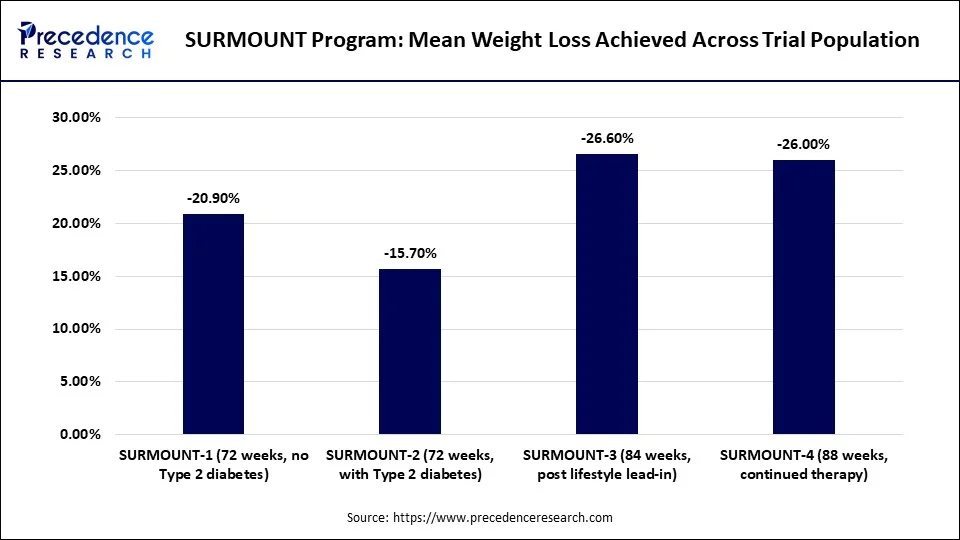
The pivotal SURMOUNT clinical trials for Eli Lilly's tirzepatide demonstrate mean body-weight reductions ranging from nearly 15% to 26.6% at the highest doses, such as 10 mg or 15 mg, depending on the specific patient population and study design. The SURMOUNT-1 trial among subjects with no type 2 diabetes resulted in a significant weight loss of 20.9% at over 20 mg dose. However, the weight loss was limited (15.7%) in patients with type 2 diabetes.
The SURMOUNT-3 trials for 84 weeks, post-lifestyle lead in resulted in the highest weight loss of 26.6%, while the SURMOUNT-4 trials for 88 weeks resulted in 26% of weight loss. This indicates that prolonged treatment with tirzapetide is beneficial for significant weight loss.
KEY INSIGHT: Weight loss is not a single number; it is context-dependent. The 26% results in SURMOUNT-3 and -4 show that combining tirzepatide with intensive lifestyle support or longer treatment duration pushes results well beyond the headline ~21% figure most commonly quoted in media coverage.
Source: Eli Lilly investor press releases (SURMOUNT-1, -3, -4 topline and detailed results); PMC systematic review of SURMOUNT categorical weight-loss data.
SECTION 4: The Head-to-Head Verdict: Tirzepatide vs. Semaglutide (SURMOUNT-5)
| Key Endpoint | Tirzepatide (Zepbound) | Semaglutide (Wegovy) |
| Body Weight Reduction at 72 Weeks | 20.20% | 13.70% |
| Waist Circumference Reduction | 18.4 cm | 13.0 cm |
| Patients Achieving ≥25% Weight Loss | 31.60% | 16.10% |
The data comes from the SURMOUNT-5 clinical trial. It shows that tirzepatide (Zepbound) achieves superior weight loss (20.2% mean reduction) compared to semaglutide (Wegovy) (13.7% reduction) at 72 weeks. Thus, both drugs share similar gastrointestinal side effects, mostly occurring during dose escalation. According to the test results, waist circumference reduction in tirzapetide was 18.4 cm and 13 cm in semaglutide. In addition, 31.6% of subjects treated with tirzapetide achieved more than 25% weight loss, while semaglutide resulted in more than 25% weight loss in about 16.1% of subjects.
KEY INSIGHT: This was the trial the obesity-drug market had been waiting for. Moreover, tirzepatide's win across every primary and secondary endpoint gives Lilly the strongest possible commercial alongside clinical argument in payer negotiations and prescriber conversations, and forces Novo Nordisk to compete on price, access, or a next-generation molecule rather than head-to-head efficacy.
Source: SURMOUNT-5 Phase 3b trial, published in The New England Journal of Medicine and presented at the European Congress on Obesity (2025); Eli Lilly Global Medical Affairs statement.
SECTION 5: The Diabetes Foundation: Glycaemic Control Across the SURPASS Program
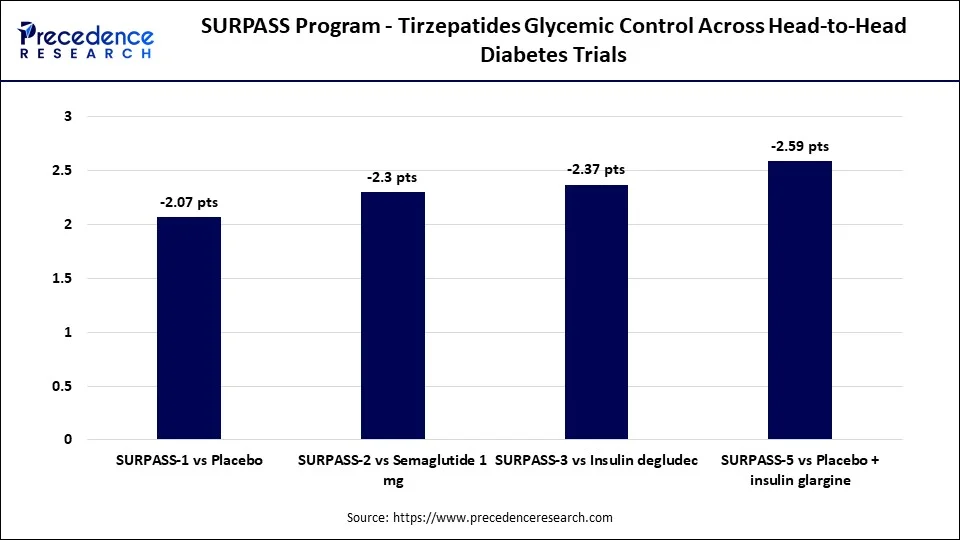
Across Eli Lilly’s SURPASS clinical program, the dual GIP/GLP-1 receptor agonist Mounjaro (tirzepatide) achieved maximum A1C reductions ranging from approximately -2.0% to -2.6% at its highest 15 mg dose, thus consistently outperforming active comparators and placebo. Tirzepatide achieved the highest A1C reduction when compared with placebo and insulin glargine, while it achieved the least A1C reduction when compared with placebo alone.
Key Insight: Before tirzepatide became a weight-loss headline, it was a diabetes-control outlier: reductions of up to 2.6 percentage points are materially larger than what most prior injectable or oral diabetes therapies achieved; that is why Mounjaro secured priority review and even rapid uptake among endocrinologists well before Zepbound existed.
Source: Eli Lilly investor press releases for SURPASS-1, -2, -3, -5 (Lancet, NEJM, and topline data); PMC meta-analysis of SBP and glycaemic outcomes across SURPASS trials.
SECTION 6: The Sleep Apnea Breakthrough: A New Pharmacologic Front for OSA
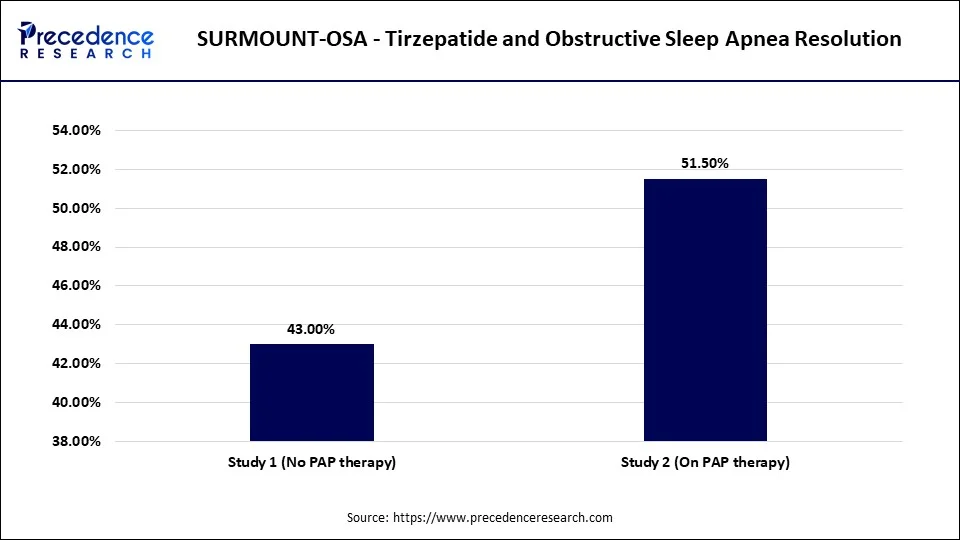
In the SURMOUNT-OSA trials, 43% of participants with no baseline positive airway pressure (PAP) therapy (Study 1), along with 51.5% of those utilizing baseline PAP therapy (Study 2), achieved formal obstructive sleep apnea (OSA) disease resolution after 52 weeks of high-dose tirzepatide. Thus, tirzapetide benefited more patients receiving PAP therapy.
Key Insight: OSA has never had an accepted primary pharmacologic treatment; CPAP/PAP devices, with their well-documented adherence problems, were the only mainstay. Tirzepatide's December 2024 approval for now OSA opens an entirely new prescribing channel such as sleep medicine and pulmonology, beyond endocrinology and obesity medicine.
Source: SURMOUNT-OSA Phase 3 trial, published in The New England Journal of Medicine (2024); Eli Lilly investor release; American Diabetes Association 84th Scientific Sessions.
SECTION 7: Beyond Weight and Glucose: Cardiovascular Proof From SURPASS-CVOT
| Metric | Result |
| Lower Relative Risk of 3-Point MACE vs. Dulaglutide | 8% |
| Lower All-Cause Mortality vs. Dulaglutide | 16% |
| Patients Randomized | 13,299 |
| Median Trial Duration | 4.5 years |
SURPASS-CVOT trial estimated 13,299 patients with type 2 diabetes and atherosclerotic cardiovascular disease across a median of 4.5 years. It was found that weekly tirzepatide (up to 15 mg) was noninferior, meaning it offered equivalent cardioprotective efficacy, to dulaglutide (1.5 mg) in preventing major adverse cardiovascular events (MACE). The results demonstrated 16% lower all-cause mortality with tirzepatide compared to dulaglutide.
Key Insight: A non-inferiority result that also shows numerically fewer cardiovascular deaths and 16% lower all-cause mortality gives Lilly an evidence base to pursue a cardiovascular-risk-reduction label expansion, the same regulatory pathway Novo Nordisk utilized to transform semaglutide's commercial positioning via the SELECT trial.
Source: SURPASS-CVOT (NCT04255433), published in The New England Journal of Medicine (December 2025); Eli Lilly investor release; coverage via TCTMD and HCPLive.
SECTION 8: The Tolerability Tax: Gastrointestinal Adverse Events at Scale
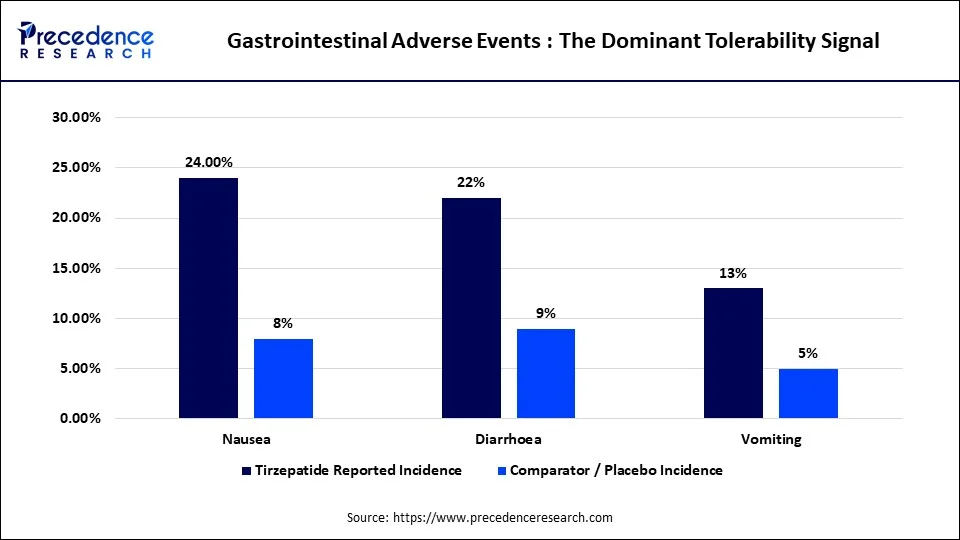
Across the pooled SURPASS-1 via -5 trials, a post-hoc analysis published in Diabetes, Obesity and Metabolism details the specific rates, severity, and clinical implications of these gastrointestinal adverse events (GI AEs). The incidence of nausea, diarrhoea, and vomiting among patients who received tirzepatide was 24%, 22%, and 13%, respectively. These results were considerably higher than those of placebo or comparator arms.
Key Insight: GI tolerability, not efficacy, is the main lever determining real-world persistence and discontinuation. A meaningful minority of patients experience mild-to-moderate GI events, concentrated in the dose-titration window, which is precisely why slow dose-escalation protocols and compounded or off-label rapid-titration practices carry outsized safety relevance.
Source: Patel et al., “Gastrointestinal adverse events and weight reduction in people with type 2 diabetes treated with tirzepatide in the SURPASS clinical trials,” Diabetes, Obesity and Metabolism (2024).
SECTION 9: The Muscle-Loss Debate: What Body-Composition Data Actually Shows
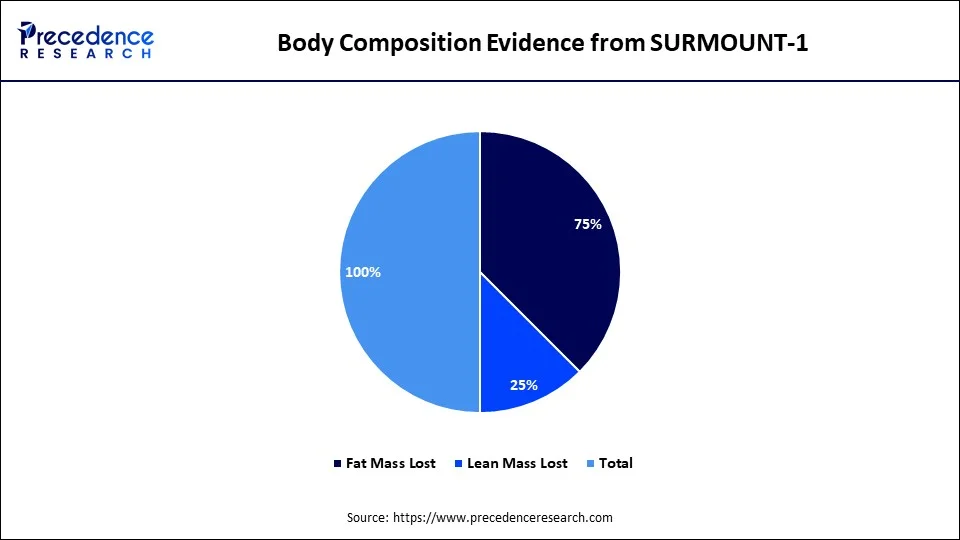
In the SURMOUNT-1 Trial DXA Substudy, participants taking tirzepatide lost 21.3% of their body weight by Week 72. Nearly 75% of this loss was fat mass, and 25% was lean mass. This 3:1 fat-to-lean ratio matched the placebo group and remained consistent across different dosages, age groups, and sexes.
Key Insight: The 75%:25% ratio is consistent with weight loss from other interventions of similar magnitude. But tirzepatide has received central attention for weight loss indication as an adjunct therapy, despite Lilly’s investigational myostatin inhibitor, bimagrumab, and third-party candidates like apitegromab, which is explicitly designed to preserve lean mass during incretin-driven weight loss.
Source: Look et al., “Body composition changes during weight reduction with tirzepatide in the SURMOUNT-1 study,” Diabetes, Obesity and Metabolism (2025), PubMed 39996356.
SECTION 10: Racing to Keep Up: Eli Lilly's Unprecedented Manufacturing Buildout
| Date | Investment |
| May-24 Lebanon, Indiana site raised to $9B total investment (from $3.7B) | $9.0B |
| Feb-25 Four new U.S. manufacturing plants pledged | $27.0B |
| 2026 Additional Indiana expansion | $4.5B |
Eli Lilly's sequenced U.S. manufacturing milestones for tirzepatide, the active ingredient in Mounjaro and Zepbound, at its mega-site in Lebanon, Indiana, highlight individual capital pledge amounts rather than cumulative totals: an initial $3.7 billion commitment, a subsequent $5.3 billion expansion addition, and a later $4.5 billion commitment for advanced/genetic facilities.
Key Insight: Company disclosures state that cumulative U.S. manufacturing commitments have surpassed $50 billion since 2020, framed by Lilly as the largest single investment in synthetic-medicine API manufacturing in the industry's history, along with a direct response to nearly two years of national supply shortages that opened the door to the compounding pharmacy market.
Source: Eli Lilly investor press releases (May 2024, February 2025); CNN; BioPharma Dive; PharmaSource manufacturing analysis.
SECTION 11: The Compounding Crackdown: How the FDA Closed the Copycat Market
| Date | Regulatory / Legal Milestone |
| Dec-22 | FDA lists tirzepatide injections as “in shortage.” |
| Oct-24 | FDA declares the shortage resolved; compounders sue. |
| Oct-24 | Court remands the decision back to the FDA for review. |
| Dec-24 | FDA reaffirms that the shortage is resolved through a declaratory order. |
| Feb-25 | 60/90-day enforcement discretion windows expire. |
| May-25 | Court denies compounders’ injunction; FDA’s position is upheld. |
The timeline traces the regulatory and legal sequence by which the FDA first allowed, then progressively shut down, mass compounding of copycat tirzepatide products, along with a market that had emerged during the 2022-2024 national shortage. After tirzepatide’s approval in May 2022, the FDA announced its shortage in December 2022, encouraging manufacturers to increase manufacturing of tirzepatide. The shortage was resolved by October 2024, as announced by the FDA.
Upon suing the FDA by compounders, the court remanded the decision back to the FDA for review. By December 2024, the FDA reaffirmed the resolution of the tirzepatide shortage. Later, in February 2025, 60/90-day enforcement discretion windows expired, and in May 2025, the court denied the compounder’s injunction, upholding the FDA’s position.
Key Insight: The compounding channel had become a meaningful, unregulated share of tirzepatide-molecule access; telehealth and med-spa channels built entire business models around it. Its closure forces that need back toward Lilly's branded products or its own self-pay channel, thus materially altering the addressable market for telehealth GLP-1 platforms.
Source: U.S. FDA declaratory orders (October 2024, December 2024); Outsourcing Facilities Association v. FDA court filings; Pharmacy Times; Lexology; McDermott Will & Emery legal analysis.
SECTION 12: One Drug, Five Prices: Mapping the Zepbound Access Architecture
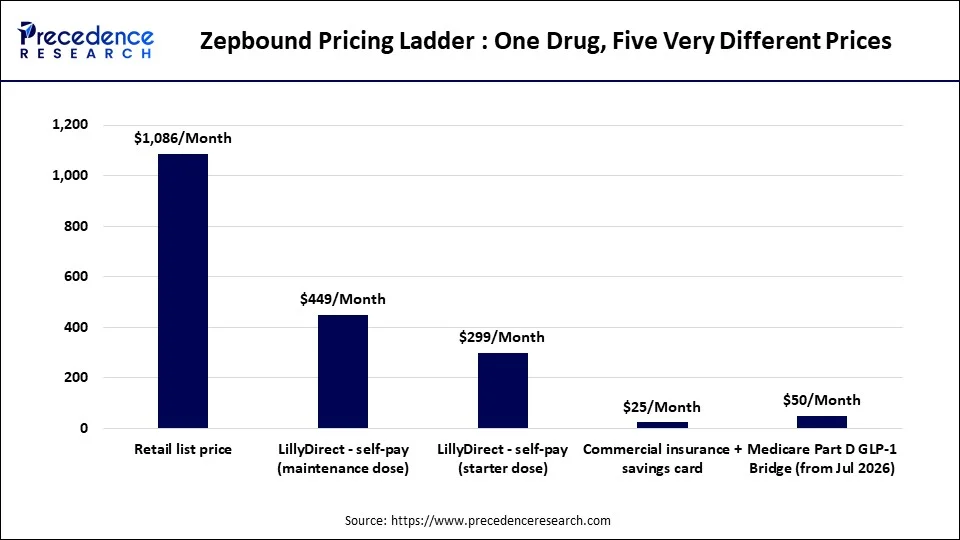
The chart lays out the very different monthly prices a U.S. individual can pay for Zepbound depending on the channel: full retail list price, Lilly's own direct-to-consumer self-pay program at two dose tiers, a commercially insured price with a producer savings card, and the new Medicare Part D pathway. The retail list price of Zepbound is around $1086/month, while the same drug can cost around $25/month with commercial insurance and $50/month for people with Medicare Part D.
Key Insight: The nearly 40x spread between the highest and lowest price points is a case study in modern U.S. drug-pricing strategy: Lilly is deliberately building parallel distribution channels such as LillyDirect, Walmart self-pay, and a government-negotiated Medicare bridge that price-discriminate by payer type rather than relying on a single list price and insurance rebate structure.
Source: Eli Lilly public pricing disclosures via LillyDirect (lilly.com, as of mid-2026); CoveredUSA and GoodRx channel pricing summaries.
SECTION 13: The Commercial Ascent: From $2.3B to $12.8B in Seven Quarters
| Quarter | Worldwide Quarterly Revenue (US$ Billion) |
| Q1 2024 | $2.3B |
| Q3 2024 | $4.4B |
| Q4 2024 | $5.4B |
| Q1 2025 | $6.2B |
| Q3 2025 | $10.1B |
| Q4 2025 | $11.7B |
| Q1 2026 | $12.8B |
Combined worldwide quarterly revenue for Eli Lilly and Company blockbuster drugs Mounjaro and Zepbound grew from nearly $2.2 billion in Q1 2024 to approximately $12.9 billion by Q1 2026, driven by soaring international adoption along with scaled-up manufacturing capacity.
Key Insight: This trajectory, more than a five-fold increase in seven quarters, is the fastest ramp of any drug franchise in pharmaceutical history and is the single largest driver of Eli Lilly overtaking Merck's Keytruda as the world's top-selling medicine by combined tirzepatide-brand revenue in 2025.
Source: Eli Lilly quarterly earnings press releases (Q1 2024 through Q1 2026, investor.lilly.com); BioSpace; FirstWord Pharma; Pharmaceutical Technology quarterly coverage.
SECTION 14: A Global Rollout: Tirzepatide's Market-by-Market Regulatory Footprint
| Market | Regulatory Milestones |
| United States | T2D approved in 2022 - Obesity in 2023 - OSA in 2024 - Adolescent T2D in 2025 |
| European Union | T2D approved in September 2022 by EMA; weight-management authorization followed |
| United Kingdom | T2D approved by MHRA in October 2022; weight-management label expanded in November 2023; NICE/NHS action in March 2023 |
| Japan | T2D approved in September 2022; obesity (Zepbound) approved by MHLW in January 2025 |
| Australia | TGA listing in 2023 for T2D; PBS subsidy listing in 2024 significantly reduced patient costs |
| Canada | Health Canada approval of Mounja |
Tirzepatide is globally approved under names such as Mounjaro and Zepbound. Major agencies authorize it for type 2 diabetes, weight control, and sleep apnea. Tirzepatide was approved for type 2 diabetes in 2022 by regulatory agencies in the U.S., EU, the UK, Japan, and Australia. It was approved a little late in 2023 by Health Canada. Further, tirzepatide gained approval for weight management in the U.S., EU, and the UK in 2023. While Japan’s MHLW approved tirzepatide for obesity in January 2025. Later, the FDA also approved tirzepatide for OSA and adolescent type 2 diabetes.
Key Insight: Indication scope varies meaningfully by market; Japan's obesity approval, for instance, is restricted to patients with a qualifying comorbidity or a high BMI threshold, and the U.S. label is broader. Any cross-border market-access strategy has to be built market-by-market rather than assuming a uniform global label.
Source: European Medicines Agency; UK MHRA and NICE; Japan MHLW (via Eli Lilly Japan K.K. and Mitsubishi Tanabe press release, Jan 2025); Australia TGA/PBS; Health Canada.
Recent Developments
The following seven developments, ordered from most to least recent, thus represent the highest-signal events shaping tirzepatide's trajectory over the past 18 months.
- In April 2026, Eli Lilly's once-daily oral GLP-1 pill was announced as the first oral incretin with no food or water restrictions. FDA approves Foundayo (orforglipron). Tirzepatide's franchise gained an oral sibling molecule priced from $149/month self-pay, broadening the incretin portfolio beyond injectables. Further, the analysts project Foundayo 2026 sales between $2.8B (Citi) and $1.5B (Guggenheim), with peak sales estimates exceeding $40B- a second, complementary growth vector alongside Mounjaro or Zepbound.
Source: Eli Lilly investor release, April 1, 2026; AJMC; mexc.com market coverage.
- In December 2025, Eli Lilly published the first peer-reviewed, prospective cardiovascular outcomes information for tirzepatide in a secondary-prevention population with established heart disease. NEJM SURPASS-CVOT full results published in The New England Journal of Medicine, confirming tirzepatide's cardiovascular non-inferiority and mortality benefit versus dulaglutide and opening a plausible path to a future cardiovascular-risk-reduction label expansion, even mirroring semaglutide's SELECT-trial-driven repositioning.
Source: NEJM (December 2025); Eli Lilly investor release; TCTMD, HCPLive coverage
- In May 2025, a U.S. District Court denied the Outsourcing Facilities Association's request to block FDA's tirzepatide shortage-resolution determination, affirming the FDA's authority. Thus, compounding pharmacies and outsourcing facilities lost their main legal argument for continuing to produce copycat tirzepatide. Materially shrinks the addressable market for compounded tirzepatide telehealth and med-spa businesses, pushing need back toward branded Lilly products.
Source: McDermott Will & Emery legal analysis, “Court Backs FDA in Tirzepatide Compounding Case.”
- In February 2025, Eli Lilly declared an additional $27 billion investment in four new U.S. manufacturing plants, bringing total domestic manufacturing commitments since 2020 to over $50 billion. Three of the four new plants will manufacture active pharmaceutical ingredients; the fourth will make injectable products, explicitly framed against the backdrop of proposed pharmaceutical tariffs. Thus, signals Lilly's read that tirzepatide-class need (and future pipeline molecules) justifies the largest manufacturing capital commitment in firm history.
Source: CNN, “Zepbound maker Eli Lilly announces $27 billion investment,” February 26, 2025.
- In December 2024, the U.S. FDA issued a declaratory order reaffirming that the tirzepatide injection shortage is resolved, along with approval of Zepbound for moderate-to-severe obstructive sleep apnea. It ends approximately two years of shortage status (first listed December 2022) and sets 60/90-day enforcement discretion windows for 503A and 503B compounders to wind down production. Moreover, it triggers the legal battle detailed in Section 11 and even directly expands Zepbound's addressable patient population into sleep medicine.
Source: FDA declaratory order, December 19, 2024; GoodRx; American Med Spa Association.
- In July 2025, Eli Lilly published the first direct randomized comparison between the two leading incretin therapies in the same population under the same protocol. Thus, the SURMOUNT-5 head-to-head trial results were published, showing tirzepatide's superiority over semaglutide across all primary and even secondary weight-loss endpoints. It offers Lilly's clinical teams and payer-negotiation teams a definitive comparative-efficacy data point against Novo Nordisk's Wegovy.
Source: NEJM; European Congress on Obesity 2025; HCPLive, tctmd.com, Rheumatology Advisor coverage.
Key Companies & Organizations
- Eli Lilly and Company is the originator and sole producer of tirzepatide, such as Mounjaro and Zepbound; also, developer of oral orforglipron (Foundayo).
- Novo Nordisk is the principal competitor; producer of semaglutide such as Ozempic, Wegovy, Rybelsus, and developer of CagriSema and other next-generation candidates.
- Boehringer Ingelheim, a collaboration partner referenced in Lilly's diabetes or obesity portfolio disclosures (Jardiance).
- Outsourcing Facilities Association (OFA), representing 503B outsourcing facilities; lead plaintiff in litigation against the FDA over tirzepatide shortage determinations.
- LifeMD, Inc., a publicly traded telehealth manufacturer whose SEC filings disclose direct business exposure to compounded tirzepatide or semaglutide access.
- FarmaKeio Custom Compounding (North American Custom Laboratories, LLC) has a 503B compounding pharmacy and is a named co-plaintiff in litigation against the FDA.
- U.S. Food and Drug Administration (FDA) is the regulator responsible for approvals, shortage determinations, and compounding enforcement actions covered throughout this briefing.
- European Medicines Agency (EMA) / UK MHRA / NICE are considered the European and UK regulators alongside the health-technology-assessment body governing tirzepatide approval and NHS reimbursement.
- Japan Ministry of Health, Labour and Welfare (MHLW) / Mitsubishi Tanabe Pharma, along with a local marketing partner for Zepbound's obesity indication in Japan.
- Centers for Medicare & Medicaid Services (CMS), a U.S. federal agency incorporating the Medicare Part D GLP-1 Bridge coverage pathway from July 2026.
Strategic Client-Attraction Questions
There are 18 questions set deliberately beyond what public data can answer; they are the kind of questions our research, benchmarking, along with forecasting capabilities are built to resolve.
- How does tirzepatide's real-world persistence rate (12/24-month) compare across insured, self-pay, and previously compounded patient cohorts- and what does that imply for lifetime-value modeling of GLP-1-adjacent product lines?
- What is the most projected crossover point at which orforglipron (oral) cannibalizes Zepbound (injectable) volume within Lilly's own portfolio, and then how should a competing manufacturer's launch sequencing respond?
- Which specific payer formularies have changed preferred-tier status toward tirzepatide following the SURMOUNT-5 head-to-head data, combine with what rebate-structure concessions did that demand?
- What is the realistic 3-to-5-year addressable market for lean-mass-preservation adjunct therapies, for example, myostatin inhibitors, given actual GLP-1 patient-reported concern rates, versus media-driven perception?
- How exposed is a given telehealth or med-spa platform's revenue base to the post-2025 compounding enforcement environment, and even what alternative supply or branded-partnership strategies mitigate that exposure?
- What incremental manufacturing capacity, such as by site, by API vs. fill-finish, is required to fully absorb currently unmet global tirzepatide need, and on what realistic timeline given Lilly's disclosed capital plans?
- How does tirzepatide's obstructive sleep apnea indication change the addressable prescriber base and referral pathways in sleep medicine and pulmonology- and which health systems are best positioned to capture that shift?
- What is the true cost-per-QALY of tirzepatide over its four current U.S. indications when modeled against site-of-care, adherence, along with discontinuation-driven weight regain data specific to a target population?
- Which countries or payer systems are most likely to expand tirzepatide reimbursement in the next 24 months, and then what does that imply for a producer's regional launch and pricing sequencing?
- How should a health system's specialty-pharmacy and then prior-authorization workflows be redesigned given the five-tier pricing architecture (list, self-pay, insured, Medicare) now in effect?
- What is the comparative supply-chain resilience of tirzepatide's API manufacturing footprint versus semaglutide's, and thus what geopolitical or tariff scenarios pose the greatest disruption risk?
- How does the observed 25-30% muscle-loss share change over treatment duration beyond 72 weeks, and what does longer-term body-composition data suggest about optimal treatment-duration protocols?
- What is the realistic penetration ceiling for tirzepatide-class therapies amongst the ~40% of U.S. adults with obesity, once access, tolerability discontinuation, along with reimbursement constraints are modeled together?
- What differentiates orforglipron's ATTAIN trial population along with results from tirzepatide's SURMOUNT population in ways that matter for head-to-head positioning against injectable therapies?
- How should a specialty insurer price risk on members initiating tirzepatide given the SURPASS-CVOT mortality and renal-function findings, relative to standard actuarial obesity-comorbidity tables?
- How is Novo Nordisk's late-stage pipeline (for example, CagriSema, oral semaglutide expansion) positioned to respond competitively to tirzepatide's efficacy lead, and on what timeline could that erode Lilly's advantage?
- What downstream need effects has the tirzepatide shortage-to-surplus cycle had on adjacent markets- bariatric surgery volumes, diabetes device makers, and food or beverage categories exposed to appetite suppression?
- How should a health-system formulary committee weigh the OSA indication's disease-resolution data against CPAP-device economics, when redesigning sleep-apnea care pathways?
Data & Intelligence Pointers
- Tirzepatide is considered the first FDA-approved dual GIP/GLP-1 receptor co-agonist, thus combining two incretin mechanisms in a single molecule (NCBI StatPearls).
- SURMOUNT-1 participants at the 15mg dose lost a mean of 20.9% of body weight over 72 weeks, versus 3.1% on placebo (Eli Lilly, SURMOUNT-1).
- In the SURMOUNT-5 head-to-head trial, tirzepatide manufactured 20.2% mean weight loss versus 13.7% for semaglutide at 72 weeks (NEJM, 2025).
- SURPASS-1 via -5 showed A1C reductions of up to 2.6 percentage points, versus nearly 1.3-1.9 points for active comparators (Eli Lilly; PMC).
- SURMOUNT-OSA showed a mean apnea-hypopnea index reduction of up to 62.8%, or about 30 fewer breathing-disruption events per hour of sleep, versus placebo (NEJM, 2024).
- SURPASS-CVOT (n=13,299, 30 countries, ~4.5-year median follow-up) stated an 8% lower relative risk of major cardiovascular events and 16% lower all-cause mortality versus dulaglutide (NEJM, December 2025).
- Of the total body weight lost in the SURMOUNT-1 DXA substudy, nearly 75% was fat mass, and 25% was lean mass (Diabetes, Obesity and Metabolism, 2025).
- Combined worldwide Mounjaro and Zepbound revenue grew from $2.3 billion (Q1 2024) to $12.8 billion (Q1 2026)- a more than five-fold rise in seven quarters (Eli Lilly earnings releases).
- Eli Lilly's cumulative U.S. manufacturing investment commitments tied substantially to tirzepatide production have thus exceeded $50 billion since 2020 (Eli Lilly investor releases; CNN).
- The FDA first listed tirzepatide injection as being in shortage in December 2022 and then did not durably resolve that status until December 2024, after a contested legal process that concluded in May 2025 (FDA; McDermott Will & Emery).
- Zepbound's U.S. retail list price is nearly $1,086 per month, while Eli Lilly's own LillyDirect self-pay channel prices it between $299 and $449 per month depending on dose- a roughly 59% discount to list (Eli Lilly pricing disclosures).
- Nausea, diarrhoea, and vomiting were the most common adverse events across the pooled SURPASS-1 to -5 trials (N=6,263), at incidences of up to 24%, 22%, and 13%, respectively, versus single-digit-to-low-double-digit rates in comparator arms (Diabetes, Obesity and Metabolism, 2024).
References
U.S. FDA “FDA Approves New Medication for Chronic Weight Management (Zepbound approval)” - Nov 8, 2023 fda.gov/news-events/press-announcements/fda-approves-new-medication-chronic-weight-management Supports: Zepbound obesity indication and approval criteria
Eli Lilly and Company “SURPASS-1 results published in The Lancet” - Jun 26, 2021 investor.lilly.com Supports: SURPASS-1 A1C and weight-loss data
Eli Lilly and Company “SURPASS-2 results published in NEJM” - Jun 25, 2021 investor.lilly.com Supports: SURPASS-2 A1C and weight-loss data vs. semaglutide
Eli Lilly and Company“Tirzepatide significantly reduced A1C and body weight (SURPASS-3 and -5)” - 2021 investor.lilly.com Supports: SURPASS-3 and SURPASS-5 detailed results
Eli Lilly and Company“Lilly's tirzepatide shows additional 21.1% weight loss (SURMOUNT-3)” - Oct 15, 2023 stocktitan.net / investor.lilly.com Supports: SURMOUNT-3 and SURMOUNT-4 combined weight-loss results
American College of Cardiology“SURMOUNT-5: Greater Loss of Weight, Waist Circumference With Tirzepatide Than Semaglutide” - Jul 10, 2025 acc.org/Latest-in-Cardiology/Journal-Scans Supports: SURMOUNT-5 head-to-head trial results
Eli Lilly and Company“SURPASS-CVOT topline results release” - 2025 investor.lilly.com Supports: SURPASS-CVOT MACE and mortality data
The New England Journal of Medicine / TCTMD“SURPASS-CVOT Published: Large Trial Confirms CVD Efficacy of Tirzepatide” - Dec 19, 2025 tctmd.com/news/surpass-cvot-published Supports: Peer-reviewed SURPASS-CVOT primary and secondary endpoints
Eli Lilly and Company“Tirzepatide reduced obstructive sleep apnea severity (SURMOUNT-OSA)” - Jun 21, 2024 investor.lilly.com Supports: SURMOUNT-OSA AHI reduction and disease-resolution data
Diabetes, Obesity and Metabolism (Wiley)“Gastrointestinal adverse events and weight reduction with tirzepatide in SURPASS trials (Patel et al.)” - 2024 dom-pubs.onlinelibrary.wiley.com Supports: Pooled GI adverse-event incidence, SURPASS 1-5
Diabetes, Obesity and Metabolism (Wiley)“Body composition changes during weight reduction with tirzepatide in SURMOUNT-1 (Look et al.)” - Feb 25, 2025 dom-pubs.onlinelibrary.wiley.com / PubMed 39996356 Supports: Fat mass vs. lean mass loss ratio
U.S. FDA“FDA clarifies policies for compounders as national GLP-1 supply begins to stabilize” - Oct 2024 - Apr 2025 fda.gov/drugs/drug-alerts-and-statements Supports: Tirzepatide shortage resolution timeline and compounding enforcement
McDermott Will & Emery“GLP-1 Update: Court Backs FDA in Tirzepatide Compounding Case” - May 2026 mcdermottlaw.com/insightsSupports: May 2025 court ruling on compounding enforcement
CNN“Zepbound maker Eli Lilly announces $27 billion investment in US drug manufacturing” - Feb 26, 2025cnn.com/2025/02/26/health/eli-lilly-manufacturing-investmentSupports: Manufacturing investment context and total commitment
Eli Lilly and Company“Lilly increases manufacturing investment to $9 billion at newest Indiana site” - May 2024investor.lilly.comSupports: Lebanon, Indiana site investment detail
Eli Lilly and Company“Q1 2026, Q3/Q4 2025, Q1/Q3 2024 quarterly earnings releases” - 2024-2026investor.lilly.comSupports: Mounjaro and Zepbound quarterly revenue figures
Eli Lilly and Company“FDA approves Lilly's Foundayo (orforglipron)” - Apr 1, 2026investor.lilly.com / prnewswire.comSupports: Orforglipron approval, pricing, and ATTAIN trial data
AJMC“FDA Approves Lilly's Oral GLP-1 Orforglipron for Obesity” - 2026ajmc.comSupports: Orforglipron indication, pricing, and boxed warning detail
GoodRx / CoveredUSA“Zepbound and LillyDirect pricing summaries” - 2026goodrx.com; coveredusa.orgSupports: Zepbound multi-channel pricing architecture
Eli Lilly Japan K.K. / Mitsubishi Tanabe Pharma“MHLW approves Zepbound to treat obesity in Japan” - Jan 2025medicalupdateonline.comSupports: Japan obesity indication and eligibility criteria
European Medicines Agency“Tirzepatide (Mounjaro) marketing authorisation” - Sep 2022ema.europa.euSupports: EU approval status
UK MHRA / NICE“Mounjaro/Zepbound UK approval and NHS technology appraisal” - Oct 2022 - Mar 2023gov.uk; nice.org.ukSupports: UK regulatory and reimbursement timeline
NCBI StatPearls (Farzam K., Patel P.)“Tirzepatide” - Feb 20, 2024 (updated 2026)ncbi.nlm.nih.gov/books/NBK585056Supports: Mechanism of action and pharmacology
LifeMD, Inc.“Form 10-K FY2024 (SEC filing)” - Feb 24, 2025sec.govSupports: Telehealth business exposure to compounded GLP-1 shortage status
A Note on Scope
This briefing is a research and business-intelligence product, not medical advice. The clinical figures are basically drawn from published trial data and regulatory filings as cited; individual patient results vary, and treatment decisions should be made with a qualified healthcare professional. Further, commercial and pricing figures reflect publicly disclosed information as of mid-2026 and are subject to change as Eli Lilly, regulators, and payers continue to adjust policy.
About the Authors

Aditi Shivarkar
Aditi, Vice President at Precedence Research, brings over 15 years of expertise at the intersection of technology, innovation, and strategic market intelligence. A visionary leader, she excels in transforming complex data into actionable insights that empower businesses to thrive in dynamic markets. Her leadership combines analytical precision with forward-thinking strategy, driving measurable growth, competitive advantage, and lasting impact across industries.



Aman Singh
Aman Singh with over 13 years of progressive expertise at the intersection of technology, innovation, and strategic market intelligence, Aman Singh stands as a leading authority in global research and consulting. Renowned for his ability to decode complex technological transformations, he provides forward-looking insights that drive strategic decision-making. At Precedence Research, Aman leads a global team of analysts, fostering a culture of research excellence, analytical precision, and visionary thinking.

Piyush Pawar
Piyush Pawar brings over a decade of experience as Senior Manager, Sales & Business Growth, acting as the essential liaison between clients and our research authors. He translates sophisticated insights into practical strategies, ensuring client objectives are met with precision. Piyush’s expertise in market dynamics, relationship management, and strategic execution enables organizations to leverage intelligence effectively, achieving operational excellence, innovation, and sustained growth.