



Interactive Voice Response Market Size, Companies, Trends, Cloud Adoption, Competitive Landscape, and Industry Outlook
Interactive Voice Response Market (By Technology/Type: Speech-Based IVR, TouchTone-Based IVR; By Deployment Mode: Cloud-Based, On-Premises; By Component: Solutions (Software/Platform), Services (Implementation/Support); By End-User Industry: BFSI (Banking, Financial Services & Insurance), Telecommunications, Healthcare & Life Science, Retail & ECommerce, Government & Public Sector, Others) - Global Industry Analysis, Size, Trends, Leading Companies, Regional Outlook, and Forecast 2026 to 2035
Source: https://www.precedenceresearch.com/interactive-voice-response-market
 Get a Sample
 Table Of Content


What is the Interactive Voice Response Market Size?
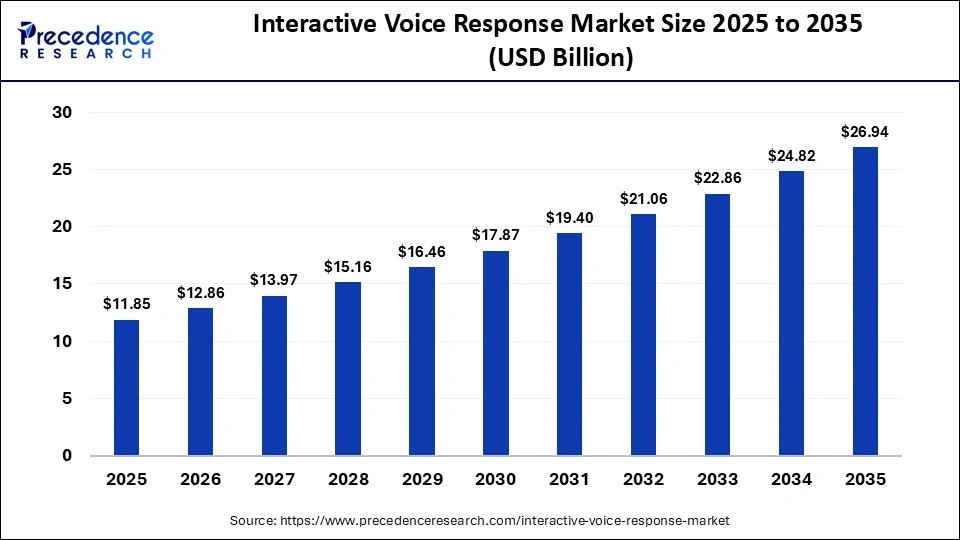
The global interactive voice response market size is predicted to increase from USD 12.86 billion in 2026 to approximately USD 26.94 billion by 2035, expanding at a CAGR of 8.56% from 2026 to 2035. The market growth is driven by increasing demand for AI-based customer support solutions and enterprises' emphasis on optimizing costs and enhancing customer experience.
Market Highlights
- North America dominated the interactive voice response market with the largest share of approximately 41% in 2026.
- Asia-Pacific is expected to grow at the fastest CAGR of 8.8% from 2026 to 2035.
- By technology type, the speech-based IVR segment led the market while holding the largest share of approximately 60% in 2026.
- By technology type, the touchtone-based IVR segment is growing at the fastest CAGR between 2026 and 2035.
- By deployment mode, the cloud-based segment contributed the largest market share of approximately 65% in 2026 and is expected to grow at the fastest CAGR of 7.7% during the forecast period.
- By deployment mode, the on-premises deployment mode is growing at a significant CAGR from 2026 to 2035.
- By component type, the solutions segment dominated the interactive voice response market with a market share of approximately 72% in 2026.
- By component type, the services segment is poised to grow at the highest CAGR of 7.8% between 2026 and 2035.
- By end user industry, the BFSI segment dominated the market with a market share of approximately 29% in 2026.
- By end user industry, the healthcare & life sciences segment is poised to grow at the highest CAGR of 7.5% between 2026 and 2035.
What is the Landscape of the Interactive Voice Response Market?
The interactive voice response market includes technologies that automate telephone interactions between callers and computerized systems to route calls, capture inputs, and deliver information without live agents. Modern IVR integrates speech recognition, natural language processing (NLP), cloud computing, and AI to improve customer service, reduce contact center costs, and enable 24/7 service across industries like BFSI, telecom, healthcare, and retail. Growth is driven by digital transformation and the demand for seamless customer engagement.
How is AI contributing to the Interactive Voice Response Market?
Artificial intelligence is significantly contributing to the market as it facilitates these systems to decipher natural speech, understand intent, and capture context instead of relying on keypad inputs. AI-based speech recognition and natural language processing enable these platforms to handle complex customer queries, personalize interactions, and route calls intelligently. These machine learning models constantly learn from past interactions to achieve better accuracy, quicker call resolution, and less agent dependency. AI-powered interactive voice response technology enhances customer experience, boosts operational efficiency, and reduces overall contact center costs.
Interactive Voice Response Market Trends
- Collaborations & Partnerships: IVR solution companies are collaborating with AI firms, cloud service providers, and contact center platform vendors to automate and enhance conversational intelligence. This collaboration has led to innovation in advanced speech recognition, real-time analytics, and integration of customer relationship management. These partnerships facilitate enterprise customers to reduce call handling time and improve the customer experience. For instance, NICE has partnered with Microsoft to integrate advanced AI with IVR.
- Government Initiatives: Governments are promoting digital customer engagement and automated delivery of public services, which drive the adoption of interactive voice response technology in the public sector. This technology is used in citizen helpline services, health services, and taxation support services. For instance, public sectors in India and the UK use this technology offered by Cisco and Avaya to deliver large-scale citizen services.
- Business Expansions: Key players in the interactive voice response market are expanding their cloud infrastructure and portfolio of services to meet the increasing demand from enterprises. Companies are adding new data centers and local language support to solidify their regional presence. For instance, Genesys expanded its operations in the Asia Pacific, while Twilio increased its presence across Europe and Latin America.
Segment Insights
Technology Type Insights
Why Did Speech-Based IVR Dominate the Interactive Voice Response Market?
The speech-based IVR segment led the market while holding the largest share of approximately 60% in 2026. This segment dominated the market because it provides quicker and more natural customer interactions than traditional keypad systems. It allows customers to speak freely, reducing call friction and abandonment rates. Various enterprises are adopting speech-based IVR because it handles complex queries with ease and supports multiple languages. Integration with AI and natural language processing further improves accuracy and self-service resolution.
The touchtone-based IVR segment is growing at the fastest CAGR between 2026 and 2035. This segment facilitates reliability, simplicity, and economical functionality for a high-traffic call environment. Many users find keypad entry more convenient for smooth, error-free navigation. Touchtone IVR works well all over the world without smartphones and internet accessibility. This segment has a low upfront cost setup, as it is easy to integrate with existing telecommunications infrastructure.
Deployment Mode Insights
Why Did the Solutions Segment Dominate the Interactive Voice Response Market?
The cloud-based segment contributed the largest market share of approximately 65% in 2026 and is expected to grow at the fastest CAGR of 7.7% during 2026-2035. This segment offers scalability, flexibility, and low upfront costs required in deployment. It facilitates quick deployment without much investment in infrastructure. Enterprises ensure easy upgrade, remote accessibility, and efficient integration with customer relationship management(CRM) systems and contact center platforms. Cloud IVR also maintains control over fluctuating call volumes at various locations. This facilitates innovation for organizations with less maintenance burden and service consistency.
The on-premises segment is growing at a significant CAGR from 2026 to 2035. The market growth of this segment is due to emphasis on data security, regulatory compliance, and direct control over voice infrastructure by various organizations. Sectors such as BFSI and healthcare have sensitive customer data on internal networks and hence prefer on-premises IVR. It is predictable and facilitates deep customization while negating latency issues. A lot of large enterprises rely on legacy telephony that integrates better with on-premises IVR solutions.
Component Type Insights
Why Did Cloud-Based Deployment Mode Dominate the Interactive Voice Response Market?
The solutions segment dominated the market with a market share of approximately 72% in 2026. The market growth of this segment is due to the growing demand for customizable IVR systems from businesses. These software platforms provide advanced call routing, AI-based speech recognition, and integration with customer relationship management (CRM) systems and contact center platforms. Companies are adopting software-based IVR systems because of their faster upgrade cycles. Innovations in analytics, automation, and multilingual support have further improved the adoption of software platforms in IVR systems.
The services segment is poised to grow at the highest CAGR of 7.8% between 2026 and 2035. The growth of this segment can be attributed to the requirement of implementing sophisticated and AI-powered IVR systems in various organizations. The need to periodically optimize voice recognition and call flow operations to ensure optimal levels of accuracy further drives the market growth. Support services facilitate the management and maintenance of intricate software as well as hardware systems.
End User Insights
Why Did the BFSI Segment Dominate the Interactive Voice Response Market?
The BFSI segment dominated the market with a market share of approximately 29% in 2026. The BFSI sector involves significant customer interaction volume, such as balance enquiries, transaction status, credit card services, and grievance handling. Advanced IVR solutions facilitate handling large volumes of customer interaction while maintaining consistency. The market adoption of IVR response systems is accelerated because they facilitate cost-effective solutions and faster dispute resolutions.
The healthcare & life sciences segment is poised to grow at the highest CAGR of 7.5% between 2026 and 2035. The market growth of this segment can be attributed to the increasing usage of automated communication between healthcare providers and patients. IVR is used for appointment scheduling, reminders, test result notifications, and prescription refill notifications. A lot of countries have seen a rising average age of the population, which demands efficient self-service solutions. The adoption of digital healthcare is a significant factor driving the market growth of this segment.
Regional Insights
What Made North America the Leading Region in the Interactive Voice Response Market?
North America dominated the market with the largest share of approximately 41% in 2026. This region has widespread adoption of innovative contact center solutions and AI-based customer interaction facilities. This region has a prominent presence of IVR and cloud communications solutions companies. There is a strong and consistent demand in the BFSI, telecommunications, and healthcare sectors, which boosts the adoption of IVR solutions. Government initiatives and investments in the region for the integration of advanced AI-based IVR solutions with traditional telecommunications infrastructure were a significant factor in driving the market growth.
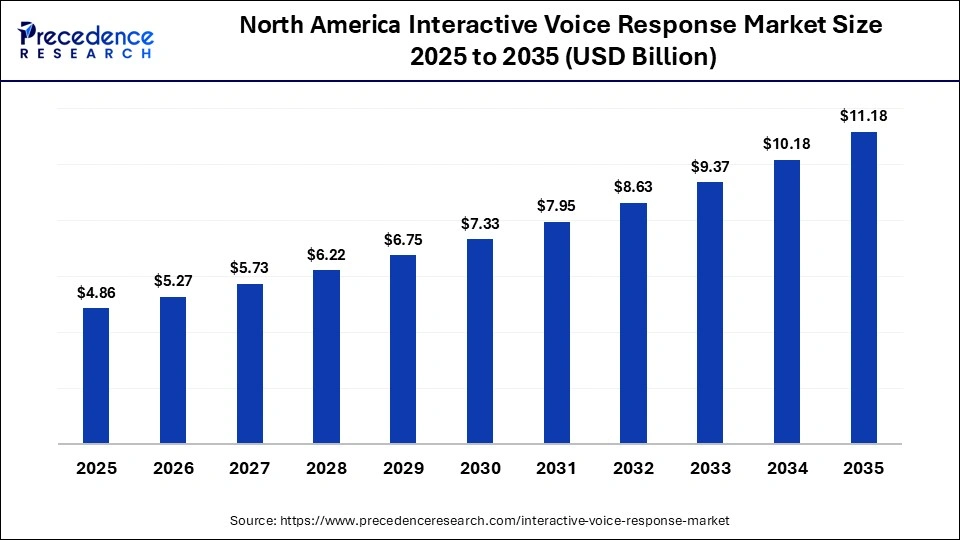
The North America interactive voice response market size is estimated at USD 5.27 billion in 2026 and is projected to reach approximately USD 11.18 billion by 2035, with a 8.69% CAGR from 2026 to 2035.
What is the Size of the U.S. Interactive Voice Response Market?
The U.S. interactive voice response market size is calculated at USD 3.95 billion in 2026 and is expected to reach nearly USD 8.44 billion in 2035, accelerating at a strong CAGR of 8.77% between 2026 and 2035.
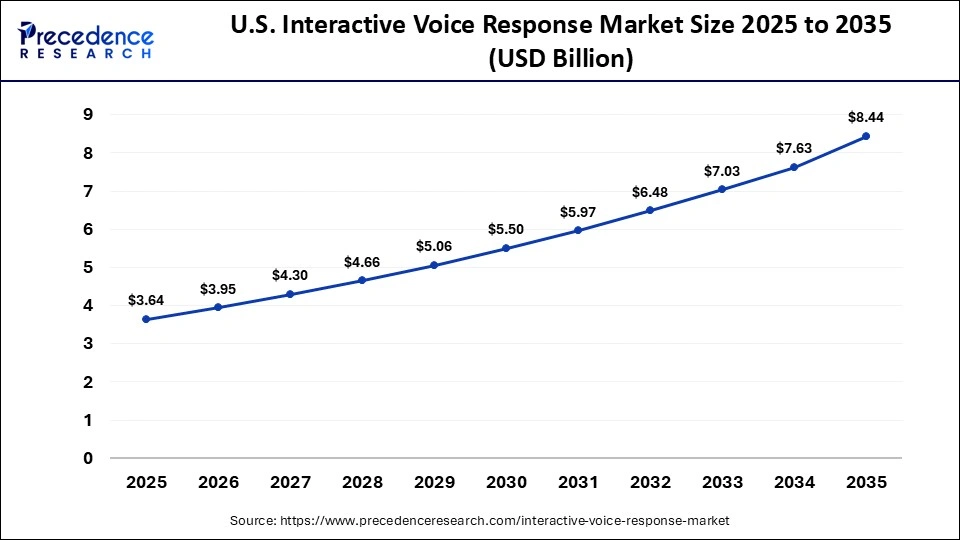
The U.S. leads the market growth in the region because of a mature enterprise infrastructure and a large volume of customer interactions. Various organizations have adopted an IVR system to respond to customer queries. The adoption of advanced IVR systems facilitates efficient customer support operations. This country has leading companies in the global interactive voice response and cloud communications industry. Government initiatives boosted the adoption of IVR solutions in the public and corporate sectors.
Why is Asia Pacific the Fastest-Growing Region in the Interactive Voice Response Market?
Asia-Pacific is expected to grow at the fastest CAGR of 8.8% from 2026 to 2035. This region is experiencing a rapid digitalization process in business institutions. The growing customer base in banking, telecommunications, and e-commerce sectors results in increased customer interactions. Businesses are increasingly adopting IVR solutions to effectively support a large customer base. The market growth in this region is further driven by rapid growth in cloud technology deployment and quick implementation of IVR solutions.
China Interactive Voice Response Market Trends
China leads the market in the Asia-Pacific region due to its developed telecommunications infrastructure and thriving e-commerce industry. This country has widespread adoption of AI and cloud-based voice automation. Various firms and service vendors in this country extend the use of IVR technology due to the need to process an enormous number of calls and improve the quality of digital services. The government has also consistently promoted the adoption of advanced AI-based automation technology in telecommunication industry.
What Are the Driving Factors of The Interactive Voice Response Market in Europe?
Europe is expected to grow at a significant CAGR during the forecast period. Europe boasts of a good IVR market, which is highly automated and has stringent data protection regulations. The companies are concerned with secure and compliant voice systems that conform to privacy laws. There is a wide use of multilingual voice bots to serve different countries.
Germany Market Trends:
Germany is concerned with the high-level IVR systems based on conversational AI. These systems are knowledgeable of natural language rather than pre-determined menu choices. The privacy of the data is highly valued, and solutions are strictly regulated. Multilingual systems are also used by businesses to cater to customers in different regions.
What Are the Driving Factors of The Interactive Voice Response Market in Latin America?
Latin America is expected to grow at a significant CAGR during the forecast period. Latin America is expanding with companies renovating old systems of customer service. Companies are embracing the use of cloud-based IVR to save on costs and enhance the quality of their services. The support of local language and accent will be significant as it will help companies relate better with their customers in various regions and markets.
Brazil Market Trends
Brazil is also emerging as a major market that has high usage rates of cloud-based IVR systems. Businesses are moving out of the conventional system to the flexibility of a cloud solution. Combining messaging channels assists customers in moving between channels without a lot of struggle. The IVR finds extensive usage in financial services and utilities to make payments, get account information, and access quicker customer support services.
How is the Middle East and Africa Performing in The Interactive Voice Response Market?
The Middle East and Africa are expected to grow at a significant CAGR during the forecast period. Digital transformation and increased use of smartphones are driving growth in the region. Businesses and governments are abandoning manual call centers and switching over to automated IVR systems. Secure and intelligent solutions such as voice biometrics are in high demand. Telecom infrastructure and e-governance investments are aiding in enhancing customer service and communication systems.
UAE Market Trends
IVR is being embraced by the UAE in the context of smart cities and digital strategies. There are automated voice systems that are applied in government and service sectors. Outbound calls to remind and update are increasingly used. AI tools are also useful in assisting human agents by analyzing customer mood, enhancing service quality, and decreasing response time.
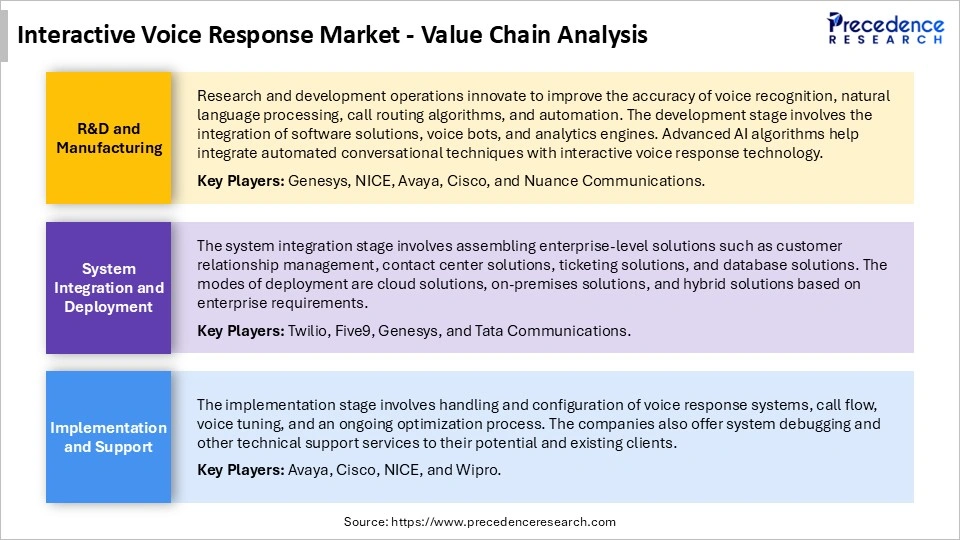
Interactive Voice Response Market Value Chain Analysis
Who are the Major Players in the Global Interactive Voice Response Market?
The major players in the interactive voice response market include Cisco Systems, Inc., Avaya Inc., Genesys Telecommunications Laboratories Inc., IBM Corporation, Nuance Communications, Inc., Oracle Corporation, Mitel Networks Corporation, AT&T Inc., Aspect Software, Inc., Verizon Communications Inc., Five9, Inc., NICE (inContact), West Corporation, 8x8, Inc., and Enghouse Systems Limited.
Recent Developments
- In March 2026, AakashTel launched an AI-Powered IVR system to streamline calls to offices, banks, and hospitals, reducing wait times and transfers while enhancing customer service by directing callers to the right departments efficiently.
(Source: https://english.ratopati.com) - In January 2026, Ami Probashi launched an Interactive Voice Response service to verify migrant visas for Bangladeshis, enhancing protection against visa fraud before departure to Oman, Qatar, and Saudi Arabia. (Source: https://www.bangladeshmonitor.com)
- In May 2026, Avaya recently partnered with Japanese robotics startup Avatarin to develop next-generation customer engagement systems that combine conversational AI, robotics, and contact center technologies. The collaboration integrates AI-powered robots with voice, chat, and IVR systems across retail, government services, and travel sectors.
(Source: https://www.avaya.com) - In February 2026, HCLTech partnered with Cisco to launch an upgraded AI-powered Fluid Contact Center platform. The solution combines cloud-based contact center infrastructure with conversational AI, multilingual virtual agents, conversational IVR, real-time analytics, and AI-assisted customer support tools.
(Source: https://www.hcltech.com) - In March 2025, Genesys launched IVR Composer 2.0, which is a cloud native IVR builder developed for supporting drag-and-drop conversational call flow for direct testing. This product facilitates faster deployment, reducing the setup time by 40%. This product is a major milestone in customer interaction technology.
(Source: https://docs.genesys.com) - In April 2025, Avaya launched Avaya Infinity Platform, a next-generation CX/CX-centric platform that facilitates AI innovations and intelligent orchestrations in contact centers. This product has an automated voice response, hybrid cloud support technology, and an AI-assisted self-service feature.
(Source: https://www.avaya.com) - In September 2025, Advanced Media Inc. launched AmiVoice ISR Studio, which is a next-generation AI-based voicebot for automated interactive telephone response. This product uses advanced AI speech recognition and generative AI. This product is being adopted in delivery, finance, and customer service systems.(Source: https://www.advanced-media.co.jp)
Interactive Voice Response Market Segments
By Technology/Type
- Speech-Based IVR
- TouchTone-Based IVR
By Deployment Mode
- Cloud-Based
- On-Premises
By Component
- Solutions (Software/Platform)
- Services (Implementation/Support)
By End-User Industry
- BFSI (Banking, Financial Services & Insurance)
- Telecommunications
- Healthcare & Life Sciences
- Retail & ECommerce
- Government & Public Sector
- Others (Utilities, IT Services, etc.)
By Region
- North America
- Europe
- Asia-Pacific
- Latin America
- Middle East & Africa
For inquiries regarding discounts, bulk purchases, or customization requests, please contact us at sales@precedenceresearch.com
Frequently Asked Questions





Ask For Sample
No cookie-cutter, only authentic analysis – take the 1st step to become a Precedence Research client
 Get a Sample




 sales@precedenceresearch.com
 Schedule a Meeting
