



Iron Casting Market Size, Key Companies, Company Production Capacity, Manufacturing Efficiency, Capacity Utilization, Raw Material Consumption, Cost Structure, Export Trends, Company Expansion Strategies, and Competitive Landscape
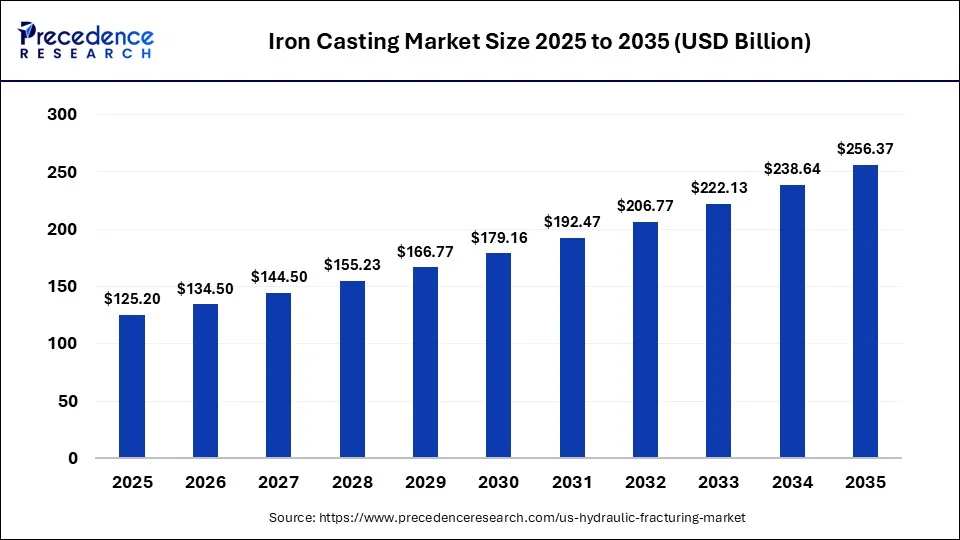
The iron casting market is expected to grow to USD 134.50 billion in 2026. The industry is fuelled by increases in the demand for automotive, construction, industrial machinery, energy, railways, and infrastructure industries. There is ongoing growth in the market for engine parts, pipes, pumps, valves, heavy equipment, and structural applications with grey iron, ductile iron, and malleable castings. Advancements in foundry automation, precision casting technologies, and sustainable manufacturing processes are further contributing to industry growth. Our senior research analyst, Vidyesh Swar, has analyzed these trends. Research results will be relevant to iron casting producers and foundries, raw material suppliers, OEMs, industrial equipment manufacturers, distributors, construction businesses, and investors.
Source: https://www.precedenceresearch.com/iron-casting-market
 Get a Sample
 Table Of Content


Iron Casting Market Size, Share, Trends, and Forecast Analysis 2035
The iron casting market is forecasted to expand from USD 134.50 billion in 2026 to USD 256.37 billion by 2035, growing at a CAGR of 7.43% from 2026 to 2035. The iron casting market is a strategically important part of the metal casting industry, serving automotive, industrial machinery, construction equipment, agriculture, infrastructure, water management, power generation, and other heavy-duty applications. The market is shaped by demand for gray iron, ductile iron, malleable iron, and specialty castings, while electrification is changing the composition of automotive demand and infrastructure modernization is supporting opportunities in pipes, fittings, pumps, valves, and other long-life components.
 Key Takeaways
- The global iron casting market was provisionally estimated at USD 125.20 billion in 2025, with the exact market value dependent on the inclusion of finished castings, machined components, pipes, fittings, and downstream processing.
- The market is expected to be evaluated through 2030 and, where relevant, 2035, with forecasts separated by application volumes, regional production, realized prices, and value-added services.
- Gray iron, ductile iron, malleable iron, and specialty alloyed iron represent the major material categories serving automotive, industrial, infrastructure, and heavy-equipment applications.
- Automotive, industrial machinery, construction equipment, agriculture, water infrastructure, and fluid-handling applications represent the major demand pools for iron castings.
- China and India are identified as important iron casting production centers, while Europe, Japan, and North America retain established capabilities for demanding industrial and automotive applications.
- High-volume automotive and standardized castings face greater pricing pressure, while complex and specification-intensive castings can generate higher revenue per tonne.
- Electrification is expected to reduce demand for certain conventional engine-related castings while retaining opportunities for cast components used in chassis, suspension, braking, drivetrain, and thermal-management systems.
- Scrap and pig iron prices, energy costs, labor availability, emissions requirements, and casting yield are major factors influencing foundry profitability.
- Automation, casting simulation, robotic pouring and fettling, metallurgical control, automated inspection, and digital production monitoring are becoming important tools for improving yield, quality, throughput, and process consistency.
- The competitive landscape includes 25 preliminary companies, but the report states that a definitive market ranking requires validation of iron casting-specific revenue, capacity, product scope, ownership, and operating status.
Overview - How Are Industrial Demand, Material Economics, and Manufacturing Technology Reshaping the Iron Casting Market?
The global iron casting market is a strategically important segment of the broader metal casting industry, supplying critical components to automotive manufacturers, agricultural machinery producers, construction equipment manufacturers, industrial machinery companies, power generation equipment suppliers, and infrastructure-related industries. Demand is closely linked to industrial production, vehicle manufacturing, equipment replacement cycles, infrastructure investment, and the performance requirements of components exposed to mechanical stress, vibration, wear, and thermal loads.
Iron castings remain commercially relevant because gray iron offers excellent vibration damping, machinability, and cost efficiency, while ductile iron combines comparatively high strength, toughness, and design flexibility. These properties support applications ranging from engine blocks, brake discs, and transmission housings to pump bodies, valve components, pipe fittings, machine-tool beds, and heavy equipment structures. The market is therefore not simply a volume-driven commodity business; it encompasses distinct value pools based on metallurgical grades, casting complexity, dimensional tolerances, machining requirements, certification, and customer qualification.
The industry is undergoing a structural transition as traditional internal combustion engine applications encounter electrification, while infrastructure modernization, water management, agricultural mechanization, and industrial automation sustain demand for other iron-based components. The implications differ by product category: engine-related castings face changing platform requirements, whereas ductile iron pipe components, industrial housings, pump bodies, and selected heavy-duty components benefit from long equipment lifecycles and established replacement demand.
From a competitive perspective, foundries operate under substantial pressure from scrap and pig iron prices, energy costs, labor availability, environmental compliance, and customer expectations for consistent metallurgical quality. Competitive differentiation increasingly depends on yield improvement, automation, process simulation, defect reduction, machining integration, and the ability to meet demanding original equipment manufacturer specifications.
The analysis of this market therefore requires an integrated view of demand, production economics, application exposure, regional manufacturing concentration, and company-level capabilities. Market size alone does not fully capture the opportunity: the profitability of an iron casting producer depends on its product mix, conversion efficiency, capacity utilization, degree of value addition, and exposure to customers with stringent quality requirements.
Key Coverage
- Global demand structure across automotive, industrial machinery, agriculture, construction equipment, infrastructure, and fluid-handling applications.
- Gray iron, ductile iron, and specialty iron casting economics and performance characteristics.
- Differences between high-volume production foundries and specialized, low-volume component manufacturers.
- The influence of electrification, equipment modernization, and infrastructure investment on future demand.
- Regional manufacturing concentration, export competitiveness, and customer qualification requirements.
- Process automation, metallurgical consistency, energy efficiency, and yield improvement as competitive differentiators.
Market Size & Forecast - Where Will Incremental Demand Emerge as Traditional Automotive Applications Evolve?
The global iron casting market is provisionally estimated at USD 125.2 billion in 2025, covering iron casting products and closely associated finished-component sales. However, this range remains an indicative working estimate rather than a standardized industry valuation, as market boundaries vary depending on the inclusion of finished castings, machined components, ductile iron pipes, fittings, and downstream processing. Demand is underpinned by automotive manufacturing, industrial machinery, construction equipment, agricultural machinery, water infrastructure, and industrial asset replacement. Revenue growth will depend not only on physical casting volumes but also on metal prices, product mix, material grades, machining intensity, and the proportion of higher-value finished components.
Our analysis indicates that incremental demand will increasingly depend on the balance between established automotive applications and diversified industrial and infrastructure requirements. Automotive production remains an important demand driver, but changing vehicle architectures and powertrain configurations may alter the composition of iron casting demand across engine-related and non-engine-related components. Meanwhile, infrastructure modernization, water distribution investment, construction equipment requirements, and industrial machinery replacement provide additional demand channels. In our assessment, revenue growth and tonnage growth must be evaluated separately: higher scrap and metal prices can increase nominal market value without a corresponding rise in shipments, while tighter tolerances, complex geometries, higher-strength grades, and machining services can improve value per tonne even when volume growth is moderate.
In our view, the most significant strategic implication is that market expansion will depend on application-level demand shifts, pricing discipline, and value-added manufacturing capabilities rather than aggregate industrial growth alone. Foundries exposed to cyclical end markets may face uneven capacity utilization and limited pricing flexibility when energy, scrap, and other input costs rise faster than customer contract prices. Conversely, suppliers serving infrastructure, specialized machinery, and higher-specification component applications may benefit from a more diversified demand base, subject to procurement requirements and competitive pressures. The full report evaluates historical market valuation, revenue and physical-volume forecasts through 2030 and, where relevant, 2035, and base-, upside-, and downside-case scenarios linked to industrial production, infrastructure expenditure, automotive platform transitions, foundry modernization, and input-cost movements. It also separates casting-only revenue from machined-component value addition to clarify the underlying sources of market growth.
The associated market database can provide a structured view of historical and forecast market value, casting tonnage, average selling prices, application mix, material grades, geographic contribution, and value-added processing by year and market segment, subject to data availability. These fields can support comparisons across regions and applications, distinguish price-driven growth from underlying volume expansion, and test sensitivities to scrap prices, energy costs, and customer pricing agreements. This dataset complements the strategic report by enabling more granular demand forecasting, market-sizing reconciliation, scenario analysis, and identification of emerging growth pockets.
Segmentation Analysis - Which Casting Grades and End Uses Capture the Most Sustainable Value?
Iron casting demand is best segmented by material, manufacturing process, application, end-use industry, and degree of finishing. Each dimension captures a different commercial characteristic: metallurgical performance, manufacturing economics, customer requirements, or the amount of value retained by the foundry.
By material type, gray iron remains relevant in applications requiring vibration damping, machinability, thermal stability, and cost-efficient production. Ductile iron is important where tensile strength, fatigue resistance, and toughness are essential, including pipe systems, automotive components, and heavy equipment. Malleable iron and specialty alloyed iron castings serve more specific engineering requirements.
By manufacturing process, sand casting supports large components, complex geometries, and flexible production volumes. Shell molding can provide improved dimensional consistency for selected applications. Investment casting is generally more closely associated with precision components and other material systems, while permanent-mold techniques have more limited applicability across the wider iron casting landscape because of the high temperatures involved.
By application, the market spans automotive powertrain and chassis components, industrial machinery, agricultural equipment, construction machinery, pumps and valves, pipe systems, and power generation equipment. Automotive production can support substantial recurring volumes, while industrial and infrastructure applications often benefit from installed equipment bases and replacement cycles.
By customer type, large original equipment manufacturers typically demand formal quality systems, repeatable metallurgical performance, traceability, and dependable delivery. Smaller industrial customers may prioritize flexibility, engineering support, and low-volume availability. These differences influence pricing, qualification periods, and switching costs.
The most commercially attractive opportunities cannot be identified by volume alone. Complex, specification-intensive components can generate higher revenue per tonne but may also require greater capital investment, specialized tooling, inspection, machining, and process controls. High-volume standardized components offer scale advantages but expose producers to more direct price competition.
Key Coverage
- Gray iron, ductile iron, malleable iron, and specialty alloyed iron.
- Sand casting, shell molding, and other relevant process categories.
- Automotive, industrial machinery, agriculture, construction, infrastructure, and fluid-handling applications.
- Revenue, volume, average selling price, and forecast growth by segment, subject to data availability.
- High-value components, emerging applications, and substitution-sensitive product categories.
- Customer concentration and the relationship between production scale and value-added services.
Market Dynamics - How Are Electrification, Infrastructure Investment, and Industrial Modernization Changing Demand?
The most important demand driver is the continued requirement for durable, economical metal components in machinery and infrastructure. Agriculture, construction equipment, industrial pumps, valves, compressors, and machine tools all depend on components that must tolerate mechanical loads and extended operating cycles.
Electrification creates a more differentiated outlook. Battery-electric vehicles eliminate several conventional engine-related casting requirements, but they retain demand for other cast components in chassis systems, suspension assemblies, braking systems, drivetrains, and thermal-management equipment. The net effect depends on vehicle architecture, material substitution, and the specific product portfolio of each foundry.
Infrastructure modernization supports demand for ductile iron pipes, fittings, valves, and water-management equipment. Agricultural mechanization and industrial automation also create opportunities for cast housings, frames, gears, and equipment structures. At the same time, lightweighting initiatives and the substitution of aluminum, fabricated steel, and engineered materials create pressure in applications where weight, design integration, or corrosion performance outweigh the cost advantages of iron.
Supply-side challenges include volatile scrap and pig iron prices, energy-intensive melting operations, emissions-control requirements, labor shortages, and the need for reliable quality assurance. Yield losses, rejected castings, machining allowances, and downtime can materially erode profitability even when headline selling prices remain stable.
Strategic Implication: producers need to manage application exposure and process economics simultaneously. Foundries concentrated in declining component categories face different risks from those supplying infrastructure and diversified industrial markets.
Key Coverage
- Demand drivers and restraints by end-use industry.
- Electrification exposure and potential component substitution.
- Raw-material and energy-cost sensitivity.
- Foundry productivity, rejection rates, and capacity utilization.
- Infrastructure and industrial replacement demand.
- Opportunities in high-specification and technically demanding castings.
Pricing Analysis - How Do Metallurgical Specifications and Conversion Efficiency Determine Profitability?
Iron castings are priced through per-kilogram or per-tonne rates, finished-component pricing, and negotiated program contracts, with realized prices varying according to metal grade, component weight, geometry, production volumes, tooling requirements, machining intensity, inspection standards, heat treatment, finishing, and logistics. Standardized castings are generally more exposed to raw-material cost fluctuations and price competition, whereas complex components requiring tighter tolerances, specialized process control, and extensive customer qualification may support higher prices.
However, these price differentials do not automatically translate into higher margins, as additional processing requirements, rejection risks, and quality assurance costs can absorb the premium. Our analysis indicates that iron casting profitability depends on the relationship between realized selling prices and total conversion costs, rather than price per tonne alone. Meaningful price comparisons therefore require normalization by grade, component complexity, geography, finishing requirements, and contract period.
In our view, the most significant profitability differentiator is a foundry's ability to convert metallurgical and manufacturing capabilities into measurable cost advantages and sustainable pricing premiums. Higher labor or energy costs may be offset by improved metal yield, automation, reduced scrap and rework, better machining utilization, and a favorable product mix. Conversely, inadequate cost pass-through mechanisms can compress margins when scrap, pig iron, alloy additions, and energy costs rise faster than customer contract prices. The commercial implication is that foundries should distinguish genuine pricing power from nominal revenue increases driven by input-cost pass-through, while evaluating operating leverage at different capacity-utilization levels. The full report examines price formation by casting grade, weight, complexity, and finish; regional price differentials; contract structures; input-cost sensitivity; machining economics; logistics; gross-margin drivers; and the relative profitability potential of standardized versus premium castings.
The associated pricing and cost database can structure available information by region, casting grade, component type, weight range, complexity, finishing requirements, contract period, selling price, raw-material costs, conversion costs, and estimated margin drivers. Where facility-level or product-level data are available, the dataset can also capture metal yield, energy consumption per tonne, scrap and rework rates, machining utilization, labor productivity, freight costs, and capacity utilization. This enables users to filter comparable product categories, benchmark regional pricing and cost structures, and conduct sensitivity analysis on input-cost changes and utilization levels. By complementing the strategic report's interpretation of pricing power and profitability, the dataset supports more granular cost benchmarking, contract negotiations, product-mix decisions, and margin improvement planning.
Demand-Supply Analysis - Where Do Capacity, Quality, and Regional Manufacturing Create Supply Advantages?
Iron casting supply is geographically distributed, with production linked to industrial clusters, automotive supply chains, machinery manufacturing, metal recycling infrastructure, and the availability of skilled foundry labor. China and India are important production centers, while Europe, Japan, and North America retain established foundry capabilities serving demanding industrial and automotive applications.
Installed capacity alone does not determine competitive supply. Effective output depends on furnace availability, molding-line throughput, labor productivity, casting yield, maintenance downtime, and the ability to manufacture customer-qualified components. Capacity can remain commercially underutilized when a foundry lacks the right tooling, certifications, process capability, or customer approvals.
The market also exhibits differences between aggregate capacity and application-specific supply. Standardized components may face intense competition, while specialized castings can experience longer qualification lead times and more limited supplier availability. Large castings, complex cores, thin-wall geometries, and tight metallurgical specifications can constrain substitution between foundries.
Key Coverage
- Production, capacity, utilization, and output by major manufacturing region.
- Supply-demand conditions by product grade and application.
- New foundry investment, modernization, and capacity rationalization.
- Import dependency, export competitiveness, and lead-time differences.
- Customer qualification requirements and bottlenecks in specialized production.
Value Chain & Supply Chain - Where Is Value Captured Beyond Molten Metal and Basic Casting?
Value capture depends on how much of this chain a manufacturer controls. Basic casting suppliers compete on metal yield, throughput, and cost per tonne, whereas integrated manufacturers can retain additional revenue through machining, finishing, engineering support, and assembly-ready delivery.
Raw-material suppliers influence working capital and input-price exposure. Foundries with reliable scrap sorting, effective charge-mix management, and controlled melt chemistry can reduce variability and improve yield. Meanwhile, tooling design, core quality, and simulation capabilities influence defect rates before metal reaches the finishing stage.
The full analysis evaluates the economics of vertical integration, outsourced machining, supplier concentration, logistics, inventory management, and the trade-off between scale and production flexibility.
Technology & Innovation - Can Automation and Process Control Improve Foundry Economics?
Iron casting technology investment is increasingly focused on reducing defects, stabilizing metallurgical properties, improving production consistency, and increasing throughput rather than replacing the casting process itself. Key technologies include computer-aided casting simulation, automated molding, robotic pouring and fettling, spectrometric chemistry control, automated dimensional inspection, and real-time furnace monitoring. Casting simulation can identify potential shrinkage, porosity, thermal gradients, and gating or risering inefficiencies before tooling commitments are finalized, while digital production monitoring helps detect bottlenecks and unplanned downtime. However, the available market information does not establish standardized, industry-wide adoption rates, productivity gains, or investment payback periods across foundries.
Our analysis indicates that technology adoption is likely to be driven by measurable improvements in yield, defect prevention, labor productivity, and process repeatability rather than automation alone. High-volume, standardized production programs can spread capital expenditure across larger output volumes, potentially strengthening the business case for automated molding, robotic handling, and integrated inspection. In contrast, foundries serving low-volume, highly variable orders may achieve greater near-term value through targeted investments in melt chemistry control, casting simulation, and quality monitoring. Our assessment is that the commercial impact of innovation depends on the interaction between production scale, component complexity, labor availability, existing defect rates, energy consumption, and the cost of capital; technology sophistication by itself does not guarantee superior operating economics.
In our view, the strategic implication is that foundries should prioritize technology investments according to their specific production constraints and measurable operational returns. Manufacturers facing recurring quality losses may benefit from defect-prevention systems, while operations constrained by labor availability or inconsistent throughput may prioritize automation and digital process monitoring. The full report evaluates casting simulation, robotics, automated molding, metallurgical control, digital quality systems, energy efficiency, and yield improvement, with a focus on investment requirements, return-on-investment considerations, and adoption differences by foundry size and application. It also examines how technology capabilities influence manufacturing consistency, cost competitiveness, and the ability to meet increasingly demanding component specifications.
Where sufficiently detailed information is available, the associated technology database can track foundry or facility, technology category, application, automation level, implementation status, investment requirements, production capacity, defect rates, metal yield, energy consumption, and documented productivity improvements. Records can be segmented by foundry size, production type, geography, and end-use application to benchmark adoption patterns and identify capability gaps. Linking technology deployment to available operational performance indicators can help distinguish investments associated with measurable efficiency improvements from those with less clearly demonstrated benefits, complementing the report's strategic assessment of technology priorities and foundry modernization opportunities.
Regulation & Sustainability - How Will Environmental Compliance Influence Production Costs and Sourcing?
Iron foundries face environmental requirements covering particulate emissions, furnace operations, energy use, sand handling, wastewater where relevant, and the management of foundry residues. Compliance requirements vary by jurisdiction, process configuration, and facility size.
Recycled ferrous material is an important input, but recycling does not eliminate the environmental burden of melting. Electricity and fuel consumption, metal yield, furnace efficiency, transport, and process emissions all influence the final environmental footprint. Reclaiming foundry sand and reducing reject rates can improve resource efficiency and limit waste-management costs.
Customer procurement requirements increasingly make traceability, emissions measurement, and documented environmental performance relevant to supplier selection. Facilities with aging equipment may face higher compliance-related capital expenditure, while modernization can improve energy efficiency and product consistency simultaneously.
Key Coverage
- Environmental compliance requirements and facility-level exposure.
- Energy intensity, recycled metal, and material recovery.
- Sand reclamation, waste reduction, and defect prevention.
- Capital expenditure for emissions control and modernization.
- Sustainability requirements in OEM procurement and supplier qualification.
Customer & Application Analysis - Which Buyers Value Cost Efficiency, Reliability, and Engineering Support?
Iron casting customers differ significantly in purchasing behavior. Automotive and equipment OEMs generally emphasize dimensional consistency, traceability, production continuity, and stringent qualification procedures. Industrial machinery manufacturers may prioritize application-specific performance, customization, delivery reliability, and lifecycle support.
Infrastructure and fluid-handling customers typically focus on durability, pressure performance where applicable, corrosion protection, compliance with relevant standards, and long operating lives. Replacement and aftermarket channels can offer a different demand profile from original equipment production, particularly for legacy machinery and installed infrastructure.
Switching suppliers is not always straightforward. Tooling ownership, component redesign, validation testing, and production approval can make supplier changes costly and time-consuming. These barriers can support recurring business for qualified manufacturers, although contractual price negotiations remain important.
Key Coverage
- Customer segmentation across OEMs, industrial buyers, distributors, and aftermarket channels.
- Procurement criteria, qualification processes, and switching costs.
- Application-specific requirements and customer concentration.
- Replacement demand and recurring component programs.
- Opportunities for engineering support and integrated machining.
Competitive Landscape - How Do Global Foundry Groups Compete With Regional Specialists?
The iron casting market has a fragmented operating structure. Competition occurs among diversified metalcasting groups, automotive-focused foundries, ductile iron specialists, industrial component manufacturers, and regional suppliers serving local machinery and infrastructure customers. Competitive position is determined not only by total revenue but also by iron casting exposure, production capacity, customer qualifications, product complexity, geographic reach, and machining capabilities.
The market includes large diversified manufacturers as well as businesses whose expertise is concentrated in specific grades, component families, or end-use industries. This makes company-wide revenue an imperfect proxy for iron casting market share: consolidated financial statements may include aluminum castings, forged products, machining, fabricated components, or unrelated industrial activities.
The competitive assessment therefore distinguishes between total corporate scale and directly relevant iron casting operations. Publicly disclosed capacity, revenue, plant footprint, customer exposure, and product mix provide useful evidence, but company-level market shares should only be calculated where the relevant revenue denominator and product boundaries are sufficiently comparable.
Tentative Leading Company Universe - Which 25 Companies Represent the Relevant Competitive Ecosystem?
| Company | Headquarters | Market position and core strength |
| Waupaca Foundry | United States | High-volume gray and ductile iron castings |
| Grede | United States | Automotive and industrial iron castings |
| Bharat Forge | India | Diversified metal components and engineering |
| Neenah Foundry | United States | Municipal and infrastructure castings |
| Charlotte Pipe and Foundry | United States | Cast iron soil pipe and fittings |
| Döktas | Türkiye | Automotive and commercial vehicle castings |
| Tupy | Brazil | Structural, engine, and commercial vehicle castings |
| Metal Technologies | United States | Automotive and industrial iron castings |
| Eagle Alloy | United States | Specialty and engineered castings |
| Pace Industries | United States | Diversified die casting and metal component manufacturing |
| Teksid | Italy | Automotive iron and aluminum casting capabilities |
| Acast | Sweden | Industrial and automotive cast components |
| Fonderia Vigevanese | Italy | Industrial foundry specialization |
| Rheinmetall | Germany | Automotive and industrial component manufacturing |
| Buderus Guss | Germany | Automotive brake discs and iron castings |
| Fundiciones del Estanda | Spain | Engineered steel and industrial castings |
| Kobe Steel | Japan | Diversified metals and industrial manufacturing |
| Hitachi Metals | Japan | Specialty metals and casting-related technologies |
| Sinto | Japan | Foundry systems and metalcasting technology |
| Toyo Denki | Japan | Industrial equipment and component manufacturing |
| Kirloskar Ferrous Industries | India | Pig iron and cast iron products |
| Electrosteel Castings | India | Ductile iron pipes and fittings |
| Jayaswal Neco Industries | India | Iron castings and industrial products |
| Nelcast | India | Automotive and tractor iron castings |
| Shiloh Industries | United States | Automotive lightweighting and metal components |
The following companies form a preliminary universe of relevant market participants. Inclusion reflects involvement in iron castings or closely associated foundry products; it does not represent a verified global ranking by iron casting revenue or market share.
The universe is tentative and requires current ownership, operating status, product scope, and market participation validation before being used as a definitive competitor list. Some companies are diversified manufacturers, and their total revenue is not equivalent to iron casting revenue.
Market Share & Competitive Ranking - How Concentrated Is the Addressable Revenue Pool?
A defensible top-five or top-ten ranking requires a consistent definition of iron casting revenue. Diversified metal manufacturers, automotive suppliers, pipe producers, and industrial foundries report financial results using different product classifications. Combining their total revenues would overstate their comparable market exposure.
The competitive analysis therefore emphasizes estimated iron casting revenue where separately disclosed, relevant capacity, application concentration, geographic reach, and customer relationships. Where direct revenue segmentation is unavailable, market position is assessed qualitatively rather than assigning artificial market shares.
Key measures include top-five and top-ten revenue concentration, the share attributable to independent foundries versus integrated industrial groups, and the importance of regional specialists in individual product categories. Concentration may differ substantially between high-volume automotive castings, municipal infrastructure products, and specialized industrial components.
Competitive Benchmarking - What Determines Structural Advantage?
| Benchmark dimension | Relevant performance indicators |
| Scale | Iron casting output, installed capacity, utilization |
| Manufacturing | Yield, rejection rates, throughput, downtime |
| Financial | Relevant revenue, operating margin, capital expenditure |
| Product portfolio | Gray iron, ductile iron, specialty grades, machining |
| Customer access | OEM approvals, contract duration, customer concentration |
| Technology | Simulation, automation, inspection, melt control |
| Geographic reach | Production locations, export capability, regional customers |
| Sustainability | Energy intensity, scrap recovery, sand reclamation |
The key analytical distinction is between scale advantages and specialization advantages. High-volume producers can spread fixed costs across larger output, while specialized foundries may compete through engineering expertise, flexibility, complex geometries, and high qualification barriers.
Product Portfolio & Technology Benchmarking - Where Can Foundries Differentiate?
Product portfolio benchmarking distinguishes broad-based suppliers from manufacturers focused on selected applications. Automotive suppliers may concentrate on engine, braking, suspension, and drivetrain components, while infrastructure-oriented producers specialize in pipes, fittings, access covers, and related products.
Technology benchmarking examines process simulation, automated molding, robotic finishing, metallurgical testing, and machining integration. The practical benefit of these capabilities depends on product mix: automation can be particularly valuable in repeatable, high-volume programs, whereas flexible tooling and engineering support may be more relevant to low-volume, complex orders.
Application benchmarking maps suppliers against automotive, agricultural machinery, construction equipment, industrial pumps and valves, and infrastructure demand. This highlights exposure to cyclical industries, long-life assets, and substitution-sensitive applications.
Geographic Competition & Manufacturing Capacity - How Do Regional Cost Structures Shape Supplier Positioning?
China and India offer substantial manufacturing ecosystems, while Europe, Japan, and North America retain important customer relationships, specialized production capabilities, and established industrial supply chains. However, regional labor and energy costs alone do not determine competitiveness. Freight, tariffs, tooling, defect risk, qualification costs, delivery requirements, and customer proximity influence the delivered cost of a casting.
Manufacturing and capacity benchmarking examines facility locations, product specialization, automation, utilization, vertical integration, and planned capacity additions. It also distinguishes nominal capacity from qualified, commercially available output. A plant cannot immediately replace another supplier for a safety-critical or tightly specified component without technical validation and customer approval.
Customer & Channel Benchmarking - How Do OEM Relationships Influence Retention and Pricing?
Direct OEM supply relationships can create recurring production volumes and improve forecasting visibility, but they also expose foundries to annual price negotiations, quality penalties, delivery requirements, and customer concentration. Distributor-led channels can broaden access to smaller industrial buyers, although they may add intermediary margins and reduce direct customer visibility.
The benchmarking evaluates customer diversification, application engineering, technical support, contract structures, tooling arrangements, and aftermarket exposure. It also considers the commercial implications of offering finished, machined components instead of supplying unmachined castings.
Strategic Developments & M&A - How Is the Industry Responding to Changing Customer Requirements?
Strategic activity in the foundry sector can take the form of capacity modernization, automation investments, geographic expansion, portfolio restructuring, acquisitions, or integration of machining capabilities. The underlying rationale is often to reduce conversion costs, improve manufacturing consistency, secure customer programs, or diversify end-use exposure.
Transaction analysis must distinguish acquisitions of entire industrial groups from deals involving standalone foundries or individual product divisions. Deal value, target revenue, capacity, and iron casting exposure should be reported only where adequately disclosed. Current transaction-level conclusions require validation of announcement dates, completion status, and the exact operations transferred.
Company profiles for the selected universe can then examine ownership, headquarters, financial performance, iron casting exposure, manufacturing locations, product families, customer industries, investments, strategic developments, and operational risks.
Company Strategic Positioning - How Do Scale, Specialization, and Diversification Shape Growth Prospects?
Strategic positioning distinguishes market participants by their principal source of advantage rather than forcing a single overall ranking.
- Scale-oriented manufacturers: Compete through high-volume production, asset utilization, purchasing efficiency, and established customer programs.
- Application specialists: Focus on particular components, grades, or industries where process knowledge and customer qualification support retention.
- Infrastructure-oriented producers: Serve pipes, fittings, municipal applications, and other products linked to long-lived assets and replacement demand.
- Diversified metal manufacturers: Spread exposure across products, materials, and end-use industries, while requiring careful assessment of their actual iron casting revenue.
- Technology-focused suppliers: Emphasize process engineering, automation, metallurgical control, machining, and complex component development.
The company-level assessment examines revenue exposure, capacity, operating performance, customer concentration, geographic reach, and strategic investment. It identifies potential strengths and vulnerabilities without treating corporate scale as a substitute for market-specific performance.
Opportunity & White-Space Analysis - Where Can Foundries Capture Higher-Value Demand?
The most relevant opportunities include complex industrial castings, ductile iron infrastructure products, engineered components for agricultural and construction equipment, and applications requiring integrated machining or specialized metallurgical properties.
Additional opportunities arise from replacing aging equipment, improving casting yield, developing lighter or more compact component geometries, and supplying customers seeking qualified alternatives to existing suppliers. Regional manufacturers may also identify opportunities in import substitution when local capacity can meet technical, quality, and delivery requirements.
The commercial attractiveness of each opportunity depends on addressable demand, qualification costs, capital requirements, achievable utilization, customer concentration, and the availability of suitable raw materials. Quantification should use application-specific demand, component prices, competitive supply, and forecast production rather than broad industrial growth assumptions.
Industry Structure - What Determines Bargaining Power and Competitive Intensity?
| Industry Force | Intensity | Key Market Factors | Impact on Iron Casting Industry | Strategic Implications |
| Bargaining Power of Suppliers | Moderate to High | Dependence on scrap iron, pig iron, alloying materials, coke, electricity, and natural gas; volatility in raw-material and energy prices; regional supplier concentration. | Input-cost fluctuations can compress foundry margins, particularly when customer contracts limit price adjustments or delay cost pass-through. | Strengthen supplier relationships, diversify sourcing, improve metal yield, and negotiate input-cost adjustment mechanisms. |
| Bargaining Power of Buyers | High | Large automotive OEMs, industrial equipment manufacturers, and other institutional buyers often procure at scale, qualify multiple suppliers, and negotiate long-term pricing agreements. | High-volume customers can exert pricing pressure, impose stringent quality requirements, and demand delivery reliability, traceability, and cost reductions. | Differentiate through quality, engineering support, delivery performance, and specialized casting capabilities while diversifying the customer portfolio. |
| Threat of New Entrants | Moderate | Capital-intensive foundry infrastructure, environmental compliance, skilled labor requirements, metallurgical expertise, customer qualification, and tooling investments create entry barriers. | New entrants may face challenges securing long-term customer programs and achieving competitive production costs, although lower-cost manufacturing locations can attract investment. | Build process expertise, maintain quality certifications, invest selectively in technology, and establish durable customer relationships. |
| Threat of Substitutes | Moderate to High | Aluminum, steel fabrication, forged components, polymers, and other lightweight or engineered materials can replace iron castings in selected applications. | Substitution risk varies by component. Weight-sensitive automotive applications may face material substitution, while applications requiring wear resistance, vibration damping, strength, or cost-effective complex geometries may retain iron casting demand. | Focus on application-specific performance, lifecycle economics, design optimization, material engineering, and applications where iron offers functional or cost advantages. |
| Competitive Rivalry | High | Fragmented regional competition, price-sensitive procurement, cyclical end-market demand, capacity utilization pressures, and differences in automation, quality, and product specialization. | Standardized castings are particularly exposed to price competition, while technically complex components may offer greater differentiation potential. Low utilization can intensify competition and reduce profitability. | Improve operational efficiency, optimize capacity utilization, pursue higher-value applications, and differentiate through technical capabilities and consistent quality. |
PESTLE Analysis - Which External Factors Could Reshape Foundry Economics?
Political: Infrastructure expenditure, industrial localization, trade measures, and domestic manufacturing policies can influence investment and sourcing.
Economic: Industrial output, interest rates, exchange rates, metal prices, and energy costs affect demand, working capital, and profitability.
Social: Skilled-labor availability, occupational safety, and workforce development influence production continuity and modernization.
Technological: Automation, simulation, inspection systems, and digital process monitoring can improve productivity and consistency.
Legal: Environmental permits, workplace requirements, product standards, and customer qualification rules affect operating requirements.
Environmental: Energy efficiency, emissions control, scrap utilization, and foundry sand reclamation influence compliance costs and investment priorities.
Market Attractiveness - Where Do Growth, Profitability, and Entry Barriers Intersect?
Attractiveness varies by application and business model rather than being uniform across the market.
| Opportunity area | Principal attractiveness factors | Main constraints |
| Industrial machinery | Diverse applications and recurring component demand | Cyclical industrial investment |
| Infrastructure and water systems | Long asset life and replacement requirements | Project timing and procurement pricing |
| Automotive castings | Large production programs and established supply chains | Electrification and OEM price pressure |
| Agricultural equipment | Mechanization and equipment replacement | Exposure to commodity cycles |
| Specialized engineered castings | Qualification barriers and technical differentiation | Higher process complexity and capital needs |
| Integrated machining | Higher value per delivered component | Additional equipment, labor, and quality requirements |
Market-entry decisions should be based on attainable customer programs, expected capacity utilization, capital expenditure, working-capital requirements, and the ability to achieve acceptable margins after scrap, rework, and compliance costs.
Future Outlook - Which Technologies, Applications, and Business Models Will Shape the Market Through 2030-2035?
The market outlook will depend on the interaction of industrial production, infrastructure investment, automotive platform changes, material substitution, and foundry productivity. The strategic distinction is between growth in physical casting demand and growth in value-added component revenue.
Under a base-case scenario, established industrial and infrastructure applications continue to support demand, while automotive component portfolios adjust to changing powertrain requirements. Producers focus on cost efficiency, customer retention, process automation, and selective diversification.
Under an upside scenario, stronger industrial investment, infrastructure modernization, agricultural mechanization, and improved utilization support production growth. Foundries that successfully add machining and complex-component capabilities may capture a greater share of customer spending.
Under a downside scenario, weak industrial production, high energy costs, sustained price competition, and faster material substitution pressure volumes and margins. Facilities with inflexible cost structures, concentrated customer exposure, or outdated equipment may experience disproportionate effects.
Numerical 2030 and 2035 forecasts should be developed from a consistent 2025 baseline, with separate assumptions for application volumes, regional production, realized prices, and value-added services. Precise scenario values are not assigned here because a validated market baseline and comparable segment-level data have not been established.
Key Coverage
- Forecast demand by casting grade, application, and geography.
- Expected changes in automotive and industrial component demand.
- Manufacturing modernization and capacity requirements.
- Pricing, conversion-cost, and margin scenarios.
- Competitive positioning and potential consolidation.
- Future investment priorities, emerging applications, and value-capture opportunities.
Key Strategic Questions Addressed
- What is the addressable global iron casting market when finished castings are separated from downstream machining revenue?
- Which material grades and applications account for the largest demand pools?
- How will electrification affect different categories of automotive iron castings?
- Which industrial and infrastructure applications offer the most durable replacement demand?
- How do scrap, pig iron, energy, and labor costs affect foundry profitability?
- Which manufacturing processes offer the greatest potential for yield improvement and defect reduction?
- How do capacity utilization and qualified production capacity differ across regions?
- What determines pricing premiums for complex, machined, or specification-intensive castings?
- Which foundries have the greatest directly attributable iron casting exposure?
- How concentrated is competition within automotive, infrastructure, and specialized industrial casting categories?
- What role do OEM qualification, tooling ownership, and customer relationships play in supplier retention?
- Which technologies can improve throughput, metallurgical consistency, and environmental performance?
- Where can regional suppliers compete through localization and import substitution?
- Which strategic investments, partnerships, and acquisitions could reshape manufacturing capabilities?
- What demand, cost, and technology assumptions should underpin the market's 2030-2035 outlook?
Iron Casting Market Segmentation
By Material Type
- Gray Iron
- Ductile Iron (Nodular or Spheroidal Graphite Iron)
- White Iron
- Malleable Iron
- Compacted Graphite Iron (CGI)
- Alloy and Specialty Cast Iron
By Casting Process
- Sand Casting
- Green Sand Casting
- Resin-Bonded Sand Casting
- Shell Molding
- Lost Foam Casting
- Investment Casting
- Permanent Mold Casting
- Centrifugal Casting
- Other Specialized Casting Processes
By Product Type
- Automotive Castings
- Industrial Machinery Castings
- Pipes and Pipe Fittings
- Valves and Pump Components
- Construction Equipment Castings
- Agricultural Machinery Castings
- Power Generation Components
- General Engineering Castings
By Application
- Automotive and Transportation
- Industrial Machinery and Equipment
- Construction and Infrastructure
- Agriculture and Farming Equipment
- Water Supply and Wastewater Management
- Oil and Gas
- Power Generation and Energy
- Mining and Mineral Processing
- Railways and Heavy Transport
- Other Industrial Applications
By Automotive Component Type
- Engine Blocks and Cylinder Heads
- Brake Discs and Drums
- Transmission and Drivetrain Components
- Suspension and Chassis Components
- Housings and Structural Components
- Commercial Vehicle Components
- Other Automotive Cast Components
By End-Use Industry
- Automotive OEMs
- Commercial Vehicle Manufacturers
- Industrial Equipment Manufacturers
- Construction Equipment Manufacturers
- Agricultural Machinery Manufacturers
- Water Infrastructure and Utilities
- Energy and Power Equipment Manufacturers
- Mining Equipment Manufacturers
- Aftermarket and Replacement Parts Suppliers
By Manufacturing and Processing Level
- Raw Castings
- Heat-Treated Castings
- Machined Castings
- Surface-Finished Castings
- Fully Finished Components
- Engineered and Precision Cast Components
By Casting Weight
- Small Castings
- Medium-Weight Castings
- Heavy Castings
- Extra-Heavy and Large Structural Castings
By Production Volume
- High-Volume Mass Production
- Medium-Volume Production
- Low-Volume Production
- Custom and Made-to-Order Production
By Customer Type
- Original Equipment Manufacturers (OEMs)
- Tier 1 Automotive Suppliers
- Tier 2 and Tier 3 Component Suppliers
- Industrial Equipment Manufacturers
- Infrastructure Contractors and Utilities
- Aftermarket Distributors
- Replacement Parts Manufacturers
By Sales Channel
- Direct Sales to OEMs
- Direct Sales to Industrial Manufacturers
- Distributor and Dealer Networks
- Aftermarket Sales
- Export and International Distribution
By Geography
- North America
- United States
- Canada
- Mexico
- Europe
- Germany
- Italy
- France
- United Kingdom
- Spain
- Other European Countries
- Asia-Pacific
- China
- India
- Japan
- South Korea
- Southeast Asia
- Australia and New Zealand
- Other Asia-Pacific Countries
- Latin America
- Brazil
- Argentina
- Other Latin American Countries
- Middle East and Africa
- GCC Countries
- South Africa
- Other Middle Eastern and African Countries
By Foundry Technology and Automation Level
- Conventional Foundries
- Mechanized Foundries
- Automated Foundries
- Digitally Integrated Foundries
- Advanced Process-Control and Smart Foundries
By Facility Size
- Small-Scale Foundries
- Medium-Scale Foundries
- Large-Scale Foundries
- Integrated Multi-Plant Foundry Operators
By Business Model
- Captive Foundries
- Independent Commercial Foundries
- Contract Casting Manufacturers
- Integrated Casting and Machining Suppliers
- Specialized Engineering and Precision Casting Providers
For inquiries regarding discounts, bulk purchases, or customization requests, please contact us at sales@precedenceresearch.com
Frequently Asked Questions





Ask For Sample
No cookie-cutter, only authentic analysis – take the 1st step to become a Precedence Research client
 Get a Sample




 sales@precedenceresearch.com
 Schedule a Meeting
