



Laser Retroreflector Array Market Size, Share and Trends 2026 to 2035
Laser Retroreflector Array Market (By Type: Single Mode Retroreflector, Polarization Maintaining Retroreflector, Multimode Retroreflector; By Application: Satellite Navigation, Optical Instrument, Vehicles & Transportation, Construction & Fabrication, Others) - Global Industry Analysis, Size, Trends, Leading Companies, Regional Outlook, and Forecast 2026 to 2035
Source: https://www.precedenceresearch.com/laser-retroreflector-array-market
 Get a Sample
 Table Of Content


What is the Laser Retroreflector Array Market Size?
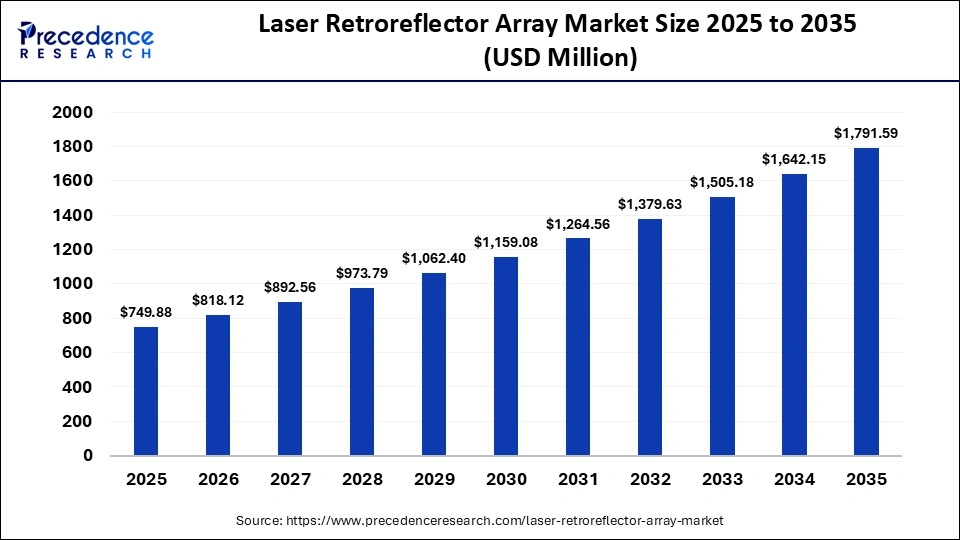
The global laser retroreflector array market size was calculated at USD 749.88 million in 2025 and is predicted to increase from USD 818.12 million in 2026 to approximately USD 1,791.59 million by 2035, expanding at a CAGR of 9.10% from 2026 to 2035.This market is growing due to the rapid rise in lunar exploration missions, which is under the NASA Commercial Lunar Payload Service Program. This significantly drives the need for lightweight, compact, and even durable passive LRAs on almost all commercial landers to serve as long-term navigational, geodetic, and also landing-accuracy landmarks.
Market Highlights
- North America dominated the market with the largest share in 2025.
- Asia Pacific is expected to grow at the fastest CAGR between 2026 and 2035.
- By type, the single mode retroreflector segment dominated the market in 2025.
- By type, the multimode retroreflector segment is expected to expand at the fastest CAGR between 2026 and 2035.
- By application, the satellite navigation segment dominated the market in 2025.
- By application, the vehicles & transportation segment is expected to expand at the fastest CAGR between 2026 and 2035.
What Drives the Laser Retroreflector Array Market?
The laser retroreflector array market is primarily driven by the rising demand for high-precision measurement in space exploration, advancements in automotive LiDAR for ADAS, and high-accuracy industrial manufacturing. The shift toward Industry 4.0 requires precise tools for inspection, alignment, and measurement in aerospace and automotive production. Laser trackers using these arrays help ensure consistency and accuracy, such as during aircraft assembly, making them essential for modern high-precision manufacturing processes.
Future Market Overview
- Expansion in Emerging Markets: There is remarkable investment in smart city projects and infrastructure development which rely on LiDAR for 3D mapping and surveying. This raises the adoption of laser-based technologies, which includes LRAs for calibration. New, smaller, along with more cost-effective LRA designs are allowing wider adoption in emerging markets, thus making it easier for smaller firms to integrate these components, unlike larger, older, and expensive alternatives.
- Integration of AI & Smart Technologies: By improving material modeling, design optimization, and manufacturing precision, AI-powered simulations are enabling the rapid development of highly efficient reflector geometries with minimized energy loss. Automated inspection systems ensure ultra-high surface accuracy and reflectivity, significantly enhancing production yield and reducing cycle times in high-specification optical component manufacturing. These advancements are making sophisticated laser retroreflector arrays more reliable, efficient, and cost-effective for a wide range of applications.
How is AI Influencing the Laser Retroreflector Array Market?
Artificial Intelligence (AI) technologies are transforming the market by improving system precision, reducing human error, and allowing predictive maintenance. AI models determine data from sensors integrated into laser systems to forecast component failures, like degradation of optical surfaces, before they happen, remarkably reducing downtime. AI improves robotics in assembly lines, enhancing the alignment of complex optical configurations and improving the overall efficiency of producing high-performance retroreflectors.
What are the Key Trends Influencing the Laser Retroreflector Array Market?
- The integration of LRA-driven sensors with AI and IoT in smart factories is boosting need for high-precision metrology.
- The demand for 3D scanning, reverse engineering, along with quality control of complex, large-scale structures in aerospace as well as automotive sectors is driving need for advanced LRA components.
- The market is benefiting from the convergence toward developed LIDAR technology for autonomous vehicles, demanding precise, long-range (>200 m) sensing.
- Laser trackers utilizing retroreflectors are increasingly vital for calibrating robotic arms and even ensuring high-precision assembly in automotive along with aerospace manufacturing.
- Increased competition and growing demand are driving down the cost of producing sophisticated, high-performance laser optics, making them more accessible for a wider range of applications.
- Industries are shifting toward maintenance-free solutions, like passive retroreflectors that do not need power or communication, reducing the total cost of ownership.
Market scope
| Report Coverage | Details |
| Market Size in 2025 | USD 749.88 Million |
| Market Size in 2026 | USD 818.12 Million |
| Market Size by 2035 | USD 1,791.59 Million |
| Market Growth Rate from 2026 to 2035 | CAGR of 9.10% |
| Dominating Region | North America |
| Fastest Growing Region | Asia Pacific |
| Base Year | 2025 |
| Forecast Period | 2026 to 2035 |
| Segments Covered | Type, Application, and region |
| Regions Covered | North America, Europe, Asia-Pacific, Latin America, and Middle East & Africa |
Segment Insight
Type Insight
What made single mode retroreflector the dominant segment in the market?
The single mode retroreflector segment dominated the laser retroreflector array market in 2025 due to its lower signal attenuation and reduced distortion, which are critical for long-distance, high-speed, and high-accuracy measurements. These retroreflectors are the standard choice for long-haul optical communication and specialized applications such as satellite laser ranging, enabling precise orbit analysis and the ability to track satellites from hundreds of kilometers away.
The multimode retroreflector segment is expected to grow at the fastest CAGR throughout the forecast period. This is because its larger core allows higher alignment tolerances, making installation easier and more cost-effective in complex or space-constrained systems. Its robustness and passive design make it highly reliable in harsh environments, including space, where it can operate for decades without maintenance. Additionally, multimode retroreflectors are well-suited for applications requiring durability and flexibility rather than ultra-high precision, broadening their adoption across industrial, aerospace, and satellite applications.
Application Insight
Why did the satellite navigation segment dominate the market?
The satellite navigation segment dominated the laser retroreflector array market in 2025. This is because these systems are critical infrastructure for global positioning and timing. The mandatory inclusion of laser retroreflector arrays on navigation constellations drove significant demand. Additionally, modern navigation systems increasingly combine data from multiple constellations, such as Galileo and GPS, to enhance accuracy, creating a consistent and high-demand market for standardized laser retroreflector array components.
The vehicles & transportation segment is expected to grow at a significant CAGR in the upcoming period because of the increasing adoption of LiDAR for autonomous vehicles and advanced driver-assistance systems (ADAS), which require highly accurate, real-time distance and positioning measurements. Additionally, laser retroreflector arrays are becoming essential for precise docking, navigation, and localization in aerospace and maritime transport. Their ability to provide reliable, fast, and accurate feedback in dynamic environments makes them indispensable for modern transportation systems.
Region Insight
What made North America the dominant region in the laser retroreflector array market?
North America dominated the laser retroreflector array market by holding the largest share in 2025. This is due to its strong presence of aerospace and defense organizations, extensive satellite programs, and advanced research infrastructure. The region's continuous investment in space exploration, satellite navigation, and autonomous vehicle technologies has driven high demand for precision measurement systems.
The region's dominance in the market is also attributed to escalating need from diverse end-use sectors, technological advancements, and also strategic investments. Evolving industry requirements for efficiency, precision, and miniaturization are accelerating the acceptance of advanced laser solutions.
U.S. Market Trends
The U.S. leads the North American laser retroreflector array market due to the growing demand for LiDAR in industries such as aerospace, automotive, and manufacturing. This demand stems from the need for precise measurements in critical components and processes. As a result, laser trackers, renowned for their exceptional accuracy, have become essential tools in applications like aircraft assembly and alignment, meeting the stringent requirements of these sectors.
What makes Asia Pacific the fastest-growing region in the laser retroreflector array market?
Asia Pacific is expected to grow at the fastest CAGR throughout the forecast period due to rapid industrialization, increasing investments in aerospace and defense programs, and the growing adoption of advanced technologies like LiDAR in automotive and manufacturing sectors. Expanding satellite programs and space exploration initiatives in countries such as China and India are driving demand for high-precision measurement systems. Additionally, rising manufacturing capabilities, government support for high-tech industries, and the growing need for accurate, real-time measurement tools in transportation and industrial applications contribute to the region's strong market growth.
China Market Trends
China's laser retroreflector array market is driven by the growing focus on high-precision tracking and distance measurement in space missions. Both government space agencies and private enterprises are increasingly deploying laser reflector arrays on satellites and lunar missions to support accurate geodetic studies, orbital tracking, and laser ranging experiments. These arrays are critical for understanding Earth-Moon dynamics and improving satellite navigation systems. The rising number of lunar and planetary exploration missions, including renewed interest in lunar landings and Mars expeditions, is expected to further boost demand for advanced reflector arrays.
How is the opportunistic rise of Europe in the market?
Europe is experiencing notable growth in the laser retroreflector array market due to its strong focus on advanced aerospace, defense, and space research programs. The region benefits from well-established satellite navigation initiatives, including Galileo, which require high-precision reflector arrays for orbit tracking and laser ranging. Additionally, increasing investments in autonomous vehicle technologies, industrial automation, and precision manufacturing are creating new applications for these arrays. Strategic collaborations between European space agencies, research institutions, and private companies are also accelerating innovation, allowing Europe to expand its presence in this high-tech market.
Who are the Major Players in the Global Laser Retroreflector Array Market?
The major players in the laser retroreflector array market include Surrey Satellite Technology Ltd, Lockheed Martin Corporation, Newport Corporation, Thorlabs, Northrop Grumman, BAE Systems, Cobham, L3Harris Technologies, Inc.
Recent Developments
- In July 2025, NASA awarded Firefly Aerospace of Cedar Park, Texas, $176.7 million to deliver two rovers as well as three scientific instruments to the lunar surface as section of the agency's CLPS (Commercial Lunar Payload Services) initiative and Artemis campaign to thus, explore more of the Moon than ever before.(Source: https://www.nasa.gov)
- In July 2024, in collaboration with NASA and the National Geospatial-Intelligence Agency, the U.S. Space Force GPS III Program Office delivered two laser retroflector arrays to Lockheed Martin. The LRAs were thus delivered under a directed program to rapidly incorporate hosted payloads on GPS satellites ahead of start call-up. The LRAs will be installed on two GPS III satellites, SV9 along with SV10, in preparation for a 2025 launch. (Source: https://www.spaceforce.mil)
Segments Covered in the Report
By Type
- Single Mode Retroreflector
- Polarization Maintaining Retroreflector
- Multimode Retroreflector
By Application
- Satellite Navigation
- Optical Instrument
- Vehicles & Transportation
- Construction & Fabrication
- Others
By Region
- North America
- Europe
- Asia-Pacific
- Latin America
- Middle East & Africa
For inquiries regarding discounts, bulk purchases, or customization requests, please contact us at sales@precedenceresearch.com
Frequently Asked Questions





Ask For Sample
No cookie-cutter, only authentic analysis – take the 1st step to become a Precedence Research client
 Get a Sample




 sales@precedenceresearch.com
 Schedule a Meeting
