



Latin America Critical Minerals Market Revenue, Leading Companies, Company Product Portfolio, Production Output, Material Consumption, Sales Performance, Pricing Trends, Distribution Analysis, Company Market Share, and Forecast
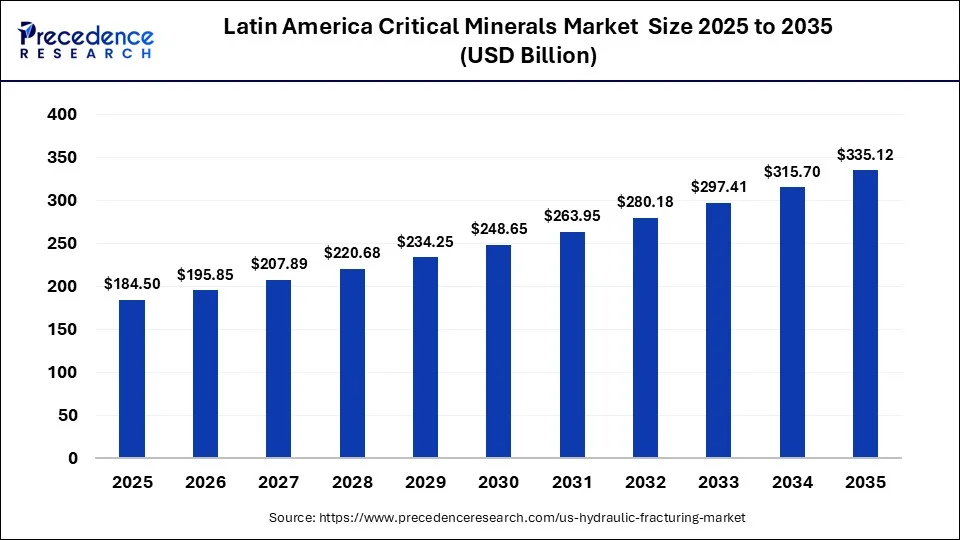
The Latin America critical minerals market accounted for USD 195.85 billion in 2026. The market growth is being driven by expansion of the exploration ecosystem in the region, enhancement in the local refining and processing industry, and growing demand for renewable energy and electric automobile sectors. These trends were evaluated by our Senior Research Analyst, Vidyesh Swar, to curate this well-researched report. His analysis benefits chemical manufacturers, distributors, industry researchers, and stakeholders in conducting competitive analysis and making well-informed decisions.
Source: https://www.precedenceresearch.com/latin-america-critical-minerals-market
 Get a Sample
 Table Of Content


Latin America Critical Minerals Market Trends, Share, and Growth Analysis 2035
The Latin America critical minerals market is forecasted to expand from USD 195.85 billion in 2026 to USD 335.12 billion by 2035, growing at a CAGR of 6.15% from 2026 to 2035. The development of regional economies, growing awareness regarding the integration of supply chains, and the growing demand for various critical minerals from next-generation technological applications are benefiting the market. Vidyesh Swar, our Senior Research Analyst, has over five years of experience in the chemical and materials industry. According to him, the expansion of mining activities still presents significant growth opportunities for countries with unexplored natural resources, but the development of regional refining and processing capabilities will help them capture more economic value in the long-term.
Key Takeaways
- By critical mineral type, the copper segment led the market with a 54.20% share in 2025.
- By mineral applications, the electricity grids and infrastructure segment dominated the market with a 27.85% share in 2025.
- By country, Chile accounted for the largest revenue share of 28.65% in 2025.
- By mineral type, the rare earth elements segment is expected to expand at the highest CAGR of 9.14% during the forecast period.
- By country, Argentina is expected to grow at the fastest CAGR of 9.08% from 2026 to 2035.
- BHP operates Escondida and Spence in Chile. Escondida is the biggest copper-producing mine in the world and produces over 1 million tons of copper in a year.
- CODELCO holds significant importance in the copper industry in Chile and contributed 26% of the nation's mined copper production in 2024.
- SQM is one of the world's most prominent lithium producers and operates in the Salar de Atacama in Chile, making it a strategically vital company for global lithium supply.
- Rio Tinto has increased its presence in the market through its lithium operations in Argentina and wider copper lineup.
- CEPAL reported that 62% of critical mineral exports from Latin America between 2019 and 2023 were unprocessed or basically refined products.
What is the Size of the Latin America Critical Minerals Market?
The Latin America critical minerals market accounted for approximately USD 184.5 billion in 2025 and is expected to expand at a CAGR of 6.15% during the forecast period. This figure is close to OLADE's evaluation that the region's critical minerals market is valued at around USD 180 billion, which is around 25% of the global market. OLADE recognizes copper, lithium, and various other strategic minerals as central to the role of this region in energy transformation.
Expert Analyst Insights
Latin America has distinct potential due to the fact that this region brings together massive geological resources with mature mining infrastructure, but a significant chunk of the value chain is still outside the region. According to the IEA, only around 20% of key energy minerals extracted in Latin America and the Caribbean were refined in the same regions in 2025, excluding lithium. Under its base-case project pipeline, the region has the potential to capture around USD 185 billion of economic value by 2035, potentially growing to USD 220 billion if significantly more refining is performed indigenously.
Which Critical Minerals are Driving the Growth of the Market?
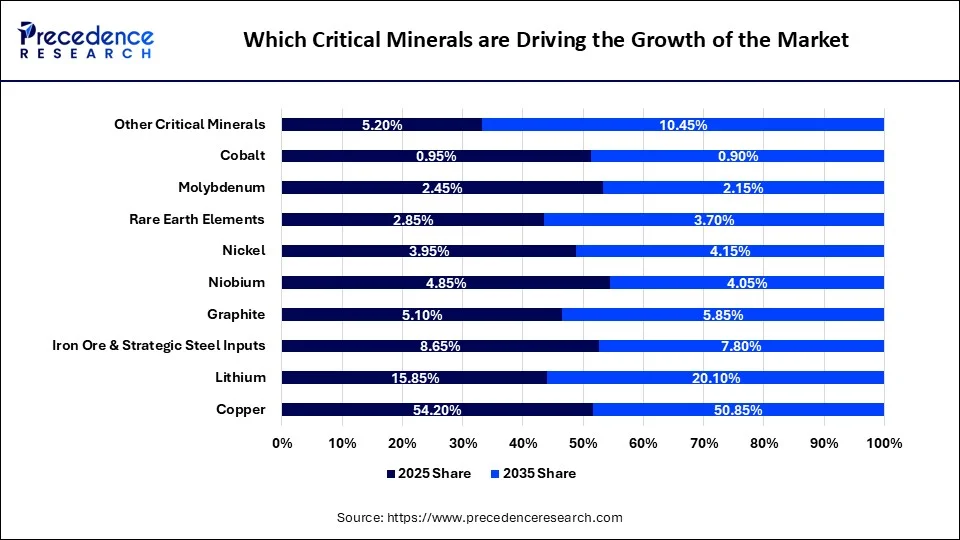
The copper segment led the market with a 54.20% share in 2025 and is expected to expand at a CAGR of 5.47% during the forecast period owing to the fact that Latin America is the leading copper-producing region across the globe. The IEA said that this region contributes to around 40% of global copper mine production. The lithium segment held a market share of 15.85% and is expected to grow at a CAGR of 8.79% from 2026 to 2035. Latin America accounts for approximately one-fourth of the global lithium supply, and the output is expected to increase by around 50% by the end of the decade. The rare earth elements segment is expected to expand at the highest CAGR of 9.14% during the forecast period.
Critical Minerals Insights by Expert Analysts
According to our Senior Researcher Aditi Shivarkar, copper holds the largest share in the market currently, but lithium and rare earths have higher growth rates. This shows that the market is gradually transitioning from conventional bulk minerals towards materials used in batteries, permanent magnets, and next-generation energy technologies.
Why Does Copper Present the Largest Critical Mineral Opportunity in Latin America?
Copper is widely used in power grids, EVs, charging infrastructure, renewable generation, motors, data centers, and for industrial electrification.
| Country | 2025 Mine Production | Approx. Global Share |
| Chile | 5.415 million tons | 22.9% |
| Peru | 2.731 million tons | 11.5% |
| Mexico | ~0.68 million tons | ~2.9% |
| Brazil | ~0.24 million tons | ~1.0% |
| Argentina | Emerging producer | <1% |
| Chile + Peru | 8.146 million tons | ~34.4% |
The 2025 data by Cochilco reports Chile at 5.415 million tons and Peru at 2.731 million tons, together representing over one-third of the worldwide mined copper production.
Expert Analyst Insights
Chile and Peru are important copper markets in the region, but the bigger potential lies in new copper capacity and processing rather than just increasing current mining yield. The IEA predicts a worldwide copper supply shortage by 2035, bolstering the strategic importance of Latin American natural resources.
Which Countries in the Region are Significant in the Lithium Segment?
| Country | Key Position | 2025/Latest Indicator |
| Argentina | Rapidly expanding producer | ~6% of global production |
| Chile | Major established producer | ~22% of global production |
| Bolivia | Very large resources, limited commercial output | 23 Mt resources |
| Brazil | Emerging hard-rock producer | Growing spodumene production |
| Mexico | Emerging lithium resource base | 1.7 Mt resources |
| Peru | Early-stage potential | 1.0 Mt resources |
According to the USGS, Argentina held around 13% of the worldwide lithium reserves in 2024 and was the fifth-largest producer, accounting for approximately 6% of global lithium production. Chile ranked second in the world, excluding U.S. production, and accounted for around 22% of global production. The 2026 USGS resource data notes Argentina at 28 million tons of lithium resources, Bolivia at 23 million tons, and Chile at 13 million tons.
Expert Analyst Insights
The trio of Argentina, Chile, and Bolivia holds significance in the region in terms of lithium resources, but these countries do not have similar commercial models. Argentina has attracted comprehensive private-sector project investment, Chile has adopted more of a state-directed framework, and Bolivia has massive critical mineral resources but significantly less commercial production.
Which Countries Held a Prominent Share in the Latin American Critical Minerals Market?
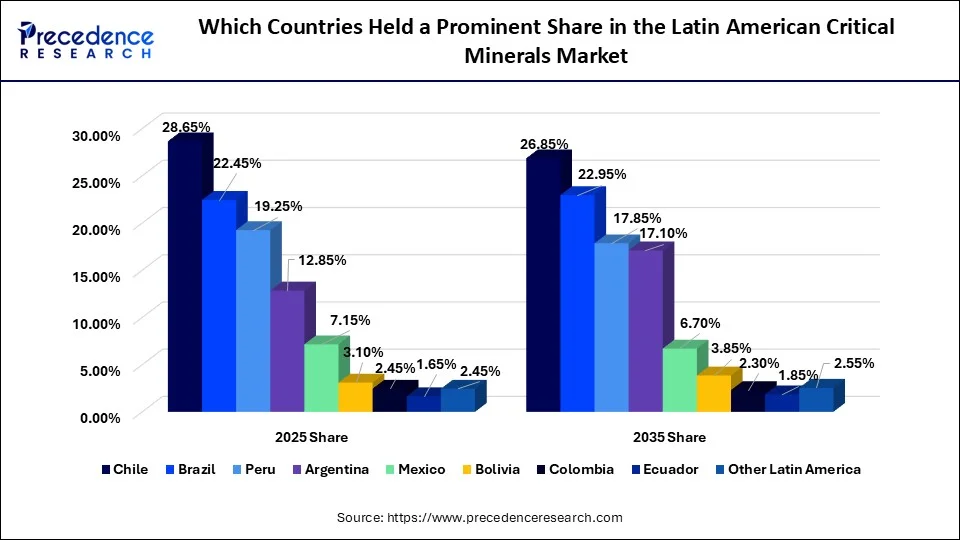
Chile led the market with a 28.65% share in 2025 and is expected to expand at a CAGR of 5.45% during the forecast period. Brazil and Peru held significant market shares of 22.45% and 19.25%, respectively, in 2025. Argentina is expected to grow at the highest CAGR of 9.08% from 2026 to 2035, increasing its share from 12.85% in 2025 to 17.10% in 2035. These are analytical estimates calculated taking into consideration the countries' mineral production, reserves, project pipelines, and investment activity.
Country Share Insights By Expert Analysts
According to our Senior Researcher Aman Singh, Chile, Peru, and Brazil presently constitute the core of the regional critical-mineral economy, and Argentina has the best high-growth potential owing to its lithium and copper pipeline. Brazil presents a different case because its potential goes beyond lithium and copper into niobium, graphite, nickel, and rare earths.
Why is Chile Strategically Crucial to the Critical Minerals Sector?
Chile brings together world-scale copper production with a mature lithium industry. In 2025, the country produced around 5.415 million tons of mined copper, which is around 22.9% of global production. CODELCO accounted for around 26% of the mined copper production in Chile in 2024, and BHP's Escondida contributed approximately 23.2% of the national production. According to BHP, Escondida has produced over 34 million tons of copper since its operations started and presently represents around 20% of the national production and approximately 5% of the worldwide production.
Expert Analyst Insights
Chile's competitive advantage is its well-developed copper environment, including mines, engineering services, infrastructure, logistics, skilled labor, and established international buyers. The upcoming growth potential is tied to increased value capture around copper and lithium, rather than depending on exports of raw materials.
Why is Brazil Emerging to be One of the Most Diverse Critical Mineral Markets?
Brazil has one of the widest critical mineral lineups in Latin America. The Brazil Geological Survey recognizes lithium, rare earths, graphite, niobium, and nickel as crucial critical and strategic mineral opportunities. Brazil is the leader in niobium production across the globe, representing around 90% of global production, according to the Brazil Geological Survey.
Brazil also holds around:
- 94% of global niobium reserves
- 26% of global graphite reserves
- 12% of global nickel reserves
As reported by the Brazilian government based on USGS data.
Brazil Critical Mineral Market Insights by Expert Analysts
The main advantage of Brazil is its mineral diversity. The market ecosystem of some countries depends on one or two minerals, but Brazil can have a presence in battery materials, permanent magnets, next-generation alloys, aerospace materials, and industrial applications.
Why is Argentina Experiencing Rapid Growth in the Market?
Argentina holds significant importance in the lithium segment. The country held around 13% of the total lithium reserves across the globe in 2024 and was the fifth-largest global producer of lithium, with around 6% of the world's output. Argentina has signed critical-minerals cooperation agreements with the European Union and the U.S., and recognizes lithium and copper as strategic areas for strengthening the supply chain. CEPAL noted that since 2019, the country has had 24 mining projects valued at around USD 10.23 billion, with 45% related to copper and 42% to lithium.
Expert Analyst Insights
Argentina has one of the best project-pipeline-growth stories in Latin America. The country's lithium industry is shifting from exploration to commercial-scale production, while copper projects could significantly broaden the national critical-minerals portfolio.
Which Critical Mineral Applications Dominated the Market in 2025?
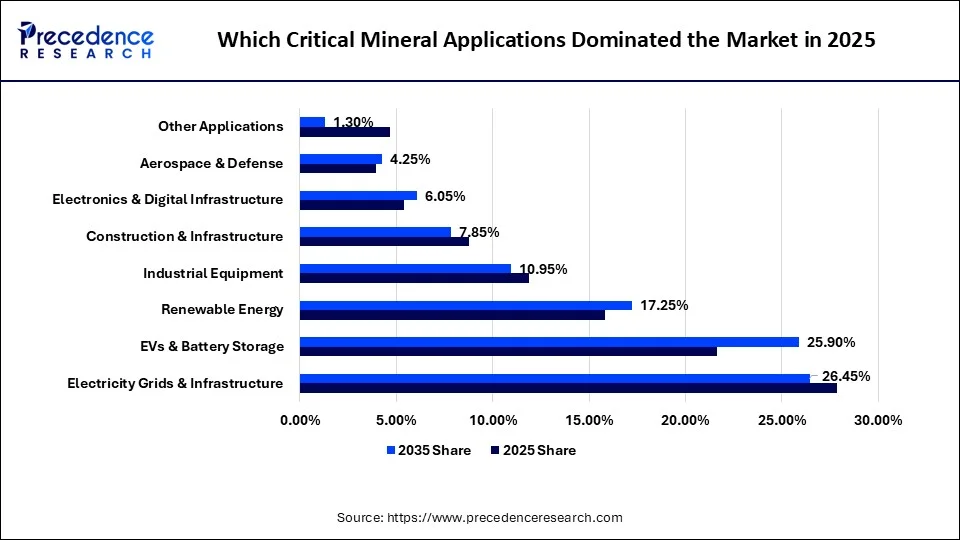
The electricity grids and infrastructure segment led the market with a 27.85% share in 2025 and is expected to grow at a CAGR of 5.61% from 2026 to 2035. The EVs and battery storage segment held the second-largest market share of 21.65% in 2025 and is expected to expand at the highest CAGR of 8.34% during the forecast period, increasing its market share to 25.90% in 2035.
Critical Minerals Applications Insights By Expert Analysts
Electric vehicles and energy storage are gaining significance, but electricity infrastructure still generates the largest demand due to the fact that copper-intensive grids, transformers, and transmission and distribution networks require significant mineral inputs. The IEA reported that energy technologies contributed around 75% of worldwide demand growth for crucial energy minerals in 2025.
How Much Investment Did the Critical Minerals Market in Latin America Secure?
| Argentina | USD 10.23B in 24 projects since Dec. 2019 |
| Chile | USD 73.66B in 53 mining initiatives, 2022–2031 |
| Brazil | USD 40.44B mining investment projected, 2022–2026 |
| Peru | Major copper project pipeline extending into 2030s |
| Latin America & Caribbean | 1,152 global mining FDI announcements, 2005–2024 |
| Critical-mineral share of regional mining FDI announcements | 42% |
CEPAL noted that out of 8,686 global FDI announcements between 2005 and 2024, 1,152 were directed towards Latin America and the Caribbean, representing 13% of the global announcements. Chile, Peru, Brazil, and Argentina accounted for 84% of the capital announced for the region. CEPAL's project review estimates planned and active mining investment in Argentina, Brazil, Chile, and Peru at USD 178.04 billion.
Expert Analyst Insights
According to our Senior Researcher Aditi Shivarkar, Capital is highly concentrated in Argentina, Brazil, Chile, and Peru. This makes these 4 countries the primary investment markets, and Mexico, Ecuador, Bolivia, and Colombia represent specialized emerging opportunities.
Which Countries are Influencing the Latin America Critical Minerals Market?
| Company | Key Country Exposure | Critical Mineral Focus |
| CODELCO | Chile | Copper |
| BHP | Chile | Copper |
| Rio Tinto | Argentina / Chile | Lithium, copper |
| SQM | Chile | Lithium |
| Albemarle | Chile | Lithium |
| Freeport-McMoRan | Peru | Copper |
| Southern Copper | Peru / Mexico | Copper |
| Vale | Brazil | Nickel, copper |
| CBMM | Brazil | Niobium |
| Sigma Lithium | Brazil | Lithium |
| AMG Critical Materials | Brazil | Lithium |
| Lundin Mining | Argentina / Chile / Brazil | Copper |
| First Quantum Minerals | Panama | Copper |
| Lundin Gold | Ecuador | Gold / strategic mining ecosystem |
| Horizonte Minerals | Brazil | Nickel |
| Serra Verde | Brazil | Rare earths |
BHP
Escondida and Spence are operated by BHP in Chile. Escondida is the largest copper-producing mine in the world and produces over 1 million tons of copper in a year. BHP said that its Chilean operations have produced over 24% of all Chilean copper since the beginning of operations at Escondida.
CODELCO
CODELCO is vital to the copper industry of Chile and contributed to 26% of the mined copper production of the country in 2024.
SQM
SQM is one of the most prominent lithium producers across the globe and operates in the Salar De Atacama in Chile, making it a strategically crucial company for the worldwide lithium supply.
Rio Tinto
Rio Tinto has expanded its critical minerals ecosystem in Latin America through its lithium operations in Argentina and broader copper lineup.
Vale
Vale helps Brazil to have an important status in terms of nickel and copper, along with its well-developed mining and logistics environment.
CBMM
CBMM is strategically vital because Brazil leads global niobium production, which finds applications in high-strength steels, aerospace alloys, and other advanced materials. The geological survey of Brazil recognizes the country as the leading global producer.
Expert Analyst Insights
The company landscape is not dominated by just a single mineral or a business model. It involves the participation of mining majors, state-owned producers, lithium specialists, and emerging developers. Strategic partnerships and offtake agreements are increasingly becoming as important as traditional mine ownership.
Which Countries are Experiencing Significant Growth Beyond the Conventional Chile-Peru-Brazil-Argentina Core?
| Country | Key Minerals | Development Stage | Opportunity |
| Bolivia | Lithium | Early commercial development | Very High resource potential |
| Ecuador | Copper | Developing | High |
| Colombia | Nickel, copper, coal-linked minerals | Established/emerging | Moderate–High |
| Mexico | Lithium resources, copper, graphite | Established mining + emerging strategic minerals | High |
| Guyana | Gold, bauxite and emerging minerals | Developing | Moderate |
| Suriname | Bauxite and strategic minerals | Developing | Moderate |
| Paraguay | Selected strategic minerals | Early stage | Emerging |
| Peru | Copper, zinc, molybdenum | Mature + expansion | Very High |
| Argentina | Lithium, copper | Rapid expansion | Very High |
Bolivia has significant lithium resources, creating an opportunity for market growth, but is currently at an early commercial development stage. Colombia has nickel, copper, and coal-based mineral resources and has a moderately established market environment, along with significant potential for expansion. Guyana has significant gold, bauxite, and other emerging mineral resources, but the national market is still in the development phase. Mexico is rich in copper, lithium, and graphite resources, and Ecuador in copper resources.
Expert Analyst Insights
Bolivia and Ecuador deserve particular attention. Bolivia has massive lithium resources but needs significant investment, technology, and commercial implementation. The copper development in Ecuador is becoming increasingly important as worldwide copper supply tightens.
How Crucial is Local Refining and Processing to Regional Growth?
| Value-Chain Stage | Regional Position |
| Mineral resources | Very strong |
| Mining | Very strong |
| Concentration | Strong |
| Basic refining | Moderate |
| Advanced refining | Limited |
| Battery materials | Emerging |
| Magnet materials | Limited |
| Battery-cell manufacturing | Limited |
| Advanced component manufacturing | Limited |
| Recycling | Early-stage |
According to the IEA, only around 20% of important energy minerals extracted in Latin America and the Caribbean in 2025 were refined in the region, excluding lithium. CEPAL reported that approximately 62% of the critical minerals exported from the region were unprocessed or only basically refined products.
Local Refining and Processing Insights by Expert Analysts
Expansion of local refining and processing infrastructure represents the strongest commercial potential in the region. Mining expansion creates cumulative value, but refining, precursor production, alloying, battery materials, and recycling can create significantly more local economic value.
What Technologies are Driving Demand for Latin American Critical Minerals?
| Technology | Key Minerals |
| EV batteries | Lithium, nickel, graphite, cobalt, manganese |
| Grid expansion | Copper, aluminum |
| Wind turbines | Copper, rare earths |
| Solar PV | Copper, silicon, silver |
| Permanent magnets | Rare earths, especially NdPr |
| Data centers | Copper, aluminum, specialty metals |
| Hydrogen systems | Nickel, platinum-group metals |
| Aerospace | Niobium, titanium, nickel, rare earths |
| Defense systems | Rare earths, titanium, niobium, specialty metals |
| Energy storage | Lithium, graphite, nickel, manganese |
The advent of electric automobiles has increased demand for EV batteries, which require significant amounts of lithium, nickel, graphite, cobalt, and manganese. The expansion of grid infrastructure drives the demand for copper and aluminum, and wind turbines require copper and rare earth minerals. The advancement in AI technologies has resulted in the expansion of data center infrastructure, which propels the demand for copper, aluminum, and specialty metals. Niobium, titanium, nickel, and rare earth minerals are important for aerospace applications.
Expert Analyst Insights
The most important transition is the rising overlap between critical minerals, AI infrastructure, electrification, and national security. This expands the demand base beyond EVs and renewable energy.
What are the Biggest Constraints Faced by the Latin America Critical Minerals Market?
| Infrastructure gaps | Raises project economics |
| Environmental permitting | Extends development timelines |
| Water availability | Important for arid mining regions |
| Social/community relations | Can affect project continuity |
| Processing concentration outside region | Limits value capture |
| Commodity price volatility | Affects investment decisions |
| Regulatory uncertainty | Raises investor risk |
| Skilled-labor shortages | Limits technical capacity |
| Logistics | Increases export and project costs |
| Technology dependence | Limits downstream development |
| Political changes | Can alter investment frameworks |
The IEA especially recognizes steep financing costs, environmental management, regulatory unpredictability, infrastructure gaps, technology and skills constraints, and local-stakeholder engagement as key challenges in the region.
Market Challenges Insights by Expert Analysts
The constraints faced by the region are increasingly transitioning from the availability of ample mineral resources to the capability of developing projects swiftly, responsibly, and at competitive prices.
Where are the Largest Opportunities in the Market Through 2035?
| Opportunity | Potential |
| Chilean copper expansion | Very High |
| Peruvian copper projects | Very High |
| Argentine lithium expansion | Very High |
| Brazilian rare earths | High |
| Brazilian graphite | High |
| Brazilian niobium value addition | Very High |
| Regional lithium refining | Very High |
| Copper refining | Very High |
| Battery-material manufacturing | Very High |
| Critical-mineral recycling | High |
| Rare-earth separation | High |
| EV supply-chain integration | High |
| Long-term mineral offtake agreements | Very High |
| Mining technology and automation | High |
| Water-efficient mining technology | Very High |
Expansion of the copper segment in Chile and the lithium ecosystem in Argentina represent very high market growth potential due to the presence of massive respective mineral resources. Brazil has high growth potential in terms of rare earths and graphite and very high growth potential in the niobium segment. The market has high expansion opportunity through critical mineral recycling, rare earth separation, and EV supply chain integration. Long-term mineral offtake agreements and the development of water-efficient mining technologies present very high growth potential in the market.
Expert Analyst Insights
The strongest opportunity is not just the expansion of mining operations. Processing, refining, recycling, mining technology, and downstream manufacturing have the potential to capture more value per ton of mineral extracted. The IEA estimates that regional project pipelines can generate USD 185 billion of economic value by 2035, and can grow to USD 220 billion with significantly higher levels of development of the local refining ecosystem, which shows the scale of this opportunity.
What are Buyers and Investors Focusing on in Latin American Critical Minerals?
| Buyer / Investor Priority | Importance |
| Long-term supply security | Very High |
| Mineral grade and quality | Very High |
| Resource size | Very High |
| Project economics | Very High |
| Infrastructure access | High |
| Environmental performance | High |
| Water management | High |
| Government stability | High |
| Permitting timeline | High |
| Local processing | Increasing |
| Traceability | Increasing |
| ESG performance | High |
| Offtake agreements | Very High |
| Strategic-country diversification | Very High |
Buyers and investors typically place long-term supply security, mineral grade and quality, resource size, project economics, offtake agreements, and strategic-country diversification at very high priority. Buyers and investors give high importance to infrastructure accessibility, environmental management, water management, government stability, and ESG performance. The importance of local processing, traceability, and technology collaborations is increasing.
Buyers' and Investors' Priorities Insights by Expert Analysts
International buyers are increasingly looking beyond just ore quality and price. The strategic value of a project increasingly relies on its ability to provide reliable supply, demonstrate responsible production, and offer access to processing capacity.
What is the Outlook for the Critical Minerals Supply Chain in Latin America Through 2035?
Latin America has the potential to gain importance as a mineral supplier needed for electrification, EVs, renewable energy, grid infrastructure, advanced manufacturing, and defense.
Some of the most important competitive advantages that the region has include:
- Massive mineral resource
- World-scale copper production
- Major lithium resources and production
- Diversified mineral base of Brazil
- Established mining expertise
- Significant renewable-energy potential
- Proximity to North American markets
- Increasing strategic partnerships with the U.S., EU, and Asian economies
The most significant strategic restraints include:
- Limited downstream processing
- Infrastructure gaps
- Financing costs
- Regulatory unpredictability
- Water constraints
- Social and environmental complexity
- Reliance on overseas technology and buyers
The IEA noted that Latin America and the Caribbean could significantly increase its economic value capture through the expansion of local refining capabilities, with the analytical high-refining case accounting for USD 220 billion by 2035.
Experts Insights
The Latin America critical minerals market is increasingly shifting from a resource story to a supply chain story. Chile and Peru dominate the copper segment, the importance of Argentina is rapidly increasing in the lithium category, and Brazil offers the widest diversification across niobium, graphite, rare earths, nickel, and lithium. The most important differentiator through 2035 is the ability to transition from extraction and export of minerals to refining, recycling, processing, and producing higher-value products indigenously. The latest regional evaluation by the IEA strongly backs this as an important value-creation opportunity.
Our Experts
- The primary market research process was carried out by Vidyesh Swar, Senior Research Associate, who also designed the methodology and did market segmentation, regional trend analysis, buyer intelligence, competitive analysis, and forecasts, laying the foundation for the analytical part of the report.
- Aman Singh, Head of Research, has gathered and checked regulatory policies, company financial information, critical minerals applications information, production information, commodity price information, and various other quantitative information sources, which were obtained independently, thereby increasing the quality of evidence supporting the calculations of the market values.
- Aditi Shivarkar, VP Research, has validated and refined the research material, verified facts, corrected inconsistencies, and completed the research document, making it accurate and to the point.
Latin America Critical Minerals Market Key Companies
- CODELCO
- BHP
- Rio Tinto
- SQM
- Albemarle
- Vale
- CBMM
- Freeport-McMoRan
- Southern Copper
- Lundin Mining
- First Quantum Minerals
- Sigma Lithium
- AMG Critical Materials
- Serra Verde
- Glencore
- Zijin Mining
Latin America Critical Minerals Market Segments Covered in This Report
By Mineral Type
- Copper
- Lithium
- Nickel
- Cobalt
- Graphite
- Rare Earth Elements
- Niobium
- Molybdenum
- Zinc
- Tin
- Bauxite / Aluminum
- Silver
- Manganese
- Vanadium
- Other Critical Minerals
By Value-Chain Stage
- Exploration
- Mining
- Ore Concentration
- Refining
- Chemical Processing
- Metal / Alloy Production
- Advanced Materials
- Component Manufacturing
- Recycling
By Application
- Electric Vehicles
- Batteries & Energy Storage
- Electricity Grids
- Renewable Energy
- Wind Energy
- Solar Energy
- Electronics
- Data Centers
- Industrial Equipment
- Aerospace & Defense
- Construction & Infrastructure
- Advanced Manufacturing
By Country
- Chile
- Brazil
- Peru
- Argentina
- Mexico
- Bolivia
- Colombia
- Ecuador
- Paraguay
- Guyana
- Suriname
- Other Latin America
By Key Mineral-Country Combination
- Chile - Copper, Lithium, Molybdenum
- Brazil - Niobium, Rare Earths, Graphite, Nickel, Lithium
- Peru - Copper, Zinc, Molybdenum
- Argentina - Lithium, Copper, Silver
- Bolivia - Lithium
- Mexico - Copper, Graphite and Strategic Minerals
- Colombia - Nickel and Other Strategic Minerals
- Ecuador - Copper
- Paraguay - Strategic/Emerging Minerals
For inquiries regarding discounts, bulk purchases, or customization requests, please contact us at sales@precedenceresearch.com
Frequently Asked Questions





Ask For Sample
No cookie-cutter, only authentic analysis – take the 1st step to become a Precedence Research client
 Get a Sample




 sales@precedenceresearch.com
 Schedule a Meeting
