



Low Code AI Platform Market Trends, Companies, Revenue / Sales Performance, Subscriber Growth, Pricing Strategies, Cloud Adoption, Infrastructure Expansion, Competitive Landscape, and Industry Outlook
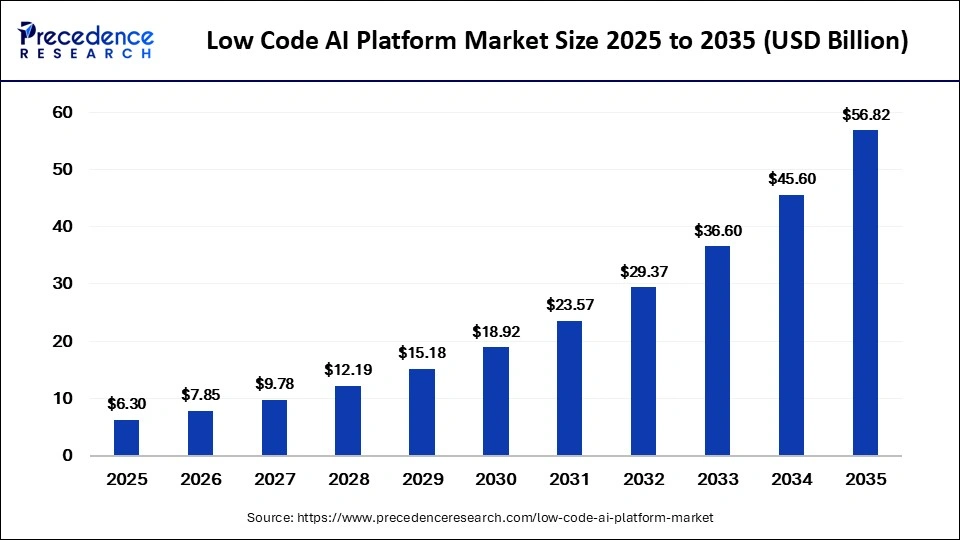
ICT industry specialist Gautam Mahajan estimates the low code ai platform market at USD 7.85 billion in 2026, with continued technology adoption expected to take the market to USD 56.82 billion by 2035 at a CAGR of 24.60%. Leading low code ai platform market providers such as Microsoft, Google Cloud, Amazon Web Services, IBM are expanding their capabilities across segments including By Deployment Model, By Technology, By Application, By End-Use Industry.
Source: https://www.precedenceresearch.com/low-code-ai-platform-market
 Get a Sample
 Table Of Content


What is the Low Code AI Platform Market Size in 2026?
The global low code AI platform market size accounted for USD 6.30 billion in 2025 and is predicted to increase from USD 7.85 billion in 2026 to approximately USD 56.82 billion by 2035, expanding at a CAGR of 24.60% from 2026 to 2035. The market is significantly growing due to the urgent need for democratization, generative AI integration in leading sectors, and the scarcity of data science skills, leading to the development of low-code platforms.
Key Takeaways
- North America held the largest low code AI platform market share of 46% in 2025.
- Asia-Pacific is expected to grow at the fastest CAGR of 30.5% during the foreseeable period of 2026-2035.
- By deployment model, the cloud-based segment held the largest market share of 80% in 2025.
- By deployment model, the on-premises segment held the second-largest market share of 20% in 2025 and is expected to grow at a CAGR of 10.5% during the foreseeable period.
- By technology, the machine learning segment held the largest market share of 30% in 2025.
- By technology, the NLP segment held the second-largest market share of 20% in 2025 and is expected to grow at a CAGR of 25.5% in the coming years.
- By application, the process automation segment held the largest low code AI platform market share of 28% in 2025.
- By application, the customer experience management segment held the second-largest market share of 22% in 2025 and is expected to grow at a CAGR of 27.5% during the forecast period.
- By end-use industry, the IT and telecom segment held the largest market share of 28% in 2025.
- By end-use industry, the BFSI segment is the second largest with a market share of 20.0% in 2025 and is expected to grow at a CAGR of 24.5% during the foreseeable period of 2026-2035.
What is the Low Code AI Platform Market?
The low code AI platform is a software tool that allows users to code with the help of AI-driven applications by using visual, drag-and-drop interfaces with less knowledge of coding. They allow ‘citizen developers' initiatives to work on a large scale and build smart applications, automate workflows, and deploy AI solutions easily.
The major reason behind market growth is to build applications 80% faster than before to stay competitive and relevant in the market. The shortage of skilled AI/ML professionals forces organizations to leverage low-code AI platforms and empower non-technical ‘citizen developers' through such platforms. Low-code platforms are rapidly adopted by data sensitive organizations and highly regulated industries like BFSI and finance, supporting market expansion.
Low Code AI Platform Market Trends
- Platforms are integrating generative AI to enable users to develop faster applications, workflows, and AI models with the help of natural language instead of complex code, eventually reducing the development time.
- Non-technical business users are increasingly embracing complex applications and shifting the development workload away from IT teams only.
- The rapid prototyping and deployment of applications allows business owners to enhance their productivity as compared to conventional ways of app development and shift into automation.
- The major trend in the market is that platforms are increasingly embedding AI governance frameworks to manage regulatory compliance for AI usage and mitigate biases in AI outcomes for higher security and transparency.
Market Scope
| Report Coverage | Details |
| Market Size in 2025 | USD 6.30 Billion |
| Market Size in 2026 | USD 7.85 Billion |
| Market Size by 2035 | USD 56.82 Billion |
| Market Growth Rate from 2026 to 2035 | CAGR of 24.60% |
| Dominating Region | North America |
| Fastest Growing Region | Asia Pacific |
| Base Year | 2025 |
| Forecast Period | 2026 to 2035 |
| Segments Covered | Deployment Model, Technology, Application, End-Use Industry, and Region |
| Regions Covered | North America, Europe, Asia-Pacific, Latin America, and Middle East & Africa |
Market Dynamics
Drivers
Urgent Need for Process Automation
The market is rapidly growing as many organizations are under pressure to automate complex manual processes. It includes invoice processing, consumer inquiries, and data entry, which are mostly time-consuming and repetitive, and can be handled by these platforms effortlessly. Businesses need to innovate rapidly to stay industry-relevant. Low-code AI reduces application development time by up to 80% and accelerates the time-to-market for new products, supporting the market expansion globally.
Restraint
Shadow IT Concerns
Despite having many benefits, low-code platforms still have some negative factors that hinder market growth. It includes shadow IT risks, integration complexity with legacy systems, and questionable data security. As applications can be easily developed even by non-tech people, unauthorized applications may run within organizations that are not properly governed. This creates potential data breaches, data ingestion risks, and data leakage.
Opportunity
Vertical-oriented Platforms
The low code AI platform industry is witnessing an opportunity to grow further as vertical-specific platforms are expanding. As many businesses adopt more IoT devices, low-code platforms can be used for data processing and run AI models at the ‘edge', offering real-time analytics. Moreover, integrating RPA allows organizations to create intelligent agents that can plan and work instead of users, which further expands functionality beyond simple automation.
Segmental Insights
Deployment Model Insights
Low Code AI Platform Market Share, By Deployment Model, 2025-2035 (%)
| Deployment Model | 2025 | 2035 | CAGR (%) |
| Cloud-based | 80.00% | 90.00% | 28.50% |
| On-premise | 20.00% | 10.00% | 10.50% |
The Cloud-based Segment Held the Largest Market Share of 80% in 2025
The cloud-based segment dominated the low code AI platform market with the highest share of 80% in 2025 due to its superior scalability, lower infrastructure costs, and improved remote collaboration capabilities. Cloud platforms eliminated the compulsion of huge upfront capital expenditure to build separate hardware and offer subscription-based models.
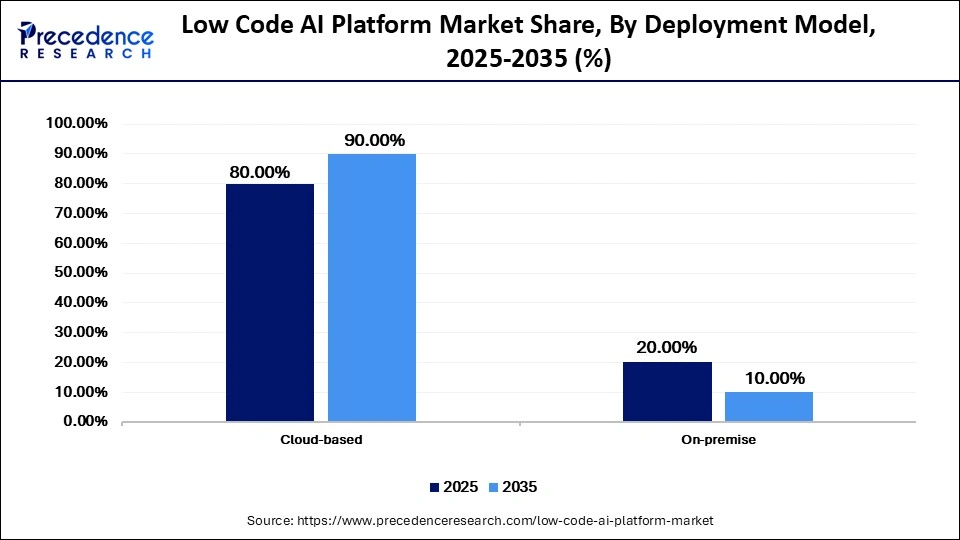
The on-premise segment held the second-largest market share of 20% in 2025 and is expected to grow at a CAGR of 10.5% over the studied years. The segment is largely driven by the increasing need to gain full control over sensitive data within an organization, and reduces dependency on third-party vendors for data processing and sharing for maximum safety.
Technology Insights
The Machine Learning Segment Held the Largest Market Share of 30% in 2025
The machine learning segment held the largest low code AI platform market share of 30% in 2025 due to the increasing demand for AI democratization and preference for specific use case solutions through AI systems. Automated ML tools within these platforms allow automatic selection, validation, and model optimization to increase development speed.
Low Code AI Platform Market Share, By Technology, 2025-2035 (%)
| Technology | 2025 | 2035 | CAGR (%) |
| Machine Learning | 30.00% | 28.00% | 23.50% |
| NLP | 20.00% | 22.00% | 25.50% |
| Predictive Analytics | 18.00% | 17.00% | 22.50% |
| Computer Vision | 15.00% | 14.00% | 21.50% |
| Generative AI | 17.00% | 19.00% | 32.50% |
The NLP segment held the second-largest market share of 20% in 2025 and is expected to grow at a CAGR of 25.5% during the foreseeable period. The segment is proliferating due to the increasing demand for intelligent and text-based apps like chatbots and sentiment analysis systems that can even be built by non-tech users.
The predictive analytics segment held a market share of 18% in 2025 and is expected to grow at a CAGR of 22.5% between 2026 and 2035. The segment is growing due to the growing demand for transforming raw data into action steps and proactive business decisions to avoid hefty fines.
The generative AI segment held a market share of 17% in 2025 and is expected to grow at the fastest CAGR of 32.5% during the foreseeable period. The segment is expanding as these tools allow non-tech users to build working applications through simple prompts in natural language. It reduces technical barriers and automates complex workflows.
Application Insights
The Process Automation Segment Held the Largest Market Share of 28% in 2025
The process automation segment led the low code AI platform market with the highest market share of 28% in 2025, owing to the increasing demand for high operational efficiency and faster digital transformation with cost reduction. By combining AI with low-code platforms, organizations can automate complex workflows.
The customer experience management segment held the second-largest market share of 22% in 2025 and is expected to grow at the highest CAGR of 27.5% in the coming years. The segment is growing as many businesses prioritize highly personalized and automated consumer journeys across various digital channels. It allows businesses to predict human interaction and suggest products based on data.
Low Code AI Platform Market Share, By Application, 2025-2035 (%)
| Application | 2025 | 2035 | CAGR (%) |
| Process Automation | 28.00% | 30.00% | 26.50% |
| Customer Experience Management | 22.00% | 24.00% | 27.50% |
| Fraud Detection | 15.00% | 14.00% | 22.50% |
| Predictive Maintenance | 18.00% | 16.00% | 23.50% |
| Sales & Marketing Automation | 17.00% | 16.00% | 24.50% |
The fraud detection segment held a market share of 15% in 2025 and is expected to grow at a CAGR of 22.5% during the foreseeable period. The segment is rapidly growing as there is an increasing need to combat highly sophisticated AI-driven scams and real-time threat mitigation to reduce downtime.
The predictive maintenance segment held a market share of 18% in 2025 and is expected to grow at a CAGR of 23.5% during the foreseeable period. The segment is growing due to the widespread IoT deployment, edge computing, and cloud native integration, which requires predictive maintenance to work seamlessly.
End-Use Industry Insights
The IT and Telecom Segment Held the Largest Market Share of 28% in 2025
The IT and telecom segment dominated the low code AI platform market with the highest share of 28% in 2025 to accelerate digital transformation and minimize overall development costs for various applications. Telecom firms are leveraging low-code AI platforms to easily deploy customer-facing apps and automated chatbots.
The BFSI segment held the second-largest market share of 20% in 2025 and is expected to grow at a CAGR of 24.5% from 2026 to 2035. The segment is largely driven by the urgent need for cost-effective automation in finance for complex transactions and improved consumer experiences. Low-code AI allows automation in routine tasks like KYC and minimizes manual intervention.
Low Code AI Platform Market Share, By End-Use Industry, 2025-2035 (%)
| End-Use Industry | 2025 | 2035 | CAGR (%) |
| IT & Telecom | 28.00% | 30.00% | 27.50% |
| BFSI | 20.00% | 19.00% | 24.50% |
| Retail & E-commerce | 18.00% | 20.00% | 28.50% |
| Healthcare | 12.00% | 13.00% | 26.00% |
| Manufacturing | 12.00% | 10.00% | 23.50% |
| Government | 10.00% | 8.00% | 22.50% |
The retail and e-commerce segment held a market share of 18% in 2025 and is expected to grow at the fastest CAGR of 28.5% during the predicted timeframe. The segment is driven by the offerings of low-code AI platforms to optimize supply chains, deliver personalized customer experiences, and automate operations without needing great technical skills in coding.
The healthcare segment held a market share of 12% in 2025 and is expected to grow at a CAGR of 26% during the foreseeable period. The segment is largely driven by the increasing need to automate administrative tasks in healthcare to focus on patient monitoring and positive outcomes after treatment. These platforms support the development of tools designed especially for remote monitoring and diagnostic imaging.
Regional Insights
North America Low Code AI Platform Market Size and Growth 2026 to 2035
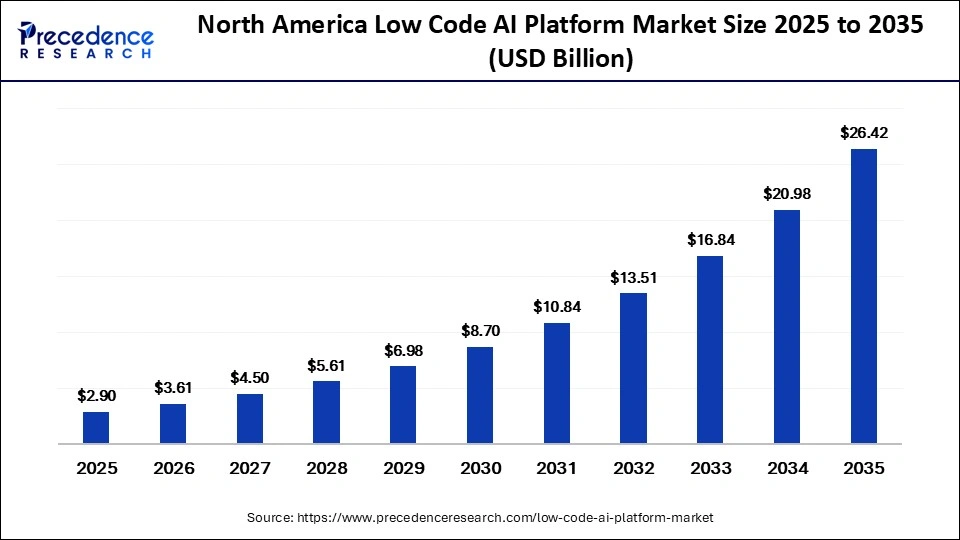
The North America low code AI platform market size is estimated at USD 2.90 billion in 2025 and is projected to reach approximately USD 26.42 billion by 2035, with a 24.72% CAGR from 2026 to 2035.
North America Held the Largest Market Share of 46% in 2025
North America dominated the low code AI platform market with the highest market share of 46% in 2025 due to the combination of factors like the presence of market leaders, early adoption of AI, massive investment in R&D for AI development, a supportive ecosystem and increasing industry demand for low-code AI platform.
The region is majorly dominated by key players, such as Salesforce, Microsoft, and OutSystems. A robust digital transformation, government-supported policies, and innovative ways to develop AI systems show a growing trend towards low-code AI platforms. The region witnesses a diverse application of low-code AI platforms in various sectors like e-commerce, social and communication areas, online education, and IoT.
U.S. Low Code AI Platform Market Size and Growth 2026 to 2035
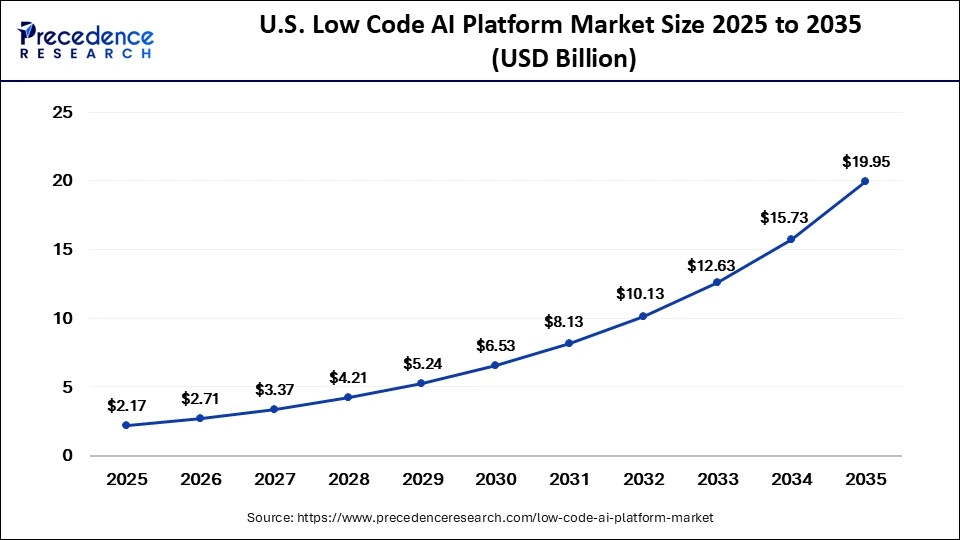
The U.S. low code AI platform market size is calculated at USD 2.17 billion in 2025 and is expected to reach nearly USD 19.95 billion in 2035, accelerating at a strong CAGR of 24.84% between 2026 and 2035.
U.S. Market Analysis
The U.S. is a major contributor to the market growth in North America, owing to the high concentration of tech leaders, emerging initiatives like citizen developers, and well-established digital infrastructure. The U.S. holds a highly mature IT infrastructure that allows easy integration of low-code AI platforms with legacy systems. Also, a shortage of skilled software developers in the region has led organizations to opt for low-code tools.
Asia-Pacific is Expected to Grow at the Fastest CAGR Of 30.5% During the Foreseeable Period
The region is rapidly growing in the low code AI platform market due to the massive digitalization across the leading countries in the Asia-Pacific, government-backed AI initiatives, and an urgent need to automate complex organizational processes. Small and medium enterprises in the region are heavily adopting low-code AI platforms to bridge the gap between skilled professionals and leverage low-cost applications. Additionally, the widespread adoption of cloud computing and the expansion of 5G in the region are further supporting an easy integration of low-code AI platforms with existing infrastructure.
China Market Analysis
China is significantly growing in the market due to the intense government support for AI development, huge transformation in terms of digitalization, and addressing the acute talent shortages. The Chinese government is encouraging organizations to integrate AI into sectors like healthcare, manufacturing, and finance. By using a low-code AI platform, enterprises can reduce project delivery cycles by nearly 70% as compared to the conventional development process, supporting the market growth in China.
Europe Held the Market Share of 24% in 2025 and is Expected to Grow at a CAGR Of 21.5% in the Coming Years
The region is witnessing a significant growth in the low code AI platform market due to the faster digital transformation, strong regulatory compliance like GDPR for data safety, and increasing demand for local AI solutions with sovereignty. European organizations are also experiencing critical shortages of skilled AI professionals and software developers, compelling them to adopt low-code AI platforms to stay competitive in the market
Germany Market Trends
Germany is one of the significant contributors to the low-code AI platform growth in European region, owing to the massive digitalization and expansion of the Industry 4.0 with cost efficiency and speed. Many organizations in Germany are leveraging low-code tools to minimize application development costs and reduce time-to-market for new products. The government is also supporting AI adoption via AI strategy and digital sovereignty with widespread AI implementation.
Low Code AI Platform Market Companies
- Microsoft
- Google Cloud
- Amazon Web Services
- IBM
- Salesforce
- Oracle
- SAP
- ServiceNow
- Appian
- OutSystems
- Mendix
- Zoho
- DataRobot
- H2O.ai
- UiPath
Recent Developments
- In February 2026, Deloitte India announced the launch of an indigenous and next-generation low-cod platform called, Gen W.AI, aiming to create codes easily accessible and enable organizations to rapidly prototype and deploy various applications and AI agents.(Source: https://www.deccanherald.com)
- In January 2026, DataSapien introduced a software development kit (SDK) for mobile development for on-device AI applications. AI apps play a crucial role in data processing within a device and use small language models with personal data storage to keep everything on the device.(Source: https://thenewstack.io)
- In August 2025, Workday acquired a low-code platform, Flowise, which is popular for the development of AI agents. By taking this strategic step, Workday aims to strengthen its roots globally for AI-based business solutions.(Source: https://www.techzine.eu)
Segments Covered in the Report
By Deployment Model
- Cloud-based
- On-premises
By Technology
- Machine Learning Platforms
- Natural Language Processing (NLP)
- Computer Vision
- Predictive Analytics
- Generative AI Integration
By Application
- Customer Experience Management
- Process Automation
- Fraud Detection
- Predictive Maintenance
- Sales and Marketing Automation
By End-Use Industry
- BFSI
- IT and Telecom
- Healthcare
- Retail and E-commerce
- Manufacturing
- Government
By Region
- North America
- Latin America
- Europe
- Asia-pacific
- Middle and East Africa
For inquiries regarding discounts, bulk purchases, or customization requests, please contact us at sales@precedenceresearch.com
Frequently Asked Questions
Tags





Ask For Sample
No cookie-cutter, only authentic analysis – take the 1st step to become a Precedence Research client
 Get a Sample




 sales@precedenceresearch.com
 Schedule a Meeting
