



Massage Equipment Market Size, Key Companies, Company Market Share, Patient Volume, Treatment Adoption Rates, Pricing Analysis, Regulatory Landscape, Competitive Positioning, and Demand Forecast
The massage equipment market reached USD 13.27 billion in 2026. The market growth is attributed to the rising demand for at-home personal care and the widespread availability of portable massage equipment. Our Senior Research Analyst, Deepa Pandey, evaluated these trends to curate this report. Her report benefits multiple stakeholders, including manufacturers, investors, distributors, raw material suppliers, and spas, hotels, fitness centers, and wellness operators.
Source: https://www.precedenceresearch.com/massage-equipment-market
 Get a Sample
 Report Description


Massage Equipment Market Demand, Size and Growth Rate Forecast 2035
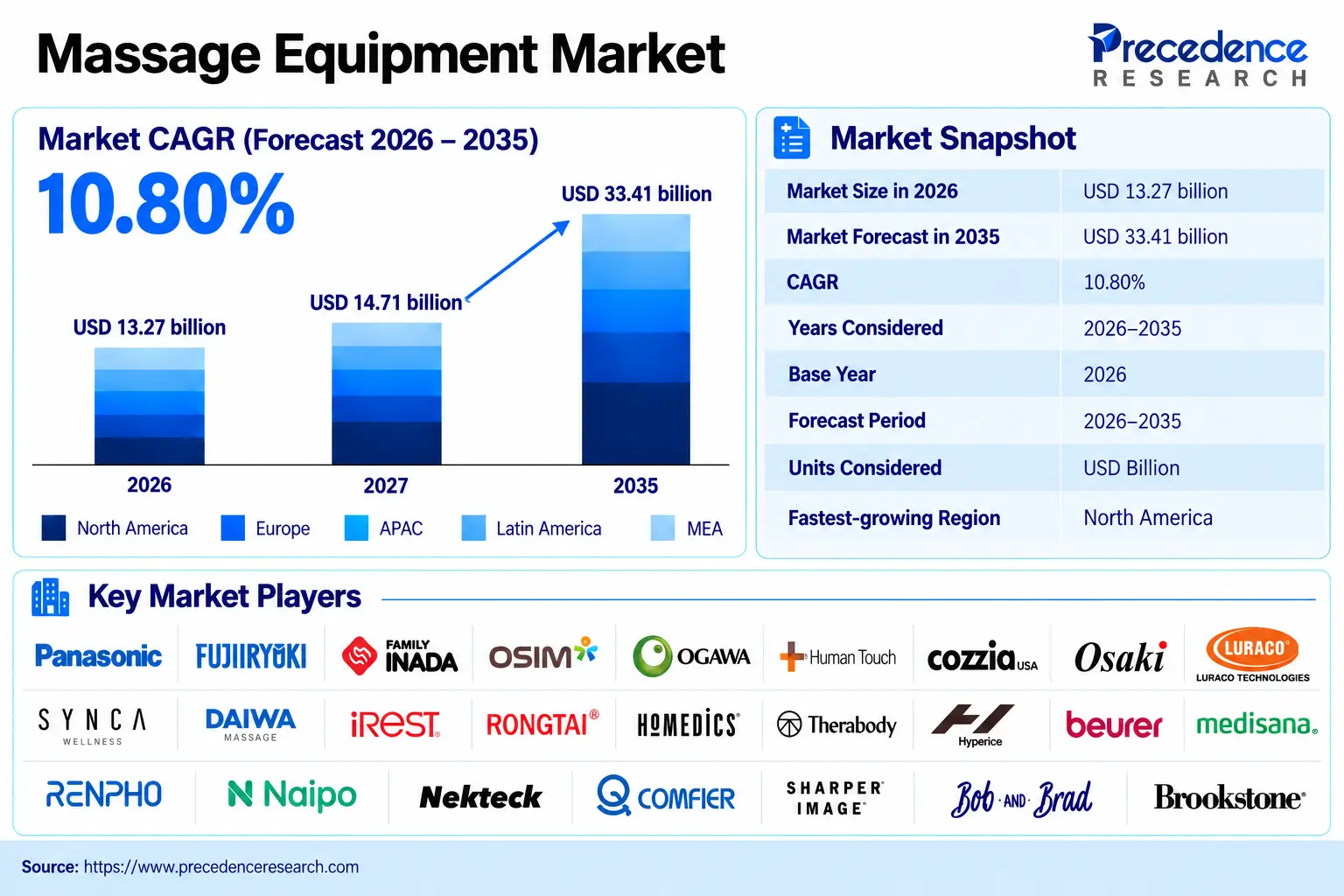
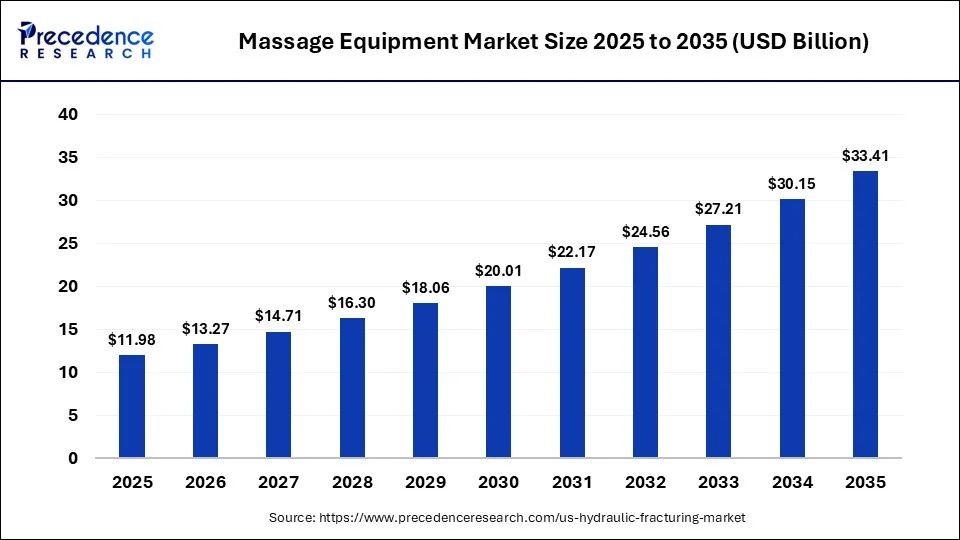
The global massage equipment market is forecasted to expand from USD 13.27 billion in 2026 to USD 33.41 billion by 2035, growing at a CAGR of 10.80% from 2026 to 2035.
Key Takeaways
Market Size & Growth Outlook
- Market size in 2026: USD 13.27 billion
- Estimated market size in 2027: USD 14.70 billion
- Projected market size by 2035: 33.41
- CAGR (2027–2036): 10.80%
Regional Market Spotlight
- North America share in 2026: 35%
- Asia Pacific share in 2026: 28%
- Europe share in 2026: 27%
Segmental Spotlight
- Massage chairs and sofas segment share in 2026: 40.7%
- Residential segment share in 2026: 55%
- Electric operating mechanism segment share in 2026: 68%
Massage Equipment Market Size 2026 to 2035
The global massage equipment industry is experiencing steady growth due to increasing consumer interest in personal wellness, muscle recovery, and at-home relaxation. Rising demand for advanced massage chairs, portable massagers, and electric massage devices is expected to support industry expansion throughout the forecast period.
North America continues to play an important role in generating revenues, being fueled by buying power, wellness channels of distribution, and premium home equipment demand. Asia Pacific is strategically important as both a manufacturing base and a consumer growth market, with opportunities arising from urbanization, expanding middle-class expenditure, and established massage and wellness practices.
The central commercial insight is that unit growth and revenue growth do not necessarily occur in the same product categories. A good quality massage chair can earn money that could be equal to several low-end massaging devices, whereas mobile massagers can have a wider consumer base. The companies need to take into account the average selling price (ASP), the number of units shipped, the number of repurchases, channel dynamics, and the replacement cycle of the product, and not just the income.
The report examines the market development up to 2035, focusing on the product mix, the difference between domestic and business demand, direct-to-consumer sales, intelligent massaging technologies, manufacturing dynamics, and the benefits of reputation and quality after-sales services.
What is the Significance of Massage Equipment?
The global massage equipment market is transitioning from a predominantly comfort-oriented appliance category into a broader wellness, recovery, and at-home personal care ecosystem. Demand spans full-body massage chairs, handheld percussion devices, neck and shoulder massagers, foot massagers, massage cushions, and professional treatment equipment. The market is based on two different economic models: expensive items that will yield a lot of money per unit sold and cheaper and smaller items that will yield money based on their mass production and increased consumption.
Coverage Highlights
- Global market size reconciliation, historical performance, and 2026 baseline.
- Product revenue distribution and premium-versus-volume growth dynamics.
- Residential, commercial, wellness, rehabilitation, and professional applications.
- Regional demand, manufacturing concentration, and distribution economics.
- Product pricing, gross-margin drivers, and replacement-cycle analysis.
- Competitive positioning, market-share estimation, and emerging white spaces.
Massage Equipment Market Segments Analysis
Massage Equipment Market by Product 2026 Share & Size
| Segments | 2026 Share | Market Value (USD Billion) |
| Massage Chairs and Sofas | 40.70% | 5.4 |
| Handheld, Neck and Shoulder Massagers | 25.00% | 3.32 |
| Back and Foot Massagers | 17.00% | 2.26 |
| Massage Cushions and Pads | 9.00% | 1.19 |
| Massage Beds, Tables and Other Equipment | 8.30% | 1.1 |
Source: Expert Interview, Secondary Sources, Precedence Research Database, Precedence Research Analysts and Researcher.
Massage chairs and sofas lead the segment with a reported 40.7% share, supported by demand for premium at-home wellness and full-body massage experiences.
Massage Equipment Market by Operating Mechanism 2026 Share & Size
| Segments | 2026 Share | Market Value (USD Billion) |
| Electric | 68% | 9.02 |
| Battery-Powered | 24% | 3.18 |
| Manual and Non-Electric | 8% | 1.06 |
Source: Expert Interview, Secondary Sources, Precedence Research Database, Precedence Research Analysts and Researcher.
Electric equipment is estimated to dominate due to its automated massage functions, adjustable intensity and suitability for home and commercial use.
Massage Equipment Market by Technology 2026 Share & Size
| Segments | 2026 Share | Market Value (USD Billion) |
| Vibration and Percussion | 30% | 3.98 |
| Kneading and Rolling | 25% | 3.32 |
| Air Compression | 12% | 1.59 |
| Heat-Assisted | 10% | 1.33 |
| Multi-Function Systems | 23% | 3.05 |
Source: Expert Interview, Secondary Sources, Precedence Research Database, Precedence Research Analysts and Researcher.
Vibration and percussion technologies are estimated to hold a leading combined share, supported by demand for muscle relaxation and post-exercise recovery devices.
Massage Equipment Market by Application 2026 Share & Size
| Segments | 2026 Share | Market Value (USD Billion) |
| Relaxation and Stress Management | 32% | 4.25 |
| Muscle Recovery | 24% | 3.18 |
| Targeted Body Relief | 20% | 2.65 |
| Professional Massage | 14% | 1.86 |
| Wellness and Rehabilitation Support | 10% | 1.33 |
Source: Expert Interview, Secondary Sources, Precedence Research Database, Precedence Research Analysts and Researcher.
Relaxation and stress management is estimated to lead as consumers increasingly incorporate massage products into their personal wellness routines.
Massage Equipment Market by End User 2026 Share & Size
| Segments | 2026 Share | Market Value (USD Billion) |
| Residential | 55% | 7.3 |
| Commercial Wellness, Spas and Salons | 25% | 3.32 |
| Fitness and Sports Facilities | 12% | 1.59 |
| Clinics and Rehabilitation Settings | 8% | 1.06 |
Source: Expert Interview, Secondary Sources, Precedence Research Database, Precedence Research Analysts and Researcher.
Residential users are estimated to represent the largest segment, driven by at-home convenience and growing interest in personal wellness equipment.
Massage Equipment Market by Price Tier 2026 Share & Size
| Segments | 2026 Share | Market Value (USD Billion) |
| Entry-Level | 22% | 2.92 |
| Mid-Range | 35% | 4.64 |
| Premium | 28% | 3.72 |
| Professional and Institutional | 15% | 1.99 |
Source: Expert Interview, Secondary Sources, Precedence Research Database, Precedence Research Analysts and Researcher.
Mid-range equipment is estimated to lead because it balances affordability, functionality and product quality for a broad customer base.
Massage Equipment Market by Distribution 2026 Share & Size
| Segments | 2026 Share | Market Value (USD Billion) |
| E-commerce Marketplaces and Brand-Owned Online Channels | 42% | 5.57 |
| Specialist Retailers | 20% | 2.65 |
| Electronics and Appliance Stores | 15% | 1.99 |
| Distributors | 13% | 1.73 |
| Direct Institutional Sales | 10% | 1.33 |
Source: Expert Interview, Secondary Sources, Precedence Research Database, Precedence Research Analysts and Researcher.
Online channels are estimated to lead distribution as consumers increasingly use digital platforms to compare features, prices and customer reviews.
Massage Equipment Market by Region 2026 Share & Size
| Segments | 2026 Share | Market Value (USD Billion) |
| North America | 35% | 4.64 |
| Europe | 27% | 3.58 |
| Asia-Pacific | 28% | 3.72 |
| Latin America | 5% | 0.66 |
| Middle East and Africa | 5% | 0.66 |
Source: Expert Interview, Secondary Sources, Precedence Research Database, Precedence Research Analysts and Researcher.
North America is estimated to lead in revenue, supported by purchasing power, premium massage equipment demand and established wellness distribution channels. Asia-Pacific remains important for manufacturing and consumer growth.
Which Segments Have the Highest Demand in the Massage Equipment Market?
The product structure is economically differentiated. Massage chairs and sofas represented approximately 40.7% of market revenue in one 2026 estimate. The use of handheld massagers is seen as a fast-growing segment owing to the portable nature of these massagers and easier purchase options.
Massage chairs are the leading high-value product category, whereas handheld and targeted massagers are positioned to expand customer reach. Foot, neck, and shoulder products offer an intermediate model: more affordable than full-body chairs but capable of supporting specialized product differentiation.
The detailed analysis takes into account the figures per segment in terms of revenues, market share, volume shipped, average selling price, CAGR forecast, and growth increment contribution to the market. This analysis further identifies the fastest-growing product and pricing combinations and evaluates the impact of emerging categories in terms of their ability to create demand versus cannibalize existing equipment sales.
What are the Key Drivers and Challenges of the Massage Equipment Market?
Opportunities include sedentary work patterns, health consciousness of consumers, recovery after exercise, aging, and convenient at-home massaging. In addition, digital shopping channels have lowered the cost of discovery and increased accessibility of specialized appliances, which are not found at general appliance stores.
Despite this, however, massage apparatuses are an optional item for many families. Top-of-the-line chairs have issues of affordability, shipping and installation costs, space constraints, and lengthy replacement periods. Budget-friendly equipment faces another kind of challenge: imitation, lack of differentiation, poor quality, and cutthroat online prices.
These include functionality, ease of use, ergonomic factors, quietness, battery life, intensity control, and safety. Other considerations for commercial consumers are utilization, maintainability, warranty, and overall cost of ownership.
The development and marketing of the product must be based on the buying motive. Premium chairs compete on experience, comfort, customization, and reliability; portable devices compete on convenience, portability, targeted performance, and price.
Coverage Highlights
- Consumer wellness and at-home usage drivers.
- Premiumization versus affordability pressures.
- Replacement cycles, durability, and product failure risks.
- E-commerce expansion and online discounting.
- Sports recovery and commercial wellness opportunities.
- Customer expectations around safety, usability, and warranty support.
What Does the Pricing Analysis of the Massage Equipment Market Indicate?
The prices of massage machine products will be based on their level of intricacy, quality of the motor and actuator, coverage, heating capacity, upholstery material, presence of sensors and control system, and warranty.
Indicative retail price bands for commercial planning are:
| Product category | Indicative retail price (USD) | Key pricing determinants |
| Basic handheld massagers | $15-60 | Motor, battery, attachments |
| Premium percussion massagers | $80-400 | Stall force, speed settings, noise, battery life |
| Neck, shoulder and back massagers | $25-200 | Coverage, heat, ergonomics |
| Foot massagers | $40-300 | Kneading, compression, heat |
| Massage cushions and pads | $25-180 | Coverage, portability, control features |
| Entry-level massage chairs | $500-1,500 | Basic rollers, airbags, adjustment |
| Mid-range massage chairs | $1,500-4,000 | Body scanning, expanded coverage, multiple programs |
| Premium massage chairs | $4,000-10,000+ | Advanced mechanisms, customization, finish and service |
These are indicative consumer-facing price bands for market segmentation, not audited 2025 global ASPs. The actual price point is based on country, brand, product mix, taxes, promotional activities, and distribution channel.
Pricing power exists when there is an obvious difference in the feeling of comfort, dependability, or functionality. In the low-end segment, product specifications can be identical, thus creating competition through pricing. In the high-end chair category, high freight cost, demonstration in showrooms, installation, and warranty can contribute to greater pricing power.
Manufacturing economies depend on motors, controller board, power supply, rollers, airbags, frame, covering, batteries, assembly labor, packing, cost of shipment, returns, and warranties. Unit-cost and gross margin information on a comparative basis is limited to public sources; thus the profitability assessment should rely on disclosed figures and estimates.
Coverage Highlights
- Product-level retail pricing and ASP segmentation.
- Premium, mid-range, and entry-level price bands.
- Cost of components, transportation, installation, and warranty.
- Online versus specialist-retail pricing differences.
- Discounts, promotion, and price elasticity.
- Gross-margin drivers and price-pass-through sensitivity.
Why is Scale in Manufacturing More Important Than Simple Capacity?
The supply base combines specialized massage chair manufacturers, consumer electronics companies, portable device brands, contract manufacturers, and suppliers of motors, controllers, mechanical assemblies, upholstery, and batteries. Asia-based production is strategically important, particularly for cost-efficient assembly and component sourcing, while North America and Europe provide important premium consumer and institutional markets.
Unlike bulk material industries, massage equipment lacks a consistently disclosed global production capacity measure. The relevant measures are annual shipments, production volume, back orders, inventory levels, utilization, parts availability, lead times, return rates, and geographical distribution network.
Though the supply may be abundant for basic portable goods, premium seating is quite challenging in the realms of logistics, installations, servicing, and inventory financing. This means that overproduction of inventory can co-exist with a lack of infrastructure for special services.
The study focuses on regional supply and demand, import risks, manufacturing risks, risks associated with concentration of suppliers and local production economic risks. It also looks at production commitments against real production, wherever company disclosure permits.
Why Do Components, Product Design and After-Sales Service Determine Value Capture?
The value chain begins with motors, gears, rollers, electronics, sensors, batteries, frame assembly, cushioning, upholsteries, and packaging. These components are manufactured through mechanical engineering, electronic engineering, programming and controls engineering, manufacturing, and quality control.
The value is created through branding, differentiation, distribution, installation, warranty, accessories, and services. In the case of premium chairs, transportation and at-home installation can have a real impact on contribution margins; for portable products, marketplace fees, customer acquisition, return costs, and warranty replacement may eat up much of the margin on sales price advantage.
The greatest bargaining power of suppliers is in those parts that need to be engineered to specific tolerances or reliability. Buyers will have more negotiating power in cases where there are several factories able to manufacture the same designs. Unique mechanisms and good quality control and service make brands harder to price-compare directly.
The whole value chain analysis will cover all issues from component procurement, assembly economics, inventory funding, distribution channels, and warranty costs, and vertical integration/dual sourcing opportunities.
What are the Technological Innovations of the Massage Equipment Market?
Innovation is shifting from basic vibration and fixed massage programs toward more adaptable and personalized equipment. Innovations in technology comprise body scanning, adjustable roller tracks, multiple joint movement, varying levels of percussion intensity, air pressure, heating abilities, mobile application, voice control, and silent motors.
The success of these innovations depends on how they benefit the consumer. Sensors that aid in better positioning, mechanisms that fit various body forms, and interfaces that make operation simpler can help in premium positioning. Nevertheless, incorporation of the connectivity technology in the massage devices without improving their reliability and usability will only increase costs without offering the price advantages.
Portable massagers have better battery performance, compactness, interchangeable components, ergonomic design, and silent motor. The professional massagers emphasize adjustability, robustness, cleanability, and repeatability.
Benchmarking is carried out based on patents where applicable, new product launches, spending on R&D, adoption of features, joint developments, and commercialization differences between the premium and standard versions.
What is the Regulatory Landscape of the Massage Equipment Market?
There are various types of product-safety requirements for electrical massage appliances, depending on the jurisdiction and intended use. The IEC 60335-2-32:2024 standard relates to household and similar electrical massage appliances such as massage chairs, foot massagers, hand-held appliances, belts, pads, and massage beds. Other standards may apply to medical-purpose devices.
The implications of commercial considerations involve the certification that concerns electrical safety, electromagnetic compatibility, transport of batteries, labeling, prohibited substances, consumer protection, warranty, and disposal of electronic goods. Statements that imply treatment and prevention of disease may result in regulations.
Sustainability is considered with regard to product life span, repairability, packaging, battery replaceability, spare parts availability, and electronic waste. Equipment that lasts longer may be cheaper in terms of lifetime cost for the consumer, while modular parts make it possible to avoid replacing the whole appliance in case of local failure.
Who are the Prominent Consumers of the Massage Equipment?
Buyers of residential properties tend to evaluate the cost, comfort, space needs, convenience of operation, testimonials, warranty, and aesthetics. Commercial customers, including spas, wellness centres, hotels, fitness facilities, and professional massage providers, place greater emphasis on durability, service response, cleaning, uptime, and cost per use.
Professional and rehabilitation settings require particular care in product positioning: consumer wellness equipment should not automatically be treated as clinically validated therapeutic equipment. For medical claims or regulated applications, intended use criteria and substantiation are important factors in the purchasing decision.
The study evaluates customer preference, application growth, procurement practices, economic channel characteristics, and underserved needs in small-space living, senior citizens, sports recovery, hospitality, and high-usage commercial environments.
How Do Market Players Compete on Different Economics in the Massage Equipment Market?
The global market is fragmented across product categories, with competition distributed among premium massage chair specialists, high-volume manufacturing companies, consumer wellness brands, portable recovery device specialists, and private-label suppliers. These competitive advantages depend on the type: premium chairs compete in terms of the sophistication of their massage mechanisms, comfort, durability, demonstrations, and after-sales service; manufacturers in terms of economies of scale in production and efficient logistics and marketing; and portable devices in terms of ergonomics, battery life, portability, and online marketing. The market does not have a single, universally applicable competitive leadership model. Rather, competitiveness hinges on economies unique to the category, customer expectations, product differentiation, and distribution channels.
Revenue ranking is an unreliable way to evaluate competitiveness because premium massage chairs produce much higher revenue per unit compared to handheld percussion devices, and portable devices operate on the basis of shipment volume and higher online presence.
Likewise, consolidated corporate revenue overstates the significance of the company if massage equipment is just a part of its operations. The problem with making unsupported claims about market shares of companies that are competing in the massage equipment market is the lack of comparable sales figures, shipment volume, and market shares among competitors.
Therefore, the primary implication that arises from this discussion is the requirement to evaluate both the income and coverage aspects of competition when conducting benchmarking studies. Companies that rely on premium products must be evaluated based on their pricing, differentiation, service capability, and retention while volume-driven and online competitors have to be assessed based on shipment scale, production capability, channel economics, and customer acquisition. This difference matters significantly during investment decision-making, entering into markets, and evaluating acquisition candidates for existing firms.
The full study offers a competitive analysis that includes the following areas: positioning in the product category, differentiation of the business model, geographies of presence, distribution approach, production capacity, pricing tiers, technological differentiation, and strategic development initiatives. In cases where there is reliable data, the competitors are benchmarked by similar metrics like revenue in the segment, unit shipments, ASP, product range, and geographical presence.
The competitive intelligence database can be an addition to the above study and include information about a company/brand at the product category, model, price tier, technology characteristics, geographies, distribution channels, revenue indicators, and year of reporting. The user can filter competitors in certain categories and differentiate between actual figures and assumptions.
Tentative Leading Company Universe
The following universe is intended for research coverage, not a validated ranking by global market share. Inclusion reflects product relevance and participation in one or more major massage-equipment categories.
| Company | Headquarters | Market position | Core strength and major segments |
| Panasonic | Osaka, Japan | Established diversified manufacturer | Massage chairs, consumer electronics |
| Fujiiryoki | Osaka, Japan | Massage-chair specialist | Premium chairs and massage mechanisms |
| Family Inada | Osaka, Japan | Premium specialist | Full-body massage chairs |
| OSIM | Singapore | Premium wellness brand | Massage chairs and lifestyle wellness |
| OGAWA | Malaysia | Regional wellness brand | Massage chairs and consumer massagers |
| Human Touch | United States | Premium wellness equipment | Massage chairs and seating |
| Cozzia USA | United States | Chair specialist | Premium and mid-range massage chairs |
| Osaki | United States | Broad chair portfolio | Multiple price tiers and chair configurations |
| Luraco Technologies | United States | Technology-focused specialist | Premium chairs and massage systems |
| Synca Wellness | United States | Premium wellness brand | Massage chairs and compact equipment |
| Daiwa Massage | United States | Chair-focused brand | Full-body massage chairs |
| iRest | China | Manufacturing-oriented participant | Massage chairs and wellness equipment |
| Rongtai | China | Established equipment manufacturer | Massage chairs and massage mechanisms |
| HoMedics | United States | Consumer-wellness brand | Neck, back, foot, and handheld massagers |
| Therabody | United States | Recovery technology brand | Percussion and targeted recovery devices |
| Hyperice | United States | Sports-recovery specialist | Percussion and recovery equipment |
| Beurer | Germany | Consumer health and wellness | Foot, neck, and handheld massagers |
| Medisana | Germany | Personal-health equipment | Consumer massage and wellness devices |
| RENPHO | United States | Digital-first wellness brand | Foot, eye, back, and handheld devices |
| Naipo | International online-oriented brand | Portable-equipment specialist | Neck, back, and foot massagers |
| Nekteck | United States-oriented consumer brand | Value-oriented participant | Neck and back massagers |
| Comfier | International online-oriented brand | Broad consumer-device portfolio | Foot, back, and cushion massagers |
| Sharper Image | United States | Consumer lifestyle brand | Massage and personal-comfort products |
| Bob and Brad | United States | Recovery-focused brand | Percussion massagers and targeted devices |
| Brookstone | United States | Consumer lifestyle brand | Massage chairs and personal-wellness products |
Headquarters and brand ownership should be verified at the legal-entity level during detailed profiling, particularly for internationally distributed brands and businesses operating through licensing or regional distribution arrangements.
What is the Market Share & Competitive Ranking of the Massage Equipment Market?
The accurate global ranking of companies calls for a consistent set of data on massage equipment sales revenue, outsourced manufacturing, regional sales volumes, and category exposure levels. These data are not consistently reported, and therefore giving exact market shares to each brand would be a case of spurious precision.
The market share framework distinguishes:
- Top five and top ten brand shares: Estimated only after aligning brand revenue, product scope, and geographic coverage.
- Chair category concentration: Evaluated separately from handheld, foot, neck, and back massagers.
- Regional concentration: Considers if there is regional concentration of premium items, local brands, or foreign devices.
- Long-tail participation: Accounts for small brands, private label items, third-party sales, and unbranded products.
In the comprehensive analysis, company market share as a percentage of the denominator market will be considered, along with the opportunities for increasing and reducing market share. Concentration measures such as CR5, CR10, and the Herfindahl-Hirschman Index can be calculated when sufficiently comparable company-level estimates are available.
What Does the Competitive Benchmarking of the Massage Equipment Market Indicate?
| Benchmarking dimension | Premium chair specialists | Portable recovery brands | Broad consumer-wellness brands | Manufacturing-oriented participants |
| Product depth | High in chair mechanisms | High in targeted devices | Broad across everyday products | Depends on OEM and brand mix |
| ASP potential | High | Low to high | Low to mid-range | Depends on customer and configuration |
| Manufacturing scale | Variable | Variable | Often outsourced or mixed | Potentially strong |
| Brand differentiation | Comfort and experience | Performance and portability | Accessibility and convenience | Cost, engineering, and supply reliability |
| Channel strategy | Showrooms and specialist retail | E-commerce and sports channels | Retail and online | OEM, wholesale, and branded sales |
| Service requirements | High | Moderate | Moderate | Customer-dependent |
| Key competitive risk | High-ticket affordability | Imitation and price pressure | Product commoditization | Customer concentration |
The most defensible advantages arise from a combination of reliable mechanisms, product differentiation, credible quality assurance, effective warranty management, and channel access. Product diversification may help to increase effectiveness in distribution channels but is not enough to make a company a technological leader.
What Makes Complete Body Coverage and Certain Muscle Relaxation Require Unique Abilities?
Chair makers differentiate themselves based on roller design, body scan capability, reclining mechanism, intensity adjustment, heat treatment, air compression, and personal programs. Portable device brands differentiate through motor performance, battery life, attachments, ergonomics, noise, and portability. Consumer-wellness brands often span several targeted body areas and price tiers.
Benchmarking of the portfolio involves identifying companies that have a high level of product category breadth, premium positioning, entry-level breadth, and product deficiencies within underserved pricing segments. It also includes an analysis of the availability of accessories, replacement parts, warranties, and commonality of components between product extensions.
The most important strategic issue is to understand whether the breadth of the product portfolio offers any kind of cross-selling or cost advantage.
How Does Adaptive Massage and Better Usability Create the Next Differentiation Layer?
The technological comparison will focus on sensor alignment, rolling technology, percussion, compression, heating, product compatibility, and noise created by motors. The technological comparison will also involve the frequency at which products are released into the market, R&D spending, patents, engineering collaborations, and availability in the market.
High-end manufacturers of chairs have scope for improvement in terms of greater customizability and minimizing the difference between perception and usability. Device makers for portable units have room to differentiate themselves through noise reduction, power management, variable force, and instructions.
Patent counts alone are not a reliable proxy for commercial leadership. The analysis distinguishes between ownership of patents and commercialization of technologies and assesses if features contribute to any benefits that can be measured or protected.
How Do the Benefits of Regional Manufacturing and Localization Affect Competitive Economics in the Massage Equipment Industry?
Asia Pacific combines important manufacturing capabilities with established consumer demand. Although North America is significant regarding premium products and direct marketing, Europe focuses on quality, safety compliance, and the availability of distribution networks.
Benchmarking is the process that includes analysis of where manufacturing happens, sales locations, distributors, business partners, and the local product portfolio. It also includes analysis of whether the manufacturer competes by exporting its products, establishing its subsidiaries and manufacturing plants in the target country, or establishing distribution partners in the target country.
Product localization is a good strategy to apply if there are significant costs associated with the transportation of bulk products such as chairs, high cost of installation, and high tariffs; but when it comes to portable products, marketplace selling reduces the barrier of entry into the market.
How Does Factory Scale Translate into Quality and Deliverable Output?
Comparisons of manufacturing are made on the basis of facility size, production capacity revealed, production quantity, usage rate, assembling, procurement, and further production capacity revealed. In case where production capacity is not revealed, then it is a comparison between known facilities and manufacturing links.
Capacities needed for chair manufacture are fabrication, assembly, electronics assembly, upholstery, testing, packaging, and transportation preparations. Portable devices depend more heavily on compact motor assemblies, batteries, electronic controls, plastics, and high-volume final assembly.
But capacity alone will not guarantee competitive advantage. Low utilization of capacity, low-quality production, warranty problems, and high inventory levels can all affect the value of economies of scale. Therefore, this analysis also considers manufacturing flexibility, defect rate where possible, lead time, and localization possibilities.
What are the Strategic Developments of Massage Equipment?
Strategic activities are measured for the last three years with respect to product launches, distribution partnerships, geographical extension, manufacturing, technology, and brand portfolio extension.
The important development areas that have been identified include premium chair enhancement, penetration into portable recovery equipment, connectivity, and online distribution growth. For each of these developments, the information on the date of the announcement, value of the investment/transaction (if known), type of product and geographical area involved, and commercial reasons for the development are recorded.
Strategic activities are classified into announcements and achievements. It is important to note the distinction between the two, as an announcement or an intended increase in capacity may not result in any business success.
What Does the M&A Landscape of the Massage Equipment Market Indicate?
Consolidation could come from mergers and acquisitions of portable recovery brands, wellness product offerings, massage chair technology, and regional distributors. Portfolio growth would facilitate channel penetration and diversification of products, while technology acquisition could speed up the process of product innovation.
The assessment follows known deals, ownership transfers, licensing, and significant partnerships. Deal value and the revenue of the target are noted, along with the reasoning behind the deal and the product category exposure.
Privately branded production and fragmented ownership could create potential for consolidation; however, the appeal of such an acquisition would depend upon customer loyalty, intellectual property protection, manufacturing standards, warranties, and distribution channel integration.
How are Different Competitors Positioned to Win Different Parts of the Market?
The strategic leaders within the market may not be the ones who have the widest portfolios. Chair producers who have positioning as premium may use engineering and experience as an excuse for setting high prices, while the producers of portable equipment may thrive through digital marketing and innovations.
| Strategic category | Relevant positioning | Critical success factor |
| Premium chair leaders | Established chair specialists and premium wellness brands | Comfort, reliability, customization, service |
| Technology leaders | Engineering-led massage and recovery specialists | Product performance and meaningful innovation |
| Scale-oriented participants | Large manufacturers and diversified appliance businesses | Cost control, sourcing, manufacturing consistency |
| Digital-first growth leaders | Online-oriented portable-device brands | Customer acquisition, reviews, product quality |
| Regional leaders | Brands with strong local distribution | Localization, pricing, after-sales service |
| Emerging challengers | Specialized recovery and connected-device brands | Differentiation, customer retention, distribution expansion |
It evaluates competitive advantages and weaknesses through qualitative means without making up an artificial rating system. In the future, competitiveness will depend on the company's ability to keep performing well, remain profitable, and innovate commercially.
What are the Potential Opportunities and White Spaces of the Massage Equipment Market?
Actionable white spaces can be found at the intersection of affordability, usability, product dependability, and underserved applications.
- Compact premium equipment: Products that fit in urban homes where there is not enough space for a large chair.
- Mid-market massage chairs: Products that offer value in comfort and function without paying top-dollar premium prices.
- Portable recovery devices: Improved ergonomics, low noise, better battery life, and intensity settings.
- Commercial equipment: Products with modular components, service contracts, and known costs of ownership.
- Older consumer usability: Intuitive controls, ease of entry and exit, proper instructions, and intensity settings.
- Emerging market distribution: Pricing tailored to the local market, financial assistance, reliable warranty, and servicing network.
- Repairability and longevity: Availability of spare parts, modular design, and whole product replacement prevention.
The complete analysis takes into account these opportunities in relation to the product category, the customer segments, geography, and pricing category. There is a clear distinction made between incremental demand and substitution, for instance, where the use of a portable product substitutes for buying a chair.
How Do Moderate Supplier Power and Strong Buyer Choice Intensify Competitive Rivalry?
The analysis examines the effects that complexities of the product, substitute suppliers, brand loyalty, market concentration, and the services needed have on competition in the product line.
| Parameters | Level | Explanation |
| Supplier bargaining power | Medium | Specialized motors, control systems, batteries, and mechanical assemblies can create dependence on qualified suppliers. Alternative manufacturers and standardized parts mitigate this risk. |
| Buyer bargaining power | Medium-High | Online comparison, promotions, and numerous alternatives strengthen consumer choice. Premium chair purchases are less comparable when comfort, installation, and service differ materially. |
| Threat of new entrants | Medium | Online distribution lowers entry barriers for portable products. There is a lower degree of comparability in premium chairs that have different levels of comfort and installation. |
| Threat of substitutes | Medium-High | Manual massage, professional massage services, foam rollers, stretching equipment, and other recovery devices compete for overlapping consumer budgets. |
| Competitive rivalry | High | Product imitation, marketplace discounting, private labels, overlapping features, and fragmented brand participation place pressure on differentiation and margins. |
What is the PESTLE Analysis of the Massage Equipment Market?
| Factor | Implication for the massage equipment market |
| Political | Import duties, trade policy, and local manufacturing incentives influence sourcing decisions. |
| Economic | Discretionary income, consumer credit, freight costs, and currency movements affect affordability and margins. |
| Social | Interest in wellness, recovery, and convenient home-use products supports adoption. |
| Technological | Better sensors, motors, batteries, and controls create differentiation but increase engineering requirements. |
| Legal | Electrical safety, product claims, consumer protection, privacy, and warranty obligations affect market access. |
| Environmental | Packaging reduction, electronic-waste rules, battery disposal, and product repairability influence lifecycle costs. |
This report focuses on analyzing such variables based on geographic regions and product groups rather than taking into consideration the same regulatory and economic environment in all markets.
What are the Market Attractiveness Parameters of the Massage Equipment Market?
| Opportunity area | Indicative attractiveness | Principal consideration |
| Premium massage chairs | Attractive | High revenue per unit, balanced against affordability and service costs |
| Portable percussion devices | Attractive | Broad addressable customer base, with intense competition |
| Neck, back, and foot massagers | Attractive | Established consumer need and opportunities for differentiation |
| Commercial wellness equipment | Moderate–Attractive | Repeat-use potential, but greater durability and service requirements |
| Connected massage equipment | Moderate–Attractive | Personalization opportunities, subject to demonstrated customer value |
| Undifferentiated entry-level devices | Challenging | Price competition, imitation, and low switching barriers |
These classifications are directional assessments, not audited investment ratings. A complete examination puts them to the test of market growth, price realization, profitability, customer acquisition, competitive intensity, and investment needs.
Which Factors Will Drive the Next Phase of the Massage Equipment Market?
In the base case scenario, portable devices increase product reach while massage chairs continue to make up an important revenue stream. Mid-level products become important in the strategic context of balancing features and price points.
Under the upside case, better product usability, stronger consumer confidence, premiumization, and expanding commercial wellness adoption support faster growth. Engineering brands with good quality and proper distribution and service will be the most capable of taking advantage of this scenario.
In the downside scenario, discretionary spending constraints, discounting, commoditization, and poor replacement demand limit sales growth and profitability potential. Firms having undifferentiated products or high service costs will have increased margins pressure.
The most attractive future profit pools are likely to emerge where brands can demonstrate meaningful functional differentiation, reliable product performance, efficient distribution, and attractive lifetime ownership economics. Functional integration can be a key to differentiation, yet market success will hinge more on usability and value than simply the number of functions.
The complete forecast covers product revenues, regional dynamics, ASP evolution, channel changes, manufacturing economics, competitor entry, and consolidation out to 2035.
Key Strategic Questions
- What is the reconciled global massage equipment market size in 2026, and how does it change under alternative market definitions?
- How much revenue is generated by massage chairs, handheld devices, and targeted body massagers?
- What types of products and price points should grow the fastest?
- How does ASP, units shipped, product mix, and discount affect revenue growth?
- Where do we have the best combinations of demand, manufacturing capability, and distribution?
- How do manufacturing costs, parts costs, logistics, warranty, and distribution economics affect profit margins?
- What technologies create differentiation and what technologies create more complexity without any additional customer value?
- What buying criteria differ for residential and commercial customers?
- Which 25 companies are most relevant to the competitive landscape, and what are their principal strategic strengths?
- What company-level revenue and market-share estimates can be validated, and where are disclosure limitations material?
- What are the major differences among competitive companies regarding their product mix, technology, production, geography, and service?
- What distribution channels provide a good balance of attracting customers, managing prices, and providing services?
- Where are the most attractive white spaces across compact premium equipment, portable recovery, commercial applications, and emerging markets?
- What market environments, competition trends, and investments are most likely to influence industry performance through 2035?
Massage Equipment Market Segments
By Product
- Massage Chairs and Sofas
- Handheld Percussion Massagers
- Neck and Shoulder Massagers
- Back Massagers
- Foot Massagers
- Massage Cushions and Pads
- Massage Beds and Tables
- Other Equipment
By Operating Mechanism
- Electric
- Battery-Powered
- Manual and Non-Electric
By Technology
- Vibration
- Percussion
- Kneading and Rolling
- Air Compression
- Heat-Assisted
- Multi-Function Systems
By Application
- Relaxation and Stress Management
- Muscle Recovery
- Targeted Body Relief
- Professional Massage
- Wellness and Rehabilitation Support
By End User
- Residential
- Commercial Wellness
- Spas And Salons
- Fitness and Sports Facilities
- Clinics and Rehabilitation Settings
By Price Tier
- Entry-Level
- Mid-Range
- Premium
- Professional and Institutional
By Distribution
- E-commerce Marketplaces
- Brand-owned Online Channels
- Specialist Retailers
- Electronics and Appliance Stores
- Distributors
- Direct Institutional Sales
By Region
- North America
- Europe
- Asia Pacific
- Latin America
- Middle East and Africa
For inquiries regarding discounts, bulk purchases, or customization requests, please contact us at sales@precedenceresearch.com
Frequently Asked Questions





Ask For Sample
No cookie-cutter, only authentic analysis – take the 1st step to become a Precedence Research client
 Get a Sample




 sales@precedenceresearch.com
 Schedule a Meeting
