



Materials for Quantum Technologies Market Size, Companies, Share, Production Capacity, Raw Material Pricing, Export & Import Analysis, Manufacturing Cost, Competitive Positioning, and Demand Forecast
Materials for Quantum Technologies Market (By Material Type: Superconducting Materials, Semiconductor Materials, Photonic & Optical Materials, Topological Insulators, Diamond (NV-Center Based Materials), Two-Dimensional Materials, Rare Earth & Exotic Materials; By Quantum Technology Type: Quantum Computing, Quantum Communication, Quantum Sensing, Quantum Metrology; By Application: Quantum Processors & Chips, Quantum Sensors, Quantum Communication Networks, Quantum Imaging Systems, Quantum Simulation Platforms; By End-Use Industry: Research Institutes & Academia, Government & Defense, Information Technology & Telecommunications, Healthcare & Life Sciences, Automotive & Industrial) - Global Industry Analysis, Size, Trends, Leading Companies, Regional Outlook, and Forecast 2026 to 2035
Source: https://www.precedenceresearch.com/materials-for-quantum-technologies-market
 Get a Sample
 Table Of Content


What is the Materials for Quantum Technologies Market Size?
The global materials for quantum technologies market size accounted for USD 340 million in 2025 and is predicted to increase from USD 420 million in 2026 to approximately USD 3,060 million by 2035, expanding at a CAGR of 23.10% from 2026 to 2035. The growing demand for materials with unique quantum properties primarily drives the market for quantum-technology materials.
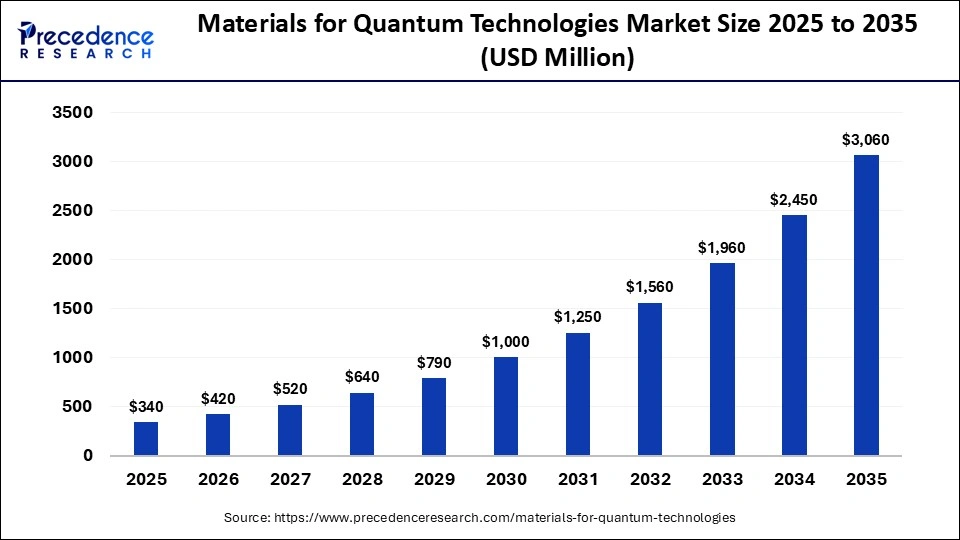
Market Highlights
- North America dominated the market, holding the largest market share in 2025.
- Asia Pacific is expected to expand at the fastest CAGR between 2026 and 2035.
- By material type, the superconducting materials segment held the largest market share in 2025.
- By material type, the two-dimensional (2D) materials segment is expected to grow at a remarkable CAGR between 2026 and 2035.
- By quantum technology type, the quantum computing segment contributed the highest market share in 2025.
- By quantum technology type, the quantum sensing segment is set to grow at a remarkable CAGR between 2026 and 2035.
- By application, the quantum processors & chips segment generated the biggest market share in 2025.
- By application, the quantum sensors segment is growing at a significant CAGR between 2026 and 2035.
- By end-user industry, the research institutes & academia segment held the largest market share in 2025.
- By end-user industry, the telecommunications segment is expected to expand at a remarkable growth rate of CAGR between 2026 and 2035.
Materials for Quantum Technologies Market Overview
The global materials for quantum technologies market includes specialized materials engineered to enable, enhance, and stabilize quantum systems used in quantum computing, quantum communication, quantum sensing, and quantum metrology. These materials are designed to operate reliably at atomic and subatomic scales, where quantum effects dominate system performance and stability.
Key material characteristics include superconductivity, long coherence times, low electrical and magnetic noise, controlled defect structures, and the ability to support quantum states such as entanglement. These properties are essential for maintaining qubit fidelity and minimizing decoherence during operation. The market underpins the development of quantum processors, qubit platforms, photonic and microwave circuits, quantum sensors, and cryogenic and vacuum systems required for controlled quantum environments.
How Are AI-Driven Innovations Reshaping the Materials for Quantum Technologies Market?
As AI technology continues to advance, its integration is playing a growing role in accelerating the development of materials for quantum technologies by improving how quantum materials are discovered, evaluated, and optimized. Artificial intelligence, particularly machine learning and generative models, enables researchers to analyze complex relationships between atomic structure, electronic behavior, and quantum performance that are difficult to capture through conventional modeling approaches.
Researchers increasingly use machine learning techniques and genetic algorithms to explore vast chemical and materials design spaces, identifying candidate materials with properties such as long coherence times, low defect densities, and stable superconducting behavior. This data-driven approach significantly reduces reliance on slow, trial-and-error laboratory experimentation. AI-powered models also support precise engineering of materials for qubits, quantum dots, and superconducting circuits by optimizing parameters such as composition, lattice structure, and fabrication tolerances, helping improve qubit stability, scalability, and overall quantum system performance.
Materials for Quantum Technologies Market Outlook
- Industry Growth Overview: Between 2025 and 2030, the industry is expected to grow at an accelerated pace. The growth of the market is driven by rapid digital transformation, driven by rising investments in quantum research & Development, a surge in government-funded quantum programs, and the increasing commercialization of next-generation quantum hardware.
- Global Expansion: Several leading players in the materials for quantum technologies market, such as IBM, Google, Microsoft, Amazon Web Services (AWS), and Intel, have undertaken numerous strategic initiatives for global expansion and to strengthen their market share, focusing heavily on cloud-based platforms, the establishment of research hubs, and strategic international partnerships with academic institutions and governments. For instance, in May 2025, IBM and Tata Consultancy Services announced a partnership to develop India's quantum computing industry as part of the State of Andhra Pradesh's Quantum Valley Tech Park, currently under construction in the capital city of Amaravati. The tech park will be anchored by an IBM Quantum System Two installation, with a 156-qubit Heron quantum processor, the largest quantum computer currently operational in India. Tata Consultancy Services has struck a partnership with IBM to support the development of algorithms and applications that will help the Indian industry and academia solve some of the nation's most challenging problems.
- Major Investors: Major investors and key players in the materials for quantum technologies market are primarily the well-capitalized tech giants and specialized firms. The significant investments are driving market expansion through breakthroughs in hardware, improvements in global infrastructure, and the formation of strategic partnerships/collaborations. For instance, in September 2025, PsiQuantum raised USD 1 billion in funding to build the world's first commercially useful, fault-tolerant quantum computers. This funding will enable the company to break ground on utility-scale quantum computing sites in Brisbane and Chicago and deploy large-scale prototype systems to validate the system's architecture and integration.
Market Scope
| Report Coverage | Details |
| Market Size in 2025 | USD 340 Million |
| Market Size in 2026 | USD 420 Million |
| Market Size by 2035 | USD 3,060 Million |
| Market Growth Rate from 2026 to 2035 | CAGR of 23.10% |
| Dominating Region | North America |
| Fastest Growing Region | Asia Pacific |
| Base Year | 2025 |
| Forecast Period | 2026 to 2035 |
| Segments Covered | Material Type, Quantum Technology Type, Application, End-Use Industry, and Region |
| Regions Covered | North America, Europe, Asia-Pacific, Latin America, and Middle East & Africa |
Segmental Insights
Material Type Insights
What Causes the Superconducting Materials Segment to Dominate the Materials for Quantum Technologies Market?
Superconducting Materials: This segment held the largest market share in 2025. The superconducting materials include niobium and aluminum (for superconducting qubits and circuits). Superconducting qubits are widely used by tech giants such as IBM, Google, and Rigetti, which rely on materials that exhibit superconductivity at low temperatures to create quantum states and perform gate operations. This material has low resistance, high conductivity, and stable quantum behavior at cryogenic temperatures.
Two-Dimensional (2D) Materials: This segment is expected to grow at a remarkable CAGR between 2026 and 2035. The major 2D Materials include Graphene, Transition Metal Dichalcogenides (TMDs), Hexagonal Boron Nitride (h-BN), Black Phosphorus (BP), and MXenes. Two-dimensional (2D) materials are enabling advances in quantum computing, quantum communication, and quantum sensing. Their atomically thin structure enables precise control over electron spin, charge transport, and photon-matter interactions, which is critical for developing low-noise qubits, single-photon emitters, and highly sensitive quantum sensors.
Quantum technology type Insights
Which segment is dominated by the quantum technology type in the materials for quantum technologies market?
Quantum Computing: This particular segment dominates the materials for quantum technologies market, holding the largest share. Quantum computing has the potential to deliver large benefits in computational tasks. Quantum computing is a multidisciplinary field that leverages the unique properties of quantum mechanics to solve complex problems faster than the most powerful classical computers. The field of quantum computing includes quantum hardware and quantum algorithms.
Quantum Sensing: The segment is the fastest-growing in the materials for quantum technologies industry. Quantum sensing technology provides unprecedented accuracy, sensitivity, and precision in detection and measurement, making it ideal for industries such as defense & aerospace, healthcare (especially in neuroscience and medical diagnostics), and automotive. Quantum sensing is an entirely separate quantum technology that provides its own quantum benefits. Quantum sensors operate on the principles of quantum mechanics.
Application Insights
Why are quantum processors & chips dominating the materials for quantum technologies market?
Quantum Processors & Chips: The quantum processors & chips segment dominates the materials for quantum technologies market, accounting for the majority of market share. The segment's growth is primarily driven by technology maturity and compatibility with existing semiconductor fabrication processes. Quantum computing chip serves as the processors for quantum computers. These quantum computing chips contain quantum bits, or qubits, quantum's key benefit over classical computing. These chips are made from superconducting circuits, trapped ions, photons, and silicon spins. Tech companies like IBM, Google, and Intel are increasingly focusing on building scalable, error-tolerant quantum hardware to solve complex problems in AI, drug discovery, and materials science.
Quantum Sensors: This segment is the fastest-growing in the materials for quantum technologies market, with the highest CAGR, owing to the growing trend toward developing chip-scale quantum sensors to reduce weight, size, and power for integration into autonomous vehicles and advanced drones. The key applications of quantum sensors include atomic clocks, advanced magnetic field sensing, next-gen navigation & positioning, and PAR quantum sensors. Quantum sensing is rapidly transforming industries by enabling measurements that are often impossible with classical technology, creating innovative capabilities in timing, navigation, environmental understanding, and medical diagnostics.
End-user industry Insights
What causes the research institutes & academia segment to dominate the materials for quantum technologies industry?
Research Institutes & Academia: The segment dominates the materials for quantum technologies industry, holding the majority of the market share, owing to rising government investments in quantum research and development globally. Academic and research institutions are at the forefront of exploring quantum materials. Several governments around the world are heavily funding quantum R&D through national programs and the establishment of quantum research parks and facilities.
- In January 2024, a framework from MIT researchers helps businesses anticipate when quantum computing might be useful and when it might not. A group of MIT researchers, in partnership with Accenture, has developed a framework to help tech-savvy executives start to evaluate the potential of quantum computing for problem-solving at their companies.
Information Technology (IT) & Telecommunications: The segments are the fastest-growing in the materials for quantum technologies market, owing to the rising reliance on advanced computational power and data security needs. IT & telecommunications are significant end users of quantum technologies, particularly in areas such as quantum computing, materials, and quantum communication, as they require unparalleled connectivity and high processing speeds to relay information as quickly as possible. Additionally, the worldwide adoption of 5G and 6G technologies and the growing demand for secure communication and protection against emerging cyber threats are expected to drive growth in this segment.
Regional Insights
How can North America dominate the materials market for quantum technologies?
North America dominates the materials for quantum technologies market, holding a 45.8% share. The region is home to major tech companies like IBM, Google, Intel, Amazon, Microsoft, IonQ, and Rigetti. The massive funding from the government and private players, as well as the growing need for secure communication and complex simulations across sectors such as aerospace & defense, telecommunications, and finance, is expected to contribute to the overall growth of the materials for quantum technologies market.
In the United States, sustained funding from federal agencies such as the Department of Energy, the National Science Foundation, and defense research bodies supports materials research for superconducting, photonic, and spin-based quantum platforms. National laboratories and university-led research centers are advancing fabrication of low-defect superconductors, ultra-pure semiconductors, and cryogenic-compatible materials required for stable qubit operation. Demand from aerospace and defense programs for quantum sensing and secure communications are accelerating the qualification of radiation-tolerant and low-noise materials. In parallel, financial institutions and telecom operators are driving applied research into materials that enable quantum-safe communication and high-fidelity quantum simulations.
How is the United States transforming the materials market for quantum technologies?
The United States leads in materials for quantum technologies, as the country is a major contributor to the global data conversion service and a hub for technology-based research and development. The country has strong R&D ecosystems, large technology giants, massive investment in artificial intelligence, and prominent universities, all of which are driving significant innovation in materials and applications. The synergy between AI and quantum materials science plays a critical role in unlocking new applications in several industries. The surge in federal funding, along with increasing private-sector investment from tech companies, is expected to fuel R&D activity in the country.
In November 2025, NVIDIA announced that the world's leading scientific computing centers are adopting NVIDIA NVQLink, a first-of-its-kind, universal interconnect for linking quantum processors with state-of-the-art accelerated computing. Tapping the low-latency, high-throughput interconnect, more than a dozen supercomputing centers and national research institutions across Asia and Europe are joining U.S. facilities in advancing their capabilities for research, development, and integration of quantum and classical hardware.
How Is the Asia-Pacific Region the Fastest-Growing in the Materials for Quantum Technologies Market?
Asia Pacific is the fastest-growing region in the materials for quantum technologies market, with a significant CAGR expected in the coming years. The region's growth is driven by the rapid digital transformation, rising investment by key players, supportive government policies & initiatives, a surge in research and development (R&D), and increasing demand for materials with unique quantum properties. The region is also experiencing a surge in government-funded quantum programs and the increasing adoption of quantum solutions across various industries. Such factors are expected to drive the growth of the materials for quantum technologies market in the coming years.
In November 2025, Union Minister of India Dr. Jitendra Singh announced the establishment of four state-of-the-art Quantum Fabrication and Central Facilities amounting to ₹720 crore. These facilities are expected to be set up at IIT Bombay, IIT Kanpur, IISc Bengaluru, and IIT Delhi under the National Quantum Mission (NQM). IIT Bombay and Kanpur will primarily focus on quantum sensing and metrology infrastructure. At the same time, IISc Bengaluru and IIT Bombay will advance quantum computing fabrication utilizing superconducting, photonic, and spin qubits, and IIT Delhi will host quantum materials and device development. This initiative is an important undertaking by India to join global leaders in next-generation quantum technologies, fostering a sovereign, secure, and scalable quantum hardware ecosystem.
China's Materials for Quantum Technologies Market Analysis
China's materials for quantum technologies market is experiencing strong growth, supported by the rapid expansion of domestic quantum research and manufacturing hubs. The country has one of the fastest-growing ecosystems for quantum technologies, with focused development across quantum computing, quantum communication, and quantum sensing. Growth is underpinned by substantial investment in superconducting qubit platforms and topological insulators, which are critical for improving qubit stability, reducing error rates, and enabling scalable, fault-tolerant quantum computing architectures.
Rising investment in AI-assisted quantum research is accelerating materials discovery, fabrication optimization, and defect control for quantum-grade materials. Strong central government support through national quantum programs, research funding, and infrastructure development continues to reinforce China's position by enabling coordinated progress across materials science, device engineering, and the deployment of system-level quantum technologies.
How Is the European Region Responsible for Growth in the Materials for Quantum Technologies Market?
Europe is experiencing notable growth in the materials for quantum technologies market, supported by a strong concentration of quantum technology companies and a well-established academic and research ecosystem. The region hosts numerous universities, national laboratories, and public-private research programs focused on advancing quantum computing, communication, and sensing technologies, which directly drives demand for specialized quantum-grade materials.
Growth is further supported by the increasing adoption of quantum computing across the banking, financial services, and insurance sectors, where institutions are exploring quantum approaches to risk modeling, cryptography, and optimization. Favorable government frameworks and coordinated funding initiatives across the European Union are accelerating investment in Quantum Key Distribution infrastructure and secure communication networks. Alongside this, the rising commercialization of next-generation quantum hardware is increasing demand for high-purity superconductors, photonic materials, and low-defect semiconductors required for scalable quantum systems across Europe.
Germany Materials for Quantum Technologies Market Trends
Germany is experiencing significant growth in the market for materials used in quantum technologies, supported by tech giants investing heavily in quantum technologies, the increasing integration of advanced technologies, and a rise in cloud-based quantum initiatives. The country has a strong research and start-up ecosystem, which boosts investment in research & development activities. In addition government funding in quantum programs, the increasing adoption of quantum technologies by industries such as BFSI and the pharmaceutical industry for applications like fraud detection, complex risk modeling, and drug discovery is expected to accelerate the market's expansion during the forecast period.
Top Players in the Materials for Quantum Technologies Market
- IBM
- Microsoft
- Intel
- Amazon
- Atom Computing
- Infleqtion
- IQM Quantum Computers
- D-Wave System
- IonQ
- Rigetti Computing
- Xanadu
- Alice & Bob
Recent Developments
- In February 2025, Microsoft unveils Majorana 1, the world's first quantum processor powered by topological qubits. It leverages the world's first top conductor, a breakthrough material that can observe and control Majorcan particles to produce more reliable, scalable qubits, the building blocks of quantum computers.(Source: https://azure.microsoft.com)
- In September 2025, IonQ, the leader in quantum computing and networking, announced a significant breakthrough in the development of essential hardware for building large-scale quantum networks and clustered computing. In collaboration with Element Six, a De Beers Group company specializing in synthetic diamond materials for industrial applications, the team has developed high-quality, quantum-grade diamond films. These films allow diamond-based devices to be made using standard semiconductor manufacturing techniques.(Source: https://www.businesswire.com)
Segments Covered in the Report
By Material Type
- Superconducting Materials
- Semiconductor Materials
- Photonic & Optical Materials
- Topological Insulators
- Diamond (NV-Center Based Materials)
- Two-Dimensional (2D) Materials
- Rare Earth & Exotic Materials
By Quantum Technology Type
- Quantum Computing
- Quantum Communication
- Quantum Sensing
- Quantum Metrology
By Application
- Quantum Processors & Chips
- Quantum Sensors
- Quantum Communication Networks
- Quantum Imaging Systems
- Quantum Simulation Platforms
By End-Use Industry
- Research Institutes & Academia
- Government & Defense
- Information Technology (IT) & Telecommunications
- Healthcare & Life Sciences
- Automotive & Industrial
By Region
- North America
- Europe
- Asia-Pacific
- Latin America
- Middle East and Africa
For inquiries regarding discounts, bulk purchases, or customization requests, please contact us at sales@precedenceresearch.com
Frequently Asked Questions





Ask For Sample
No cookie-cutter, only authentic analysis – take the 1st step to become a Precedence Research client
 Get a Sample




 sales@precedenceresearch.com
 Schedule a Meeting
