



MEA Thermal Interface Materials Market Size, Share and Trends 2026 to 2035
MEA Thermal Interface Materials Market (By Product: Elastomeric Pads, Tapes & Films, Greases & Adhesives, Metal Based, Phase Change Materials, and Others; By Application: Computer, Telecom, Medical Devices, Consumer Durables, Industry Machinery, Automotive Electronics, and Others) Industry Size, Share, Growth, Trends 2025-2035
Source: https://www.precedenceresearch.com/mea-thermal-interface-materials-market
 Get a Sample
 Table Of Content


The MEA thermal interface materials market size accounted for USD 1.85 million in 2025 and is predicted to touch around USD 5.55 million by 2035, growing at a CAGR of 11.61% from 2026 to 2035. The market is mainly driven by the electrification of the automotive industry (EVs), investments in AI/cloud data centers, and the growing integration of telecommunications networks.
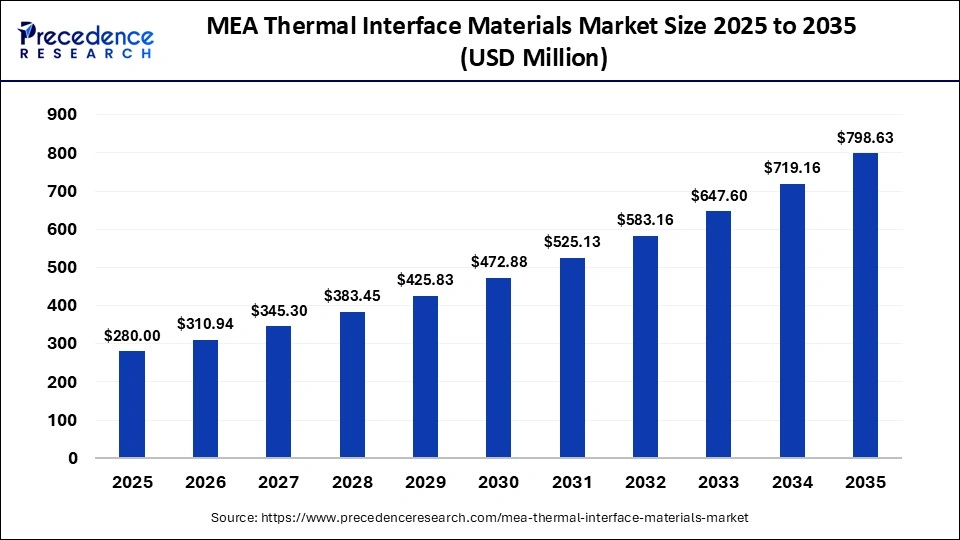
MEA Thermal Interface Materials Market Statical Scope
| Reports Attributes | Statistics |
| Market Size in 2025 | USD 280 Million |
| Market Size in 2026 | USD 310.94 Million |
| Market Size by 2035 | USD 798.63 Million |
| CAGR 2026 to 2035 | 11.05% |
| Base Year | 2025 |
| Forecast Period | 2026 to 2035 |
The MEA (Middle East & Africa) Thermal Interface Materials (TIMs) Market is becoming important due to the rapid growth of digital infrastructure and harsh climate conditions in the region. Effective heat dissipation is crucial for ensuring the performance and longevity of advanced semiconductors, 5G base stations, and high-performance computing (HPC) systems. Essential TIMs like gap fillers, greases, and adhesives help prevent critical electronic components from overheating in challenging environments.
The rising use of smart devices and automotive electronics in the MEA region needs specialized materials for efficient thermal load management. Top manufacturers are consistently innovating formulations with improved thermal conductivity and mechanical compressibility to satisfy these demanding operational requirements.
MEA Thermal Interface Materials Market, By Product, 2025
| Segments | Shares (%) |
| Elastomeric Pads | 25.80% |
| Tapes & Films | 15.60% |
| Greases & Adhesives | 24.10% |
| Metal Based | 11.80% |
| Phase Change Materials | 13.20% |
| Others | 9.50% |
- Elastomeric Pads - The elastomeric pads segment, with a share of 25.80% in 2025, plays a dominant role in the Thermal Interface Materials market in the Middle East and Africa (MEA) as it offers clean, easy handling, and dependable heat dissipation. These pads are preferred for servicing and maintaining essential electronics in the region's harsh desert conditions as they do not require curing time and are much less messy than thermal greases.
- Tapes & Films - The tapes and films segment, with a share of 15.60% in 2025, in the MEA Thermal Interface Materials (TIMs) Market is essential for managing extreme localized heat in telecom towers and data centers. Given the area's severe hot climate, these materials are crucial for heat dissipation, ensuring system reliability, and avoiding expensive hardware failures without the need for mechanical clamps.
- Greases & Adhesives - The greases and adhesives segment, with a share of 24.10% in 2025, is important in the MEA due to the rapid growth of 5G telecom, data centers, and electric vehicle adoption. In the extreme heat of desert and coastal areas, these materials are highly used for directing heat away from sensitive electronics, preventing thermal failures in high-power systems.
MEA Thermal Interface Materials Market, By Application, 2025
| Segments | Shares (%) |
| Computer | 20.80% |
| Telecom | 17.30% |
| Medical Devices | 11.90% |
| Consumer Durables | 15.70% |
| Industry Machinery | 13.60% |
| Automotive Electronics | 14.80% |
| Others | 5.90% |
- Computer - The computer segment, with a share of 20.80% in 2025, is leading the Thermal Interface Materials (TIM) market in the Middle East and Africa (MEA) as the fast-paced digitization, growth of cloud computing, and rise of high-performance gaming PCs create a need to safeguard heat-producing components (like CPUs and GPUs) from overheating and failure. Effective thermal management is crucial for system longevity and performance in these challenging environments.
- Telecom - In the MEA, the telecom sector, with a share of 17.30% in 2025, is a crucial driver of the Thermal Interface Materials (TIM) market. It is particularly important due to the region's harsh desert climates, strong dependence on 5G infrastructure, and rapid digital and smart-city developments, as well as the shift towards cashless, digital economies, which require highly reliable network cooling solutions.
- Medical Devices - The medical device sector, with a share of 11.90% in 2025, is vital for Thermal Interface Materials (TIMs) in the Middle East and Africa, due to the region's fast-growing and modern healthcare system. Governments are working to enhance hospital networks, reduce the size of medical electronics, and boost remote patient monitoring. As a result, effective heat dissipation is necessary to avoid component failures and for precise clinical diagnoses.
Competitive Landscape
The Thermal Interface Materials (TIM) market in the Middle East and Africa (MEA) is quite consolidated. Although global market trends play a significant role, this region depends largely on imported products from major international companies. The industry is highly competitive, driven by sectors like telecommunications (5G), renewable energy, and consumer electronics, with a few leading chemical and materials firms at the forefront.
- Henkel AG & Co. KGaA is a global frontrunner that uses AI-based formulation platforms. Their product range features silicone-free liquid gap fillers, thermally conductive adhesives, and the popular Bergquist Sil-PAD series.
- Dow Inc. focuses on materials for semiconductor packaging, offering ultra-pure silicone matrices, thermal gels, and fluids designed to enhance cooling efficiency.
- 3M Company is recognized for its advanced materials and industrial solutions, supplying highly compliant thermal interface tapes, electrically conductive adhesives, and flexible thermal pads.
- Parker Hannifin Corporation, through its Chomerics division, produces cure-in-place gels, dispensable thermal compounds, and phase-change materials (PCMs).
- Honeywell International Inc. offers high-quality phase-change materials, thermal greases, and potting compounds specifically designed for demanding applications such as data centers and power electronics.
Segments Covered in the Report
By Product
- Elastomeric Pads
- Tapes & Films
- Greases & Adhesives
- Metal Based
- Phase Change Materials
- Others
By Application
- Computer
- Telecom
- Medical Devices
- Consumer Durables
- Industry Machinery
- Automotive Electronics
- Others
For inquiries regarding discounts, bulk purchases, or customization requests, please contact us at sales@precedenceresearch.com
Frequently Asked Questions





Ask For Sample
No cookie-cutter, only authentic analysis – take the 1st step to become a Precedence Research client
 Get a Sample




 sales@precedenceresearch.com
 Schedule a Meeting
