



U.S. Thermal Interface Materials Market Size, Share and Trends 2026 to 2035
U.S. Thermal Interface Materials Market (By Product: Elastomeric Pads, Tapes & Films, Greases & Adhesives, Metal Based, Phase Change Materials, and Others; By Application: Computer, Telecom, Medical Devices, Consumer Durables, Industry Machinery, Automotive Electronics, and Others) Industry Size, Share, Growth, Trends 2025-2035
Source: https://www.precedenceresearch.com/us-thermal-interface-materials-market
 Get a Sample
 Table Of Content


The U.S. thermal interface materials market size was estimated at USD 1.06 billion in 2025 and is projected to be worth around USD 3.09 billion by 2035, growing at a CAGR of 11.30% from 2026 to 2035. The market is mainly driven by the rapid growth of AI, cloud data centers, quick electrification of EVs, and the rise of advanced electronics and telecommunications.
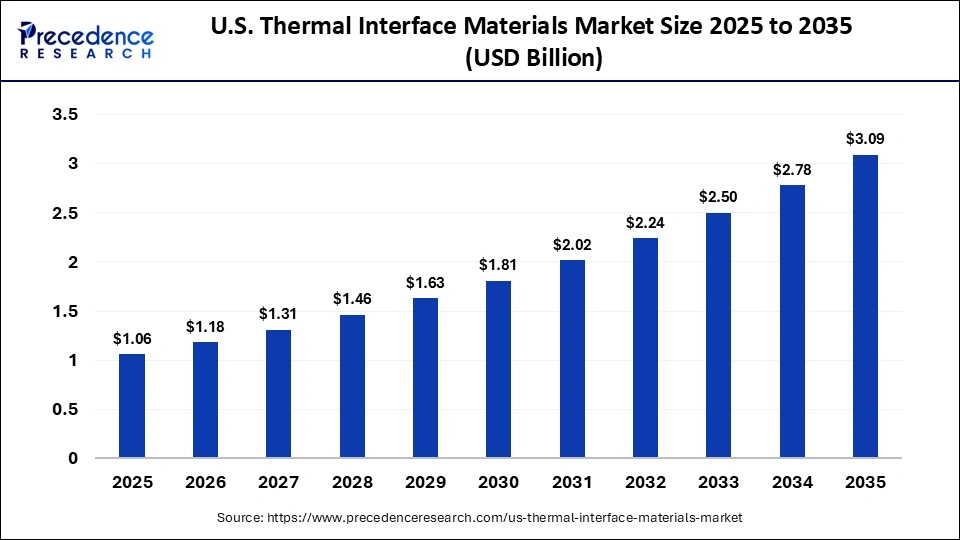
U.S. Thermal Interface Materials Market Statical Scope
| Reports Attributes | Statistics |
| Market Size in 2025 | USD 1.06 Billion |
| Market Size in 2026 | USD 1.18 Billion |
| Market Size by 2035 | USD 3.09 Billion |
| CAGR 2026 to 2035 | 11.30% |
| Base Year | 2025 |
| Forecast Period | 2026 to 2035 |
The market is vital as the U.S. leads in high-performance computing, aerospace, defense, and electric vehicles. As advanced AI processors and 5G technology produce significant heat, TIMs like Thermal Greases and Gap Filler Pads are crucial for preventing overheating, enhancing reliability, and prolonging the life of components. The surge in data centers and AI processors demands innovative TIMs to handle extreme heat and ensure stable computing.
The U.S. defense sector requires highly reliable thermally conductive materials that can endure harsh conditions in military and aerospace electronics. The transition to Electric Vehicles (EVs) also depends on effective thermal management to cool battery packs and power electronics. Major U.S. technology and materials companies, such as 3M, Honeywell International, and The Dow Chemical Company, dominate the market.
U.S. Thermal Interface Materials Market, By Product, 2025
| Segments | Shares (%) |
| Elastomeric Pads | 24.30% |
| Tapes & Films | 16.80% |
| Greases & Adhesives | 21.40% |
| Metal Based | 13.20% |
| Phase Change Materials | 14.70% |
| Others | 9.60% |
- Elastomeric Pads - Elastomeric pads, with a share of 24.30% in 2025, play a dominant role in the U.S. Thermal Interface Materials (TIM) market as they offer a clean and mess-free option compared to thermal grease, removing the need for specialized application training. Their mechanical flexibility helps them adapt to uneven surfaces without harming delicate electronics, and their high durability safeguards components in extreme temperatures.
- Tapes & Films - The segment of thermal interface materials (TIM) tapes and films, with a share of 16.80% in 2025, is essential in the U.S. market as it provides a clean, peel-and-stick solution to messy thermal greases. This eliminates the requirement for mechanical fasteners like screws or clips, while offering important electrical isolation, conformability, and structural support in compact, high-power-density electronics.
- Greases & Adhesives - The Greases & Adhesives segment, with a share of 21.40% in 2025, is vital to the U.S. Thermal Interface Materials (TIM) market, due to its unmatched versatility, compatibility with automated, high-volume manufacturing, and its ability to both dissipate heat and bond hardware mechanically.
U.S. Thermal Interface Materials Market, By Application, 2025
| Segments | Shares (%) |
| Computer | 27.60% |
| Telecom | 14.20% |
| Medical Devices | 11.80% |
| Consumer Durables | 15.40% |
| Industry Machinery | 12.70% |
| Automotive Electronics | 13.60% |
| Others | 4.70% |
- Computer - In the U.S. Thermal Interface Materials (TIM) market, the computer segment, with a share of 27.60% in 2025, is leading due to the rapid increase in power density and thermal loads. High-performance computing (HPC), AI accelerators, enterprise servers, and consumer electronics produce considerable heat. TIMs fill microscopic air gaps to enable effective heat transfer from processors to heat sinks, preventing performance throttling and hardware failures.
- Telecom - The U.S. telecom segment, with a share of 14.20% in 2025, is crucial to the Thermal Interface Materials market as the deployment of 5G infrastructure creates extreme heat. Telecommunication base stations and antennas function continuously in outdoor, space-limited settings. TIMs fill microscopic air gaps between hot components, such as semiconductors and power amplifiers, and heat sinks to avert equipment failure.
- Medical Devices - In the U.S. market for Thermal Interface Materials (TIM), the medical devices sector, with a share of 11.80% in 2025, is crucial due to the need for dependable, continuously operating equipment in modern healthcare that requires effective heat dissipation. Effective thermal management is essential for maintaining the durability and accuracy of important hardware such as imaging systems, surgical instruments, and diagnostic tools.
Competitive Landscape
The U.S. Thermal Interface Materials (TIM) market is very competitive and consolidated. It is driven by high-performance computing, AI cloud data centers, and EV battery systems. Market leaders like Honeywell and 3M are at the forefront, while Henkel and Dow have significant shares in silicone- and epoxy-based solutions.
- Honeywell International Inc. leads in the high-performance segment, providing advanced phase-change materials (PCMs) and thermal greases used in processors, enterprise servers, and telecommunications equipment.
- 3M Company is recognized for its specialized thermal tapes, adhesive transfer tapes, and thermally conductive interface pads that create a clean, structural bond for heat sinks and electronic components.
- Henkel AG & Co. KGaA is a key player with a wide range of products under the LOCTITE and BERGQUIST brands, including thermally conductive gap fillers, greases, adhesives, and phase-change materials suitable for automotive electronics.
- Dow Inc. emphasizes silicone-based TIMs, offering reworkable gap fillers, thermally conductive compounds, and encapsulants that can endure high temperatures in EV battery packs and power modules.
- Parker Hannifin Corporation specializes in thermal management products that remove air gaps and reduce thermal impedance, with their Parker Chomerics division providing gap filler pads, thermal putties, and thermally conductive insulators.
- Indium Corporation focuses on solder and metal-based TIMs, featuring their Heat-Spring product that uses pure, soft metal for efficient heat transfer in semiconductor packaging.
- Momentive Performance Materials is known for its high-performance silicone and resin-based thermal solutions designed for reliability in automotive and industrial electronics.
Segments Covered in the Report
By Product
- Elastomeric Pads
- Tapes & Films
- Greases & Adhesives
- Metal Based
- Phase Change Materials
- Others
By Application
- Computer
- Telecom
- Medical Devices
- Consumer Durables
- Industry Machinery
- Automotive Electronics
- Others
For inquiries regarding discounts, bulk purchases, or customization requests, please contact us at sales@precedenceresearch.com
Frequently Asked Questions





Ask For Sample
No cookie-cutter, only authentic analysis – take the 1st step to become a Precedence Research client
 Get a Sample




 sales@precedenceresearch.com
 Schedule a Meeting
