



Meal Replacement Products Market Size, Share and Trends 2026 to 2035
Meal Replacement Products Market (By Product: Powder, Ready to Drink, Protein Bar; By Distribution Channel: Online, Offline) - Global Industry Analysis, Size, Trends, Leading Companies, Regional Outlook, and Forecast 2026 to 2035
Source: https://www.precedenceresearch.com/meal-replacement-products-market
 Get a Sample
 Table Of Content


What is the Meal Replacement Products Market Size?
The global meal replacement products market size was estimated at USD 25.51 billion in 2025 and is predicted to increase from USD 27.61 billion in 2026 to approximately USD 55.74 billion by 2035, expanding at a CAGR of 8.13% from 2026 to 2035. The growing demand for plant-based meal options, elevating financial health of manufacturers, improved market penetration strategies, and increased consumer awareness for preventing and treating lifestyle disorders such as diabetes, obesity, and cardiovascular diseases are the factors linked to the growth of the meal replacement products market.
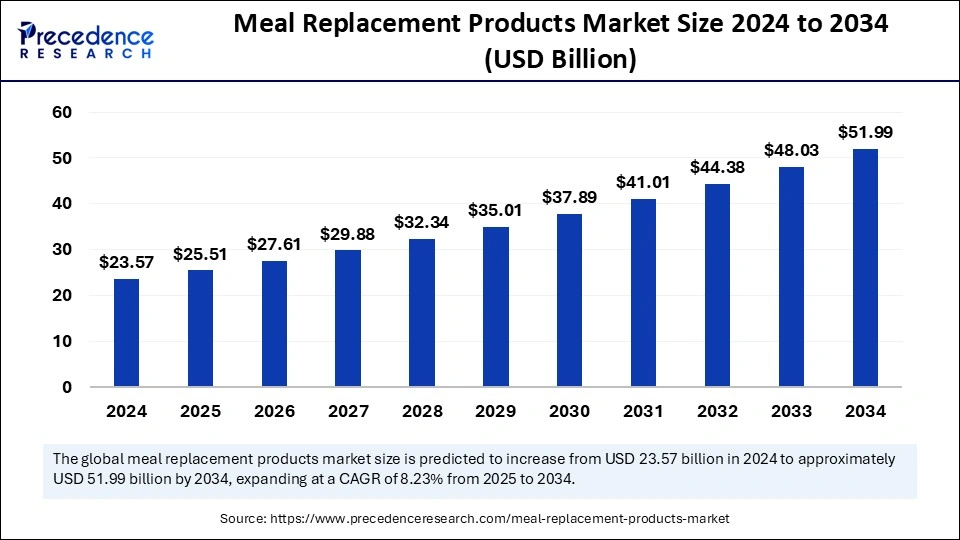
Meal Replacement Products Market Key Takeaways
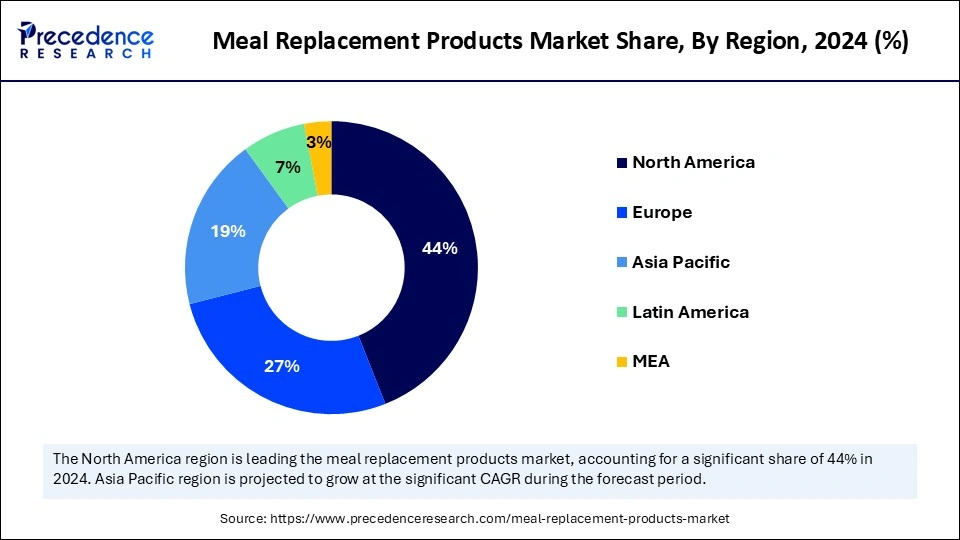
- North America dominated the global market with the highest share of 44% in 2025.
- Asia Pacific is estimated to expand at the fastest CAGR of 9.84% in the market between 2026 and 2035.
- By product, the powder segment held the largest market share of 63% in 2025.
- By product, the ready to drink segment is anticipated to grow at a remarkable CAGR of 8.73% between 2026 and 2035.
- By distribution channel, the offline channel segment captured the largest market share in 2025.
- By distribution channel, the online channel segment is expected to expand at a notable CAGR over the projected period.
What are Meal Replacement Products?
Meal replacement products refer to products such as protein bars, shakes and powdered drinks acting as a substitute for solid foods replacing one or more meals in a day with controlled quantities of essential nutrients and calories. These products are easy to make and help in maintaining a healthy lifestyle for fitness-conscious and busy people looking for convenient meal options enriched with essential nutrients.
Advancements in food processing technologies, rising investments for the development of innovative products, increased revenues of companies making them self-sufficient, growing number of gymnasiums and health and fitness centres, dynamic lifestyles and surging cases of non-communicable diseases (NCDs) such as diabetes and obesity are the factors driving the expansion of the meal replacement products market. Furthermore, supportive government initiatives for enhancing food security and encouraging healthy food choices with nutrition education in public awareness campaigns, schools, online platforms and point-of-sale information is fostering the growth of consumer base.
Integration of AI in Meal Replacement Products
Artificial Intelligence in meal replacement products can be utilized to develop user-friendly and personalized experiences for consumers. Impact of AI on meal replacement products such as for recommending personalized nutrition strategies by analyzing individual user's health data with AI algorithms and optimization of ingredients for identification of best combinations of texture, taste, and nutritional balance through analysis of vast ingredient databases.
Furthermore, the utilization of AI-powered vision systems in quality control for monitoring production lines, enhancing product development by analyzing market trends and feedback of consumers as well as the implementation of AI-enabled virtual assistants or chatbots for virtual dietary coaching of meal replacement product consumers is driving the incorporation of AI in the market. Rising collaborations for advancing the development of meal replacement products with the use of AI are creating opportunities for market growth.
- For instance, in July 2024, Shiru, an AI-powered protein discovery company partnered with Ajinomoto Health & Nutrition (AHN) North America Inc., for developing and commercializing sweet proteins for utilization in specialty products and beverages.
The alliance aims to combine the capacities of both entities for introducing natural, functional ingredients to the market by leveraging AHN's deep expertise in fermentation and Shiru's powerful AI-enabled discovery capabilities.
Market Trends
- Consumers' Busy Lifestyles: The growing consumers' busy lifestyles, especially among urban dwellers and young professionals, increase demand for meal replacement products. The hectic routines of consumers increase demand for ready-to-consume options like meal replacement products.
- Increasing Health Consciousness: The increasing prevalence of conditions like diabetes & obesity and focus on weight management increases demand for meal replacement products for controlling calories. The growing consumer demand for products that offer essential nutrition like proteins, fats, vitamins, and minerals increases the adoption of healthy meal replacement products.
- Rise in E-Commerce: The growing expansion of e-commerce platforms and availability of various products & brands on e-commerce platforms increases the purchase of meal replacement products through online platforms.
Trade Analysis of the Meal Replacement Products Market
- Import Activity: 108 shipments were made on the international meal replacement shake imports.
- Trade coverage: 18 exporting nations and 16 importing nations were involved in the world.
- Market players: 42 consumers and 35 sellers in the global markets.
- Expansion of Buyer Network: 68 buyers in various international markets.
- Shipment Volume: 249 import shipments were registered with the same export shipment volume around the world.
- Global Reach: 19 importing countries and 22 exporting countries involved worldwide.
(https://www.volza.com)
(https://www.volza.com)
Meal Replacement Products Market Growth Factors
- Expanding customer base: Companies are actively adopting and utilizing effective marketing strategies by identifying and targeting specific demographics, increasing focus on market diversification with different flavours and functional ingredients suitable to dietary needs, improving distribution channels and by leveraging online platforms to expand the consumer base in the competitive market. Furthermore, increased product availability and growing consumer trust are boosting incomes for manufacturers fostering innovation.
- Development of personalized products: Increased consumer demand for personalized meal replacement options is making manufacturers to focus on diversifying their product ranges to cater the specific dietary needs of the diverse demographics. Implementation of features such as plant-based variations, allergen-free options, macronutrient customization and dietary restrictions for personalized meal replacement products is fuelling market growth.
Market Scope
| Report Coverage | Details |
| Market Size by 2035 | USD 55.74 Billion |
| Market Size in 2025 | USD 25.51 Billion |
| Market Size in 2026 | USD 27.61 Billion |
| Market Growth Rate from 2026 to 2035 | CAGR of 8.13% |
| Dominating Region | North America |
| Fastest Growing Region | Asia Pacific |
| Base Year | 2025 |
| Forecast Period | 2026 to 2035 |
| Segments Covered | Product, Distribution Channel, and Regions. |
| Regions Covered | North America, Europe, Asia-Pacific, Latin America, and Middle East & Africa |
Market Dynamics
Drivers
Rising incidences of lifestyle disorders
Lifestyle disorders are significantly rising across the globe due to factors such as lack of physical activity, unhealthy diet and eating habits, sedentary and stressful lifestyles, excessive consumption of alcohol, tobacco use and insufficient sleep leading chronic health disorders such as obesity, hypertension, diabetes and heart diseases. People are becoming aware of the importance of following healthy eating habits and weight management which is driving the need for meal replacement products packed with functional nutrition. Furthermore, the growing trend of health and wellness, increased consumer preference for vegan food, plant-based options and meat alternatives as well as the development of innovative products to cater the specific demands of the population is fuelling the market expansion.
Restraint
High product prices
The higher prices of meal replacement products often restrain the consumer from buying these products over the traditional meals which are cheaper. The high quality premium ingredients such as protein sources, fiber, minerals and vitamins added in precise ratios as well as the complexity of formulating and manufacturing for creating a nutritionally balanced meal replacement product while maintaining the right amount of macronutrient distribution and taste by implementing advanced processing techniques is a costly process. Moreover, the increased investments research and development of products with innovative flavours, textures and targeted dietary needs adds to the cost of the production leading to heightened product prices.
Opportunity
Increased emphasis on developing databases and plant-based meals
With the surging demand for plant-based meal options, busy lifestyles, increased popularity of health and fitness trends, environmental awareness and advancements in technologies is creating opportunities for meal replacement products market growth. Manufacturers are heavily investing in developing naturally derived and plant-based meal replacement food options for enhancing consumer convenience and providing functional nutrition more efficiently while adhering to the regulatory guideline to meet the organic certification standards.
Companies are focusing on developing databases of essential functional nutrients such as proteins, mineral among others by leveraging AI tools for quick identification of right nutrients leading to faster product development with less errors and increased efficiency.
- For instance, in May 2024, Shiru, The Protein Discovery Company, launched ProteinDicovery.ai which is the world's first marketplace and protein discovery platforms allowing anyone for searching, discover, piloting and buy molecules for agriculture, food, personal care, and application to advanced materials.
More than 33 million molecules by sequence, functional use and successful expression are available in the searchable database catalog.
Segment Insights
Product Insights
The powder segment dominated the market with the largest share in 2025. Powder-based meal replacement products act as an ideal at home or on-the-go option for people such as health-conscious individuals, busy professionals, athletes and people with dietary restrictions looking for fast and controlled meal options. The portability and user convenience, easy customization with additional ingredients of consumer choice, enhanced shelf-life and cost-effectiveness of powders promote the market growth.
Moreover, the increased emphasis on product development by manufacturers to keep up with the market competition, focus on providing evidence-based research regarding the nutritional benefits, utilization of customer engagement strategies such as user-generated content and feedback for strengthening brand loyalty and reputation as well as rising collaborations with grocery chains, online marketplaces and health food stores for expanding product visibility are the factors driving the market dominance.
How the Powder Segment Dominated the Meal Replacement Products Market?
The powder segment dominated the meal replacement market in 2024. The increasing demand for longer shelf-life products and focus on lowering waste increases the demand for powder meal replacements. The nutritional flexibility, like precise control over fat, protein, and carbohydrate, increases adoption of powder meal replacements. They are budget-friendly and provide a high degree of customization. Powder meal replacements have a longer shelf life and are easily prepared at home. The growing popularity among fitness enthusiasts, athletes, and weight management solutions drives the overall growth of the market.
The ready-to-drink segment is expected to witness lucrative growth over the forecast period. Growing consumer awareness towards health and wellness and the burgeoning demand for plant-based beverages and vegan food as a meal replacement option are expanding the market. Rising incidences of lifestyle diseases such as obesity and diabetes, advancements in food technology, rapid urbanization, flourishing e-commerce industry, increased focus on publicizing products to targeted audiences for improving profits and brand positioning, growing number of the fitness centre and gymnasiums as well as the intensifying market penetration of ready to drink products with availability in supermarkets and online platforms at discounted prices is anticipated to promote the market growth in the upcoming years.
Distribution Channel Insights
The offline channel segment accounted for the largest market share in 2025. Implementation of specific strategies such as partnering with health food retailers for securing shelf space in stores and for promoting loyalty programs, increased emphasis on direct mail marketing for targeting specific demographics with benefits of products and special discounts, in-store marketing with creation of engaging displays and signage, building brand awareness by engaging with local communities and offering samples of products at farmer's markets, health fairs and fitness events are the factors driving the market expansion of this segment.
Furthermore, the growing focus of manufacturers on setting up production facilities in close proximity to transportation channels and places with availability of skilled workforce as well as increased product accessibility and tailored services for customers provided by offline channels is fuelling market growth.
Why did the Offline Channel Segment Dominate the Meal Replacement Products Market?
The offline channel segment dominated the meal replacement market in 2024. The growing availability of meal replacement products in specialty stores, supermarkets, and hypermarkets helps the market growth. The increasing consumer demand for examining products in person and seeking advice from store staff before buying increases demand for offline purchases. The well-established retail infrastructure and increasing demand for personalised recommendations increase the adoption of the offline channel, supporting the overall growth of the market.
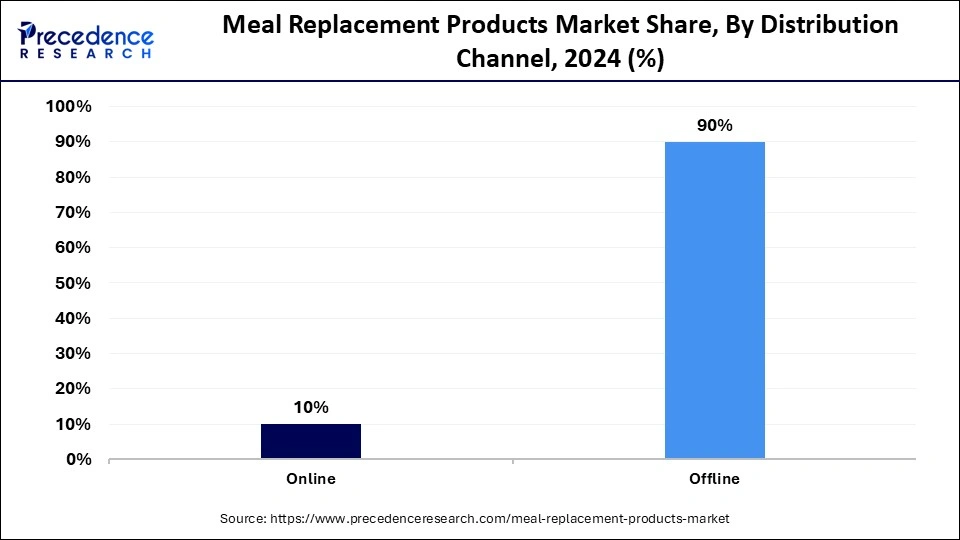
The online channel segment is predicted to show the fastest growth during the forecast period. The growth of this segment is driven by the availability of a wide variety of meal replacement products through online platforms, the convenience of price comparison across several brands and retailers, enhanced product transparency through detailed reviews and feedback provided by consumers, increased use of targeted marketing strategies by manufacturers, increased customer engagement with direct-to-consumer sales through online platforms, development of subscription-based models for fostering customer loyalty.
Moreover, the rising use of digital marketing tactics through social media, targeted ads and content marketing as well as growing collaborations with fitness influencers and healthcare bloggers for creating brand awareness by sharing product experiences such as testimonials and recipe ideas is expected to fuel the market growth over the forecast period.
- For instance, in December 2024, Him & Hers Health, the health and wellness platform, launched an initiative of adding daily meal replacement bar and shakes in their extensive weight loss program. The supplements are available at $110 per month which are delivered to customers directly and are designed specifically for enhancing individualized weight loss plans, especially for patients on glucagon-like peptide-1 (GLP-1) medications.
Regional Insights
What is the U.S. Meal Replacement Products Market Size?
The U.S. meal replacement products market size was evaluated at USD 7.86 billion in 2025 and is projected to be worth around USD 17.56 billion by 2035, growing at a CAGR of 8.37% from 2026 to 2035.
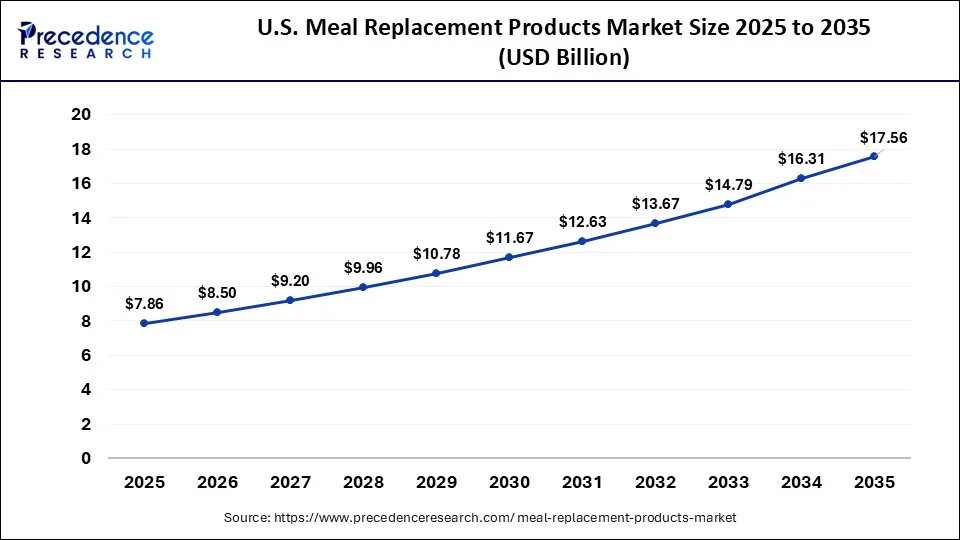
North America Meal Replacement Products Market Trends
North America led the global meal replacement products market with the largest share in 2025. The market dominance of this region is driven by the growing consumer awareness towards health and wellness, increased influence of social media platforms for promoting the benefits of meal replacement products, surging demand due to fast-paced lifestyles, increased R&D activities for to cater broad spectrum of dietary preferences through product innovations and rising disposable incomes.
U.S. Meal Replacement Products Market Trends
U.S. is leading the meal replacement products market in North America. Increased R&D activities for product innovation, rising disposable incomes, growing use of online healthcare platforms for maintaining a healthy lifestyle and overcoming obesity, focus on developing strategies for better customer reach through retail networks, social media influence, adoption of e-commerce platforms and established transportation channels foster the market growth.
- The U.S. FDA's initiatives such as the Human Foods Program for improving food safety and the Dietary Supplement Health and Education Act of 1994 (DSHEA) prohibit marketing of adulterated and misbranded dietary supplements.
Europe Meal Replacement Products Market Trends
Europe is considered to be a significantly growing area in the global meal replacement products market. The region's growing shift towards plant-based and vegan food options among consumers, demand for balanced nutrition, increasing discretionary incomes, rising geriatric population, and surging focus on health and wellness are the factors expected to fuel the market growth of this region. Regional key players like Germany, Spain, the UK, Sweden, and Denmark are also remarkably contributing to the European meal replacement products market.
Germany is dominating the market in the Europe region owing to the growing demand for replacement meals with a major focus on products for weight management and loaded with ingredients such as plant proteins and fiber.
Asia Pacific Meal Replacement Products Market Trends
Asia Pacific region is expected to witness lucrative growth over the forecast period. The growth of this region can be attributed to the rapid urbanization of various areas in the region, the growing influence of social media platforms for maintain a healthy lifestyle, increasing number of fitness centres, surging use of e-commerce platforms, increasing disposable incomes and rising obesity rates. Furthermore, swiftly rising economies such as Japan, India and China are expected to boost the market growth in the upcoming years.
Japan & China Meal Replacement Products Market Trends
Japan is the major contributor to the Asia Pacific meal replacement product market. The robust retail infrastructure, increased adoption of functional foods by consumers and rising focus of maintaining a healthy lifestyle are fostering the market growth of this country.
Meal replacement products in China are available in various forms, including powders, ready-to-drink beverages, bars, and other types like cookies, soups, and smoothies. The meal replacement market in China is expanding, driven by health trends and evolving consumer habits. However, companies must navigate economic sensitivities, regulatory landscapes, and demographic considerations to effectively meet market demands.
What are the Advancements in the Meal Replacement Products Industry in Latin America?
Latin America is expected to witness substantial growth in the market. This growth and development is driven by rising health awareness, urbanization, and increasing disposable incomes. Regulatory bodies in the region are also increasingly promoting health and wellness initiatives, which help to support the adoption of meal replacement products as convenient dietary solutions. Countries like Brazil and Mexico are leading players.
Brazil Meal Replacement Products Market Trends: The country's market landscape is evolving at a steady pace, with companies increasingly focusing on innovative flavors and formulations to cater to diverse consumer preferences. The increasing trend of fitness and wellness is further propelling the demand for meal replacements in this region.
What are the Key Trends in the Meal Replacement Products Industry in the Middle East and Africa?
The Middle East and Africa region is expected to grow steadily throughout the forecast period. This growth is driven by increasing urbanization efforts, changing dietary habits, and a rising awareness of health and nutrition. Regulatory frameworks are also evolving in the region to help support health-focused products, which is expected to enhance market penetration in the upcoming years. Countries like Saudi Arabia, the UAE, and South Africa are leading players.
Saudi Arabia Meal Replacement Products Market Trends: The country's market landscape is still in its developing stages, with both local and international brands competing for market share. The region's unique cultural preferences are also influencing product offerings, opening up opportunities for tailored meal replacement solutions.
Meal Replacement Products Market-Supply Chain Analysis
- Raw Material Sourcing: This stage deals with sourcing raw materials that are required to make meal replacement products such as whey, soy, pea, and other plant-based proteins.
Key Players: Cargill, Glanbia, Ingredion - Manufacturing Process: In this stage, the raw materials are blended, processed, and then packaged into products like shakes, powders, and bars.
Key Players: Archer Daniels, Nestle, Amway - Distribution Process: Here, the packaged meal replacement products are distributed to supermarkets, health stores, gyms, pharmacies, and even e-commerce platforms.
Key Players: Walmart, Costco, Amazon
Meal Replacement Products Market Companies
- Abbott Nutrition: Offers science-based nutrition products such as Ensure, Glucerna, and PROTALITY that target adult nutrition, diabetes management, and weight control solutions.
- SlimFast: Sells pre-prepared weight loss plans in the form of shakes, snacks, and smoothie mixes to allow consumers to make convenient portion-based diets even when busy.
- Nestle: Provides clinical and functional nutrition using Optifast, Resource, and Compleat to support weight loss, protein intake, and medical nutrition requirements.
- Wild Oats Markets: Specializes in organic, natural foods with plant-based smoothies as sustainable meal replacements in retail chains.
- Blue Diamond Growers: Produces almond-based protein powders that offer plant-based nutrition, allowing healthy and nutrient-rich formulations of meal replacement shakes around the world.
Other Major Key Players
- Soylent
- General Mills
- Herbalife
- Glanbia
- Unilever
Leader's Announcements
- In November 2024, Huel, a meal replacement company, announced the rise in financial gains with the growth of its customer base and expansion of product portfolios into chewable foods. Chief Executive James McMaster said that “Nutrition, unfortunately, is actually quite complicated. We try to make it simple for people. Around 70 percent of all UK supermarkets have a Huel product in them.”
Recent Developments
- In January 2026, Danone announced the expansion of its Alpro product line in Europe with meal-replacement drinks branded as Alpro Meal to Go. The rollout begins in Belgium and Germany, with plans to enter two additional European markets soon, pending confirmation from the company. (Source: https://www.just-drinks.com)
- In June 2025, Sur Nutrition introduced its Organic Meal Replacement Shake, created for athletes and wellness enthusiasts. This chef-crafted chocolate shake emphasizes both performance and culinary integrity, offering an exceptional taste with real ingredients. (Source: https://www.endurancesportswire.com)
- In May 2025, Zantus Lifesciences LLP, an Indian nutraceutical start-up, launched Reducarb, low-carb meal replacement powders aimed at pre-diabetics, reducing daily carbohydrate intake from 70% to 55%. (Source: https://www.nutraingredients.com)
- In September 2024, Arla launched meal-replacement drinks in Denmark. The drink is available in two flavors: vanilla hazelnut & chocolate caramel and contains fibre, vitamins, and minerals. The drink consists of 12g of fibre and 30 g of protein. (Source: https://www.just-food.com)
- In February 2025, Arla Foods Ingredients launched a toolbox offering 12 recipes utilizing Nutrilac ProteinBoost range to South American functional food producers which will help them in creating high protein, low-fat dairy-based desserts with a creamy and smooth texture.
- In September 2024, Arla Foods, a Danish-Swedish multinational dairy company, launched their new Protein Food to Go range of meal-replacement milk-based drinks which include 30g of protein and 12g of fibre and are available in chocolate caramel and vanilla hazelnut flavours.
Segments Covered in the Report
By Product
- Powder
- Ready to Drink
- Protein Bar
By Distribution Channel
- Online
- Offline
By Region
- North America
- Asia Pacific
- Europe
- Latin America
- Middle East and Africa
For inquiries regarding discounts, bulk purchases, or customization requests, please contact us at sales@precedenceresearch.com
Frequently Asked Questions





Ask For Sample
No cookie-cutter, only authentic analysis – take the 1st step to become a Precedence Research client
 Get a Sample




 sales@precedenceresearch.com
 Schedule a Meeting
